Immunocompetence and Allergy
Stephen J. McGeady, MD
ABSTRACT. Developed nations are experiencing a marked increase in prevalence of the familial allergic diseases including asthma, allergic rhinitis, atopic der-matitis, and allergic gastroenteropathy, which are often called atopic diseases. No satisfactory explanation for this epidemic is known, but it has been proposed that some facets of modern life tend to bias immune re-sponses away from the Th1 cellular immune rere-sponses that protect against many infections and toward Th2 responses that favor atopy. There are 2 hypotheses to explain why this epidemic is occurring now. Hypothesis 1 suggests that nutritional patterns have changed or that we are exposed to environmental toxicants that were not previously present. Hypothesis 2 holds that some aspects of modern lifestyles in affluent nations have minimized exposure to infectious agents or to their by-products, such as endotoxin. This feature of contemporary lifestyle, it is suggested, has favored the development of Th2 im-mune responses to environmental allergens and the de-velopment of the attendant atopic diseases. This latter theory has been designated the “hygiene hypothesis.” Although there is evidence both for and against both hypotheses, evidence for hypothesis 2 is stronger and more convincing. Pediatrics 2004;113:1107–1113; atopy, asthma, Th1 cells, Th2 cells, hygiene hypothesis.
ABBREVIATIONS. Ig, immunoglobulin; IL, interleukin; IFN-␥, interferon-␥; TNF-, tumor necrosis factor-; MAS, Multicenter Allergy Study;
T
he term “allergy” refers to any clinical event that is caused by immune mechanisms and is harmful to the host.1 Although allergic reac-tions have been classified into 4 types,2it is type 1 allergic reactions that are caused by immunoglobulin (Ig) E antibody and lead to the release of chemical mediators that are by far the most common and of greatest clinical concern. Whereas some IgE-medi-ated conditions, such as anaphylaxis, occur sporadi-cally in the population, the IgE-related diseases that run in families and are encountered most often in-clude allergic rhinitis, atopic dermatitis, allergic asthma, and gastrointestinal allergies. These are re-ferred to as “atopic” diseases.1They afflict ⬎20% of the population in the United States,3and theirprev-alence is rising at an alarming rate in developed nations.4 – 6There is no completely satisfactory expla-nation for this increased prevalence, but the enor-mous cost of these diseases in terms of human suf-fering and their economic impact has led to extensive research. This has extended from investigation of the basic immune mechanisms leading to atopy to epi-demiologic studies that have considered the preva-lence of atopy over time and by geographic distribu-tion. Although a great deal has been learned about atopic diseases, the full explanation of the “epidemic of atopy” remains elusive.
IMMUNOLOGY OF ATOPY
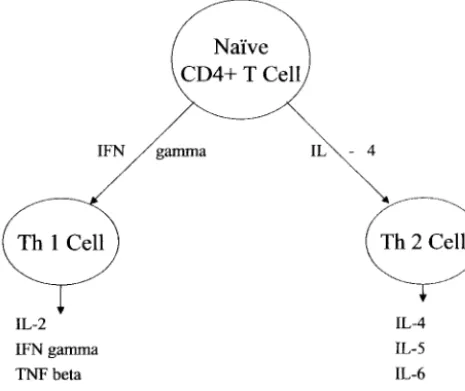
In 1986, it was discovered that when naı¨ve helper (CD4⫹) T cells are stimulated, they may develop into 2 distinct populations depending on the nature of the stimulus (see Fig 1); these populations are defined by the types of cytokines produced. One population of CD4⫹ cells, designated Th1, produces interleukin (IL)-2, interferon-␥ (IFN-␥) and tumor necrosis fac-tor-(TNF-). A second population, called Th2, pro-duces IL-4, IL-5, IL-6, and IL-13.7,8 The cytokines produced persist over time, indicating that the cells are lineage committed once they have acquired these defining properties. The cytokines in the microenvi-ronment at the time of stimulation of the naı¨ve helper T cells determine which pathway of develop-ment the cell will follow. If the naı¨ve T cells are exposed to IFN-␥, then they develop into Th1 cells, whereas if IL-4 is prevalent, then they become Th2 cells. Thus, if either IFN-␥or IL-4 is abundant when a CD4⫹helper cell is activated, then the T cells will
be guided into the Th1 or Th2 pathway, respectively, and the other pathway will be inhibited. Subsequent studies have identified a third population, desig-nated Th0, which produces cytokines of both types, although the relevance of this population is unclear.9 It has been shown that human antibody-producing cells exposed to IL-4 and IL-13 will produce IgE antibody, and this effect plus that IL-5 promotes eosinophilic inflammation indicates that atopy is a Th2-dependent process.10 Our current attempts to understand the development of atopy are aimed at determining what causes naı¨ve CD4⫹T cells, which
have the potential to enter either the Th1 or the Th2 pathway, to become persistently “deviated” toward Th2 in atopic individuals.11 It is known that all in-fants are normally born with a bias toward Th2 re-sponses to newly encountered antigens and tran-siently produce IgE antibody. This is possibly because the Th2 mode avoids rejection of the preg-nancy.12 In most infants, however, this tendency to From the Division of Allergy and Clinical Immunology, Nemours
Chil-dren’s Clinic–Wilmington, Alfred I. duPont Hospital for Children, Wil-mington, Delaware, and Department of Pediatrics, Thomas Jefferson Uni-versity, Philadelphia, Pennsylvania.
Received for publication Oct 7, 2003; accepted Oct 20, 2003.
Reprint requests to (S.J.M.) Division of Allergy and Clinical Immunology, Alfred I. duPont Hospital for Children, Box 269, Wilmington, DE 19899. E-mail: [email protected]
produce IgE antibody is lost early in life, possibly as a result of the appearance of IFN-␥. In infants who are destined to develop into atopic individuals, how-ever, there is less IFN-␥ produced and the Th2 bias persists, and these children continue to produce IgE antibody in excessive quantities to commonly en-countered substances such as foods and environmen-tal allergens.13
HEREDITY AND ATOPY
The definition of atopy, as noted above, includes the familial nature of atopic diseases, so there is no question of the role of genetic factors in the develop-ment of atopy. It has become clear that atopic dis-eases are “complex” disdis-eases in which multiple ma-jor and minor genes interact, some of which are immune-response genes and some are IgE-regulat-ing genes14,15; both types may themselves be modu-lated by nongenetic factors such as the level and frequency of allergen exposure.16 –18 The ultimate phenotype of atopy versus nonatopy or in the spe-cific atopic disease developed is likely to reflect this highly complicated and variable system. Although the role of genetics in the development of atopic disease is undisputed, it is not able to explain the “epidemic of atopy” that is observed today. Why has allergic rhinitis, which was virtually unknown 200
years ago in Europe and North America,19
pro-gressed to where it now afflicts⬎20% of the popu-lation in industrial nations?3 During the past 2 de-cades, 2 general hypotheses have been generated to explain the increase of atopy and of asthma in child-hood:
1. New risk factors that were not present in the past have become relevant. These might reflect changes in nutrition or environmental exposure. 2. Abandonment of the more traditional lifestyle of
the past has led to the loss of factors that protect against atopy.16
Critical Times of Vulnerability for Atopic Sensitization
Before considering the possible influences pro-posed in these hypotheses, it is helpful to consider
the development of allergy as a function of the child’s age. Investigators have sought explanation for the current “epidemic of atopy” in events of the first years of life.16,18 As noted, a bias toward Th2 immune responses is present at birth in all infants but is soon replaced by a balanced Th1/Th2 response pattern in nonatopic infants. Although the specific influences that cause retention of the Th2 response in atopic infants are not known with certainty,13,20there is evidence that compartmentalization into Th1 or Th2 of long-lived memory T cells that recognize al-lergen occurs before the age of 5 years.13,21Studies of birth dates show that birth during or shortly before a pollen season is associated with increased pollen allergy later in life, suggesting a critical role for early exposure.22,23 Epidemiologic studies of former East and West German populations show that lifestyle differences in the first year of life influence the de-velopment of atopy in populations that are geneti-cally similar.24 In the recent Multicenter Allergy Study (MAS) of German children, it was found that some early childhood viral infections may actually protect against development of asthma25or atopy.26 Only those infections contracted during the first year of life exerted such an effect, however. Finally, anti-bodies of the IgG and IgE classes to house dust mite were shown to be present in the second and third years of life in children of 1 atopic parent, suggesting that early sensitization is expressed soon after it oc-curs.27 These findings in aggregate suggest that ini-tial sensitization or events that modulate asthma or atopy occur very early in life. Little is known about whether the vulnerability persists or wanes over time, but interventions to prevent the development of atopy, such as maternal dietary avoidance during pregnancy or dietary interventions for the child dur-ing early infancy, have been attempted. The majority of studies seem to indicate that the benefits of such interventions are at best marginal and that later de-velopment of asthma will not be prevented, suggest-ing that the potential for sensitization persists and may only be delayed by early avoidance measures.16 Cytokine production profiles reflecting the Th1 and Th2 cell balance in atopic and nonatopic children become similar at 4 to 5 years of age, suggesting that the earlier years, when Th2 responses may dominate in the atopic child, may be critical for atopic sensiti-zation.13,28There is, however, evidence showing that high allergen concentration may cause atopic sensi-tization in school-aged children,29indicating that the period of vulnerability to being sensitized may ex-tend beyond infancy. In addition, many atopic adult health care workers became sensitized to allergens associated with natural rubber latex in the 1980s and early 1990s, indicating that the capacity to develop allergy is retained well beyond the early years.30
HYPOTHESIS 1 FOR THE INCREASE OF ATOPY
The hypothesis that new factors previously not present may be relevant in causing the observed increase in prevalence of atopy has been explored in terms of nutrition and environmental exposure.
Nutrition
Breast milk is seen as the food least likely to elicit allergies in the “at-risk” infant. In reality, however, despite the many proven advantages of breastfeed-ing, its ability to prevent allergies is highly contro-versial.18 In a review of 14 published prospective studies of the anti-allergic potential of breast milk, nursing was found to be beneficial in 8 studies but was either of no benefit or made allergies worse in 6.31 A recent longitudinal study found that breast-feeding for 4 months or longer led to lower IgE levels in children at ages 6 and 11 years. This effect was seen, however, only when the mother herself had low IgE levels. In mothers with high IgE levels, nurs-ing for 4 months or longer was associated with in-creased IgE at those ages.32It must be concluded that the anti-allergic effect of breastfeeding is complicated and presently unproved.
Nutritional interventions have consisted of avoid-ance of highly allergenic foods during pregnancy, during lactation, or in early infancy. These dietary manipulations have generally shown transient ef-fects and have failed to prevent asthma and atopy in later childhood.33,34One interesting theory holds that changes in the diet in more affluent industrialized nations influence the bacterial flora of the gut and fail to redirect the Th2 responses seen in atopic infants toward a more balanced Th1/Th2 response seen in nonatopic infants.35,36
Environment
Environmental toxicants have been scrutinized closely in relation to the increase of atopy because many contemporary toxicants were scarce or nonex-istent in the past. In considering the impact of envi-ronmental toxicants, asthma and atopic sensitization are best thought of separately because wheezing in young children is thought to be heterogeneous, and distinct subtypes may result in wheezing early in life. In more than half of children, wheezing illnesses in the first 3 years of life have been associated with diminished airway function at birth, and wheezing in these children often disappears by age 6 years. Such children are nonatopic but may develop a wheezing response as a result of an irritant rather than an immune response to the toxicant. A signifi-cant minority of children with early wheezing, how-ever, are atopic and are more likely to have persistent asthma.37
Environmental pollution has been divided into type I, consisting of sulfur dioxide and large dust particles, which is prevalent in Eastern European nations, and type II, characterized by nitrogen ox-ides, ozone, tobacco smoke, and diesel exhaust, which is found in industrialized Western nations with many motor vehicles.38 In the past decade, some epidemiologic studies have compared the prevalence of asthma and atopic sensitization in pop-ulations that live in the highly polluted Eastern na-tions with those in the supposedly cleaner West. Paradoxically, the populations that live in the West have shown a higher prevalence of both asthma and atopy.39 – 42An explanation of this finding may lie in
the observation that type II pollutants are able to promote asthma and atopic diseases.43,44 Some type II pollutants, such as ozone, may cause wheezing symptoms by acting as primary irritants, but others, such as diesel exhaust particles, seem to function as immunologic adjuvants that shift the balance of T helper cells toward the allergic Th2 pathway.45– 48 Additional evidence that type II pollutants may have this effect is the finding of higher rates of atopic sensitization and asthma prevalence in inner cities of the United States, where such pollution is great-er.41,49,50 Of the substances associated with type II pollution, the role of environmental tobacco smoke in the early years of life has been examined most closely, and there is evidence that, even in utero, exposure to smoke can contribute to both atopic sensitization and asthma.51–53In addition to promot-ing overall atopic sensitization, exposure to smoke in utero seemed to lower the age of subsequent allergen sensitization in the large MAS in Germany.52 Post-natal exposure to maternal smoking has also been reported to increase the relative risk of developing asthma in children,53,54 and there is evidence that exposure early in life to a mother who smoked may increase the odds of having asthma or wheezing in adolescence and adult life.55Other studies, however, have failed to confirm the role of environmental pollutants, including tobacco smoke. In Munich, high traffic volume increased respiratory symptoms but failed to increase allergic sensitization, asthma, or bronchial hyperreactivity.56 A similar assessment in Dresden failed to show association between pol-lution levels and atopy or bronchial hyperreactiv-ity,57and a large British investigation concluded that air pollution was completely unassociated with ato-py.58Some surveys evaluating the effects of environ-mental tobacco smoke have likewise come to contra-dictory conclusions, including the study referenced above, which actually noted a decrease in atopy among individuals whose mothers smoked while pregnant.58 Other investigators have also found a decrease in atopic sensitization59or no association60 in children whose mothers smoke during their early years. Despite these conflicting findings on the asso-ciation of smoking with asthma and atopy, there is almost unanimous agreement that tobacco smoke is associated with increased risk of lower respiratory tract illness in infancy and childhood, including bronchitis, pneumonia, and significant reduction in pulmonary function.51,61 It is also widely accepted that environmental tobacco smoke causes more asth-matic episodes and increased severity in children
with previously diagnosed asthma.16,61 Thus,
whether pollutants, including tobacco smoke, cause atopy and asthma either alone or in concert with allergens or merely increase morbidity by function-ing as irritants remains uncertain.
HYPOTHESIS 2 FOR THE INCREASE OF ATOPY
higher prevalence of asthma and atopy in highly industrialized Western nations compared with less developed former Soviet bloc nations.24,35,36Some of these investigations compare populations that are genetically similar, making lifestyle-associated fac-tors particularly suspect in causing the observed dif-ferences. Insight into the specific aspects of the tra-ditional lifestyle that contribute to decreased asthma and atopy has come from evaluation of children who live on farms in Western nations.62,63 Comparing farm-residing children with non–farm-residing chil-dren from the same region has shown a significantly lower prevalence of atopy in the farm-residing chil-dren. These results were confirmed in a large multi-national project involving subjects who lived in Ger-many, Austria, and Switzerland.64,65 Using multiple regression analysis, this study identified contact with livestock or poultry as the feature of farm life that most protected against the development of asthma, hay fever, and symptoms of allergic rhinitis. The effect was most prominently seen, however, when contact with farm animals occurred during preg-nancy or early in life. The mechanism by which protection is conferred is not known, but it has been noted that farm-residing children are exposed to sig-nificantly higher levels of bacterial endotoxin.66 Bac-terial endotoxins are potent stimulators of IL-12 pro-duction, which in turn elicits IFN-␥and evokes a Th1 response from naı¨ve helper T cells.33,66This sequence of events may explain a diminished tendency for Th2 responses and thus a lower prevalence of atopy. Additional support for a beneficial role of endotoxin may be found in a recent prospective survey that found that children from homes with 2 or more dogs or cats, a known source of endotoxin, during their first year of life have a decrease in the risk of atopic sensitization to several allergens at age 6 to 7 years.67 Although atopy may be less important in causing wheezing associated with irritant pollutants, it is clearly associated with some childhood asthma; thus, decreased atopic sensitization may explain the lower prevalence of asthma in children from farms.
A number of investigators have examined the role of infection in the development of asthma and atopic disease. In affluent Western nations, families are smaller, antibiotics are used liberally, immunizations are routinely given to young children, and obvious sources of infection are avoided. It has recently been recognized, however, that there is a possible protec-tive role for some viral infections against the devel-opment of asthma,25 atopic sensitization,68 and ele-vated IgE levels.69 The protective effect of viral infections seemed limited to those that occur very early in life, which is a finding consistent with the study of children in child care cited above.26 Atten-dance at child care was found to be associated with a decrease in allergies at school age, detected by ques-tionnaire and skin test, but the effect was seen only when the child began child care at⬍12 months of age. Other researchers have reported a decrease in atopic sensitization in children from large sibships, suggesting that multiple early exposures to viral in-fections may decrease atopic sensitization.58,59,69,70 An often-cited study examined the effect of
myco-bacteria on allergic symptoms, IgE levels, and Th2 cytokine production in Japanese children who were given bacille Calmette-Gue´rin immunization. It was found that a positive tuberculin test at ages 6 and 12 years was inversely correlated with asthma, atopic characteristics, and levels of Th2 cytokines.71Others, however, have failed to find a beneficial role of mea-sles72 or of bacille Calmette-Gue´rin immunization73 in preventing asthma or atopic disease. Nonetheless, the evidence supporting an anti-allergic effect by at least some infections is considerable. The theory that infectious diseases have become so few in affluent Western societies that their Th1-promoting effect has been lost has become known as the “hygiene hypoth-esis” and is often proposed as an explanation for the rapidly increasing prevalence of atopic diseases in these societies.74 On balance, the evidence that life-style changes have led to conditions that favor the development of atopy and asthma (hypothesis 2) seems more convincing than evidence for environ-mental toxicants promoting these conditions (hy-pothesis 1), but the influences of modern lifestyle are likely to be complex, and the hypotheses are not mutually exclusive.38
Allergen Effect on the Increase of Atopy
There is abundant evidence that exposure to high levels of allergens in early life is a major contributor to the development of atopy. Because atopic sensiti-zation is strongly associated with persistent wheez-ing in children,37,52 it would be very helpful to de-termine whether critical levels of allergen exposure exist below which sensitization does not occur. It has been found that sensitization to specific allergens reflects the mean level of allergen found in homes. In many communities, house dust mite is the principal allergen, but where house dust mites are rare, such as in dry climates or high altitudes, the principal allergens are emanations from dogs and cats.75In the inner cities of the United States, low-income people who live in heavily infested houses are most often sensitized to allergens derived from German cock-roaches.76 Because of these differences, attempts to define a sensitizing dose of an allergen are compli-cated and are made more so by the different prop-erties of allergens. The principal allergens of house dust mites (designated Der pI for one species of mite and Der fI for another) and German cockroaches (Bla gI) are found on weighty particles that are best quan-tified in house dust because they settle quickly, and the quantity thus is expressed as micrograms of al-lergen per gram of house dust. In contrast, the ema-nations of house pets are airborne in 5m or smaller particles, and their level of exposure might best be measured by air-sampling techniques. Epidemio-logic surveys of pet allergens to date, however, have reported the animal allergens in micrograms per gram of house dust,17and it is not known how well this method reflects the exposure level.
be recommended for primary prevention of sensiti-zation in children.29In another report, the prevalence of dust mite sensitization increased from 4.3% in homes where the average dust mite allergen was found to be 1g/g of dust to⬎25% where dust mite allergen exceeded 20g/g.77In a study that prospec-tively evaluated 67 children in the United Kingdom, a trend toward correlation between dust mite aller-gen level in the home and atopic sensitization was found. No child with exposure to⬍2g of Der pI per gram of dust became sensitized, whereas of those who were exposed to⬎10 g/g of dust, 50% were sensitized.78 In the German MAS, the investigators noted that family background exerted a strong effect modification on sensitization. They found that in children with a family history of atopy, a mite aller-gen concentration below 0.75 g/g of house dust resulted in a 3% sensitization rate. In children with no family history of atopy, an exposure level of 25 g/g was needed to produce a 3% sensitization rate. These researchers concluded that no general expo-sure threshold for any allergen could be proposed, because children with genetic risk could respond to very low exposure levels.79 Exposure thresholds have been proposed for other allergens, including cockroach, for which a level of⬍2 U/g of dust was suggested as safe,76 but the same qualification re-garding genetic risk would apply. The importance of allergen exposure in the development of atopy and asthma is emphasized by a recently published meta analysis evaluating all environmental factors sus-pected of being responsible for the increased preva-lence of these conditions. After comparing the strength of all effects, the authors concluded, on the basis of the literature, that indoor allergen exposure has the strongest effect on the manifestation of asth-ma.80
EXTRAPOLATION OF ANIMAL DATA TO INFANTS AND CHILDREN
A great deal of information derived from experi-mental animals contributes to understanding the im-munology of atopic disease. The paradigm of Th1/ Th2 divergence of helper T cells is based on studies in murine species9and has been shown to be appli-cable to humans as well. This model may ultimately provide the immunologic explanation for the “epi-demic of allergy.”13 The positive contributions of animal research must be viewed along with their limitations. Some observations in animals may not be applicable to humans. An example of failure to apply might be the observation of the effect of diesel par-ticles enhancing IgE antibody production in experi-mental animals.46,47 As noted above, the evidence that this occurs in humans is at best conflicting.57,58 Data from animal studies can be useful but must be viewed critically for its applicability.
POLICY AND RESEARCH IMPLICATIONS
Much has been learned about the development of atopy, but a central question remains unanswered: Why is the prevalence of atopy rising rapidly in developed nations? Although many of the findings summarized in this discussion provide fascinating
data and lead to interesting new theories, almost all are countered by studies that present opposing data, and the debates continue. At a time in history when science and technology are at an unprecedented level of sophistication, experimental design has been greatly refined, powerful information technology is available, the power of intergroup collaboration has been appreciated, more robust statistical methods have been developed, and research funding through the National Institutes of Health and other agencies has risen by an order of magnitude in a short time, these conflicting findings are now resolvable. Some key questions that remain unresolved include the following:
1. Why are there conflicting data on the effect of environmental pollution and living standard on atopy and asthma? Populations in Eastern Eu-rope, which is relatively poor and polluted, have less atopy and asthma, whereas in the United States, indigent people in the polluted inner cities have more atopy and asthma.
2. What is the relationship between atopy and asthma? Although it is clear that the conditions are closely related, we see evidence that some environmental conditions lead to an increase in asthma but not in atopic sensitization. Conversely, high allergen concentrations contribute to an in-crease in atopic sensitization but not necessarily in asthma. It seems that the conditions are separate. Although it is widely recognized that wheezing is a heterogeneous condition, the relationship to atopy needs better delineation.
3. Does exposure to passive tobacco smoke aggra-vate asthma and/or promote atopic sensitization? Does it protect against such sensitization, or is there no effect on these conditions at all? Large, well-conducted studies support each of these po-sitions. Because tobacco smoke is 1 variable that public education campaigns might modify, it is important to know its impact.
There are many other questions that would be im-portant to explore, but these seem fundamental.
REFERENCES
1. Terr AI. The atopic diseases. In: Parslow TG, Stites DP, Terr AI, Imbo-den JB, eds.Medical Immunology. 10th ed. New York, NY: Lange Medical Books; 2001:349
2. Shearer WT, Fleisher TA. The immune system. In: Middleton E Jr, Reed CE, Ellis EF, Adkinson NF Jr, Yunginger J, Busse WW, eds.Allergy Principles and Practice. 5th ed. St. Louis, MO: Mosby; 1998:1–13 3. Strachan D, Sibbald B, Weiland S, et al. Worldwide variations in
prev-alence of symptoms of allergic rhinoconjunctivitis in children: the In-ternational Study of Asthma and Allergies in Childhood (ISAAC).
Pediatr Allergy Immunol. 1997;8:161–76
4. Burr M, Butland BK, King S, Vaughan-Williams E. Changes in asthma prevalence: two surveys 15 years apart. Arch Dis Child. 1989;64: 1452–1456
5. Aberg N, Hesselmar B, Aberg B, Eriksson B. Increase of asthma, allergic rhinitis and eczema in Swedish schoolchildren between 1979 and 1991.
Clin Exp Allergy. 1995;25:815– 819
6. Ninan TK, Russell G. Respiratory symptoms and atopy in Aberdeen schoolchildren: evidence from two surveys 25 years apart.BMJ. 1992; 304:873– 875
lymphokine activities and secreted proteins. J Immunol. 1986;136: 2348 –2357
8. Heinzel FP, Sadick MD, Holaday BJ, Coffman RL, Locksley RM. Recip-rocal expression of interferon gamma or interleukin 4 during resolution or progression of murine leishmaniasis. Evidence for expansion of distinct helper T cell subsets.J Exp Med. 1989;169:59 –72
9. Street NE, Schumacher JH, Fong TA, et al. Heterogeneity of mouse helper T cells. Evidence from bulk cultures and limiting dilution cloning for precursors of Th1 and Th2 cells.J Immunol. 1990;144:1629 –1639 10. Paul WE, Seder RA. Lymphocyte response and cytokines.Cell. 1994;76:
241–251
11. Holt PG. Primary allergic sensitization to environmental antigens: peri-natal T cell priming as a determinant of responder phenotype in adult-hood.J Exp Med. 1996;183:1297–1301
12. Wegmann T, Lin H, Guilbert L, Mosmann TR. Bidirectional cytokine interactions in the maternal-fetal relationship: is successful pregnancy a TH2 phenomenon?Immunol Today. 1993;14:353–356
13. Prescott SL, Macaubas C, Smallacombe T, Holt BJ, Sly PD, Holt PG. Development of allergen-specific T-cell memory in atopic and normal children.Lancet. 1999;353:196 –200
14. Marsh DG, Neely JD, Breazeale DR, et al. Linkage analysis of IL-4 and other chromosome 5q 31.1 markers and total serum immunoglobulin E concentrations.Science. 1994;264:1152–1156
15. Cookson WO, Sharp PA, Faux JA, Hopkin JM. Linkage between immu-noglobulin E responses underlying asthma and rhinitis and chromo-some 11q.Lancet. 1989;1:1292–1295
16. Wahn U, von Mutius E. Childhood risk factors for atopy and the importance of early intervention. J Allergy Clin Immunol. 2001;107: 567–574
17. Platts-Mills TA, Vervloet D, Thomas WR, Aalberse RC, Chapman MD. Indoor allergens and asthma: report of the Third International Work-shop.J Allergy Clin Immunol. 1997;100:S2–S24
18. Bjorksten B. The intrauterine and postnatal environments.J Allergy Clin Immunol. 1999;104:1119 –1127
19. Emanuel MB. Hay fever, a post industrial revolution epidemic: a history of its growth during the 19th century.Clin Allergy. 1988;18:295–304 20. Warner JA, Miles EA, Jones AC, Quint DJ, Colwell BM, Warner JO. Is
deficiency of interferon gamma production by allergen triggered cord blood cells a predictor of atopic eczema? Clin Exp Allergy. 1994;24: 423– 430
21. Yabuhara A, Macaubas C, Prescott SL, et al. TH2-polarized immuno-logical memory to inhalant allergens in atopics is established during infancy and early childhood.Clin Exp Allergy. 1997;27:1261–1269 22. Bjorksten F, Suoniemi I, Koski V. Neonatal birch-pollen contact and
subsequent allergy to birch pollen.Clin Allergy. 1980;10:585–591 23. Holt PG, McMenamin C, Nelson D. Primary sensitization to inhalant
allergens during infancy.Pediatr Allergy Immunol. 1990;1:3–13 24. von Mutius E, Martinez FD, Fritzsch C, Nicolai T, Roell G, Thiemann
HH. Prevalence of asthma and atopy in two areas of West and East Germany.Am J Respir Crit Care Med. 1994;149:358 –364
25. Illi S, von Mutius E, Lau S, et al. Early childhood infectious diseases and the development of asthma up to school age: a birth cohort study.BMJ. 2001;322:390 –395
26. Kramer U, Heinrich J, Wjst M, Wichmann HE. Age of entry to day nursery and allergy in later childhood.Lancet. 1999;353:450 – 454 27. Rowntree S, Cogswell JJ, Platts-Mills TA, Mitchell EB. Development of
IgE and IgG antibodies to food and inhalant allergens in children at risk of allergic disease.Arch Dis Child. 1985;60:727–735
28. Lemanske RF. Issues in understanding pediatric asthma: epidemiology and genetics.J Allergy Clin Immunol. 2002;109:S521–S524
29. Kuehr J, Frischer T, Meinert R, et al. Mite allergen exposure is a risk for the incidence of specific sensitization.J Allergy Clin Immunol. 1994;94: 44 –52
30. Lagier F, Vervloet D, Lhermet I, Poyen D, Charpin D. Prevalence of latex allergy in operating room nurses.J Allergy Clin Immunol. 1992;90: 319 –322
31. Michel FB, Bousquet J, Dannaeus A, et al. Preventive measures in early childhood allergy.J Allergy Clin Immunol. 1986;78:1022–1027 32. Wright AL, Sherrill D, Holberg CJ, Halonen M, Martinez FD.
Breast-feeding, maternal IgE, and total serum IgE in childhood.J Allergy Clin Immunol. 1999;104:589 –594
33. von Mutius E. Environmental factors influencing the development and progression of pediatric asthma. J Allergy Clin Immunol. 2002;109: S525–S532
34. Zeiger RS, Heller S. The development and prediction of atopy in high-risk children: follow-up at age seven years in a prospective randomized study of combined maternal and infant food allergen avoidance. J Allergy Clin Immunol. 1995;95:1179 –1190
35. Sepp E, Julge K, Vasar M, Naaber P, Bjorksten B, Mikelsaar M. Intestinal microflora of Estonian and Swedish infants. Acta Paediatr. 1997;86: 956 –961
36. Bjorksten B, Naaber P, Sepp E, Mikelsaar M. The intestinal microflora in allergic Estonian and Swedish 2-year-old children.Clin Exp Allergy. 1999;29:342–346
37. Martinez FD, Wright AL, Taussig LM, Holberg CJ, Halonen M, Morgan WJ. Asthma and wheezing in the first six years of life. The Group Health Medical Associates.N Engl J Med. 1995;332:133–138
38. Ring J, Eberlein-Koenig B, Behrendt H. Environmental pollution and allergy.Ann Allergy Asthma Immunol. 2001;87:2– 6
39. Braback L, Breborowicz A, Julge K, et al. Risk factors for respiratory symptoms and atopic sensitization in the Baltic area.Arch Dis Child. 1995;72:487– 493
40. Brehler R, Luger TA. Atopy: immunodeviation and environment.J Allergy Clin Immunol. 1999;104:1128 –1130
41. Nowak D, Heinrich J, Jorres R, et al. Prevalence of respiratory symp-toms, bronchial hyperresponsiveness and atopy among adults: west and east Germany.Eur Respir J. 1996;9:2541–2552
42. Weiland SK, von Mutius E, Hirsch T, et al. Prevalence of respiratory and atopic disorders among children in the East and West of Germany five years after unification.Eur Respir J. 1999;14:862– 870
43. Scannell C, Chen L, Aris RM, et al. Greater ozone-induced inflammation response in subjects with asthma.Am J Respir Crit Care Med. 1996;154: 24 –29
44. Dockery DW, Speizer FE, Stram DO, Ware JH, Spengler JD, Ferris BG Jr. Effects of inhalable particles on respiratory health of children.Am Rev Respir Dis. 1989;139:587–594
45. Diaz-Sanchez D. The role of diesel exhaust particles and their associated polyaromatic hydrocarbons in the induction of allergic airway disease.
Allergy. 1997;52:52–56
46. Diaz-Sanchez D, Tsien A, Fleming J, Saxon A. Combined diesel exhaust particulate and ragweed allergen challenge markedly enhances human in vivo nasal ragweed-specific IgE and skews cytokine production to a T helper cell 2-type pattern.J Immunol. 1997;158:2406 –2413
47. Diaz-Sanchez D, Dotson AR, Takenaka H, Saxon A. Diesel exhaust particles induce local IgE production in vivo and alter the pattern of IgE messenger RNA isoforms.J Clin Invest. 1994;94:1417–1425
48. Peden DB. Air pollution in asthma: effect of pollutants on airway inflammation.Ann Allergy Asthma Immunol. 2001;87:S12–S17 49. Gottlieb DJ, Beiser AS, O’Connor GT. Poverty, race, and medication use
are correlates of asthma hospitalization rates. A small area analysis in Boston.Chest. 1995;108:28 –35
50. Call RS, Smith TF, Morris E, Chapman MD, Platts-Mills TA. Risk factors for asthma in inner city children.J Pediatr. 1992;121:862– 866 51. Kulig M, Luck W, Lau S, et al. Effect of pre- and postnatal tobacco
smoke exposure on specific sensitization to food and inhalant allergens during the first 3 years of life. Multicenter Allergy Study Group, Ger-many.Allergy. 1999;54:220 –228
52. Illi S, von Mutius E, Lau S, et al. The pattern of atopic sensitization is associated with the development of asthma in childhood.J Allergy Clin Immunol. 2001;108:709 –714
53. Martinez FD, Cline M, Burrows B. Increased incidence of asthma in children of smoking mothers.Pediatrics. 1992;89:21–26
54. Cook DG, Strachan DP. Health effects of passive smoking-10: summary of effects of parental smoking on the respiratory health of children and implications for research.Thorax. 1999;54:357–366
55. Strachan DP, Butland BK, Anderson HR. Incidence and prognosis of asthma and wheezing illness from early childhood to age 33 in a national British cohort.BMJ. 1996;312:1195–1199
56. Wjst M, Reitmeir P, Dold S, et al. Road traffic and adverse effects on respiratory health in children.BMJ. 1993;307:596 – 600
57. Nitta H, Soto T, Nakai S, Maeda K, Aoki S, Ono M. Respiratory health associated with exposure to automobile exhaust. I. Results of cross-sectional studies in 1979, 1982, and 1983.Arch Environ Health. 1993;48: 53–58
58. Strachan DP, Harkins LS, Johnston ID, Anderson HR. Childhood ante-cedents of allergic sensitization in young British adults.J Allergy Clin Immunol. 1997;99:6 –12
59. von Mutius E, Martinez FD, Fritzsch C, Nicolai T, Reitmeir P, Thiemann HH. Skin test reactivity and number of siblings.BMJ. 1994;308:692– 695 60. Kuehr J, Frischer T, Karmaus W, et al. Early childhood risk factors for
sensitization at school age.J Allergy Clin Immunol. 1992;90:358 –363 61. National Research Council.Environmental Tobacco Smoke: Measuring
Ex-posures and Assessing Health Effects. Washington, DC: National Academy Press; 1986
the same rural community. SCARPOL team. Swiss Study on Childhood Allergy and Respiratory Symptoms with Respect to Air Pollution.Clin Exp Allergy. 1999;29:28 –34
63. Von Ehrenstein OS, Von Mutius E, Illi S, Baumann L, Bohm O, von Kries R. Reduced risk of hay fever and asthma among children of farmers.Clin Exp Allergy. 2000;30:187–193
64. Riedler J, Braun-Fahrlander C, Eder W, et al. Exposure to farming in early life and development of asthma and allergy: a cross-sectional survey.Lancet. 2001;358:1129 –1133
65. Braun-Fahrlander C, Riedler J, Herz U, et al. Environmental exposure to endotoxin and its relation to asthma in school-age children.N Engl J Med. 2002;347:869 – 877
66. Liu AH. Endotoxin exposure in allergy and asthma: reconciling a par-adox.J Allergy Clin Immunol. 2002;109:379 –392
67. Ownby DR, Johnson CC, Peterson EL. Exposure to dogs and cats in the first year of life and risk of allergic sensitization at 6 to 7 years of age.
JAMA. 2002;288:963–972
68. Shaheen SO, Aaby P, Hall AJ, et al. Measles and atopy in Guinea-Bissau.
Lancet. 1996;347:1792–1796
69. Martinez FD, Stern DA, Wright AL, Taussig LM, Halonen M. Associa-tion of non-wheezing lower respiratory tract illnesses in early life with persistently diminished serum IgE levels. Group Health Medical Asso-ciates.Thorax. 1995;50:1067–1072
70. Svanes C, Jarvis D, Chinn S, Burney P. Childhood environment and adult atopy: results from the European Community Respiratory Health Survey.J Allergy Clin Immunol. 1999;103:415– 420
71. Shirakawa T, Enomoto T, Shimazu S, Hopkin JM. The inverse
associa-tion between tuberculin responses and atopic disorder.Science. 1997; 275:77–79
72. Paunio M, Heinonen OP, Virtanen M, Leinikki P, Patja A, Peltola H. Measles history and atopic diseases: a population-based cross-sectional study.JAMA. 2000;283:343–346
73. Alm JS, Lilja G, Pershagen G, Scheynius A. Early BCG vaccination and development of atopy.Lancet. 1997;350:400 – 403
74. Strachan DP. Hay fever, hygiene, and household size.BMJ. 1989;299: 1259 –1260
75. Munir AK, Bjorksten B, Einarsson R, et al. Cat (Fel d I), dog (Can f I), and cockroach allergens in homes of asthmatic children from three climatic zones in Sweden.Allergy. 1994;49:508 –516
76. Rosenstreich DL, Eggleston P, Kattan M, et al. The role of cockroach allergy and exposure to cockroach allergen in causing morbidity among inner-city children with asthma.N Engl J Med. 1997;336:1356 –1363 77. Peat JK, Tovey E, Toelle BG, et al. House dust mite allergens. A major
risk factor for childhood asthma in Australia.Am J Respir Crit Care Med. 1996;153:141–146
78. Sporik R, Holgate ST, Platts-Mills TA, Cogswell JJ. Exposure to house-dust mite allergen (Der p I) and the development of asthma in child-hood. A prospective study.N Engl J Med. 1990;323:502–507
79. Wahn U, Lau S, Bergmann R, et al. Indoor allergen exposure is a risk factor for sensitization during the first three years of life.J Allergy Clin Immunol. 1997;99:763–769
2004;113;1107
Pediatrics
Stephen J. McGeady
Immunocompetence and Allergy
Services
Updated Information &
http://pediatrics.aappublications.org/content/113/Supplement_3/1107
including high resolution figures, can be found at:
References
#BIBL
http://pediatrics.aappublications.org/content/113/Supplement_3/1107
This article cites 77 articles, 21 of which you can access for free at:
Subspecialty Collections
ub
http://www.aappublications.org/cgi/collection/allergy:immunology_s
Allergy/Immunology
sub
http://www.aappublications.org/cgi/collection/environmental_health_
Environmental Health following collection(s):
This article, along with others on similar topics, appears in the
Permissions & Licensing
http://www.aappublications.org/site/misc/Permissions.xhtml
in its entirety can be found online at:
Information about reproducing this article in parts (figures, tables) or
Reprints
http://www.aappublications.org/site/misc/reprints.xhtml
2004;113;1107
Pediatrics
Stephen J. McGeady
Immunocompetence and Allergy
http://pediatrics.aappublications.org/content/113/Supplement_3/1107
located on the World Wide Web at:
The online version of this article, along with updated information and services, is
by the American Academy of Pediatrics. All rights reserved. Print ISSN: 1073-0397.