University of New Hampshire
University of New Hampshire Scholars' Repository
Honors Theses and Capstones Student Scholarship
Spring 2018
Alternative Energy: An Examination of Costs,
Safety, and Potential
Evan Searles
University of New Hampshire, Durham, [email protected]
Follow this and additional works at:https://scholars.unh.edu/honors
Part of theNatural Resource Economics Commons,Natural Resources and Conservation Commons,Oil, Gas, and Energy Commons, and theTechnology and Innovation Commons
This Senior Honors Thesis is brought to you for free and open access by the Student Scholarship at University of New Hampshire Scholars' Repository. It has been accepted for inclusion in Honors Theses and Capstones by an authorized administrator of University of New Hampshire Scholars' Repository. For more information, please [email protected].
Recommended Citation
Searles, Evan, "Alternative Energy: An Examination of Costs, Safety, and Potential" (2018).Honors Theses and Capstones. 420.
Alternative Energy
An Examination of Costs, Safety, and Potential
Evan Searles
Importance of Energy:
In the modern world few things are more important than energy. Energy is the lifeblood
that powers everything and has a hand in virtually all aspects of human life. Whether it is
powering machines in hospitals, transporting products around the world, assisting scientific
discovery, or making modern agriculture possible, energy is everywhere. Unfortunately, there
are over 1 billion people on the planet who have no electricity and another 3 billion who have
almost no electricity by western standards (Epstein 42). The lack of energy can be deadly to
people living in parts of the world without electricity and without energy. With energy
lifesaving surgeries are possible, without them people die needlessly in the third world. Energy
powers modern agriculture so it can grow enough food for a larger population to eat while
without energy mass food production is impossible. In parts of the world without energy people
go hungry and malnutrition due to insufficient diets are common place. The importance of
energy to human life is often ignored when thinking about energy issues.
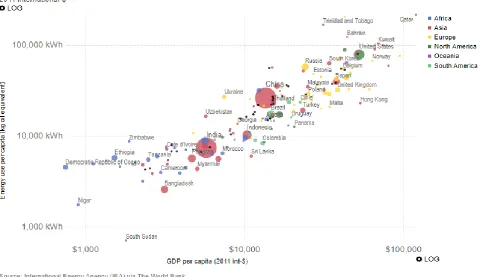
Energy use correlates strongly with the GDP, as can be seen by the graph below from
the International Energy Agency. This illustrates the importance of energy to people’s standard
of living and overall quality of life. Few people appreciate how much the modern world
depends on energy to maintain this standard. The fact that a person can get on a flight from
New York City to Los Angeles is not appreciated by most people. That it is possible to transfer
food and supplies to areas during natural disasters or bad crop years to avoid famines is seen as
crop meant starvation. It is no coincidence that virtually every measure of quality of life has
risen exponentially since the industrial revolution (Epstein 77). Energy is the driving factor
behind the vast majority of the growth in the past several hundred years. In light of this
information it is important to be careful when coming to decisions about what energy sources
humans should be using. After careful examination of alternative energy sources, it is clear that
nuclear energy is the best option and has the greatest potential to become the world’s leading
energy source in the future.
Terminology and Technicalities of Energy:
Below is a list of important terms and definitions taken from Guild Energy (Energy
Terms).
Energy: a measure of how much fuel is contained in or used by something over a period
of time.
Power: the rate at which energy is used or generated.
Kilowatt (kW): Unit of power equal to 1,000 watts.
Kilowatt-Hour (kWh): The electricity produced by 1 kilowatt acting for one hour.
Amount of electricity consumed in one hour by ten 100-watt light bulbs. Electricity
meters use kilowatt-hours as the standard measurement.
Megawatt: Unit of power that is equal to 100 kilowatts.
Watt (W): The unit of electrical measurement.
Watthour (Wh): The work done by a watt in an hour.Current Energy Landscape:
The worldwide energy landscape is dominated by fossil fuels, which consist of oil,
natural gas and coal. In 2013 fossil fuels made up 86% of world energy consumption, nuclear
was 4.5%, and hydro made up 6.7% (Epstein 44). Wind and Solar combined made up less than
1% of the worlds energy at this same point in time. The energy consumption makeup of the
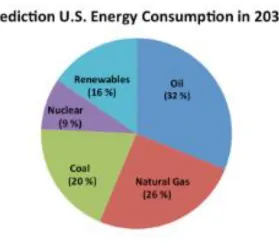
United States is similar with 81.5% of it coming from fossil fuels in 2015 (Pisupati). Coal use has
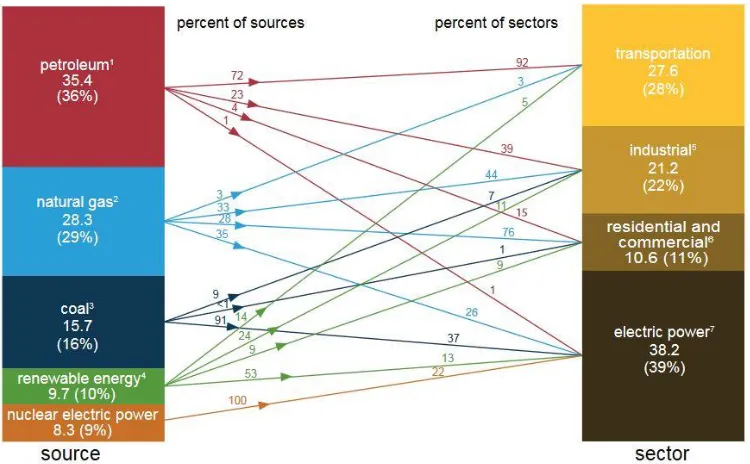
due to cheap natural gas prices and more renewable energy. The graphs below shows the
breakdown of worldwide energy consumption and where U.S energy comes from and where it
goes. By looking at table 1.2 it shows that fossil fuels make up the vast majority of global energy
consumption and have for a long time. Biofuels, which primarily consists of burning wood,
make up fraction of energy consumption globally at the bottom of the graph. This is primarily
done in the third world, where more advanced energy sources are not widely used. Wind and
solar energy are the tiny sections towards the top of the graph and make up very little of global
energy consumption. Table 1.3 shows where the energy comes from and goes in the United
States. It shows that oil is the largest energy source in the U.S, followed by natural gas and coal.
Roughly 40% of U.S energy goes towards producing electricity and 28% is used for
transportation. Industrial energy usage makes up about 22% of the energy usage in the U.S and
Table 1.2:
Fossil Fuels:
Fossil fuels are called that because it is theorized that they are the condensed
concentrations of energy from plants over millions of years. These condensed forms of plant
energy are made up of carbon and hydrogen atoms, attached by chemical bonds. As these
bonds are burned and used, the bonds break and release energy (Epstein 66). Over the course
of millions of years dead plants pile up and get piled under layers of earth. During this process,
the energy is condensed over the course of millions of years (Epstein 66). This leads to the
extreme density of fossil fuel energy, meaning a lot of energy is stored in a very small space.
Fossil fuels come in three different forms, solid (coal), liquid (oil), and gas (natural gas). The
main advantage of fossil fuel energy from a cost perspective is that it is highly concentrated and
reliable energy (Epstein 66). Other forms of energy, such as wind or solar, can vary in their
production but fossil fuels always give you a reliable amount of energy. The other advantage is
that there are large amounts of fossil fuels on the planet even today. For example, according to
current usage rates, there is over 3,000 years of recoverable coal reserves (Epstein 66). Each of
these forms of fossil fuel energy have specific uses and pros and cons, which is why they each
are used in different ways.
Coal is the world’s leader in electricity production, particularly in the developing world
(Epstein 67). The primary reasons it is used so frequently are that it is a solid and is fairly
abundant around the world. Coal is also not spread extremely thinly in the earth, meaning it
can be mined easier because minors do not need to mine large land areas to get usable
amounts of coal (Epstein 67). The levelized cost of energy for coal, according to the Wall Street
some energy sources but due to the abundance and reliability of coal it still makes up a large
portion of the worlds electricity generation. Coal use is expected to rise in the coming decades
due to developing countries industrializing over that time period.
Natural gas is used frequently for peak load electricity, which is the electricity demand
that has to be dialed up and down to meet changing demand. There is base-load power of
electricity that is the amount that will always be required no matter what for an area. Peak-load
electricity varies more based upon specific daily circumstances and require the energy source to
scale up and down very frequently (Epstein 69). Extreme heat is often what requires peak load
electricity since people use air conditioners in those situations, which drives electricity demand
up for relatively short periods of time. Natural gas is particularly good at scaling up or down,
which is why it is used primarily for peak load electricity. Coal, nuclear, and hydroelectric power
all specialize in base load power, on the other hand. The cost of natural gas according to the
Lazard study varies depending on the process used. It ranges from a cost of $42/MWh to
$210/MWh depending on the method used to produce electricity with natural gas (Levelized
Cost of Electricity 2017).
Oil is the final form of fossil fuel energy and is primarily used for transportation. In 2015
oil accounted for 92% of all transportation fuel used in the United States (Pisupati). Currently
the price for a barrel of oil is hovering around $60, according to Bloomberg, and is relatively
cheap. Most transportation vehicles, including cars, trucks, trains and planes, use oil as their
primary energy source. One major reason oil is so good for transportation is because it is highly
concentrated, as well as being a liquid. Liquid fuels are best for transportation because they can
big important (Epstein 71). Other energy sources have struggled to meet this challenge form a
competitive standpoint. Electric cars, powered by batteries, are the only true competitor yet
are extremely expensive. Specifically, battery technology has not advanced very quickly over
time due to technical restraints and hurdles that must be overcome. This can be seen clearly by
examining the energy density of batteries. The Tesla Roadster battery has an energy density
that is 107 times less than gasoline, meaning the amount of energy that can be stored in the
battery is 107 times less than what is stored in gasoline. This factor decreases to 35 times less
because the electric motor is more efficient at using the energy than a gasoline powered motor
is (Epstein 72). Even after that though, it is still an enormous difference in terms of performance
capability. Electric cars have been around longer than gasoline powered cars, contrary to
popular belief, so it may take a long time for them to become competitive.
Solar:
Solar power is produced by converting the sun’s solar rays into energy. The sun releases
energy particles called photons, which travel to the earth and can be converted into solar
power. The number of photons that reach the earth in an hour would be enough to power the
whole planet for a whole year in theory (SunPower). Solar energy is produced by using solar
panels, which can be put on rooftops or on large solar farms. Solar panels, also called
photovoltaic (PV) solar panels, are made up of solar cells. The cells are made of silicon and have
both a positive and a negative layer, which combine to create an electric field in the vain of a
the panel. The electrons then flow through the electrical field created by the positive and
negative layers of the cells, creating electricity.
Solar power has a cost to install it at first and then a continuous cost afterwards such as
maintenance costs. According to EnergySage, a solar energy equipment supplier, the
homeowners are paying between $2.71 and $3.57 per watt to install solar power. This comes
out to a cost of $18,840 before tax credits or $11,380 - $14,990 after the tax credit (Matasci).
The cost is done by using the U.S average system size of 6 kilowatts (kW). The tax credit
decreases the cost by about 30% and many states and localities offer further incentives that
make it cheaper. The price to install a solar panel also varies by state, with a per watt cost of
about $3.50 in Massachusetts and $2.65 per watt in Florida (Matasci). EnergySage also lists the
amount of savings people can get over the course of twenty years by installing solar panels on
their homes. This ranges from $63,000 for someone living in Boston to about $35,000 for
someone living in Austin (Matasci). If this is calculated on a per year basis someone living in
Boston would save about $3,150 a year, compared to about $1,750 in Austin.
The other cost is the continual cost of operating after the solar panels are installed. One
way to measure this cost is to use the levelized cost of energy (LCOE). This is when you take the
total expected lifetime costs of the technology and divide it by the total expected costs over its
lifetime (Sendy). The result is a cost for different energy sources that can be compared to each
other. It works very similar to what the Net Present Value (NPV) is in the financial world.
According to a recent 2017 analysis by the financial company Lazard, in some scenarios solar
energy is cheaper according to this metric than conventional sources of energy such as coal or
utility-scale solar photovoltaic (PV) energy (Levelized Cost of Energy 2017). The LCOE for utility
scale solar energy has declined 86% from 2009 to 2017, from a mean rate of $359 per
megawatt hour to $50/MWh. The current cost of $50/MWh is much less than the $102/MWh
price for coal in 2017 (Levelized Cost of Electricity 2017). It also notes, however, that the cost
decline seems to be slowing down so it may not continue to drop in price nearly as fast in the
future. Despite that, the decrease in cost should lead to more solar capacity being installed in
the years to come, according to this analysis (Levelized Cost of Electricity 2017).
According to the Institute for Energy Research, in 2015 solar energy made up less than
1% of the total energy production in the United States (Solar). Europe has pushed a lot harder
for solar energy, as well as wind energy, than the United States. The countries that are often
cited as being the leaders in both wind and solar energy are Germany and Denmark. As a result,
they will be used for purposes of comparison to the United States and as a benchmark for the
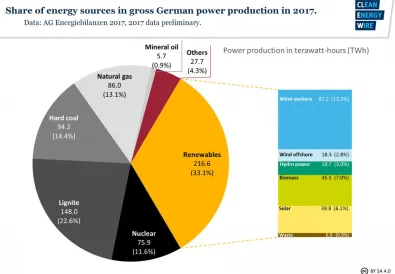
success of these energy sources as well as costs. In Germany, 6.1% of the electricity produced in
2017 came from solar energy according to a non-partisan German research organization
(Germany’s energy consumption). If solar energy is cheaper than conventional sources of
energy such as nuclear and coal one would expect it to make up a much larger percentage of
the energy market. One reason for this is that solar energy is very intermittent, meaning it
varies in its availability (Solar). The sun does not shine at night, so right away solar energy is
only available for half the day in the best case scenario. Even during the day the sun does not
shine all the time due to cloud cover, which can be more common in different parts of the
world. Producing solar energy in Seattle is very different from doing so in Southern California.
position in the sky. This means solar energy produces the most during the times closest to
noon, when the sun reaches its maximum intensity. Places such as Alaska or northern
Scandinavia get very little sunlight during certain times of the year due to their distance away
from the equator. Another problem solar energy faces is that it is diluted compared to
conventional forms of energy (Epstein 49). This means that it is not a very dense energy source
and it requires many solar panels to equal one nuclear or coal plant. Coal can store a lot of
energy into a very compact space whereas the sun is spread very thin when it comes to
concentrating its rays into usable energy for people.
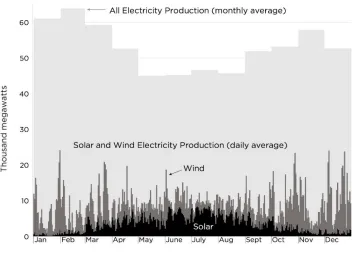
By looking at the two charts below you can see the wind and solar electricity production
in Germany over the course of the year and a month (Epstein 51-52). The two energy sources
together are never able to meet Germany’s electricity demand. The intermittency problem is
evident from the charts, which shows how the overall electricity provided is very inconsistent
and fluctuates constantly. At nighttime the solar energy goes down to zero because the sun is
not out and wind energy tends to be correlated with solar energy. As a result, there are brief
moments where they both can combine to provide perhaps 40%-80% of the electricity
Germany needs. These are only brief moments and do not last long or happen frequently
enough. At other points in time, particularly at night and in the evening, they both provide
almost no energy. Conventional energy sources, such as coal, then have to make up for the lack
of production from wind and solar energy (Solar). This means coal and nuclear plants have to
constantly scale their production up and down over the course of a month, leading to increased
Table 1.4: Germany Electrical Production Source: The Moral Case for Fossil Fuels page 51
The downsides of varying electricity production and the problems this creates are the
main reasons that wind and solar make up such a small percentage of the market in Germany
and Denmark. It is also a testament to the difficulty in providing electricity without using
conventional, reliable sources that can consistently produce a certain amount of electricity on a
daily basis. It is also important to note that these charts only include electricity, not total energy
in Germany that is used. Things such as transportation fuel for vehicles or heating fuels for
buildings and homes are not included. Right now, the vast majority of transportation is done
with conventional energy sources, namely oil. While electric cars have made some progress
they are still quite expensive and unlikely in the near future to be widely used (Epstein 72). In
addition, airplanes, trains, large trucks, and boats would also have to be electricity based to be
powered by solar or wind energy. This further magnifies the problems with using alternative
energy to power a civilization at the moment, and will likely remain problems for quite some
time.
The other problem that both solar and wind energy have is that there is no way to store
the energy. Since both of these sources of energy are intermittent, they provide very little
energy most of the time and then sometimes there is too much energy. The only solution to
this problem is to develop a mass storage system that can collect enough energy during peak
production to use when it is low. This is not included in the Levelized Cost of Electricity
calculations and is a massive cost. As of 2018 there is still no mass energy storage system in the
world that is in development or even any concrete ideas on how it can be done. The only way
right now that electricity can be stored in any amount is some sort of battery technology.
people on demand will require massive improvements (Epstein 72). It is possible that there
could be a breakthrough in technology that will solve this problem but with little evidence to
date that this can be done it may be a long time off. This is another reason that wind and solar
do not make up much larger proportions of energy production. Without a reliable source of
energy or anywhere to store massive quantities of it, any industrialized world will not be able to
run on it. Everything from hospitals, food production, and transportation all rely on energy to
keep going. Any shortage of this will result in massive reductions in living standards all around
the world so it is important to consider this when deciding on the energy of the future and
crafting public policy.
Table 1.6
Wind:
Wind power is a form of energy created by using the wind to turn a turbine in order to
create electricity. It is another form of solar energy because the wind is caused by different
temperatures of pockets of air in the atmosphere (Wind Energy Basics). Wind turbines turn the
kinetic energy of the wind into mechanical energy which is then turned into electricity by a
generator. This is done with wind turbines built on top of metal towers, where lightweight
blades are attached to the top and spin due to the wind, powering a generator which creates
electricity (Wind Energy Basics). Numerous wind turbines are grouped together on wind farms
to produce large amounts of power to be used.
Wind energy is similar to solar energy in that there are a lot of installation costs but
much lower maintenance costs afterwards. The initial cost of installing a 5 kW pole-mounted
wind turbine is about $32,000 according to The Renewable Energy Hub. Wind power
installation also benefits from the 30% tax credit as well as additional incentives and tax breaks
for different states and localities (How much does a wind turbine cost?). The cost of wind
energy varies by state, similar to how solar energy installation costs do. The center of the
United States tends to have the cheapest costs due to high and consistent wind speeds. The
western states have historically had the most expensive wind energy production costs,
according to the Energy Information Administration. The cost of the wind turbine itself is the
single greatest cost factor, accounting for over 70% of the total cost for a land-based wind
project (The Cost of Wind Energy). The capacity of a wind mill installation will be determined by
the location, however, wind power technology is improving with lighter blades and taller
maintenance required (The Cost of Wind Energy). The reason that it only lasts for 20-25 years is
due to normal wear and tear, eventually resulting in maintenance costs rising as it ages in the
same way they do for cars. The blades, electric converter, and many other parts have to be
replaced and eventually it is more financially beneficial to use a new windmill. The maintenance
is relatively cheap until the later years when they start to increase as it approaches the average
lifespan of a wind mill.
Looking at the same Lazard 2017 study used previously for solar energy costs, wind
power has a competitive LCOE. It is even cheaper on the low end than solar energy. The study
found that the LCOE for wind power is between $30/MWh - $60/MWh in 2017, which is
cheaper than the cost of cost of coal and nuclear (Levelized Cost of Energy 2017). The U.S
Department of Energy states that the cost of wind energy has declined by over 90% since the
early 1980s. Despite all of these declines in cost and studies of the LCOE, wind power only
produced 4.7% of all electricity generated in the United States in 2015 (Wind). Germany is often
cited as the leader in renewable energy, particularly wind and solar, yet it only produced 16% of
Germany’s electricity in 2017 (German Energy Production). The reasons behind this are largely
similar to the problems that solar energy faces. Wind energy is very intermittent and does not
produce at a consistent rate, a key trait of what keeps the power grid stable. Wind varies
throughout the day and by region of the country, with the Great Plains region in the middle of
the country having the most wind (The Cost of Wind Energy).
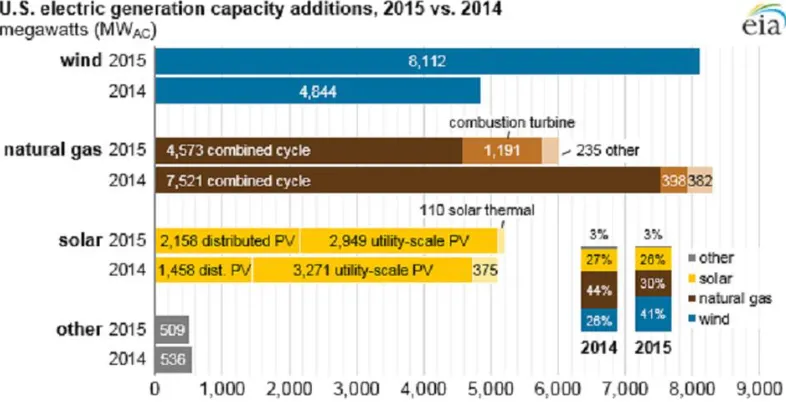
The lack of consideration of the intermittency of wind energy, as well as solar, lead
many people to make common mistakes in regards to energy statistics. Many claims are made
example, in 2015 the Energy Information released a graph (which can be found below) showing
that wind, solar, and natural gas contributed nearly all of the electricity capacity additions in
the previous year (The Myth of Wind and Solar ‘Capacity’). A simple misunderstanding of
terminology leads to statements like this being interpreted wrongly. Electrical generation
capacity is not the same thing as an ability to provide consistent energy. Capacity is simply a
technical term that is the maximum ability to provide electricity, but it says nothing about the
consistency over time to provide energy. A more important point to consider is the capacity
that an energy source can run at on a day to day basis. A nuclear plant may be able to run at
80%-90% of its capacity factor on a consistent basis whereas wind or solar energy may run at an
average of 20% (The Myth of Wind and Solar ‘Capacity’). During times where it is very windy
and the sun is out they may operate at high capacity levels but this is not a consistent
phenomenon.
Table 1.7:
A significant portion of the reason conventional energy sources are used is because they
are reliable, which is often taken for granted by many people. When someone goes to the
hospital to get a lifesaving treatment that requires technology, they need an energy source that
will be available to them. The ability to flip on a light switch and have a light turn on
immediately is not appreciated by most people but it is probably the most amazing aspect of
modern electrical grids. A good analogy to understand the important of reliability to a power
grid would be that of a cell phone plan. Any particular phone plan may be extremely cheap, but
if it only provides service 20-30% of the time and the specific times are not very predicable it
becomes less valuable. As a result, few would wonder why these phone plans do not make up a
larger portion of overall plans even though they may appear to be cheaper.
Wind power also suffers from being a fairly dilute energy source in the same way that
solar power does. The easiest way to understand this is to see the amount of resources
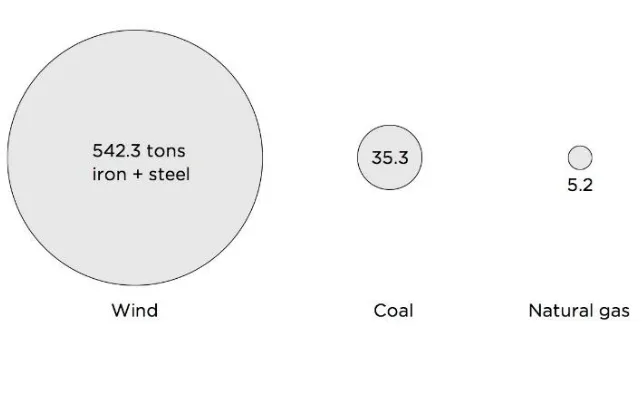
required to produce a given unit of energy for wind compared to other forms of energy. In
order to produce one Megawatt of wind energy it requires about 542.5 tons of iron and steel
(Epstein 49). This is a resource heavy process because it takes a lot of effort to get a lot of wind
energy since it is not a dense energy source like oil is. Compare those numbers to 35.3 tons of
iron and steel for coal and 5.2 tons for natural gas. This paints a clear picture that getting
energy from wind energy takes many more resources than conventional forms of energy. The
fact that in different parts of the country wind energy is even more resource intensive and in
Figure 1.8:
Source: The Moral Case for Fossil Fuels page 49
Now that both solar and wind have been examined from a cost perspective according to
LCOE analysists, it is important to look at real world examples. While both energy sources are
intermittent and dilute, surely they are still going to be cheaper than conventional forms of
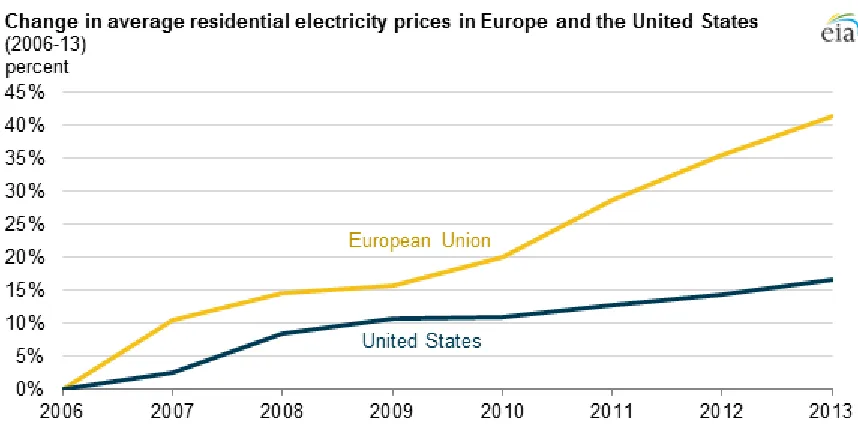
energy if these LCOE studies are correct. According to the Department of Energy in 2014,
Europe has seen a faster increase in the cost of their electricity from 2006 until 2014 when this
was looked at (Marcy & Metelitsa). During that time Europe saw more than a 40% increase in
the average residential electricity costs. When you compare this to the 16% increase in the
United States over that same timeframe, it looks all the more alarming. Most European
countries produce a larger portion of their electricity from wind and solar energy than the
United States. This is a result of governments throughout Europe pushing hard to promote
the United States has not done this to nearly the same degree it is concerning to see the rapid
increase in electricity costs in Europe compared to the U.S.
Figure 1.9:
Germany and Denmark, which are typically cited as large scale success stories for wind
and solar, will be the benchmarks to study how wind and solar impact costs on an electrical
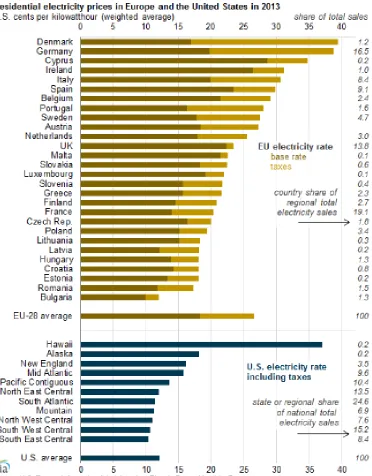
grid. Looking at the data from the department of energy Germany and Denmark have the most
expensive residential electricity costs in all of Europe. The costs for both countries is roughly 3-4
times as expensive as residential electricity costs in the U.S, depending on the exchange rate. In
Germany it costs roughly 38 U.S cents per kilowatt hour for electricity production and 39 U.S
cents per kilowatt hour for Denmark (Marcy & Metelitsa). The price in the U.S is roughly 13 U.S
cents per kilowatt hour, as seen in figure 1.10 below, although it can vary by state. It can be as
cheap as 8.67 cents/kWh in Washington to 18.84 cents/kWh in New York and 36.99 cents/kWh
in Hawaii due to transportation costs. A significant portion of the additional costs throughout
high as 57% in Denmark (Marcy & Metelitsa). Taxes on residential electricity are typically used
for subsidies towards wind and solar energy to help pay for the investment in these energy
sources. So even if these taxes were to be abolished it would not solve the problem of
increased costs due to greater usage of wind and solar energy.
If wind and solar energy are cheaper than conventional sources the cost trends in
Europe are hard to understand. The problem is that the metric of using Levelized Cost of Energy
does not capture everything and is a flawed way of measuring energy costs. Some LCOE
measurements do not properly account for the cost of subsidies when making calculations. The
biggest problem is that the Levelized Cost of Energy does not factor in the costs of grid
integration or storage costs (Deign). This is usually mentioned in the text of the study, although
it is often ignored when people use LCOE to claim wind and solar are much cheaper than they
actually are. The grid integration is extremely important because of the intermittency problem
that wind and solar energy have. The inconsistent nature of both energy sources cause serious
problems with integrating them into a grid system on a large scale. The electricity supply and
demand need to be close to the same at all times to avoid blowing the grid up or blackouts due
to shortages. Since the intermittency means the energy production will vary widely over the
course of the month, or even days, this becomes hard to avoid. Thus, it increases the cost
Hydroelectric:
Hydroelectric energy is created by using the kinetic energy of water to spin a turbine,
similar to wind power, in order to generate electricity (How Hydroelectric Energy Works). The
water needs to be moving at a fast speed in order to turn the turbine fast enough. In order to
do this a dam is built on a river with a steep drop in elevation. The dam collects water and a
pipe called a penstock is used to drop water down to spin the turbine, which is connected to a
generator to produce electricity. Hydropower works best on larger rivers with big changes in
elevation (Hydroelectric power: How it works). Hydroelectric power is typically used to provide
peak electricity, when demand is highest for electricity. Demand for power is not flat but shifts
over the course of the day. Electricity demand is higher during the day and lower at night.
Hydro power is typically used during peak demand during the day (Hydroelectric power: How it
works). At the end of the day water is pumped back up to be stored for the next day so the dam
is ready to meet peak electricity demand again.
Hydroelectric energy is the cheapest type of energy, according to an analysis done by
Navigant Consulting and the American Council on Renewable Energy (ACORE). It found that
hydro power LCOE is about 2 cents per kWh, compared to 7.5 cents for coal and 6 cents for
natural gas (Affordable). Another major advantage of hydroelectric power is that it is far more
controllable than wind and solar energy. While droughts can lead to problems in production,
these are relatively rare and easier to predict than the sun and wind. Dams also have the ability
to store water for later use so it can be scaled up or down whenever needed (Hydroelectric
power water use). This means that hydroelectric power can be used for both base load power
means the costs are spread out over a long period of time as well. They also need relatively
little repairs and maintenance over the course of those 50 years, which is another reason the
cost is so low (Affordable).
Hydroelectric energy makes up about 17% of the worlds electricity production
(Hydroelectric power water use). In the United States hydro produces roughly 6% of the
electricity, varying by region of the country (Hydroelectric). Hydro power is used significantly
more than wind and solar are worldwide. Since wind and solar appeared to be much cheaper
according to LCOE methods it is important to look at real world examples when examining
costs. States that use high amounts of hydro energy tend to have the cheapest electricity bills in
the U.S. Some examples include Idaho, Oregon, and Washington, all of which get over 80% of
their electricity using hydro (Hydroelectric power water use). The electric bills in these states
are amount the lowest in the country, proving that this is not just something that can be shown
in a study. Looking outside of the United States, there are many countries that get a large
portion of their electricity from hydro power. According to The World Bank, Norway gets over
95% of its electricity from hydro power and Iceland gets 73%. This indicates that hydroelectric
energy can provide large amounts of electricity to countries at a cheap cost, since both of these
countries have relatively cheap electricity costs.
The main problem that prevents hydropower from being used more frequently and
becoming a global energy source is that the locations are limited. While hydropower has an
advantage on wind and solar by being much more controllable and far less dilute, it can only be
done in certain bodies of water. Most of the rivers in the United States that are suitable for
the Pacific Northwest are great for hydro power, Arizona or Nebraska are not nearly as good.
This means hydro power is unlikely to ever become the leading source of electricity in most
countries around the world. That does not mean, however, that it cannot be expanded in many
parts of the world. According to the International Energy Agency, hydroelectricity has the
potential to grow by 80% in Asia and 92% in Africa. The agency also estimates that hydro could
produce up to twice as much energy globally as it does now, at 6% of the current global energy
makeup. Only time will tell if this will actually occur but it is certainly not the price of hydro
power that will ultimately hold it back, but rather the limited locations where it can be utilized.
One area of potential in the field of hydroelectric power is the usage of micro
hydroelectric power plants. This is something that some companies have experimented with to
help individuals and isolated communities get power at a good cost. This is where submerged
turbines are placed in small rivers of streams that have very small changes in elevation (Micro
Hydro). As long as there is moving water and a small drop, even just centimeters, power can be
generated for an individual or a small group of people. These turbines do not block the flow of
water and as a result there is no increased risk of flooding as a result of it. Also, they are
designed to avoid harming fish and so that fish that swim into the turbines will emerge
unharmed (Micro Hydro). These micro hydroelectric power turbines are capable of generating
cheap electricity for a small number of people and can be built far more widely than a
traditional hydroelectric dam can be. This could potentially open up the possibilities of
Nuclear Energy:
Nuclear power is created by either splitting or combining atoms, which gives off a
byproduct of energy every time this is done (Nuclear Explained). Atoms are small particles that
make up everything and are made up of protons, electrons, and neutrons. The core of an atom
is called a nucleus and has protons and neutrons in it and the electrons surround it. The bonds
that hold the nucleus together contain a huge amount of energy. The first process of creating
nuclear power is called nuclear fission and is when a heavier atom is split to release energy
(Nuclear Explained). This is the process that is used in every nuclear plant in the world right now
and is usually done using uranium atoms. A neutron is used to split an atom, which releases
more neutrons and continues the process in what is called a nuclear chain reaction. The other
process is called nuclear fusion and is when two lighter atoms are combined in order of create a
larger atom, which produces energy as a byproduct (Nuclear Explained). Nuclear fusion is the
process that every star, such as the sun, uses to produce energy. Fusion energy is not used in
any nuclear power plants right now and is in a research phase to try and make it useful to
produce electricity. The reason is because it is difficult to use fusion at a cheap cost right now
because it takes more energy to produce the energy than it produces (Epstein 196). It is also
very difficult to control the fusion process, which has limited research.
Nuclear energy is one of the most fascinating prospects for a large scale energy source
to many in the energy field. There are several reasons for this, including the concentration of
the energy and the scalability it can provide. The importance of having dense, concentrated
energy can be seen by contrasting oil with wind and solar energy. Oil can store a lot of energy in
limited space. Wind and solar, as discussed prior, are both very dilute energy sources and
therefore require a lot of work to produce energy. Uranium, which is what nuclear power plants
use, has an energy concentration of over a million times that of oil and 2 million times coal. The
current state of nuclear technology, however, only allows us to get thousands of times the
energy per unit of output (Epstein 61). Having an ultra-concentrated form of energy is very
important if the goal is to use it to power a civilization. There is enough uranium on the planet
to power the whole world for thousands of years, even at increased rates of energy usage
(Epstein 61). Scalability is another major advantage that nuclear energy has compared to other
alternative energy sources. Fossil fuels are used to widely because they are scalable for billions
of people at a cheap cost. It can be used anywhere at any time without having to worry about
cost or reliability problems due to intermittency. Hydroelectric power is great where it can be
used but is extremely limited due to the number of rivers or bodies of water that can be
dammed.
A nuclear power plant is not limited by the location of a river or by how much sunlight
or wind is present at any given point in time. This means that it is extremely reliable, as well as
being much denser compared to other sources of energy. All of this leads to the ability to scale
for large numbers of people in the way that fossil fuels can. Other alternative energy sources
may work in small amounts in the right places but as of right now are not capable of providing
energy for the entire globe. This is a problem that must be solved to provide cheap, abundant,
and reliable energy for billions of people. The concerns of nuclear critics are the cost of the
process, as well as the perceived danger of it due to concerns of terrorism and radiation, among
Understanding how many resources there are remaining for different types of energy
showcases the great potential of nuclear power. There are often concerns over how much fossil
fuels are left in the earth by supporters of alternative energy sources. The table below shows
the size and per capita cash value of numerous resources relating to energy (Zubrin 139). It is
also divided into two sections, with the one on the top being resources that are usable now and
the bottom part being resources that could potentially be useful in the future. The energy
column is listed in terawatt years (TW-Years) and the right column is in 1000s of dollars per
capita (Zubrin 138). A terawatt year is a trillion watt years, which is a standard unit of energy. A
50 watt year light bulb uses 50 watt years of energy in a year, to give some context. In the
United States the per capita use of energy is about 11,000 watt years in 2010. According to this
table there is 1,197 years of fossil fuel resources left on Earth. Roughly 15
terawatt-years of energy are used every single year by humans, meaning there are roughly 80 terawatt-years of
fossil fuel energy resources remaining and many more for nuclear energy (Zubrin 138). It is
important to note, however, that this is at current usage rates, which are subject to change.
Also, almost every year new technology allows more of them to be recovered without losing
money or energy. Estimates of how much of a resource are on the planet only include those
that can financially be recovered. This is why the number always expands even though more of
Figure 1.11
The Earth’s Energy Resources Source: Merchants of Despair, page 139
Currently
Usable Resources
Energy
(TW-Years)
Value Per Capita
(1000s of Dollars)
Oil (known reserves)202 18
Coal (known reserves)
790 69
Natural Gas (known
conventional reserves) 205 18
Nuclear Fission
(Uranium fuel, without reprocessing)
685 60
Nuclear Fission
(Uranium fuel, with reprocessing)
50,000 4,400
Nuclear Fission
(Thorium fuel, with reprocessing)
200,000 17,500
Resources Potentially
Usable in the Future
Natural Gas (including sub-seamethane hydrates) 24,000 2,100
Nuclear Fusion
100,000,000,000 8,800,000,000
The current known reserves of uranium and thorium fuel for nuclear energy totals about
250,000 terawatt-years of energy, which is significantly more than the current fossil fuel
reserves. With that much energy the globe could be powered at our current usage rates for
roughly 16,000 years (Zubrin 138). Even with the increased usage of energy around the globe
whole globe. All of the concerns of energy supply in the future due to fossil fuel shortages are
ignoring the potential of nuclear energy. By looking at the per capita dollar value of each
resource it becomes even clearer. All of these numbers are obtained by taking the total value of
each resource converted into electricity at a price of 7 cents per kilowatt hour. This number is
then divided equally among the total human population on Earth, presently about 7 billion
(Zubrin 139). The per capita values of fossil fuels is $69,000 for coal, $18,000 for oil, and
$18,000 natural gas. By comparison, the value of nuclear fuel (uranium fuel with reprocessing
and thorium fuel with reprocessing) would come out to nearly 22 million dollars for every
person on the planet (Zubrin 140). The opportunity this provides for massive amounts of energy
is something that people have been overlooking due to concerns about nuclear power. The two
main concerns are that it costs too much and safety concerns, including radiation, waste
storage, terrorism, nuclear proliferation, and nuclear accidents that have occurred.
The Lazard analysis done in 2017 found that nuclear energy has a Levelized Cost of
Electricity ranging from $112/kWh-$183/kWh (Levelized Cost of Energy 2017). This is more
expensive than many other forms of energy, such as coal or wind energy, according to this
analysis. The Energy Information Agency did another study recently looking at the LCOE for
plants and energy sources that would be up in running in the future. The LCOE for new nuclear
plants that would be running in 2022, according to expected capacity additions, is about
$90.2/MWh (Levelized Cost and Levelized Avoided Cost). The implication is that nuclear energy
will continue to get cheaper over time, although other energy sources will likely do the same as
well. As mentioned before, there are limitations to the Levelized Cost of Energy method of
It is important first to understand how widely used nuclear power is and what the
results have been. According to the World Nuclear Association, nuclear power made up 20% of
the electricity production in the United States in 2016. The world leader in nuclear power in
terms of proportionality is France with roughly 72% of their electricity coming from nuclear
plants in 2016 (Nuclear Power in the World Today). This is as a result of a major push in the
1970s and 1980s to use less fossil fuels in France. Other countries include Belgium, which gets
52% of their electricity from nuclear power, and South Korea, which got 30% from nuclear in
2016 (Nuclear Power in the World Today). This indicates that several industrialized countries
deprive a large portion of their electricity from nuclear power. China and India both use small
amounts of nuclear power in terms of proportions of their electricity supply but both
governments are planning on expanding the usage a lot over the next few decades (Ferguson
64). There is almost no nuclear power being utilized in Africa, South America, or Australia,
although there is some interest by many governments in developing some. Each nuclear power
plant is capable of providing enough electricity for about 600,000 people, which is roughly the
population of a mid-sized city (Ferguson 41). So many more plants would have to be built in
order to provide electricity for entire countries. In addition, technological improvements will
likely make future plants better able to provide electricity to larger amounts of people.
In the United States nuclear energy has gotten more expensive over time rather than
less so. In the 1970s nuclear energy was becoming more prominent and cheap, even replacing
some coal plants at the time due to costs. Since it is clear that the input products, like uranium,
are abundant and relatively cheap, this is hard fact to make sense of. Proponents of nuclear
the 1970s there was a large anti-nuclear movement that opposed nuclear power due to fears of
safety, partly due to hysteria of nuclear weapons (Zubrin 136). This movement was led by
people such as Ralph Nader, and led to a massive resistance of nuclear power among
environmentalists. Groups such as the Sierra Club and Greenpeace made opposing nuclear
energy top priorities and still do so today. Many “Green” politicians, activists, and political
parties worked to protest the construction or proposed construction of nuclear power plants all
over the country (Zubrin 137).
The results were very effective just by looking at the rate of new nuclear plants being
built and ordered. From 1970 to 1974 a total of 115 orders for new nuclear plants were placed
in the United States, averaging 23 each year (Zubrin 136). After the anti-nuclear movement
gained steam these numbers fell drastically to less than 3 per year from 1975 to 1979. Since
1979, there have been zero construction orders for new plants to be built in the United States,
which showcases the power this movement has had at achieving its goals. If the nuclear
industry continued to expand at the same rate it did during the early 1970s, nearly all fossil fuel
electrical generation would have been replaced by nuclear energy by today (Zubrin 137). The
movement made it harder to build nuclear plants not just in terms of the number of plants but
by increasing the length of time it took to build one. The first commercial nuclear power plant
in the United States was the Shippingport nuclear power plant in Pennsylvania in 1958
(Shippingport Nuclear Power Plant). The plant took 4 years to build whereas today it can take
anywhere from 15 to over 20 years to build a nuclear plant. Fixed costs make up the vast
majority of the costs of nuclear energy. As a result, anything that drives up these costs will
plants is the actual plant itself so when it takes decades to complete one it dramatically raises
that costs. Decades of investment with no return and paying interest on loans makes it very
difficult to succeed. When you add in local communities bringing the owners of the plant to
court complaining about the construction based on misconceptions, it makes the investment a
tough sell for most companies.
As a result of this movement, the industry was demonized by many environmentalists.
This created numerous regulations that crippled the industry’s ability to expand due to over
exaggerated safety concerns. This is what has led to the construction length increasing so much
over time. Towns do not want nuclear plants to be built nearby and they oppose any new
nuclear plants due to misconceptions related to safety. People also bring the company building
the plant to court frequently, which halts construction and this makes it more expensive to
build. Since the construction process takes up the majority of the cost, this drove the price up
over time and is preventing nuclear energy from competing cheaply, not because of an inability
to compete. This is not necessarily a phenomenon limited to the United States, as many other
industrialized countries have had similar concerns and regulations. A good example of this
would be how Japan has been making in nearly impossible to use nuclear energy after the
Fukushima accident in 2011. This has nothing to do with other forms of energy out competing it
but irrational fears that are making it harder to develop nuclear power.
The main driver of the anti-nuclear movement was concerns over safety. One of the
main claims made in the 70s by this movement, and still believed by some people today, is that
nuclear power plants could be blown up in a nuclear explosion. That is simply not true, a
happen because the Uranium fuel must be enriched properly. Enrichment is when isotopes are
separated in order to concentrate, or enrich, one isotope over others. Isotopes are simply
different variations of an element with the same number of protons but different neutrons,
lead to a different atomic mass but otherwise similar qualities. In nature isotope U 235 is less
than 1% of the concentration of Uranium and to use for energy or a bomb it must be a higher
concentration, or enrichment level. Uranium must be enriched to over 90% in order to be used
in a nuclear bomb effectively. A nuclear power plant uses uranium that is only enriched to 3%
of the isotope U 235 (Zubrin 147). It is simply not capable of creating a nuclear bomb and would
be a violation of the laws of physics for it to occur. Fear over nuclear explosions is one of the
main factors that have been utilized in order to limit the growth of nuclear power. Nuclear
energy expert Petr Beckmann put it best when he said “the media keep playing on the the
psychological association of “nuclear” and “bomb,” which makes as much sense as the
association of “electric” and “chair”.” (Beckmann 13).
Another fear of nuclear power is of terrorist organizations using it to develop nuclear
weapons. First, it is almost impossible for an individual to build, steal, or obtain sufficient
materials to develop a bomb (Beckmann 135). Even if someone could get their hands on
enriched Uranium or plutonium capable of being used to build a bomb, the odds that they
would ever figure out how to do so are extremely low. It requires a lot of expertise and to
create a working nuclear bomb (Ferguson 135). In addition, there are many ways to kill large
numbers of people that would be far more realistic for someone looking to cause harm. Even
for a well-funded terrorist organization this would be supremely hard to accomplish. In the
make far more sense to try to acquire a ready-made weapon or partly completed weapon
instead of making one (Beckmann 136). It is highly unlikely that a group of terrorists would
possess the knowledge to create their own bomb. There are numerous nuclear weapons in the
United States military stockpile, even with the numbers dropping dramatically since the cold
war. Many U.S military bases in foreign countries may already have some stored for use in case
of war. Any terrorist would have far more success trying to take on of these in an attack rather
than using materials from a nuclear plant to try and develop one over a lengthy process.
The other concern regarding terrorism is that a nuclear plant could be attacked in order
to release large amounts of radiation on a nearby population. In order for this to happen an
explosion would have to blow a hole in the containment building at a nuclear power facility.
The containment buildings have extremely thick walls that would be extremely difficult to
properly make large holes in it. Even if it were to happen it would still need the right weather
conditions for the radioactivity to not simply disperse in the atmosphere with little, if any, harm
done. Finally, even if the weather did keep the radiation bunched together it would still need a
favorable wind that would blow it right into a major city or population center to cause damage
(Beckmann 67). This is an extraordinary set of circumstances that would have to be met and
planned out, accounting for unpredictable weather conditions in addition to actually attacking
the plant itself. It would be far easier to attack an oil pipeline or a ship storing natural gas at a
harbor to cause mass destruction and deaths (Beckmann 149). Similarly to the idea of a
terrorist organization creating a nuclear weapon, there are far better targets than nuclear
Radiation is one of the main concerns cited as a reason to avoid nuclear power. What
radiation is are particles that move as electromagnetic waves and have high energy levels. It is
measured in units called rems, or millirems (one thousandth of a rem). If a person receives high
doses over short time periods it can lead to cancer or radiation poisoning (Zubrin 146).
However, the U.S Nuclear Regulatory Commission has acknowledged that there is, “no data to
establish unequivocally the occurrence of cancer following exposure to low doses and does
rates – below 10,000 mrem”. This is extremely important because the average nuclear power
plant only gives about 0.01 millirems per year. So the concern of nuclear power plants giving
everyone cancer in the local area is not something that people should be extremely worried
about. The table below shows radiation doses from numerous sources, giving context to how
much radiation people come into contact with on an annual basis (Zubrin 146). At the very
bottom it shows that the average amount of radiation people are exposed to each year is
roughly 270 millirems per year. That is well below the threshold that can lead to danger and
cause people harm. Nuclear plants may even reduce radiation because they usually replace
Figure 1.12
Radiation Doses from Natural and Artificial Sources
Blood 20 mrem/year
Building Materials 35 mrem/year
Food 25 mrem/year
Soil 11 mrem/year
Cosmic Rays (sea level) 35 mrem/year
Cosmic Rays (Denver altitude) 70 mrem/year
Medical X-Rays 100 mrem/year
Air travel (New York to LA round trip) 5 mrem Nuclear power plant (limit, at property line) 5 mrem/year
Nuclear power plants (dose to general public) 0.01 mrem/year Average annual dose (general public) 270 mrem/year
Source: Merchants of Despair, page 146
The risks and hazards of nuclear waste disposal are another major concern of activists
and environmentalists opposing nuclear power. During the process of releasing the energy from
uranium or plutonium through a fission process a certain amount of waste is created. This
needs to be stored somewhere safely until it is no longer dangerous, which can take a long
time. In 1982 The Nuclear Waste Policy Act of 1982 (NWPA) said the Department of Energy
needed to find a location to store nuclear waste. In 2002 Congress and the President approved
Yucca Mountain, located in Nevada, as the site for this waste but in 2010 the Department of
Energy shut down the Yucca Mountain project without explanation (Used Nuclear Fuel). The
plan meets the safety standards, such as the requirement for the radiation to be below a
dosage of 15 millirems of radiation per year for 10,000 years. The actual amount of radiation
years (Zubrin 145). Most experts on the subject of nuclear waste disposal have indicated that
the Yucca Mountain project would work and in order for the project to continue it simply needs
funding. So it is not very difficult to deal with nuclear waste and if it would only get funded the
Yucca Mountain plan would be more than adequate in providing a solution to the problem.
Nuclear proliferation is another major concern that people have with nuclear energy.
This is the idea that nuclear weapons might become more widespread because the process of
creating nuclear energy could be used by foreign governments to create bombs (Ferguson 103).
This presents a greater challenge than terrorists making a bomb because foreign governments
have greater access to scientists who may be able to succeed where terrorist organizations
cannot. Natural uranium itself only contains 0.7% uranium-235, capable of fission, whereas the
remaining 99.3% is uranium-238, which cannot be used for fission (Zubrin 147). This uranium is
enriched for usage in a nuclear power plant, to about 3% uranium-235. The enrichment
facilities where this occurs could be used to enrich it further to 93% uranium-235 concentrated,
making it now usable in bombs. Additionally, plutonium-239 can be created during a controlled
reaction and is also capable of fission and being used for a bomb. So it is not outside the realm
of possibility that a determined government could use this process to try and make a nuclear
bomb in the future and it is a legitimate concern. If governments wanted to make a nuclear
bomb they are likely already doing it so it does not make sense to argue that commercial
nuclear plants should not be used around the world.
The danger is not with the nuclear plants themselves but at the enrichment and
reprocessing centers. This could be managed by forbidding certain countries from having these
countries and social fabrics could also be prohibited from having these facilities (Zubrin 147).
The idea that nuclear power is needed for the creation of atomic weapons fails on its own logic.
Nuclear energy was not used commercially until the 1950s, at which point the United States
and Soviet Union already had nuclear weapons during the Cold War. Some countries may not
be fully prepared for nuclear power due to unstable, corrupt governments, among many other
problems. As Robert Zubrin put it in his book Merchants of Despair, “The issue is not one of
“inappropriate technology,” but of inappropriate social conditions” (Zubrin 148). Many parts of
the world, such as western, industrialized countries, have the conditions to utilize nuclear
energy and avoid the risks some parts of the world would have. The world needs to be made
safer in order to allow nuclear energy to thrive, but this does not mean that some countries are
not ready now.
The next concern people have about nuclear energy is the possibility of nuclear
accidents. While accidents at nuclear power plants are possible, they are also incredibly rare.
Three specific incidents in the nuclear industry over the last 50 years have scared people away
from the technology. The first is the Three Mile Island accident in Pennsylvania in 1979, the
second is Chernobyl in the Ukraine in 1986, and the third is the accident in Fukushima, Japan, in
2011 (Ferguson 143). The accident at Three Mile Island was the result of the failure of the
cooling system, which resulted in a core meltdown. The lost reactor cost about a billion dollars
but there were no human deaths due to the accident (Zubrin 141). Numerous studies into the
Three Mile Island accident have found that there have been no significant environmental
The Chernobyl accident was the most series accident of the three, particularly in terms
of radiation released. The amount of radiation released was the equivalent to the amount
released by a nuclear bomb (Zubrin 142). Roughly 50 people were killed during the accident
itself and during the immediate aftermath. A study by International Atomic Energy Agency and
World Health Organization found that close to 4,000 people will end up dying due to delayed
effects of the accident. This may seem like a large number, but it is only relevant in context to
the alternatives. A more important indicator of the dangers of a nuclear accident are to
compare them to deaths from other energy sources. Pollution from fossil fuel plants causes
more deaths by far than nuclear energy ever has each and every year (Zubrin 142). A runaway
chain reaction in the reactor is what led to the accident and containment breach. This was the
result of a badly designed reactor that was used specifically in the Soviet Union at the time. A
proper reactor is designed so that as the temperature goes up it actually powers down. This
prevents a runaway reaction where the temperature keeps getting higher and cannot be
contained. Most nuclear power plants use water to pump into cooling channels throughout the
reactor. This design is so the reaction cannot occur unless the water is present because it slows
down the nuclei enough to interact with surrounding nuclei. This design makes it impossible for
a runaway reaction to occur because once the reactor begins to heat up the water boils off and
the reaction slows down, reducing the power level until it stops. The reactor used at Chernobyl
did not utilize water in its cooling system. Instead, it used graphite, which cannot boil and this
led to a runaway reaction that could not be contained. The system actually led to an increase in
the reactions, which made the situation worse (Zubrin 143). A reactor like the one in Chernobyl
The last and most recent nuclear disaster was the one at Fukushima, Japan in March
2011. The accident was the result of a tsunami caused by an undersea earthquake. This led to
50 foot waves hitting the nuclear plant, flooding the facilities and a meltdown of 3 of the six
reactors (Ferguson 164). Deaths due to the earthquake and tsunami totaled around 20,000
people whereas no one died due to radiation. In many ways, this shows how safe nuclear
power is rather than how dangerous. All of the casualties were caused by the earthquake and
tsunami rather than the nuclear accident, yet people still focus far more on the later over the
former. The U.S navy was instructed to stay 100 miles away from the site, which stranded
people at sea or under trapped buildings (Zubrin 141). This was due to fears of nuclear radiation
without much evidence that there was anything to fear. Ironically, this caused far more deaths
than any radiation danger ever did.
There is no such thing as safe energy because energy is inherently dangerous and risky.
Converting raw materials into large amounts of energy always carries risks, which in the right
circumstances, can lead to significant harm for humans. The way to think about safety is to
compare it to the best alternative and see which option is the safest. Looking at the statistics of
energy deaths it becomes clear that nuclear energy, while having some risks, is by far the safest
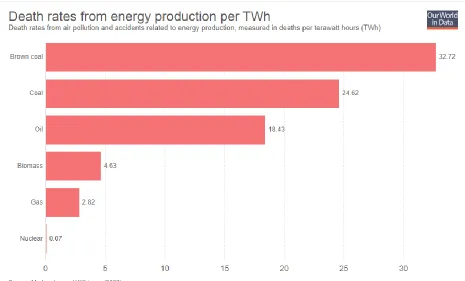
energy source at the moment. The graph below shows the death rates of energy production per
a terawatt hour for numerous energy sources. This includes pollution and deaths resulting from
accidents during the production process. Coal has a death rate of 24.62/TWh while the rate for
nuclear energy is just 0.07/TWh (Energy Production & Changing Energy Sources). So nuclear
energy is not only a safer form of energy, it is much safer according to this data. According to
wind and solar. Solar has a rate of 440 deaths/kWhr while the rate for wind energy is 150 and
for nuclear it is 0.1 deaths/KWhr (Conca). In this comparison, nuclear energy is safer than even
wind or solar and by a large margin. The fear over nuclear energy does not seem to match up
with real world data or science.
Figure 1.13
The greatest opportunity that nuclear energy provides is the possibility of nuclear
fusion. All commercial nuclear plants that exist today use nuclear fission, which as mentioned
prior, take heavier elements like uranium and split the atoms to release energy. Fusion energy
is the opposite, where two lighter atoms are brought together and produce energy as a
byproduct (Epstein 196). This is the process that the sun uses in its core to produce energy. The
resources combined could many times over. By looking at the table that shows the amount of
each resource, fusion energy has 100 million times more than all fossil fuels resources
combined and half a million times great than the fission resources. The per capita value of
nuclear fusion resources is in the billions of dollars. Even in the scenario where energy usage
increases by a factor of 10, there would be enough energy for close to a billion years (Zubrin
149). Another major advantage is that in addition to producing no greenhouse gases, fusion
energy would produce very little radioactive waste compared to fission. A successful fusion
reactor would only produce about 0.1 percent of the waste that a fission reactor produces. If
the reactor is made from carbon-carbon graphite it would produce no waste at all (Zubrin 149).
Nuclear fusion is difficult to do commercially because it requires very hot temperatures
and a high degree of pressure to work properly. The research for fusion energy has been mostly
experimental and conducted by scientists, often with the support of government funding. At
very high temperatures, the kind required for fusion, matter exists as plasma. This simply
means the atoms of the elements being used to produce the energy are so hot that they exist
as plasma instead of the three typical states of matter; solid, liquid, and gas (Zubrin 150). Since
plasma moves extremely fast at high temperatures it can escape and leak out, meaning it can
lose energy. The problem with fusion development is containing the plasma and preventing it
from cooling too much and losing energy. There are three factors that determine fusion
performance; temperature, plasma density, and the particle confinement time. Together these
three factors are simplified into the Lawson parameter (Zubrin 151). A more simply way to put
it is that the reaction needs to create more energy than is required to heat the plasma. This is
net energy. The final threshold would be the ignition point, which is where the heat from the
fusion reactions is so great that it heats itself and eternal heating is no longer required.
Reaching this point would make nuclear fusion commercially viable and the immense potential
of fusion energy could finally be used (Zubrin 152). Over the last 35 years fusion technology has
made dramatic improvements and the Lawson factor has been increased significantly over this
time span. It only needs to go up little bit farther in order to finally reach the ignition point,
where no external heating would be needed to keep the reaction going. This just may be
possible in the years to come if people have the desire to do so (Zubrin 153).
Fusion not only provides more energy than anyone could imagine, but it offers new
potential uses of energy due to its nature. As Robert Zubrin mentions in Merchants of Despair,
“we will be able to use the superhot plasma that fusion reactors create as a torch to flash any
kind of rock, scrap, or waste into its constituent elements, which could then be separated and
turned into useful materials” (Zubrin 149). This would open up the possibility of taking
advantage of resources that do not even exist right now or are currently not usable. Lastly,
fusion technology could improve the prospect of space travel by opening up the possibility of
propulsion methods that are much greater than current methods. Thus, long distance space