IJEDR1702185 International Journal of Engineering Development and Research (www.ijedr.org) 1107
Video Event Classification Based on Image Search
Engine
1
Monika B. Khakhariya,
2Prof. Tosal M. Bhalodia,
1Student, 2Assistant Professor,
1MECE, At miya Institute of Technology and Science (AITS), Ra jkot, Gu jarat
________________________________________________________________________________________________________ Abstract—The bulk of video in the web is huge and analytic s pecific allotment of a video can be accomplished applic ation a agreeable or argument based vi de o inde xing, gr oupi ng, anal ytic and re trie val appr oac hes. To apprehe nd agreeable based vi de o searching, in this plan we adduce are na base d vi de o c omment for the i de ntification and labeling of contest and altar in a vi de o wi th a anec dotic te xt.Vi de o c omment re quires a ability abject to ascertai n semantic acce ptati on of contest and al tar in the vi de o. Manual and se mi super vise d vi de o comme nt appr oaches abort as both cr ave ability for the actual i dentificati on and labeling of vi deo conce pts. Comme nt re quires a abundant acc or d of abstr acti on annex and relate dness processing to accor d anec dotic acc ount to a are na in the vi de o.
IndexTerms— Video annotation, J oint Group Weighting Learning (J GWL),Near-duplicate segment
________________________________________________________________________________________________________
I. IN TRO DUC TION
Due to the atomic advance of user-generated videos aggregate on the Internet and the abeyant demands in assorted multimedia applications, such as the Web video indexing, customer agreeable management, and open -source intellige nce analysis,thetaskofmu ltimediaeventrecognitionhasreceived accretion absorption in contempt years. The multimedia acc ident acceptance involves the automated acceptance of circuitous contest from a a mple set of airy videos. This assignment is acutely arduous due to four factors: (a) mult imedia contest are higher-level circuitous descriptions of multimedia data, which cover several semantic concepts of objects, scenes and animal actions; (b) contest generally accept significant intra -class variations and inter-class similarit ies on both the visual appearance and semantic concepts; for exa mple, both the events of „birthday party ‟and „we dinning ceremony‟ may contain objectssuchascandlesandcakesasshowninFig.1,butthese altar ability not arise in all the videos that accord to the sameeventcategory;(c)videosareoftentakenbyconsumersin airy environ ments with altered recording devices; asaresulttheyusuallycontainsignificantvisualvariationsand noise[1];and(d)therearedtypicallyonlyfewpositiveexamp les for complicated events. Many efforts are fabricated on evaluating the efficacy of low-level appearance [2], [3]. Ho wever, as contest are generally characterized by affinity in semantics rather than visualappearance,recentapproachesstarttousehigh – levelsemantic concepts to abetment inthe recognition of events .
One of the popular video retrieval approaches adopted by large multimedia search engines such as YouTube is using video descriptions embedded in the meta tags and titles of each video document. In 2014, considering YouTube video, 300 hours of videos are uploaded every minute and everyday hundreds of millions of hours YouTube video are watched [1]. To facilit ate searching processes, YouTube provides manual annotation service which is tiresome, costly and time consuming. A lot has been done on video annotation but most of the works did not go beyond annotating objects and events in a shot. Video annotation is different fro m image annotation as users want not only object description but also events, object motions have to be annotated and presented at scene level rather than key frame level. In video, an object may have several role in a scene unlike a key fra me . The ma in challenge in video annotation is providing descriptive object and event annotations within a scene while keeping scene l evel fra me dependencies and spatiotemporal correlations between objects.
II.RELA TED WO RK
In this A generic video annotation framework in [9] considers every shot on an individual basis whereas expansion a video. This fra me work contains 2 layers of similarity analysis; the primary layer co mputes simila rity between videos in a very datas et and also the question video, whereas the second is employed to differentiate and merge similar annotation texts fro m similar videos. Video signature, a compact illustration of spatio -temporal options, is generated so as to perform video simila rity and later to search out free-te xt annotations from simila r v ideos. These video signature is generated explo itation SIFT options [10] e xtracted at some flight points in a very video. A video matching is finished by activity a simila rity co mparison between eve ry and each flight purpose of the question video and a video in a very dataset norma lized with the minimu m range of trajectories found in either of the 2 videos.
IJEDR1702185 International Journal of Engineering Development and Research (www.ijedr.org) 1108 of reports video to mechanically annotate similar v ideos. a picture feature combined with te xt, and SVM conception options ar ea unit accustomed hunt for connected videos. This work is predicated on one shot video as a result of with one text questi on it should not be doable to e xpla in an outsized video. Once connected set of videos area unit generated transcripts of those vide os area unit deep-mined as AN input for the annotation method.
A term frequency vector is made for every v ideo transcript to pick those with ma xima l range of inc idence to be used for annotation. the matter here is however similar those searched videos would be. The results of annotation is extre me ly enthusiastic about the similarity between videos and, it's unlikely to induce fu ll length annotated videos terribly the same as the input video. compared with transcripts, subtitles area unit a lot of out there in documentaries and films. A fra mework for c luster primarily {based} image retrieval and video annotation is projected in [14] that uses region based wave remodel simila rity methodology to match question video with preannotated videos. A video frame is split into 4X4 region and a feature vector is taken into acco unt victimization the center of mass purpose of the wave reworked in formation at the region. Once the feature vector is built, similarity is calcu lated victimization earth move ment distance live between identica l bloc ks of fra mes of every video.
The basic downside of this analysis work is, it takes the full annotation t ext of comparab le video into the POS tagger and directly uses those known set of objects and events within the sentence merging module. during this case, not all known eve nt s and objects might presumably be within the question video and also the temporal a rrange ment of these events and objects isn't glorious. although a video is split into fra mes and annotation is predicated on key frames of comparable v ideos, the approach disregards context; i.e. an occurrence found in one video fra me, might not continuous ly have an analogous context in another video fra me. As a result, unrelated set of events is also generated from such annotation works. metaphysics and rule learning prima rily based video annotation and retrieval is projected in [15]. The metaphysics conta ins ideas, idea instances and their linguistic relat ionship from WordNet and rule learning is finished from the metaphysics. Once a rule is learned, it's applied to the metaphysics that contains instances, obtained victimizat ion linguistics classifiers, to mechanically e xtend the video annotation. for instance, if metaphysics contains „„airp lane‟‟, „„sky‟‟ and „„ground‟‟ instances, the observer detectors “airplane take -off ” is that the associated. These detectors are created victimization the Viola and Jon es algorithmic rule (provided by OpenCV) and color-based pel classification with a support vector machine, to observe and localize objects. Then, the spatiotemporal evolution o f the looks of ideas is decided.
III.PRO POSED WO RK
Fig 1. Flow of the proposed approach
Step 1: Input vi de o
Take a c ric ket video for the pre-processing as input. Step 2: Conver t vi deo into frames
The input video is converted into the number of fra mes. Step 3: Ke y Fr ame Gener ation
IJEDR1702185 International Journal of Engineering Development and Research (www.ijedr.org) 1109 Algorithm: Ke y Fr ame Gener ati on
Read all the fra mes. For each shot fra me do
Take 1st, last and Middle fra me of each shot Store to another folder.
Step 4: Scene Recogniti on
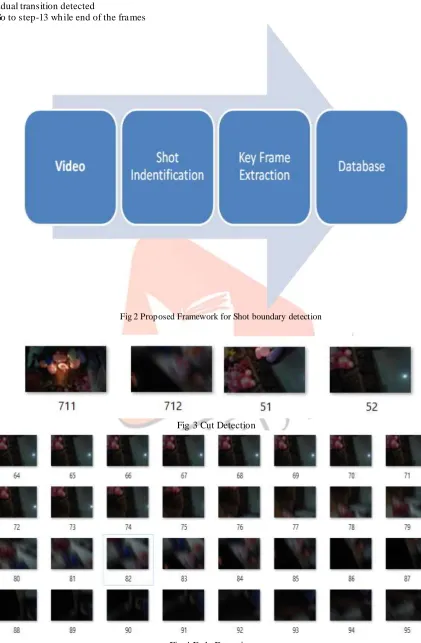
We square measure finding shot boundary detection for various transitions. initia l input are going to be video of any motion -picture show then it'll transfer to shot Boundary detection then in this cut fade and dissolve detection are going to be done that helps to spot the shots in motion-p icture show. In every shot we tend to extract three fra mes for key fra me e xtraction.
In each shot first frame last frame and middle fra me are going to be take into account as key frames. Those all key fra mes square measure info fo r retrieval section. thus for higher retrieval it's required that there ought to be sensible shot bound ary detection. Identification of actual cut fade and dissolve can offer higher retrieval.
In this module we tend to square measure finding scene detection for various transitions like abrupt transitions and gradual transition. Abrupt transition simple |isstraightforward|is simple} to find however gradual transitions aren't easy to spot as a result of these isn't eye catching sequence. solelycolor histograms may be used for cut detection. Edge a mend ment magnitude relatio n is emp loyed for distinguishing cut, fade and dissolve. variance is e mployed for distinguishing fade and dissolves.
For cut detection we tend to square measure combin ing distinct circular function Transformation, Edge amendment magnitude relation and HSV (Hue Saturation Value) bar graph. CT (discrete c ircula r function Transformation) represents fr ame as total of sinusoids and frequencies. It works on N X N blocks. These all options aren't decent one by one for any detection. Thus we tend to square measure co mbining these all options for higher t ransition detection.
Thus we are going to mix these all n create one new para meter fo r detection. Corre lation is emp loyed for matching method that done consecutive fra me by fra me.
Colour changes won't occur quickly among an effort. It‟ll solely occur between consecutive shots. Thus solely colour feature may be used for cut detection. If colour histograms between 2 consecutive fra mes square measure larger than threshold then there'll be shot amendment occur.
There‟s risk that there'll be no same edge between first and second frame. The quantity of input and output edges may be counted [3]. If each the frames belong to an equivalent shot then the quantity of input and output edges is additional or les s same . Thus if distinction is e xt re mely giant then shot amend ment may be happens. If there square measure n pi xe ls within the fra me a nd therefore the in edges square measure Xin and therefore the out edges square measure Xout for frames f and f − one severally.
𝐸𝐶𝑅 = max(𝑋𝑖𝑛 𝑛 ,
𝑋𝑜𝑢𝑡
𝑛 )
Fade and Dissolve transitions square measure combination of repetitive amendment in constituent intensities. Mistreatment window one will observe frames for his or her intensity amendment. If adequate numbers of pixe ls show repetitive amend ment in their intensity inside the window, we will assign current fra me to be enclose dissolve transition [12].
A bar graph could be a operate that calculates the quantity of observations that be every of the dislodge classes called bins . we discover bar graph for indiv idual H, S & V e le ments of image we've got return to the important HSV b ar graph that is nothing however the mix of a ll 3 individual Histograms.
If we have a tendency to let n be the overall variety of annotations and k be the overall variety of bins. This equation for individual H, S & V ele ments of image and that we return t o the resultant HSV bar graph that is nothing however the permutation of all 3 individual Histograms.
𝑛 = 𝑚𝑖
𝐾
𝑖 =1
We are using single feature that can be used for every transition. That feature comb ines different methods for cut fade and other gradual transition.
Algorithm for Scene Recogniti on Step-1: Fra me Conversion
Step-2: Co mputer HSV histogram
Step-3: Find Discrete Cosine transformation Step-4: Co mpute edge detection
Step-5: Find entropy
Step-6: Calcu late standard deviation Step-7: Go to step-2 while end of the fra mes Step-8: Corre lation of para meters
Steo-9: Find unique para meter with co mbination of th is all features. New para meter= 1 / (hsvhistocorr+graycorr+h istocorr+edgecorr) Step-10: Find Mean and Standard deviation of new para meter
Step-11: Ca lculate Th resholding
Tb = Mean + a * standard deviation where a is constant Step-12: Start fro m 1st fra me
Step-13: If new para meter of fra me > Tb St rong cut detected
IJEDR1702185 International Journal of Engineering Development and Research (www.ijedr.org) 1110 Step-13 If entropy of fra me is ze ro
Fade detected
Step-14 If accu mulated difference of fra me > Tb Gradual transition detected
Step-15 Go to step-13 wh ile end of the fra mes
Fig 2 Proposed Framework for Shot boundary detection
Fig 3 Cut Detection
IJEDR1702185 International Journal of Engineering Development and Research (www.ijedr.org) 1111 Fig 5 Dissolve Detection
Step 5: Matching Pr ocess
After feature e xtraction matching method may be a key component. mistreatment Visual feature like color te xture form we'll match key fra mes of our input video with image informat ion set. however there's a problem that if there's face then it' ll match with person class however it'll not discover similar face thus for that we'll use face recognition fo r highe r matching method, Another issue is that generally nearly ninety fifth image is same however object is complete ly different than there'll be fa l se result for that we have a tendency to area unit mistreatment object detection and matching.
Target detection refers to the employ ment of high spectral resolution remotely perceived pictures to map the locations of a target or feature (often a plant species of interest) with a specific spectral or abstraction signature. Target detection or feature e xtraction encompasses a broad vary of techniques, together with measure ments derived from individual bands and a lot of complicated ways designed to acknowledge distinct options by form, hyper spectral signature, or texture. Targets of interest area unit usually smaller than the element size of the image (sub element target detection) or area unit mixed with different non -target cowl varieties among a ele ment, requiring techniques like spectral mixture analysis to discover the target species. Hyper spectral pictures area unit helpful in target detection as a result of they contain an oversized contiguous set of spectral bands, usually enumeration within the tons of to thousands, and supply giant quantities of high spectral resolution information. e mp loyin g a hyper spectral image, the spectral properties of the target, like distinction, variability, similarity and discriminability, are often accustomed discover targets at the sub element level. The user specifies spectral finish me mbers, that area unit the reflectivity spectra of the “pure” targets that occur across the landscape, and image process computer code is emp loyed to characterize the e xtent of the target across the landscape. the choice of spectral finish me mbers is comparable to the thought of distinguishi ng coaching areas in supervised classification, however the spectral fin ish me mber will then be used at a sub element level to discover the species of interest. Spectral fin ish me mbe rs area unit usually generated within the field e mp loying a field spectroradiometer. Then the image is processed mistreatment classification algorith ms to discover the locations of the target species.
We have taken each genre's 100-200 images for database for matching We are also using IMDB Images as database.
Among them if object matched then its genre's will be annoted Matching will be based on shape color te xture by sub pixe ls matching Algorithm for Matching Pr ocess
Load Image Database For each key fra me
For each data base frames
RGB to Grey Key fra me and Image Database fra me Edge detection of both the frames let a and b Filter for a & b
One to one pixe l (Sub pixe l matching) using correlat ion if it equals to 1
Then image has matched object
For each object matched image matched image name on database will be written in te xt file. Similar Ob jects name will be discarded
Step 6: Face de tection If Face Detected?
Go to step 7 Else
IJEDR1702185 International Journal of Engineering Development and Research (www.ijedr.org) 1112 Step 7: Face Matching
If any face matched with stored known database? Add label in te xt file
Else
Go to step 8
Step 7: Inde xing and labelling
Most relevant labels will be given in this step. Labels which a re inde xed 1 -10 will be co mes many times in every fra mes during matching process according to that we will g ive appropriate na ming to it.
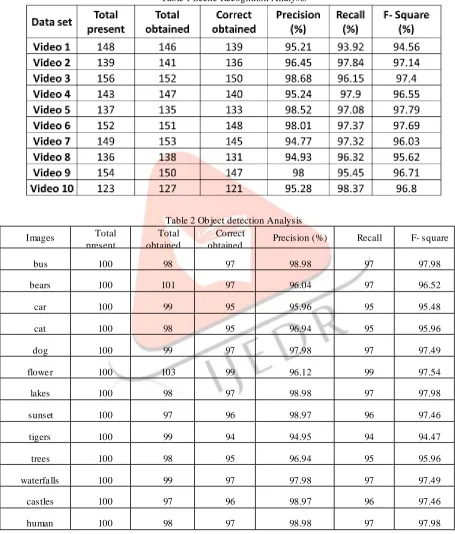
Table 1 Scene Recognition Analysis
Table 2 Ob ject detection Analysis
Images Total
present
Total obtained
Correct
obtained Precision (%) Recall F- square
bus 100 98 97 98.98 97 97.98
bears 100 101 97 96.04 97 96.52
car 100 99 95 95.96 95 95.48
cat 100 98 95 96.94 95 95.96
dog 100 99 97 97.98 97 97.49
flowe r 100 103 99 96.12 99 97.54
lakes 100 98 97 98.98 97 97.98
sunset 100 97 96 98.97 96 97.46
tigers 100 99 94 94.95 94 94.47
trees 100 98 95 96.94 95 95.96
waterfa lls 100 99 97 97.98 97 97.49
castles 100 97 96 98.97 96 97.46
human 100 98 97 98.98 97 97.98
IV.CO NCLUSION
IJEDR1702185 International Journal of Engineering Development and Research (www.ijedr.org) 1113 annotation. Video has several content in it like visual options, foreground options, background options, objects audio featur e and lots of a lot of, fro m that videos extracting helpful content for matching with the labelled pictures has difficu lt job. Thus for that we've studied numerous papers and from that we are able to propose a sturdy formula for any kind of videos like movies, cartoons, news, sports, parties etc.
We have imp le mented scene recognition which works very well in our approach then imp le mented key fra me e xtraction for reduction of time. After that we have try to develop system which is used to detect object from various key frames. Our o bject detection is works very well in less informative image but it works not that much good for real time images of videos so we will try to improve matching of object in various key frames. Another approach is our matching process detects that it is a face so fa ce detection has been done but it is of whom? We also have to detect that so we have imple mented face recognition algorithm for better results. It gives good result for indoor videos but if person is far fro m ca mera or he/she is not showing their e xact face to camera then it will be difficult to recognize. In this area there is more to wor k.
REFER ENC ES
[1] Wang, Han, and Xin xiao Wu. "Finding Event Videos via Image Search Engine." 2015 IEEE International Conference on Data Mining Work shop (ICDMW). IEEE, 2015.
[2] Wang, Han, Xin xiao Wu, and YundeJia. " Video annotation via image groups from the web." IEEE Transactions on Multimedia 16.5 (2014): 1282-1291.
[3] Duan, Dingbo, and Jian Ma. "Automatic video annotation by motion recognition." Progress in Informatics and Computing (PIC), 2014 International Conference on. IEEE, 2014.
[4] Rouvier, M ickae l, et al. "Audio-based video genre identification." IEEE/ACM Transactions on Audio, Speech, and Language Processing 23.6 (2015): 1031-1041.
[5] Chou, Chien-Li, et al. "A novel video annotation frame work using near-duplicate segment detection." Multimedia & Expo Work shops (ICMEW), 2015 IEEE International Conference on. IEEE, 2015.
[6] Sun, Shih-Wei, et al. "Automatic annotation of web videos." 2011 IEEE International Conference on Multimedia and Expo. IEEE, 2011.