R E S E A R C H A R T I C L E
Open Access
Design and validation of a German version
of the GSRS-IBS - an analysis of its
psychometric quality and factorial structure
Sarah K. Schäfer
1†, Kathrin Julia Weidner
2†, Jorge Hoppner
3, Nicolas Becker
1, Dana Friedrich
4, Caroline S. Stokes
4,
Frank Lammert
4and Volker Köllner
5,6*Abstract
Background:Currently, a suitable questionnaire in German language is not available to monitor the progression and evaluate the severity of irritable bowel syndrome (IBS). Therefore, this study aimed to translate the Gastrointestinal Symptom Rating Scale for Irritable Bowel Syndrome (GSRS-IBS) into German and to evaluate its psychometric qualities and factorial structure.
Methods:This study is based on a total sample of 372 participants [62.6% female, mean age = 41 years (SD = 17 years) ]. 17.5% of the participants had a diagnosis of IBS, 19.9% were receiving treatment for chronic inflammatory bowel disease, 12.1% of the participants were recruited from a psychosomatic clinic, and 50.5% belonged to a control group. All participants completed the German version of GSRS-IBS (called Reizdarm-Fragebogen, RDF), as well as the Gießen Subjective Complaints List (GBB-24) and the Hospital Anxiety and Depression Scale - German version (HADS-D). Results:The internal consistency of the RDF total scale was at least satisfactory in all subsamples (Cronbach’s Alpha between .77 and .92), and for all subscales (Cronbach’s Alpha between .79 and .91). The item difficulties (between .25 and .73) and the item-total correlations (between .48 and .83) were equally satisfactory. Principal axis analysis revealed a four-factorial structure of the RDF items, which mainly resembled the structure of the English original. Convergent validity was established based on substantial and significant correlations with the stomach-complaint scale of the GBB-24 (r= .71;p< .01) and the anxiety (r= .42;p< .01) and depression scales (r= .43;p< .01) of the HADS-D.
Conclusion:The German version of the GSRS-IBS RDF proves to be an effective, reliable, and valid questionnaire for the assessment of symptom severity in IBS, which can be used in clinical practice as well as in clinical studies. Keywords:Irritable bowel syndrome, Questionnaire, Questionnaire design, Self-report, Colonic diseases
Background
Irritable bowel syndrome (IBS) is diagnosed on the basis of recurrent abdominal pain related to defecation or changes in stool frequency or form [1, 2]. The current prevalence of IBS ranges from 2.5 to 25%, depending on the diagnostic criteria used [3, 4]. For instance, the Man-ning criteria are associated with considerably higher
prevalence rates when compared to the Rome I-III cri-teria. The prevalence of IBS is higher in women than in men. However, these gender differences decrease with in-creasing age [5, 6].
Patients with IBS experience a great degree of stress as a result of the condition. Several investigations with het-erogeneous patient samples have illustrated that quality of life is perceived as being significantly impaired [7–10]. Further, adolescents suffering from IBS report a lower quality of life [11]. Moreover, IBS patients show consid-erably reduced health-related quality of life on all scales of the Short Form Health Survey (SF-36) [12] compared to other patient groups such as those with heart insuffi-ciency [13]. A recent cross-sectional study from Norway
* Correspondence:[email protected]
†Equal contributors
5Department of Psychosomatic Medicine, Rehabilitation Clinic Seehof, Lichterfelder Allee 55, 14513 Teltow, Germany
6Psychosomatic Rehabilitation Research Group, Department of Psychosomatic Medicine, Center for Internal Medicine and Dermatology Charité–Universitätsmedizin Berlin, Berlin, Germany
Full list of author information is available at the end of the article
has shown that IBS is associated with poor outcomes, particularly in the presence of health complaints, organic diseases, and affective disorders [14].
Three validated scales are available to assess IBS sever-ity, of which the IBS severity scoring system (IBS-SSS) is most frequently used [15]. However, the IBS-SSS is an ex-ternal assessment tool which has to be administered by the treating physician.
Häuser [16] has produced a German translation of the Rome III criteria for IBS that allows for a categorical decision about the presence of IBS. However, none of these tools in-clude a patient self-assessment which would provide valuable additional information to the external assessment, particu-larly with regard to the disruptions in quality of life fre-quently occuring [9, 17]. The validated Gastrointestinal Symptom Rating Scale for Irritable Bowel Syndrome (GSRS-IBS) by Wiklund et al. [18] firstly represents such a diagnos-tic tool, which is currently only available in the English language.
The instrument was first introduced in 2003 with the aim to establish a self-assessment tool specifically adapted to IBS patients [18]. The GSRS-IBS is based on the Gastrointestinal Symptom Rating Scale (GSRS-IBS, [19]) developed for IBS patients and the Health-Related Quality of Life Questionnaire (HRQL, [20]) which is dis-ease independent.
Currently, there is no appropriate questionnaire available in the German language (spoken by approximately 100 million people) to assess self-perceived symptom severity in IBS. However, such an assessment tool would be useful in the context of clinical practice as it would aid formation of a diagnosis and the monitoring of the course of IBS and additionally, for clinical studies.
Objectives
Therefore, the aim of this study was to develop a German version of the GSRS-IBS (in the following called Reizdarm-Fragebogen, RDF) and to carry out a cross-cultural validation. For this purpose, the original question-naire was translated into German and, in accordance with Wiklund et al. [18], was subsequently validated in a sam-ple of IBS patients. Moreover, control groups were in-cluded to evaluate the specificity of the questionnaire.
Methods
The purpose of the following section is to provide a brief overview of the translation and design process of the German version of GSRS-IBS and to describe its validation in a sample of different subgroups.
Design of the German instrument GSRS-IBS
The English version GSRS-IBS includes 13 items, which are rated on a seven-point scale ranging from "1 = no
discomfort at all" to "7 = very severe discomfort". All items exclusively capture IBS constructs. The question-naire was neither designed to produce ceiling effects nor to assess redundant information. A factor-analytical examination of all items in a validation cohort provided the following five factors: pain, diarrhoea, satiety, consti-pation, and bloating. Based on these findings identically named subscales containing two to four items were de-fined and demonstrated satisfactory internal consisten-cies reflected in Cronbach’s Alpha (α) ranging from .74 to .85.
Translation
In order to ensure a high quality translation process, a series of standards exists specifically for the cross-cultural translation of psychological and medical questionnaires [21]. The translation of the GSRS-IBS into German (RDF) was conducted in accordance with these recommended procedures. A preliminary version of the questionnaire was subsequently tested in a clinical sample. Contrary to the recommended standard specifications, no committee of experts was consulted concerning the quality of the questionnaire. Nonetheless, experienced gastroenterolo-gists (including FL) confirmed its validity.
With regard to the specific process, two translators pos-sessing the necessary knowledge of English and medical expertise independently translated the original question-naire into their native German language. Both translations were then compared and the language was fine-tuned, which resulted in the translators agreeing on one version of the questionnaire. In order to assure the quality of the translation, the new version was retranslated back to English by two native English speakers who were not fa-miliar with the original text. Except for some different choice of wording, the original English text did not differ from the retranslated version of the questionnaire, thus confirming the accuracy of the initial translation of the GSRS-IBS into German. Subsequently, the newly gener-ated version of the questionnaire was given to a group of patients in a psychosomatic rehabilitation clinic in Blies-kastel (MediClin Biestal-Kliniken), who were asked to check the comprehensibility of the items. None of these patients reported problems with comprehension. There-fore the German version was considered ready for imple-mentation in the following validation study.
Study process Sample recruitment
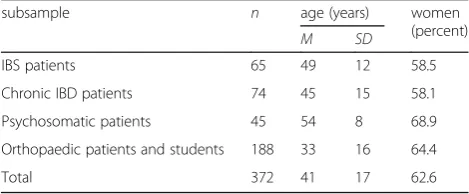
in Neunkirchen, Germany. For quality control purposes, the Rome III-criteria was used to validate the IBS diagnosis in these patients, and only those with an appropriate diag-nosis were included. A random selection of IBS patients was not possible due to difficulties in ensuring a sufficient sample size during recruitment. 45 patients with a psycho-somatic disorder were recruited from the MediClin Bliestal clinic in Blieskastel, Germany. Further, 74 patients with chronic inflammatory bowel disease (IBD) who were treated at Saarland University Medical Centre, Homburg, Germany, took part. A control group of students and orthopaedic patients with no gastroenterological conditions was also included in the study. The students voluntarily completed the questionnaires during an introductory course of the elective course‘Medical case history’at Saar-land University, and the orthopaedic patients were ques-tioned in a radiology practice in Neustadt/Weinstraße, Germany, whilst awaiting an MRI scan. The mean age of the included subjects wasM= 41 years (SD= 17 years) (for sample characteristics see Table 1). The mean age would be considerably higher, if the students were excluded from the sample.
Study procedure and instruments
Study procedure In addition to the RDF, a German version of the Hospital Anxiety and Depression Scale (HADS-D) [22] as well as a short version of the Gießen Subjective Complaints List (GBB-24) [23] were used to verify conver-gent validity.
GBB-24 The GBB-24 assesses the psychosomatic causes of physical complaints [23]. The 24-item short version was given to subjects instead of the longer 57-item long version [24]. GBB-24 assesses organ-specific, objective and subjective symptoms. The following physical plaints were documented: cardiac and gastric com-plaints, pain in the limbs, and fatigue. The total score represents the overall subjective complaints [25]. The split-half-reliabilities were situated in a satisfactory range between r= .75 (gastric discomfort) and r= .94 (general complaints, total score).
HADS-D The HADS-D questionnaire contains 14 items and assesses symptoms of anxiety and depression (7 items per scale) based on somatic and physical complaints [22]. The HADS-D can therefore be applied as a screening tool as well as to assess the severity of anxiety and depressive symptoms. Both, the anxiety and the depression scale showed a good internal consistency ofα= .80.
Statistical analyses
Initially, according to Wiklund et al. [18] a total score of the RDF as well as the individual sub-scores for the five proposed subscales in the English version were calculated for each subject by summing the total of the 13 items. Moreover, sum scores were calculated for the identified subscales in the German version following the outcome of a subsequent factor analysis. Regarding both, the GBB-24 and the HADS-D, scoring was carried out according to the respective manual instructions. A total score as well as scores for the proposed subscales were calculated for the GBB-24. Additionally, a total score for anxiety and depres-sion symptoms was calculated for the HADS-D. In case of missing data for a maximum of two of the 13 RDF items, the missing values were replaced by the subject's mean score. If three or more answers were missing, the subject was excluded from all analyses. The same principle was applied to the HADS-D and the GBB-24. However, in case of the latter a subject was excluded from analyses if five items or more were missing.
A new variable was created to compare presence versus absence of IBS. Thereafter, a binary logistic regression was calculated in order to verify if the IBS patients could be distinguished from the other groups based on their RDF results.
Internal consistencies (Cronbach’s Alpha, α, [26]) were calculated for the entire questionnaire and for the sub-scales identified in the German version of the question-naire, to determine the reliability of the RDF. Furthermore, the item difficulties and the item-total corre-lations were evaluated in order to assess item quality. To identify the factorial structure of the questionnaire, in comparison to the English validation, a slightly different procedure was employed: An exploratory principal axis analysis was performed with an oblique (Direct oblimin, Delta = 0) rotation. This analysis was chosen since ex-ploratory factor analyses only consider item variance which is shared by at least two items. This was deemed to be more appropriate regarding measurement error [27]. Additionally, an oblique rotation appears to be more rea-sonable concerning the nature of IBS symptoms with re-spect to the chosen orthogonal rotation from Wiklund et al. [18]. To assume that those who suffer from severe con-stipation perceive the same amount of pain as those who do not suffer from constipation is implausible, which is Table 1Age and gender distribution of the entire sample
subsample n age (years) women
(percent)
M SD
IBS patients 65 49 12 58.5
Chronic IBD patients 74 45 15 58.1 Psychosomatic patients 45 54 8 68.9 Orthopaedic patients and students 188 33 16 64.4
Total 372 41 17 62.6
why it seems appropriate to permit intercorrelations be-tween factors.
The factor analyses were performed for the entire sam-ple as well as separately for the subgroups (IBS, IBD, psy-chosomatic patients and control groups). Consequently, there is a factorial structure analysis for the entire sample (n= 372) from which 83% did not have a diagnosis of IBS. This can subsequently be compared to the factorial struc-ture analysis in 65 patients with IBS. Moreover, this ana-lysis in the IBS subsample can be compared with the IBS sample that was recruited for the validation of the original English version of the questionnaire. However, this com-parison is limited due to the different types of factor ana-lysis. Correlations with the GBB-24, its subscales and the HADS-scores were calculated to illustrate the question-naire's convergent construct validity.
Results
Descriptive statistics
A comparison of the mean RDF scores between the differ-ent subgroups (see Table 2) revealed significant differences: The group of IBS patients had a significantly higher total score [t(111) =−12.27,p< .01], corresponding to more se-vere symptoms related to IBS (see Fig. 1). Likewise, the stu-dent [t(367) = 9.85,p< .01] and orthopaedic control groups [t(367) = 2.65,p= .004] differed significantly from the mean scores of all clinical samples. These considerable differences could be demonstrated for all subscales of the question-naire, irrespective of whether they were based on the Ger-man or English factor structure. Binary logistic regression analysis was used to differentiate IBS patients from the rest of the cohort (non-IBS patients) using the RDF items. Overall, 90.3% of IBS cases were correctly classified [χ2(13) = 140.95,p< .01].
Assessment of item quality Item quality
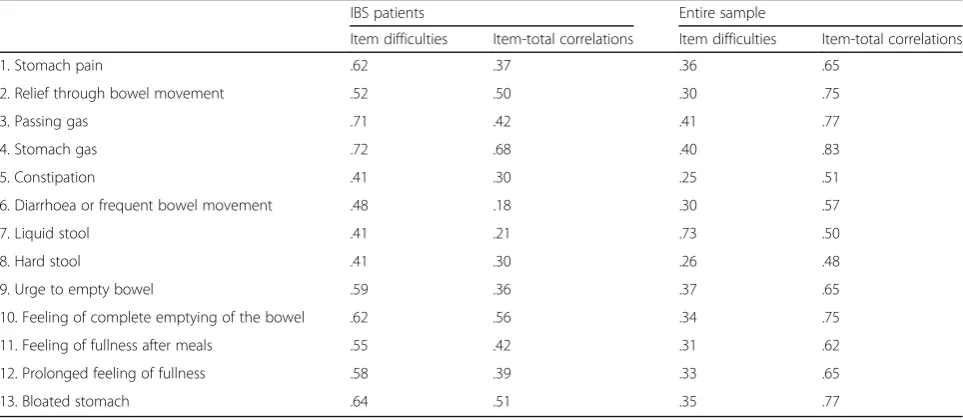
The item difficulties of the RDF ranged between p= .25 andp= .73 in the entire sample (see Table 3). As expected they were slightly lower (p= .41 top= .72) in the IBS sam-ple and had a lower range. The majority of the items were medium in difficulty with a few being very difficult or very easy. Such a distribution appears to be reasonable for dif-ferentiating IBS patients. The mean item-scale correlation
for the entire sample was r= .65. This corrected item-scale correlation is satisfactory. However, it was consider-ably lower for the IBS patients (mean r= .40). That is, however, to be evaluated in context to the later described diverging factorial structure.
Equally satisfactory are the results of the reliability ana-lyses, with a Cronbach’s Alpha in the entire sample of α = .92 for the RDF total scale (α= .77 in the IBS sample), and Cronbach’s Alpha for the subscales of the German version within an acceptable range fromα= .84 toα= .93 (α= .72 toα= .92 in the IBS sample) [28].
Factor analyses
The suitability of conducting a factorial analysis on the data derived from the entire sample was reflected in a KMO value (Kaiser-Meyer-Olkin measure of sample adequacy) of KMO = .88 and a significant Barlett test [χ2(78) = 3457.68,
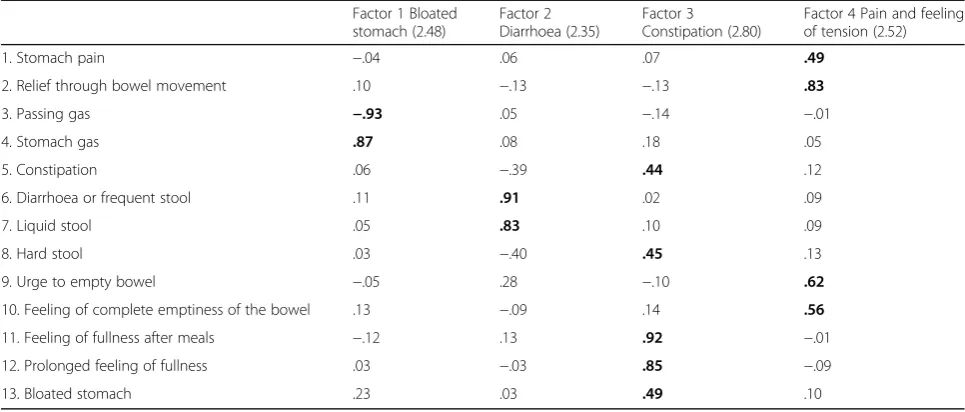
p< .01]. The principal axis analysis with oblique rotation (Oblimin direct, Delta = 0) provided a two-factorial result for the overall sample according to Kaiser-Guttmann (Table 4). The first factor indicated an eigenvalue of 6.69 while the second factor lagged noticeably behind with an eigenvalue of 1.77. The KMO value of .68 for the IBS pa-tients was not as strong, but nevertheless still appropriate for conducting a factor-analytical evaluation. The lower value might only reflect a significantly reduced sample size. The Barlett test of sphericity was also significant [χ2(78) = 463.37,p< .01]. The principal axis analysis with an identical rotation provided a four-factorial structure for the IBS sam-ple according to Kaiser-Guttman. The first factor is charac-terized principally by bloating-related sensations and the passing of gas, whereas the second factor mainly summa-rises symptoms of diarrhoea. The third factor is associated with constipation while the fourth factor is related to the urge to empty the bowel and the ensuing relief that the pa-tients feel. In total, 64.5% of the item variance could be ex-plained by these four extracted factors.
Intercorrelation of subscales
To determine the correlations between the various ques-tionnaires, for RDF a total score with item 3 recoded was calculated. This process takes the negative sign of the factor scores into account. Subsequently, bivariate correlation analyses were conducted between the subscale scores and
Table 2Mean values and standard deviations (in brackets) of the RDF scales for the various samples
Subgroups Total (13 Items) Pain (2) Diarrhoea (4) Constipation (2) Satiety (2) Bloating (3) IBS 50.85 (12.86) 8.03 (2.92) 14.74 (5.93) 5.74 (3.83) 7.89 (3.80) 14.45 (4.60) Chronic IBD 31.90 (13.57) 4.59 (2.85) 11.62 (6.01) 3.30 (2.20) 4.41 (2.76) 7.98 (4.55) Psycho-somatic 29.85 (15.90) 3.86 (2.35) 8.54 (5.17) 4.36 (3.24) 4.38 (3.13) 8.72 (5.68) Control group 21.84 (10.59) 3.61 (2.43) 6.10 (3.26) 2.85 (1.86) 3.44 (2.06) 5.84 (3.90) Total 29.88 (16.18) 4.61 (3.05) 9.00 (5.75) 3.63 (2.77) 4.52 (3.14) 8.12 (5.37)
the total score of the RDF, both for the entire sample and separately for patients with IBS (Table 5). This analysis re-vealed that the first subscale,‘bloating’(items 3 and 4), is the most independent. However, in IBS patients, a substantial association with constipation-related com-plaints was observed. Concerning the subscale 'diar-rhoea' (items 6 and 7), significant correlations were shown for 'constipation' however not for IBS patients), 'pain and feelings of tension'. Significant correlations were identified between the subscale constipation
(items 5, 8, 11, 12, and 13), and all other subscales. However, the correlations with 'diarrhoea' and 'pain and feelings of tension' are not significant for IBS patients. The subscales 'pain and feelings of tension' are consid-erably associated with the scales 'diarrhoea' and 'consti-pation' (but not for IBS patients). However, they were not correlated with 'bloating' in both, the IBS and the total sample. All subscales correlated significantly with the RDF total score (with the exception of the‘bloating’ subscale in the entire sample).
Fig. 1Means of the GSRS-IBS/RDF total score for the different subgroups. Legend: The bars indicate the 95% confidence interval of the group mean.GSRS-IBSGastrointestinal Symptom Rating Scale for Irritable Bowel Syndrome;IBD(chronic) inflammatory bowel disease;IBSirritable bowel syndrome;RDFReizdarm-Fragebogen
Table 3Item difficulties and item-total correlations for RDF in the entire sample and in the group of IBS patients
IBS patients Entire sample
Item difficulties Item-total correlations Item difficulties Item-total correlations
1. Stomach pain .62 .37 .36 .65
2. Relief through bowel movement .52 .50 .30 .75
3. Passing gas .71 .42 .41 .77
4. Stomach gas .72 .68 .40 .83
5. Constipation .41 .30 .25 .51
6. Diarrhoea or frequent bowel movement .48 .18 .30 .57
7. Liquid stool .41 .21 .73 .50
8. Hard stool .41 .30 .26 .48
9. Urge to empty bowel .59 .36 .37 .65
10. Feeling of complete emptying of the bowel .62 .56 .34 .75
11. Feeling of fullness after meals .55 .42 .31 .62
12. Prolonged feeling of fullness .58 .39 .33 .65
13. Bloated stomach .64 .51 .35 .77
Convergent validity
The correlations between the HADS-D and GBB-24 total scores and RDF scores reflect the convergent validity for the latter (Table 6). All analysed samples showed significant and similar correlations between the responses on the RDF and those on the subscale for stomach pain in the GBB-24. As expected, the correlation was particulary strong in IBS patients (r = .65, p < .01). The same applies to the correlation of the GBB-total value that is associated with general abdominal pain and the total scores of the RDF. Cor-relations were significant for the entire sample (r = .56, p< .01) as well as for the group of IBS patients (r= .44, p< .01). Likewise, the correlations for the subscales of the HADS-D depression and anxiety were significant for the entire sample. It is, however, apparent that the correlations of RDF score and HADS scores are notably lower in the group of IBS patients than in the total sample.
Discussion
The results suggest that the RDF as the German version of the GSRS-IBS, can be used as a reliable and valid question-naire to assess self-perceived severity and to monitor pro-gress in IBS patients in German-speaking countries. The present analyses establish the RDF as a reliable and economical tool. This is evidenced by the sufficient psycho-metric quality of the tests, its plausible, factorial structure as well as its selective sensitivity for IBS symptoms. In line with this, significant differences in the total RDF score were reported for IBS patients in comparison to other clinical and non-clinical samples. Its suitability is further reflected by the convergent validity apparent in the correlations be-tween the RDF and the GBB-24 and the HADS-D. The present study further demonstrates that the German ver-sion of the RDF is also suitable for subjective severity as-sessment of IBS and that the same IBS construct is consequently acquired in the English-speaking world as well as in Germany [29].
Table 4Loading matrix (pattern matrix) of the oblique rotation (factor eigenvalue in brackets)
Factor 1 Bloated stomach (2.48)
Factor 2 Diarrhoea (2.35)
Factor 3
Constipation (2.80)
Factor 4 Pain and feeling of tension (2.52)
1. Stomach pain −.04 .06 .07 .49
2. Relief through bowel movement .10 −.13 −.13 .83
3. Passing gas −.93 .05 −.14 −.01
4. Stomach gas .87 .08 .18 .05
5. Constipation .06 −.39 .44 .12
6. Diarrhoea or frequent stool .11 .91 .02 .09
7. Liquid stool .05 .83 .10 .09
8. Hard stool .03 −.40 .45 .13
9. Urge to empty bowel −.05 .28 −.10 .62
10. Feeling of complete emptiness of the bowel .13 −.09 .14 .56
11. Feeling of fullness after meals −.12 .13 .92 −.01
12. Prolonged feeling of fullness .03 −.03 .85 −.09
13. Bloated stomach .23 .03 .49 .10
Note: Factor loadings > .40 in bold print
Table 5Correlations and internal consistencies of the various dimensions in the entire sample (first correlation,n= 372) and the subsample of IBS patients (second correlation,n= 65)
1 2 3 4 5
Bloating (1) .93/.90 .01/.05 .13*/.32* −.01/.07 .04/.25*
Diarrhoea (2) .89/.92 .37**/−.11 .58**/.31* .64**/.36**
Constipation (3) .85/.82 .63**/.22 .82**/.64**
Pain and feeling of tension (4) .84/.72 .91**/−.75**
RDF total (5) .92./.77
The diagonal contains internal consistencies of each subscale, first for the entire sample and second for the IBS subsample IBSirritable bowel syndrome,RDFReizdarm-Fragebogen
However, it must be noted that the factorial structure of the German version does not perfectly match the original English version. The method of choice to prove the simi-larity of the factorial structure would certainly have to be a confirmatory factor analysis [30]. This method was de-liberately not applied in the present study due to meth-odological reasons. A different exploratory approach was chosen that, on the one hand, seems to be more appropri-ate for the data - with respect to the inter-factor correla-tions and the considered variances - but, on the other hand, distinctly limits the comparison of the findings with the results from Wiklund et al. [18]. The employed factor-ial analysis resulted in four instead of five factors and raises concerns over whether the five-factorial structure found in the English original and the associated interpret-ation of the scales should be adjusted. It may be advisable to initially focus on the value of the entire RDF and to subsequently define the exact scale structure and compile indications of its interpretation, only after a further valid-ation sample.
Despite the scale structure that still needs to be investi-gated, the RDF can certainly be recommended for its application in a screening procedure. However, in order to ensure a meaningful implementation in daily clinical prac-tice or in general practitioner pracprac-tices, it would be reason-able to define cut-off-values. This would require a larger sample of IBS patients, which would also be necessary to determine the extent to which the questionnaire is suitable to assess the subjective and additionally the objective de-gree of IBS. A comparison with the currently used severity scores in daily clinical practice would be particularly im-portant. Such a comparison would also establish to what extent the RDF can be meaningfully implemented to docu-ment the (subjective) progression of IBS and if it should be included in the standard therapy plan.
Limitations
On a critical note, only 65 patients with IBS were recruited for this investigation, a small sample compared to the 234 IBS patients used in the validation of the original English version. This relatively small sample size is especially
associated with limitations in the interpretation of the fac-torial analytical results. Smaller samples (and thus samples with a greater range restriction) are more likely to be asso-ciated with a larger number of factors, which could present an alternative explanation for the diverse factorial struc-tures in the total cohort and in the group of IBS patients. The fact that the IBS patients were less suitable for the fac-tor analytic investigation is reflected in the significantly lower KMO coefficients, even when compared to the entire sample. Moreover, the control group comprising students is a further limitation, as characteristics such as age, years of education and socioeconomic status differed in the two groups, thus limiting their comparability. However, the in-clusion of orthopaedic patients should have reduced such influences. Nevertheless, a replication and expansion of this study with a larger patient cohort and a matched control group would be desirable.
Additionally, not all aspects of the test quality could be taken in consideration. For instance, findings regarding sta-bility of the results in terms of retest-reliasta-bility are lacking. The coherence of the HADS-D and the GBB-24 point to-wards a persuasive convergent construct validity, while a proof of a sufficient discriminant validity is indeed missing. Likewise, it seems reasonable to examine the extent to which the RDF scores correlate with other relevant variables within IBS.
Conclusion
The German version of the GSRS-IBS RDF proves to be an effective, reliable, and valid questionnaire for the assess-ment of self-perceived symptom severity in IBS, which can be used in clinical practice as well as in clinical studies.
Additional files
Additional file 1:German_Questionnaire_Reizdarmfragebogen. German version of the GSRS-IBS/Reizdarmfragebogen including scoring instructions. (PDF 54 kb)
Additional file 2:Data_Validation_Reizdarmfragebogen. Dataset used during this study. (XLSX 103 kb)
Abbreviations
GBB-24:Gießen Subjective Complaints ListGießener Beschwerdebogen 24; GSRS-IBS: Gastrointestinal Symptom Rating Scale for Irritable Bowel Syndrome; HADS-D: Hospital Anxiety and Depression Scale - Deutsche Version (German Version) HRQLHealth-Related Quality of Life Questionnaire; IBD: (Chronic) inflammatory bowel disease; IBS: Irritable bowel syndrome; KMO: Kaiser-Meyer-Olkin measure of sample adequacy; RDF: Reizdarm-Fragebogen
Acknowledgements
We would like to sincerely thank Dr. Jutta Besch, who supported this project by helping us to recruit patients with IBS from her internal medicine practice in Neunkirchen. Further, we thank Marlene Staginnus for helping proof reading the manuscript.
Funding
There was no funding for this work.
Table 6Correlations of RDF total scores and other instruments for the total sample (first correlation,n= 372) and the sample of IBS patients (second correlation,n= 65)
1 2 3 4
RDF total (1) – .42**/.15 .26**/.12 .26**/.56** HADS-D Anxiety (2) – .49**/.71** .23**/.20
HADS-D Depression (3) – .55**/.12
GBB-24 stomach discomfort (4) –
GBB-24Gießen Subjective Complaints List 24,HADS-DHospital Anxiety and Depression Scale - German Version,IBSirritable bowel syndrome, RDFReizdarm-Fragebogen
Availability of data and materials
The German version of the questionnaire (RDF) is provided as Additional file 1. The dataset used and analyzed during the current study is uploaded as Additional file 2.
Authors’contributions
CSS, DF, FL, JH, KJW and VK helped in study concept and design; DF, JH and KJW were responsible for acquisition of data; NB and SKS performed all statistical analyses and interpreted data; SKS drafted the manuscript. All authors contributed to the first version and the critical revision of the manuscript for important intellectual content. All authors read and approved the final version of the manuscript.
Ethics approval and consent to participate
The study was approved by the German Regional Ethical Review Board (Ethik-Kommission der Ärztekammer, No. 12/15). Before inclusion in the study, all patients and students gave written informed consent.
Consent for publication
Not applicable.
Competing interests
The authors declare that they have no competing interests.
Publisher’s Note
Springer Nature remains neutral with regard to jurisdictional claims in published maps and institutional affiliations.
Author details
1Department of Psychology, Saarland University, Saarbrücken, Germany. 2University Mannheim, I. Medical Clinic-Cardiology, Pneumology and Angiology Mannheim, Mannheim, Germany.3University Heidelberg, Clinic for Diagnostic and Interventional Radiology Heidelberg, Heidelberg, Germany. 4Saarland University, Department of Medicine II–Gastroenterology und Endocrinology, Homburg, Germany.5Department of Psychosomatic Medicine, Rehabilitation Clinic Seehof, Lichterfelder Allee 55, 14513 Teltow, Germany.6Psychosomatic Rehabilitation Research Group, Department of Psychosomatic Medicine, Center for Internal Medicine and Dermatology Charité–Universitätsmedizin Berlin, Berlin, Germany.
Received: 4 July 2016 Accepted: 17 November 2017
References
1. Ford AC, Lacy BE, Talley NJ. Irritable bowel syndrome. N Engl J Med. 2017; 376:2566–78.
2. Lacy BE, Mearin F, Chang L, Chey WD, Lembo AJ, Simren M, et al. Bowel disorders. Gastroenterology. 2016;150:1393–407.
3. Häuser W, Lempa M. Reizdarmsyndrom. Schmerz. 2004;18:130–5. 4. Spiller R, Aziz Q, Creed F, Emmanuel A, Houghton L, Hungin P, et al.
Guidelines on the irritable bowel syndrome: mechanisms and practical management. Gut. 2007;56:1770.
5. Häuser W, Layer P, Henningsen P, Kruis W. Funktionelle Darmbeschwerden bei Erwachsenen. Dtsch Arztebl. 2012;109:83–93.
6. Layer P, Andresen V, Pehl C, Allescher H, Bischoff S, Classen M, et al. S3-Leitlinie Reizdarmsyndrom: Definition, Pathophysiologie, Diagnostik und Therapie. Gemeinsame Leitlinie der Deutschen Gesellschaft für Verdauungs-und Stoffwechselkrankheiten (DGVS) und der Deutschen Gesellschaft für
Neurogastroenterologie und Motilität (DGNM). Z Für Gastroenterol. 2011;49:237–93. 7. Andrews E, Eaton S, Hollis K, Hopkins J, Ameen V, Hamm L, et al. Prevalence and demographics of irritable bowel syndrome: results from a large web-based survey. Aliment Pharmacol Ther. 2005;22:935–42.
8. Gulewitsch MD, Enck P, Hautzinger M, Schlarb AA. Irritable bowel syndrome symptoms among German students: prevalence, characteristics, and associations to somatic complaints, sleep, quality of life, and childhood abdominal pain. Eur J Gastroenterol Hepatol. 2011;23:311–6.
9. Hahn B, Kirchdoerfer L, Fullerton S, Mayer E. Patient-perceived severity of irritable bowel syndrome in relation to symptoms, health resource utilization and quality of life. Aliment Pharmacol Ther. 1997;11:553–9.
10. Jamali R, Jamali A, Poorrahnama M, Omidi A, Jamali B, Moslemi N, et al. Evaluation of health related quality of life in irritable bowel syndrome patients. Health Qual Life Outcomes. 2012;10:12.
11. Devanarayana NM, Rajindrajith S, Benninga MA. Quality of life and health care consultation in 13 to 18 year olds with abdominal pain predominant functional gastrointestinal diseases. BMC Gastroenterol. 2014;14:150. 12. Ware JE, Kosinski M, Dewey JE, Gandek B. SF-36 health survey: manual and
interpretation guide: Quality Metric Inc.; 2000.
13. Whitehead WE, Burnett CK, Cook EW, Taub E. Impact of irritable bowel syndrome on quality of life. Dig Dis Sci. 1996;41:2248–53.
14. Michalsen VL, Vandvik PO, Farup PG. Predictors of health-related quality of life in patients with irritable bowel syndrome. A cross-sectional study in Norway. Health Qual Life Outcomes. 2015;13:113.
15. Francis CY, Morris J, Whorwell PJ. The irritable bowel severity scoring system: a simple method of monitoring irritable bowel syndrome and its progress. Aliment Pharmacol Ther. 1997;11:395–402.
16. Häuser W. Übersetzung der Rome III-RDS-Kriterien ins Deutsche. 2013. 17. Lembo A, Ameen VZ, Drossman DA. Irritable bowel syndrome: toward an
understanding of severity. Clin Gastroenterol Hepatol. 2005;3:717–25. 18. Wiklund I, Fullerton S, Hawkey C, Jones R, Longstreth G, Mayer E, et al. An
irritable bowel syndrome-specific symptom questionnaire: development and validation. Scand J Gastroenterol. 2003;
19. Svedlund J, Sjödin I, Dotevall G. GSRS—a clinical rating scale for gastrointestinal symptoms in patients with irritable bowel syndrome and peptic ulcer disease. Dig Dis Sci. 1988;33:129–34.
20. Guyatt GH. Measurement of health-related quality of life in heart failure. J Am Coll Cardiol. 1993;22:A185–91.
21. Beaton D, Bombardier C, Guillemin F, Ferraz MB. Recommendations for the cross-cultural adaptation of health status measures. N Y am Acad. Orthop Surg. 2002:1–9.
22. Herrmann-Lingen C, Buss U, Snaith RP. HADS-D: Hospital anxiety and depression scale: Deutsche Version. Huber; 2011.
23. Brähler E, Hinz A, Scheer JW. GBB-24. Der Giessener Beschwerdebogen. Manual, 3. überarbeitete und neu normierte Ausgabe. Bern: Hans Huber Verlag; 2008.
24. Brähler E, Hinz A, Scheer JW. GBB-24: der Giessener Beschwerdebogen: Manual. Bern: H. Huber; 2008.
25. Brähler E, Schumacher J, Brähler C. Erste gesamtdeutsche Normierung der Kurzform des Giessener Beschwerdebogens GBB-24. PPmP-Psychother Psychosom Med Psychol. 2000;50:14–21.
26. Cronbach LJ. Coefficient alpha and the internal structure of tests. Psychometrika. 1951;16:297–334.
27. Bryant FB, Yarnold PR. Principal-components analysis and exploratory and confirmatory factor analysis. In: Reading and understanding multivariate statistics. Washington, DC: American Psychological Association; 1995. p. 99–136. 28. Beaton DE, Bombardier C, Guillemin F, Ferraz MB. Guidelines for the process
of cross-cultural adaptation of self-report measures. Spine. 2000;25:3186–91. 29. Stieglitz R-D. Diagnostik und Klassifikation psychischer Störungen:
Konzeptuelle und methodische Beiträge zur Evaluierung psychiatrischer Diagnostikansätze. Verlag f. Psychologie: Hogrefe; 2000.
30. Thompson R. Exploring the link between maternal history of childhood victimization and child risk of maltreatment. J Trauma Pract. 2016;5:57–72.
• We accept pre-submission inquiries
• Our selector tool helps you to find the most relevant journal
• We provide round the clock customer support
• Convenient online submission
• Thorough peer review
• Inclusion in PubMed and all major indexing services
• Maximum visibility for your research
Submit your manuscript at www.biomedcentral.com/submit