International Journal of Emerging Technology and Advanced Engineering
Website: www.ijetae.com (ISSN 2250-2459,ISO 9001:2008 Certified Journal, Volume 4, Issue 2, February 2014)
152
Distance Based Skyline Query Processing for Mobile Based
Applications
R. Sampath
Assistant Professor KCG College Of Technology
Abstract— Query processing for location based services increased more attention due to the consideration of spatial and non spatial attributes of objects. The previous focus is based on the solving point or line based skyline queries where the query location is a static location point or a line segment. Because of the security issues and the accuracy of localization devices the input from received from the user is of spatial range. Here the new issue rises that how to process the distance based skyline queries. Index based and non index based are the two algorithms used to handle queries for the mobile environments. Due to the frequent movement of objects being queried improved version of the index based and non index based algorithms are more efficient to handle the frequent movement of objects and also avoids the re computing the query index. It is also more important to build an efficient solution for uninterrupted range based skyline queries. Frequent moving of objects in mobile environments also ensure the saving of computation cost in improved version of the indexed and non indexed based algorithms.
Keywords— Query processing, Mobile environments, skyline queries, Location based services
I. INTRODUCTION
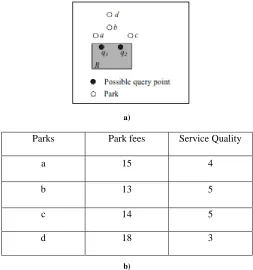
The combination of personal locator technologies, global positioning systems, and wireless communication technologies has flourished location-based services. The main usage of location-based services is to provide mobile users with timely information at the right place for their decision making. Earlier location-based services focus on processing proximity-based queries, including the range query and nearest neighbor which are not sufficient for the applications where spatial and non-spatial attributes of the objects being queried. A typical scenario is finding a nearby car park with cheap parking fee, in which distance is a spatial attribute and parking fee is a non-spatial attribute. Here a multi-criterion query is more appealing than a conventional spatial query that considers the distance only. Among various multi-criterion queries, the skyline query is considered as one of the most classical ones and receives the most attention in Location-based services.
a)
[image:1.612.317.570.223.493.2]b)
Fig. 1. Example of Distance-based skyline query
The dynamic nature of the spatial attribute makes skyline queries in LBSs unique and challenging. At different locations, the distances from the user to the car parks are not the same. As a consequence, the skyline query results differ for different locations. To efficiently compute location-based skyline results a number of algorithms used for one-shot queries and continuous queries which have their own limitations. These algorithms assume that the query location is an exact location point or a line segment.
Distance -based skyline query, which takes a spatial range as the input of user location,as opposed to a point or a line in existing location based systems skyline studies. The distance based skyline queries are more practical when compared with static skyline environments
Parks Park fees Service Quality
a 15 4
b 13 5
c 14 5
International Journal of Emerging Technology and Advanced Engineering
Website: www.ijetae.com (ISSN 2250-2459,ISO 9001:2008 Certified Journal, Volume 4, Issue 2, February 2014)
153
1.The location of the query issuer could be shaped as a spatial region
2.Due to limited accuracy of localization devices, the query issuer does not have clear knowledge about his/her exact location.
3.Due to security reasons, the query issuer may not want to expose his/her exact location to the service provider .And a widely-used solution is to blur the location into a cloaking region so that the adversary has no clue about where the query issuer is exactly located
To study the range-based skyline problem, Fig. 1(a) shows an example of the above park-finding scenario, where the hollow points represent the parks’ locations and the rectangle R represents the input range of the query The non-spatial attributes of the parks are shown in Fig. 1(b), where low parking fee and high service quality are preferred. Given two parks p1 and p2, if p1 is no worse than
p2 in non-spatial attributes and p1 is closer to the query point than p2, here p1 dominates p2. A skyline query is to
find all parks that are not dominated by any other park. The skyline results depend on the location of the query point. For example, if the query point is q1, the skyline result set is {a, b} because c is dominated by b while d is dominated by both a and b; if the query point is q2, the skyline result set is {b, c} because a and d are both dominated by c. Thus, given a range-based skyline query, the service provider should return a collective set of skyline results for every possible query point of the user in R. Unfortunately this is not easy as the number of possible points in R is infinite. The issue is addressed through an index based algorithm called I SKY. The idea is to pre compute the skyline scopes for all objects by their dominance relations. By indexing the skyline scopes, a range based skyline query can be efficiently processed through a root-to-leaf traversal of the index tree. The Distance based skyline problem becomes even more challenging for dynamic datasets where the objects being queried can move and update their spatial attributes frequently. Processing skyline queries over moving objects has numerous applications, such as object tracking and monitoring, location-aware computing, virtual environments, and computer games. In battlefields, to send critical supplies such as ammunitions and medical kits, the best locations can be dynamically determined by the positions of ground troops that are on the move and other non spatial factors such as the current equipments and the number of wounded persons. Such highly dynamic scenarios, the index-based I-SKY algorithm may not be efficient, as the index maintenance cost is expensive.
To overcome this drawback, a non-index algorithm, called N-SKY. It reduces a range-based skyline query into several segment based skyline queries, for which we develop efficient query processing techniques.
Example:
The interesting data-points in the dataset are {a,i ,k} a has the least distance from the beach ,K has the lowest price , I has neither the shortest distance nor the minimum price , i has a lesser distance value than k and a lower price value than a. i is hence not dominated by either one of them.
Highlights:
1. The problem of range-based skyline queries arising in Location based systems.
2. Processing of distance based skyline queries index-based algorithm called I-SKY is used for static datasets and a non-index algorithm called N-SKY is used for highly dynamic datasets.
3. To achieve better and effective results probabilistic and continuous range-based skyline queries can also be attempted.
4. To process probabilistic top-k queries, we propose pruning techniques to improve computational efficiency.
5. To process continuous queries, scope of each skyline object validated which can provide efficient results. The paper is organized as follows: Section 2 describes the related work on sky line queries and range based queries. Section 3 presents index based algorithms I-SKY and the non index algorithms N SKY. Section 4 presents the future work and conclusion.
II. RELATED WORK
Range-based skyline query inherits the characteristics of a skyline query and a range-based query
Skyline Query Processing
International Journal of Emerging Technology and Advanced Engineering
Website: www.ijetae.com (ISSN 2250-2459,ISO 9001:2008 Certified Journal, Volume 4, Issue 2, February 2014)
154
In the Bitmap approach each data point is encoded in a bit string and the skyline is computed by some efficient operations on the bit matrix of all data points. In a high-dimensional dataset is converted into a one high-dimensional dataset and a B+-tree is built to accelerate query processing. an algorithm called NN was proposed based on the depth-first nearest neighbor search via R*-tree. An improved algorithm called Branch-and-Bound Skyline (BBS), which was based on the best-first nearest neighbor search. By accessing only the nodes that contain skyline points and employing effective pruning techniques, BBS achieves the optimal I/O access. Obviously, range-based skyline queries cannot be processed by simply applying the existing algorithms because the number of query points/line segments in a range is infinite.
Range-based Query Processing
Range-based query processing has recently received notable attention as the location privacy issue is becoming increasingly important. For privacy reasons, mobile clients tend to blur their exact locations into an uncertain range so that the service provider cannot find where they are exactly located. The service provider then returns a superset of candidate results for every possible query point in the range. Finally, the clients filter these results and obtain the true result by their exact locations. Existing range based query algorithms studied only range-based kNN (RkNN) Query.
III. PRELIMINARIES
A.Problem Definition
Before we present the detailed algorithms for processing range-based skyline queries, in this section we give some preliminaries of the problem. We consider a dataset of objects O. Each object o ∈ O is associated with one spatial (i.e., location) attribute and several other non-spatial attributes (e.g., parking fee and service quality).
Definition 1 (Non-Spatial Dominance)
Given two objects o and o′, if o′ is no worse than o in all non-spatial attributes, then we say o′ non-spatially dominates o. And o′ is a non-spatial dominator object of o, and o is a non-spatial dominanceobject of o′. Formally, it is denoted as o′ ⊳ o. The set of o’s non-spatial dominator objects is denoted as Dom(o), i.e., o is dominated by any object in Dom(o) on non-spatial attributes.
Definition 2 (Dominance)
Given a query point q and two objects o and o′, if (1) o′ non-spatially dominates o, and (2) o′ is closer to q than o (i.e., o′ also spatially dominates o), then we say o′ dominates o w.r.t. the query point q. Formally, it is denoted as o′ ⊳q o.
Definition 3 (Point-based Skyline Query (PSQ)):
Given a dataset O, the point-based skyline of a query point q returns a subset of O in which each object is not dominated by any other object in O w.r.t. q. We call this subset skyline set and denote it as PSQ(q,O).
Definition 4 (Range-based Skyline Query (RSQ))
Given a dataset O and a query range R, the range-based skyline query returns a superset of objects that appear in the skyline set of some point in R. Formally, it is denoted as RSQ(R,O), and RSQ(R,O) = {o | ∃q ∈ R, o ∈ PSQ(q,O)}. In the example of Fig. 1, objects a and b are members of PSQ(q1,O), c is a member of PSQ(q2,O), and d is dominated by b w.r.t. any point in R. Hence, RSQ(R,O) is {a, b, c}.
TABLE I
GEOMETRICAL NOTATIONS
PerBis(ao) Perpendicular bisector of line segment ao. H(o,m) The open half-plane on o side of PerBis(om).
Cir(o, a) Interior area of the circle centered at o and with a radius of |oa
Line(l) The line on which line segment l is located. CSPha, o,
li
Intersection point of PerBis(ao) and Line(l) for two objects a and o satisfying a ⊳ o.
B.Assumptions and Notations
To efficiently compute RSQ(R,O) given the query range R and the dataset O. To facilitate query processing, we make the following assumptions:
1. Both the mobile user and the objects are located in a 2D plane and the distance metric is Euclidean distance.
2. In a dynamic environment, both the mobile user and the objects may move and update their spatial locations.
3. The values of non-spatial attributes remain constant throughout the query period.
4. The query range R is rectangular.
International Journal of Emerging Technology and Advanced Engineering
Website: www.ijetae.com (ISSN 2250-2459,ISO 9001:2008 Certified Journal, Volume 4, Issue 2, February 2014)
155
IV. INDEX-BASED RSQALGORITHM:I-SKY 1. if object o joins then
2: compute SS(o) and insert it into the index tree; 3: for each o’s non-spatial dominance object m do 4: if PerBis(mo) intersects with SS(m) then 5: SS(m) = SS(m) ∩ H(m, o);
6: replace SS(m) in the index tree; 7: if object o leaves then
8: remove SS(o) from the index tree;
9: for each o’s non-spatial dominance object m do 10: if o has contributed to m’s skyline scope then 11: sort m’s non-spatial dominator objects into DomQueue ordered by their distances to m;
12: initialize the search area and incremental area by Theorem 1;
13: while DomQueue is not empty do 14: x ← DomQueue.pop();
15: if the incremental area is open then 16: maxDist ← ∞;
17: else maxDist ← the distance from the farthest vertex of the incremental area to m;
18: if dist(x,m) > 2 × maxDist then 19: break;
20: if x is in the search area then
21: cut the intermediate skyline scope by PerBis(xm); 22: update the incremental area and search area by Theorem 1;
23: replace SS(m) in the index tree;
I-SKY indexes the skyline scopes, which accelerates the processing of range-based skyline queries. However, the maintenance cost of the skyline scope index would be high if the objects update their locations frequently. Frequent object location updates may still cause many unnecessary index updating operations on the skyline scopes that are not being queried.
Block diagram for distance base Query processing
I/P
Web Server
Index based processing of the input
Non-index based retrieval of the solution
International Journal of Emerging Technology and Advanced Engineering
Website: www.ijetae.com (ISSN 2250-2459,ISO 9001:2008 Certified Journal, Volume 4, Issue 2, February 2014)
156
Non index based retrieval
The Retrieval of data sets is done based on the non index based query processing. It contains a priority list which contains the update Queue to store the enter-in and leave-out points from left to right. When the query point moves, pop up will be done for the first element of Update Queue and execute the corresponding enter-in or leave-out operation. The enter-in and leave-out points of some object(s) will change as well and the corresponding elements in Update Queue should be adjusted. The leave-out operation will not affect the enter-in or leave-leave-out point of any other object. The enter-in operation of an object will affect the enter-in and leave-out points of object’s non spatial dominance objects only. Specifically, the enter-in point of some object may move rightwards and the leave-out point of some object may move leftwards. Thus, the corresponding elements in Update Queue must change accordingly. In some cases the new enter-in point of some object may lie to the right of it’s the leftmost non spatial dominate. In this situation there is no chance for the object to enter the skyline set any longer, such an enter-in point should be removed from Update Queue.
V. CONCLUSION
Distance -based skyline query as an extension to point- and line-based skyline queries. Index-based (I-SKY) and non-index resolve the range-based skyline problem.
To handle the movement of the objects being queried, the incremental construction of the I-SKY index has also been formed. Distance-based skyline problem to reduce both the result set size and computation cost. Distance-based skyline query to the continuous domain, and developed query processing algorithms for static and moving objects. This method provides a solution in terms of both the CPU time and I/O cost.
VI. FUTURE ENHANCEMENT
The query processing can be extended to Random shapes that have a close form of mathematical expression those like arc like boundaries. It can also extended to distance based query accessing problem for road networks
REFERENCES
[1 ] Xin Lin, Jianliang Xu, and Haibo Hu Range-based Skyline Queries in Mobile Environments
[2 ] Ms. R.D. Kulkarni, Prof. Dr. B.F. Momin ,Research Directions in Skyline Computation International Journal of Computer Engineering Science (IJCES)Volume 2 Issue 5 (May 2012)
[3 ] J. L. Bentley, H. T. Kung, M. Schkolnick, and C. D. Thompson. On the Average Number of Maxima in a Set of Vectors and Applications. J. ACM, 25(4): 536-543, 1978.