S Y S T E M A T I C R E V I E W
Open Access
A Meta-Comparison of the Effects of
High-Intensity Interval Training to Those of
Small-Sided Games and Other Training
Protocols on Parameters Related to the
Physiology and Performance of Youth
Soccer Players
Philipp Kunz
1*, Florian Azad Engel
2, Hans-Christer Holmberg
3,4and Billy Sperlich
1Abstract
Background:High-intensity interval training (HIIT) is frequently employed to improve the endurance of various types of athletes. To determine whether youth soccer players may benefit from the intermittent load and time efficiency of HIIT, we performed a meta-analysis of the relevant scientific literature.
Objectives:Our primary objective was to compare changes in various physiological parameters related to the performance of youth soccer players in response to running-based HIIT to the effects of other common training protocols (i.e., small-sided games, technical training and soccer-specific training, or high-volume endurance training). A secondary objective was to compare specifically running-based HIIT to a soccer-specific form of HIIT known as small-sided games (SSG) in this same respect, since this latter type of training is being discussed extensively by coaches.
Method:A systematic search of the PubMed, SPORTDiscus, and Web of Science databases was performed in August of 2017 and updated during the review process in December of 2018. The criteria for inclusion of articles for analysis were as follows: (1) comparison of HIIT to SSG or some other training protocol employing a pre-post
design, (2) involvement of healthy young athletes (≤18 years old), and (3) assessment of variables related to
endurance or soccer performance. Hedges’g effect size (dppc2) and associated 95% confidence intervals for the
comparison of the responses to HIIT and other interventions were calculated.
(Continued on next page)
* Correspondence:[email protected]
1Integrative & Experimental Exercise Science and Training, Institute of Sport
Science, University of Würzburg, Judenbühlweg 11, 97082 Würzburg, Germany
Full list of author information is available at the end of the article
© The Author(s). 2019Open AccessThis article is distributed under the terms of the Creative Commons Attribution 4.0
International License (http://creativecommons.org/licenses/by/4.0/), which permits unrestricted use, distribution, and
(Continued from previous page)
Results:Nine studies, involving 232 young soccer players (mean age 16.2 ± 1.6 years), were examined. Endurance training in the form of HIIT or SSG produced similar positive effects on most parameters assessed, including peak
oxygen uptake and maximal running performance during incremental running (expressed asVmaxor maximal
aerobic speed (MAS)), shuttle runs (expressed as the distance covered or time to exhaustion), and time-trials, as well as submaximal variables such as running economy and running velocity at the lactate threshold. HIIT induced a moderate improvement in soccer-related tests involving technical exercises with the soccer ball and other game-specific parameters (i.e., total distance covered, number of sprints, and number of involvements with the ball). Neuromuscular parameters were largely unaffected by HIIT or SSG.
Conclusion: The present meta-analysis indicates that HIIT and SSG have equally beneficial impacts on
variables related to the endurance and soccer-specific performance of youth soccer players, but little influence on neuromuscular performance.
Keywords: Adolescents, Children, Conditioning, Endurance, Repeated sprint
Key Points
Various reports on responses of both youth and adults to high-intensity interval training (HIIT) have been published, but no systematic comparison of the effects of HIIT and other training regimes on parameters related to the performance of youth soccer players has yet been published.
The calculated effect sizes indicate that HIIT has more beneficial effects than various other exercise programs on all of the parameters examined, with the exceptions of sprinting and jumping performance and repeated sprint ability.
Small-sided games (SSG), a sport-specific form of HIIT, exerted similar effects on parameters related to soccer performance (i.e., maximal oxygen uptake, maximal running performance, running economy, and running at the lactate threshold).
HIIT and SSG both enhance the key performance of youth soccer players in a time-efficient manner, leaving more time for training sport-specific skills such as technique and tactics.
Background
Youth soccer is characterized by constant changes in the intensity of a variety of activities, including standing, walking, running, and sprinting with frequent changes in direction, as well as jumping, often with involvement of
the ball and/or opponents [1]. This varying intensity
(from low to high), as well as matches lasting as long as 90 min (depending on age), involves on average > 80% of
peak heart rate [2] and approximately 75% of maximal
oxygen uptake [1] in youth soccer players, imposing
considerable demands on both aerobic and anaerobic energy production (i.e., in connection with short sprints,
jumps, tackles) [1,3]. Accordingly, high-level endurance
performance is an important prerequisite for success [3].
High-volume or continuous low-intensity training has been employed successfully to improve certain aspects of endurance performance, such as peak oxygen uptake
(VO2peak), individual anaerobic threshold, and/or
maximal velocity in youth soccer players [4, 5]. HIIT,
characterized by periods of intense exercise at > 90% of
peak heart rate (HRpeak) alternating with periods of
low-intensity activity [6], and SSG, a soccer-specific form
of HIIT [7], show great potential to improve certain
as-pects of the endurance of youth soccer players. Both of these types of training improve key variables related to
success in soccer, e.g., VO2peak [8, 9] and maximal
run-ning performance (i.e., shuttle run testing and
time-trials) [10, 11], as well as performance in
connec-tion with soccer-specific tests (i.e., total distance cov-ered, number of sprints, and number of contacts with
the ball) [12,13] in a time-efficient manner [14].
The lengths of training periods and intervals of rest, number of intervals and sessions of HIIT or SSG per week, and the number of players and size of the pitch can be varied in virtually an endless number of ways
[14–18]. Various HIIT protocols improve different
indi-cators of endurance performance [10] and SSG enhances
both fitness and soccer-specific performance [14, 16].
Clearly, in addition to technical and tactical skills, such physiological factors are also important determinants of
success [19].
From a practical point of view, questions arise among coaches concerning (1) the overall responses of youth soc-cer players to HIIT in comparison to other endurance protocols with respect to endurance and other important determinants of performance, such as the ability to sprint and jump; and (2) whether SSG, a sport-specific form of HIIT, results in improvement of these same parameters comparable to those achieved with running-based HIIT.
soccer players as reported in numerous publications dur-ing the past decade to those of other traindur-ing regimes (in particular SSG). Such analysis should aid in designing HIIT and/or SSG to improve the endurance of youth soc-cer players most effectively.
Methods
Databases and Search Profile
This systematic analysis of peer-reviewed investigations on the effects of HIIT and SSG on several parameters re-lated to performance in youth soccer players was
con-ducted in accordance with established guidelines [20]. A
comprehensive computerized search of the PubMed, SPORTDiscus, and Web of Science databases, with no restriction as to year of publication, was performed in August of 2017, with an update during the review process in December of 2018, employing the following search strings: high-intensity interval training OR high-intensity training OR intensive interval training OR aerobic interval training OR sprint interval training OR specific endurance training OR aerobic endurance OR aerobic training AND young players OR young athletes OR adolescent athletes OR teen athletes OR junior
athletes OR children athletes OR children OR adoles-cents AND soccer OR football.
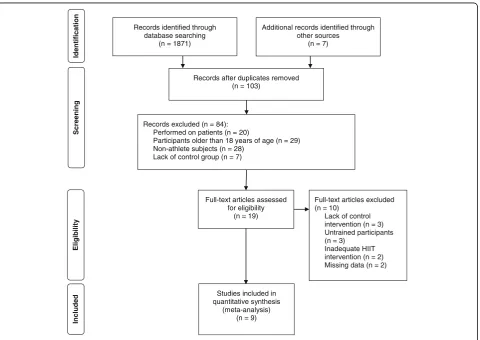
The search was limited to original research articles written in English and published in peer-reviewed jour-nals. The screening and selection process is illustrated in
Fig.1.
In addition, the references cited by the articles re-trieved were examined for potential relevance. Data was extracted from the studies included by one of the au-thors and this extraction checked independently by a second author.
Selection and Quality Assessment of Articles
The inclusion criteria were as follows: (1) involvement of
endurance training in the form of HIIT (e.g., at≥90% of
maximal oxygen uptake [21], 90–95% of HRpeak [10], or
as (supra)maximal interval sprinting [22]); (2)
involve-ment of male soccer players 18 years of age or younger; (3) pre- and post-assessment of exercise performance, physiological parameters related to performance, and/or soccer-specific performance; (4) intervention for at least 4 weeks; and (5) inclusion of a control treatment (i.e., SSG, high-volume training, or technical training).
Records identified through database searching
(n = 1871)
Scr
e
ening
Included
Eligibility
Identification
Additional records identified through other sources
(n = 7)
Records after duplicates removed (n = 103)
Records excluded (n = 84): Performed on patients (n = 20)
Participants older than 18 years of age (n = 29) Non-athlete subjects (n = 28)
Lack of control group (n = 7)
Full-text articles assessed for eligibility
(n = 19)
Full-text articles excluded (n = 10)
Lack of control intervention (n = 3) Untrained participants (n = 3)
Inadequate HIIT intervention (n = 2) Missing data (n = 2)
Studies included in quantitative synthesis
(meta-analysis) (n = 9)
Studies on patients with specific conditions (e.g., obes-ity, diabetes mellitus, or asthma) were excluded, as were conference abstracts, dissertations, theses, and articles that had not undergone peer review.
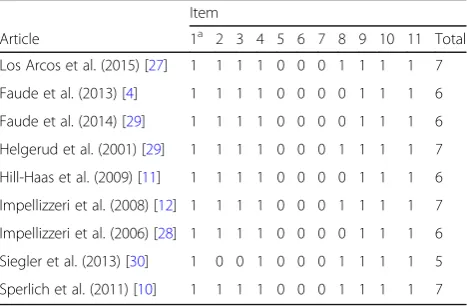
To ensure the methodological quality of the articles selected, the criteria of the Physiotherapy Evidence Data-base (PEDro) scale were applied, with one point for each criterion fulfilled and a maximal possible score of 10
[23]. The quality of each article is documented in
Table1.
Statistical Analyses
The findings on HIIT were compared to those with (1) all of the other interventions, (2) all of the other inter-ventions except SSG, and (3) SSG alone.
Effect sizes (ES) were calculated as the mean differ-ence between the experimental and control groups,
di-vided by SDpooled, as recommended by Carlson and
Schmidt [24].
SDpooled¼
ffiffiffiffiffiffiffiffiffiffiffiffiffiffiffiffiffiffiffiffiffiffiffiffiffiffiffiffiffiffiffiffiffiffiffiffiffiffiffiffiffiffiffiffiffiffiffiffiffiffiffiffiffiffiffiffiffiffiffiffiffiffiffiffiffiffiffiffi
nexp−1
SD2
expþðncontr−1ÞSD2contr
nexpþncontr−2
s
wherenis the number of participants in the experimen-tal (nexp) and control groups (ncont) and SDexp and SDcontthe corresponding pretest standard deviations.
In addition, in light of the tendency for findings with small samples to be positively biased, leading to overesti-mation, a correction factor (CP) was employed:
CP¼1− 3
4 nexpþncontr−2
−1
This approach to the calculation of ES (dppc2) is
opti-mal in the case of studies involving pre- and post-testing
and a control group [25]:
dppc2¼CP½ M
post;exp−Mpre;exp
− Mpost;contr−Mpre;contr
SDpooled
The ES values obtained were classified as trivial (< 0.10),
small (0.10–0.30), moderate (0.30–0.50), or large (> 0.50)
[26]. Heterogeneity was assessed using anI2value and the
95% confidence interval (CI) calculated.
All statistical analyses were carried out in version 11.5.1.0 of the Med-Calc software (MedCalc Software, Mariakerke, Belgium).
Results
Characteristics of the Studies Analyzed
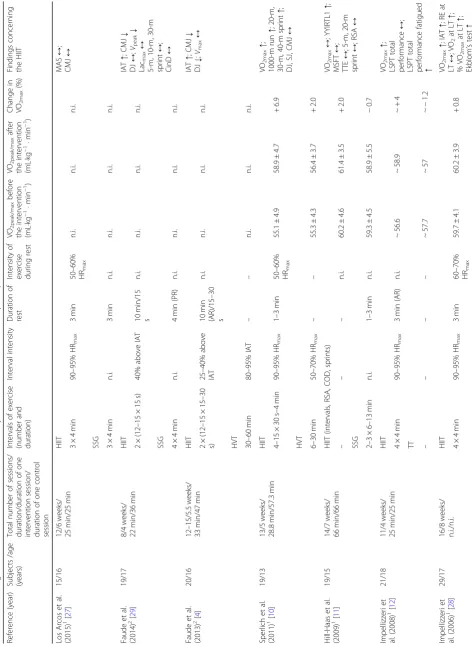
Nine studies were included (see Table 2for a summary)
and assessed in accordance with the PEDro scale,
result-ing in an average score of 6.3 (range 5–7). In four of
these, SSG was the control program [11,27–29], the five
others comparing either a form of high-volume training
[4,10,30] or technical soccer training [12,13] to HIIT.
Altogether, these studies involved 232 male soccer players (mean 22.6 ± 8.2 participants per study; range
15–39), 13–18 years of age (mean age: 16.2 ± 1.6 years),
of whom 50% performed intense interval training and the other 50% control programs of exercise, i.e., either SSG, some form of low-intensity high-volume exercise, or soccer-specific drills (e.g., generic soccer training, technical and tactical training).
All of these participants played regularly for a club, in
most cases professional. Four studies [11,12,27,28]
ex-plicitly excluded goalkeepers, with their special physical requirements and training regimes, from their interven-tions. In five of these nine studies in which this
param-eter was measured [10–13,28], the initial mean VO2peak
of the subjects was 57.4 ± 1.7 (range 55.1–60.2)
mL·kg−1·min−1. HRmaxwas determined with incremental
treadmill tests [10–13, 28], incremental field tests [4,
29], or the University of Montreal Test (UM-TT) [27].
Protocols of the HIIT Interventions
The mean duration of the interventions was 6.4 ± 2.0
weeks (range 4–10), with an average of 2.9 ± 0.9 sessions
per week (range 2–4.5).
The HIIT protocols employed differed with respect to
intensity, duration, and work-to-rest ratio (Table2).
Not-ably, three studies involved 4 × 4 min of running at 90–
95% of maximal heart rate (HRmax), with 3-min intervals
of rest [12,13,28].
In most cases, the target intensity was > 90% HRmax
[10,12, 27, 28, 30], although two studies set this
inten-sity at 25–40% greater than the participant’s individual
anaerobic threshold velocity [4,29]. Two studies employed
elements of functional HIIT, such as repeated squats,
jumps, interval sprints, and agility drills [11, 30]. The
in-tervals of exercise were either short (~ 15–30 s; [4, 29] or
Table 1The Physiotherapy Evidence Database (PEDro) score for
each article included
Item
Article 1a 2 3 4 5 6 7 8 9 10 11 Total
Los Arcos et al. (2015) [27] 1 1 1 1 0 0 0 1 1 1 1 7
Faude et al. (2013) [4] 1 1 1 1 0 0 0 0 1 1 1 6
Faude et al. (2014) [29] 1 1 1 1 0 0 0 0 1 1 1 6
Helgerud et al. (2001) [29] 1 1 1 1 0 0 0 1 1 1 1 7
Hill-Haas et al. (2009) [11] 1 1 1 1 0 0 0 0 1 1 1 6
Impellizzeri et al. (2008) [12] 1 1 1 1 0 0 0 1 1 1 1 7
Impellizzeri et al. (2006) [28] 1 1 1 1 0 0 0 0 1 1 1 6
Siegler et al. (2013) [30] 1 0 0 1 0 0 0 1 1 1 1 5
Sperlich et al. (2011) [10] 1 1 1 1 0 0 0 1 1 1 1 7
a
Table 2 The design of the studies included in this me ta-analysis and char acteristics of their participants Refere nce (year) Subjects /ag e (years) Total num ber of se ssions/ duratio n/duration of one intervent ion sessio n/ duratio n of one control session Intervals of exerc ise (numb er and durati on) Interval inten sity Durat ion of res t Inten sity of exerc ise dur ing res t VO 2peak/max be fore the intervent ion (m L·kg − 1 · min − 1 ) VO 2peak/max after the interve ntion (mL· kg − 1 ·m in − 1 ) Change in VO 2max (%) Finding s conc ernin g the HIIT Los Arcos et al. (2015 ) 1 [ 27 ] 15/16 12/6 we eks/ 25 min /25 min HIIT MAS ↔ ; CMJ ↔ 3 × 4 min 90 – 95% HR max 3 min 50 – 60% HR max n.i. n.i. n.i.
SSG 3×
4 min n.i. 3 min n.i. n.i. n.i. n.i. Faude et al. (2014 ) 2[ 29 ] 19/17 8/4 weeks/ 22 min /36 min HIIT IAT ↑ ; CMJ ↓ DJ ↔ ; Vpeak ↓ Lac max ↔ 5-m, 10 -m, 30 -m sprint ↔ ; CinD ↔ 2 × (12 – 15 × 15 s) 40% above IAT 10 min/1 5 s n.i. n.i. n.i. n.i.
SSG 4×
4 min n.i. 4 min (PR) n.i. n.i. n.i. n.i. Faude et al. (2013 ) 2 [ 4 ] 20/16 12 – 15 /5.5 we eks/ 33 min /47 min HIIT IAT ↑ ; CMJ ↓ DJ ↓ ; Vmax ↔ 2 × (12 – 15 × 15 – 30 s) 25 – 40% above IAT 10 min (A R)/15 – 30 s n.i. n.i. n.i. n.i.
HVT 30–
60 min 80 – 95% IAT –– n.i. n.i. n.i. Sperl ich et al. (2011 ) 1 [ 10 ] 19/13 13/5 we eks/ 28.8 min /57.3 min HIIT VO 2max ↑ ; 1000-m run ↑ ; 20-m , 30-m , 40-m spr int ↑ ; DJ, SJ, CM J ↔ 4 – 15 × 30 s – 4 min 90 – 95% HR max 1 – 3m in 5 0 – 60% HR max 55 .1 ± 4.9 58.9 ± 4.7 + 6.9
HVT 6–
30 mi n 50 – 70% HR max –– 55 .3 ± 4.3 56.4 ± 3.7 + 2.0 Hill-Haas et al. (2009 ) 1[ 11 ] 19/15 14/7 we eks/ 66 min /66 min HIIT (i ntervals, RSA, COD, spr ints) VO 2max ↔ ; YYIR TL1 ↑ ; MSFT ↔ ; TTE ↔ ; 5-m, 20-m sprint ↔ ; RSA ↔ –– – n.i. 60 .2 ± 4.6 61.4 ± 3.5 + 2.0
SSG 2–
Table 2 The design of the studies included in this me ta-analysis and char acteristics of their participants (Continued) Refere nce (year) Subjects /ag e (years) Total num ber of se ssions/ duratio n/duration of one intervent ion sessio n/ duratio n of one control session Intervals of exerc ise (numb er and durati on) Interval inten sity Durat ion of res t Inten sity of exerc ise dur ing res t VO 2peak/max be fore the intervent ion (m L·kg − 1 · min − 1 ) VO 2peak/max after the interve ntion (mL· kg − 1 ·m in − 1 ) Change in VO 2max (%) Finding s conc ernin g the HIIT
SSG 4×
4 min in length [12,13,27,28], with one study involving a
mixture (30 s–4 min) [10]. The recovery period between
intervals of exercise ranged from 15 to 180 s.
The SSG Interventions
In four cases, HIIT was compared to SSG [11, 27–29].
Two of these studies employed 4 × 4-min games [28,29],
one 3 × 4-min of SSG [27], and one 2–3 sets of 6–
13-min games [11]. The recovery between intervals of
exercise ranged from 1 to 4 min and the pitch dimen-sions varied, as did the duration and number of players (range 2 against 1 to 7 against 7).
Maximal or Peak Oxygen Uptake
Comparison of HIIT to All Other Interventions
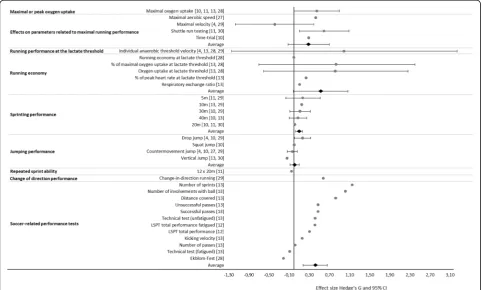
In comparison to all other interventions, HIIT induced a moderate mean positive effect on peak oxygen uptake
(meandppc20.45 ± 0.46; range 0.08–1.11). Among the four
analyses of peak or maximal oxygen uptake, one effect
was trivial positive [28], one small positive [11], one
mod-erate positive [10], and one large positive [13] (Fig.2).
Comparison of HIIT to All Other Interventions Except SSG
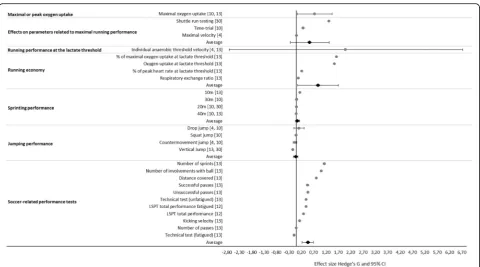
In comparison to all interventions except SSG, HIIT re-sulted in a large mean positive effect on maximal or
peak oxygen uptake (meandppc20.75 ± 0.50; range 0.40–
1.11). In the two studies analyzed in this respect, one
re-ported a moderate positive [10] and the other a large
positive effect [13] (Fig.3).
Comparison of HIIT to SSG
In comparison to SSG, HIIT exerted a small positive
ef-fect on maximal or peak oxygen uptake (mean dppc2
0.15 ± 0.10; range 0.08–0.22), as shown by two studies,
one demonstrating a trivial positive effect [28] and the
other a small positive effect [11] (Fig.4).
Effects on Parameters Related to Maximal Running Performance
HIIT Versus All Other Interventions
As assessed in six studies, HIIT induced a moderate mean positive effect on parameters related to maximal
running performance (mean dppc2 0.30 ± 0.58; range −
0.78–1.34) [4, 10, 11, 27, 29, 30], in association with
either incremental running tests (expressed as maximal
aerobic speed (MAS) orVmax) [4,27,29], different
shut-tle run tests [11, 30], or a 1000-m time-trial run [10]
(Fig.2). TheI2value of 14% indicated low heterogeneity.
HIIT Versus All Other Interventions Except SSG
As examined in three studies [4, 10,30], in comparison
to all other interventions except SSG, HIIT induced a
large positive mean effect on maximal running
perform-ance (meandppc20.55 ± 0.70; range 0.01–1.34) (Fig.3).
HIIT Versus SSG
Three studies [11, 27, 29] demonstrated small positive
effects of HIIT on maximal running performance (mean
dppc2 0.14 ± 0.52; range −0.78–0.45) in comparison to
SSG, as determined by incremental running tests [27,
29] and shuttle run testing [11] (Fig.4).
Running Performance at the Lactate Threshold
HIIT Versus All Other Interventions
With respect to running performance at the lactate threshold, reported in four cases, HIIT exerted a large positive mean effect in comparison to all other
Fig. 3Comparison of the overall and individual effect sizes (dppc2, dots) and corresponding 95% confidence intervals (lines) for parameters related to the performance of youth soccer players with HIIT to those of all other interventions except SSG
interventions (mean dppc2 1.00 ± 2.29; range −0.40–
4.42). One of these four studies indicated a moderate
negative [4], one trivial negative [28], one no [29], and
one large positive effect [13] (Fig.2). The lactate
thresh-old was determined either from the lactate curve [4,29]
according to the procedure of Stegmann and colleagues
[31] or defined as a blood lactate concentration 1.5
mmol/L higher than baseline [13,28].
HIIT Versus All Other Interventions Except SSG
As shown in two reports, in comparison to all other in-terventions except SSG, HIIT had a large positive effect on running performance at the lactate threshold (mean
dppc22.01 ± 3.41; range−0.40–4.42) [4,13] (Fig.3).
HIIT Versus SSG
Comparison of HIIT to SSG in two publications [28,29]
demonstrated a trivial negative mean effect of the former on running performance at the lactate threshold (mean
dppc2−0.01 ± 0.02; range−0.03–0.00) (Fig.4).
Running Economy
HIIT Versus All Other Interventions
In comparison to all other interventions, HIIT induced a large positive mean effect on running economy (mean
dppc2 0.53 ± 0.74; range 0.00–1.64). Two trivial positive
[28], three small positive [13,28], and two large positive
effects [13] were obtained in the two investigations on
different parameters of relevance (i.e., the respiratory ex-change ratio, percentage of peak heart rate, and percent-age of peak oxygen uptake at the lactate threshold) (Fig.
2). A moderate degree of heterogeneity was indicated by
theI2value of 43%.
HIIT Versus All Other Interventions Except SSG
One article reported that in comparison to all control in-terventions except SSG, HIIT produced a large positive
mean effect on running economy (mean dppc2 0.88 ±
0.83; range 0.10–1.64) [13] (Fig.3).
HIIT Versus SSG
One comparison of HIIT to SSG revealed a trivial posi-tive mean effect of the former on running economy
(meandppc20.05 ± 0.05; range 0.00–0.10) [28] (Fig.4).
Sprinting Performance
HIIT Versus All Other Interventions
HIIT exerted a small positive effect on linear sprinting
performance (mean dppc2 0.10 ± 0.12; range −0.01–0.35)
over the various distances (5, 10, 20, 30, and 40 m) exam-ined in five different studies. Trivial effects were found for
5 m [11], 20 m [10,11,30], 30 m [10], and 40 m [10]; small
positive effects for 10 m [13,29], 30 m [29], and 40 m [13];
and one moderate positive effect for 5 m [29] (Fig.2). The
I2value of 12% indicated low heterogeneity.
HIIT Versus All Other Interventions Except SSG
In comparison to all other interventions except SSG, HIIT exerted a trivial positive effect on sprinting
per-formance (mean dppc2 0.06 ± 0.08; range −0.01–0.17).
One small positive effect was found for 10 m [13], two
trivial effects for 20 m [10, 30], and one trivial effect
each for 30 m [10] and 40 m [10] (Fig.3).
HIIT Versus SSG
In comparison to SSG, HIIT produced a small positive
effect on sprint performance (mean dppc2 0.15 ± 0.15;
range 0.01–0.35), with one trivial and one moderate
positive effect for 5 m [11, 29], one small positive effect
for 10 m and 30 m [29], and one trivial positive effect for
20 m [11,29] (Fig.4).
Jumping Performance
HIIT Versus All Control Interventions
In comparison to all other interventions, HIIT had a trivial positive effect on jumping performance (counter-movement jump, drop jump, squat jump, and vertical
jump) (meandppc20.01 ± 0.15; range −0.14–0.28). Small
negative effects were found in three studies [13, 29,30],
and trivial effects were detected in two cases for the
countermovement jump [4, 10] and one case each for
the drop jump and squat jump [10]. Small positive
ef-fects were calculated for the countermovement jump in
one investigation [27] and for the drop jump in two
studies [4, 29] (Fig. 2). No heterogeneity was observed
(I2= 0%).
HIIT Versus All Other Interventions Except SSG
In comparison to all other interventions except SSG, HIIT showed a trivial negative effect on jumping
per-formance (mean dppc2 −0.02 ± 0.12; range −0.14–0.22),
based on two small negative effects on the vertical jump
[13, 30]; four trivial effects, two for the
countermove-ment jump [4,10] and one each for the drop jump and
squat jump [10]; and one small positive effect for the
drop jump [4] (Fig.3).
HIIT Versus SSG
In comparison to SSG, HIIT had a trivial positive effect
on jumping performance (mean dppc2 0.08 ± 0.21; range
−0.13–0.28), as a result of two small positive effects,
one on the countermovement jump [27] and one on the
drop jump [29], as well as one small negative effect on
Repeated Sprint Ability
HIIT Versus SSG
Comparison of the impact of HIIT on repeated-sprint ability to that of SSG in one study involving a 12 × 20-m
test [11] resulted in a trivial negative effect (dppc2−0.05)
(Figs.2and4).
Change of Direction Performance
HIIT Versus SSG
One publication showed that in comparison to SSG,
HIIT exerted a large positive effect on
change-of-direction performance (dppc2 0.59) [29] (Figs.
2and4).
Soccer-Related Performance Tests
HIIT Versus All Other Interventions
The effect of HIIT on variables related to soccer per-formance was moderately positive in comparison to that
of all other interventions (mean dppc2 0.42 ± 0.42; range
−0.21–1.15) [12, 13, 28] (Fig. 2). The tests involved in
this context included technical tests [12,13,28], kicking
velocity [13], and data collected during actual soccer
matches [13] (distance covered, number of sprints,
num-ber of contacts with the ball, numnum-ber of successful and
unsuccessful passes). The calculated I2of 8% indicated a
low degree of heterogeneity.
HIIT Versus All Other Interventions Except SSG
Comparison of HIIT to all other interventions except SSG revealed a moderate positive effect of the former on soccer-related performance, including kicking velocity
[13], the Loughborough Soccer Passing Test (LSPT)
[12], and data collected during actual soccer matches
[13] (meandppc2 0.47 ± 0.39; range −0.09–1.15) [12,13]
(Fig.3).
HIIT Versus SSG
In comparison to SSG, HIIT exhibited a small negative
effect on soccer-related performance (dppc2 −0.21), as
assessed by the Ekblom’s test [28] (Fig.4).
Time Efficiency
The average durations of one session of HIIT and of all the other programs were 33 ± 14 min and 41 ± 15 min,
respectively—a difference that is noteworthy, even if not
statistically significant. Considered separately, in the two studies involving high-volume endurance exercise as the
control training [4,10], the average session lasted
signifi-cantly longer than in the case of HIIT (52 ± 7 min vs 31 ± 3 min). In four studies, the duration of intervention
and control sessions was matched [11–13,27].
Discussion
The present meta-analysis compares the effects of HIIT on youth soccer players to those of alternative training regimes, including SSG.
The overall findings were as follows:
(i) In comparison to all other interventions, HIIT induces moderate-to-large positive effects on maximal or peak oxygen uptake, variables related to running performance (i.e., maximal running performance, running performance at the lactate threshold and running economy), change-of-direction performance, and soccer-related performance tests (i.e., technical exercises with the ball and game-specific parameters such as the total distance covered, number of sprints, and number of involvements with the ball) (ii) In comparison to all other interventions except
SSG, HIIT demonstrates moderate-to-large effects on maximal or peak oxygen uptake, variables related to running performance, and, again, soccer-related performance
(iii) In comparison to SSG, HIIT exerts a large effect on change-of-direction ability
(iv) In comparison to all other interventions including or excluding SSG, as well as to SSG alone, HIIT has little or no impact on sprint running performance, jumping performance, or repeated sprint ability
Although endurance performance is unquestionably a key determinant of the success of advanced youth soccer
players [13, 32], numerous other variables that require
time to develop, such as technical and tactical skills, also
play major roles [33, 34]. In this context, time-efficient
training in the form of HIIT and SSG, especially in com-parison to traditional high-volume training, may offer an excellent approach to improving the endurance perform-ance of these athletes. In this regards, HIIT not only takes
less time, but also improves VO2peak to a greater extent
than other training strategies [35]. Furthermore, intense
regimes of this sort involve physiological loads comparable to those encountered in an actual soccer game, where the
heart rate averages 85% of HRmaxand intensities as high
as 90–95% of HRmaxcan be reached [2,36].
In this regards, HIIT and SSG improve endurance pa-rameters (e.g., maximal oxygen uptake, maximal running performance, running performance at the lactate thresh-old, and running economy) to a similar extent, with
slightly higher values of VO2peakfor HIIT, in agreement
with previous findings [35]. However, SSG also includes
soccer-specific drills with the ball or tactical training
[14], improving additional determinants of soccer
suc-cess [19]. Unfortunately, our analysis does not allow
training in intervals lasting 15 s to 4 min) and SSG (vari-ations in duration, pitch size, and number of players) are most beneficial to youth soccer players. It is noteworthy that there has been some concern that HIIT may be
un-pleasant for young athletes [37], as well as may lead to
overtraining [38, 39]. Although none of the studies
ana-lyzed here reported any signs of overreaching or over-training, further investigation of the long-term effects of HIIT and SSG is warranted.
The present analysis indicates that improvements in neuromuscular parameters (i.e., sprinting and jumping) with HIIT and SSG were trivial or, at best, small. In most
cases, HIIT involved 4-min intervals at 90–95% of peak
heart rate, but not sprinting for only a few seconds at
100% intensity [40], and the same was true for SSG. In
this context, the most pronounced positive effects on sprinting and jumping performance were found in two
studies using short (15–30 s) intervals of HIIT [4, 29],
indicating that for improving sprinting, intervals less than approximately 15 s may be more beneficial. With the constantly increasing demands on the sprinting abil-ity of youth soccer players from under 13 to younger
than 18 years of age [41], the development of explosive
strength, often decisive for success, appears to be one major aspect for further development. As also indicated by the effects of HIIT and SSG concerning sprinting and jumping described here, additional training of these abil-ities appears to be beneficial for youth soccer players. Furthermore, when developing neuromuscular abilities,
the state of the child’s maturation should be taken into
consideration and before puberty, development of
strength and speed should be the main target [42]. In
adolescents, additional components such as power and
hypertrophy should be developed [42].
The single investigation that examined repeated
sprints [11] observed a trivial effect of HIIT in
com-parison to SSG, i.e., SSG and HIIT appear to improve this ability to a similar extent. From a practical point of view, shorter intervals of HIIT or SSG at inten-sities close to that of repeated sprints may be suffi-cient to improve such performance. In the one
investigation on change-of-direction performance [29],
HIIT had a large positive effect in comparison to SSG, in contrast to other findings of greater
improve-ment of this sort with SSG [43], a discrepancy that
cannot be explained at present. The effects on re-peated sprint ability and change of direction perform-ance both require further scientific evaluation.
In practice, coaches may focus on the effects of vari-ous training regimes on performance in connection with soccer-related tests. The medium-positive effect of HIIT on such performance compared to all other interven-tions can be attributed to the large positive effects on the number of sprints, total distance covered, and
number of involvements with the ball, all of which re-quire the endurance that can be achieved with HIIT.
The negative effect of HIIT in the Ekblom’s test in
com-parison to SSG (Fig.4) may be explained by the various
soccer-specific movements involved in this test (i.e., jumping, slalom running, running backward, changes in direction, running sideways), which are most closely mimicked in SSG.
HIIT and SSG provide similar benefits with respect to
most of the parameters analyzed here (Fig.4). Moreover,
SSG may offer additional advantages, improving essen-tial neuro-muscular and cognitive skills such as reaction time, decision-making, and change-of-direction speed
[44]. Participants may also experience greater motivation
[45] and enjoyment [27] when performing SSG than
HIIT protocols that are less sport-specific. At the same time, the intensity of SSG can be varied greatly, being higher on larger pitches and with a smaller number of
players [16], and the optimal design remains to be
determined.
From a practical point of view, the choice of a HIIT or SSG protocol for training youth soccer players depends to a large extent on the time-point during the season and the
coach’s overall strategy. HIIT induces somewhat more
pronounced increases in VO2peakthan SSG, thereby
devel-oping adequate aerobic endurance. During a season, running-based protocols that do not involve ball drills often appear impractical. From this perspective, SSG may provide a viable alternative for maintaining endurance and skills such as ball handling and tactical thinking.
Limitations
The following limitations of the present analysis need to be considered: (1) Only nine studies met our criteria for inclusion, and in some cases, no more than one ES could be calculated for each parameter; (2) for some pa-rameters, there was considerable heterogeneity (as
indi-cated by the 95% CI), especially for running
performance at the lactate threshold; (3) we categorized each report on the basis of what the authors stated. For
instance, in one of the studies [11] involving repeated
sprints as the intervention, the authors stated explicitly that these were performed as a form of HIIT; (4) we cannot assess the benefits of HIIT and SSG to youth soc-cer players in individual competitive situations, since a standardized soccer match (or simulation thereof ) does not yet exist; (5) there may be major age-dependent dif-ferences in the development of the parameters investi-gated here, and there is no clear-cut division between youth and adult soccer players; (6) although all of the HIIT and SSG protocols analyzed met our criteria, these protocols were somewhat heterogeneous, especially with respect to duration, intensity, and ratio of load to rest
Conclusions
On the basis of the present analysis, we conclude that HIIT in general and the more sport-specific SSG both result in similar improvements in maximal or peak oxy-gen uptake, variables related to running performance (i.e., maximal running performance, running perform-ance at the lactate threshold, and running economy), and soccer-related performance tests in youth players. In contrast, repeated sprint ability and sprinting and jumping performance are virtually unaffected by either HIIT or SSG. Change of direction performance was improved to a greater extent by HIIT than SSG, but this difference re-quires further investigation. Thus, HIIT and SSG both offer an effective approach to simultaneously improve cer-tain physiological characteristics and the sport-specific skills of youth soccer players.
Abbreviations
AR:Active rest; CI: Confidence interval; CinD: Change-in-direction run; CMJ: Countermovement jump; DJ: Drop jump; ES: Effect size; HIIT: High-intensity interval training; HRmax: Maximal heart rate; HRpeak: Peak heart rate; HVT: High-volume training; IAT: Individual anaerobic threshold;
Lacmax: Maximal blood lactate concentration; LIST: Loughborough Intermittent Shuttle Test; LSPT: Loughborough Soccer Passing Test; LT: Lactate threshold; MAS: Maximal aerobic speed; MSFT: Multistage fitness test; n.i.: Not indicated; PEDro: Physiotherapy Evidence Database; PR: Passive rest; RE: Running economy; Reps: Repetitions; RSA: Repeated sprint ability; SJ: Squat jump; SSG: Small-sided game; TT: Technical training; TTE: Time to exhaustion; VJ: Vertical jump;Vmax/peak: Maximal velocity during incremental step test; VO2max: Maximal oxygen uptake; VO2peak: Peak oxygen uptake; VOT: Volume-oriented training at low intensities; VT: Ventilatory threshold; YYIETL1: Yo-Yo intermittent endurance test level 1; YYIRTL1: Yo-Yo intermittent recovery test level 1
Acknowledgements
Not applicable.
Funding
This publication was funded by the German Research Foundation (DFG) and the University of Wuerzburg in the funding programme Open Access Publishing.
Availability of Data and Materials
Data sharing not applicable as no datasets were generated or analysed during the present study.
Authors’Contributions
PK drafted the manuscript. FAE, H-CH, and BS read and approved the final manuscript. All authors read and approved the final manuscript.
Ethics Approval and Consent to Participate
Not applicable.
Consent for Publication
Not applicable.
Competing Interests
The authors, Philipp Kunz, Florian Azad Engel, Hans-Christer Holmberg, and Billy Sperlich, declare that they have no competing interests.
Publisher’s Note
Springer Nature remains neutral with regard to jurisdictional claims in published maps and institutional affiliations.
Author details
1Integrative & Experimental Exercise Science and Training, Institute of Sport
Science, University of Würzburg, Judenbühlweg 11, 97082 Würzburg, Germany.2Institute of Sport and Sport Science, Heidelberg University, Heidelberg, Germany.3School of Sport Sciences, UiT The Arctic University of Norway, Tromsø, Norway.4Swedish Winter Sports Research Centre, Department of Health Sciences, Mid Sweden University, Östersund, Sweden.
Received: 31 July 2018 Accepted: 11 February 2019
References
1. Stølen T, et al. Physiology of soccer: an update. Sports Med. 2005;35(6): 501–36.
2. Mendez-Villanueva A, et al. Match play intensity distribution in youth soccer. Int J Sports Med. 2013;34(2):101–10.
3. Vanderford ML, et al. Physiological and sport-specific skill response of olympic youth soccer athletes. J Strength Cond Res. 2004;18(2):334–42. 4. Faude O, et al. High intensity interval training vs. high-volume running training during pre-season conditioning in high-level youth football: a cross-over trial. J Sports Sci. 2013;31(13):1441–50.
5. Meckel Y, et al. Effects of a very short-term preseason training procedure on the fitness of soccer players. J Sports Med Phys Fitness. 2014;54(4):432–40. 6. Gibala MJ, et al. Physiological adaptations to low-volume, high-intensity
interval training in health and disease. J Physiol. 2012;590(5):1077–84. 7. Rampinini E, et al. Factors influencing physiological responses to small-sided
soccer games. J Sports Sci. 2007;25(6):659–66.
8. McMillan K, et al. Physiological adaptations to soccer specific endurance training in professional youth soccer players. Br J Sports Med. 2005;39(5): 273–7.
9. Impellizzeri FM, Rampinini E, Marcora SM. Physiological assessment of aerobic training in soccer. J Sports Sci. 2005;23(6):583–92.
10. Sperlich B, et al. Effects of 5 weeks of high-intensity interval training vs. volume training in 14-year-old soccer players. J Strength Cond Res. 2011; 25(5):1271–8.
11. Hill-Haas SV, et al. Generic versus small-sided game training in soccer. Int J Sports Med. 2009;30(9):636–42.
12. Impellizzeri FM, et al. Effects of aerobic training on the exercise-induced decline in short-passing ability in junior soccer players. Appl Physiol Nutr Metab. 2008;33(6):1192–8.
13. Helgerud J, et al. Aerobic endurance training improves soccer performance. Med Sci Sports Exerc. 2001;33(11):1925–31.
14. Hill-Haas SV, et al. Physiology of small-sided games training in football: a systematic review. Sports Med. 2011;41(3):199–220.
15. MacInnis MJ, Gibala MJ. Physiological adaptations to interval training and the role of exercise intensity. J Physiol. 2017;595(9):2915–30.
16. Halouani J, et al. Small-sided games in team sports training: a brief review. J Strength Cond Res. 2014;28(12):3594–618.
17. Gibala MJ, et al. Short-term sprint interval versus traditional endurance training: similar initial adaptations in human skeletal muscle and exercise performance. J Physiol. 2006;575(Pt 3):901–11.
18. Esfarjani F, Laursen PB. Manipulating high-intensity interval training: effects on VO2max, the lactate threshold and 3000 m running performance in moderately trained males. J Sci Med Sport. 2007;10(1):27–35.
19. Sarmento H, et al. Talent identification and development in male football: a systematic review. Sports Med. 2018;48(4):907–31.
20. Liberati A, et al. The PRISMA statement for reporting systematic reviews and meta-analyses of studies that evaluate healthcare interventions: explanation and elaboration. BMJ. 2009;339:b2700.
21. Buchheit M, Laursen PB. High-intensity interval training, solutions to the programming puzzle. Part II: anaerobic energy, neuromuscular load and practical applications. Sports Med. 2013;43(10):927–54.
22. Laursen PB, Jenkins DG. The scientific basis for high-intensity interval training: optimising training programmes and maximising performance in highly trained endurance athletes. Sports Med. 2002;32(1):53–73. 23. Olivo SA, et al. Scales to assess the quality of randomized controlled trials: a
systematic review. Phys Ther. 2008;88(2):156–75.
24. Carlson KD, Schmidt FL. Impact of experimental design on effect size: findings from the research literature on training. J Appl Psychol. 1999;84(6):851. 25. Morris SB. Estimating effect sizes from pretest-posttest-control group
26. Fröhlich M, et al. Outcome effects and effects sizes in sport sciences. Int J Sports Sci Eng. 2009;3(3):175–9.
27. Los Arcos A, et al. Effects of small-sided games vs. interval training in aerobic fitness and physical enjoyment in young elite soccer players. PLoS One. 2015;10(9):e0137224.
28. Impellizzeri FM, et al. Physiological and performance effects of generic versus specific aerobic training in soccer players. Int J Sports Med. 2006; 27(6):483–92.
29. Faude O, et al. The effect of short-term interval training during the competitive season on physical fitness and signs of fatigue: a crossover trial in high-level youth football players. Int J Sports Physiol Perform. 2014;9(6): 936–44.
30. Siegler J, Gaskill S, Ruby B. Changes evaluated in soccer-specific power endurance either with or without a 10-week, in-season, intermittent, high-intensity training protocol. J Strength Cond Res. 2003;17(2):379–87. 31. Stegmann H, Kindermann W, Schnabel A. Lactate kinetics and individual
anaerobic threshold. Int J Sports Med. 1981;2(3):160–5.
32. Hoff J, Helgerud J. Endurance and strength training for soccer players: physiological considerations. Sports Med. 2004;34(3):165–80.
33. Memmert D. Testing of tactical performance in youth elite soccer. J Sports Sci Med. 2010;9(2):199–205.
34. Kannekens R, Elferink-Gemser MT, Visscher C. Positioning and deciding: key factors for talent development in soccer. Scand J Med Sci Sports. 2011;21(6): 846–52.
35. Engel FA, et al. High-intensity interval training performed by young athletes: a systematic review and meta-analysis. Front Physiol. 2018;9:1012. 36. Rebelo A, et al. Physical match performance of youth football players in
relation to physical capacity. Eur J Sport Sci. 2014;14(Suppl 1):S148–56. 37. Fernandez-Fernandez J, et al. The effects of sport-specific drills training or
high-intensity interval training in young tennis players. Int J Sports Physiol Perform. 2017;12(1):90–8.
38. Kentta G, Hassmen P, Raglin JS. Training practices and overtraining syndrome in Swedish age-group athletes. Int J Sports Med. 2001;22(6):460–5. 39. Winsley R, Matos N. Overtraining and elite young athletes. Med Sport Sci.
2011;56:97–105.
40. Lockie RG, et al. The effects of different speed training protocols on sprint acceleration kinematics and muscle strength and power in field sport athletes. J Strength Cond Res. 2012;26(6):1539–50.
41. Buchheit M, et al. Match running performance and fitness in youth soccer. Int J Sports Med. 2010;31(11):818–25.
42. Lloyd RS, Oliver JL. The youth physical development model: a new approach to long-term athletic development. J Strength Cond Res. 2012; 34(3):61–72.
43. Chaouachi A, et al. Multidirectional sprints and small-sided games training effect on agility and change of direction abilities in youth soccer. J Strength Cond Res. 2014;28(11):3121–7.
44. Young W, Rogers N. Effects of small-sided game and change-of-direction training on reactive agility and change-of-direction speed. J Sports Sci. 2014;32(4):307–14.