On the Generation and Evaluation of Mobile
Application Service Concepts
Moon-soo Kim
Dept. of Industrial and Management Engineering, Hankook University of Foreign Studies, Yongin, Republic of Korea Email: [email protected]
Chulhyun Kim*
Dept. of Technology & Systems Management, Induk University, Seoul, Republic of Korea Email: [email protected]
Abstract—This study suggests an approach to mobile application service concepts generation and evaluation with an analysis of a mobile application store database. To generate mobile application service concepts, text mining and morphological analysis are employed. Conjoint analysis is applied to evaluate them. The detailed procedure is illustrated with a case study of mobile game application service concept development by analyzing the Apple App Store. The proposed can provide service managers and designers with guidelines and implications in the real processes of mobile service concept generation and evaluation.
Index Terms—Mobile Application Service Concept, Concept Generation, Concept Evaluation, Application Store DB, Text Mining, Morphological Analysis, Conjoint Analysis
I. INTRODUCTION
According to the shift of the sources of industrial competitiveness from manufacturing to services, new service development (NSD) as the growth engine of the next generation is considered one of the most crucial tasks for the sustainability of nations and firms [1][2]. Under rapidly changing and highly competitive circumstances, the timely design, development, and marketing of new services with creative and innovative features are essential for a company’s survival [3]. As is the case with IBM’s change to becoming a service firm and Apple’s success in the mobile service market, many global firms have sought distinctive strategies through the aggressive development of new services, and have been raising R&D investment for NSD [4][5]. Consequently, NSD has paid more and more attention to and a lot of studies on NSD have been conducted.
Previous studies on NSD have mainly focused on traditional offline services, ranging from the service idea generation stage to the detailed service design stage [6]. Recently, the focus of NSD has been shifting from traditional services to technology-based services, which
are enabled through the rapid development of technologies, especially information and communication technologies. The development of new mobile services is one such area. It has frequently been observed that the rapid evolution of mobile technologies has created new service markets, the growth rate of which often surpasses that of product markets [7]. Therefore, developing new mobile services has become a crucial issue and specially, the development of new mobile service concepts is regarded as the first and most important stage, since it influences the direction of the remaining activities [8].
Although the background and techniques of service concept generation are heterogeneous and complex, the methods for service concept generation can be classified into two main approaches, customer-centered and service-centered, according to their idea source. The customer-centered approach begins with customers, for service concept generation. In other words, new service concepts are created after analyzing customers’ experiences or needs, which are identified through market research techniques such as surveys, observation, interviews, and focused group discussions [9][10]. Among customer-centered approaches, the Kano model, quality function deployment (QFD), and conjoint analysis have been actively adopted in both practical and academic use. The customer-centered approach is the traditional, most widely used approach for service concept generation. On the other hand, the service-centered approach focuses on services for the creation of service concepts. In other words, by analyzing information from service and/or technologies related to target services, new service ideas are created. The typical service-centered approaches, amongst others, are morphological analysis and TRIZ.
The main weakness of the customer-centered approach is that it is difficult to generate innovative concepts using the approach. Since concept generation through the customer-centered approach relies on customers’ experiences and need of existing services, it has a limited capacity to find solutions for completely differentiated concepts from existing ones, especially for concepts that customers do not know about. In contrast, the service-centered approach does not reflect the opinions of Manuscript received June 1, 2013; accepted October 11, 2013.
customers who are the users of the services. The concepts generated through the service-centered approach can obviously be evaluated by customers. However, this also has limitations, since, as previously mentioned, customers may not be aware of the new service concepts and what they themselves require.
In response, this study suggests an approach to service concept development that integrates the service-centered and the customer-centered approach with the analysis of a mobile application store database. Especially, this study extends our previous work [11] that proposed only a framework for service concept development by conducting case study on the development of mobile game application service concepts. Since it preserves a huge number of mobile application documents that contain a vast amount of information on real mobile services, they can be a valuable data source not only in generating mobile services but also in evaluating them. For concept generation, the proposed approach applies morphological analysis, which systematically generates all possible alternative mobile services with dimension and shape parameters, using the contents of mobile application service documents. For concept evaluation, conjoint analysis is employed to identify promising concepts from among the set of derived alternative concepts that are based on customers’ ratings of existing services. Morphological analysis and conjoint analysis are similar in that both techniques are decomposition methods that break down a system into subsystems with several attributes and decide which alternative is dominant over others by combining the most valuable levels in each attribute. Although morphological analysis is effective for modeling a problem and to find alternatives for it, it has limited capacity in evaluating alternatives and selecting solutions systematically. On the contrary, conjoint analysis is, in nature, a process for prioritizing alternatives. However, conjoint analysis requires the assumption that alternatives exist for each attribute. That is, morphological analysis and conjoint analysis have complementary relationships between generation and evaluation of alternatives.
The remainder of this paper is organized as follows. Section 2 reviews literature related to this study. Section 3 explains the proposed approach. Section 4 illustrates the proposed approach with a case study of mobile game services. Section 4 presents the conclusions of the paper.
II. METHODOLOGICAL BACKGROUND
A. Morphological Analysis
Morphological analysis is a systematic method that is used to find all the solutions to a problem. The basic idea of morphological analysis is that a system can be broken down into several dimensions, through which the system can be explained as comprehensively and in as much detail as possible [12]. A table, which is called a morphological box, is created with the generic components of the architecture and the specific instantiations of each component. The components and instantiations of the morphological box are called the
dimension parameters and shape parameters, respectively. Analogously, a system’s instantiated physical architecture is a selection of one box from each column in the morphological box. Morphological analysis identifies the various shapes that each dimension takes and, by combining these shapes, examines all possible alternatives that a system may adopt. Since its introduction by the Swiss astronomer, Zwicky, in 1996 [13], this method has contributed to a broad spectrum of scientific disciplines, such as linguistics, zoology, and geology, as well as engineering disciplines [14]. Recently, this technique is applied to the diversified areas like corporate strategy development [15], new product development [16], and technology forecasting [17].
The basic procedure of morphological analysis is as follows [18]. First, the fundamental functions of the subject are defined. In this step, the features of the subject are broken down into several dimensions. Second, all possible shapes wherein each dimension can manifest itself are listed. Third, all combinations that can produce unique sets of levels are investigated. Fourth, practical instances for each combination are identified. The final step is to eliminate the infeasible combinations and list the remaining combinations in the order of importance. B. Conjoin Analysis
Conjoint analysis, one of the most popular methods in marketing research, is a statistical technique for measuring customers’ preferences among multi-attributed products or services [19][20]. The aim of this method is to analyze the impact of the combination of independent variables (the attributes of the target) on the dependent variable (the target itself). Thus, it provides information on customers’ preferences for potential products or services with a set of multi-level attributes. An important measure in conjoint analysis is utility, which stands for the customers’ subjective judgment of preference for each level of attributes. With this measure, companies can form benefit segments and develop optimal service configurations to maximize sales and profits for a given competitive setting. The utility values associated with each level of attributes are summed to the overall utility values for corresponding combinations. Then, combinations are prioritized according to the utility values.
Several steps are involved in conjoint analysis [21]. First, the attributes and levels of each attribute are decided. Second, a service profile is designed by combining attributes and levels, and a stimulus set is constructed. Third, data on preference is collected. Fourth, the model of preference is selected from among vector, ideal-point, part-worth function, and mixed model. Finally, preference is calculated and estimated.
III. PROPOSED APPROACH
A. Overall Process for the Development of New Mobile Service Concepts
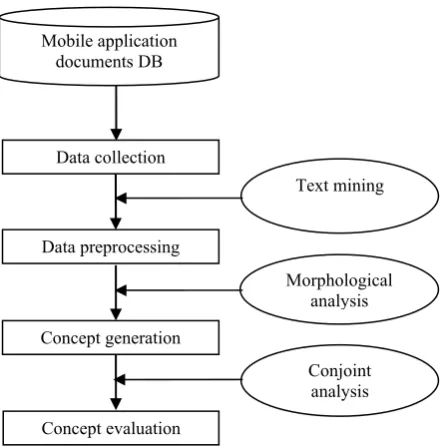
employing various methods like text mining, morphological analysis, and conjoint analysis. The approach is composed of four steps. First, documents regarding target mobile application services are collected from the application store website. Second, keywords are extracted by applying text mining to the collected documents and all documents are transformed to a keyword frequency vector. Third, the alternatives of mobile application service concepts are generated employing morphological analysis to the keyword frequency vector. Finally, the alternatives are evaluated through the application of conjoint analysis to the morphological box with the information of customers' rating. Fig. 1 depicts the overall process of this study. A detailed explanation is provided below.
Figure 1. Overall process of proposed approach
B. Data Collection
The data source of this study is mobile application service documents registered in iPhone Apps Plus (http://www.iPhoneAppsPlus.com). iPhone Apps Plus is a web site that provides information on applications for iPhone and iPod Touch from over 70 iTunes stores and from user reviews of applications written in dozens of language. The rating of each application, provided by users, against a set of criteria is also provided. Since iPhone Apps Plus tracks the rating and reviews of all iPhone applications in all iTunes application stores every hour, the latest applications for Apple’s iPhone and iPod Touch are always covered. Each application document registered in iPhone Apps Plus contains information such as title, registered date, category, maker, rating, file size, price, description, etc.
Since application documents are in HTML, they have to be converted into an appropriate form for analysis. First, the format of the collected document files is parsed into text. Subsequently, all the information contained in each parsed document file is extracted. Finally, extracted
information is into the database. With this process, all the information is prepared for the next step.
C. Data Preprocessing
As mobile application service documents are expressed in a natural language format, they should be transformed into structured forms appropriate for further analysis. At first, keywords are extracted by applying text mining to the application documents. Words that are closely associated with a specific mobile service and that appear frequently in application documents can be adopted as keywords. With extracted keywords, documents are transformed into a structured form, that is, keyword vectors. A keyword vector is composed of a data field that contains the frequency with which each keyword occurs in the documents. If a specific keyword is included in the description of a document, then the corresponding keyword vector field is filled with the frequency of occurrence. Fig.2. presents an example of the keyword vector into which mobile application service documents are transformed. In the Mobile Application Service 1 document, the first keyword occurs two times, the second keyword five times, and so on.
Figure 2. Example of keyword vector
D. Concept Generation
The process that leads to the discovery of new mobile service concepts and previously unidentified potential mobile service breakthroughs is based on keyword-based morphological analysis, as follows. First, dimension parameters are defined by breaking down the features of the target services into several attributes. They can be identified in various ways such as service components and service processes, according to the objectives or perspectives. Second, the shape parameters representing the possible and relevant conditions that each dimension can manifest should be decided. They are defined by affiliating keywords in keyword vector to each cluster extracted above. With these two steps, a morphological box of target service is identified. Third, all combinations that can produce unique sets of shapes are investigated. They can play the role of possible alternatives to the mobile service concept. Fourth, existing mobile service configurations are determined by mapping existing keywords into their associated morphology. The keyword vector enables the identification of a mobile service’s morphological shape. Assume that a morphological box of target service is identified and that one of its dimensions has three shapes, A, B, and C. If a mobile service document has more keywords associated with A than with B or C, the shape of this dimension can be given as A. Finally, unoccupied configurations in the
Mobile application service 1: (2, 5, 3, 1, 0, ..., 1) Mobile application service 2: (4, 5, 1, 6, 2, ..., 0)
...
Mobile application service N: (0, 1, 7, 2, 4, ..., 3) Data preprocessing
Concept generation
Morphological analysis
Concept evaluation Data collection Mobile application
documents DB
Text mining
morphological box are listed by excluding the existing morphology from all possible alternatives.
E. Concept Evaluation
The service concept vacuum of unexploited service opportunities needs to be evaluated to facilitate service concept selection. In this study, customers’ preference for the derived alternative mobile service concepts is selected as evaluation criteria and conjoint analysis is used as evaluation method. That is, the utility values calculated by conjoint analysis are customers' preference for the relevant alternatives. Among all possible combinations, an alternative with the highest utility value is selected as a promising one.
The process of alternatives evaluation by conjoint analysis is as follows. First, a model of preference and the data collection method are selected. Second, the profile of mobile service applications is constructed. Third, the measure for customers' preference is decided to calculate the utility of each level. Fourth, the part-worth of each attribute and level is calculated by applying such methods as MONANOVE, LINMAP, and regression. Finally, the promising concept of mobile application services is selected through combining each level with the highest utility value.
IV. CASE STUDY
To illustrate the process of executing and utilizing the proposed approach, we present a case study of the development of mobile game application service concepts. A. Data Collection
A total of 11,165 application documents that were classified in the game category of iPhone Apps Plus website and registered in 2009 were collected. Since application documents are in HTML, they have to be converted into an appropriate form for analysis. For this aim, we developed a Java-based parsing and mining program that consists of three modules: ‘Parse Files’, ‘Extract Information’, and ‘Insert into DB’. ‘Parse Files’ module changes the format of the collected document files into text. ‘Extract Information’ module extracts all the information contained in each parsed document file. ‘Insert into Database’ module inserts extracted information into the MS Access database. With this program, all the information was prepared for the next step.
B. Data Preporcessing
The collected data was pre-processed by extracting and filtering keywords. Among the information contained in DB, the descriptions of each application were used for the extraction of keywords since they explain the content of the mobile application services in detail. As keywords should be English nouns, descriptions expressed in other languages were excluded. Consequently, descriptions of 8,912 applications were gathered, and keywords were extracted with the text mining package, Text Analyst 2.1 from Microsystems Co. Ltd.
There were many keywords that are too general or insignificant to express the characteristics of mobile game
application services, and it is necessary to filter them with the involvement of domain experts. First, we excluded the keywords that did not have any explanatory power regarding the difference among mobile game application services or the characteristics of these application services. For example, keywords such as ‘app’ or ‘fun’ had a high frequency; however, it is very difficult to determine the difference or the characteristics of the mobile game application service through them. Second, keywords with the same meaning were treated as one keyword. For example, keywords such as ‘user interface’ and ‘UI’ were treated as the same. Third, only nouns were selected as keywords. After all the collected keywords were investigated with the help of a domain expert, 114 keywords remained. Finally, frequency vectors were constructed. If a specific keyword was included in the description of a mobile game application service, then the corresponding keyword vector field was filled with the frequency of occurrence. With this process, the keyword frequency vector with dimensions of 8,912 by 114 was constructed.
C. Concept Generation
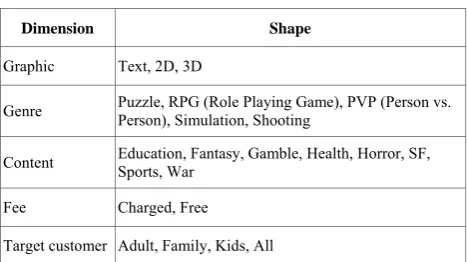
The first step of concept generation is to define dimension parameters to compose a morphological box for mobile game application services. For this aim, we broke down game services into seven dimensions – ‘Channel’, ‘ Machine’, ‘Graphic’, ‘Genre’, ‘Content’, ‘Fee’, and ‘Target Customer’ [22]. Among them, we excluded ‘Channel’ and ‘Machine’ since they had only one shape (online and smart phone, respectively).
The shapes that each dimension can take were defined by affiliating the 114 keywords to their corresponding dimensions. Then, keywords with similar matter were grouped together as a shape. For example, among the keywords affiliated to the ‘Content’ dimension, ‘poker’ and ‘ black jack’ were merged and used to define the ‘Gamble’ shape. The shape parameters of a dimension ‘Fee’ are defined to ‘Charged’ and ‘Free’ with the price information of each application. With this process, the morphological box for mobile game application services was identified as shown in Table I.
TABLE I.
MORPHOLOGICAL BOX OF MOBILE GAME SERVICES
Dimension Shape
Graphic Text, 2D, 3D
Genre Puzzle, RPG (Role Playing Game), PVP (Person vs. Person), Simulation, Shooting
Content Education, Fantasy, Gamble, Health, Horror, SF, Sports, War
Fee Charged, Free
All possible alternatives of mobile game application service concept can be produced by combining shapes in each dimension. The number of possible configurations was computed by multiplying the number of shapes in each dimension, creating 960 distinguishable combinations (i.e. 3 × 5 × 8 × 2 × 4).
D. Concept Evaluation
The 960 alternatives of mobile game service concept were evaluated through conjoint analysis as follows. First, the part-worth model was selected as a model of preference because the levels (shapes, in morphological analysis) in each attribute (dimension, in morphological analysis) had discrete relationships, not linear relationships. Second, for the data collection method, the full-profile approach was used. Third, the profile of mobile game service applications was constructed. Since the attribute and level in conjoint analysis correspond to the dimension and shape in morphological analysis, the morphological box derived at previous stage was used for profile. Fourth, the measure for customers' preference was decided to calculate the utility of each level. The information of 'customer rating' for each mobile application service (from 0 to 10) was used for this measure. If several mobile game application services exhibited the same configuration, the average values of rating information of these services were assigned to that configuration. Fifth, the part-worth of each attribute and level was calculated with ordinary least square (OSL) regression by using SPSS Release 19.0.
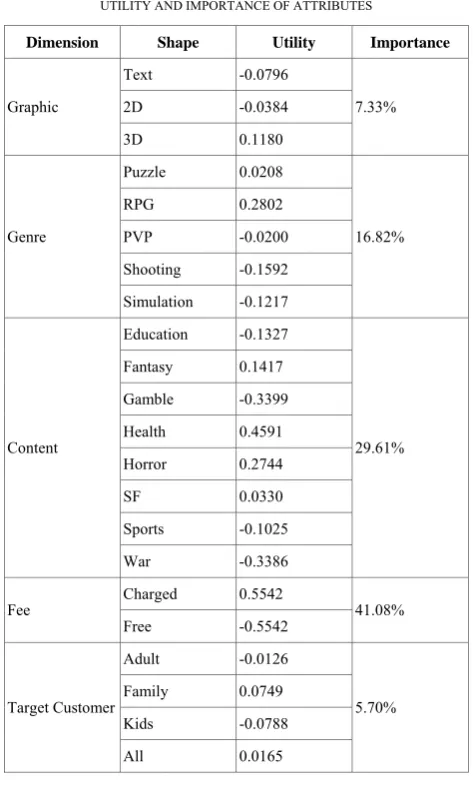
Table II exhibits the values of the part-worth of each level and the importance of each attribute. As shown in Table II, the levels with the highest part-worths in each attribute were ‘3D’, ‘RPG’, ‘Health’, ‘Charged’, and ‘Family’. Besides, the important of attributes can be calculated by examining the range of utility across all levels of the attribute, because this range represents the maximum impact that the attribute can have on an application service. In mobile game application services, ‘Fee’ was the most important attribute and service designers should pay the most attention to it during development process.
The overall utility of a configuration is the sum of the utility of each level selected in each attribute. By calculating the part-worths of the attributes, the utility of each configuration could be derived, as shown in Table III. The set of levels whose part-worth is the highest in each attribute was ‘3D–RPG–Health–Family’. This implies that 3D paid mobile application game for family whose genre is RPG about health has the highest utility from the perspectives of customers’ satisfaction. With this process, 960 alternatives could be prioritized and promising ones could be identified.
V. CONCLUSIONS
The main contributions of this study are as follows. First, the proposed approach can be systematically employed in the development of new mobile service concepts, ranging from the generation to the evaluation of concepts. Second, it overcomes the limitation of
conventional customer-centered approach, in that mobile service concepts are developed on the basis of the analysis of vast amounts of information from application documents. Therefore, this approach could overcome the shortcomings of conventional customer-centered approaches. Finally, it will provide service managers and designers with guidelines and implications in the real processes of mobile service concept development.
TABLE II.
UTILITY AND IMPORTANCE OF ATTRIBUTES
Dimension Shape Utility Importance
Graphic
Text -0.0796 7.33% 2D -0.0384 3D 0.1180
Genre
Puzzle 0.0208
16.82% RPG 0.2802 PVP -0.0200 Shooting -0.1592 Simulation -0.1217
Content
Education -0.1327
29.61% Fantasy 0.1417 Gamble -0.3399 Health 0.4591 Horror 0.2744 SF 0.0330 Sports -0.1025 War -0.3386
Fee Charged 0.5542 41.08%
Free -0.5542
Target Customer
Adult -0.0126
5.70% Family 0.0749 Kids -0.0788 All 0.0165
TABLE III.
LIST OF ALTERNATIVES ORDERED BY THEIR UTILITY VALUES
Alternatives Utility
3D - RPG - Health - Charged - Family 29.73
2D - RPG - Health - Charged - Family 27.29
3D - RPG - Horror - Charged - Family 26.03
… …
This research, however, is subject to some limitations, which are issues for further research. First, the process of morphological analysis, especially the definition of dimensions and shapes is qualitative, since it requires qualitative judgments. Data-driven approaches, such as factor analysis of extracted keywords, can be applied for overcoming this limitation. Second, the focus of this study is only on the service concept. Future studies can extend this approach to other service innovation processes such as system design and implementation. Furthermore, the introduction of other methodologies such as a technology roadmap can have interesting effects on the development of new mobile service concepts.
ACKNOWLEDGMENT
This work was supported by Hankook University of Foreign Studies (HUFS) Research Fund.
REFERENCES
[1] X.X. Shen, K.C. Tan, and M. Xie, “An Integrated approach to innovative product development using Kano’s model and QFD,” European Journal of Innovation, Vol. 3, No. 2,
pp. 91-99, 2000.
[2] C. Hipp and H. Gruup, “Innovation in the service sector: the demand for service specific innovation measurement concepts and typologies,” Research Policy, Vol. 34, No. 4,
pp. 517–535, 2005.
[3] J. Spohrer, P.P. Maglio, J. Bailey, and D. Gruhl, “Steps Toward a Science of Service systems,” Computer, Vol. 40,
No. 1, pp. 71-77, 2007.
[4] J. Howells, Innovation And Services: New Conceptual Frameworks, CRIC Discussion Paper No. 38, University of
Manchester, 2000.
[5] R. Davis, “Conceptualising fun in mobile commerce environments,” International Journal of Mobile Communications, Vol. 8, No. 1, pp. 12–40, 2010.
[6] S.M. Goldstein, R. Johnston, J. Duffy, and J. Rao, “The service concept: the missing link in service design research,” Journal of Operations Management, Vol. 20,
No. 2, pp. 121-134, 2002.
[7] W.H. Tsai, H.W. Lo, and W.C. Chou, “Evaluation of mobile services for the future of 3G operators,”
International Journal of Mobile Communications, Vol. 7,
No. 4, pp. 470-493, 2009.
[8] C. Lee, B. Song, and Y. Park, “Generation of new service concepts: A morphology analysis and genetic algorithm approach,” Expert Systems with Applications, Vol. 36, No.
10, pp. 12454-12460, 2009.
[9] A. Xu and Y. Yuan, “The impact of context and incentives on mobile service adoption,” International Journal of Mobile Communications, Vol. 7, No. 3, pp.363–381, 2009.
[10]Y. Park, H. Kim, and J. Lee, “An empirical analysis on consumer adoption of mobile phone and mobile content in Korea,” International Journal of Mobile Communications,
Vol. 8, No. 6, pp. 667–688, 2010.
[11]M. Kim and C. Kim, “A Methodology for the Development of New Mobile Application Service Concepts,” Proceedings of the 2013 International Conference on Internet Service Technology and Information Engineering, May 2013.
[12]J.G. Wissema, “Morphological analysis: its application to a company TF investigation,” Futures, Vol. 8, No. 2, pp.
146-153, 1976.
[13]F. Zwicky, Discovery, Invention, Research - Through the Morphological approach. Toronto: Macmillan Company,
1969.
[14]D. Cuesta-Frau, M. Aboy, J. McNames, and B. Goldstein, “Morphology analysis of intracranial pressure using pattern matching techniques,” Proceedings of the 25th Annual International Conference of the IEEE EMBS, September
2003.
[15]J.M. Higgins, “Innovate or evaporate: Creative techniques for strategists,” Long Range Planning, Vol. 29, No. 3, pp.
370–380, 1996.
[16]H.H. Lai, Y.C. Lin, and C.H. Yeh, “Form design of product image using grey relational analysis and neural network models,” Computers and Operations Research,
Vol. 32, No. 10, pp. 2689–2711, 2005.
[17]B. Yoon and Y. Park, Y, “A systematic approach for identifying technology opportunities: Keyword-based morphology analysis,” Technological Forecasting and Social Change, Vol. 72, No. 2, pp. 145–160, 2005.
[18]B. Yoon and Y. Park, “Development of New Technology Forecasting Algorithm: Hybrid Approach for Morphology Analysis and Conjoint Analysis of Patent Information,”
IEEE Transactions on Engineering Management, Vol. 54,
No. 3, pp. 588-599, 2007.
[19]V. Srinivasan and A.D. Shocker, “Estimating the weights for multiple attributes in a composite criterion using pair-wise judgments,” Psychometrika, Vol. 38, pp. 479-493,
1973.
[20]P.E. Green, A.M. Krieger, and Y.L. Wind, “Thirty years of conjoint analysis: Reflections and prospects,” Interfaces,
Vol. 31, No. 3, pp. S56-S73, 2001.
[21]C. Kim, S. Choe, C. Choi, and Y. Park, “A systematic approach to new mobile service creation,” Expert System with Applications, Vol. 35, No. 3, pp. 762-771, 2008.
[22]C. Lee, B. Song, and Y. Park, “Generation of new service concepts: a morphology analysis and genetic algorithm approach,” Expert Systems with Applications, Vol. 36, No.
10, pp. 12454–12460, 2009.
Moon-soo Kim is a professor of Department of Industrial & Management Engineering, Hankuk University of Foreign Studies (HUFS) in Korea. He has experienced as a project manager at ETRI for 5 years prior to joining the university. His research focuses on technology management and its various application fields. Dr. Kim has published papers in several international journals such as International Journal of Innovation Management, Scientometrics, Technology Analysis & Strategic Management, Omega, ETRI J, Telecommunications Policy and Technological Forecasting & Social Change, etc., and also in several domestic journals. He holds a Ph.D. from Seoul National University in Korea.