An Experimental Study on The Behavior of M20
Grade Cement Concrete by Partial Replacement
of Cement by Rice Husk Ash (RHA)
Harish B A Hanumesh B M
Assistant Professor M. Tech Student Department of Civil Engineering Department of Civil Engineering GMIT, Davanagere, Karnataka, India UBDTCE, Davanagere, Karnataka, India
Siddesh T M Sanjay S J
M. Tech Student M. Tech Student Department of Civil Engineering Department of Civil Engineering UBDTCE, Davanagere, Karnataka, India UBDTCE, Davanagere, Karnataka, India
Siddhalingesh B K
M. Tech Student Department of Civil Engineering UBDTCE, Davanagere, Karnataka, India
Abstract
Concrete is no longer made of aggregates, Portland cement and water only it is not always incorporate so it requires at least one of the additional ingredients such as admixtures, supplementary Cementitious material or fibers to increase the strength and durability. Rice husk ash is one of the pozzolanic materials that can be blended with Portland cement for the production of durable concrete. Supplementary Cementitious materials prove to be effective to meet most of the requirements of durable concrete. Rice husk ash is found to be greater to other supplementary materials like silica fume and fly ash. In the current study an attempt has been made to investigate the strength parameters of M20 concrete (compressive and split tensile). For control concrete, IS method of mix design is adopted. Partial replacement of cement has been made with different percentage of RHA namely, 5%, 10% and 15%. Large range of curing periods starting from 7, 14 and 28 days are considered in the present study.
Keywords: Rice husk ash (RHA), Pozzolanic, Mix-design, Workability, Compression, Split tensile
________________________________________________________________________________________________________
I. INTRODUCTION
II. STATEMENT OF PROBLEM
A comparative evaluation of strength characteristics of control concrete of grade M20 and rice husk ash concrete produced by replacing cement by raw RHA in different percentage (0%, 5%, 10%, 15%.)
III. OBJECTIVE OF THE STUDY
The following are the main objective of study:
To compare the compressive strength of control concrete of M20 grade and rice husk ash concrete produced by replacing cement by raw RHA in different percentage (0%, 5%, 10%, 15%.)
To evaluate the split tensile strength of control concrete of M20 grade and rice husk ash concrete produced by replacing cement by raw RHA in different percentage (0%, 5%, 10%, 15%.)
To determine the optimum dosage of the rice husk ash to be added to the concrete mix. To determine the effect of rice husk ash on workability.
IV. SCOPE OF THE STUDY
The increasing demand for producing durable materials is the outcome of fast polluting environment. Supplementary cementitious materials prove to be effective to meet most of the requirements of the durable concrete. Rice husk ash is found to be greater to other supplementary materials like silica fume and fly ash.
V. PROPERTIES OF RICE HUSK ASH (RHA)
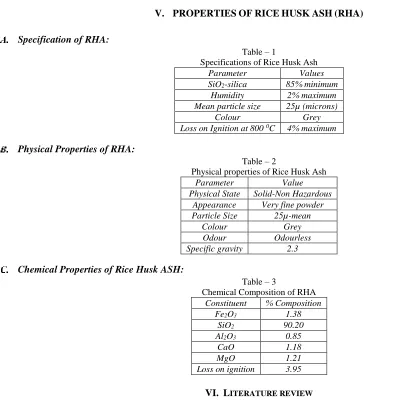
Specification of RHA:
Table – 1
Specifications of Rice Husk Ash Parameter Values SiO2-silica 85% minimum
Humidity 2% maximum Mean particle size 25µ (microns)
Colour Grey
Loss on Ignition at 800 0C 4% maximum
Physical Properties of RHA:
Table – 2
Physical properties of Rice Husk Ash Parameter Value Physical State Solid-Non Hazardous
Appearance Very fine powder Particle Size 25µ-mean
Colour Grey
Odour Odourless Specific gravity 2.3
Chemical Properties of Rice Husk ASH:
Table – 3
Chemical Composition of RHA Constituent % Composition
Fe2O3 1.38
SiO2 90.20
Al2O3 0.85
CaO 1.18
MgO 1.21
Loss on ignition 3.95
ingredients such as admixtures, supplementary cementitious material or fibers to enhance its strength and durability. The use of mineral admixture in combination with chemical admixture has allowed the concrete technologists to tailor the concrete for many specific requirements. Amongst the mineral admixture, silica fume, because of its finely divided state and very high percentage of amorphous silica, proved to be most useful, if not essential for the development of very high strength concretes and concrete of very high durability i.e. high performance concrete. Therefore it is being used on a worldwide scale in concrete, for the making of high performance concrete. In spite of its numerous advantages silica fume suffers from one major disadvantage that it is imported therefore, very costly. In this work an attempt has made to find a suitable alternate of rice husk ash. The objective of research paper to analysis the M-30 and M-60 grade concrete and find what effect on compressive strength of concrete at 7 days and 28 days. Replacement of cement by rice husk ash showed in M30 grade concrete compressive strength improvement up to the replacement of 10% in all ages. Both concrete mixes at 10% rice husk ash level showed 3 to 10% increase in compressive strength. Rice husk ash levels of 15 to 20% showed reduction in compressive strength in all ages.
Study of the Properties of Concrete by Partial Replacement of Ordinary Portland cements by Rice Husk Ash by Abhilash Shukla Et.Al. (2011):
Over the past years, there has been seen an increasing number of research on the use and utilization of industrial, agricultural and thermoelectric plants residue in the production of concrete. Different materials with pozzolanic properties such as fly ash, condensed silica fume, blast furnace slag and rice husk ash have played an important part in the production of high performance concrete. During the late 20th century, there has been an increase in the consumption of mineral admixture by the cement and concrete industries. The rate is expected to increase. The increasing demand for cement and concrete is met by the partial cement replacement. Substantial energy and cost savings can result when industrial by-products are used as a partial replacement for the energy intensive Portland cement. The presence of mineral admixture and mineral admixtures in concrete is known to impart significant improvement in workability and durability. Among the different existing residues and by products, the possibility of using rice husk ash in the production of structural concrete is very important for India. India is the second largest rice paddy cultivating country in the world. Both the technical advantages offered by structural concrete containing rice husk ash and the social benefits related to the decrease in number of problems of ash disposal in the environment have simulated the development of research into the potentialities of this material.
Benefits of Use of Rice Husk Ash in Concrete by P. Chandan kumar and P. Malleswara Rao (2010):
In this investigation, a feasibility study is made to use Rice Husk Ash as an admixture to an already replaced Cement with fly ash (Portland Pozzolana Cement) in Concrete, and an attempt has been made to investigate the strength parameters of concrete (Compressive and Flexural). For normal concrete, Indian Standard (IS) method of mix design is adopted. Five different replacement levels namely 5%, 7.5%, 10%, 12.5% and 15% are chosen for the study concerned for replacement method. A range of curing periods starting from 3 days, 7 days, 28 days and 56 days are considered in the present study. Strength and cost savings of Rice Husk Ash concrete proves it to be a better material than various other supplementary materials which involve higher transport cost. By using this Rice husk ash in concrete as replacement the emission of greenhouse gases can be decreased to a greater extent. As a result there is greater possibility to gain more number of carbon credits.
Effect of Rice Husk Ash on Properties of Concrete by Makarand Suresh Kulkarni et.al. (2014):
The optimized RHA, by controlled burn and/or grinding, has been used as a pozzolanic material in cement and concrete. Using it provides several advantages, such as improved strength and durability properties, and environmental benefits related to the disposal of waste materials and to reduced carbon dioxide emissions. Up to now, little research has been done to investigate the use of RHA as supplementary material in cement and concrete production in Vietnam. The main objective of this work is to study the suitability of the rice husk ash as a pozzolanic material for cement replacement in concrete. However it is expected that the use of rice husk ash in concrete improve the strength properties of concrete. Also it is an attempt made to develop the concrete using rice husk ash as a source material for partial replacement of cement, which satisfies the various structural properties of concrete like compressive strength. From the entire experimental work & studies it is concluded that mix M2 (M0+20%RHA) is the best combination among all mixes, which gives max, tensile, flexure & compression strength over normal concrete.
Effect of Partial Replacement of Cement by Rice Husk Ash in Concrete by Manu Chaudhary et.al. (2013):
VII.MATERIALS AND METHODOLOGY
Materials Used:
Cement:
In this experiment 43 grade ordinary Portland cement (OPC) with brand name Ultratech was used for all concrete mixes. The cement used was fresh and without any lumps. The testing of cement was done as per IS 8112:1989.
Table – 4
Physical properties of cement
Sl. No. Name Result
1. Standard consistency 30% 2. Initial setting time 31 minutes 3. Specific gravity 3.15
Fine Aggregate:
The sand used for the experimental program was locally procured and was conforming to zone-II as per IS 383:1970. Table – 5
Physical properties of fine aggregate
Sl. No. Name Result
1. Specific gravity 2.64 2. Fineness modulus 2.25 (Fine Sand)
3. Grading Zone II
Coarse Aggregate:
Locally available coarse aggregate having the maximum size of 20mm were used in the present work. The specific gravity of coarse aggregate is found to be 2.66.
Rice husk ash:
Rice husk ash is obtained from local rice mill in Davanagere. Which is burnt in furnace and the process of burning is uncontrolled.
Water:
Portable tap water was used for the preparation of specimens and for the curing of specimens. Portable water as available in GMIT campus was used for the preparation of specimens.
The standard tests are conducted on cement, fine aggregate and coarse aggregate then results are tabulated in table 4.
Concrete Mix Design:
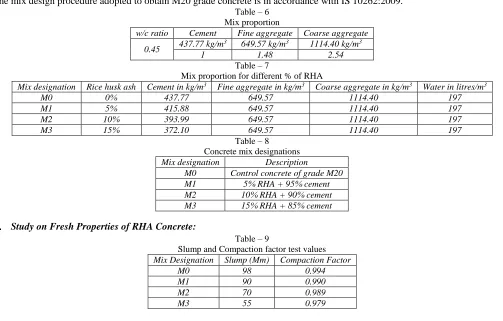
The mix design procedure adopted to obtain M20 grade concrete is in accordance with IS 10262:2009. Table – 6
Mix proportion
w/c ratio Cement Fine aggregate Coarse aggregate
0.45 437.77 kg/m
3 649.57 kg/m3 1114.40 kg/m3
1 1.48 2.54
Table – 7
Mix proportion for different % of RHA
Mix designation Rice husk ash Cement in kg/m3 Fine aggregate in kg/m3 Coarse aggregate in kg/m3 Water in litres/m3
M0 0% 437.77 649.57 1114.40 197
M1 5% 415.88 649.57 1114.40 197
M2 10% 393.99 649.57 1114.40 197
M3 15% 372.10 649.57 1114.40 197
Table – 8 Concrete mix designations Mix designation Description
M0 Control concrete of grade M20 M1 5% RHA + 95% cement M2 10% RHA + 90% cement M3 15% RHA + 85% cement
Study on Fresh Properties of RHA Concrete:
Table – 9
Slump and Compaction factor test values Mix Designation Slump (Mm) Compaction Factor
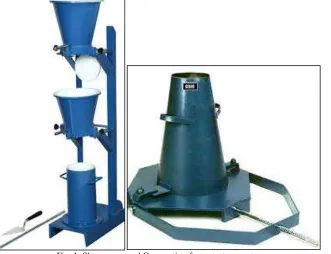
The slump and compaction factor values decreased upon the inclusion of RHA as partial replacement of ordinary Portland cement. Thus it can be inferred that to attain the required workability, mixes containing RHA will required higher water content than the corresponding conventional mixes.
Fig. 1: Slump cone and Compaction factor test apparatus
VIII. EXPERIMENTAL RESULTS
Compressive Strength Test Results:
For each concrete mix the compressive strength is determined on the three 150X150X150 mm cubes at 7, 14 and 28 days of curing. Following table give the compressive strength test results of control concrete and RHA concrete produced with 5%, 10% and 15% of RHA.
Table – 10
Overall results of compressive strength % of RHA
(Mix Designation)
Compressive strength in N/mm2 Average compressive strength in N/mm2 7 days 14 days 28 days 7 days 14 days 28 days
0% (M0)
30.00 31.11 53.11
29.25 33.85 42.88 29.77 34.22 37.77
28.00 36.22 37.77
5% (M1)
27.11 30.22 40.00
29.33 39.99 43.70 30.22 50.22 42.22
30.66 39.55 48.88
10% (M2)
28.00 28.44 35.11
29.03 35.55 40.29 33.33 38.22 46.22
25.27 40.00 39.55
15% (M3)
31.33 35.11 33.33
26.36 31.40 39.10 24.44 35.55 46.66
Fig. 2: Overall Results of Compressive strength
Split Tensile Strength Test Results:
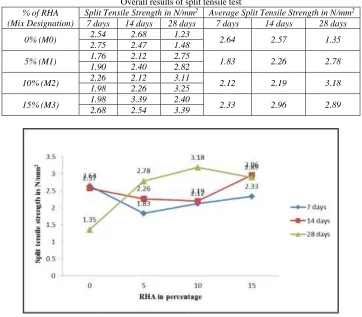
Test has been conducted after 7, 14 and 28 days of curing. Split tensile test is conducted on 150 mm diameter and 300 mm height cylinders. Following table give the split tensile strength test results of control concrete and RHA concrete produced with 5%, 10% and 15% of RHA.
Table – 11
Overall results of split tensile test % of RHA
(Mix Designation)
Split Tensile Strength in N/mm2 Average Split Tensile Strength in N/mm2 7 days 14 days 28 days 7 days 14 days 28 days
0% (M0) 2.54 2.68 1.23 2.64 2.57 1.35
2.75 2.47 1.48
5% (M1) 1.76 2.12 2.75 1.83 2.26 2.78
1.90 2.40 2.82
10% (M2) 2.26 2.12 3.11 2.12 2.19 3.18
1.98 2.26 3.25
15% (M3) 1.98 3.39 2.40 2.33 2.96 2.89
2.68 2.54 3.39
Fig. 3: Overall Results of Split tensile strength
IX. OBSERVATION AND DISCUSSIONS
The result of Split Tensile strength of concrete cylinders shows that the split tensile strength reduces as the percentage replacement of RHA increased. However the Split Tensile strength increased as the number of days of curing increased for each percentage of RHA replacement.
X. CONCLUSION AND SCOPE FOR FUTURE WORK
Conclusions:
Based on the limited experimental study carried out on the strength behavior of Rice Husk Ash Concrete, the following conclusions are drawn:
1) According to the test results of the compressive strength, addition of 5% of RHA shows a better result than the control concrete for M20 grade of concrete.
2) According to the results of the Split Tensile strength, addition of 5-10% of RHA shows a better result in split tensile strength at 28 days of curing.
3) As the replacement of cement by RHA in concrete increases, the workability of concrete decreases.
4) Rice husk ash generated as a waste material in cities, using it as a replacement to cement in concrete makes it a useful material and reduces the cost of construction.
5) The optimum strength is obtained at the level of 5 % of OPC replaced by RHA for M20 grade concrete.
6) The replacement of cement with RHA results in reduction of density of concrete. This is due to the fact that the specific gravity of the RHA is much lower than that of cement.
7) As the rice husk ash is a waste material, it reduces the cost of construction.
Scope for Future Work:
1) In the present study M20 grade concrete was considered, the present work can be extended for higher grades of concrete. 2) In the present study 5%, 10% and 15% of cement is replaced by Rice husk ash was considered, the present work can be
extended for higher percentage of RHA.
3) In the present study influence of RHA on compressive and split tensile were investigated, the present work can be extended for higher percentage of RHA on flexural tensile of concrete.
4) Other innovative low cost locally available materials that can be used, as mineral admixtures are required to be developed.
REFERENCES
[1] Abhilash Shukla et.al., “Study of the Properties of Concrete by Partial Replacement of Ordinary Portland cement by Rice Husk Ash” International Journal of Earth Sciences and Engineering, ISSN 0974-5904, Volume 04, No 06 SPL, October 2011, pp. 965-968.
[2] Anil kumarsuman, Anil kumarsaxena, T R Arora, “Assessment of concrete strength using partial replacement of cement for RHA”, vol-4, ISSN 2231-2307, pages 131-133.
[3] Makarand Suresh Kulkarni et.al., “Effect of Rice Husk Ash on Properties of Concrete” Journal of Civil Engineering and Environmental Technology, Print ISSN: 2349-8404; Online ISSN: 2349-879X; Volume 1, Number 1; August, 2014 pp. 26-29.
[4] Manu Chaudhary et.al, “Effect of Partial Replacement of Cement by Rice Husk Ash in Concrete” International Journal of Science and Research (IJSR). [5] Naveen et.al, “Effect of Rice Husk on Compressive Strength of Concrete” International Journal on Emerging Technologies 6(1): 144-150 (2015). [6] P. Chandan Kumar and P. Malleswara Rao “Benefits of Use of Rice Husk Ash in Concrete” Jr. of Industrial Pollution Control 26 (2)(2010) pp 239-241. [7] Deepa G Nair, K Sivaraman and Job Thomas, “Mechanical properties of RHA-High strength concrete”, AJER, vol-3, ISSN: 2320-0847, pages 14-18. [8] M.S. Shetty “Concrete Technology” S.Chand and company Ltd, 2008.
IS Codes
[9] IS 10262:2009 “Specification for concrete mix proportioning”, Bureau of Indian standards? [10] IS 456:2000 “Plain and Reinforced concrete – code of practice”, Bureau of Indian standards. [11] IS 9103:1999 “Specification for concrete admixture”, Bureau of Indian standards? [12] IS 383:1970 “Specifications for coarse and fine aggregate”, Bureau of Indian standards.