Review on Mona: Secure Multi-Owner Data
Sharing for Dynamic Groups in the Cloud
1 Swapnil N. Naidu, 2 Sunilkumar N. Jaiswal, 3 Sujeet S. More
1
Research Scholar, JNEC, Aurangabad.
2
HOD IT, JNEC, Aurangabad.
3 Asst. Professor, JNEC, Aurangabad
.
Abstract - With the character of low maintenance, cloud computing provides an economical and efficient solution for sharing group resource among cloud users. Unfortunately, sharing data in a multi-owner manner while preserving data and identity privacy from an un trusted cloud is still a challenging issue, due to the frequent change of the membership. A secure multi owner data sharing scheme, named Mona, for dynamic groups in the cloud is proposed. By leveraging group signature and dynamic broadcast encryption techniques, any cloud user can anonymously share data with others. Meanwhile, the storage overhead and encryption computation cost of our scheme are independent with the number of revoked users. In addition, to it analyzing the security of the scheme with rigorous proofs, and demonstrate the efficiency of the scheme in the experiments.
Keywords -Multi Owner, Untrusted, Dynamic Groups.
1. Introduction
Cloud computing is the use of computing resources (hardware and software) that are delivered as a service over a network (typically the Internet). The name comes from the common use of a cloud-shaped symbol as an abstraction for the complex infrastructure it contains in system diagrams. Cloud computing entrusts remote services with a user's data, software and computation. Cloud computing consists of hardware and software resources made available on the Internet as managed third-party services. These services typically provide access to advanced software applications and high-end networks of server computers.
1.1 Benefits of Cloud Computing [2]
1. Achieve economies of scale – increase volume output or productivity with fewer people. Your cost per unit, project or product plummets.
2. Reduce spending on technology infrastructure. Maintain easy access to your information with minimal upfront spending. Pay as you go (weekly, quarterly or yearly), based on demand. 3. Globalize your workforce on the cheap. People
worldwide can access the cloud, provided they have an Internet connection.
4. Streamline processes. Get more work done in less time with less people.
5. Reduce capital costs. There’s no need to spend big money on hardware, software or licensing fees.
6. Improve accessibility. You have access anytime, anywhere, making your life so much easier! 7. Monitor projects more effectively. Stay within
budget and ahead of completion cycle times. 8. Less personnel training is needed. It takes
fewer people to do more work on a cloud, with a minimal learning curve on hardware and software issues.
9. Minimize licensing new software. Stretch and grow without the need to buy expensive software licenses or programs.
10. Improve flexibility. You can change direction without serious “people” or “financial” issues at stake.
1.5 Advantages
1. Price: Pay for only the resources used.
2. Security: Cloud instances are isolated in the network from other instances for improved security.
4. Scalability: Auto-deploy cloud instances when needed.
5. Uptime: Uses multiple servers for maximum redundancies. In case of server failure, instances can be automatically created on another server. 6. Control: Able to login from any location. Server
snapshot and a software library lets you deploy custom instances.
7. Traffic: Deals with spike in traffic with quick deployment of additional instances to handle the load.
CLOUD computing is recognized as an alternative to traditional information technology [2] due to its intrinsic resource-sharing and low-maintenance characteristics. In cloud computing, the cloud service providers (CSPs), such as Amazon, are able to deliver various services to cloud users with the help of powerful datacenters. By migrating the local data management systems into cloud servers, users can enjoy high-quality services and save significant investments on their local infrastructures. One of the most fundamental services offered by cloud providers is data storage. Let us consider a practical data application. A company allows its staffs in the same group or department to store and share files in the cloud. By utilizing the cloud, the staffs can be completely released from the troublesome local data storage and maintenance. However, it also poses a significant risk to the confidentiality of those stored files. Specifically, the cloud servers managed by cloud providers are not fully trusted by users while the data files stored in the cloud may be sensitive and confidential, such as business plans. To preserve data privacy, a basic solution is to encrypt data files, and then upload the encrypted data into the cloud [3]. Unfortunately, designing an efficient and secure data sharing scheme for groups in the cloud is not an easy task due to the following challenging issues.
First, identity privacy is one of the most significant obstacles for the wide deployment of cloud computing. Without the guarantee of identity privacy, users may be unwilling to join in cloud computing systems because their real identities could be easily disclosed to cloud providers and attackers. On the other hand, unconditional identity privacy may incur the abuse of privacy. For example, a misbehaved staff can deceive others in the company by sharing false files without being traceable. Therefore, traceability, which enables the group manager (e.g., a company manager) to reveal the real identity of a user, is also highly desirable. Second, it is highly recommended that any member in a group should be able to fully enjoy the data storing and sharing services provided by the cloud, which is defined as the multiple-owner manner. Compared with the single-owner manner [4], where only the group manager can store and modify data in the cloud, the multiple-owner manner is more flexible in practical
applications. More concretely, each user in the group is able to not only read data, but also modify his/her part of data in the entire data file shared by the company. Last but not least, groups are normally dynamic in practice, e.g., new staff participation and current employee revocation in a company. The changes of membership make secure data sharing extremely difficult. On one hand, the anonymous system challenges new granted users to learn the content of data files stored before their participation, because it is impossible for new granted users to contact with anonymous data owners, and obtain the corresponding decryption keys. On the other hand, an efficient membership revocation mechanism without updating the secret keys of the remaining users is also desired to minimize the complexity of key management.
2. Literature Survey
2.1 Plutus: Scalable Secure File Sharing on Untrusted Storage [5]
Plutus is a cryptographic storage system that enables secure file sharing without placing much trust on the file servers. In particular, it makes novel use of cryptographic primitives to protect and share files. Plutus features highly scalable key management while allowing individual users to retain direct control over who gets access to their files[5]. We explain the mechanisms in Plutus to reduce the number of cryptographic keys exchanged between users by using filegroups, distinguish file read and write access, handle user revocation efficiently, and allow an untrusted server to authorize file writes. We have built a prototype of Plutus on OpenAFS. Measurements of this prototype show that Plutus achieves strong security with overhead comparable to systems that encrypt all network traffic.
2.2 Sirius: Securing Remote Untrusted Storage [6]
2.3 Improved Proxy Re-Encryption Schemes with Applications to Secure Distributed Storage [7]
In 1998, Blaze, Bleumer, and Strauss (BBS) proposed an application called atomic proxy re-encryption, in which a semi trusted proxy converts a cipher text for Alice into a cipher text for Bob without seeing the underlying plaintext[7]. We predict that fast and secure re-encryption will become increasingly popular as a method for managing encrypted file systems. Although efficiently computable, the wide-spread adoption of BBS re-encryption has been hindered by considerable security risks. Following recent work of Dodis and Ivan, we present new re-encryption schemes that realize a stronger notion of security and demonstrate the usefulness of proxy re-encryption as a method of adding access control to a secure file system. Performance measurements of our experimental file system demonstrate that proxy re-encryption can work effectively in practice.
2.4 Secure Provenance: The Essential of Bread and Butter of Data Forensics in Cloud Computing [8]
Secure provenance that records ownership and process history of data objects is vital to the success of data forensics in cloud computing, yet it is still a challenging issue today[8]. In this paper, to tackle this unexplored area in cloud computing, we proposed a new secure provenance scheme based on the bilinear pairing techniques. As the essential bread and butter of data forensics and post investigation in cloud computing, the proposed scheme is characterized by providing the information confidentiality on sensitive documents stored in cloud, anonymous authentication on user access, and provenance tracking on disputed documents. With the provable security techniques, we formally demonstrate the proposed scheme is secure in the standard model.
2.5 Cipher text-Policy Attribute-Based Encryption: An Expressive, Efficient, and Provably Secure Realization [9]
We present a new methodology for realizing Cipher text-Policy Attribute Encryption (CP-ABE) under concrete and no interactive cryptographic assumptions in the standard model[9]. Our solutions allow any encryption to specify access control in terms of any access formula over the attributes in the system. In our most efficient system, cipher text size, encryption, and decryption time scales linearly with the complexity of the access formula[9]. The only previous work to achieve these parameters was limited to a proof in the generic group model. We present three constructions within our framework. Our first system is proven selectively secure under a assumption that we
call the decisional Parallel Bilinear Diffie-Hellman Exponent (PBDHE) assumption which can be viewed as a generalization of the BDHE assumption.
Our next two constructions provide performance tradeoffs to achieve provable security respectively under the (weaker) decisional Bilinear-Diffie-Hellman Exponent and decisional Bilinear Diffie-Hellman assumptions.
3. System Development
3.1 Proposed System
1. We propose a secure multi-owner data sharing scheme. It implies that any user in the group can securely share data with others by the untrusted cloud.
2. Our proposed scheme is able to support dynamic groups efficiently. Specifically, new granted users can directly decrypt data files uploaded before their participation without contacting with data owners. User revocation can be easily achieved through a novel revocation list without updating the secret keys of the remaining users. The size and computation overhead of encryption are constant and independent with the number of revoked users.
3. We provide secure and privacy-preserving access control to users, which guarantees any member in a group to anonymously utilize the cloud resource. Moreover, the real identities of data owners can be revealed by the group manager when disputes occur.
4. We provide rigorous security analysis, and perform extensive simulations to demonstrate the efficiency of our scheme in terms of storage and computation overhead.
3.2 Advantages of Proposed System
• Any user in the group can store and share data
files with others by the cloud.
• The encryption complexity and size of cipher texts are independent with the number of revoked users in the system.
• User revocation can be achieved without updating the private keys of the remaining users.
• A new user can directly decrypt the files stored in
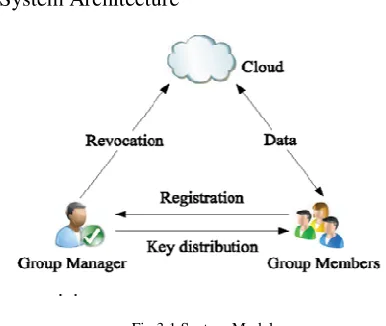
3.3 System Architecture
Fig 3.1 System Model
3.5 System Modules Description
3.5.1.Cloud Module
In this module, we create a local Cloud and provide priced abundant storage services. The users can upload their data in the cloud. We develop this module, where the cloud storage can be made secure. However, the cloud is not fully trusted by users since the CSPs are very likely to be outside of the cloud users’ trusted domain. Similar to we assume that the cloud server is honest but curious. That is, the cloud server will not maliciously delete or modify user data due to the protection of data auditing schemes, but will try to learn the content of the stored data and the identities of cloud users.
3.5.2. Group Manager Module
Group manager takes charge of followings:
1. System parameters generation, 2. User registration,
3. User revocation, and
4. Revealing the real identity of a dispute data owner.
Therefore, we assume that the group manager is fully trusted by the other parties. The Group manager is the admin. The group manager has the logs of each and every process in the cloud. The group manager is responsible for user registration and also user revocation too.
3.5.3.Group Member Module
Group members are a set of registered users that will
1. Store their private data into the cloud server and 2. Share them with others in the group.
Note that, the group membership is dynamically changed, due to the staff resignation and new employee participation in the company. The group member has the ownership of changing the files in the group. Whoever in the group can view the files which are uploaded in their group and also modify it. The group meme
3.5.4. File Security Module
1. Encrypting the data file.
2. File stored in the cloud can be deleted by either the group manager or the data owner. (i.e., the member who uploaded the file into the server).
3.5.5. Group Signature Module [11]
A group signature scheme allows any member of the group to sign messages while keeping the identity secret from verifiers. Besides, the designated group manager can reveal the identity of the signature’s originator when a dispute occurs, which is denoted as traceability.
3.5.6. User Revocation Module
User revocation is performed by the group manager via a public available revocation list (RL), based on which group members can encrypt their data files and ensure the confidentiality against the revoked users.
4. Conclusion
In this paper multiple users are able to share their data with other group members while maintaining identity privacy.
References
[1] Xuefeng Liu, Yuqing Zhang, Member, IEEE, Boyang Wang, and Jingbo Yan,” Mona: Secure Multi-Owner Data Sharing for Dynamic Groups in the Cloud” IEEE TRANSACTIONS ON PARALLEL AND DISTRIBUTED SYSTEMS, VOL. 24, NO. 6, JUNE 2013.
[2] M. Armbrust, A. Fox, R. Griffith, A.D. Joseph, R.H. Katz, A. Konwinski, G. Lee, D.A. Patterson, A. Rabkin, I. Stoica, and M. Zaharia, “A View of Cloud Computing,” Comm. ACM, vol. 53,no. 4, pp. 50-58, Apr. 2010.
[3] S. Kamara and K. Lauter, “Cryptographic Cloud Storage,” Proc.Int’l Conf. Financial Cryptography and Data Security (FC), pp. 136-149, Jan. 2010.
[5] M. Kallahalla, E. Riedel, R. Swaminathan, Q. Wang, and K. Fu,“Plutus: Scalable Secure File Sharing on Untrusted Storage,” Proc.USENIX Conf. File and Storage Technologies, pp. 29-42, 2003.
[6] E. Goh, H. Shacham, N. Modadugu, and D. Boneh, “Sirius:Securing Remote Untrusted Storage,” Proc. Network and Distributed Systems Security Symp. (NDSS), pp. 131-145, 2003.
[7] G. Ateniese, K. Fu, M. Green, and S. Hohenberger, “Improved Proxy Re-Encryption Schemes with Applications to Secure Distributed Storage,” Proc. Network and Distributed Systems Security Symp. (NDSS), pp. 29-43, 2005.
[8] R. Lu, X. Lin, X. Liang, and X. Shen, “Secure Provenance: The Essential of Bread and Butter of Data Forensics in Cloud Computing,” Proc. ACM Symp. Information, Computer and Comm.Security, pp. 282-292, 2010.
[9] B. Waters, “Ciphertext-Policy Attribute-Based Encryption: An Expressive, Efficient, and Provably Secure Realization,” Proc. Int’l Conf. Practice and Theory in Public Key Cryptography Conf. Public KeyCryptography, ttp://eprint.iacr.org/2008/290.pdf, 2008.
[10] V. Goyal, O. Pandey, A. Sahai, and B. Waters, “Attribute-Based Encryption for Fine-Grained Access Control of Encrypted Data,” Proc. ACM Conf. Computer and Comm. Security (CCS),pp. 89-98, 2006. [11] D. Boneh, X. Boyen, and H. Shacham, “Short Group
Signature,” Proc. Int’l Cryptology Conf. Advances in Cryptology (CRYPTO), pp. 41-55, 2004.
[12] D. Boneh, X. Boyen, and E. Goh, “Hierarchical Identity Based Encryption with Constant Size Ciphertext,” Proc. Ann. Int’l Conf. Theory and Applications of Cryptographic Techniques (EUROCRYPT), pp. 440-456, 2005.
[13] C. Delerablee, P. Paillier, and D. Pointcheval, “Fully Collusion Secure Dynamic Broadcast Encryption with Constant-Size Ciphertexts or Decryption Keys,” Proc. First Int’l Conf. Pairing-Based Cryptography, pp. 39-59, 2007.
[14] D. Chaum and E. van Heyst, “Group Signatures,” Proc. Int’l Conf. Theory and Applications of Cryptographic Techniques (EUROCRYPT), pp. 257-265, 1991. [15] A. Fiat and M. Naor, “Broadcast Encryption,” Proc.
Int’l Cryptology Conf. Advances in Cryptology (CRYPTO), pp. 480-491, 1993.
Author Profile
Swapnil Naidu received B.E (Comp sci&Engg) degree from Dr.B.A.M.University, Aurangabad; 2009.He is currently working towards Masters in Computer & Sci Engg from Dr.B.A.M.University. His research interests focuses on cloud computing, cryptography and security.
Sunilkumar N. Jaiswal is Head of Information and Technology Dept.His research interests include cloud computing, operating systems and security.