MANET: ROUTING PROTOCOLS AND PERFORMANCE ISSUES
Rajat Dixit1, Dr. Sanjeev Sharma2I. INTRODUCTION
With the widespread rapid development of computers and the wireless communication, the mobile computing has already become the field of computer communications in high-profile link. Mobile Ad Hoc Network (MANET) is a completely wireless connectivity through the nodes constructed by the actions of the network, which usually has a dynamic shape and a limited bandwidth and other features, network members may be inside the laptop, Personal Digital Assistant (PDA), mobile phones, MP3 players, and digital cameras and so on. On the Internet, the Mobility is the term used to denote actions hosts roaming in a different domain; they can retain their own fixed IP address, without the need to constantly changing, which is Mobile IP technology. Ad Hoc Network to be provided by Mobility is a fully wireless, can be any mobile network infrastructure, without a base station, all the nodes can be any link, each node at the same time take Router work with the Mobile IP completely different levels of Mobility. Early use of the military on the Mobile Packet Radio Networked in fact can be considered the predecessor of MANET, with the IC technology advances, when the high-tech communication equipment, the size, weight continuously decreases, power consumption is getting Wireless Ad-Hoc Network, Personal Communication System (PCS) concept evolved, from the past few years the rapid popularization of mobile phones can be seen to communicate with others anytime, anywhere, get the latest information, or exchange the required information is no longer a dream and gradually it has become an integral part of life.
II. WIRELESS AD-HOC NETWORKS
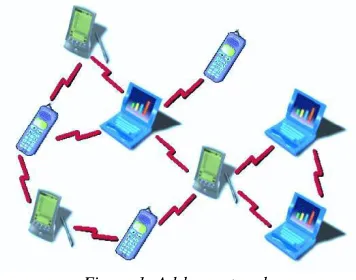
MANET is a collection of two or more devices or nodes or terminals with wireless communications and networking capability that communicate with each other without the aid of any centralized administrator also the wireless nodes that can dynamically form a network to exchange information without using any existing fixed network infrastructure. And it’s an autonomous system in which mobile hosts connected by wireless links are free to be dynamically and some time act as routers at the same time. All nodes in a wireless ad hoc network act as a router and host as well as the network topology is in dynamically, because the connectivity between the nodes may vary with time due to some of the node departures and new node arrivals. The special features of Mobile Ad Hoc Network (MANET) bring this technology great opportunity together with severe challenges [4].All the nodes or devises responsible to organize themselves dynamically the communication between the each other and to provide the necessary network functionality in the absence of fixed infrastructure or we can call it ventral administration, It implies that maintenance, routing and management, etc. have to be done between all the nodes. This case called Peer level Multi Hopping and that is the main building block for Ad Hoc Network. In the end, conclude that the Ad Hoc Nodes or devices are difficult and more complex than other wireless networks. Therefore, Ad Hoc Networks form sort of clusters to the effective implementation of such a complex process. Figure 1 will show some nodes
1
Department of Computer Science & Engineering, IET, AGRA, U.P., INDIA 2
Department of Mathematics, IBS, AGRA, U.P., INDIA
Abstract:- Mobile Ad Hoc Network (MANET) is a collection of two or more devices or nodes or terminals with wireless communications and networking capability that communicate with each other without the aid of any centralized administrator also the wireless nodes that can dynamically form a network to exchange information without using any existing fixed network infrastructure. And it’s an autonomous system in which mobile hosts connected by wireless links are free to be dynamically and some time act as routers at the same time, and we discuss in this paper the distinct characteristics of traditional wired networks, including network configuration may change at any time , there is no direction or limit the movement and so on, and thus needed a new optional path Agreement (Routing Protocol) to identify nodes for these actions communicate with each other path, An ideal choice way the agreement should not only be able to find the right path, and the Ad Hoc Network must be able to adapt to changing network of this type at any time. and we talk in details in this paper all the information of Mobile Ad Hoc Network which include the History of ad hoc, wireless ad hoc, and types of mobile ad Hoc networks. In this paper, we represent the more representative of routing protocols, analysis of individual characteristics an d advantages and disadvantages and present the all applications of Mobile Ad Hoc Networks.
forming ad hoc networks, and there are some nodes more randomly in different direction and different speeds.
Figure 1: Ad-hoc network
The people became realized to use all the technology so widely and it is based on information resource provided by the connections of different communication networks for clients also we have seen a rapid expansion in the field of Mobile Computing, widely available wireless devices. A new small devices such as personal communication like cell phones, laptops, Personal Digital Assistants (PDAs), handhelds, and also there’s a lot of traditional home appliances such as a digital cameras, cooking ovens, washing machines, refrigerators and thermostats, with computing and communicating powers attached.
III. TYPES OF AD-HOC NETWORK
The wireless Ad Hoc Network divided into two main types, firstly quasi-static Ad Hoc Network secondly, Mobile Ad Hoc Network (MANET). In the quasi-static Ad Hoc network the nodes may be portable or static, because the power controls and link failures, the resulting network topology may be so active. The Sensor Network is an example for the quasi-static Ad Hoc Network [14]. In the Mobile Ad Hoc network. (MANET) here the entire network may be mobile and the nodes may move fast relative to each other. And now we will discuss both of them.
A. Mobile Ad Hoc Networking (MANET)
Mobile Ad hoc Networking (MANET) is a group of independent network mobile devices that are connected over various wireless links. It is relatively working on a constrained bandwidth. The network topologies are dynamic and may vary from time to time. Each device must act as a router for transferring any traffic among each other. This network can operate by itself or incorporate into large area network (LAN).
There are three types of MANET. It includes Vehicular Ad hoc Networks (VANETs) , Intelligent Vehicular Ad hoc Networks (InVANETs) and Internet Based Mobile Ad hock Networks (iMANET). The set of application for MANETs can be ranged from small and static networks that are limited by power sources, to large-scale, mobile, highly dynamic networks On top of that, the design of network protocols for these types of networks is face with multifaceted issue. Apart from of the application, MANETs need well-organized distributed algorithms to determine network organization, link scheduling, and routing. Conventional routing will not work in this distributed environment because this network topology can change at any point of time. Therefore, we need some sophisticated routing algorithms that take into consideration this important issue (mobile network topology) into account. While the shortest path (based on a given cost function) from a source to a destination in a static network is usually the optimal route, this idea is not easily far-reaching to MANETs. Some of the factors that have become the core issues in routing include variable wireless link quality, propagation path loss, fading, interference; power consumed, and network topological changes. This kind of condition is being provoked in a military environment because, beside these issues in routing, we also need to guarantee assets security, latency, reliability, protection against intentional jamming, and recovery from failure. Failing to abide to of any of these requirements may downgrade the performance and the dependability of the network.
B. Mobile Ad Hoc Sensor Network
environments [15]. The Wireless ad-hoc sensor networks [16] are now getting in style to researchers. This is due to the new features of these networks were either unknown or at least not systematized in the past. There are many benefits of this network, it includes:
Use to build a large-scale networks
Implementing sophisticated protocol
Reduce the amount of communication (wireless) required to perform tasks by distributed and/or local precipitations. Implementation of complex power saving modes of operation depending on the environment and the state of the
network.
With the above-mentioned advances in sensor network technology, functional applications of wireless sensor networks increasingly continue to surface. Examples include the replacement of existing detecting scheme for forest fires around the world. Using sensor networks, the detecting time can be reduced significantly. Secondly is the application in the large buildings that at present use various environmental sensors and complex control system to execute the wired sensor networks. In a mobile ad-hoc sensor networks, each host may be equipped with a variety of sensors that can be organized to detect different local events.
IV FUNDAMENTALS FOR MOBILE AD-HOC NETWORKS
A. Dynamic topologies: nodes can move freely, network topology may change rapidly, restructuring, but may also have symmetric and asymmetric links.
B. Bandwidth-constrained, variable capacity Links. Compared with the wired network environment, the capacity of the wireless link itself is relatively small, but also susceptible to external noise, interference, and signal attenuation effects
C. Energy-constrained operation A laptop or handheld computers are often used batteries to provide power, how to save electricity in the context of depletion of system design is also necessary to consider the point.
D. Limited physical security Network Security With the network deeply embedded in our daily lives and the benefits have become increasingly important in the wireless network to provide security support is also an important issue.
V. TYPES OF MOBILE ADS-HOC NETWORK ROUTING PROTOCOL
Ad Hoc Network routing protocols is divided to three type of routing protocols, which that depending on a different of routing protocols.
A. Oriented routing table Protocol (Table-driven)
It is an active routing environment in which the intervals between the wireless nodes will send medical information with more paths. Each wireless node is on the basis of information gathered recently to change its route table. When the network topology change makes the original path is invalid, or the establishment of any new path, all nodes will receive updates on the status path. The path will be continuously updated, so that the node in time of peace on its own routing tables is ready, and immediately available when needed. However, such agreements must be periodically to broadcast messages, so a considerable waste of wireless bandwidth and wireless node power, but if you want to reduce the broadcast bandwidth consumption caused by a large number, we should lengthen the interval between each broadcast time, which in turn will result in the path table does not accurately reflect network topology changes.
B. Demand-driven Protocol (On-demand)
When needed to send packets only it began to prepare to send the routing table. When a wireless node needs to send data to another wireless node, the source client node will call a path discovery process, and stored in the registers of this path. The path is not valid until the expiration or the occurrence of conditions of the agreement with the first phase of a ratio of such agreements in each node. A smaller amount of data needed, and do not need to save the entire network environment and the routing information. The main benefit of this agreement is that the use of a lower bandwidth, but the drawback is that not every wireless node that sends packets can always quickly find the path. The path discovery procedure can cause delays and the average delay time is longer [2].
C. Destination-Sequenced Distance-Vector Routing (DSDV)
if the change very little, it is only for the part of the exchange, known as the incremental packet.
D. Global State Routing Protocol (GSR)
Global State Routing Protocol (GSRP) [22] is almost the same as DSDVP, because it has the idea of link state routing but it makes a progress by decreasing the flooding of routing messages. In this algorithm, each node maintains a neighbour list, a topology table, a next hop table and a distance table.
1) The neighbour list of a node includes the list of its neighbours (all nodes that can be heard by it).
2) The link state information for each destination is maintained in the topology table together with the timestamp of the information.
3) The next hop table includes the next hop to which the packets for each destination must be dispatched.
4) The distance table contains the shortest distance to each destination node. The routing messages will be created on a link change as in all link state protocols. Whenever it accepts a routing message, the node updates its topology table if the sequence number of the message is later than the sequence number stored in the table and it then reconstructs its routing table and broadcasts the information to its neighbours.
E. Wireless Routing Protocol (WRP)
Wireless Routing Protocol [12] makes use of the routing table at each node in the record to complete the routing, and DSDV with CGSR difference is that, WRP require each node to operate a record four tables, namely Distance table, Routing table, Link-cost table, Message retransmission list table. WRP use the update message between adjacent nodes in each pass is used to determine whether the adjacent nodes to maintain their link relationship, and Message retransmission list (MRL) is used to update records which need to re-transmission, and which update needs acknowledgement. WRP use of distance and the second-to-last hop information to find the path, such an approach can effectively improve the distance-vector routing possible count-to-infinity problem.
F. Ad Hoc On-Demand Distance Vector Routing Protocol (AODVP)
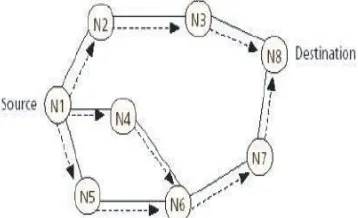
Ad Hoc On-Demand Distance Vector Routing Protocol using distance-vector concept [18,19,20], but in several different ways and the above is that, AODVP does not maintain a routing table, but when a node needs to communicate with another node on demand only to the approach to building routing table. When a node wants to send data to another node in the network, the first to broadcast a Route Request (RREQ) packet [8], RREQ where the record that this is given by which a source is to be used to find which of a destination node. RREQ in the network is a kind of flooding of the transfer mode, destination until they were received, of course, a node can only be processed once on the same RREQ in order to avoid routing loop generation. In theory all the nodes between the source and the destination of the RREQ will be passing a temporary record will be on the last hop of the RREQ via Path of information, when the destination of the RREQ received from different places, choose a shortest path, and to the source sent the direction of Route Reply (RREP).
Figure 2. AODV: reverse path formation
Figure 3. AODV: forward path formation
It is noteworthy that, AODV and DSDV routing table inside the same have also recorded a destination sequence number, to avoid routing loop from occurring, but also to ensure the path recorded in the latest expression of the topology.
G. Dynamic Source Routing Protocol (DSRP)
Dynamic Source Routing Protocol [7,9,10]. As the name suggests is the use of the concept of source routing, the routing information that is directly recorded in the inside of each packet, but to be in the MANET environment, the use of such a special, DSR is needed only when the path to find out the path, that is, on demand. Route Discovery with AODV is similar, but also broadcast from the source client to send a Route Request, the difference is, Route Request after one for each hop, this hop of the ID will be recorded in the Route Request a Route Record, the way, When the Route Request reaches destination, they will have all the nodes in the path of information, destination in many elected a request where the best path, according to Route Record to send a Route Reply back to source, source will be recorded in the route reply stored inside the route record in the routing table, then all should be sent to the destination of the packet will have the route record on the inside, only the source path need to have this information, source and destination paths between other nodes in the packet as long as the view inside the route record and then forward you can go out without having to re-select the path.
VI. MOBILE AD-HOC NETWORK ISSUES
Even the most zealot supporters of MANET have to admit that it is a challenging task to enable fast and reliable communication within such a network. The inherent characters of MANET make it a flawed architecture no matter what we have done or will do to improve the performance of the networks. Below are the factors that prevent the mobile ad hoc networks to be an in-flawed architecture.
A. Security in Mobile Ad-hoc Networks
Security is an important thing for all kinds of networks including the Mobile Ad Hoc Networks. It is obviously to see that the security issues for Mobile Ad Hoc Networks are difficult than the ones for fixed networks. This is due to system constraints in mobile devices as well as frequent topology changes in the Mobile networks. Here, system constraints include low-power, small memory and bandwidth, and low battery power. Mobility of relaying nodes and the fragility or routes turn Mobile Ad-hoc Network architecture into highly hazardous architectures. No entity is ensured to be present at every time and it is then possible to rely on a centralized architecture that could realize network structure or even authentication. The people who consider the Mobile Ad hoc Networks are not a flawed architecture, while we cannot see it used in practice is only because most of its applications are in military are totally wrong. It is true that Mobile Ad hoc Networks come from the military. But perhaps those persons forgot one of the most important things: the Security. That is to say, security is the most important issue for ad hoc networks, especially for those security sensitive applications. As we have mentioned before, in Mobile Ad-hoc Networks, security is difficult to implement because of the networks constrains and the rapidly topology changes[1].
VII. MOBILE AD-HOC NETWORK PERFORMANCE ISSUES
As the MANET with the traditional wired, fixed networks have many different characteristics, so to design a suitable routing protocol for MANET operating environment and MANET must also consider the different directions, the following sub-qualitative and quantitative aspects:
1. Distribution operation: Due to theexistence of MANET where there is no prerequisite for the construction of the underlying network, so routing cannot rely on a particular node to operate [15].
2. Loop-freedom: All the routingprotocol should be consistent with the characteristics; we must ensure the normal work in order to avoid waste of bandwidth.
3. Demand-based operation: In order toreduce the burden on each node, if the link is not so much the demand should be considered when using On-demand approach to the establishment of the path, and only when the need for a particular path query, the establishment of the path.
4. Proactive operation: With the On-demand concept of the contrary, if the network resources fairly adequate, proactive table-driven approach could speed up the path to the establishment of speed.
5. Security: Because it is the wirelessenvironment, to how to ensure the security of the connection cannot be ignored will be part of network security is also a MANET from theory to implementation of the key challenges
VIII CONCLUSION
types of ad hoc network. Most of the papers pointed to a phenomenon, not a routing protocol which can adapt to all environments, whether it is Table-Driven Protocol, On-Demand Protocol or a mixture of two kinds, are limited by the network characteristics. In this paper we also discussed the relevant Ad Hoc Network (Mobile approach) on a multicast (Multicasting), applications on Ad Hoc Networks. Mobile Ad Hoc Network related research has become the current internet trends one of the most anticipated technology.
IX REFERENCES
[1] Toh. C.K., 2002. Ad Hoc Mobile Wireless Networks Protocols and Systems. Prentice Hall,Inc
[2] J. A. Freebersyser and B. Leinerr, “A DoD perspective on mobile ad hoc networks,” in Ad Hoc Networking, C. E. Perkin, Ed. Addison-Wesley, 2001, pp. 29–51.
[3] AKKAYA, K., AND YOUNIS, M. A Survey on Routing Protocols in Wireless Sensor Networks. In Ad-hoc Networks (2005).
[4] AKYILDIZ, I. F. SU. W. SHANKARA SUBRAMANIAN and CARIRCI, A Survey on Sensor Networks, IEEE Communication Magazine, (August 2002), 102-114.
[5] Belding-Royer,E.M. and C.K. Toh,1999. A review of current routing protocols for ad-hoc mobile wireless networks.IEEE Personal Communication magazine pp: 46-55.
[6] Royer, E. M and C.E Perkins 1999. Multicast operation of the ad-hoc on-demand distance vector routing protocol, Aug.1999, pp: 207-214.
[7] Samir, R., D. Perkins, C.E Elizabeth and M. Royer, 2000. Performance comparison of two on demand routing protocols for ad hoc network.
[8] Liu Cheng-Ying, a random wireless network strategies and the stability of the routing Methods, 1999.
[9] J.Broch, D.B. Johnson and D.A. Maltz. The dynamic source routing protocol for mobile ad hoc networks, IETF MANET Working Group, Internet-Draft, October 1999.
[10] Charles E. Perkings, Elizabeth M. Belding-Royer, Samir R.Das, Ad Hoc On- Demand Distance Vector (AODV) Routing.
[11] Perkins, C.E. and E.M. Royer, 1999.ad-hoc on-demand distance vector routing. In Proceeding of 2nd IEEE Workshop on Mobile Computing Systems and Application.
[12] Perkins, C.E., E.M. Royer and S.R. Das, 2001. Ah Hoc on-demand distance vector (AODV) routing.
[13] J.Broch, D.Johnson, and D. Maltz, The Dynamic Source Protocol for Mobile Ad hoc Networks, IETF MANET orking Group,Internet- Draft, October 1999. hoc Networks, IETF MANET Working Group, Internet-Draft, October 1999.
[14] Johnson, D. and D .Maltz, 1996. Dynamic Source routing protocol in Ad Hoc Network.T.Imielinki and H.Korth, (Eds). Mobile Computing Ch. 5, Kluwer.
[15] V. D. Park and M. S. Corson, “A Highly Adaptive Distributed Routing Algorithm for Mobile Wireless Networks,” Proc. INFOCOM ’97, Apr. 1997.
[16] C-K. Toh, “A Novel Distributed Routing Protocol to Support Ad-Hoc Mobile Computing,” Proc.1996 IEEE 15th Annual Int’l. Phoenix Conf. Comp. and Commun., Mar. 1996, pp. 440–46.
[17] "CEDAR: a Core-Extraction Distributed Ad hoc Routing algorithm," P. Sinha, R.Sivakumar, V.Bharghavan, IEEE INFOCOM'99
[18] Charles E. Perkins, “An Introduction of Ad Hoc Networking”, Ad Hoc Networking, ed. C.E.Perkins, ISBN: 0-201-11976-9, Publisher: Addison Wesley Professional, 2001
[19] Chlamtac, I., Conti, M., and Liu, J J.N.wireless networks”, in Proceedings of IEEE ICC’94 Volume 1, 7-11 June 1994 Page(s):171 - 175 vol.1
[20] Charles E. Perkins, Ad Hoc Networking, ed. C. E. Perkins, ISBN: 0-201- 11976-9, Publisher: Addison Wesley Professional, 2001.
[21] T. Chen and M. Gerla, “Global state routing: A new routing scheme for ad hoc networking: imperatives and challenges. Ad Hoc Networks 2003, pp 13–64.
[22] Hsin Liu, S. Chang,” The study of effectiveness for ad-hoc wireless network”, Department of Computer Science, Chinese Culture University, ICIS 2009, November 24-26, 2009 Seoul, Korea.