90 S.Afr.Tydskr.Bibl.Inligtingk., 1998,66(3)
Knowledge-based enterprises: an overview
Diane B. Doyle
Werksmans Attorneys, P.O. Box 927, Johannesburg, 2000 Republic of South Africa [email protected]
Adeline S.A. du Toit*
Department of Information Studies, Rand Afrikaans University, P.O. Box 524, Auckland Park, 2006 Republic of South Africa
Most enterprises are not managing their knowledge well and achieving the potential benefits of its exploitation. They have knowledge assets they do not exploit and they buy in expertise that they possess, since they do not know what they know. This article addresses recent developments in management theory whilst noting the social context in which knowledge management takes place. Prevailing management trends and techniques which have a bearing on the needs of knowledge workers are discussed to gain insights into knowledge management. The impact of the theory of knowledge management on the transformation of an enterprise to a knowledge-based business model are also discussed.
Die meerderheid ondernemings bestuur nie kennis in die onderneming doeltreffend nie en benut dus nie die poten-siele voordele van kennisbestuur nie. Hulle beskik oor kennisbates wat nie ontgin word nie en kundigheid word ingekoop omdat hulle nie bewus is van die kundigheid beskikbaar in die onderneming nie. Hierdie artikel bespreek onlangse ontwikkelings in die bestuursteorie met die klem op die sosiale konteks waarin kennisbestuur plaasvind. Algemene bestuurstendense en tegnieke wat 'n invloed het op die behoeftes van kenniswerkers word bespreek om sodoende 'n insig in kennisbestuur te verkry: Die impak van die teorie van kennisbestuur op die transformasie van 'n onderneming tot 'n kennisgebaseerde besigheidsmodel word ook bespreek.
*
Author to whom correspondence should be addressed.The realization that information and knowledge are
funda-mental to economic growth, whether at national or
com-pany level, is beginning to permeate economic and
management thinking. The emphasis of economic growth
theory is increasingly on the role of human capital, the
brainpower that applies knowledge to provide a
competi-tive advantage. Building the knowledge asset and turning it
into a strategic and eventually a financial asset is a vital
skill which the management of enterprises in South Africa
are only just beginning to grasp. The rapid pace of
techno-logical change means that learning must be constant and
that education must be updated throughout a person's
working life. Employees have to increase their learning
power to sustain their earning power.
Problem statement
This article will trace recent developments in management
theory whilst noting the social context in which knowledge
management takes place. As with other socially
construct-ed systems, management reflects prevailing attitudes and
shifts in values. Lack of adaptability and flexibility by
leadership will inevitably impact on an enterprise. This can
be the result of outdated management styles or youthful
in-experience. Either way, too much inflexibility at either
extreme can ultimately cause irreparable damage to the
enterprise because of the alienation it causes amongst
stakeholders. Prevailing management trends and techniques
which have a bearing on the needs of knowledge workers
will be discussed to gain further insight into knowledge
management. Finally, the concept of a knowledge-based
enterprise will be analyzed and discussed.
Revolutionary trends in management theory
As a discipline, management theory is barely fifty years
old. However, no function in history has emerged as rapidly
as management has done, nor, in recent times, has there
been an equivalent concept which has achieved support of
such global proportions. Contemporary management
theory takes into account the knowledge transformation of
business which has resulted from the convergence of
struc-tural changes in the marketplace and continuing trends in
information technology. Information now exists within an
entirely new paradigm. It is a valuable commodity in
cer-tain circumstances, yet worthless in others. It often forms
the underlying raw material of much knowledge work and
thus needs to be effectively produced and managed. The
new information-based economy relies on the networked
distribution of information. This networked environment
affects policy, limits influence, and redefines power on an
international scale. Donlon and Haapaneimi (1997 :52-62)
lists the five structural changes which impact on the
environment as being:
Demand fragmentation - the differentiation of
consu-mer behaviour;
S.Afr.J .Libr.lnf.Sci., 1998,66(3)
- Deregulation - less state intervention;
- Time-based competition - the speed with which de-livery to the consumer takes place;
- Disintermediation - the redundancy of the middle man;
and
Virtual enterprise - electronic work environments and telecommuting.
These changes, in conjunction with the advances in tech-nology, starting with the microchip techtech-nology, high speed telecommunication networks linked to computers and user-friendly technology have resulted in the transformation of the workplace as well as the nature of competition. Ac-cording to Drucker (1995), although management in most business schools is taught as a bundle of techniques, it is essentially aimed at making various types of knowledge productive. In other words, good management will harness the collective and individual knowledge within the enter-prise to optimum effect. Management therefore, must ultimately be a social function.
The past two decades have been marked by various man-agement philosophies, promoting practices which support-ed theories involving some of the following concepts: sustainable competitive advantages, critical success factors, market differentiation, shareholder value, total quality
management (TQM), continuous improvement, change
management and business. process reengineering (BPR).
Each one of these managementtmnds has contributed to-wards shaping the various management techniques that managers look to in order to overcome many complex managerial problems and challenges. Abrahamson (1996: 254-286) takes the approach that managers adopt these theories because they need to gain insight into management techniques that would assist them in dealing with issues such as competitive advantage and the impact of environ-mental change on the enterprise. Brooking (1996:62-63) reinforces this view by pointing out that certain manage-ment philosophies can be considered to be infrastructural assets in that they reflect prevailing environmental trends and motivate workers.
One of the more recent management philosophies,
business process reengineering, has met with much
resistance. Strassman (1994) argues that any effective
at-tempts to improve the way people work must be
evolutionary, not revolutionary. In his damning comment-ary on the failings of management attempts at business process reengineering he points out that the management of an enterprise should never undervalue the importance of its people, customer relationships and other tangible and in-tangible assets. By disregarding the lessons taught by history it is possible to overlook the fact that every radical movement of the last 200 years has failed. According to Strassman (1994), BPR initiatives have failed precisely because they offer a radical approach to business rein-vention as opposed to business improvement, enhancement or modification. This point is illustrated with observations by both Korchinsky (1997:95-97) and James (1996:39)
91
that up to 70% of all top-down BPR initiatives have been unsuccessful. They add that this is primarily due to problems with the computer systems used to implement the new processes. Up until recently, information technology has proved unsuccessful in achieving successful process
reengineering initiatives or compensating for the loss of skills due to downsizing. In fact, as a result of wholescale attempts to revolutionize business, many subtle and com-plex processes and relationships have been lost forever to the detriment of the survival of the enterprise.
Abrahamson (1996:255) argues in favour of an approach which sees management theories as a series of actions and reactions. He refers to such trends as management fashions, qualifying this view by saying that, unlike aesthetic fashions, management fashions define which management techniques result in the logical progression of management practice. According to Amsden, Ferratt and Amsden (1996: 6) conventional management theory devises a system of principles, concepts, techniques and philosophies that regulate the running of a business. Whereas proponents of BPR and TQM argue that their theories are revolutionary in that they represent a complete shift to a new and preferable paradigm, Abrahamson (1996:254-286) is more pragmatic in his views, arguing that new management innovations, albeit that they depart significantly from the prevailing state-of-the-art in management practice at a given time, qualify as innovation because they differ significantly from existing management techniques and not because they have been established as being an improvement on prevailing practices nor for the reason that they are technically more efficient. The point worth noting here, is that management theories which attempt to revolutionize the workplace are inherently high risk in that they hold absolutely no guarantee of success. In fact, Strassmann (1994) argues that such theories possess only one possible advantage in that they are a drastic choice of last resort when no time is left to implement evolutionary change.
According to Greeson and Lowenhaupt (1996: I) ignor-ance of the dangers involved in BPR can result in change management initiatives which merely act as an euphemism for downsizing. The controversy surrounding BPR is worth noting in that it represents the ultimate extreme of trans-formational management. However, it does not obviate the very real need for business to change. Malhotra (1996) concludes that most enterprises have chosen not to follow the call for absolute radical change and instead have selected a variety of approaches to organizational trans-formation, including reengineering, continuous improve-ment and enterprise restructuring. In the words of Gouillart (1995:20)
'strategic agility is more important than strategy -a firm's -ability to m-ake money h-as more to do with its ability to transform itself, continuously, t~an whether it has the right strategy'.
92
structural and technological changes which constantly take
place.
Tracing the roots of knowledge-based
manage-ment theory
Given that evolutionary management theory acknowledge the need to integrate and assimilate relevant aspects of the various earlier management models, it now becomes pos-sible to examine the facets of the different approaches and how they help to shape comtemporary management styles. By incorporating an awareness of socio-technical issues along with a need for sustained innovation within the enterprise, it becomes increasingly apparent that one of the main elements critical to the success of the enterprise is an environment which, according to Strassmann (1994)
'stimulates morale and imagination, creating con-ditions for rewarding organizational learning and for inspiring employees to discover innovative ways to deal with adversity and competitive chal-lenges' .
In other words, management models which derive from the industrial era need to be revised to meet the needs of workers in the information age. The rise of the information age is evidenced by the adoption and integration of information technology and the subsequent synthesis of value-added content within the workplace. This techno-logy-enabled content provides the information that directly supports a variety of business processes. The users of such technology-enabled content are frequently referred to as knowledge workers. Drucker (1995) describes the knowl-edge worker as being a highly skilled, well-educated specialist who has learned how to learn, and throughout his or her lifetime continues to learn.
Skyrme and Amidon (1997 :9) list four key factors which have given rise to the concept of knowledge management. These are:
- Realization of the changing role of knowledge in
society and business;
- Cost avoidance by reducing duplication of knowledge processes;
- Knowledge leverage as a competitive enabler; and - Increasing appreciation of the value of intangibles
which is often reflected as intellectual capital in the share price of listed companies.
The need to sustain employee innovation and morale must be combined with the awareness that one of the key competitive factors for survival demands that both the individual as well as the collective members of an enter-prise effectively use knowledge. This ultimately leads to the conclusion that human resources, in addition to any other knowledge assets within the enterprise, must be managed competently to ensure that the objectives of the enterprise are attained.
Pursuant to their study of knowledge-based businesses, Skyrme and Amidon (1997: 18) make the point that, as yet, none of the larger enterprises has effective information
S.Afr.Tydskr.Bibl.lnligtingk .•1998.66(3 )
management, let alone knowledge management practices. However, what is apparent is the ability for knowledge management initiatives to coexist with and support other performance enhancing initiatives, regardless of which management school the performance initiative derives itself from. In the view of Barclay and Murray (1997) this broadness in scope and ability to integrate into a variety of other management techniques such as change management, best practice, risk management and benchmarking can be attributed to knowledge management's central premise which is according to Wiig in Skyrme and Amidon (1997: 32) that all the factors that lead to superior performance -organisational creativity, operational effectiveness, and quality of products and services - are improved when better knowledge is made available and used competently. Given
that the basis of the new economy is knowledge work and that those people participating in this economy are knowl-edge workers, it becomes possible to examine the impact of selected management theories on the contemporary enter-prise. These developments have been made explicit in the research conducted by Amidon (1996) who has created a timeline technique to portray the antecedents of today's focus on knowledge. A few of the more notable concepts and principles which have provided a foundation for aspects of the prevailing knowledge agenda will be dis-cussed in the following sections.
Business transformation
Management for change rests on the assertion that massive environmental upheaval during the past decade has re-quired both breakthrough strategies along with speedy im-plementation. It is apparent that change is inherent in contemporary organizational experience, and management of change is critical to organizational success and survival. Such change require of enterprises that they flatten man-agerial structure, encourage greater initiative among their front-line employees, and operate more creatively. Early progenitors of transformational business set the tone for a succession of later initiatives such as TQM and BPR. Dostal and Osler (1990:20) examine the development of the metanoic enterprise which was originally promoted by Senge and Kiefer. The metanoic enterprise derives its name from the Greek words meta (meaning 'transcending') and noia (meaning 'mind'), metanioa means a fundamental shifting of minds. Dostal and Osler (1990:2 I) argue that the metanoic enterprise combines the positive aspects of both socialism and capitalism. To quote Dostal and Osler's definition of the metanoic enterprise:
S.Afr.J .Libr.lnf.Sci.,1998,66(3)
in co-designing and co-creating a desirable future and shared ownership of the organisation.
The metanoic enterprise and the learning enterprise form part of a continuum. The metanoic enterprise established the basic tenets for the psychological and spiritual survival of the enterprise, whilst the learning enterprise assimilates these principles and maps out the prerequisites for com-petitive success within the knowledge society.
Learning enterprises
The acceptance of the concept of organizational learning has become increasingly prevalent amongst those enter-prises who wish to be competent, innovative and thus achieve competitive advantage. The attractiveness of this concept lies in the pervasive requirement for individuals and enterprises to continuously be able to adapt to change.
Whilst programmes like TQM and BPR attempted to
enhance the enterprise's adaptive capabilities, these have often been found to succeed or fail depending on human factors implicit in the culture of the enterprise. Learning occurs within existing social constructs, what is learned is interrelated with the environment in which learning takes place. This is confirmed in research on inter-enterprise collaboration conducted by Powell, Koput and Smith-Doerr (1996: 116) which conclude that knowledge creation is context-bound, requiring an environment that is adaptable as opposed to inflexible. Traditional, hierarchical enter-prises offer very little incentive for learning. This can be attested to by the negative response often generated from activities such as reading a newspaper or journals during working hours. Because sources of innovation do not reside exclusively inside an enterprise but are frequently found where the interests of commerce, universities, research laboratories, suppliers and customers intersect, it is es-sential that the enterprise be alerted to any changes taking place in these areas to assess their impact on the enterprise itself. According to Johnson (1993) the learning enterprise carries with it the conviction that when all members of an enterprise can achieve their full potential in alignment with the vision of the enterprise, the potential of both the individual and the enterprise will be fully realized. Thus the philosophy of a learning enterprise acknowledges the need for ail enterprise both to learn and unlearn, that is, to be able to discard or revise learning which could impact nega-tively on the survival of the enterprise.
Three types of learning in the enterprise are mentioned by Balasubramanian (1995):
- Single-loop learning (SLL): by diagnosing and recti-fying mistakes the enterprise is able to continue on its desired course. Such learning enhances the corporate memory and skills-base of an enterprise without changing the underlying nature of the enterprise. This is considered to be the more routine lower-level or opera-tional learning of an enterprise.
- Double-loop learning (DLL): this type of learning takes place once the enterprise is able to question and modify
93
the prevailing value-system in addition to being able to undertake single-loop learning. This learning attempts to change the underlying nature of the enterprise - it's value, culture and norms. It is perceived as higher-level, strategic learning. Strategic learning is the process by which an enterprise makes sense of its environment in
ways that expand its opportunities and enhance its resources.
- Deutero-Iearning (DL): this learning combines the ability of the enterprise to apply the first two types of learning simultaneously. By being aware of any gaps in competencies, the enterprise is able to bridge such gaps through learning initiatives. For this reason it is essential that a suitable infrastructure be established to facilitate learning.
94
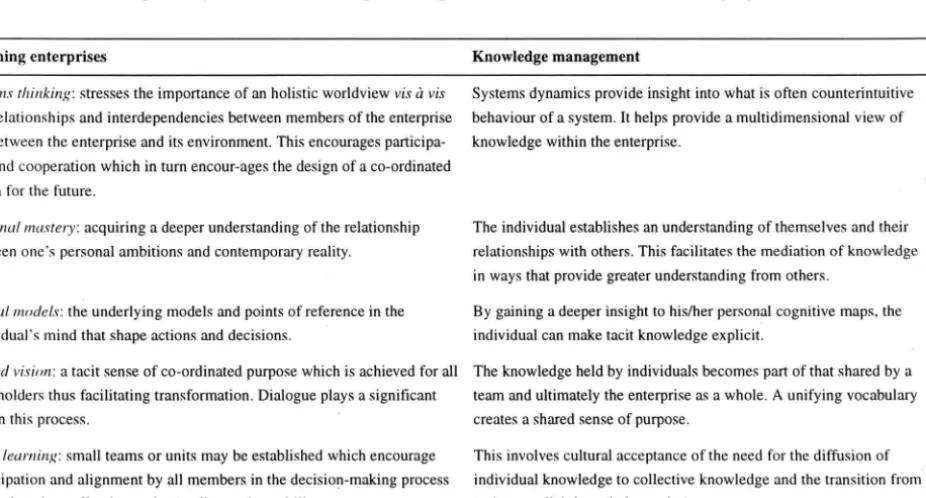
Skyrme and Amadin (1997:366) provide some useful
in-sights into the close relationship between the
characteris-tics of learning enterprises and their contribution to
knowledge management (see Table 1).
It is vital to note that, amongst knowledge management
practitioners, there is a commonly held view that unless the
principles of the learning enterprise are being practised
within an enterprise, any knowledge-based business
initi-ative will encounter problems which may eventually
sabot-age the entire project.
Innovation
For any enterprise wishing to be proactive In the
market-place and have the competitive edge, innovation is vital.
Whereas earlier organizational studies of innovation
con-centrated on the most suitable organizational structures for
cultivating creativity, prevailing approaches highlight the
psychological context of innovation. Stakeholders in the
enterprise will produce more creative work when they feel
that management is encouraging them to solve problems
creatively. McPherson (1995:33) argues that the accent in
economic growth theory is now on the human capital, the
brainpower that applies knowledge and information to
provide competitive advantage. Given that competitiveness
in the marketplace is essential for the survival of the
enter-prise and that the ability to sustain innovation is recognized
as a strategic advantage, it has become evident that
knowl-edge must be generated and integrated within the enterprise
at an accelerated pace. Such knowledge is essential for
successful learning and innovation or knowledge creation
within the enterprise.
S.Afr.Tydskr.Bibl.lnligtingk., 1998.66(3 )
Knowledge-based systems
According to Skyrme and Amidon (1997:21) several prac-titioners of knowledge-based business management had entered the field via knowledge-based systems. Examples of expert systems include artificial intelligence (lA), man-agement information systems (MIS) such as decision sup-port systems (DSS), and executive information systems (EIS). Although these systems have been part of the business world for more than a decade, they have not earned much praise and often, despite the effort that was made in creating a virtually flawless and sophisticated ex-pert system, such information resources were rarely ac-cessed by the end-user and fell into disrepair. This was because these systems were often designed on behalf of the end-user by a computer systems analyst who had little understanding of the value of a participative and colla-borative culture in the creation of such systems nor the need to recognize the value of informal information gather-ing as well as the incorporation of softer, 'fuzzy' logic as part of the information content. However, a redefined version of the expert system appears to be experiencing a renaissance in popularity due to the increasingly enhanced capabilities of networked personal computers which have made it possible to distribute valuable business intelligence immediately. Today's expert information system (EIS) en-ables an enterprise to extract data from selected internal sources and convert it into meaningful information suitable for strategic analysis. This includes not only transactional or financial data but textual information as well. Such in-formation can provide a historical account of the enterprise as well as detect patterns and changes in activity such as an
increase in sales by an enthusiastic salesperson and thus the need to adapt distribution programs by geographical
Table 1 The learning enterprise and knowledge management: some common themes (Skyrme & Amidon, 1997:
366)
Learning enterprises
Systems thillkinR: stresses the importance of an holistic worldview visiivis
interrelationships and interdependencies between members of the enterprise and between the enterprise and its environment. This encourages participa-tion and cooperaparticipa-tion which in turn encour-ages the design of a co-ordinated vision for the future.
Per.wllu/ mustery: acquiring a deeper understanding of the relationship between one's personal ambitions and contemporary reality.
Mefllu/mode/s: the underlying models and points of reference in the individual's mind that shape actions and decisions.
ShU/.ed visioll:a tacit sense of co-ordinated purpose which is achieved for all stakeholders thus facilitating transformation. Dialogue plays a significant role in this process.
Teum /eumiIlR: small teams or units may be established which encourage participation and alignment by all members in the decision-making process thus enhancing collective understanding and capability.
Knowledge management
Systems dynamics provide insight into what is often counterintuitive behaviour of a system. It helps provide a multidimensional view of knowledge within the enterprise.
The individual establishes an understanding of themselves and their relationships with others. This facilitates the mediation of knowledge in ways that provide greater understanding from others.
By gaining a deeper insight to his/her personal cognitive maps. the individual can make tacit knowledge explicit.
The knowledge held by individuals becomes part of that shared by a team and ultimately the enterprise as a whole. A unifying vocabulary creates a shared sense of purpose.
This involves cultural acceptance of the need for the diffusion of individual knowledge to collective knowledge and the transition from tacit to explicit knowledge and vice vasu.
S.AfrJ .Libr.lnf.Sci.,1998,66(3)
location within a short time period. These types of systems allow management to plan strategically by forecasting future developments based on how the given environment has behaved in the past. These scenario forecasts are often
derived from a complicated algorithm component and
business-based model which has been incorporated into the initial design of the tool. They are able to formulate hypotheses based on a fixed set of rules. Although there is no guarantee that the same pattern of events will emerge, it becomes possible, in the view of Twine (1996:20) to reduce the infinite number of possibilities down to a manageable few.
An important factor in the spread of this type of tech-nology is its ability to extract data from a variety of ap-plications and data warehouses (O'Conner 1996:8). In addition, the user-friendly nature of more recent expert systems makes them more readily accepted by the end-user.
Skyrme and Amidon (1997:404-408) refer to the new
generation of EIS as enterprise information systems due to the fact that they are no longer only accessed by a small
group of elite staff but can be accessed by people
throughout the enterprise. They argue that online analytical processing (OLAP) is the next development in the trans-formation of the original EIS tools used for gathering business intelligence. OLAP provides a summarized multi-dimensional extract of the data for rapid analysis which users can easily access and manipulate. OLAP often makes use of what is now commonly referred to as intelligent software that is able to search vast quantities of data residing in a variety of data repositories.
Another emerging trend which moves beyond the
parameters of existing expert systems involves the inter-vention of humans in the process of decision making and clarification by means of embedded textual knowledge. Emerging technologies such as hypermedia publishing on the corporate intranet can facilitate the creation of the enterprise's memory. Such technology not only captures formal knowledge such as procedural manuals, but in-formal knowledge such as expertise, tacit know-how and experiences as well. The emerging knowledge base can be treated as the collective intelligence of the grobp. Both Simpson and Prusak (1995:413) as well as Twine (1996: 20) warn that expert systems can face the danger of experiencing information overload. Twine (1996:21) warns that it is misleading to assume that more data and in-formation will result in better decision making. There is certainly no guarantee that the hierarchy of data, in-formation, knowledge and wisdom simply falls into place without effort and intelligence. Hesitating over which direction to take for fear that one has not taken all the available information into account, can result in ineffectual or dysfunctional decision making. Despite Twine's warn-ing, the primary role that information technology now plays cannot be ignored. Information technology exists as both a driver of change in the marketplace as well as a facilitator of enterprise transformation. Thus, it is essential
95
that anyone involved in a knowledge-based management initiative monitor the developments in this area and establish the contribution such technology can make to the knowledge-based enterprise.
Intellectual assets
In any contemporary enterprise, its most valuable assets are perceived as money, knowledge and information. Of these assets, only the first possesses any tangible value that can be measured within an existing accounting' framework. Trying to assess the value of intangibles such as knowl-edge, information or intelligence in conventional economic terms provides an inaccurate reflection of the real worth of these assets. McPherson (1994:203) argues that inform-ation is intrinsically part of the enterprise, it forms the basis of knowledge production and facilitates communication processes within the enterprise. Information is what allows the enterprise to create a view of the outside world. How-ever, trying to measure the return on investment of this resource in purely monetary terms will provide only one limited dimension of value. Brooking (1996: I I) confirms this argument by referring to a recent survey of 226 companies which are amongst some of the top performing
Financial Times companies in the United Kingdom. She
notes that 76% of these companies did not assign any value to their intangible assets in the annual financial statement. Without knowing what their intangible assets are, it is not possible for the enterprise to establish their worth nor how they are to be managed. This impacts on the ability of an enterprise to accurately report on its potential for creating future value. There is some indication of the recognition of the growing economic value of knowledge capital. This is reflected in the share price and price-earnings ratio of the intelligent enterprise. According to Moore in Ostro (1997: 58), the chairman of Coopers & Lybrand, the intellectual assets of a company are often worth three or four times the company's tangible book value. That value is converted into dollars in the course of mergers and acquisitions activity. Strassmann (1994) adds that when a company is sold at a high multiple of its book value, there is an attempt to place a monetary worth on its knowledge capital. Saint-Onge (1996: 10) defines three constituent elements that comprise the intellectual capital within an enterprise. These are:
- Human capital which is embodied in the aptitude of individuals in the workplace to determine the best options or solutions for clients.
- Customer capital which includes the following: depth and extent of market penetration, customer loyalty and profitability.
- Structural capital consists of the infrastructures and systems in operation such as processes, databases as well as intellectual property.
96
of knowledge management and the intellectual assets of the enterprise is made explicit. Bateson of Gemini consulting
in Chemical Week Association (1996:26-27) considers
there to be three practical tasks involved in managing an enterprise's intellectual assets:
- Managing the corporate memory which entails finding a way to capture the knowledge of the people with special expertise when they retire, resign, or are retrenched. - Doing real reengineering as opposed to downsizing so
that the company's know-how can be maintained and used.
- Sustained innovation which must be achieved by
meeting the constant intellectual challenge of R&D as product cycles shorten and research efforts expand globally.
By initiating programs which attempt to monitor these three aspects of intellectual capital, the enterprise is able to commence with the first step in their knowledge manage-ment program. This is because it is these resources that are the most valuable intangibles in ,an enterprise and the most complex to gauge in any commonly accepted manner.
Knowledge-based enterprises
Many enterprises have previously engaged in efforts to manage their knowledge - either by documenting certain standard processes or establishing assorted depositories for selected internal records so that knowledge can be derived from these types of transferable information. However, it is only in recent years that the management of internal knowl-edge has become recognized as a critical component of many corporate strategies. The information-based para-digm shift that is now taking place is the result of the effective application of information technology to knowl-edge resources. Information technology no longer merely offers tools or solutions for distinct business needs but now furnishes enterprises with the virtual environment in which work is done. It must be noted, though, that studies have shown that there is no relationship between computer ex-penditures and company performance whatsoever. Mal-hotra (1997) refers to Brown, the director of Xerox Parc Research Centre, who said that despite the investment in technology of more than one trillion dollars by US industry in the past 20 years, little benefit has been realized by way of improvements on the efficiency or productivity of its knowledge workers. He attributes this failure to the enter-prise's ineptitude at understanding the communication needs and behaviours of knowledge workers. Knowledge workers need to network effectively to redefine the social processes of collaboration, knowledge sharing and brain-storming. The problem could also be one of social per-ception, for it is the industrial era that placed so much emphasis on productivity whereas contemporary enter-prises rely far more on individual insights and innovation. Both these pursuits depend heavily on the need for con-templation which is the antithesis of the traditional expectation of immediate action.
S.Afr.Tydskr.Bibl.Inligtingk., 1998,66(3)
Information technology is capable of generating volumes of data and information to the point where many knowl-edge workers have begun experiencing symptoms of in-formation overload. The problem now lies in improving performance by leveraging internal resources - the ex-pertise embedded in the minds of employees and the know-how and experience buried in the enterprise's collective memory bank. It is these) intangibles, such as sustained innovation, in-depth understanding of customer needs and the strategic utilization of an enterprise's intellectual capital that have now become critical. The effective man-agement of an enterprise's intellectual assets reduces costs, replaces simple inventories with valuable information and insights, removes the need for expensive fixed assets and promotes corporate adaptability (Cooney 1997:76). The real problem, however, lies in pinpointing such assets, as most corporate knowledge is tacit and has to be made explicit before it can be evaluated, enhanced and shared.
There are two inherent levels of knowledge: explicit and tacit knowledge. Explicit knowledge is articulated knowl-edge - knowlknowl-edge which has been formalised by way of speech, text, visual graphics and the data we compile. It is the concrete, documented expression of our intellectual en-deavours and thus far less complex to manage than tacit knowledge. It is tacit knowledge that becomes the focus of knowledge management.
Information becomes knowledge when introduced into each individual's mental model. New experiences are as-similated via the context and social constructs integral to each individual. This context is tacit-based which leads to
the conclusion that all our knowledge is ultimately centred in a tacit dimension. It is this tacit, unarticulated knowledge which is rapidly being recognized as being of greater importance in an enterprise. Tacit knowledge includes the intuition, perspectives, beliefs, and values that people form as a result of their experiences. Our decisions and patterns of behaviour are based on the beliefs and assumptions in our individual mindsets. Knowledge is not private but social. Our individual experiences of reality combine with socially conveyed knowledge to reinforce a certain mind-set. The close connection between this viewpoint and the interpretation of knowledge as action or experience is clear, for it is the process of putting information into practice that allows it to become knowledge. This has both positive and negative repercussions for enterprises.
S.Afr.J .Libr.lnf.Sci.,1998,66(3)
ways of doing things for the enterprise. It defines the enterprise's culture. Although the collective mindsets of an enterprise remain largely implicit and commonly accepted, they have a noticeable impact on the collective actions and attitudes of the members. Huang (1997), the director of
Knowledge Management and Asset Reuse at IBM
Con-sulting Group, IBM Global Services, has documented the methodology used by IBM's Intellectual Capital Manage-ment team to instill the principles of knowledge man-agement into the corporate psyche. He outlines four major processes which IBM has used, namely making knowledge visible, building knowledge intensity, building knowledge infrastructure and developing a knowledge culture.
In Huang's (1997) experience, the most challenging issue had been dealing with the transformation of the enterprise's culture. The strategies used to change the culture may vary from one enterprise to another, depending on prevailing conventions. Table 2 outlines the underlying shift in values that Malhotra (1997) believes is required in order for a knowledge management initiative to gain momentum with-in an enterprise.
By subtly encouraging a change in the fundamental at-titudes and expectations of workers, the tacit understanding of the enterprise's culture begins to shift. By adhering to a commonly understood value system we are able to act promptly and effectively, without having to devise new
solutions or deliberating over each problem. However, this can result in an inability to adapt swiftly to a new set of challenges which are presented in a new and unfamiliar context. Knowledge management, in the words of Ostro (1997 :58), therefore becomes the explicit and organized fashion in which corporations attempt to become smarter. It is the management of tacit knowledge which permits us to tind ways of making meaning from knowledge. Although
97
the diversity of individual value systems within an
enter-prise is vital for creativity and innovation, if explicit knowl-edge is to be effectively shared, it is essential that at least a minimal level of congruence exists in the tacit knowledge of the enterprise.
Tacit knowledge must be recorded and made formal if it is to become a resource within the enterprise and not just an individual proficiency. What is internal must be articulated and made explicit. It is through the creation of this common understanding that the enterprise is able to achieve its goals. Murray (1997) makes the point that recording the tacit knowledge of an enterprise enables workers to con-sider the connection between the objective in performing a task and the supporting information that is available. The underlying principle here is that one should not need to commit specific details to memory but rather be able to apply certain principles and concepts one has learnt and then only acquire additional detail if needed. The ability to master the pattern in which detail is organized, both on a micro and macro level should form the basis for tacit knowledge. It is through the communication of ideas and expertise by means of enabling technologies such as group-ware and intranets that the poineers of knowledge manage-ment are being empowered to begin revealing the true value of the enterprise's intangible assets.
Conclusion
This article combined a revIew and analysis of a selection of academic and technical literature on the theory of knowl-edge management along with some practical observations of how the theory might impact on the transformation of an enterprise to a knowledge-based business model. Informa-tion overload is currently. considered to be a major obstacle for most knowledge workers. Timeous access to the most
Table 2 Implementation measures for facilitating a knowledge management culture (Malhotra, 1997: Online)
Instead of the traditional emphasis on controlling the people and their behaviours by setting up pre-defined goals and procedures, they would need to view the enterprise as ahuman community capable o(providinli diverse meaninlis to information outputs generated by the technological systems.
De-emphasize the adherence to the company view of 'how things are done here' and 'best practices' so that such ways and practices are continuously assessed from multiple perspectives for their alignment with the dynamically changing external environment.
Invest inmultiple and diverse intel7JretatiollS to enable constructive conflict mode of inquiry and, thus, lessen oversimplification of issues or premature decision closure.
Encourage greater proactive involvement o(human imUliination and creativity to facilitate greater internal diversity to match the variety and complexity of the wicked environment.
Give moreexplicit recolinitirJll to tacit knowledlie and related human aspects, such as ideals, values, or emotions, for developing a richer conceptualization of knowledge management.
Implement new, flexible technologies and systems that support and enable communities of practice, informal and semi-informal networks
of inlernal employees and external individuals based on shared concerns and interests.
98
relevant information plays a primary role in achieving
competitive advantage. The interoperability of systems and
the ability to move freely between a variety of information
sources and applications is vital to any enterprise. Such
capabiliti'es allow the knowledge worker to gain a holistic
view of the corporate memory as well as its many
knowl-edge bases, almost as if the enterprise was now able to act
as a human brain with both hemispheres finally connected
and each lobe to link and communicate with the others.
This view of the enterprise as an organic system is a useful
synonym as it reflects contemporary management theory
with particular reference to terminology like corporate IQ
and' metanoic enterprises. The enterprise is now seen as
something dynamic and alive, constantly learning and
adapting.
References
Abrahamson. E. 1996. Management fashion: management fads. Academy of management review,21 (I ):254-286.
Amidon, D. 1996.The momentum of knowledge management: in-sight. [Online]. Available: http://www.entovation.com/images/ wellfore.gif
Amsden, R.T., Ferratt, T.W &Amsden, D.M. 1996. TQM: core paradigm changes. Business horizons, 39(6):6-9.
Balasubramanian, V. 1995.Organizational learning and informa-tion systems. [Online]. Available: http://eies.njit.edu/-333/ orglrn.html
Barclay. R.O. &Murray, P.c. 1997. What is knowledge manage-ment. [Online]. Available: http://www.media-access.com/ whatis.html
Brooking, A. 1996.Intellectual capital. London: International Thomson Business.
Chemical Week Association. 1996. Intellectual assets: know-how management systems. Chemical week, 158(48):26-31. Cooney . .I. 1997. Intellectual capital: the new wealth of
organisa-tions. Business quarterley, 61(4):76-78.
Donlon,.I. P.&Haapaneimi, P. 1997. Knowledge capital. Chief executive. 120:52-62.
Dostal. E.&Osler, K. 1990. Organisational renewal: the metanoic organization in South Africa. IPM journal, 8(12): 17-21. Drucker, P.F. 1995.Knowledge work and the knowledge society:
the social transformation of this century. [Online]. Available: http://kgswww.harvard.edu/-kgspress/drucklec .htm
Drucker. P.F. 1997.Pearls of wisdom. [Online]' Available: http:// www.business-intelligence.co.uk/fastrackpearls.html
S.Afr.Tydskr.Bibl.lnligtingk., 1998,66(3)
Greeson, D.&Lowenhaupt, M. 1996. A benchmark strategy: in medical cost control. Physician executive, 22( 10): 10-16.
Gouillart, F. 1995. The day the music died. Journal of business management, 16(3): 14-20.
Huang, K.T. 1997. Capitalizing collective knowledge for winning: execution and teamwork. [Online]. Available: http://www.ibm.
com/services/articles/intelcap. html
.lames, G. 1996. Intranets rescue reengineering. Datamation, 42( 18):39-46.
Johnson, K.W 1993.The learning organization: what isit why become one. [Online]. Available: http://www.navran.com/ Newsletter/93-1 0/ 10-93c.html
Korchinksky, M. 1997. Re-engineering needs to get quicker and leaner, but in todays rapid-free business world, its more vital than ever.Computerworld, 31 (16):95-97.
Koulopoulos, T.M. 1997. Overcoming the past. [Online]. Avail-able: http://www.delphigroup.com/km/InstinctExcerpt.html
McPherson, P.K. 1995. Information mastery. Managing inform-ation, 2(6):33-36.
Malhotra, Y. 1996.Business process redesign: an overview. [Online]. Available: http://www.brint.com/papers/bpr.htm
Murray, P.c. 1997.Rolesfor knowledge workers. [Online]. Avail-able: http://www.ktic.com/topics6/12_infkm.htm
O'Conner, R. 1996. EIS: tapping into data sources. Accountancy SA,April:5-8.
Ostro, N. 1997. The corporate brain. Chief executive, 123:58-63.
Powell, WW, Koput, K.W &Smith-Doerr, L. 1996. Interorgani-zational collaboration and the locus of innovation: networks of learning in biotechnology. Administrative science quarterly, 41 (I): 116-130.
Saint-Onge, H. 1996. Tacit knowledge: the key to the strategic alignment of intellectual capital. Strategy &leadership, 24(2):10-15.
Simpson, C.W &Prusak, L. 1995. Troubles with information overload: moving from quantity to quality in information provision. International journal of information management, 15(6):413-425.
Skyrme, D.&Amidon, D. 1997.Creating the knowledge-based business. London: Business Intelligence.
Strassmann, P.A. 1994.The hocus-pocus of reengineering. [Online]. Available: http://www.strassmann.com/pubs/hocus-pocus.html
Twine, T. 1996. Information overlord vs information overload. Intelligence, November:20-21.