Feature Adaptive Neural Network Model for
Plant Disease Identification
Seema Pahal
M.Tech Scholar, Department of Electronics and Communication Engineering
Bhagat Phool Singh Mahila Vishwavidyalaya, Khanpur Kalan, Sonepat, Haryana, India.
Priyanka Anand
Assistant Professor, Department of Electronics and Communication Engineering
Bhagat Phool Singh Mahila Vishwavidyalaya, Khanpur Kalan, Sonepat, Haryana, India.
Abstract- Plant disease identification is critical application of agriculture image processing. In this paper, a neural network based featured intelligent method is presented for plant disease identification. This work model is divided in set of continuous stages. At the earlier stage, the segmentation on plant images is performed to identify the most effective regions. Once the region identification is done, the feature analysis is applied. Multiple features based analysis is applied to describe the critical region effectively. At the final stage, the featured information is processed under neural network to identify the disease existence. The work is applied on MATLAB environment for multiple sample sets. The result shows that the approach provided the accuracy over 90%.
Keywords: Neural Network, Agriculture, Plant.
I.INTRODUCTION
Agriculture industry is having the key strength for an economy. But this industry suffers from various kinds of diseases that can destroy the agricultural products, its quality and reduces the productivity. Because of this, there is the requirement to recognize the impact of such disease at earlier stage and apply the relative solution. Disease identification in plants depends on the product type which can be a leaf, fruit etc. The information content can be either in the form of quantized data information or the image information. In this paper, plant images are observed to identify the critical disease regions and the diseases. As some of the plant disease cannot be identified from naked eyes or without common proactive. In such case, there is the requirement of some automated way that can capture the plant images and verify the existence of disease. This automated disease identification is one of the key research areas to improve the productivity. Image processing is effective enough to provide the solution of some of the critical questions relative to plant disease. Some of these questions include
1. Identification of Disease Region over the agriculture product 2. Generation of plant features
3. The product specific feature analysis 4. Identification of disease
5. Identification of disease criticality
The plant disease recognition system is applied to perform the recognition so that the normal and the critical disease instances can be identified. The feature adaptive analysis along with relative decision can be generated and extracted. The operation specific observation so that the recognition process is applied for the recognition. The plant features generation is also the product specific. In this work neural network modeling is applied for recognition of plant disease.
1.1 Neural Network Modeling
In this paper, a neural based intelligent method is defined for plant disease recognition. The work is presented as the layered model. The statistical features are processed under neural network model for disease identification. In this section I, the significance of agricultural image processing is described along with different aspects and criticalities. Section II describes the work defined by earlier researchers. The proposed work model is presented in section III. This section also defined the algorithm for feature description. In section IV, the results are presented on different sample sets. A conclusion obtained from the work followed by the references is presented in section V.
II. RELATED WORK
Plant disease includes various aspects in terms of specialized product as well as applied method. The availability of the product images and the lesser descriptive information of disease vector increase its criticality. As of key research area lots of work is defined by different researchers. In this section, some such work applied in same direction by different researchers is discussed. Author [1] provided a work on disease identification for fruit images. Author defined the supervision against the risk factors and identifies the plant pathogens. Author provided the fruit feature analysis for disease identification and recognition of intact region. Author [2] also applied work on a specialized database of apple fruit. Author used the LBP features along with clustering and classification method. K_means clustering is applied to identify the region and applied SVM classifier for disease prediction. Author [3] also provided a work on fruit disease identification from the 3D plant images. Author applied the textural feature analysis to generate the surface method so that the disease identification will be done. Author [4] applied a bean twing based analysis work for disease identification. Author provided a work on selective map based observation so that the featured disease identification will be done. Author [5] provided a characteristic observation based featured map for identification of plant disease. Author generated a dedicated featured set and relatively generated effective feature map so that the recognition can be effectively better. Author provided an effective recognition method for plant feature analysis. Author [6] provided a work on neural network based analysis method for classification of plant disease region identification. Author generated the featured map so that the spikes will be generated over the region. Once the regions are separated, the featured comparison can be applied with learning rate mapping so that the featured representation can be done. Author provided the complex featured set analysis for identification of features and improving the recognition process. Author [7] provided an unsupervised learning model for identification of image patterns. The layered model with binary features is processed to generate the feature vector to observe the content method so that the recognition will be effective. Author [8] generated the spiking featured analysis with neural network modeling to generate the feature pattern. Once the pattern is generated the disease region identification and classification is done. Author applied a constant feature analysis and map to recognize the disease. Author [9] provided an intelligent system to process the image features and signal strength to generate the effective feature pattern. The rules are defined with fuzzy rule specification to improve the recognition results. Author generated the feature map with feature map so that the improvement to the recognition features will be done more significantly. Author generated the rules to collect and features in conclusive form. Author [10] defined an improved learning performance model for sequence generation and feature map. Author generated the neurons for recognition with weighted map so that the learning features so that the recognition feature can be applied so that more accurate recognition results are obtained. Author [11] provided a feature map based method along with temporal features. Author generated the feature patterns processed under neural network modeling for disease identification. Author generated the object modeling along with feature regulation. Author captured the features and takes the criticality observation over it. Author [12] defined a temporal method modeling based image processing method for improving the object recognition. Author used the classification to describe the feature more accurately. Author [13] defined the temporal feature and relative feature map based recognition modeling. Author generated the featured spikes so that the recognition improvement will be achieved
III. RESEARCH METHODOLOGY
Figure 1. Proposed Model
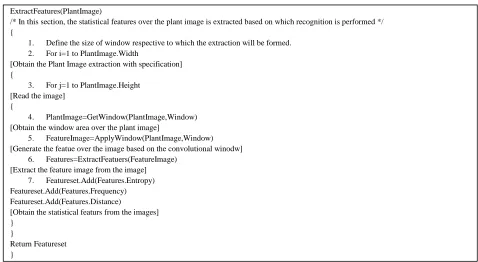
In this model, the plant leaf is taken as input and applied preprocessing operations to improve the image strength. The feature strength improvement is done here in terms of size level adjustment and contrast adjustment. Once the features are improved, the next work is to extract the critical feature region over the image. For this extraction a block segmentation method is applied. Once the effective region is generated, the statistical feature extraction is applied. In the final stage of this work model, the neural network model is applied for disease recognition. The algorithmic specification of this feature extraction model is shown in Table 1.
Table 1 Feature Extraction ExtractFeatures(PlantImage)
/* In this section, the statistical features over the plant image is extracted based on which recognition is performed */ {
1. Define the size of window respective to which the extraction will be formed. 2. For i=1 to PlantImage.Width
[Obtain the Plant Image extraction with specification] {
3. For j=1 to PlantImage.Height [Read the image]
{
4. PlantImage=GetWindow(PlantImage,Window) [Obtain the window area over the plant image]
5. FeatureImage=ApplyWindow(PlantImage,Window) [Generate the featue over the image based on the convolutional winodw]
6. Features=ExtractFeatuers(FeatureImage) [Extract the feature image from the image]
7. Featureset.Add(Features.Entropy) Featureset.Add(Features.Frequency) Featureset.Add(Features.Distance)
[Obtain the statistical featurs from the images] }
}
Return Featureset }
After generating the features, the neural network modeling is applied to perform the recognition. It is a neuron adaptive model that is applied on the featured dataset. The features are taken here in terms of frequency analysis, entropy value and the distance measure. The dataset is provided in terms of training set to adapt the feature relative to the complex neuron specification. Number of layers, iterations and the weight functions are applied to process the specified dataset. The validation rule is also applied to generate the optimized result. The time based mapping with maximum and minimum neuron point so that the accurate recognition will be performed.
Layer 1
Disease Region Identification
Layer 2 Feature Extraction
Layer 3
IV. RESULTS
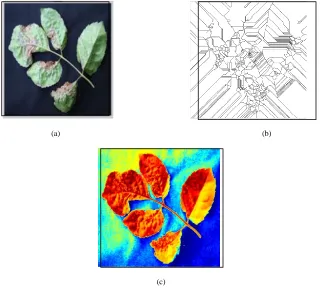
The work is applied on a sample set of leaf images extracted from random web sources. The work is applied on more than 50 instances of leaf images taken for different plants and disease. The sample set images are high resolution color jpg images. The feature extraction results applied on a sample image is shown in Figure 2. Results on Sample Leaf Image
(a) (b)
(c)
Figure 2. (a) Input Leaf Imag (b) Structure Extracted Image (c) Classified Result Image
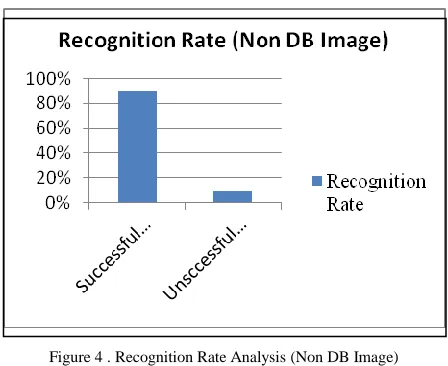
Here Figure 2. is showing the results obtained from the work. The work is applied on sample set and generated the result in the form of recognition rate. The results in the form of recognition rate are shown in Figure 3. and Figure 4.
Figure 3. Recognition Rate Analysis
Figure 4 . Recognition Rate Analysis (Non DB Image)
From Figure 4. it is revealed that the recognition rate for non database image. The figure shows that the presented work model provided the 90% recognition rate.
IV.CONCLUSION
In this work, a layered model is provided for recognition of plant image. The work is divided in three main stages. In first stage, the effective region extraction is done using block based segmentation. Later on the statistical features are generated over the leaf image. Finally, the neural network model is applied to perform the recognition. The work is applied on multiple sample sets. The work model provided the 90% accuracy for non db images and 100% accuracy for data base (db) image.
REFERENCES
[1] Teng-fei. M, Market Disease Pathogens Detection of Imported Fruits in Shanghai, Agricultural Sciences in China 2009, 8(9): 1087-1096. [2] S. R. Dubey and A. S. Jalal, “Detection and classification of apple fruit diseases using complete local binary patterns”, Proc. IEEE Third
Int. Conf.on Computer and Communication Technology., Allahabad, 2012. , pp. 346-351 2012.
[3] Haishi.T., Rapid detection of infestation of apple fruits by the peach fruit moth, Carposina sasakii matsumura, larvae using a 0.2-t dedicated magnetic resonance imaging apparatus, Journal of Apple Magnetic Resonance 41(1) (2011)1-18.
[4] Azegami k.,Tsukamoto T., Matsuura T., Inoue Y.,Uematsu H., Ohara T., Mizuno A., Yoshida K., Bessho H., Erwinia amylovora can pass through the abscission layer of fruit-bearing twigs and invade apple fruit during fruit maturation., Journal of General Plant Pathology.72(1) (2006) 43-45.
[5] He Y-H., Isono S., Characterization of a new Apple dimple fruit viroid variant that causes yellow dimple fruit formation in ‘Fuji’ apple trees., Journal of General Plant Pathology 76(1) (2010) 324–330.
[6] Sporea I., Gr uning A.,Supervised Learning in Multilayer Spiking Neural Networks., 25(2) (2013) 473-509.
[7] R. Lorenzo, "A new unsupervised neural network for pattern recognition with spiking neurons",Proc. IEEE Int. Conf. on Neural Networks Sheraton Vancouver 2006.
[8] M. Oster, Lichtsteiner. P, Delbruck. T. and Liu, S-C,“A spike-based saccadic recognition system”, Proc. IEEE Int. Symposium on circuit and System,2007.
[9] Q. Wu, “knowledge representation and learning mechanism based on networks of spiking neurons”, Proc. IEEE Int. Conf. on Systems, Man, and Cybernetic . October 8-11, 2006, Taipei, Taiwan.
[10] S. Nagatoishi, “Effect of refractoriness on learning performance of a pattern sequence”, Proc. IEEE Int.Conf.on Neural Networks, Atlanta, Georgia, USA, June 14-19, 2009 .
[11] Y. Meng, Y. Jin, J. Yin and M. Conforth, "Human activity detection using spiking neural networks regulated by a gene regulatory network," Proc. IEEE Int. Conf.on Neural Networks , Barcelona, pp. 1-6 2010.
[12] J. S. Seo et al., B. Brezzo.,Y. Liu., B.Parker.,S. Esser., R. Montoye., B. Rajendran., J.Tierno., L.Chang.,D.Modha.,D. Friedman "A 45nm CMOS neuromorphic chip with a scalable architecture for learning in networks of spiking neurons," Proc. IEEE Int. Conf.on Custom
Integrated Circuits Conference , San Jose, pp. 1-4 2011.