A PROPOSED MODEL FOR MITIGATION OF DATA FLOODING
ATTACKS IN AD HOC NETWORKS
Sunil S. Jadhav1*, Dr.S.N.Lokhande2, Dr.P.U.Bhalchandra2, Dr.S.D.Khmaitkar2, Dr.N.K.Deshmukh2, Mr.S.R.Mekewad2, Pawan Wasnik2 and Dr.G.B.Kurundkar3
1
System Expert, SRTM University, Nanded, MS, 431606, India.
2
School of Computational Sciences, SRTM University, Nanded, MS, 431606, India.
3
Dept of Computer Science, SGBS College, Purna, Dist Parbhani, MS, 431606, India.
Article Received on 18/09/2016 Article Revised on 08/10/2016 Article Accepted on 29/10/2016
ABSTRACT
Network security is a weak link in wired and wireless network systems
which if breeched then the functionality of the underlying network is
impaired by malicious attacks and causes tremendous loss to the
network. Denial of Service (DoS) attacks is one such most harmful
network security threat. Ad Hoc networks are even more vulnerable to such attacks as they
are infrastructure less and without any centralized authority. This paper narrates part results
of an undertaken research work whose objective was to study the impact of Data Flooding
DoS attacks on the performance of Ad Hoc networks. The gained knowledge is used to
design and develop a security framework to detect intrusion and perform response actions.
The validations of proposed defense system are carried out using statistical approach. All
Simulations were carried out in NS-2.
KEYWORDS: Security in Ad Hoc Networks, DoS Attacks, Simulation, Intrusion Detection.
I. INTRODUCTION
In recent years, the explosive growth of mobile computing devices has impelled a
revolutionary change in the computing world. This lead to emerging ubiquitous computing[1]
which merely does not dependent of capability provided by the personal computer and has
been a research hot spot in last few years. The nature of the ubiquitous computing has made it
necessary to adopt wireless network as the interconnection method. In wireless networks,
World Journal of Engineering Research and Technology
WJERT
www.wjert.org
SJIF Impact Factor: 3.419*Corresponding Author Sunil S. Jadhav
System Expert, SRTM
University, Nanded, MS,
nodes transmit information through electromagnetic propagation over the air, making it cost
economic and suitable for voice & data transmission. Wireless networks broadly fall into two
main categories, infrastructure based called wireless through wireless Access Point (AP) and
AdHoc network, where the nodes communicate with each other without having a central
access point.[2] Our study centers on the later on. The Ad Hoc wireless Network is an
autonomous system of mobile nodes. Such networks are known as infrastructure less network
because no any per-existing infrastructure is required for communications.[3] Here mobile
nodes form a time being network without help of centralized administration. These nodes
generally have a limited transmission range and each node seeks the assistance of its
neighboring nodes in forwarding packets.[4] This is the basic reason the nodes in an Ad Hoc
network can act as both routers and hosts. Wireless Ad Hoc networks have wide range of
applications including military applications, disaster management, business environments for
cooperative & collaborative computing and sensor networks. It is witnessed that the
computing scenario is drastically changed due to applicability of wireless communications.
Today we have number of application areas where wireless networks can play important role.
However, the risk also increases of getting harmed by intrusions and threats as the network is
open and without centralized coordinator. According to[5], a threat can be defined as the
potential possibility of a deliberate unauthorized attempt to access information, perhaps
manipulate information and render a system unreliable or unusable. Since the prime concern
of this research is security in Ad Hoc networks, an attempt is made herein to discuss the
various security related attacks in the Ad Hoc networks. These attacks can roughly be
classified into two major categories, namely passive attacks and active attacks.[6] In the
passive mode of attack, data being exchanged is obtained without affecting the
communication process. An active attack involves information interruption, modification, or
fabrication, thereby disrupting the normal functionality of an Ad Hoc network.
Eavesdropping, traffic monitoring, traffic analysis are few examples of passive attacks. Radio
signal jamming, data modification, impersonating, denial of service (DoS) and message
replay are examples of active attacks. According to the sphere of influence the attacks can
also be classified as external attacks and internal attacks.[7] When an attack is carried out by a
node which is not in the domain of the network is referred as external attack. When a node
within the domain of network is compromised and performs the malicious activity is referred
as internal attack. As compared to the external attacks, internal attacks are more severe due to
fact that the insider has privileged access rights and knows valuable and secrete information.
attacks can also be classified as per the network protocol stacks. We choose Denial of
Service (DoS) attacks as they can be external as well as internal. These attacks attempts to
prevent the victim from being able to use all or part of his/her network connection.[8] Denial
of service attacks may extend to all layers of the protocol stack. They target service
availability or authorized users' access to a service provider. These are very easy to generate
but are very difficult to detect and hence they are popular choice of hackers.[9] These can
easily be applied to wireless networks, where legitimate traffic cannot reach clients or the
access point because illegitimate traffic overwhelms the network. These attacks can be active
or passive.[11,12] As compared with wired networks, DoS attacks in wireless Ad Hoc networks
may not only bring damage to the victim node, but may also degrade the performance of the
whole network because nodes have limited battery power and the network can easily be
congested due to the limited bandwidth available as compared to fixed networks.[10] We have
chosen two Dos attacks for our study, viz, data flooding attack and Black hole attack.. In data
flooding attack, massive amount useless data packets will exhaust the communication
bandwidth in the network and in black hole attack, a malicious node uses the routing protocol
to advertise itself as having the shortest path to the node whose packets it wants to
intercept.[13,14,35]
II. LITERATUREREVIEW
It is evident from the literature reviewed in the context of research hypothesis that there are
numbers of intrusion detection and prevention systems proposed for traditional wired
networks as we need to monitor central monitoring devises only.[16] The same is not true with
Ad Hoc network as they do not have physical ambiance or central monitoring devices. Case
drastically changes in wireless Ad Hoc networks where the communication medium is widely
open and shared among different users.[2, 3] This highlights chances of being accessed by both
legitimate and malicious users. This also gives scope to intruders as there is no clear
severance between normal and abnormal activities in a mobile environment. In Ad Hoc
network, nodes can move randomly in any direction and at any movement a node can leave
or join a network. If a node is compromised, it will generate false routing information. Many
intrusion detection systems have been proposed to suit these characteristics of Ad Hoc
network.[15] Numerous architectures have been evolved over the time and they have implicit
considerations of intrusions.[15,17] We have chosen Distributed and Cooperative Intrusion
Detection Systems for the underlying study. In this architecture each node has an IDS and
every node participates in intrusion detection and responses by their IDS agent. To determine
collecting local events and data. If the data evidence is uncertain for intrusion detection, then
neighboring nodes IDS agents cooperatively participates in global intrusion detection actions.
This architecture is more suitable for flat network infrastructure, not for multi-layer network.
In case of Ad Hoc network, every node works as router for other, nodes and thus a mobile
node depends on neighboring nodes to forward packets to its destination. A neighboring node
may be selfish or it may be compromised by an external attacker. This compromised node
may cause of DoS (Denial of Service) attack by denying services to the legitimate nodes. As
the nodes of Ad Hoc network may have less processing power as well as battery life and
consequently would try to preserve these resources.[33] Actions of a selfish node could lead to
congestion, lower throughput and denial of service. The IDS Model proposed by Brutch and
Ko[25,33] is a statistical anomaly detection algorithm. It was our basic observation that the
most of the surveyed models use packets and network traffic related information such as
updates in routing table or request-reply flow in the network. IDS Model as described in[26]
utilizes the statistics derived from packet or traffic related statistics, for instance, the
correlation between the number of packets dropped and the percentages of updates in routing
table. Above cited literature review highlights novelties and contemporary research
investigations in detection of DoS attacks. Since our research hypothesis deals with
mitigation and prevention of DoS attacks, it is need of hour to address issues regarding
responses related to specific attacks. Many studies, as cited above, have incorporated
prevention and mitigation of such attacks. Such attempt needs understanding of Intrusion
detection and intrusion response framework. The framework components are relevant and
coexist with each other. It was our critical observation that while designing IDS, intrusion
response framework has given less attention than intrusion detection framework.[27] After a
rigorous analysis all above related issues, a common finding came in picture that the IDA for
Ad Hoc network must work with localized and partial audit data. It is more difficult for IDA
in Ad Hoc network to distinguish between normal and intrusion traffic.[15] In wireless
network, there is often no clear line between normal or abnormal activities. In wireless
network the connection is not stable and mobile nodes can join and leave the network at any
time. In addition, the communication between nodes for IDA purpose should not use much
bandwidth resources. The communication between IDA on different nodes must be secure to
not allow attackers gain the access to such communication. However, encryption in Ad Hoc
network is a difficult task itself as compared to wired network mainly because of requirement
of physical connection for access. Unlike in a wired network, Ad Hoc network nodes can be
secured. Therefore, in cooperative algorithm, the IDA must not assume that any node can be
fully trusted. IDA must address high false alarm rate problem. It is difficult to obtain enough
audit data to make an intrusion detection decision, because the bandwidth of Ad Hoc network
is much restricted compared with wired network. As a result, IDA in Ad Hoc network can
easily result in either having too much false alarm or missing many attacks.[28] Thus, the most
important requirement feature is to find an appropriate architecture of IDA that will fit the
mobile and Ad Hoc aspects of the wireless network. For a proper security mechanism we
need to sketch out efficiently a way to use the audit data source since the audit data in
wireless network is often partial and local. Further enough concentration should be given to
find another efficient way to distinguish attack traffic from normal traffic. In many cases, the
normal traffic that seems abnormal due to numerous factors like poor network connections,
contradicts our assumptions and the IDA will have a high false alarm rate.[15] On the
backdrop of all above discussions and research findings, the goal of this research study is to
observe the impact of combination of prevention and mitigation of selected DoS attacks in
Ad Hoc networks. The findings of the research clearly state that the implementations of such
unified mechanisms have a significant impact on the overall network positively. On the other
hand, the implementation of such mechanisms does not only mitigate the attack effects, it
also increases the overall performance above the normal state of the network. When we
investigated above facts and tried to establish proposition for our research hypothesis, it was
seen that there are several open issues in the models that were reviewed. The important
among them must be highlighted before our experimental setup is established.
III. PROPOSEDMODEL
It was understood from earlier two sections of this paper that the data flooding and black hole
attacks will affect the significant parameters as well as the performance of the Ad Hoc
network. It was also understood that cooperative distributive framework is necessary for IDS
designing. This fact is used as base for our intrusion detection and prevention framework.
The proposed framework will monitor different significant parameters for the detection of
intrusive activity in Ad Hoc network. If these parameters change rapidly, the appropriate
threat is detected and intruder is identified. Later a corrective action is taken. The challenge
here is the identification of sensitive parameters and their threshold values to predict the intrusion correctly. Many researchers’ uses parameters and their threshold values for the
intrusion detection in Ad Hoc network.[29,30,31] The parameter Threat (T) is used by detection
between 0 to 3, when there is no attack, the network is in the normal state (NS) and this is
indicated by the T range 0; when there is an attack, the network is in the vulnerable state (VS)
and is indicated by the T range from 1 to 3; The threshold value of Threat (T) for the normal
and vulnerable state are obtained by measuring the values of the significant parameters.
When the network is in operating state the values of parameters are measures and the new
value of Threat (TI). By comparing the computed TI with the T threshold, the node is
classified as being in the normal or vulnerable state and this classification detects the attack.
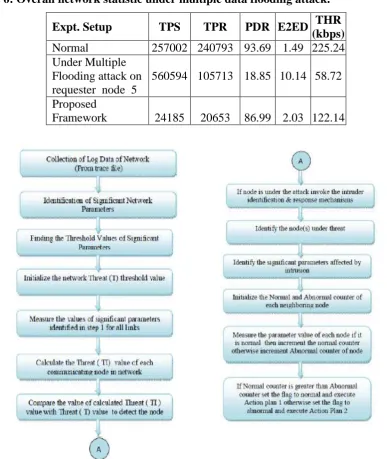
Each step of the threat detection framework, whose objective is to calculate the Threat to
detect an attack, is explained below. Steps of the proposed framework are shown in figure 1.
We refer to the terminology in[32] for the sketching of the response and prevention mechanism
which gets triggered when an attack is detected by the detection framework. The significant
parameters identified and the thresholds for these significant parameters in the detection
framework are used by the response and prevention framework to defend the attack. When
detection framework detects an attack, each neighboring source node to the node under threat
is examined by the response framework and different action plans are initiated based on the
identification of the nature of the intrusion nodes.[32] On the basis of threshold values, the
node is reputed using the counters and flags on their behavior, which is achieved by
monitoring significant parameters of node. The reputation counter is updated by comparing
the values of the significant parameters against an expected norm. Based on the reputation
counter, the reputation flag is asserted as Normal, or Vulnerable. If the reputation flag is
Normal, no action is necessary. If the reputation flag is Vulnerable then response action is
executed. The response action may isolate, block or deny further connections to malicious
nodes. This framework works on the basis of the network parameters and performing
response action on the basis of assertion of reputation flag. Such a framework allows for
response to flooding and black hole attacks. Those malicious and selfish nodes that generate
abnormal parameter values are identified and isolated. The following action plans[32] are used
in the response framework.
a) Action Plan 1: If a neighboring node to the node under threat is flagged as “normal”, no
action is needed.
b) Action Plan 2: If a neighboring node to a node under threat is flagged as “abnormal”,
action plan 2 is executed which may isolate or block the attacking node to protect the
Thus, with the help of the intruder identification mechanism and action plans, malicious
nodes that create threat in the network will be isolated or blocked from the activities in the
network.
IV. EXPERIMENTATIONS, OBSERVATIONS AND RESULTS FOR DATA FLOODINGATTACKS
We have carried out experimentations for DoS attacks. They are narrated briefly herein. As
the first objectives of this study is to measure the impact of data flooding DoS attack on
server node. In the first stage, the simulated network runs the under the normal operation
where the nodes are communicated by sending and receiving the data packets normally. A set
of random and moderate Constant Bit Rate (CBR) traffic is generated over the simulated
normal network. In the normal run the basic network performance parameters are measured
and referred to as the baseline of the normal network behaviors. These include total packet
sent, total packet received, total no. of packets forwarded, total number of packets dropped
end to end delay. These parameters are then used to measure average packet delivery ratio,
network throughput etc. of the network under normal operation using the AWK script. In the
second stage, multiple attacking nodes are launched , which performs data flooding DoS
attack over the service provider node in the simulated network during normal network
operation. The data flooding DoS attacker nodes generates huge amount of data packets
which are generally larger than the normal packet size. The impact of this attack and changes
in networks/nodes performance parameters are measured. In the third stage, the proposed
intrusion detection and prevention framework is launched in the network. The defense
framework will identify the attacking nodes on the basis of nodes parameters by comparing it
with the values of normal and under the data flooding attack. This will confront the flooding
DoS attack going over the service provider node and will be identified the attacking nodes for
isolation so as to stop all the further requests from this attacking node. The network
performance parameters are recorded and compared to the values against the attacked phase.
A. Experiment 1: Normal network
In this experiment, the wireless Ad Hoc network of varying numbers of nodes was simulated
in NS-2 (15, 25, 35 and 50) and varying numbers of connections. The wireless nodes are
moving randomly in the topographic region. These different simulation scenarios are run to
extract the behavior patterns of network. The log data (trace file) of these scenarios is
network parameters like total packet sent (TPS), total packets received (TPR), total packets
dropped (TPD),total packets forwarded (TPF), which are then used to calculate the
throughput (THR), packet delivery ratio (PDR), end to end delay (E2ED) etc. It was observed
while experimentation that the values of packet sent, received and packet dropped ratio for
varying network size. As the size of network is increased then ultimately the parameters
values of network are increased, this may be due to the increased numbers of nodes and
numbers of active connections. Also a graph of PDR (Packet Delivery Ratio) is plotted for
the varying sized network. It was also observed that the packet delivery ratio of the network
in the normal operation is lies between the 85 to 93 %.
B. Experiment 2: Data Flooding Attack on Service Provider Node
In this set of experiments the performance of network under the data flooding attack on
service provider node is evaluated. Comparison of the Normal Operation, Data Flooding
Attack at Service provider node and Proposed Defense frameworks response to this attack are
measured as result. The service provider is node 4 and the service requesters are node 1 and
node 5 respectively. There is one attacker node 6, sending continues data packets towards
service provider node 5. In the normal operation of network the service provider node is able
to send data packets towards requester nodes 1 and 5; also both the nodes are receiving the
data packets normally without any interruption. Once the simulation starts, all nodes,
including the service provider node and service requester nodes are randomly moving at
constant speed of 8 m/s in the topographic region. The simulation experiment is carried over
900 second and the log data of NS-2 trace file is collected. This log data of trace file is
processed and analyzed using the AWK script to find the values of network performance
parameters like total number of packets send, total number of packets received packet
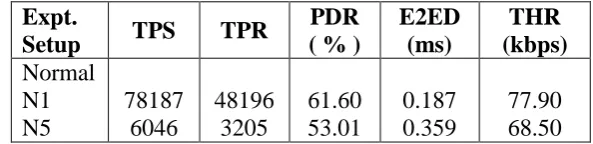
delivery ratio, end to end delay and throughput. Table 1 shows the values of network
parameters in the normal network operation. In the second stage of data flooding attack on
service provider node, an intruder node is configured in the network. In the simulated
network node 6 is placed near the service provider node, which then sends the useless data
packets/traffic towards node 4 to exhaust the memory of node 4 and its queue will full with
this useless data packets , due to this the service provider node cannot process or receive the
further requests from requester nodes. This affects the communication between service
provider and service requester nodes. From the screen shot of NAM output, it was clearly
seen that, once the data flooding attack is started by node 6 on node 4 at that time node 4 is
amount of this useless data traffic node 5 cannot receive its intended service over the
network. This causes the severe impact on the performance of network by affecting the
parameters values. The log data from the trace file after the data flooding attack on the
service provider node is processed and the results obtained are shown in the following Table
2. From the data its witnessed that the flooding DoS attacks decreases the parameters values
as the throughput of the node1 decreases from 77.90 to 22.30 and for node 5 decreases from
68.501 to 18.906 and there is increase in the end to end delay time from 0.359 to 0.754.
When we compared the results of these two scenarios we can say that the data flooding attack
on the service provider node has drastic impact on the performance of the network. In other
experimentation, multiple data flooding attackers are implemented and launched in the
network. In this scenario the service provider node and service requester nodes are same as in
the previous scenario. The nodes 6, 7, 8 and 9 are data flooding nodes in the network. All the
four attacker nodes are placed around the service provider node 4. All the four attacker nodes
simultaneously send useless data packets towards service provider node. Table 3 shows the
values of parameters affected by the multiple data flooding attack on service provider node. It
is also observed that the huge amounts of data packets are transmitted in the network. Due to
this huge data traffic there is congestion in the network which affects the performance of
network. From this it is concluded that the multiple data flooding attack affects the
performance parameters and also the performance of the network. In the next step of
experiment, the proposed intrusion detection and response framework is launched in all the
genuine nodes including the service provider node. The intrusion detection and response
framework identifies the attacking nodes on the basis of parameters identified as sensitive
parameters and blocks the attacking nodes. The defense framework helps the network to gain
more useful packet delivery ratio, throughput and improves the overall performance of
network under the data flooding DoS attack which targeted directly at the service provider
node. The Throughput of receiver is measured which is a ratio of the first and last data packet
received over the time difference between them. Average throughput is the average of per
receiver throughput. Table 4 shows the network throughput comparison of normal network
operation, under data flooding attack at service provider node and in the presence of proposed
defense framework. When this graph is plotted, it is seen that the throughput of the network
under normal operation without the data flooding attack is 71.96 kbps where as under the data
flooding attack it is decreased to 16.38 kbps means the throughput is decreased by 76.82 % .
When the proposed framework is launched it countermeasures the attack and helps to
41.97 kbps. The overall delivered packets for service requester node 1 and node 5 in the
normal operation, under the data flooding attack at service provider nodes and in the presence
of proposed defense framework to data flooding attack at service provider node over 900
seconds . The defense system improves the delivery rate of the individual and overall service
traffic by eliminating the attacking packets while transmitting the legitimate packets. We can
conclude that the defense framework helps to increase packet delivery rate. In this case, the
delivered packets of node 1 in 900 seconds are improved by 32.64% and the delivered
packets of node N5 are improved by 52.33%.
C. Experiment 3: Data Flooding Attack at Service Requester Node.
In this experiment, service provider is node 4 which transmits the packets towards the
services requester nodes node 1 and node 5. Node 6 is launched in the simulated network
which performs the data flooding attack on requester node 5. During the data flooding attack
scenario, the attacker node is deployed nearby the requester node 5, and sending the useless
data packets towards the node 5. Once the simulation run starts, all nodes, including the
service provider node, service requester nodes and attacker nodes are randomly moving in
topology region. When the attacker nodes start the data flooding attack, it results in a traffic
congesting and dropping packets around the requester node 5. Table 5 shows the statistical
data of node 5 during the normal operation, under the flooding attack and in the presence of
proposed security framework. It is seen that the E2ED which is doubled under the data
flooding attack as compared to the normal operation and is decreased up to 2 ms when the
proposed framework is launched in the network. Similarly the comparison of packet delivery
ratio and throughput under the data flooding attack clearly shows that the values of network
parameters are decreased under the data flooding attack drastically and under our proposed
framework the values are decreased which helps to maintain the network its normal state. In
another experiment multiple data flooding attackers are launched in the network. The service
provider is node 4 which transmits the packets towards the services requester nodes node 1
and 5. There are four attacker nodes are node 6, 7, 8 and 9. During the data flooding attack,
the attackers are deployed nearby requester node 5 and they start sending the useless data
packets towards the node 5. Once the simulation runs starts, all nodes, including the service
provider node, service requester nodes, and attacker nodes are randomly moving in topology
region. When the attacker nodes start the data flooding attack, it results in a traffic congesting
and dropping packets around the requester node 5. Table 6 shows the statistical data of node
security framework. We have also plotted graphs for PDR, Delay and YHR which cannot be
shown here due to page limitations. From these graphs, we can conclude that the multiple
data flooding attackers will decreases the network performance, whereas our proposed
framework helps the network to acquire its normal state by suppressing the excessive data
traffic, which increases the values of packet delivery ratio, throughput and decreases the
valued of end to end delay.
Table 1: Parameter values before data flooding attack. Expt.
Setup TPS TPR
PDR ( % ) E2ED (ms) THR (kbps) Normal N1 N5 78187 6046 48196 3205 61.60 53.01 0.187 0.359 77.90 68.50
Table 2: Parameter values after data flooding attack. Expt.
Setup TPS TPR
PDR ( % ) E2ED (ms) THR (kbps) Under Data Flooding Node 1 Node 5 67268 4058 31956 1928 47.50 47.51 0.459 0.754 22.306 18.906
Table 3: Parameter values after data flooding. Attack On Node N4
Expt. Setup TPS TPR PDR (%)
E2ED (ms)
THR (kbps)
Node (4) Under Multiple
Flooding Attackers
560594 105713 18.85 10.14 58.72
Table 4: Overall throughput comparison.
Experiment Runs Overall
throughput
Table 5: Overall network statistic under single data flooding attacker. Expt. Setup TPS TPR PDR E2ED THR
Normal 257002 240793 93.69 1.49 225.24
Under Flooding
On Node 5 355210 132021 38.42 3.10 73.35
In Presence of Proposed Framework
242085 206513 85.30 2.03 122.14
Table 6: Overall network statistic under multiple data flooding attack. Expt. Setup TPS TPR PDR E2ED THR
(kbps)
Normal 257002 240793 93.69 1.49 225.24 Under Multiple
Flooding attack on requester node 5
560594 105713 18.85 10.14 58.72
Proposed
V. CONCLUSION
This research paper narrates creation, deployment and cross validation of an intrusion
detection and response model for Ad Hoc network against data flooding DoS attack.
Extensive simulations were performed to evaluate the performance of proposed framework in
NS-2 simulator. The statistical validations are also carried out with the help of Chi- square
approach. The fitness of our proposed framework is tested under the various scenarios and
the results obtained prove that our proposed framework is good for the intrusion detection
and prevention in the Ad Hoc network.
REFERENCES
1. Marco Conti, Body, Personal and Local Ad Hoc Wireless Networks, in Book The
Handbook of Ad Hoc Wireless Networks (Chapter 1), CRC Press LLC, 2003.
2. M. Ilyas, The Handbook of Ad Hoc Wireless Networks, CRC Press, 2003.
3. W. Stallings, Wireless Communication and Networks, Pearson Education, 2002.
4. J. Schiller, Mobil communication. Addison-Wesley, 2000.
5. J. P. Anderson, “Computer Security Threat Monitoring and Surveillance”, James P.
Anderson Co., Fort Washington, 1980.
6. Wu et al., “A Survey of Attacks and Countermeasures in Mobile Ad Hoc Networks”,
Wireless/Mobile Network Security, Springer, 2006; 17.
7. Vinay P.Virada, “Intrusion Detection System (IDS) for Secure MANETs: A Study”,
International Journal Of Computational Engineering Research (ijceronline.com)., October
2012; 2(6): 2250-3005(online).
8. XiaoYang Zhang; Sekiya, Y.; Wakahara, Y., “Proposal of a method to detect black hole attack in MANET”, International Symposium on Autonomous Decentralized Systems.,
2009; (ISADS '09): 1-6.
9. M. Al-Shurman, S-M. Yoo, and S. Park, “Black Hole Attack in Mobile Ad Hoc Networks”, ACM Southeast Regional Conference, 2004.
10.Nital Mistry, Devesh C Jinwala, Mukesh Zaveri, “Improving AODV Protocol against Blackhole Attacks”, Proceedings of the international multi conference of engineer and
computer science, 2010; 2.
11.Imad Aad, Jean-Pierre Hubaux, Edward W. Knightly, “Denial of Service Resilience in Ad Hoc Networks” , in Proceedings of the 10th annual international conference on mobile
12.John Bellardo and Stefan Savage, “802.11 Denial-of-Service Attacks: Real Vulnerabilities and Practical Solutions”, in Proceedings of the 12th Conference on
USENIX Security Symposium – Vol.12.
13.Safdar Ali Soomro,Sajjad Ahmed Soomro, Abdul Ghafoor Memon, Abdul Baqi, “Denial
of Service Attacks in Wireless Ad hoc Networks” , Journal of Information &
Communication Technology, 4(2): 1-10.
14.Minakshi Bhardwaj, G.P. Singh, “Types of Hacking Attack and their Countermeasure”,
International Journal of Educational Planning & Administration., 1(1): 43-53.
15.IAad, J.P, Hubaux, and E.W. Knightly, “Denial of Service Resilience in Ad Hoc Networks”, ACM, MOBICOM, Philadelphia, PA, USA, 2004.
16.Y. Zhang, W. Lee, and Y. Huang, “Intrusion Detection Techniques for Mobile Wireless Networks,” ACM/Kluwer Wireless Networks Journal (ACM WINET), September 2003;
9(5).
17.Mukherjee, L. Heberlein, and K. Levitt, “Network intrusion detection”, IEEE Network,
May 1994; 8(3): 26-41.
18.Y. Huang, W. Fan, W. Lee, P. S. Yu, “Cross-feature analysis for detecting Ad Hoc routing anomalies”, in Proceedings of 23rd International Conference on Distributed
Computing Systems, 2003; 478-487.
19.C. Tseng, P. Balasubramanyam, “A specification-based intrusion detection system for AODV”, in Proceedings of ACM Workshop on Security of Ad Hoc and Sensor
Networks, 2003; 125-134.
20.P. Brutch , C. Ko, “Challenges in intrusion detection for wireless Ad Hoc networks”, in
Proceedings of Symposium on Applications and the Internet Workshop, 2003; 368-373.
21.O. Kachirski , R. Guha, “Effective intrusion detection using multiple sensors in wireless Ad Hoc networks”, in Proceedings of 36th International Conference On System Sciences,
2003; 57-64.
22.N. Stakhanova, S. Basu, J. Wong, “Taxonomy of intrusion response systems”, Computer
Science, Lowa State University, Technical Report 06-05, 2006.
23.Kong, H. Lou, K. Xu, D. Gu, M. Gerla, S. Lu, “Adaptive security for multilayer ad hoc networks”, Special Issue of Wireless Communication and Mobile Computing, Vol. 2, pp.
533-547, August 2002.
24.N.Ye, Q.Chen, “An Anomaly Detection Techniques based on a CHI-SQUARE Statistics for Detecting Intrusion into Information System”, Quality and Reliability Engineering
25.N.Ye, X.Li, M.Emran, M.Xu, “Probabilistic Techniques for Intrusion Detection Based on Computer Audit Data”, IEEE Transaction on Systems, Man & Cybernetics, 2001.
26.S. P. Alampalayam et al, Intruder Identification and Response Framework for Mobile Ad
hoc Networks, Conference proceedings, Conference: 22nd International Conference on
Computers and Their Applications, CATA-2007, Honolulu, Hawaii, USA, March 28-30,
2007.
27.S. P. Alampalayam, classification and review of security schemes in mobile computing,
wireless sensor networks, 2010; 2: 419-440.
28.Syed Atiya Begum , Techniques for resilience of Denial of service Attacks in Mobile Ad
Hoc Networks, International Journal of Scientific & Engineering Research., March -2012;