UDC: 004.8.032.26:616.12
AI Models of the Hemodynamic Simulation
O. Miljkovic1*, M. Ivanovic2, N. Filipovic3, M. Kojic2,4,5
1 College of Computer Science, Megatrend University of Belgrade, Bulevar umetnosti 29,
11000 Novi Beograd, Serbia, [email protected]
2 Research and Development Center for Bioengineering, BioIRC, Kragujevac, Serbia
3 Faculty of Mechanical Engineering, Sestre Janjic b.b. 34000 Kragujevac, Serbia
4 Harvard School of Public Health,677 Huntington Ave. Boston, MA, USA
5 Department of Biomedical Engineering, University of Texas Medical Center at Houston, USA
[email protected] *Corresponding author
Abstract
A trial to find the right reasons of the pathogenesis of the pathological changes on the blood vessels and to prevent the growing of the cardiovascular diseases, includes many different techniques of the Artificial Intelligence (AI). Fuzzy modeling and Neural Network reasoning are shown in this paper as two possible solutions in measuring valuable hemodynamic factors in the arterial blood circulation. The interactive program MedCFD, using Finite Element Method (FEM), provides automatic generation of a realistic geometric model of an aneurysm, as the most frequent pathological change on the blood vessels, and offers possibility to determine and evaluate the effects of flow characteristics. Its inputs and outputs will be training data for neural network model and a source of the knowledge for fuzzy modeling of the same real system. Input parameters of these models are geometrical parameters of the aneurysm. The values of the maximum shear stress at inlet and outlet zones are their output parameters. Both of artificial intelligence models approximate the MedCFD calculation of these important hemodynamic factors and are able to simulate and give good responses to new inputs. A significant achievement of this approach is its time saving feature. Instead of solving large systems of equations which may last for days, we are able to collect results of fuzzy or neural network model of the same phenomena instantaneously.
Keywords: Hemodynamics, Neural Network, Fuzzy Modeling, Computer Fluid Dynamics, Grid computing
1. Introduction
There is a growing trend to practice minimally invasive endovascular procedures in measuring these valuable hemodynamic variables (Filipovic et al. 2003).
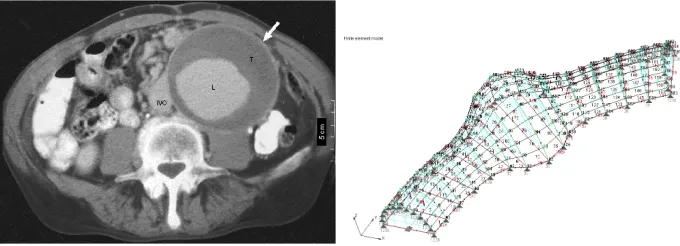
One of the most common cardio-vascular diseases is the occurrence of an arterial aneurysm. An aortic aneurysm is a weakened and bulging area in the aorta, the major blood vessel that feeds blood to the body. Depending on the size and rate at which the aortic aneurysm is growing, treatment may vary from watchful waiting to emergency surgery. Once an aortic aneurysm is found, doctors will closely monitor it so that surgery can be planned if it's necessary. How quickly an aortic aneurysm may grow is difficult to predict. Aneurysms can develop anywhere along the aorta, but most occur in the abdomen and are called abdominal aortic aneurysms (Fig.1). In general, the larger the aneurysm, the greater the risk of rupture. Specialized tests which can confirm having this blood vessel deformation might include
abdominal ultrasound, Computerized tomography (CT) scan and Magnetic resonance imaging
(MRI).
Fig. 1. a) Cross sectional CT image of the abdomen showing a large Abdominal Aortic Aneurysm b) Typical finite element mesh of an artery with an aneurysm.
Numerical modeling is one of the available methods to have a close insight into hemodynamic parameters (Kojić et al. 2008). Finite element method (FEM), as one of the classical Computational Fluid Dynamics (CFD) methods, makes possible to acquire relevant hemodynamic factors without measuring in vivo. Finite Element Method (FEM), as one of image-based and non-invasive computational methods, makes possible to carry out hemodynamic simulation and produces results in values of relevant hemodynamic parameters in each indicated mesh point (Miljković et al. 2005).CFD pre-processing features, as well as 3-D graphical representation and CF3-D post-processing features are integrated into MedCF3-D
(Research and Development Center for Bioengineering, Kragujevac, Serbia) plugin-based
software tool. The aim of this tool is to make CFD modeling procedure easy to use and to provide an interface familiar to medical personnel. Aneurysm plug-in module of MedCFD tool
gives physicians a piece of information that is crucial in determination which aneurysms are
likely to rupture and to indicate an immediate and aggressive intervention. At each time step of the simulation, a system containing huge number (even millions) of equations have to be solved and a majority of the reliable CFD analyses cannot be performed using a personal computer in a reasonable time with reasonable memory consumption. This fact disables a wide usage of biomechanical modeling in clinical practice. Nowadays, High Performance Computing (HPC) is a wide accepted solution for this kind of modeling (gLite 3 User Guide 2008).
potential aneurysm rupture. In this research, we present AI techniques which produce these wall shear stress values for differing aneurysm geometry including many subtypes of aneurysm. Proposed Neural Network and Fuzzy models can be used like a CFD system for calculating shear stress values at inlet and outlet zones of an aneurysm depending on its geometry, but without a high computing resource and time consumption demand.
2. Pre-modeling
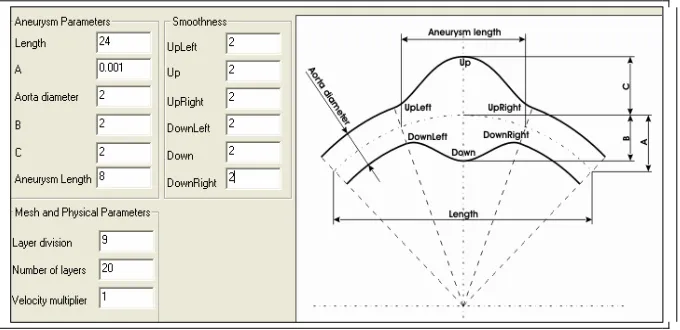
Finite element mesh is a starting point in patient specific blood flow simulation and measurement of valuable hemodynamic variables. MedCFD software tool provides an engine for pre-and post-processing of finite element data and specific module capable of an image based and parametric model generation. The first step is specification of the aneurysm geometry. A newly developed MedCFD module generates precise structured finite element mesh of the aneurysm whose shape is defined by groups of parameters shown in Fig.2. (Kojić et al. 2008).
Fig. 2. Defining parameters of the aneurysm geometry.
A, B and C parameters have been chosen to be input variables of Neural Network and Fuzzy models which describe the aneurysm shape. Here, A is the height of the arc of central line, B is the radius from the central line to the inner wall of the aneurysm, C is the radius from the central line to the outer wall of the aneurysm. Values of remaining parameters in Fig.2. are considered constant. Both of AI models effect a computation by mapping these input values to output values SSinlet, SSoutlet which represent the time average value of shear stress at the thin
0 .0 0.2 0.4 0 .6 0.8 1.0 -5 0
0 50 100 150 200 250 300 350
Q [
m
l/
s
]
T im e t/t
p
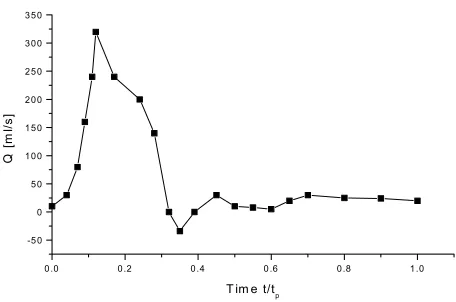
Fig. 3. A typical in-flow waveform at the artery entry.
An identical boundary condition is prescribed for all input parameter values. Fig.3. shows a typical waveform prescribed at the aneurysm inlet (Kojić et al. 2008), Q is the volumetric in-flux, and t/tp is the relative time with respect to the cycle period tp. Other relevant quantities
with constant values are: blood density ρ=1.05 g/cm3, kinematic viscosity ν=0.035 cm2/s,
Length=24cm, Aorta diameter=2cm and Aneurysm length=8cm. The three-dimensional flow of a viscous incompressible fluid (such as blood) is governed by the Navier-Stokes equations.
For a 3D analysis we use the 21/8 node finite element, where 21 and 8 nodes are used to interpolate the velocities and pressure, respectively. Taking into account dynamical nature of an analysis which must include full heart cycle and that a typical artery mesh consists of tens of thousands or even hundreds of thousands of nodes, it is clear that significant number of computing jobs have to be performed. After initializing group of input parameters and creating appropriate finite element mesh, a large number of CFD analyses has to be executed to acquire wall shear stress values. For this problem, computations on the grid platform for distributed computing is a logical approach (gLite 3 User Guide 2008). Then the computing time is reduced by one or two orders of magnitude. The infrastructure used here is SEE-GRID (South East European GRID), with gLite middleware developed under EGEE project.
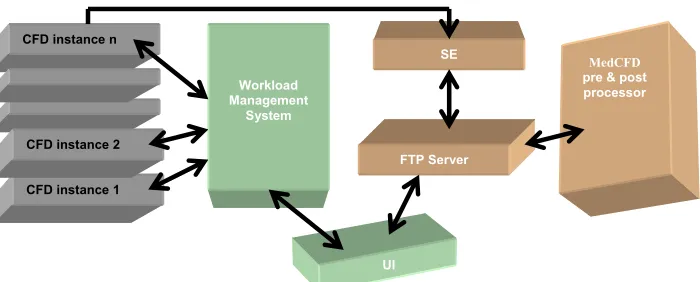
Fig. 4. The grid computing scheme.
MedCFD module generates finite element models for each CFD run. All data is then transferred to Storage Element (SE) directing from User Interface (UI). Then, each CFD instance reaches destination worker node anywhere in the infrastructure, determined by Workload Management System (WMS). This procedure significantly saves time, enabling all CFD runs to be executed concurrently.
The table acquired as an output of assembling CFD results contains ordered sequences of five input/output parameter values (A, B, C, SSinlet, SSoutlet) whose number is equal to the total
number of all CFD runs. These vectors are input data for both of AI models.
3. Fuzzy-hemodynamic model
Reasoning in the fuzzy logic is just a matter of generalizing the familiar yes-no logic. Fuzzy logic starts with the concept of a fuzzy set. A fuzzy set admits the possibility of partial membership in it. The degree an object belongs to a fuzzy set is denoted by a membership value between 0 and 1. A membership function associated with a given fuzzy set maps an input value to its appropriate membership value.
The point of fuzzy logic is to map an input space to an output space, and the primary mechanism for doing this is a list of if-then statements called rules. The rules themselves are useful because they refer to variables and the adjectives that describe those variables. A single fuzzy if-then rule assumes the form if x is A then y is B where, A and B are linguistic values defined by fuzzy sets on the ranges X and Y, respectively (Lee 1990).
The following actions precede building If-Then rules of the Fuzzy-Hemodynamic model: 1. Specification of an aneurysm geometry using relevant parameters;
2. Specification of boundary conditions;
3. Generation of multiple finite element meshes related to all value combinations of model input parameters;
4. Dynamic FEM analyses.
Our fuzzy model is a Three-Input-Two-Output system which maps the fuzzy input space (A, B, C) into the output fuzzy space (SSinlet , SSoutlet), where SSinlet and SSoutlet represent the time
CFD instance n
CFD instance 1
Workload Management
System
MedCFD pre & post processor
FTP Server SE
UI
average value of shear stress at the thin belts just before and just after an aneurysm bulge itself, respectively (Mathworks 2002), (Jang 1993). Here, an identical boundary condition is prescribed for all possible combinations of input parameter values. Input data set considers 250 different aneurysm shapes for which CFD analyses has to be executed.
In the third pre-building phase, a structured mesh is created automatically using a batch procedure for each value combination of the model input parameters A, B and C (Miljković et al. 2005). All input and output fuzzy variables are described with three or four linguistic values. For example, the input parameter A can take values from the interval [0, 10] and it can be characterized with three selected linguistic values 'low', 'medium' and 'high'. Each combination of linguistic values of input variables requires one CFD run to be processed (Tanaka 1996). The total number of CFD runs, needed to be performed in order to generate the entire set of If-Then rules, is equal to NA*NB*NC, where NA , NB and NC are the numbers of linguistic values of
fuzzy parameters A, B and C, respectively. In the fourth pre-building step, dynamic FEM
analyses are performed related to all combinations of linguistic values of input parameters, using grid infrastructure.
After building fuzzy rules, they have to be interpreted. This is a three-part process (Bezdek 1981). The first is a fuzzification of input parameters. The second part is to apply fuzzy operator to multiple part antecedents and finally, the third part is the application of an implication method. The consequent of a fuzzy rule assigns an entire fuzzy set to the output. The output of each rule is a fuzzy set. The output fuzzy sets for each rule are then aggregated into a single output fuzzy set. Finally, the resulting set is defuzzified, or resolved to a single number.
Mamdani type of fuzzy inference mechanisms (Yao, 2000) is implemented here in order to form a fuzzy engine suitable to give shear stress values at aneurysm inlet/outlet as approximate to CFD results as possible. Fuzzy-Hemodynamic model is realized as the MATLAB application (Mathworks 2002). Fuzzy models in which each input and output variable is described by three or four linguistic values are noted here as three membership function (3MF) or four membership function (4MF) model, respectively. Gaussian membership function is used for all variables.
The FIS Editor (Fuzzy Inference System Editor) displays general information by a simple diagram about a fuzzy inference system, with the names of all input/output variables. This
scheme is given in the Fig.5. where all inputs/outputs are 3MF variables.
Fig . 5. Schematic view of the aneurysm fuzzy inference system (3MF).
In order to produce all fuzzy rules, the 3MF and 4MF models require 27 and 64 CFD runs,
respectively. The and, or, implication and aggregation methods are supported respectively by
acquired by centroid defuzzification method which returns the center of the area under the curve (Yao, 2000).
The inference procedure is here described using an example. The random sample of input parameter values is (A, B, C ) = (1.5, 1.15, 2.4) and the subset of rules influencing to these inputs, in the case of 3MF model, looks like
if (A is min) and (B is min) and (C is mid) then (SSinlet is mid)
if (A is mid) and (B is min) and (C is mid) then (SSinlet is max)
if (A is min) and (B is min) and (C is max) then (SSinlet is mid)
if (A is mid) and (B is min) and (C is max) then (SSinlet is max).
In Fig.6., graphical representation is shown for the entire fuzzy inference process which only contains four active rules and leads to the centroid deffuzified solution for SSinlet variable.
Fig.6. Distribution of the subset of rules (3MF) using input data A=1.5cm, B=1.15cm, C=2.4cm.
Generally, a fuzzy modeling demands multiple iterations. The fuzzy model is tested many times. After comparing the model results to CFD outputs for the same inputs, required corrections and improvements were implemented, so that this new software tool is able to produce good responses to new inputs.
4. Neural network-hemodynamic model
AI techniques have been successfully applied in many fields because of its multidisciplinary nature. Neural networks are useful for functional prediction and system modeling where the physical processes are not quite understood or are highly complex (Schraudolph et al.). Neural network with biases, a sigmoid layer, and a linear output layer is capable of approximating a functionality between input and output parameters of this hemodynamic model.
gray vertical bars at the middle and the right are the numbers of hidden and output neurons, respectively. In the second layer, Layer Weight (LW) matrices coming from layer outputs are used as well as Input Weight (IW) matrices and the linear function is used as a transfer function. This is architecture of neural network which computes wall shear stresses values at inlet and outlet zones of an aneurysm.
Fig. 7. General function approximator.
Input training vector consists of three geometric parameters A, B and C (Fig.3.) whose
values fit their required intervals. Output training vector consists of two target parameters, the maximum shear stress at inlet and outlet zone of the aneurysm. First step in the training process is assembling odered sequences of five input/output parameter values (A, B, C, SSinlet, SSoutlet)
using grid computing. The typical performance function that is used for training feedforward neural networks is the mean sum of squares of the network errors
2 2
1 1
1 N 1 N ( )
i i i
i i
mse e t a
N = N =
=
∑
=∑
−The training set considers 1050 different aneurysm shapes for which CFD analyses has to be executed. The next step in training a feedforward neural network is to create the network object. The network has three input neurons, two output neurons and as an initial guess, we use five neurons in the hidden layer. Weights and biases have been initialized and the network is ready for training (Hagan et al. 1994). To make the neural network training more efficient, scaling network inputs and targets is done by normalizing the mean and standard deviation of the training set (Caudill et al. 1992). MatLab application for training neural net uses Levenberg-Marquardt algorithm as one of the fastest algorithm for training moderate sized - feedforward neural networks. Levenberg-Marquardt algorithm was designed to approach second-order training speed without having to compute the Hessian matrix (Mathworks, 2002.).
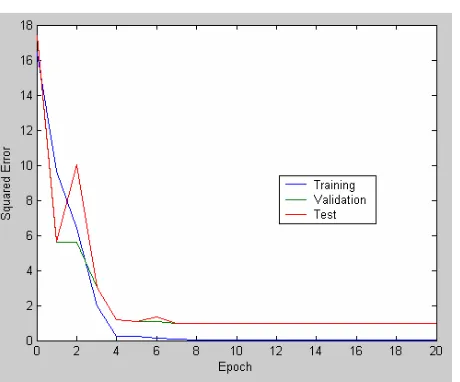
Here, early stopping is used as a method for improving generalization. It is a technique based on dividing the data into three subsets. The first subset is the training set used for computing the gradient and updating the network weights and biases. The second subset is the validation set. Validation vectors are used to stop training early if the network performance on the validation vectors fails to improve or remains the same. The third subset is the test set. It is used to verify the network design. The training stopped after 20 iterations because when the network begins to overfit the data, the mean square error on the validation set will typically begin to rise. The weights and biases at the minimum of the validation error are returned. The test set error is not used during the training. Figure 8 illustrates a useful diagnostic tool to plot the training, validation and test errors to check the progress of training.
IW1,1
b1
3
Tan
Sig
Pure
Line
+
2×3 32× n1 LW2,1 b2 2+
n2p1 1 a1 1 S a2=y
Fig. 8. The training, validation and test errors during the training proccess.
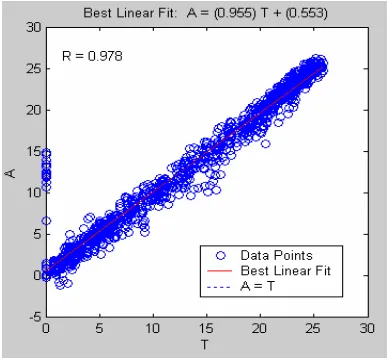
When a hidden layer is too large it can degrade the network’s performance. MATLAB application trains the neural network and fitting the network input/output data can be further improved by adding one by one unit to the hidden layer (Nguyen et al. 1990.). After each simulation related to obtained number of hidden units, a specific routine which performs a regression analysis between the network response and the corresponding targets is run. It returns three parameters. The first two correspond to the slope and the y-intercept of the best linear regression relating targets to network outputs. If outputs exactly equal to targets, the slope would be 1, and the y-intercept would be 0. The third variable is the correlation coefficient (R) between the outputs and targets. It is a measure of how well the variation in the output is explained by the targets. If this variable is equal to 1, then there is perfect correlation. After post-processing analysis, the neural net with the best performance is saved (Mathworks 2002). Searching for the best resulting fit with prescribed maximum number of hidden units, the final number of neurons in the hidden layer is 37.
The performance of a trained network can be measured to some extent by the square errors on the training, validation and test sets. The entire data set (training, validation and test) is put through the network and linear regression between the network outputs and the corresponding targets is performed. The figure 9 shows the linear regression analysis between the network
outputs of SSinlet and the corresponding targets. The network outputs are plotted versus the
Fig. 9. Linear regression analysis.
5. Results and discussion
How defined AI models work when using regular random values for input parameters A, B and C is given as an illustration. There is the sample of eight random values of input model parameters A, B and C. In Table 1 is given a comparison between the results obtained by CFD, fuzzy-hemodynamic and Neural Network model with respect to the appropriate CFD solutions with relative percentage error. Relative error is obtained using
Error(%) = ABS(SSAI– SSCFD)/ SSCFD*100,
where SSCFD is the maximum shear stress inlet value at systole peak obtained by CFD
simulation, while SSAI is the value obtained by one of two defined AI models. The average
error, using this random sample of the input data is close to 10%.
SSFUZZY (Pa) Error (%)
A
(cm)
B
(cm)
C
(cm)
SSCFD
(Pa) 3MF 4MF
SSNEURO
(Pa) 3MF 4MF SSNEURO
9.7 1.3 1.1 20.39 22.2 17.2 21.19 8.88 15.64 3.94 6.7 1.6 2.4 22.57 21.8 21.9 24.12 3.41 2.97 6.88 8.4 2.5 2.8 18.05 15.1 18.2 21.22 16.34 0.83 17.56
3 1.2 1.2 21.54 16.7 18.8 21.37 22.47 12.72 0.80 7.8 1.7 2.4 21.3 21.7 21.1 22.33 1.88 0.94 4.84 3.6 1.2 2.2 20.02 19 21.1 22.4 5.09 5.39 11.89 9.5 2.4 2.4 19.52 16.9 17.3 20.43 13.42 11.37 4.67 7.6 2 1.6 23.63 20.8 19.1 23.34 11.98 19.17 1.23
Average Error(%) 10.43 8.63 6.48
Using greater samples of new values of input model parameters, the computed average relative errors are between 4 and 15 percents. Evidently, wall shear stress estimations obtained by the AI approaches are very close to the CFD values. 4MF fuzzy model generally gives slightly better results than the 3MF fuzzy model.
In order to compare CFD and fuzzy model, graphical representation in Fig.10. is given to describe how the shear stress at inlet zone partially depends on parameters A, while keeping the remaining two parameters constant. The fuzzy inference system shows the very same increasing and decreasing trend behavior when compared to the CFD diagram. Both systems, especially 3MF inference system show a significant descent looking as a system deviation.
Fig. 10. Wall shear stress inlet as a function of the parameter A (B=2, C=2).
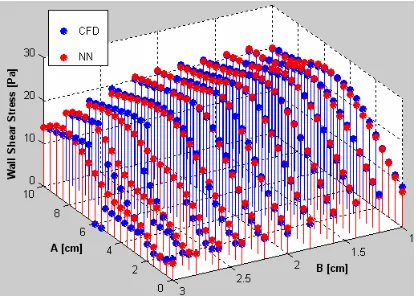
Following three-dimensional stem plot visualizes a wall shear stress inlet as a function of two variables A and B while keeping the remaining parameter C constant (C=2), using a sample of 250 new random values of input parameters (Fig.11.). Red and blue marker symbols represent three-dimensional discrete sequence data corresponding the Neural Network and CFD model results, respectively. Evidently, red and blue circles are quite close and indicate good resulting fit, except the quite small number of points.
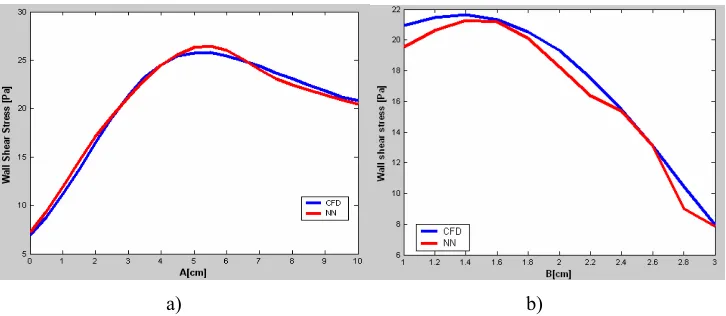
Next linear graphical representations are given on how the shear stress at inlet zone
partially depends on parameter A and B in the Fig.12., while keeping the remaining two
parameters constant.
a) b)
Fig. 12. The wall shear stress as a linear function of parameter A (a) C=2 and B=1.6 (b) C=2 and A=3.
New useful AI approach of hemodynamic simulation through an aneurysm is realized.
Created Neural Network-Hemodynamic model can perform hemodynamic simulation for any
new input and gives wall shear stress estimation values approximate to CFD shear stress values. This information is a recommendation in prevention of fatal consequences which can occur when a blood vessel with aneurysm breaks. It is a clue in a further clinical analysis and medical treatment of blood vessels with this pathological change.
6. Summary and conclusions
Importance of evaluating hemodynamic factors in blood vessels is important for understanding a formation and rupture due to pathological changes on blood vessels and for the outcome of their endovascular and surgical treatment. Finite element method (FEM), as one of the image-based computational methods, can provide hemodynamic simulation without invasive measuring in vivo. Based on the FEM, MedCFD as a user friendly software tool, generates precise 3D geometry, performs hemodynamic simulation and gives a list of computed hemodynamic quantities like blood pressure, velocity and wall shear stress (Kojić et al. 2008). Finite element hemodynamic CFD simulation requires significant time for execution and is unsuitable for everyday practice.
mutually independent and computation can be simply distributed over a computing grid. Thus, the total computational time was significantly reduced.
A neural network AI technique is proposed as another alternative approach to acquire wall shear stress values at inlet and outlet zones of an aneurysm depending on its geometry (Bezdek 1981). The table acquired as an output of assembling CFD results contains ordered sequences of five input/output parameter values (A, B, C, SSinlet, SSoutlet) which make the neural network
training data. Neural network with biases, a sigmoid layer, and a linear output layer is capable of approximating a functionality between input and output parameters of this hemodynamic model. MATLAB application for training neural network uses Levenberg-Marquardt algorithm (Hagan et al. ‚1994), (Nguyen et al. 1990). Early stopping is used as a method for improving generalization. Fitting the network input/output data is improved by adding one by one unit to the hidden layer. After post-processing analysis, MATLAB application saves the neural network with the best performance (Jang et al. 1997).
Considering numerous test results, the inference system presented here can be used in case of time and expert skills deficiency to perform a real CFD simulation. Instead of solving large systems of equations which may last for days, we have simulation results instantaneously. Significant advantage of AI approaches is in the prevention of aneurysm rupture, in its efficiency considering performance, time duration, needed computer resources and usage simplicity. It can give an early sign of potential aneurysm rupture and indicate necessary CFD analysis or medical intervention.
Both of AI models can be further upgraded with many changes and improvements which include in the case of the fuzzy model: another selection of fuzzification and deffuzzification strategies; more sophisticated system with larger number of appropriate linguistic values of input and output parameters, but without risk of decreasing reliability, another type of fuzzy inference mechanism; more precisely defined fuzzy rules etc. In the case of the neural network model, it can be further upgraded with other available neural network training methods with right selection of number of neurons in the hidden layer and with any other more suitable neural network architecture. Using suggested methodologies, it could be possible to determine many other functionalities between input arterial blood flow parameters and relevant hemodynamics.
References
N. Filipovic, M. Kojic, B. Stojanovic, M. Ivanovic and V. Rankovic, Three-dimensional computer simulations of blood flow through the abdominal aortic aneurysm, International Congress of Computational Bioengineering, Zaragoza, Spain, (2003) 24-26 September, pp. 15-20
M. Kojić, N. Filipović, B. Stojanović, N. Kojić, Computer Modeling in Bioengineering,
Theoretical Background, Examples and Software, John Wiley&Sons, England, 2008. Miljković, O., Tuba, M., Stojanović, B., Contours Detection of Medical Image Objects for
Finite Element Mesh Generation, Bulletins for Applied Mathematics (BAM), CVII, Nr 2254, pp. 142-149, Budapest, 2005.
gLite 3 Middleware User Guide, https://edms.cern.ch/file/722398//gLite-3-UserGuide.pdf Elger, D.F., Blackketter, R.S., Budwig R.S., and Johansen K.H., The Influence of Shape on the
Stresses in Model Abdominal Aortic Aneurysms, ASME J. Biomesh. Eng., 118, pp. 326-332, 1996.
Lee, C.-C., Fuzzy logic in control systems: fuzzy logic controller-parts 1 and 2, IEEE Transactions on Systems, Man, and Cybernetics, Vol. 20, No. 2, pp 404-435, 1990.
Jang J.-S. R., ANFIS: Adaptive-Network-based Fuzzy Inference System, IEEE Transactions on Systems, Man, and Cybernetics, Vol. 23, No. 3, pp. 665-685, May 1993.
K. Tanaka, An Introduction to Fuzyy Logic for Practical Applications, Springer-Verlag, New York, 1996.
Bezdek, J.C., Pattern Recognition with Fuzzy Objective Function Algorithms, Plenum Press, New York, 1981.
J. Yao, M. Dash, S.T.Tan, H.Liu, Entropy based fuzzy clustering and fuzzy modeling, Fuzzy Sets and Systems, Vol 113, No 3, 381-388, 2000.
Nici Schraudolph and Fred Cummins, Lecture Notes prepared by Genevieve Orr, Willamett University, http://www.willamette.edu/~gorr/classes/cs449/intro.html
Neural Network Toolbox 4.0 Release Notes, Version 6.5.0.180913a Release 13, The Math Works, June 2002.
Hagan, M. T., and M. Menhaj, Training feedforward networks with the Marquardt algorithm, IEEE Transactions on Neural Networks, vol. 5, no. 6, pp. 989-993, 1994.
Caudill, M., and C. Butler, Understanding Neural Networks: Computer Explorations, Vols. 1 and 2, Cambridge, MA: the MIT Press, 1992.
Nguyen D., and B. Widrow, Improving the learning speed of 2-layer neural networks by choosing initial values of the adaptive weights, Proceedings of the International Joint Conference on Neural Networks, vol 3, pp. 21-26, 1990.