Available online on 15.11.2017 at http://ujpr.org
Universal Journal of Pharmaceutical Research
An International Peer Reviewed Journal
Open access to Pharmaceutical research
This is an open access article distributed under the terms of the Creative Commons Attribution-Non Commercial Share Alike 4.0 License which permits unrestricted non
commercial use, provided the original work is properly cited
Volume 2, Issue 5, 2017
RESEARCH ARTICLE
DEVELOPMENT AND EVALUATION OF FAST DISSOLVING THIN FILMS OF
ARIPIPRAZOLE
Edenta Chidi1 , Nwobodo Ndubuisi Nwobodo2, Offiah Raymond O3 1
Department of Biochemistry Renaissance University, Enugu, Nigeria 2
Department of Pharmacology and Therapeutics, Division of Clinical Pharmacology and Translational Medicine, Enugu, Nigeria 3
Department of Pharmacology and Therapeutics, Faculty of Clinical Medicine, College of Medicine, ESUT, Enugu, Nigeria
ABSTRACT
Objectives: Aripiprazole, is an atypical antipsychotic. It is recommended and primarily used in the treatment of schizophrenia and
bipolar disorder and it undergoes extensive hepatic metabolism. The aim of the current study was to develop thin films of Ariprazole to avoid its hepatic metabolism.
Methods: In the present research, five different rapidly dissolving films of Aripiprazole were prepared successfully by using
different polymers by means of solvent casting method. The prepared films were evaluated for different parameters including thickness, mass uniformity, pH, folding endurance, drug content uniformity, cumulative percent release, in-vitro dissolution test and accelerated stability studies. Drug release kinetics of the films, the data obtained were fitted to various kinetic equations
Results: The thicknesses of the films were ranged in between 0.15±0.14mm to 0.20±0.09mm and weight in the range 41.3±0.68 to
47.6±0.83mg. The disintegration time of the films were found to be from 19±0.48 to 24±0.52seconds. Formulation of batch F4 has shown maximum release 95.48% in 30 minutes. There was no significant change in appearance, pH, folding endurance, drug content, in vitro disintegration and percentage drug release during stability testing.
Conclusion: Study concludes effective delivery of Aripiprazole in the form of fast dissolving thin films. On the basis of different
evaluated parameters formulation of batch F4 was found to be optimum formulation.
Keywords: Aripiprazole, bioavailability, fast dissolving thin films, first pass metabolism, in-vitro dissolution studies, release
kinetics.
Article Info: Received 3 November 2017; Revised 8 November; Accepted 12 November, Available online 15 November 2017
Cite this
article-Chidi E, Nwobodo NN, Offiah RO. Development and evaluation of fast dissolving thin films of aripiprazole. Universal Journal of Pharmaceutical Research 2017; 2(5): 19-23.
DOI:http://doi.org/10.22270/ujpr.v2i5.R5 Address for Correspondence:
Edenta Chidi, Department of Biochemistry Renaissance University, Enugu, Nigeria, E-mail: [email protected]
INTRODUCTION
At present scenario there are so many advanced drug delivery system for administration of various drugs through various route, but the oral route is considered as the most convenient and the preferred route of administration because of low-cost and ease of administration increases the patient compliance1.More than 70% of drugs are available in the market in the form of oral drug delivery system. Dysphagia (difficulty in swallowing) is commonly found in pediatric and geriatric patients thus they tend to avoid taking oral solid dosage preparations like tablets and capsules due to fear of choking or suffocation due to physical obstruction2. Ultra thin postage stamp size (2x3 cm) fast dissolving oral thin-film is a novel approach, useful for such types of patients3. These films consist of hydrophilic polymers, which rapidly disintegrate or dissolve within a few seconds after coming in contact of saliva to release the drug without
need of water or chewing. Since the mucosa is highly enriched with blood supply, it provided quick absorption and instant bioavailability of drugs. It is suitable for the drugs that undergo high first pass metabolism4.
Aripiprazole is a phenylpiperazine is effective for the treatment of acute manic episodes of bipolar disorder in adults, children, and adolescents. It is insoluble in water and has a partition co-efficient of 4.5375. Aripiprazole is an effective add-on treatment for major depressive disorder; however, there is a greater rate of side effects such as weight gain and movement disorders. Aripiprazole displays linear kinetics and has an elimination half-life of approximately 75 hours. Steady-state plasma concentrations are achieved in about 14 days. Cmax (maximum plasma concentration) is achieved 3-5 hours after oral dosing6. Bioavailability of the oral tablets is about 90% and the drug undergoes
hydroxylation, and N-dealkylation), principally by the
enzymes CYP2D6 and CYP3A47. Better patient
compliance can be achieved if the drug is given in form of mouth dissolving matrix films. Due to presence of sweet taste and flavors drugs can be delivered just like a mouth freshener rather than a medicine. All these facts make Aripiprazole an ideal candidate to prepare and evaluate as fast dissolving thin films.
MATERIALS AND METHODS
Aripiprazole was obtained Afrab-Chem Limited, Lagos State, Nigeria. HPMC E-5 LV and Polyvinyl
pyrollidone were obtained from Amexco
Pharmaceutical Company, Lagos, Nigeria. Propylene glycol and Citric acid were obtained from Emzor Pharmaceuticals Limited, Lagos, Nigeria. Mannitol and menthol were obtained from Food and Pharma Nig. Limited, Lagos, Nigeria.
Development of mouth dissolving film of Aripiprazole by solvent casting method
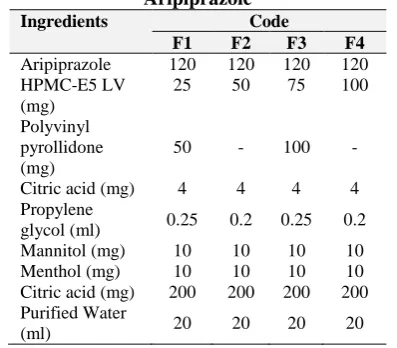
The casting solution was prepared by mixing polymer solution with drug, sweetener (Mannitol) and flavor (menthol) and saliva stimulating agent (citric acid) as shown in Table 1. All excipients were added with continuous stirring. The resulting solution was deaerated by sonication, then poured into appropriate moulds and dried to obtain the films. The casted films were dried in oven at 60°C for three hours or until dryness. The final dosage form was cut into strips (2×2 cm) with a stainless steel cutter. The samples were packed in a high density polyethylene sheet, sealed and stored in desiccators at room temperature8.
Table 1: Composition of oral thin films containing Aripiprazole
Ingredients Code
F1 F2 F3 F4
Aripiprazole 120 120 120 120
HPMC-E5 LV (mg)
25 50 75 100
Polyvinyl pyrollidone (mg)
50 - 100 -
Citric acid (mg) 4 4 4 4
Propylene
glycol (ml) 0.25 0.2 0.25 0.2
Mannitol (mg) 10 10 10 10
Menthol (mg) 10 10 10 10
Citric acid (mg) 200 200 200 200 Purified Water
(ml) 20 20 20 20
Evaluation of films 1. Thickness
Five Aripiprazole films of each formulation were taken and the film thickness was measured by using micrometer screw gauge (Glutfield Nigeria Limited, Nigeria) at different strategic locations (5 locations).
Mean thickness and standard deviation were
calculated9.
2. Weight variation test
For weight variation test, 10 Aripiprazole films of every formulation were randomly selected and weighed individually to determine the average weight and standard deviation was also calculated10.
3. Folding endurance
It is expressed as the number of folds required for developing visible cracks or breaking any given film. This gives an indication of brittleness or flexibility of the film. A 2x2 cm strip was subjected to this test by folding the film at the same point repeatedly several times until a visible crack was observed11.
4. Drug content
The Aripiprazole films were tested for content uniformity. Films of 2.25 cm2 were cut and placed in a 100 ml volumetric flask and dissolved in methanol and the volume was made up to 100 ml. Solution was suitably diluted. The absorbance of the solution was measured at 217 nm12.
5. Surface pH of films
If the pH of the film is too acidic or alkaline, it may cause irritation. So it is important to determine surface pH of the film. Surface pH of the film should be neutral i.e., 7 or should be close to 7. The Aripiprazole film to be tested was placed in a test tube and was moistened with 1.0 ml of distilled water and kept for 30 second. The pH was noted by pH meter (Finlab Nigeria Limited, Nigeria) after bringing the electrode of the pH meter in contact with the surface of the formulation and allowing equilibrating for 1 min. The average of three determinations for each of the formulation was taken and standard deviation was also calculated13.
6. Percentage moisture loss
For moisture content test, three Aripiprazole films of each formulation were taken. Initially, these selected films were weighed accurately and kept in desiccator containing fused anhydrous calcium chloride14. After 3 days, films were removed, weighed and percentage moisture loss was calculated using the formula-
7. Tensile strength
Tensile strength of the Aripiprazole films was checked by Universal Tensile Strength Testing Machine (LS5, Lloyd Instruments Limited, UK) equipped with a 500 N load cell. Test was conducted under normal laboratory conditions. The film of 400 mm2 was randomly selected. The lower clamp was held stationary and the film was pulled apart by the upper clamp at a speed of 50 mm/min. The force of the film at the point, when the film broke was recorded15. The experiment was performed in triplicate and average values were reported.
The tensile strength at break value was calculated using formula:
8. Disintegration time
9. In vitro dissolution test
The dissolution test on Aripiprazole films was performed using the USP apparatus II (Finlab, Nigeria, Limited, Nigeria). The dissolution test was performed using the 500 ml of simulated saliva solution, which consist of pH 6.8 phosphate buffer as dissolution medium. The temperature of the medium was maintained at 37±0.5oC. The apparatus was set at 50 rpm. A film sample of 4cm2 (2×2cm) was cut and placed in the basket. Five ml of samples were withdrawn at an interval of 2 minutes for 16 minutes and the same amount of the dissolution medium was replaced with fresh phosphate buffer at the same time in order to maintain the sink condition throughout the dissolution medium. The withdrawn samples were filtered using Whatman filter paper. Appropriate dilutions were made to the withdrawn sample and were
analyzed through UV spectrophotometer at a wavelength of 217 nm. The dissolution study was performed in triplicates and the average value of percentage release was taken17.
10. Accelerated stability studies
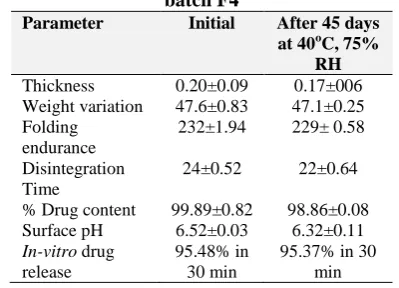
The stability studies on Aripiprazole films were conducted according to ICH guidelines to investigate the effect of temperature, relative humidity on drug in formulation. Final optimized formulation of batch F4 was subjected to aggravated conditions of temperature and relative humidity by wrapping it in aluminum foil and packaging it in glass container. The films were kept in stability chamber, at 40±2oC temperature and 75 ± 5% RH for 45 days. After it, films were tested for thickness, weight variation, folding endurance, disintegration time, % drug content, and in-vitro drug release18.
Table 2: Evaluation of physicochemical parameters of Aripiprazole films
Table 3: Statistical analysis of Aripiprazole films
Code Zero order First order Higuchi Plot Hixon-Crowell Korsmeyer-Peppas
K0 R2 K1 R2 KH R2 KHC R2 KKP R2 N
F1 5.6328 0.9765 0.1754 0.8963 24.321 0.9331 0.1883 0.8917 1.9471 0.8854 0.2361 F2 6.7891 0.9647 0.1867 0.9158 25.413 0.9473 0.1741 0.8764 2.4628 0.8637 0.3114 F3 7.0215 0.8971 0.1843 0.8951 23.541 0.9234 0.2265 0.9331 1.8243 0.9146 0.2941 F4 6.9874 0.8558 0.2043 0.8862 25.338 0.9148 0.2345 0.9486 2.3781 0.8965 0.3252
RESULTS AND DISCUSSIONS
In the present study, fast dissolving oral thin films of Aripiprazole were prepared successfully by using different polymer such as hydroxypropyl methyl cellulose (HPMC-E5 LV), polyvinyl pyrollidone using solvent casting method. Total five formulations were prepared. Formulations were totally homogenous, flexible with smooth surface both sides. The films were evaluated for various properties including thickness, mass uniformity, pH, folding endurance, drug content uniformity, cumulative percent release, in-vitro
dissolution test and accelerated stability studies. It was found that as the concentration of the polymer increases the flexibility of the film decreases. Films with very low concentration of polymer were sticky and brittle in nature. The films with optimum concentration of polymer were found to have good, flexible film forming property. The thicknesses of the films were found to be from 0.15±0.14mm to 0.20±0.09mm. The thicknesses of the films were found to increase with increase in concentration of the polymer. The weight variations of the samples were found to be in the range 41.3±0.68 to 47.6±0.83mg. It was observed that slight increase in the weight of films was due to increase in concentration of the polymer. The folding endurance of the film was found to be in the range 183±1.02 to 232±1.94. The folding endurance was found to increases with increase in
concentration of the polymer. The tensile strength of the prepared films was found to lie in between 2.84± 0.09 to 4.23±0.06Kg/mm2.Tensile strength was found to increase with increase in concentration of polymer. The pH of the films was found to be in the range between 6.38±0.02 to 6.74±0.04.
Table 4: Stability study of Aripiprazole films of batch F4
Parameter Initial After 45 days at 40oC, 75%
RH
Thickness 0.20±0.09 0.17±006
Weight variation 47.6±0.83 47.1±0.25 Folding
endurance
232±1.94 229± 0.58
Disintegration Time
24±0.52 22±0.64
% Drug content 99.89±0.82 98.86±0.08
Surface pH 6.52±0.03 6.32±0.11
In-vitro drug release
95.48% in 30 min
95.37% in 30 min
Drug content of the films with all polymers was found to be in the range of 96.51±0.03 to 99.89±0.82%. Estimation of drug content indicated that the drug is uniformly distributed throughout the film for most of the films evidenced by the low values of standard deviation. The disintegration time of the films were found to be from 19±0.48 to 24±0.52seconds. It was observed that disintegration time of a film increases
Code Thickness (mm)
Weight uniformity
(mg)
Surface pH
% Drug content
Moisture content loss
(%)
Folding endurance
Tensile strength
(mPa)
Disintegration time (Sec.)
F1 0.15±0.1 4 41.3±0.68 6.38±0.02 96.6±0.28 8.41±0.29 183±1.02 3.67±0.08 19±0.48
F2 0.17±0.23 43.2±0.57 6.43±0.03 96.51±0.03 7.52±0.25 187±1.45 2.84±0.09 21±0.49
F3 0.19±0.13 45.5±0.16 6.74±0.04 98.48±0.48 6.82±0.25 226±2.03 3.83±0.11 22±0.51
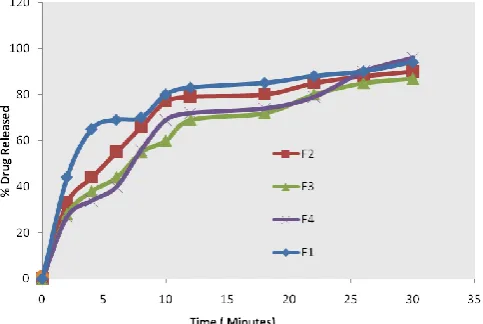
with increase in concentration of the polymer. It was observed that the drug release was found to decrease with increase in concentration of polymer. It indicates that increase in level of polymer, results in formation of high viscous gel layer caused by more intimate contact between the particles of polymers resulting in decreased mobility of drug particles in swollen matrices, finally leading to decreased release rate. Formulation of batch F4 has shown maximum release 95.48% in 30 minutes. For analyzing the mechanism of drug release kinetics of the films, the
data obtained were fitted to various kinetic equations of zero order, first order, Higuchi model and Korsmeyer-Peppas model. The regression coefficient was calculated. Regression coefficients are summarized in Table 4. The optimized formulation F4 was evaluated for the stability studies. Formulations were stored at 40oC, 75% RH for 45 days. From the evaluation, it was found that there is no significant change in appearance, pH, folding endurance, drug content, in vitro
disintegration and percentage drug release.
Figure 1: In-vitro dissolution profile of Aripiprazole films
CONCLUSION
Fast dissolving oral thin films for oral cavity are an innovative and promising dosage form especially for use in pediatrics and geriatrics or others have difficulty of swallowing. The results have shown that the HPMC-E5 LV is a good film former. In combination with PG, it has shown promising fast drug release within 30 min.
Successful formulation of Aripiprazole mouth
dissolving films may prevent first pass metabolism to a large possible extent. However to verify this fact there is need of in-vivo study using Aripiprazole films. On the basis of different evaluated parameters formulation of batch F4 was found to be optimum formulation. The preparation of films did not require the addition of any disintegrant separately, so this formulation seems to be an attractive alternative to conventional marketed formulations. Present study concludes that mouth dissolving films is a potential drug delivery system for
Aripiprazole with a considerably good
physicochemical characteristics and release profile.
AUTHOR’S CONTRIBUTION
The manuscript was carried out, written, and approved in collaboration with all authors.
CONFLICT OF INTERESTS
There are no conflicts of interest.
REFERENCES
1. Nishimura M, Matsuura K, Tsukioka T, Yamashita H, Inagaki N, Sugiyama T, Itoh Y. In vitro and in vivo
characteristics of prochlorperazine oral disintegrating film. Int J Pharmaceutics 2009; 368(1-2): 98-102.
https://doi.org/10.1016/j.ijpharm.2008.10.002
2. Rawda KA, Shabarayal AR, Azharuddin M. Design and evaluation of fast dissolving oral films of granisetron hydrochloride. Am J Pharm Tech Res 2012; 2(6): 591-609. https://doi.org/10.13140/RG.2.2.11262.23360
3. Gade R, Aynampudi A, Makineni A, Murthy TEGK, Rao CB, Nama S. Design and development of pravastatin sodium fast dissolving films from natural mucilage of
Ocimum bacilicum seeds. Int J Pharmaceut Res Rev 2014;
2(3): 17-27.
4. Kaza R, Prasanna RY, Ravouru N. Design and characterization of fast dissolving films of valsartan. Turk J Pharm Sci 2014; 11(2): 175-184.
https://doi.org/10.1007/s00289-018-2503-y
5. Leucht S, Cipriani A, Spineli L, Mavridis D, Orey D, Richter F, Samara M, Barbui C, Engel RR, Geddes JR, Kissling W, Stapf MP, Lässig B, Salanti G, Davis JM (September 2013). Comparative efficacy and tolerability of 15 antipsychotic drugs in schizophrenia: a multiple-treatments meta-analysis. Lancet 382 (9896): 951–62.
https://doi.org/10.1016/S0140-6736(13)60733-3
6. Barnes TR. Evidence-based guidelines for the pharmacological treatment of schizophrenia: recommendations from the British Association for Psychopharmacology. J Psychopharmacol 2011; 25 (5): 567–620. https://doi.org/10.1177/0269881119889296
7. De Fruyt J, Deschepper E, Audenaert K, Constant E, Floris M, Pitchot W, Sienaert P, Souery D, Claes S. Second generation antipsychotics in the treatment of bipolar depression: a systematic review and meta-analysis. J Psychopharmacol 2012; 26 (5): 603–17.
8. Kai BL, Yvonne Tze Fung Tan, Kok K Khiang Peh. Characterization of oral disintegrating film containing donepazil for the alzhemier disease. AAPS Pharm Sci Tech 2012; 13:134-42. https://doi.org/10.1208/s12249-011-9729-4
9. Dinge A, Nagarsenker M. Formulation and evaluation of fast dissolving films for delivery of triclosan to the oral cavity. AAPS Pharm Sci Tech 2008; 9(2): 349-56.
10. Chen MJ, Tirol G, Bass C, Corniello CM, Watson G, Sanchez I. Castable edible pharmaceutical films. Drug Del Tech 2008; 8(6): 35-41.
11. Francesco C, Irma EC, Paola M, Susanna B, Francesca S, Chiara GMG, Luisa M. Nicotine fast dissolving films made of maltodextrins: A feasibility study. American Assoc Pharm Sci Pharm Sci Tech 2010; 11 (4), 1511-1517. https://doi.org/10.1208/s12249-010-9525-6
12. Yasmeen R, Firoz, Y, Chandra Mouli, Vikram A, Mahitha B. Preparation and evaluation of oral fast dissolving films of citalopram hydrobromide. Int J Bioph 2012; 2, 103- 106.
13. Barnhart S D, Sloboda M S, The future of dissolvable films, Drug Deliv Technol 2007; 7: 34-37.
14. Juluru NS. Fast dissolving oral films: a review. Int J Advan Pharm Bio Chem 2013; 2(1): 108-112.
15. Sayed HA, Mahmoud ELB, Mohamed AI. Design, formulation and characterization of fast dissolving films containing dextromethorphan. Dig J Nanomater Biostruct 2014; 9: 133-141.
16. Marzia A, Tasneem F, Pathan SI. Formulation and evaluation of swellable oral thin film of metoclopramide hydrochloride. Bangladesh Pharmaceutical J 2014; 17(1): 102-112.https://doi.org/10.3329/bpj.v17i1.22325
17. Yoshifumi M, Takashi I, Kofuji K, Nishida N, Kamaguchi R. Preparation of fast dissolving films for oral dosage from natural polysaccharides. Materials 2010; 3: 4291-4299.https://doi.org/10.3390/ma3084291