WWJMRD 2018; 4(3): 235-240 www.wwjmrd.com
International Journal Peer Reviewed Journal Refereed Journal Indexed Journal UGC Approved Journal Impact Factor MJIF: 4.25 E-ISSN: 2454-6615
Latha.A
Assistant Professor Panimalar Engineering College, Chennai, Tamil Nadu, India
Kannan.P
UG Students Civil Engineering Panimalar Engineering College, Chennai, Tamil Nadu, India
Karthikeyan.R
UG Students Civil Engineering Panimalar Engineering College, Chennai, Tamil Nadu, India
Karthikeyan.R
UG Students Civil Engineering Panimalar Engineering College, Chennai, Tamil Nadu, India
Madan Mohan Malaviya.V UG Students Civil Engineering Panimalar Engineering College, Chennai, Tamil Nadu, India
Correspondence: Latha.A
Assistant Professor Panimalar Engineering College, Chennai, Tamil Nadu, India
Cellulose Insulation Material Using Paper Waste
Latha.A, Kannan.P, Karthikeyan.R, Karthikeyan.R, Madan Mohan
Malaviya.V
Abstract
The majority of abandoned paper waste accumulating from the countries all over the world causes certain serious environmental problems. At the same time, it is necessary to reduce the environmental impact of industries that are vital to economic development. The present study focuses on utilizing the waste materials like waste paper into cost effective building bricks and recycle the wastepaper without any environmental problem to the surrounding environment and the society. This paper insulation is made from recycled newspaper and cardboards, superior alternative to chemical foams. Both insect resistant and fire retardant due to the inclusion of boric acid. It can be blown into cavity walls, filling every crack and it has no health problems
Keywords: Paper Waste and Building Bricks
1. Introduction
Cellulose Insulation is made with up to 80% recycled paper most of it post-consumer waste paper likes newspapers and harmless chemicals to make it highly fire retardant. The paper normally comes from community based recycling programs. Paper drives,
used for fund raising purposes by non-profit groups, also provide much of the newspapers used to produce cellulose insulation.
When it comes to building insulations, none of the most common and popular products can come close to the recycled content found in cellulose insulation.
One amazing fact that is often misunderstood by consumers is how insulation made from paper can actually reduce the spread of fire.
The fire retardants in cellulose insulation are so effective that cellulose insulation is one of the most fire resistant building materials found in a home.
Learn more about the fire rating of cellulose insulation and how CIMA producers turn recycled paper into fire protection.
Papercrete is an amazing, simple material gaining acceptance over the last decade by alternative builders, and even code officials across the US.
Start with a small sculpting project, or insulate your pet's outdoor shelter, maybe insulated the garage walls.
Papercrete can be stunning or a horrible mess and it all depends on the detail and attention you pay2. Objective
The major Objective of the project is replacing the costly and scarce conventional building walls use of glass and wood materials by an innovative and alternative building wall material, which satisfies the following characteristics,
Required
Cost effective
Environmental friendly
Less weight
Inflammable
Less water absorption
Easily available
3. Methodology
Table 1 Flowchart
4. Material Used
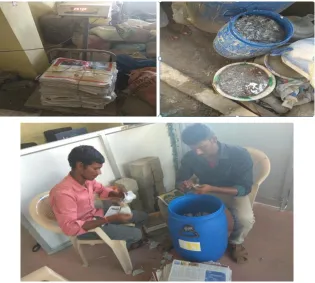
Paper Waste or Cardboard Box Waste. Boric Acid
Water.
5. Paper Waste
Paper is a natural polymer, which consists of wood cellulose, which is the most abundant organic compound in the planet. Cellulose is made of units of monomer glucose (polysaccharide).
The links in the cellulose chain are a type of sugar as ß-D-glucose. Despite containing several hydroxyl groups, cellulose is water insoluble.
The reason is the stiffness of the chains and hydrogen bonding between two OH groups on adjacent chains.
The chains pack regularly in places to form hard, stable crystalline regions that give the bundled chains even more stability and strength.
Paper is a natural polymer, which consists of wood cellulose, which is the most abundant organic compound in the planet. Cellulose is made of units of monomer glucose (polysaccharide).
The links in the cellulose chain are a type of sugar as ß-D-glucose. Despite containing several hydroxyl groups, cellulose is water insoluble.
The reason is the stiffness of the chains and hydrogen bonding between two OH groups on adjacent chains. The chains pack regularly in places to form hard,
stable crystalline regions that give the bundled chains even more stability and strength.
6. Boric acid
Boric acid, also called hydrogen borate, boracic acid, orthoboric acid and acidum boricum, is a weak, monobasic Lewis acid of boron, which is often used as an antiseptic, insecticide, flame retardant, neutron absorber, or precursor to
otherchemical compounds.
It has the chemical formula H3Bo3 (sometimes written B (OH) 3), and exists in the form of colorless crystals or a white powder that dissolves in water. When occurring as a mineral, it is called sassolite
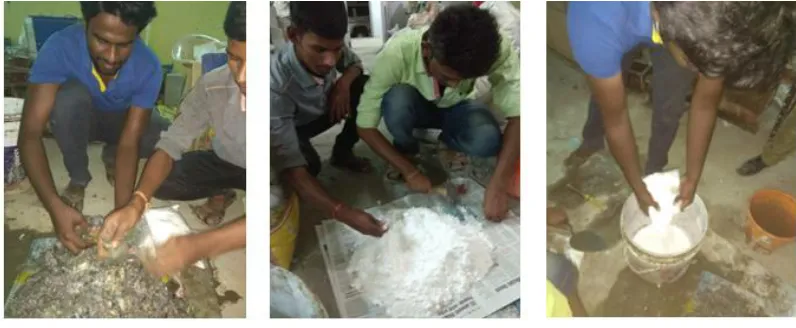
Fig 2: Mixing Boric Acid
7. Mix Design
There is no standard method for proportioning cellulose paper (i.e. mix design), but it is a specified target plastic density that becomes a prime design criterion.
Based on target plastic density a theoreticalmix design
is to be formulated, site trials are undertaken, and the results from the site trials are used as mix design for the cellulose paper waste.
Site Trials :Mix – 1
Paper waste 80% and Boric acid 20%
S.No Paper waste (kg) Boric acid(kg) Water (kg) Density(kg/m3)
1 330 70 60 1024.0
2 330 70 60 1130.0
Site Trials: Mix – 2
Paper waste 70% and Boric acid 30%
S.No Paper waste(kg) Boric acid (kg) Water (kg) Density (kg/m3)
1 295 90 60 1010.0
2 295 90 60 1180.0
8. Working Procedure
In this research, different mixes of cellulose paper 80% and boric acid were used as cellulose paper wall mortar.
The mixtures in series includes a control mixture using only paper waste and boric acid with 70%-80% of recycled paper waste like newspapers, shipping boxes and cardboards etc.
Remaining 20%-30% composed of natural fire retardants boric acid.
The powdered boric acid added to cellulose 20% by weight and prevents flaming and smouldering to concerns about losing effectiveness for 200 years for fire retardant to be effected.
Installation method for the loose fill dry cellulose blown into small holes in pre-existing walls.
Ideal for well retrofitting old homes where dry wall is already in place.
Work well in attics where gravity can hold the insulation in place settle 20%.
Wet fill is the ideal for newly built walls and very little
setting natural adhesive properties from water and excess build-up is trimmed down to proper thickness prior to dry wall installation.
9. Curing And Casting
Preparing steps for the cellulose paper waste specimens are followings.
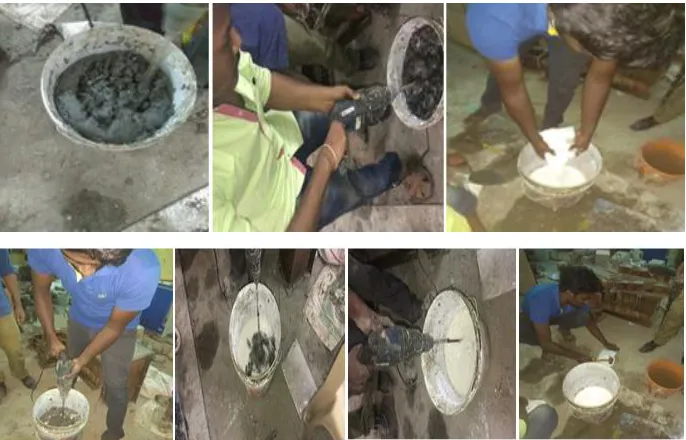
The first step in sample arrangement is well mixing of cement paper waste and boric acid was added by proportion replacement volume of filled water and blended by mixing hand tools and machinery tools. Filling the blended mixture into moulds to perform
cube, and wall shaped mould-taking moulds off done after hardening of cellulose samples in the moulds 48 h. Mould removal and marking on the specimens. The samples in water basin until completion of each
age 28 days.
The required quantities of Boric acid, paper waste and water were weighted out as per proportions and mixing was done as per IS specification.
Fig 3: Curing and Casting
Casting of Specimens
The well-mixed Cellulose paper waste is filled in to the moulds by Vibration.
Fig 4: Casting of Specimens
Curing
The specimen is divided in to 2 sets after the vibration and the
testing for the Cubes, for 7 days, 14 days and 28 Days. De – Moulding of the specimen was done after the 48 hours.
Fig 5: Curing
Conclusion
Cellulose insulation is often made by hammer milling waste newspaper. The newspaper is treated with chemicals, such as boric acid, to retard the spread of fire.
(R-value: metric R2.6 per 100 mm; imperial R3.8 per inch) which is about the same as or slightly better than glass wool or rock wool. This does not represent the whole picture of thermal performance. Other important aspects are how well the building envelope is sealed from air infiltration, convective airflows, and thermal bridging.
Cellulose is very good at fitting around items in walls like pipes and wiring, leaving few air pockets that can reduce the overall efficiency of the wall. Dense pack cellulose can seal walls from air infiltration while providing the density to limit convection, when installed properly.
The cellulose insulation lost 26.4% less heat energy over time compared to the fiberglass insulation. It also was shown to tighten the structure more than 30%. Subsequent real world surveys have cellulose performing 20-30% better at reducing energy used for heating than fiberglass.
Compared to closed cell, Polyurethane foam insulation (R=5.5 to 6.5 per inch), cellulose has a lower R-value per inch, but is much less expensive; foam has a higher cost per equivalent R-value.
Insulation reduces sound travelling through walls and between floor levels. Cellulose provides mass and damping.
This reduces noise in 2 ways; it reduces the lateral movement of sheetrock and attenuates the passage of sound along cavities. Cellulose is approximately three times denser than fiberglass, providing a slight improvement in sound reduction.
The borate treatment also gives cellulose the highest (Class I) fire safety rating. Many cellulose companies use a blend of ammonium sulfate and borate.
A vapor barrier may not be needed with cellulose insulation. An insulation that fills the wall cavity completely (such as cellulose or foam) can help prevent moisture problems. Recommendations against using vapor barriers with cellulose insulation are supported by studies, even though they classify cellulose as vapor permeable.
In addition, cellulose acts to distribute moisture throughout the cavity, preventing the buildup of moisture in one area and helping to dry the moisture more quickly. Cellulose manufacturers do not recommend the installation of a vapor barrier with cellulose.
For a given R-value, loose cellulose weighs roughly three times as much per square foot as loose fiberglass. Ceiling structures should be inspected for signs of weakness before choosing a material for insulating the ceilings of existing structures.
There is some evidence of increased mold infestation inside buildings insulated with wet spray dense pack cellulose especially when used with a vapor barrier.
Cellulose is made with locally available paper, while mineral insulation factories ship materials and products over greater distances.
References
1. Ahmadi, B. and Al-Khaja, M. “Utilization of paper waste sludge in the building construction industry”, Resources Conservation & Recycling, Vol. 32, No. 2, pp. 105-113, 2001.
2. Algin Halil Murat and Turgut Paki, “Cotton and limestone powder wastes as brick material”, Construction and Building Materials, Vol. 22, No. 6, pp. 1074-1080, 2008.
3. Akhtar, J.N., Alam, J. and Akhtar, M.N. “Bricks with Total Replacement of Clay by Flyash mixed with different Materials”, International Journal of Engineering Science and Technology, Vol. 3, No. 10, pp. 7338-7346, 2011.
4. Andreas Stavridis and Shing, P.B. “Finite-Elemnt Modelling of Nonlinear Behavior of Masonry-Infilled RC Frames”, Journal of Structural Engineering ASCE, Vol. 136, No. 3, pp. 285-296, 2010.
5. Asteris, P.G. “Lateral Stiffness of Brick Masonry Infilled Plane Frames”, Journal of Structural Engineering ASCE, Vol. 129, No. 8, pp. 1071-1079, 2003.
6. ASTM C1585, “Standard test methods of Sorptivity and Permeability of Standard Concrete Specimen”, American Society for Testing and Materials, Retrieved 2001. 7. ASTM C67 – 94, “Standard test methods of sampling and testing brick and structural clay tile”, American Society for Testing and Materials, Retrieved 2008. 8. ASTM C618 – 08, “Standard Specification for Coal
Fly Ash and Raw or Calcined Natural Pozzolana for Use in Concrete”, American Society for Testing and Materials, Retrieved 2008.
9. Aygun Murat, “Generation and evaluation of alternatives for building elements”, Building and Environment, Vol. 38, No. 5, pp. 707-712, 2003. 10. Balasubramaniam, S.R., Balaji Rao, K., Vasuki, P.,
Anoop, M.B., Daniel Ronald Joseph, J. and Nagesh R. Iyer, “District wise first order seismic loss estimation to the brick masonry buildings, in the states: Uttar Pradesh, Uttarkhand, Punjab and TamilNadu”, Journal of Structural Engineering, Vol. 36, No. 6, pp. 429-432, 2010. 11. Karthi R R, Dhanabalan S, Comparitive Analysis of
Plain and Herringbone Grooved Journal Bearing under the Hydrodynamic Lubrication Conditions, Pakistan Journal of Biotechnology, ISSN: 2312-7791, May-2017, Vol - 14, PP 25-31.
12. Karthi R R, Dhanabalan S, Jeeva R, Manikandan A, An Investigation on Micro Robot for Medical Applications, Pakistan Journal of Biotechnology, ISSN: 2312-7791, May-2017, Vol - 14, PP 32-36. 13. Dhanabalan S,Karthi R R, Multi - Objetive
Optimization of EDM Parameters for Ti Alloy, Pakistan Journal of Biotechnology, ISSN: 2312-7791, May-2017, Vol-14, PP 54-57.
14. Dhanabalan S, Karthi R R, Sivakumar K, & Sathiya Narayanan C, Optimization Of Rotary EDM Process Parameters for Inconel 718 Using Artificial Neural Network, Pakistan Journal of Biotechnology, ISSN: 2312-7791, May-2017, Vol - 14, PP 58-60.
16. Boopathi, Kapil Kumar, Karthik Vijentra, Kuralarasan, Karthi, Comparative Analysis of Drag Force in Various Car Bodies Using CFD - A Review, International Journal For Innovative Research In Science & Technology, ISSN : 2349 – 6010, Conference Issue 4 :March – 2017,RAME -17,PP 184 – 186.
17. Karthi R R, Tamilarasu B, Nagaraj R, Boobal A, Knee Design For a Bipedal Walking Robot Based on Passive Dynamic Walking, Imperial Journal of Interdisciplinary Research, ISSN : 2454 – 1362,Nov – 2017, Vol – 3, Issue – 11.
18. Karthi R R, Tamilarasu B, Nagaraj R, Boobal A, Design And Synthesis Of Six Legged Walking Robot Using Single Degrees Of Freedom Linkage, Imperial Journal of Interdisciplinary Research, ISSN : 2349 – 3585, Oct 2017, Vol – 8, Issue – 4.
19. Karthi R R, Tamilarasu B, Gokul Raja S, Gowtham M, Gokul P, Comparison of Mechanical Properties of Carbon Glass & Palm Banana Fibres Reinforced Hybrid Composite Bar,International Journal For Scientific Research & Development, ISSN : 2321-0613, Nov – 2017, Vol – 5, Issue – 9.
20. Karthi R R, Tamilarasu B, Navaneethan S, Stewart-Gough Platform Manipulator with Six Degrees of Freedom Mechanism, World Wide Journal of Multidisciplinary Research and Development, ISSN : 2454-6615, Aug-2017,Vol – 3, Issue -8, PP 101 – 107. 21. Karthi R R, Tamilarasu B, Naveenkumar G, Kavinraj
P, Design and Fabrication of Composite Mono Leaf Spring For Heavy Truck, International Journal For Science and Advance Research In Technology, ISSN : 2395-1052, Jan – 2018, Vol – 4, Issue – 4.
22. Karthi R R, Tamilarasu B, Gokul P, Ragu P, Design and Analysis of Mechanical Behavior of Al-Si in Railway Vehicle Brake Slack Adjuster, International Journal of Scientific Research In Science and Technology, ISSN: 2395-602X,Oct – 2017, Vol – 3, Issue – 7.
23. Karthi R R, Tamilarasu B, Gokul P, Gokul Raja S, Navaneethan S, Allan Franklin B, Fabrication of Pneumatic Hacksaw, International Journal Of Innovative Research In Technology, ISSN: 2349-6002, Feb – 2018,Vol – 4, Issue – 9.
24. Karthi R R, Tamilarasu B,Ashwanth G,Viyash G,Raveendran S, Investigation of Mechanical Properties of Aluminium Alloy 7075 Reinforced with Tungsten Carbide and Fly-Ash Hybrid Metal Matrix Composites, International Journal For Scientific Research & Development, ISSN : 2321-0613, VOL – 5, ISSUE – 12.