On the realization of the recognition‑primed
decision model for artificial agents
Syed Nasir Danial, Jennifer Smith, Brian Veitch and Faisal Khan
*Introduction
Naturalistic decision making (NDM) is a relatively new approach to decision-making that relies on situation awareness (SA) [20] rather than having a fixed set of principles from which to choose the best or optimal solution. One of the prominent models of NDM is Klein’s [33] recognition-primed decision model. RPDM has a descriptive nature, and it requires a thorough understanding of philosophical concepts, such as intuition, perception, and mental simulation. The purpose of this study is to develop a method based on the theory of RPDM that can be implemented in an artificial agent.
Abstract
This work proposes a methodology to program an artificial agent that can make deci-sions based on a naturalistic decision-making approach called recognition-primed decision model (RPDM). The proposed methodology represents the main constructs of RPDM in the language of Belief-Desire-Intention logic. RPDM considers decision-making as a synthesis of three phenomenal abilities of the human mind. The first is one’s use of experience to recognize a situation and suggest appropriate responses. The main concern here is on situation awareness because the decision-maker needs to establish that a current situation is the same or similar to one previously experi-enced, and the same solution is likely to work this time too. To this end, the proposed modeling approach uses a Markov logic network to develop an Experiential-Learning and Decision-Support module. The second component of RPDM deals with the cases when a decision-maker’s experience becomes secondary because the situation has not been recognized as typical. In this case, RPDM suggests a diagnostic mechanism that involves feature-matching, and, therefore, an ontology (of the domain of inter-est) based reasoning approach is proposed here to deal with all such cases. The third component of RPDM is the proposal that human beings use intuition and imagination (mental stimulation) to make sure whether a course of action should work in a given situation or not. Mental simulation is modeled here as a Bayesian network that com-putes the probability of occurrence of an effect when a cause is more likely. The agent-based model of RPDM has been validated with real (empirical) data to compare the simulated and empirical results and develop a correspondence in terms of the value of the result, as well as the reasoning.
Keywords: Modelling RPDM, Agent modeling, Ontological reasoning, Markov logic network, Feature matching, Mental simulation modeling
Open Access
© The Author(s) 2019. This article is distributed under the terms of the Creative Commons Attribution 4.0 International License (http://creat iveco mmons .org/licen ses/by/4.0/), which permits unrestricted use, distribution, and reproduction in any medium, provided you give appropriate credit to the original author(s) and the source, provide a link to the Creative Commons license, and indicate if changes were made.
RESEARCH
*Correspondence: [email protected] Centre for Risk, Integrity and Safety Engineering (C-RISE), Faculty
There may be many reasons for why an artificial agent based on RPDM should be pre-ferred over those that exploit conventional decision theories. Here are a few concerns important to us. The first being the way how a human mind operates when a decision is to be made. This is even true for cases outside of typical NDM environment that usually is characterized by contextual factors as ill-structured problems, time stress, etc. [67]. For example, in a typical chess play, factors like memory abilities, and the depth of plan-ning (including the number of moves ahead in planplan-ning), which are important factors for a decision-making algorithm in terms of comparisons (comparing moves to find the best one in a given state of chess board) and checking alternatives, or finding the best move, have been assessed in experts and novice chess plays [7, 15]. Notice that these factors are important for logical deductions, and so are considered great source of motivations in writing chess programs. The real chess masters, however, have been found to exploit none of these factors, in general, for their mastery in chess playing [35]. de Groot [15] have discovered that novice and expert chess players behave similarly in terms of the overall structure of their thought processes—chess master’s ability to handle the depth of search is almost the same as for the weaker players. The idea that masters can see fur-ther ahead than naïve players was dismissed by de Groot’s analysis of verbal protocols, which were obtained when masters and novice players played chess games by thinking a loud in an experiment in 1965. de Groot [15] was unable to pinpoint quantitative differ-ences that could be considered main players for obtaining a mastery in chess except that the masters were found to be able to reconstruct a chess position almost perfectly after viewing it for only 5 s or so [7]. The second reason why RPDM based artificial agents would be better in decision-making lies in the ability to see familiar patterns in the form that could be used to retrieve associated or related information from memory, e.g., the actions performed in a similar situation before, unlike brute force calculations that needs a high-end or a supercomputer to produce desired results by including every bit of information. An example of brute force based calculations used in chess playing was in the IBM Deep Blue that was a supercomputer that defeated the world champion Garry
Kasparov in 1996 [48]. The RPDM based agent model has scope in potentially any
deci-sion problem, most importantly are those that involve high stakes, and time pressure, such as trading agents, firefighting, and emergency evacuation simulation applications.
RPDM may be considered as a way to develop insight into improving ways to better respond in different operating conditions. However, the model is for experienced people, not for artificial agents. The purpose of this study is to develop a realization of RPDM suitable to be implemented in an agent that is expected to show human-centered
arti-ficial intelligence (AI). RPDM (see Fig. 1) explains how human decision-makers plan,
Nowroozi et al. [42] proposed a model of RPDM called Computational-RPD (C-RPD)
and defined the constructs of RPD in Unified Modelling Language (UML). Although
C-RPD’s general form is slightly more detailed than the original RPDM, and the authors claim that different sections of their work describe different constructs of RPDM. It is unclear how the modeling was performed; C-RPD does not seem to add a scien-tific methodology that may be considered as a general model covering the concepts in RPDM. For example, how can “Evaluate Actions” be done quantitatively, or how can an agent build stories. Will itbe a process that incorporates if-then-else conditions, where the consequent comes by interacting with the physical world1? Or by using an old belief about how the world reacts to when the condition in the if-clause is true? Or will it be a hard-coded knowledgebase where each action has been assigned some pros and some cons, and the agent or the model needs only to fetch the required information? Such questions require a thorough investigation into how each concept in RPDM can be mod-eled separately into different modules, and then how interactions among the modules could be setup so that the overall activity of all modules, combined together, may resem-ble RPDM. Norling [40], and Norling et al. [41] proposed a Belief-Desire-Intention (BDI) based agent model by integrating it with RPDM so that the agent can behave more like a human when it comes to deciding something. The agent model can be used to populate a multi-agent simulation environment. Ji et al. [29] proposed an RPDM based model that
Is Situaon typical? [Prototype or Analogue]
Experience the Situaon in a changing context
YES Diagnose
[Feature matching] [Story building]
NO
Anomaly [Expectancies
violated?] inference
Evaluate acons {n}
[Mental simulaon] work?Will it Recognion has four by-products
Relevant Cues
Acons 1 … n
Plausible goals
Expectancies
NO
Implement course of acon YES
Modify
Yes, but Calrify
Fig. 1 Integrated Klein’s RPD model. Source [33], p. 27)
1 Consider an agent having a class A fire extinguisher (such as water), willing to apply to a fire due to flammable liquids.
can be used to analyze drug effects. Based on the experience of how a military
com-mander contributes to decision-making during warfare operations, Sokolowski [58],
uses RPDM to capture the dynamics of human mental processes that are involved in decision-making at critical situations.
The authors could not find studies suggesting a rigorous methodology to implement the RPD model. The majority of the literature seen, even where the researchers claim their model as quantitative, present their realization of RPDM as more descriptive or sometimes less formal than RPDM itself [6, 25, 27, 41, 42, 45, 53]. This work aims to add more precisely defined components of a realization of RPDM. For example, the SA part is modeled as an experiential-learning and decision support (ELDS) module, which is based on a Markov logic network (MLN) that needs training to acquire experience. An informational theory based account on modeling SA is given in [17], which is based on
Barwise and Perry’s [2] situation semantics. A common approach to quantitative
mode-ling of SA involves Bayesian networks (BN) [26, 39]. However, BNs do not support cyclic dependencies that may arise in the causal structure among the factors or conditions on which a situation is dependent. To overcome this limitation Domingos and
Richard-son [19] proposed Markov logic, whereby a Markov network, which supports cycles, is
developed based on information represented in the form of first-order-logic (FOL) rules. The mental simulation component is considered here as a cause-and-effect phenome-non [33], p. 89–90), and is proposed to be represented in the form of Bayesian
formal-ism [46]. Lastly, the diagnostic mechanism of RPDM is modeled as an ontology of the
domain in which the agent is supposed to operate. An ontology is considered as a tool to represent a set of concepts and their relations in a domain of interest. Sowa [60] exploits ontologies to represent different situations in the world. Because the purpose of OBR module is to diagnose a situation based on common knowledge of the domain of inter-est, therefore, the choice of using an ontology to represent that knowledge, and thereby suggesting possible matching situations seems reasonable, unlike other approaches to SA that require training (as in MLNs) or prior probabilities (as in BNs).
A recent study [26] exploits RPDM to model human pilot behavior during midair
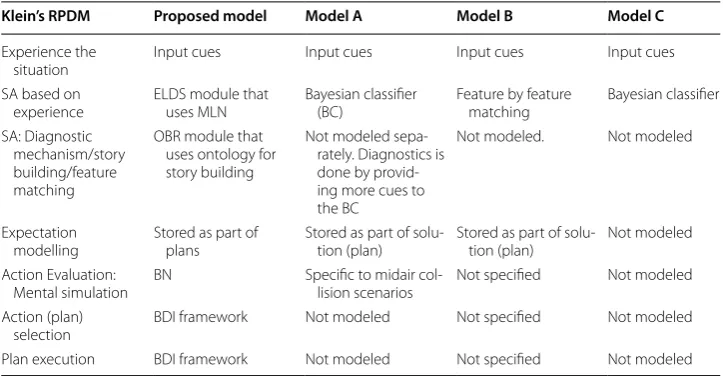
there must be involvement of an inference mechanism in order to decide which story best suits the matched symptoms or cues of a situation under consideration. The present study exploits ontological-based reasoning (OBR) that uses feature-matching between the available features (not dependent on new or more information) and the ontological knowledge of the agent as opposed to the operational or experience-based knowledge to dig out and give the situation a name. Table 1 explains how each concept of Klein’s RPD model may be mapped onto the constructs proposed in the present study. Also, OBR supports inference based on which a recognized situation can be used to suggest a more meaningful interpretation. For example, a situation: “a cat is on a mat”, may mean some-thing about the past of the cat, by interpreting this as, “the cat has taken her meal”. Or by connecting a current situation into a future state, which is the requirement of level 3 SA [20], for example, if the situation “a fire is spreading” is related with another situation “people must escape”, then such a general (domain) knowledge is an important tool for an expression of rational behavior.
“Background concepts” section describes some background concepts, which will help
develop an understanding of this study. “Methodology” section explains the
method-ology proposed here, which includes the development of ELDS and OBR modules. In “Implementing the proposed realization of RPDM model: a case study” section, we
pre-sent a case study that explains how the methodology of “Methodology” section can be
implemented in the form of an agent. The case study in “Implementing the proposed
realization of RPDM model: a case study” section is based on an experiment that is used to collect human performance data, which is later used for validating the simulated results from the proposed RPDM based agent model. The ELDS, and OBR modules,
which were proposed in “Methodology” section, are developed and explained in detail
in this section, and simulation are performed. “Conclusion” section concludes the study with future directions. Some background details and partial computer code are listed in Appendices.
Table 1 A comparison/mapping of the major concepts of Klein’s RPD model
with the components in the proposed realization, and in some previous works
Model A is proposed in [26], Model B is proposed in [42], and Model C is proposed in [37]
Klein’s RPDM Proposed model Model A Model B Model C
Experience the
situation Input cues Input cues Input cues Input cues SA based on
experience ELDS module that uses MLN Bayesian classifier (BC) Feature by feature matching Bayesian classifier SA: Diagnostic
mechanism/story building/feature matching
OBR module that uses ontology for story building
Not modeled sepa-rately. Diagnostics is done by provid-ing more cues to the BC
Not modeled. Not modeled
Expectation
modelling Stored as part of plans Stored as part of solu-tion (plan) Stored as part of solu-tion (plan) Not modeled Action Evaluation:
Mental simulation BN Specific to midair col-lision scenarios Not specified Not modeled Action (plan)
Background concepts
Some important concepts are described in this section. Details about RPDM can be found in Appendix A.1. Appendix A.2 describes background information about the sim-ulator used in this study.
Ontology
Ontology is defined as, “The study of the categories of things that exist or may exist in some domain” [60], p. 492). The result of such a study comes in the form of a catalog that contains types of things that exist in a domain D from the point of view of a person who uses a language L to talk about D. There are different Conceptual Structures (CS) that can be used to express knowledge about things, in terms of types and relations, in an ontology.
In [30, 32], the authors propose four types of CSs: type, relation-type, individual, and situation to define an ontology. Formally, a CS can be defined in terms of a conceptual graph (CG), which is a bipartite graph between concept nodes and the relations among
the concepts [59]. Because an ontology provides a context for representing domain
knowledge, the present work exploits the formalism of ontology to provide the agent the knowledge about the domain in which it is likely to operate. Using the proposed
ontology (“The ontology-based reasoning module” section), the agent would be able to
retrieve meaningful knowledge and can reason about it. Also, representation of domain knowledge in the form of a separate ontology would make the system modular in that the operational knowledge, which comes through experience, can be represented in a separate formalism. The separation of operational knowledge from domain knowledge has benefits in many respects, such as analyzing domain knowledge, making domain assumptions explicit, reusing the domain knowledge, and sharing of the domain knowl-edge [23].
Markov network
A Markov network (MN) is composed of a graph G and a set of potential functions φk.
G has a node for each variable, and MN has a potential function for each clique in G. A clique of a graph G is a complete subgraph of G. A potential function is a non-negative real-valued function of the configuration or state of the variables in the corresponding clique. The joint distribution of the variables X1, X2, …, Xn can be developed to under-stand the influence of a site, i.e., a variable, on its neighbors [50] as defined below:
where x[k] is the configuration of the kth clique, i.e., the values of the variables in the kth clique. Z is partition function for normalization, Z=
x∈Ω
kφk
x[k]
.
Markov logic network
Because a random variable assigned with a value can be considered as a proposition [24], p. 58. Domingos and Richardson [19] define MN by first considering the variables (1) P(X=x)= 1
Z
k
φk
x[k]
as rules/formulas in a FOL. Unlike FOL, a formula in MLN is assigned a weight (a real number), not just the Boolean true or false. Formally, an MLN L is defined as a set of pairs (Fi, wi) with Fis being the formulas and wis being the weights assigned to the formulas.
If C= {c1, c2, …, c|C|} is the set of constants or ground predicates (the facts), then L induces a Markov network ML,C such that the probability distribution over possible worlds x is given by:
where ni(x) is the number of true groundings of Fi inx, x[i] is the state or configuration (i.e., the truth assignments) of the predicates in Fi, and φi
x[i]
=ewi.
Methodology
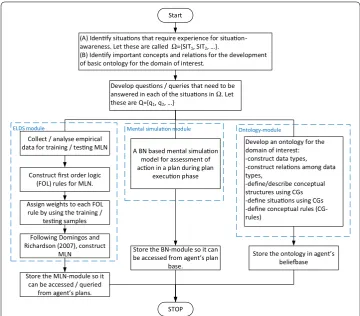
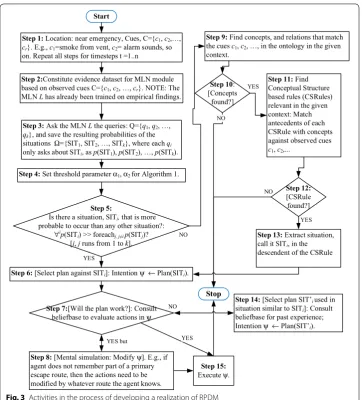
The kind of situations suitable for constructing a realization of the RPDM approach for artificial agents should include the ingredients of NDM [43]. At the conceptual level, the agent decision-making process is conceived here in terms of the mental modalities sug-gested in Bratman’s theory of practical reasoning [4]. Specifically, these mental attitudes are a belief, desire, and intention (BDI), which are the basis of the BDI-agent model [51]. The proposed agent model has a beliefbase that contains context information, past expe-riences, an ontology [60] about the domain in which the agent is being operated, and any other kind of information that affects a possible deliberation step. A planning scheme is responsible for matching available cues and a plan to be executed. In simple words, a planning scheme takes all the sensory observations (cues), assesses the situation, selects a plan for execution, and performs mental simulation if necessary. Figure 2 describes the general steps needed to develop the ELDS module based on MLN, OBR module contain-ing the ontology for the domain in which the agent operates, a module to performs men-tal simulation as a cause-and-effect mechanism using a BN, and where these modules should be stored within the BDI-framework so that upon receiving the sensory data, the agent can have access to each type of knowledge. Figure 3 describes the flow of control, starting from collecting cues in the environment to having a decision for what needs to be done when a situation unfolds demanding action on the agent’s part.
The approach of this work involves modeling decision-making at three levels. The
first is the situations that are recognized as typical by the ELDS-module, i.e., the
situations that can be inferred by the MLN inference mechanism. The second is the situations where MLN performs poorly by predicting approximately the same proba-bilities for more than one situation so that it becomes difficult to distinguish among the candidate situations as being the one currently observed. These are the situa-tions when the agent receives inadequate or conflicting cues at a single time step at a given location in the environment. An agent in such a situation is considered as the one whose experience does not relate well enough to the situation at hand and who has to rely on some basic knowledge to classify/recognize a situation based on per-ceived cues. This level of decision-making is modeled here in terms of an ontology about possible situations that could arise. These two levels of decision-making—the (2)
P(X=x)= 1
Z exp
i
wini(x)
= 1
Z
i
φi
x[i]
one based on experience, and the one involving feature-matching using an ontol-ogy—are governed by a third level that decides in what circumstances the agent should select one of these levels. Algorithm 1 describes this higher level of decision-making. Lines # 2–7 deal with decision-values taken from MLN based inference, and
lines 8-11 calls a method DIAGNOSE-SITUATION that queries the agent’s
ontol-ogy by using available cues as concepts and then extracts CS-Rules that satisfy the
concepts. The working of the DIAGNOSE-SITUATION method can be understood
as actions taken in steps Steps 9–13 in Fig. 3. For example, if an agent has a visual of smoke in the messhall, and for some reasons it is unable to get other cues, then the agent will take smoke and messhall as concepts and search the ontology for possible relations. If a relation is found the agent applies inference to explore connected or related situations that contain specific or doable actions. These actions are the final
output of the agent. The DIAGNOSE-SITUATION method corresponds to Klein’s
variation 2 of the RPDM model [33], p. 26) as explained in the preceding section.
Steps 1–8 correspond mainly to recognize the given situation, where there are a finite number of observable cues represented as {c1, c2, …}, based on MLN L that is developed by using the FOL rules.
(A) Idenfy situaons that require experience for situaon-awareness. Let these are called Ω={SIT1, SIT2, …}.
(B) Idenfy important concepts and relaons for the development of basic ontology for the domain of interest.
Start
Collect / analyse empirical data for training / tesng MLN
Store the MLN-module so it can be accessed / queried
from agent’s plans.
STOP
Develop quesons / queries that need to be answered in each of the situaons in Ω.Let these are Q={q1, q2, …}
Construct first order logic (FOL) rules for MLN.
Assign weights to each FOL rule by using the training /
tesng samples
Following Domingos and Richardson (2007), construct
MLN
Develop an ontology for the domain of interest: -construct data types, -construct relaons among data types,
-define/describe conceptual structures using CGs -define situaons using CGs -define conceptual rules (CG-rules)
Store the ontology in agent’s beliease
ELDS module Ontology-module
A BN based mental simulaon model for assessment of acon in a plan during plan
execuon phase
Mental simulaon module
Store the BN-module so it can be accessed from agent’s plan
base.
Algorithm 1: A general higher-level decision-making.
Assumptions: An MLN can distinguish among m possible situations. An ith situation is SITi. These are considered as typical situations for which the agent is trained. p(SITi) is the probability of occurrence of
SITi. PLANSITrefers to a plan associated with the situation SITi.
Inputs: 1>> 2and ε is a positive real number near zero. Theoretically, 1, 2 [0, 1]. Output: The decision , which is a plan having actions to perform.
1. fortimesteps= 1 to ndo
2. ifp(SIT1)> 1&& [p(SIT2)< 2, p(SIT3)< 2,…, p(SITm) < 2] then 3. PLANSIT
4. else ifp(SIT2)> 1&& [p(SIT1)< 2, p(SIT3)< 2,…, p(SITm) < 2] then
5. PLANSIT
6. else if p(SITk)> 1&& [p(SIT1)< 2,…, p(SITk-1)< 2,p(SITk+1)< 2,…,p(SITm)< 2] then
7. PLANSITk
8. else if |p(SIT1) p(SIT2)| ε &&, …, && |p(SITm 1) p(SITm)| ε then
9. PLANDIAGNOSE-SITUATION 10. return
Start
Step 2:Constitute evidence dataset for MLN module based on observed cues C={c1, c2, …, cr}. NOTE: The MLN L has already been trained on empirical findings.
Step 3: Ask the MLNL the queries: Q={q1, q2, …, qk}, and save the resulting probabilities of the situations Ω={SIT1, SIT2, …, SITk}, where each qi only asks about SITi, as p(SIT1), p(SIT2), …, p(SITk).
Step 4:Set threshold parameter α1,α2 for Algorithm 1.
Step 5:
Is there a situation, SITi,that is more probable to occur than any other situation?:
∀ip(SITi) >> foreachj, j≠i p(SITj)? [i, jruns from 1 to k].
Step 6: [Select plan against SITi]: Intention ψ ←Plan(SITi).
YES
Step 15: Execute ψ. Step 7:[Will the plan work?]: Consult
beliefbase to evaluate actions in ψ
YES
Step 8:[Mental simulation: Modify ψ]. E.g., if agent does not remember part of a primary escape route, then the actions need to be modified by whatever route the agent knows. Step 1:Location: near emergency, Cues, C={c1, c2,…, cr}. E.g., c1=smoke from vent, c2= alarm sounds, so on. Repeat all steps for timesteps t =1..n
YES but
Stop
Step 9:Find concepts, and relations that match the cues c1, c2, …, in the ontology in the given context.
NO
Step 10: [Concepts
found?]
NO
Step 11:Find Conceptual Structure based rules (CSRules) relevant in the given context: Match antecedents of each CSRule with concepts against observed cues c1, c2,...
Step 12: [CSRule found?]
YES
NO
Step 13:Extract situation, call it SITi, in the descendent of the CSRule
YES
Step 14:[Select plan SIT’i used in situation similar to SITi]: Consult beliefbase for past experience; Intention ψ ←Plan(SIT’i).
NO
The experiential‑learning and decision‑making module
The purpose of the ELDS module is to support decision-making based on experience. In the real world, different people consider the same rules differently in terms of how effective they are in assisting a person for deciding on a given situation. That is, there is a diversity among people for adopting a method for a given decision problem. This phenomenon gives rise to people having different experiences about the same or similar situations with different beliefs about the choices they make. Klien’s RPDM model con-siders this diverse nature of experiences among experts by generally describing that a sit-uation recognition task should result in four by-products: relevant cues, typical actions, plausible goals, and expectancies. The RPDM model does not argue as to how the goal of computing the four by-products of recognition should be achieved. The present study argues that an experiential learning technique is a suitable choice to capture the crux of situation recognition in the Endsley’s SA model [20], because this way, different agents can have different experiences about a domain of choice. Rules regarding recognition of fire (FIRE) and evacuate (EVACUATE) emergencies are proposed in Table 2. As an example of how agents with different experiences can be made in a real system, consider rule #9 in Table 2:
This rule says that if an agent (a1) Has Focus On (HFO) the PA (p_a) announcement at
some time t, and a1 is able to understand or Follow the PA (FPA), and a1 knows what to
do in that specific PA announcement (the predicate KMLPA(p_a, mloc) is stored as
a fact that means the agent knows which muster location is used in which PA), then a1
should develop an intention (represented by the predicate HITR) according to its knowl-edge about that specific PA and, thereby, the associated weight, w, of the rule. For exam-ple, in the caseof a PA related to the GPA alarm, a1’s intention should be to move to the
primary muster station; in the case of a PAPA alarm, the intention should be to move to the alternate muster station. However, if an agent keeps repeating a mistake by, say, HFO(a1,+p_a,+t)∧FPA(ag,+p_a,+t)∧KMLPA(+p_a,+mloc)⇒HITR(ag,+mloc,+t)
Table 2 The FOL rules for developing the MLN L suitable for emergency response in FIRE
and EVACUATE emergencies
# Rules
1. ¬L(ag, al, t)⇒¬R (ag, al, t)
2. L(ag,+al,t)^HITR(ag,+mloc,t)^ BST(ag,+al,t)⇒R(ag,+al,t) 3. L(ag, al, t)⇒HSES(ag)
4. ST(ag, thrt, t)⇒HSES(ag)
5. (HFO(ag,+p_a,t)^FPA(ag,+p_a,t)^KETPA(+p_a,+emgType))v
(ST(ag,+thrt,t)^KETT(+thrt,+emgType))v
(L(ag,+al,t)^HITR(ag,+mloc,t)^KETA(+al,+emgType)^BST(ag,+al,t
))
⇒ HES(ag, +emgType, t)
6. HES(ag,FIRE,t0)^HES(ag,EVACUATE,t1)^Gt(t1,t0) ⇒ ¬HES(ag, FIRE, t1)
7. HES(ag,FIRE,t)⇒¬HES(ag, EVACUATE,t)
8. HES(ag, EVACUATE, t)⇒¬HES(ag, FIRE, t)
9. HFO(ag, +p_a,+t)^FPA(ag, +p_a,+t)^KMLPA(+p_a,+mloc)
⇒ HITR(ag,+mloc,+t)
10. L(ag,+al,t)^R(ag,+al,t)^BST(ag,+al,t)^KMLA (+al,+mloc)
attributing GPA to alternate muster station rather than the primary, then in the event
of a FIRE emergency this agent will likely move to the alternate muster station even
though it is contrary to the required action.
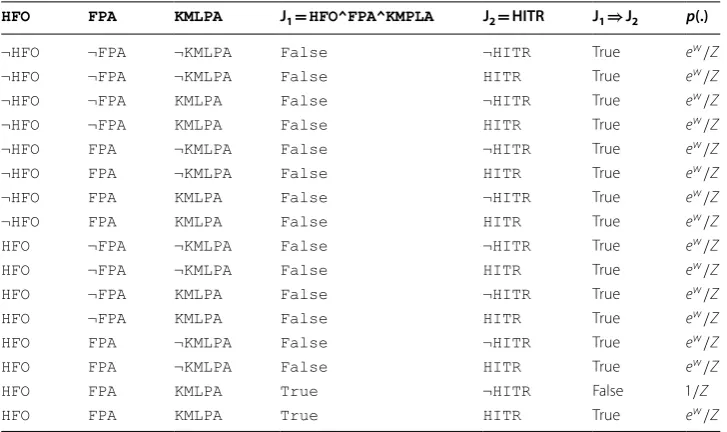
In the current study, the variables p_a, t, and mloc belong to the sets A = {PAGPA, PAPAPA}, T = {t0, t1}, and M = {MESSHALL, LIFEBOAT}, respectively. This gives rise to eight different permutations resulting from grounding rule#9 for the constants in the sets A, T, and M. As there are four predicates in rule #9, there will be 24× 8= 128 total number of different worlds altogether. For brevity, assume that the variables p_a, t, and mloc belong to sets each having a single constant. So, let p_a= {pa}, t= {t} and mloc= {m}. Then, there will be 24= 16 possible worlds, as shown in Table 3, where w shows the weight assigned to the rule, and the table excludes the parameters of each predicate for better readability. The probability that the world that is inconsistent with rule #9 occurs, i.e., the probability p({HFO,FPA,KMLPA,¬HITR}) is equal to 1/Z is less likely than all other probabilities as shown in Table 3, provided w > 0. Here Z is the partition function as described in “Background concepts” section. The probability for a
world to be true depends on the weight w assigned to each rule. Agents with the same
rules differing in respective weights are expected to behave differently.
An explanation of the FOL rules
A set of FOL rules are proposed in Table 2 so that an agent can recognize the FIRE
and EVACUATE situations in the similar way as a human counterpart recognizes them. The preconditions (antecedents of FOL rules) used here are common among experts and have been suggested in earlier studies [8, 21, 49, 56, 57, 61–65]. Similar work is reported in [38] where the authors constructed decision trees based on some of the preconditions used in this study, such as the presence of hazard, route direction in PA that actuallyis a byproduct of understanding thePA.
Table 3 Joint probability table for possible worlds entails by rule#9
The probability p({HFO,FPA,KMPLA,¬HITR}) = 1/Z represents the probability of a world that is inconsistent with rule#9.
The probabilities for all other possible worlds are equal to ew/Z , where w is the weight assigned to the rule. The operator ‘
⇒’ is for logical implication
HFO FPA KMLPA J1=HFO^FPA^KMPLA J2= HITR J1⇒ J2 p(.) ¬HFO ¬FPA ¬KMLPA False ¬HITR True ew/Z
¬HFO ¬FPA ¬KMLPA False HITR True ew
/Z
¬HFO ¬FPA KMLPA False ¬HITR True ew
/Z
¬HFO ¬FPA KMLPA False HITR True ew
/Z
¬HFO FPA ¬KMLPA False ¬HITR True ew
/Z
¬HFO FPA ¬KMLPA False HITR True ew/Z
¬HFO FPA KMLPA False ¬HITR True ew/Z
¬HFO FPA KMLPA False HITR True ew
/Z
HFO ¬FPA ¬KMLPA False ¬HITR True ew
/Z
HFO ¬FPA ¬KMLPA False HITR True ew
/Z
HFO ¬FPA KMLPA False ¬HITR True ew
/Z
HFO ¬FPA KMLPA False HITR True ew
/Z
HFO FPA ¬KMLPA False ¬HITR True ew/Z
HFO FPA ¬KMLPA False HITR True ew/Z
HFO FPA KMLPA True ¬HITR False 1/Z
HFO FPA KMLPA True HITR True ew
Rule #1 in Table 2 is a hard constraint which signifies the fact that for recognizing a sound, it must have been heard first. Alarms are made to produce loud and clear audio frequencies so that people can hear the alarm sound, but somebody who is hearing an alarm sound does not necessarily pay attention to it. Several studies [49, 63, 66] show that people need training to be vigilant about alarm sounds.
There are several sources that give intention a vital role in deliberation [4, 62]. In rule #2, an agent must be listening to an alarm, which means she is paying attention to the alarm, and at the same time developing the deliberative intention [4], p. 56), due to delib-eration that involves carefully listening the alarm, to moving to a (particular) muster location. Because the agent has formed the intention just after listening to the alarm at time t, and the deliberation involving the act of listening or the formation of intention is done before having to see a visual cue about a possible threat (the predicate BST ensures that the intention was formed before seeing a threat), it clearly means that the alarm has been recognized at the same time. Nonetheless, the agent cannot act upon the intention unless recognition of the alarm is made, because deliberation requires the location of the muster station, which can only be decided after recognition of the alarm. Therefore, as in rule #2, if the intention is made before recognition, then it needs to be updated with the value of the muster location (i.e., MESSHALL or LIFEBOAT) at some later time, say t2, before performing the actions in the intention and according to the result of the recog-nition of the alarm. Rule #2 thus models HITR as a policy-based intention as explained in the literature [4], p. 56), that is, the agent will form a general intention of moving to a muster location right at the time of listening to an alarm, and will later determine which muster station is the right choice.
Rules #3 and 4 have the same descendent: Has Some Emergency Situation, which is
referred to here by the predicate name HSES (see Table 2). A true value of HSES means
that the agent knows there is some emergency. Having HSES true does not necessarily
tell the agent-specific details about the kind of emergency that has occurred. Rules # 3 and 4 say that an agent will be aware of ‘some’ emergency situation if it just listens to an alarm or observes a threat.
PA announcements are important cues in a developing situation [8, 21, 61, 65]. PAs are verbal announcements with clear words detailing the situation with the type and loca-tion of a hazard, other affected areas, and possible plan to assist evacualoca-tion. An agent needs to focus on PA wordings in order to gain advantage of the message in a developing emergency. Stress is considered a factor that influences focus of attention in offshore environments [57]. In short, the predicate HFO is true when the agent has a focus on a PA being uttered. An agent that is engaged in all activities except what is communicated in the PA is defined to have no focus, whereas one that suspends its current engage-ments and begins performing the required actions is considered to have focus on the PA. Similarly, if an agent, while moving, suddenly changes its course because of instruc-tions given in the PA a moment before, this also considered to have exhibited a clear sign of deliberative intention [4] in response to the PA. This deliberative intention is cap-tured in rule #9 by the predicate HITR when the agent considers HFO and FPA, and has
a prior knowledge about possible deliberation steps (the predicate KMLPA that stands
for Knows Muster Location according to PA). The predicate FPA is used to demonstrate
though the agent had focus on the PA’s words, it is confused or does not have under-standing of the situation, and therefore, the agent is unable to follow the PA. Rule #5 is a disjunction of three different rules: the first determines SA about the emergency based on focus and understanding of PA, the second uses direct exposure to the threat/hazard, and the third is based on the recognition of alarms. This last disjunct in rule #5 uses the predicate KETA to link an alarm to the corresponding situation or emergency type because that is needed to conclude in the consequent predicate HSES.
Rule #6 uses time as factor for ignoring an earlier understanding about a FIRE situa-tion when FIRE is escalated to EVACUATE. That is, if an agent has awareness about a FIRE at t1, and at some later time t2 the situation escalates to EVACUATE, then there is no need to keep the impression of FIRE situation because the agent needs to act accord-ing to EVACUATE situation. Rules #7 and 8 are to ensure that FIRE and EVACUATE are two distinct types of situations, besides that EVACUATE may occur because of a fire [8,
61]. Rule #10 determines a formation of intention to move to a muster location by listen-ing to an alarm (the predicate L), recognition of alarm (the predicate R), and belief about what is needed in that particular alarm type (the predicate KMLA that stands for Knows Muster location against the Alarm). In this case, the formation of deliberative intention [4] is based on deliberation about the act of listening and recognizing the alarm type.
Training the ELDS module
The dataset Tr is used for training the ELDS module, and the dataset Te is used as
test-ing/evidence while querying the ELDS’s MLN L. The model is trained by employing a
discriminative learning method [18, 55] using the software package Alchemy [1] so that weights can be assigned to the rules presented in Table 2. A fragment of the MLN L is depicted in Fig. 4. The nodes in Fig. 4 are obtained for each possible grounding of each predicate appearing in a formula. An edge between two nodes means that the corre-sponding ground predicates have appeared at the same time in at least one grounding of one formula in L.
HES(P4G1,EVAC,T1)
KETPA(PAPA,EVAC)
KETA(PAPA,EVAC) HITR(P4G1,LIFEBOAT,T1)
KMLA(PAPA,LIFEBOAT) L(P4G1,PAPA,T1)
KMLPA(PA-PAPA,LIFEBOAT)
FPA(P4G1,PA-PAPA,T1) HFO(P4G1,PA-PAPA,T1)
The ontology‑based reasoning module
The OBR module incorporates the need for basic concepts that may come into one’s mind when an emergency is encountered that involves fire, smoke, evacuation, or escape. These basic concepts and those derived from them have been defined in the ontology by exploiting the formalism of Sowa [59, 60], that is, by using CGs. Figure 5
shows a fragment of important concepts represented in the proposed ontology for off-shore emergency situations.
The conceptual relations: agent (agnt), attribute (attr), characteristic (chrc), expe-riencer (expr), instrument (inst), object (obj), and theme (thme) are used here as defined in [59], p. 415–419). The concept agnt does not refer to the concept of agent as defined in AI literature, rather it is a relation used in conceptual structures to refer to a relation that links an [ACT] to and an [ANIMATE], where the ANIMATE concept represents the actor of the action. The concept of ACT is defined as an event with an animate agent.
Definition 3.2.1 The relation agnt links the concept [ACT] to [ANIMATE], where the ANIMATE concept refers to an actor of the action. Example: A CG for “A Man moves to a destination” in the linear form (LF) will be represented as:
[MoveTo]−(agnt)→[Person],
−(attr)→[Destination].
Universal
Situation
Relation
Action
Object
Attribute
Person
Unexpected Event
Emergency Hazard
Explosion
Smoke
Fire Escape
Flame
Alarm
Route
Light
Arch chrc
has agnt
inst
thme involve
area
Definition 3.2.2 The relation attr links [Entity: *x] to [Entity: *y], where *x has an attribute *y. Example: Fire has flame. The CG is: [Fire] → (attr) → [Flame] such that Fire and Flame are represented as two concepts of type Entity, and Fire has an attribute Flame.
Definition 3.2.3 The relation chrc links [Entity: *x] to [Entity: *y] such that *x has a characteristic *y. Example: Emergency is a danger to people and property. The CG is: [Emergency] → (chrc) → [danger] → [Person_Property].
Definition 3.2.4 The relation expr links a [State] to an [Animate], who is experienc-ing that state. For example, because Emergency is defined here as a situation as well as a state, therefore, the concepts in the sentence, “Emergency is experienced by people”, are described as CG by [Emergency] → (expr) → [Person].
Definition 3.2.5 The relation inst links an [Entity] to an [Act] in which
the entity is causally involved. For example, the CG [Fire] ← (obj) → [
Pro-duce] → (inst) → [Combustion] reflects a causal relationship between the chemical process of combustion and the birth of a fire.
Definition 3.2.6 The relation obj links and [Act] to an [Entity], which is acted upon. For example, in the event of an emergency “a person moves to the secondary muster sta-tion (LIFEBOAT)”, is represented in the ontology as an descendent of a CS-Rule as:
Antecedent part
Descendent part
Definition 3.2.7 The relation thme is to represent a thematic role. For example to express the intent in the sentence, “Muster station has hazard”, one can write the CG as [MusterStation] – (thme) → [Hazard] (see [60] for a detail account on thematic roles in ontologies).
Definition 3.2.8 The relations require (req) and (involve) links a [Person] to an [Action], and an [Action: x] to an [Action: *y], respectively where *x involves *y. As an example the descendent in following CS-Rule represents the use of req relation.
Antecedent part:
Descendent part:
[MESSHALL]−(attr)→[Compromised],
− (expr)→[Person].
[MoveTo]−(agnt)→[Person],
− (attr)−[Destination]−(obj)→[LIFEBOAT].
[Place]−(thme)→[Hazard],
− expr→[Person].
[Person]−(req)→[ImmediateAction]−(involve)→[RaiseAlarm],
Definition 3.2.9 The concept Combustion is defined as an act of burning. The CG is:
Definition 3.2.10 The concept Fire is defined as an entity that has attributes of heat, light, flame and that is produced as a result of combustion. The CG is:
Definition 3.2.11 The concept Smoke is defined as a child concept of [Hazard] that is produced as a result of combustion. The CG is:
Definition 3.2.12 The concept of muster station is defined as a place of temporary ref-uge during an emergency. It is represented as:
Definition 3.2.13 The concept of emergency is classified as a situation, and as a state. It is formally defined in terms of a CG as:
Definition 3.2.14 The following CS-rules are stored for memory-based inference: CS-rule #1
If a muster station, x, gets a hazard, then the muster station, x, will be considered as compromised.
[Combustion] −(actOf)→ [Burning].
[Fire]−(attr)→[Heat], − (attr)→[Flame],
− (attr)→[Light],
←(obj)−[Produce]−(inst)→[Combustion].
[Produce]−
−(inst)→[Combustion],
− (obj)→[Hazard:super].
[MusterStation]−(attr)−
→[TemporaryRefugeArea]−(attr)→[Duration]− − (involve)→[Emergency].
[Emergency]−
−(isa)→[UnexpectedEvent],
−(isa)→[Situation:super],
−(req)→[ImmediateAction],
−(attr)→[Duration], −(attr)→[Area], −(chrc)→[Danger]
−(to)→[Person_Property],
Antecedent:
[MusterStation: *x] – (thme) → [Hazard]. Consequent:
CS-rule #2
If a person finds the MESSHAL compromised, then the person should move to the
LIFEBOAT station.
Antecedent:
Consequent:
[Person] ← (agnt) – [MoveTo] –(attr) → [Destination] – (obj) → [LIFEBOAT].
CS-rule #3
If a person finds the LIFEBOAT station compromised, then the person should escape
from the platform as quickly as possible.
Antecedent:
Consequent:
[Person] ← (agnt) – [Escape] –(actOf) → [ImmediateAction] – (involve) → [EMERGENCY].
CS-rule #4
If a person finds a hazard at some location, then the Person should raise alarm and move out of that location.
Antecedent:
[MusterStation: ∗x]−
− (attr)→ [Compromised],
− (expr)→ [Person].
[MESSHALL]−
−(attr)→[Compromised], −(expr)→[Person].
[LIFEBOAT]−
−(attr)→[Compromised], −(expr)→[Person].
[Place]−
−(thme)→[Hazard],
Consequent:
Implementing the proposed realization of RPDM model: a case study
A general methodology to prepare a working model of RPDM for agents is described in Figs. 2 and 3. It is not possible to proceed with it unless there are specific modules for ELDS, OBR, and mental simulation. These modules, in turn, require situation-specific data so that rules can be outlined on the basis of which ELDS-module for SA is made, and an ontology for basic terms and general principles can be designed. In this section,
we will discuss how the concepts explored in “Methodology” section can shape a
work-ing model for an artificially intelligent agent that makes decisions in the sense of the
the-ory behind the RPDM model as explained in [33]. We will describe an experiment that
has been used here for developing some situations in which the proposed methodology of “Methodology” section may be implemented. Moreover, subsequent subsections will discuss how the insight developed in the experiment is used to develop the ELDS-mod-ule and an ontology for basic domain knowledge.
Human‑competence measurement in a virtual environment
Smith [56] performed an experiment to assess how training in a virtual environment
(VE) for emergency response affects human competence in different emergency egress scenarios. Emergency response training is a regulated part of industrial safety. For exam-ple, SOLAS Chapter II-2 Regulation 13 [28] describes specific guidelines about the use of exit signs in escape routes on offshore petroleum platforms. The OSHA fact sheet [44] describes operational features of all escape routes and urges at least two routes for rapid and safe evacuation in an emergency. A thorough investigation into different kinds of accidents, hazards, emergencies, and required responses is given in [8, 10]. Smith’s experiment involved 36 participants divided into two groups: Group 1 containing 17 and Group 2 containing 19 participants. Group 1 participants were trained in several training sessions, and Group 2 participants received only a single basic training exposure (Fig. 6).
Evacuation scenarios and decision tasks
The training curriculum of Smith’s study [56] targeted six learning objectives: (1)
establish spatial awareness of the environment, (2) alarms recognition, (3) routes and mapping, (4) continually assess situation and avoid hazards on routes, (5) register at temporary saferefuge, and (6) general safe practices. In the present study, Group 1 par-ticipants’ data from cabin-side scenarios are used for validating the simulation results
from the agent model proposed in “Methodology” section. The agent is supposed to
operate given the same input as was perceived by participants in the Smith’s experiment. The participants were tested throughout three separate sessions: S1, S2, and S3, each comprising various training and testing sessions involving a range of activities. The testing sessions were recorded as replay video files so they can be watched later using
[Person]−
←(agnt)−[MoveOut],
AVERT. In cabin side scenarios, session one (S1) comprised two learning (LE2, LE3) and two testing (TE1, TE3) scenarios. At the beginning of S1, the participants were given a 30-min video tour (named LE1) to get acquainted with the virtual platform. As the par-ticipants were trained in S1 and S2 prior to S3 it means a compounding training effect from S1 and S2 was already present in S3. Session 2 (S2) targeted training and testing for emergency alarm recognition during muster drills. For cabin-side scenarios, S2 con-tained two training (LA2, LA3) and testing (TA1, TA3) scenarios. The purpose of S2 was to train the participants for alarm recognition in fire and evacuation emergencies so that they can decide, upon listening to an alarm, which type of emergency has occurred. Ses-sion 3 (S3) was developed to train and test the participants for muster drills for fire and evacuation emergencies. In these drills, participants listen to platform alarms followed by public address (PA) announcements, and encounter fires and smoke hazards. S3 com-prises two training (LH3, LH4) and two testing (TH1, TH2) scenarios.
The hazards block part of the primary escape route and compromise the primary mus-ter location in TH1. A detailed account on these training/testing scenarios is available in [56]. In scenario TH1, initially a fire broke out in a galley, and a general platform alarm (GPA) began sounding to notify personnel of a FIRE situation. The GPA alarm was also followed by a PA announcement that told the participants the kind of hazard, the loca-tion of the hazard, and possible acloca-tions needed (where to muster, the primary or the secondary muster station). The protocol instructed the participants to leave their cabins immediately and proceed to the primary muster station and register there by moving the T-card from the steady to mustered state. After some time, the fire escalated, and the situation turned from FIRE to EVACUATE emergency. This was signaled by a change in the alarm sound from GPA to Prepare-To-Abandon-Alarm (PAPA) followed by another PA announcement. Participants need to decide which muster location is the right choice and which egress route to follow in case the primary escape route becomes inaccessible.
All training and testing scenarios were recorded, and a log file for each participant was maintained that contained specific information about the way the participant proceeded in a scenario towards making a required decision. Factors that play important roles in deciding about the kind of emergency (FIRE or EVACUATE), recognizing alarms, and developing an intention to move to a particular muster location using an escape route are listed in Table 4.
Data collection
All observations were collected in the form of Boolean variables or predicates reported in Table 4. Table 5 reports a sample of data collected through knowledge elicitation that involves breaking each participant’s session into two parts. The first part concerned with the question of recognizing a FIRE emergency and then deciding upon accordingly. The
S3: Training Practice Testing Feedback
S1: Basic Training, practice, testingand feedbacksessions
S2: Training, practice, testingand
feedbacksessions Session S3
second part involves recognition of EVACUATE emergency and act accordingly. The methodology to collect data for each of the predicate is based on “Observing partici-pants’ performing tasks” [9], p. 14–15). There are three methods to perform this type of data collection. The first is based on the approach called theory (TT) that says, given the information about a person’s observed behaviors, or gestures, an attributor can make inferences about the person’s intentions, beliefs and goals [14]. The second approach to mind reading, called rationality theory (RT), exploits the use of principles of rationality [16] to attribute different states to others based on their behavior. The third approach used in this work to collect data through re-play videos is referred in cognitive science literature [3, 54] as simulation theory (ST). Appendix B described a set of assumptions that are made about the participants of Smith’s experiment.
In order to show how data pertaining to each predicate is gathered from the re-play videos of participants, we present here, for brevity, only the procedure adopted
to collect data for the predicates HFO and FPA. The primary way to determine
whether a participant had focus on PA wordings was to see if the participant’s move-ment has changed starting with the PA. For instance, if it is observed that as soon as the PA begins the participant starts getting slowed down in speed, or stopped, or Table 4 Variables (and corresponding predicate names) to be used in the ELDS module development along with parameter types and description are shown
a The PA was made by a verbal announcement of the message, “Attention all personnel! This is the offshore installation
manager speaking. We have report of a fire in a galley.”
Factor/variable Predicate Parameters Descriptions
Alarm Recognition R (agent, alarm, t) An agent recognizes an alarm as being GPA or PAPA during time interval t
Focus of attention or has focus on HFO (agent, pa, t) An agent has focus on pa messagea during time t
Encounters or sees a threat or
hazard ST (agent, thtType, t) An agent has seen a hazard of type, thtType, during t Follows a PA FPA (agent, pa, t) An agent understands the wording
in PA. Intention to move to a specific
muster location HITR (agent, musterLoc, t) An agent has (developed) an inten-tion during t to reach a specific muster location
Situation awareness of
emer-gency HES (agent, emgSitType, t) An agent got awareness about the situation type, emgSitType, during time t
Paying attention to alarm L (agent,alarm,t) An agent listens to an alarm during time interval t
Assessment of alarm recognition
based on listening alarm BST (agent,alarm,t) An agent listens to an alarm before seeing the threat. This predicate is used in conjunction with others in rules 2, 5, 9 to assess if the alarm recognition is done before seeing a threat (BST). This concludesthat the alarm is recog-nized otherwise the SA might be due to some other factor such as watching a fire
Table
5
A sample of empiric
al obser
va
tions f
or the decision choic
es made b
y the fiv
e par
ticipan
ts
The time in
ter
val t0 star
ts with the beg
inning of the sc
enar
io un
til the GP
A alar
m ends
. T
he in
ter
val t1 star
ts when the P
AP
A alar
m beg
ins sounding
, i.e
., just af
ter the GP
A ends and the situa
tion escala
tes fr
om FIRE t
o
EV
ACU
ATE
. I
t ends a
t the end of the sc
enar
io
a P
ar
amet
ers obser
ved ar
e: P4G1, SMK_VENT
, and t0
b P
ar
amet
ers obser
ved ar
e: P5G1, SMK_ST
AI, and t0
c T
he in
ten
tion f
or mo
ving t
o the messhal w
as dev
eloped la
te dur
ing the beg
inning of the in
ter
val t1
d P
ar
amet
ers obser
ved ar
e: P6G1, SMK_ST
AI, and t0
e P6G1 kept the impr
ession of FIRE un
til it r
ec og niz es E VA CU ATE situa
tion in t1
f P
ar
amet
ers obser
ved ar
e: P7G1, SMK_ST
AI, and t0
g P
ar
amet
ers obser
ved ar
e: P10G1, SMK_MSHA, and t0
h P4G1 did not see an
y thr
ea
t dur
ing t1
i P
ar
amet
ers obser
ved ar
e: P5G1, SMK_MSHA, and t1
j P
ar
amet
ers obser
ved ar
e: (P6G1, SMK_MSHA, t1), and (P6G1, SMK_ST
AI,t1) Par ticipan t Pr edica tes L (.,GPA,t0) R (.,GPA,t0) BST (.,GPA,t0) HITR (.,MSH,t0) ST HFO (.,PAGPA,t0) FPA (.,PAGPA,t0)
HES (.,FIRE,t0)
P4G1 True False False False True a True False True P5G1 True True True True True b True True True P6G1 True True True False c True d True True True e P7G1 True True True False True f True True True P10G1 True True True True True g True True True Par ticipan t Pr edica tes L (.,PAPA,t1) R (.,PAPA,t1) BST (.,PAPA,t1)
HITR (.,LBS,t1)
k P6G1 kept impr
ession of FIRE emer
genc
y dur
ing the beg
inning of the in
ter
val t1, la
ter underst
ood escala
tion of situa
tion fr
om FIRE t
o E
VA
CU
ATE
, thus HES has thr
ee g
roundings: HES(P6G1,FIRE
,t0), HES(P6G1,FIRE
,t1),
and HES(P6G1,E
VA
CU
ATE
,t1)
l P
ar
amet
ers obser
ved ar
e: P7G1, SMK_MSHA, and t1
m P7G1 beha
ved same as P6G1 and kept impr
ession of FIRE dur
ing some time in the beg
inning of the in
ter
val t1
n P
ar
amet
ers obser
ved ar
e: P10G1, SMK_MSHA, and t1
o P10G1 c
ould not r
ec
og
niz
e E
VA
CU
ATE situa
tion and kept the impr
ession of FIRE situa
tion till the end of the sc
enar
io
Table
5
(c
on
kept walking slowly as if trying to listen to the words. Only one participant ignored PA for FIRE situation. This participant ignored all other cues too. This participant’s behaviors were tracked in other scenarios, not reported here, and it is found that he had developed a tendency to move to the lifeboat station, irrespective of any situa-tion. Four other participants were found who only ignored or did not focus on PA related with EVACUATE situation as their gestures showed no change in their pace of their previously selected actions. For instance, all of them were heading towards the messhall when the GPA alarm turned to PAPA and the PA related with PAPA started being announced. But none of them re-routed to show their understanding or vigilance with the new demands in the PA. That is the reason, the authors inferred that these four participants did not put their attention on the PA. So, in all these five
cases the predicate HFO was assigned with a Boolean false value.
For the predicate FPA, if a person does not focus on PA wordings, no actions
according to the PA should be expected unless another cue triggers the same. In all
cases, where a participant did not focus on the PA wording, we assigned FPA a false
value. Also, there were four cases where the participants showed focus on the PA by pausing their activities, which they were engaged in before the PA announcement began, and then resuming after the PA is over, but they did not act according to the PA wordings. These PAs were related to EVACUATE situation but none of these participants re-routed immediately after listening to the PA. Therefore, we have
assigned false values to FPA for these cases too with corresponding HFO having
true values. In the rest of the cases FPA takes a true value.
The dataset for all 17 participants of Group 1, each participant having data for two situations, the FIRE and the EVACUATE situation, was collected and split into the training sample, Tr, containing 80% of the data, and the testing/evidence sample, Te, containing the remaining 20%. The testing/evidence data is used here for making inferences from the trained ELDS module.
Simulation results
An agent has been programmed using the concepts proposed in the work. The agent program is made using three technologies: (1) an object-oriented design
pat-tern for the autonomous agent programming language called OO2APL [13], which
is available as a Java API, (2) Alchemy 2.0 [1] that supports Markov logic network
development, and (3) the Amine platform [30–32] for the design and development
of ontology. This section reports the results obtained after executing the agent pro-gram, and a comparison is performed between the simulated scenarios, which are
the results of the query predicates R, HITR, and HES, and the empirical
observa-tions. MC-SAT [47] inference algorithm is used for querying the ELDS module.
Table 6 reports the simulated results along with the evidence data Te that is used to make inference from the MLN in ELDS module.
Situation # 1A
total testing time, i.e., the interval t0, in which a GPA alarm begins sounding followed by the relevant PA while the participant was in the cabin. The agent’s ELDS module was set with the values of the predicates L, BST, ST, HFO, and FPA as evidence as mentioned in Sit#1A in Table 6. MC-SAT algorithm was executed with queries ?R, ?HITR, and ?HES (with required arguments) and the probabilities that these predicates are true are found to be 0.87 for recognizing the alarm (i.e., the predicate R), 0.66 for developing the inten-tion to move to MESSHALL during t0, and 0.46 for moving to LIFEBOAT station during
t0 (i.e., HITR(., LIFEBOAT, t0)),
where the parameter values MESSHALL and LIFEBOAT represent the primary and
alternate muster locations, respectively. The probabilities for the agent to recognize and be aware of FIRE and EVACUATE emergencies during t0 are found to be 0.94 and 0.64 respectively. As there are two sets of probabilities for each of the queried predicate, the agent needs to decide which value to use. Algorithm 1 has been implemented to resolve this issue. The parameter α1 has been set to 0.6, and the value of α2 has been set to 20% of the value of α1. These values were obtained so that the simulated results are found to be as close to the empirical values as possible. The result of Algorithm 1 based on its implementation
in Appendix C.1, determines that during t0 the agent will move to the primary muster
station. This result is the same that was observed in the empirical finding where the partici-pant chose to move to the primary muster station (see the value true in the last column of row 1A in Table 6) during interval t0.
Situation # 1B
The empirical findings during the second half of the testing scenario for participant P1G1 is reported in Sit#1B in Table 6 by using the Boolean (true or false) values. The numeric parenthesized values are obtained by running the simulation using the agent. The agent was provided with the same evidence that was perceived by the participant P1G1. The evi-dence formed the collection of Boolean values for the predicates L, BST, ST, HFO, and FPA. Although, P1G1 was able to form the intention of moving to the right muster station, i.e., the LIFEBOAT station during t1, despite the fact that P1G1 was not found to focus on lis-tening to the PAPA alarm and following relevant PA. The moment when P1G1 was enter-ing into the MESSHALL durenter-ing t0, the interval t0 had ended and the PAPA alarm started sounding. The presence of smoke was a visual cue that has a dominance [52] over the other cues like audio signals (such as listening to the PAPA alarm and PA), therefore, we argue that P1G1 could not utilize the PAPA alarm and the relevant PA to come to form the inten-tion of moving to the LIFEBOAT stainten-tion. The only cue that was used during t1 was the presenceof smoke in the MESSHALL. P1G1 made intention to move to the LIFEBOAT sta-tion because he found the MESSHALL compromised already. The simulasta-tion results for this part of the emergency are given here as under:
Because the rules where HITR is consequent (rule#9, 10 in Table 2) are based on HFO, FPA, L, R, and BST. All of these predicate values were set to false because of the
ina-bility of P1G1 to perceive the corresponding cues. The probaina-bility that HITR(P1G1,
Table 6 T he e videnc e/t est da ta c ollec ted as 20% of the empiric al obser va tions . C olumns with pr edic at
e names ha
ving a pr ec eding ‘?’ c on tain simula ted r esults , which ar e the pr
obabilities these pr
edic at es ar e tr ue giv en the e videnc e da ta (a) M1 is shor t f or messhall
, the pr
imar y must er sta tion, and M2 is shor t f
or the alt
er
na
te must
er sta
tion, the lif
eboa
t sta
tion
(b
) T
rue and false ar
e the empir
ically obser
ved sta
tes f
or the pr
edica
tes in each c
olumn
(c) A pr
edica
te star
ting with a
‘?’
is the one tha
t has been quer
ied in the ELDS module
. T
he r
emaining pr
edica
tes ar
e used as evidenc
e/t
est da
ta in the quer
y pr
oc
ess
. ELDS module tha
t c
ompr
ises MLN is quer
ied b
y
emplo
ying the MC
‑SA T inf er enc e algor ithm (d) The r
esults of quer
ying f
or R, HITR, and HES ar
e r
epor
ted as the pr
obabilit
y tha
t the pr
edica
tes ar
e true g
iv
en the evidenc
e da ta. These pr obabilities ar e r epor
ted as v
alues in par
en
thesis under the r
espec tiv e c olumns . A pr obabilit y v
alue with a subscr
ipt
M1
stands f
or the r
esult r
ela
ted with the pr
imar
y must
er sta
tion, wher
eas the one ha
ving a subscr
ipt
M2
ref
ers t
o the pr
obabilit
y tha
t the pr
edica
te is true in
volving the alt
er na te must er sta tion
(e) H1 r
ef
ers t
o FIRE emer
genc
y, H2 r
ef ers t o E VA CU ATE emer genc y. The pr obabilit y tha
t a FIRE emer
genc
y is oc
cur
red is r
ef er red t o b y nH1
, and the pr
obabilit
y tha
t an E
VA
CU
ATE emer
genc
y has oc
cur
red is r
ef er red t o b y nH2 , wher e 0 ≤ n ≤ 1
a T
he par
ticipan
t kept impr
ession of FIRE dur
ing some time in the beg
inning of the in
ter
val t1
b Obser
ved SMK_VENT dur
ing t0
c Obser
ved SMK_VENT dur
ing t0
d SMK_MSHA, SMK_ST
AI, SMK_VENT all obser
ved dur ing t1 Sit# Pr edica tes L (.,GPA,t0) ?R (.,GPA,t0) BST (.,GPA,t0) ?HITR (.,M1|M2,t0) ST HFO (.,PAGPA,t0) FPA (.,PAGPA,t0) ?HES (.,H1|H2,t0) 1A True True (0.87) True True (0.66 M1 , 0.46 M2 ) False True True True
a (0.94
the agent perceived the smoke, determined its current position (which was MESSHALL), and passed this information in the form of the following CG:
to the OBR-module (reported in “The ontology-based reasoning module” section). A
match of the CG in (3) was made with the antecedent of CS-rule#1 because MESSHALL
is a subtype of MusterStation, and Smoke is a subtype of Hazard. The inferred
consequent that comes from CS-rule#1 is:
The above CG (4) has further been considered as antecedent of CS-rule #2, and the final inferred output is the following CG:
This final CG (5) contains the relevant cues, which are Smoke that was present at the MESSHALL, and the destination to be reached, which is the LIFEBOAT station. The above CS-rule, during the simulation, has been used to form the intention to move to the destination: = LIFEBOAT station, and the BDI framework executes the plan associ-ated with moving to the lifeboat station, which was the required action when the primary muster station is engulfed in a hazard.
Situation # 2A
The situation reflects a participant, P2G1, in his cabin when the GPA alarm begins sounding. In the next second, the PA announces that there is a FIRE in the galley. The participant clearly listened to the GPA, understood the PA announcement and made an intention to move to the primary muster location. In this situation, as shown in Table 6 (line 2A), P2G1 has perceived all the cues that led all the predicates to true. During simulation, the agent, was provided with the evidence predicates, L, BST, ST, HFO, and FPA, all having the Boolean values true. The ELDS module computed the probability of forming intention to move to the MESSHALL as 0.66. At the same time, the probability of moving to the LIFEBOAT sta-tion was found to be 0.43. Algorithm 1 decides the MESSHALL as the destination location during the interval t0 because the probability of HES has been calculated as 0.96 for the FIRE emergency. As the agent knows the plan about what to do in case of FIRE emergency, which is to move to the MESSHALL, the agent performs the action of moving to the MESSHALL.
Situation # 2B
Continuing the situation 2A, during the next half interval of time, i.e., t1, P2G1 received a PAPA alarm with the relevant PA, and perceived correctly all the available cues
(3) [MESSHALL]−(thme)→[Smoke]
(4)
[MESSHALL]−
−(attr)→[Compromised],
−(expr)→[Person].
(5)
[MESSHALL]−
−(attr)→[Compromised],
−(thme)→[Smoke],
−(expr)→[Person]←(agnt)−[MoveTo]−
![Fig. 1 Integrated Klein’s RPD model. Source [33], p. 27)](https://thumb-us.123doks.com/thumbv2/123dok_us/840230.1581733/3.595.119.479.87.367/fig-integrated-klein-s-rpd-model-source-p.webp)