SUPPRESSION OF POWERLINE
INTERFERENCE IN ECG USING
ADAPTIVE DIGITAL FILTER
Mbachu C.B 1, Onoh G. N 2, Idigo V.E 3, Ezeagwu C.O4, Ezechukwu O.A5
1
Department of Electrical and Electronic Engineering, Anambra State University, Uli.
2
Department of Electrical and Electronic Engineering Enugu State University of Science and Technology, Enugu.
34
Department of Electronic and Computer Engineering, Nnamdi Azikiwe University, Awka. Nigeria.
5
Department of Electrical Engineering, Nnamdi Azikiwe University Awka
Email:[email protected], [email protected],[email protected]
Abstract
Artifacts in electrocardiogram (ECG) records are caused by various factors, such as powerline interference, electroencephalogram (EEG), electromyogram (EMG) and baseline wander. These noise sources increase the difficulty in analyzing the ECG and to obtaining clinical information. For that reason, it is necessary to design specific filters to decrease such artifacts in ECG records. In this paper, FIR adaptive filter based on a least mean square (LMS) algorithm for eliminating 50Hz powerline interference in ECG signal is proposed. The filter is designed with FDAtool of Matlab and tested with ECG signal corrupted with various powerline frequencies. Results are obtained and presented.
Keywords: Electrocardiogram, Matlab and Simulink, Least Mean Square (LMS) algorithm.
1. Introduction
ECG records carry information about abnormalities or responses to certain stimuli in the heart. Some of the characteristics of these signals are the frequency and morphology of their waves. These components are in the order of just a few up to 1mV and their frequency content within 0.5Hz and 100Hz depending on individual. The morphology and frequency are analyzed by physicians in order to detect heart disorders and heart related pathologies. However, the ECG signal is generally with other biological signals like electroencephalogram, electromyogram, baseline Wander and powerline interference. Due to the presence of artifacts, it is difficult to analyze the ECG, for they introduce spikes which can be confused with cardiological rhythms. Thus, noise and undesirable signals must be eliminated or attenuated from the ECG to ensure correct analysis and diagnosis.
Different researchers have worked on powerline interferences in ECG using adaptive filters. In [1] Daniel Olguin Olguin et al worked on the use of adaptive noise canceller (ANC) with variable step size parameter and LMS algorithm for the elimination of powerline interferences in the recording of EEG signals. Hong Wan et al in [2] used a variable step size least mean square (LMS) adaptive filtering algorithm to eliminate the 50Hz powerline interferences for which its frequency has small fluctuations from ECG signal. In [3] Yufeng Wu et al presented an unbiased and normalized adaptive noise reduction (UNANR) system to suppress random noise in eectrocardiographic signals. In [4] Guohua Lu et al evaluated the performance of adaptive noise cancellation filter in removing electrocardiogram interference from surface EMGs using recursive least square (RLS) algorithm. In [5] Sachin Singh and K. L. Yadav carried a performance evaluation of different adaptive filters for ECG signal processing. In [6] FC Chang et al carried out evaluation measures for adaptive PLI filters in ECG signal processing. In [7] Wilfried Philips presented a time-warped polynomial filter (TWPF), a new interval-adaptive filter for removing stationary noise from non stationary biomedical signals. A Garces Correa et al in [8] used cascaded adaptive FIR filters based on LMS algorithm to remove artifacts including powerline interference from ECG. Abdel-Rahaman Al-Qawasmi and Khaled Daqrouq worked on ECG enhancement using wavelet transform. In [10] J. Mateo et al worked on the adaptive approach to remove baseline wander from ECG recordings using Madeline Structure. In [11] Yun-Li Liu et al suggested the use of adaptive algorithm for canceling power line interference in biopotential measurement. In [12] Mikhled Alfaouri and Khaled Daqrouq considered ECG signal denoising by wavelet transform thresholding.
2. Coefficient Update Process of Least Mean Square (LMS) Based FIR Adaptive Filter.
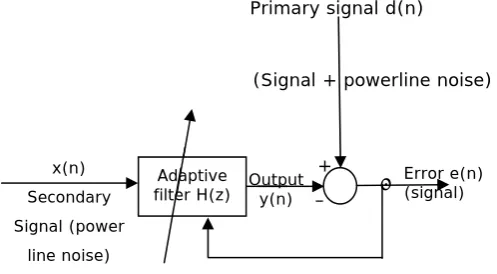
which in this case is the powerline noise. The filter produces an output y(n) which is subtracted from d(n) to compute an error e(n)
Fig. 1: Adaptive filter for power line noise removal in ECG
Normally, the output of FIR filter is a convolution of the input and the filter coefficients as shown below:
=
−
=
Lk
k
x
n
k
h
n
y
0
)
(
)
(
(1)where L is the order of the filter, x(n) is the secondary input signal, hk are the filter coefficients and y(n) is the
filter output. The error signal e(n) is defined as the difference between the primary signal d(n) and the filter output y(n). That is to say;
( ) ( ) ( )
n
d
n
y
n
e
=
−
(2)∴ substituting for y(n) will give
( ) ( )
=
−
−
=
Lo k
k
x
n
k
h
n
d
n
e
.
(
)
(3)The Square Error is
2
0 0
2
2( ) ( ) 2 ( )
. ( )
. ( )= =
− +
− −
= L
k
L
K k k x n k h x n k
h n d n d n
e (4)
The Square Error expectation for N samples is given by
( )
[ ]
( )
=
=
NK
n
e
n
e
E
0 2 2
(5)
Adaptive filter H(z)
+ – •
x(n) Secondary Signal (power
line noise)
Output y(n)
Error e(n) (signal)
Primary signal d(n)
( )
[ ]
( )
( )
= = =
−
+
−
−
=
N K L K L K kk
x
n
k
h
x
n
k
h
n
d
n
d
n
e
E
0 2 0 0 2 2)
(
.
)
(
.
2
=
[ ]
( )
( )
(
)
= = = = = =−
−
+
−
−
N n N K L K L k k k L k k N nk
n
x
h
k
n
x
h
k
n
x
h
n
d
n
d
1 0 0 0 0
1 2
)
(
.
)
(
.
.
2
=
[ ]
( )
(
)
= = = = = =−
−
+
−
−
L n L K L l N n l k N n k N nk
n
x
k
n
x
h
h
k
n
x
n
d
h
n
d
0 0 ; 0 1 1 1 2)
(
).
(
.
.
)
(
2
=
[ ]
( )
(
)
= = = = = =−
−
+
−
−
L n L K L l N n l k N n k N nl
k
k
n
x
n
x
h
h
k
n
x
n
d
h
n
d
0 0 ; 0 1 1 1 2)
)(
(
)
(
.
.
)
(
2
( )
[ ]
[ ]
( )
= = =−
+
−
=
L K L k L l xx L k dxk
R
n
h
h
R
n
k
l
h
n
d
n
e
E
0 0 0
2 2
)
)(
(
)
(
2
(6)Where Rdx(n) is the cross-correlation function between the primary and secondary input signals while Rxx(n) is
the autocorrelation function between the same two inputs. That is to say that
−
−
=
Nn
dx
n
d
n
x
n
k
R
1)
(
).
(
)
(
(7)
−−
=
N nXX
n
x
n
x
n
k
R
1)
(
).
(
)
(
(8)The objective of this update process is to minimize the squared error. To get this goal the optimization technique of steepest descent is used. With this it is possible to calculate the filter coefficient vector for each iteration k, having information about the previous coefficients and gradient, multiplied by a constant. That is,
( ) (
k)
k
k
n
h
n
h
(
+
1
)
=
+
μ
−
∇
(9)Where
μ
is a coefficient that controls the rate of update and it is called the step-size. The gradient is defined as,[ ]
)
(
)
(
2n
h
n
e
k k∂
∂
=
∇
(10)Using (10) in (9) yields
( )
[ ]
)
(
)
(
)
1
(
2n
h
n
e
n
h
n
h
k k k∂
∂
−
=
+
μ
(11)Differentiating with respect to
h
k gives( )
[ ]
)
(
)
(
)
(
2
)
1
(
n
h
n
e
n
e
n
h
n
h
k k k∂
∂
−
=
+
μ
(12)( )
)
(
)
(
.
)
(
)
(
2
)
1
(
0n
h
k
n
x
h
n
d
n
e
n
h
n
h
k L k k k k∂
−
−
∂
−
=
+
μ
= (13)Since d(n) and x(n) are not functions of
h
k, (13) condenses to( )
n
e
n
x
(
n
k
)
h
n
h
k(
+
1
)
=
k−
2
μ
(
)
−
(14)The expression of (14) is the final description of the algorithm to compute the filter coefficients as a function of the signal error e(n) and the reference input signal x(n). The coefficient or step-size
μ
is a scaler constant that must be chosen to guarantee fast convergence or adaptation without losing stability. The filter is stable ifμ
satisfies the condition;0<
μ
<Where L is the order of the filter and Pxx is the power of the input signal computed as
)
(
1
1
10 2
n
x
M
p
M
n
xx
−
=
+
=
(16)The interpretation of (14) is that a new set of coefficients
h
k(
n
+
1
)
is generated by updating the previous coefficientsh
k(
n
)
in accordance with the reference input noise signal.3 Design of FIR Adaptive noise canceller (ANC) using LMS Algorithm. The canceller is for removing the 50Hz powerline interference.
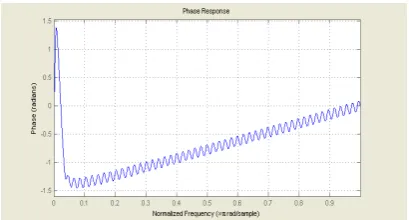
The order of the filter is 100 and the step size is 0.001. The design is carried out with FDAtool of Matlab. The instanteneous impulse, frequency and phase responses of the adaptive filter are depicted in fig. 12, fig. 13 and fig.14 respectively.
Fig. 2: Instantaneous impulse response of the adaptive noise canceller
Fig. 3: Instantaneous frequency response of the adaptive noise canceller
Fig. 4: Instantaneous phase response of the adaptive noise canceller
4 Results
Fig. 5: ECG signal corrupt with 50Hz powerline
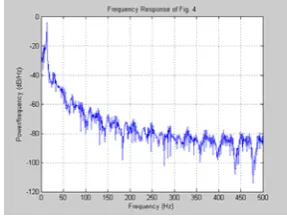
Fig. 6: Frequency response of ECG signal corrupt with 50Hz powerline
Fig. 7: ECG signal after filtration with the adaptive filter
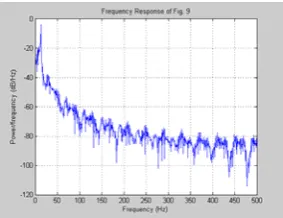
Fig. 9: Adaptive filter estimated output
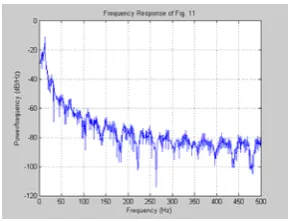
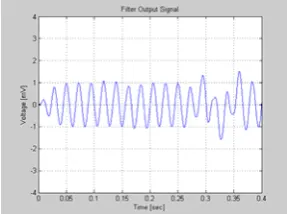
Fig. 10 depicts an ECG signal corrupt, with 60Hz powerline interference and fig 11 is the frequency response. Fig 11 shows that the power of the signal at 60Hz is approximately (-46.12dB ). Fig 12 shows the filtered signal and fig 14 is the frequency response. The estimated output signal is represented in fig 14. From fig 13 the power at 60Hz frequency drops ton (-58.19dB ), implying that the adaptive filter has removed the 60Hz noise. Comparing fig. 10 and fig 13 confirms noise removal.
Fig. 10: ECG signal corrupt with 60Hz powerline
Fig. 11: Frequency response of ECG signal corrupt with 60Hz powerline
Fig. 13: Frequency response of ECG signal after filtration with the adaptive filter
Fig. 14: Estimated output of the adaptive filter
Fig 15 shows an ECG signal corrupt with 45Hz powerline interference while fig. 16 is the frequency response.
From fig. 16 it can be seen that the power of the corrupt signal at 45 Hz is (-44.99dB ). When the corrupt signal is applied to the adaptive filter, the filtered output is shown in fig17 while the frequency response of the filtered output is shown in fig. 18. Fig. 19 is the estimated filter output. From fig 18, it can be confirmed that the power of the signal has reduced to (-57.78dB ) which means that the adaptive filter has removed the 45Hz powerline. A comparison of fig. 16 and fig. 17 also provides the information that the adaptive filter has removed the 45Hz powerline noise.
Fig. 15: ECG signal corrupt with 45Hz powerline
Fig. 17: ECG signal after filtration with the adaptive filter
Fig. 18: Frequency response of ECG signal after filtration with the adaptive filter
Fig. 19: Estimated output of the adaptive filter
5. Conclusion
The instantaneous impulse and magnitude responses of the adaptive filter show that the filter is very stable. The phase response is also indicating that the filter has a linear phase, which is desirable in filtering complex waves like ECG signal. the results of the implementation are confirming that when the frequency of the input noise changes, the adaptive filter tracks such changes and adjusts its coefficient to produce the same filtered output. Therefore, adaptive filter is most suitable when the frequency of the noise to be filtered out is not stable.
References
[1] Daniel Olguin Olguin, Frantz Bouchereau and Sergio Martinez; “Adaptive notch filter for ECG signals based on the LMS algorithm with variable step-size parameter”. 2005 conference on information sciences and systems, the John Hopkins University; March 16 – 18, 2005.
[2] Hon Wan, Rongshen Fu and Li Shi, “The elimination of 50Hz powerline interference from ECG using a variable step size LMS adaptive filtering algorithm”. Life Science journal, Vol. 3, No. 4, pages 90 – 93. 2006.
[3] Yufeng Wu, Rangaraj M. Rangayyan, Yachao Zhou and Sin-Chun Ng: “Filtering electrocardiographic signals using an unbiased and normalized adaptive noise reduction system” Journal of Medical Engineering and Physics, Vol 31, Pages 17 – 26. 2009.
[4] Guohua Lu, John-Stuart Brittain, Peter Holland, John Yianni, Alexander L. Green, John F. Stein, Tipu Z. Aziz and Shouyan Wang, “Removing ECG noise from surface EMG signals using adaptive filters”. Journal of Neuroscience letters, Vol. 462, pages 14 – 19. 2009.
[5] Sachin Singh and K.L. Yadav, “performance evaluation of different adaptive filters for ECG signal processing”. International journal on computer science and engineering, Vol. 02, no4, pages 90-93. 2006.
[7] Wilfried Philips, “Adaptive noise removal from biomedical signals using warped polynomials”. IEEE transactions on biomedical engineering, vol 43, No. 5, pages 480 – 492. May, 1996.
[8] Garces Correa, E. Laciar, H. D. Patino and M. E. Valentinuzzi, “Artifact removal from ECG signals using adaptive filters in cascade”. Journal of Physics: Conference series 90 (012081), pages 1 – 10. 2007.
[9] Abdel-Rahaman AL- Qawasmi, and Khaled Daqrouq, “ECG signal enhancement using wavelet transform’’. WSEAS transactions on biology and biomedicine, issue 2, volume7, pages 62- 72; April, 2010.
[10] J. Mateo, C. Sanchez, C. Vaya, R. Cervigon and J. J. Rieta, “A new adaptive approach to remove baseline wander from ECG recordings using Madeline structure”. Computers in Cardiology, Vol. 34, pages 533 – 536. 2007.
[11] Yun-Li Liu, Nin-Chun change, sheng-feng Hsu, Dong- long Lin and Yue- Der Lin, “An adaptive algorithm for canceling power-Line interference in biopotential measurement”. Biomedical engineering, basis and communication, Pages 350- 354. December, 2004. [12] Mikhled Alfaouri and Khaled Daqrouq, “ECG signal denoising by wavelength transform thresholding”. American Journal of applied