Lincoln University Digital Thesis
Copyright Statement
The digital copy of this thesis is protected by the Copyright Act 1994 (New Zealand).
This thesis may be consulted by you, provided you comply with the provisions of the Act
and the following conditions of use:
you will use the copy only for the purposes of research or private study
you will recognise the author's right to be identified as the author of the thesis and
due acknowledgement will be made to the author where appropriate
you will obtain the author's permission before publishing any material from the
thesis.
Subterranean clover to increase the
legume content of pastures in spring
A dissertation submitted in partial fulfillment
of the requirement for the Degree of
Bachelor of Agricultural Science with Honours.
at Lincoln University
by
Will Hurst
Lincoln University
i ABSTRACT
Abstract of a Thesis submitted in partial fulfillment of the requirement for
the Degree of
Bachelor of Agricultural Science with Honours.Subterranean clover to increase the legume content of pastures in spring
By
W. J. Hurst.
Traditional ryegrass/white clover pastures frequently have less than the optimum 50%
legume content for animal production, particularly in early spring when white clover
growth rates are low. Three experiments were used to investigate ways to increase the
legume content of pastures in early spring.
Experiments 1 & 2 investigated the potential for over-drilling subterranean clover in
autumn into established ryegrass-based pastures to increase dry matter yields and
legume content in early spring. Dry matter yields in Experiment 1 were 310 kg DM/ha
greater in ‘Woogenellup’ pastures than controls, although these yields were depressed by
higher than average rainfall and slug and grass grub damage. Total clover content in
‘Woogenellup’ reached 13.6% by early October, compared with 8.18% in the control.
Experiment 2 at Invernia, a commercial dairy farm in North Otago, aimed to introduce
subterranean clover under normal management of a dairy farm. Dry matter yields were
not increased, but clover content was higher in ‘Woogenellup’ (21.7%) and ‘Antas’
(17.1%) than ‘Denmark’ (9.22%) and the control (5.95%). Subterranean clover was
over-drilled into a second paddock, with no experimental design. In there, the subterranean
clover content of pasture reached 25% in some areas, however it did not grow where
white clover made up >25% of the pasture in spring. ‘Woogenellup’ showed greater
ii
higher pH soils of Experiment 2. The maximum subterranean clover yield measured in
Experiments 1 & 2 was 320 kg DM/ha. Over-drilling subterranean clover was estimated to
be profitable if yields could reach 500-1000 kg DM/ha.
Experiment 3 applied gibberellic acid (GA) to pure subterranean clover swards to increase
spring dry matter yields. However, dry matter yields were not increased by GA at any
stage in the experiment. Plant height did increase 44 days after GA application. In mixed
pastures, this may lead to increased light interception of subterranean clover, and
represents an area for further work. Large leaved cultivars produced more dry matter
than small leaved cultivars, which was consistent with results at Experiments 1 & 2. Dry
matter yields of 3.5-4 t DM/ha in ‘Narrikup’, ‘Woogenellup’ and ‘Antas’ were recorded in
early October.
The concept of over-drilling subterranean clover into dairy pastures to increase early
spring dry matter yields and production was successful, but not at levels that would
support a financial return. The concept requires further work, which could include using
balansa clover, which survives in the wet conditions that depressed subterranean clover
growth in Experiments 1 & 2.
Keywords: Trifolium subterraneum, Trifolium repens, Lolium perenne, legume content,
iii
TABLE OF CONTENTS
ABSTRACT ... i
Table of Contents ... iii
List of Tables ... vii
List of Figures ... viii
List of Plates ... x
List of Appendices ... xi
1 General INTRODUCTION ... 1
2 REVIEW OF THE LITERATURE ... 4
2.1 Introduction. ... 4
2.2 Clover content in dairy pastures. ... 5
2.2.1 Current methods for meeting feed demand. ... 5
2.2.2 Ryegrass/white clover pastures and feed demand of dairy cows. ... 6
2.2.3 Legumes as a tool for keeping production costs low... 9
2.2.4 Limitations of white clover in dairy pastures. ... 11
2.2.4.1 Growing season ... 11
2.2.4.2 Clover root weevil (Sitona lepidus). ... 11
2.3 Subterranean clover. ... 13
2.3.1 History. ... 14
2.3.2 Cultivar choice ... 14
2.3.3 Herbage production ... 15
2.3.4 Seed production and seed set. ... 19
2.3.5 Subterranean clover establishment. ... 20
2.3.5.1 Germination. ... 20
2.3.5.2 Soil fertility. ... 21
2.3.5.3 Waterlogging. ... 22
2.4 Methods for increasing clover content in spring. ... 23
2.4.1 Over-drilling as a method for increasing yield. ... 23
2.4.1.1 Issues with over-drilling subterranean clover. ... 23
2.4.2 Gibberellic acid... 24
2.5 Conclusions. ... 26
3 MATERIALS AND METHODS ... 27
3.1 Experiment 1 – Iversen field (I3). ... 27
3.1.1 Experimental location. ... 27
iv
3.1.3 Thousand seed weight. ... 28
3.1.4 Sowing ... 28
3.1.5 Defoliation management... 29
3.1.6 Insect/slug control. ... 29
3.1.7 Establishment counts. ... 29
3.1.8 Leaf appearance rate. ... 30
3.1.9 Pasture cuts. ... 31
3.1.10 Soil tests ... 31
3.2 Experiment 2 - Invernia ... 32
3.2.1 Experimental location. ... 32
3.2.2 Experimental design. ... 32
3.2.3 Sowing. ... 32
3.2.4 Grazing ... 33
3.2.5 Establishment counts. ... 33
3.2.6 Herbage accumulation measurements. ... 34
3.3 Experiment 3 – Iversen Field ... 34
3.3.1 Experimental location. ... 34
3.3.2 Sowing. ... 35
3.3.3 Experimental design. ... 35
3.3.4 Height measurements. ... 35
3.3.5 Pasture cuts. ... 36
3.4 Weather data ... 36
3.5 Statistical analysis. ... 39
3.5.1 Experiment 1 ... 39
3.5.2 Experiment 2 ... 40
3.5.3 Experiment 3 ... 40
4 RESULTS ... 41
4.1 Experiment 1 – Iversen Field (I3) ... 41
4.1.1 Emergence ... 41
4.1.2 Leaf appearance ... 41
4.1.3 Pasture yields. ... 43
4.1.4 Botanical composition. ... 46
4.2 Experiment 2 – Invernia. ... 48
4.2.1 Emergence. ... 48
4.2.2 Pasture yields. ... 48
4.2.2.1 Airport 6. ... 48
v
4.2.3 Woolshed 5 ... 54
4.2.3.1 Herbage yield ... 54
4.2.3.2 Botanical Composition. ... 55
4.3 Experiment 3 – Iversen Field (I2) – Gibberellic acid on subterranean clover. ... 56
4.3.1 Plant height. ... 56
4.3.1.1 Measurement 1 – 13/09/2017 ... 56
4.3.1.2 Measurement 2 – 06/10/2017. ... 56
4.3.2 Pasture cuts ... 58
4.3.2.1 Dry matter yields - 1st cut (16th August 2017). ... 58
4.3.2.2 Botanical Composition - 1st cut (16th August 2017). ... 60
4.3.2.3 Dry matter yields - 2nd cut (13th September). ... 61
4.3.2.4 Botanical composition - 2nd cut (13th September). ... 63
4.3.2.5 Dry matter yields - 3rd cut (6th October) ... 64
4.3.2.6 Botanical composition - 3rd cut (6th October). ... 67
5 DISCUSSION ... 68
5.1 Experiment 1 ... 68
5.1.1 Dry matter yields. ... 68
5.1.2 Low overall yields ... 69
5.1.3 Botanical composition. ... 71
5.1.4 Establishment. ... 71
5.1.5 Leaf accumulation and leaf appearance. ... 72
5.2 Experiment 2. ... 73
5.2.1 Dry matter yields. ... 74
5.2.2 White clover competitiveness. ... 75
5.2.3 Subterranean clover production. ... 76
5.2.4 Establishment. ... 76
5.3 Experiment 3. ... 77
5.3.1 Dry matter between GA levels. ... 77
5.3.2 Plant height between GA levels... 77
5.3.3 Dry matter between cultivars. ... 78
5.3.4 Growth rate. ... 79
6 GENERAL DISCUSSION AND CONCLUSIONS ... 80
6.1 Over-drilling subterranean clover. ... 80
6.1.1 Profitability ... 80
6.1.2 Leaf size ... 81
6.1.3 Does over-drilling work? ... 81
vi
6.2 Experiment 3 - Gibberellic acid on pure subterranean clover. ... 83
6.2.1 Dry matter yields with GA ... 83
6.2.2 Cultivar differences ... 83
6.3 Conclusions ... 84
Acknowledgements ... 85
References ... 86
vii
LIST OF TABLES
Table 2.2.1: Pasture intake, DM%, milk yield (L/cow/d) and milk solid production (kg MS/cow/d) of cows fed 0, 25, 50 and 75% clover under two different feed
allocations (Harris et al., 1997). ... 7
Table 2.2.2: DM response (kg DM/kg N) and growth rate (kg DM/ha/°Cd) of ‘Revolution’, ‘Cannon LE’ and ‘Aries’ (sown at 8, 12 and 15 kg/ha) perennial ryegrass (Fasi et al., 2008). ... 10 Table 2.2.3: Root BiochaninA concentration (mg/g DM), N fixation (mg N/plant) and reductions in shoot and root dry matter (%) of clovers subjected to CRW
(adapted from Crush et al., 2007). ... 13
viii
LIST OF FIGURES
Figure 2.3.1:Total accumulated annual dry matter (DM) production of CF/Sub, CF/Bal,
CF/Wc, CF/Cc, RG/Wc and lucerne pastures for five growth seasons (Mills et
al., 2008). ... 18
ix
x
LIST OF PLATES
Plate 3-1: Subterranean clover seedlings showing cotyledon damage by slugs on the 07/04/2017 at paddock I3, Ivesen field, Lincoln University, New Zealand. .... 30 Plate 4-1: ‘Woogenellup’ subterranean clover on the 31/10/2017 at Experiment 1, Lincoln
University, New Zealand. ... 47 Plate 4-2: ‘Woogenellup’ subterranean clover in the ‘top’ block of Woolshed 5 on the
03/09/2017 at Invernia, North Otago, New Zealand. ... 54 Plate 4-3: ‘Leura’ subterranean clover shown with a height stick on the 13/09/2017 at
Experiment 3, Lincoln University, New Zealand. ... 56 Plate 4-4: ‘Narrikup’ subterranean clover on 06/10/2017 at Experiment 3, Lincoln
xi
LIST OF APPENDICES
Appendix 1: Experimental design for Experiment 1 at Iversen Field, Lincoln University, New Zealand. ... 93 Appendix 2: Experimental design for Experiment 2 at Invernia, North Otago, New
1
1
GENERAL INTRODUCTION
Traditional dairy pastures in New Zealand have been dominated by perennial ryegrass
(Lolium perenne) / white clover (Trifolium repens) mixes (Da Silva et al., 2004). The
popularity is due to ease of establishment, tolerance of a wide range of environments,
complementary growth patterns and high pasture production (Nobilly, 2015). However
these pastures can be limited by poor persistence of white clover in areas with no or
unreliable irrigation (Singh et al., 1999). In addition, a decrease in nutritive value occurs in
late spring for perennial ryegrass as more reproductive tillers are produced (Wims et al.,
2017). There are also slow growth rates of pastures at the beginning of the lactation
period (McEvoy et al., 2008). These limitations can be mitigated by the use of
supplementary feeds, particularly early and late in the milking season when pasture
growth rates are low. Grass silage is a common supplement used to balance the nutritive
demand of dairy cattle with pasture production (Mackle et al., 1999). However milk
production has been shown to be greater when cows are fed on grazed pasture
compared with grass silage (Dillon et al., 2002). Therefore it is beneficial for farmers to
find ways to increase pasture production to meet demand early in the season in place of
feeding out grass silage.
The use of diverse pastures (pastures with three or more species) is a tool that is being
promoted to the dairy industry. They have shown an ability to improve the nitrogen (N)
use efficiency of dairy cows which could aid industry work towards environmental goals
(Totty et al., 2013). However reports have shown no increases in either dry matter intake
or milk solid yield (Barry, 2015), which has led to limited farmer usage of these pastures.
Increases in dry matter intake and metaboliseable energy (ME) intake have been shown
to increase milk production (Mackle et al., 1999). Furthermore, increases in the legume
content of pasture has been shown to maximise milk yield (Cosgrove et al., 2006). One
way to increase early spring production and legume content of pastures could be to use
winter annual legumes, and in this study the emphasis is on subterranean clover
(Trifolium subterraneum). Subterranean clover has the potential to increase the dry
matter and ME production of pastures in late winter/early spring due to its ability to
2
Subterranean clover is a winter annual legume that produces its herbage in late winter
and early spring, much earlier in the season compared with white clover (Mills et al.,
2014). In dryland systems subterranean clover sets seed in late spring/early summer,
before moisture stress occurs. Emergence of seedlings occurs after the first autumn rains,
allowing the plant to avoid summer droughts. Subterranean clover has been widely used
in Australia and in parts of dryland New Zealand for sheep and beef production. To avoid
losing moisture from the soil, subterranean clover is most commonly direct drilled into
soil, usually as part of a pasture mix with other drought tolerant species (Murray, 2012).
Over-drilling subterranean clover into irrigated dairy pastures is an area that has received
no research, and it may not work. However, Ates et al., (2010) showed increases in spring
DM yield of 23-45% when subterranean clover was over-drilled into dryland cocksfoot
(Dactylis)/ryegrass pastures, showing that it is relatively easy to introduce into
cultivatable land that most dairy pastures are located on.
Gibberellic acid (GA) is a plant growth hormone that helps to promote stem elongation
and plant growth (Lewak & Khan, 1977). Early studies have shown GA increased yields
initially, followed by a lag phase where plant growth was decreased (Morgan & Mees,
1958). However, this lag has been reported to be due to excessive rates of application.
More recent articles have stated application rates of 8 g GA/ha, compared with early
studies that used rates of up to 700 g GA/ha (Matthew et al., 2009). Using lower rates, GA
application was shown to increase spring clover yields by 53% (van Rossum, 2013). This
points to the potential for GA to be a useful tool for increasing pasture and clover yields
during early lactation on dairy farms.
Recent popular press articles have reported on farmer efforts to increase legume content
of pasture by over-drilling subterranean clover into permanent summer moist pasture in
the Catlins (Cosgrove, 2016). However, there is no experimental data available to test
whether over-drilling subterranean clover can be successful in a dairy pasture. Therefore,
the aim of this study is to increase early spring growth and clover content of permanent
ryegrass based irrigated or summer moist pastures. The specific objectives are: 1) to
investigate and quantify the potential for over-drilling subterranean clover into irrigated
3
potential for the use of gibberellic acid to increase early spring growth of subterranean
clover.
This dissertation is in six chapters. Chapter 2 is a literature review that covers the
importance of legumes in dairy pastures, followed by the limitations of white clover being
the sole legume of dairy pastures. Subterranean clover is then reviewed on its potential
as an additional legume into dairy pastures, followed by methods that could be used to
improve spring legume content such as over-drilling subterranean clover into pastures,
and the use of gibberellic acid to increase spring growth of pasture. Chapter 3 details the
materials and methods used to carry out three experiments. Experiment 1 and 2 explored
whether over-drilling subterranean clover into permanent, moist ryegrass pastures could
increase the early spring legume content of pastures. Experiment 1 was carried out at
Lincoln University, New Zealand, while Experiment 2 was carried out at a commercial
dairy farm in North Otago, New Zealand. Experiment 3 investigated the use of gibberellic
acid to increase the production of pure subterranean clover swards at Lincoln University.
Chapter 4 details the results these experiments, followed by their discussion in Chapter 5,
4
2
REVIEW OF THE LITERATURE
2.1 Introduction.
Increasing the energy intake of dairy cows will result in an increase in milk solid
production and therefore an increase in farm revenue (Dalley et al., 2005). The two ways
energy intake can be increased is by increasing feed quality or increasing feed supply.
Increasing the clover content of pastures has been shown to increase the feed quality of
pastures, and can result in a greater energy intake for grazing animals (Woodward et al.,
2003). Increasing legume content also adds fixed nitrogen back into pastures, which can
decrease fertilizer costs for farmers. However, white clover is limited by the fact that its
growing season doesn’t start until October, meaning pastures are often low in legume
content in early spring (Cooper et al., 1997). Further, white clover is susceptible to attack
from clover root weevil (Sitona Lepidus) (Crush et al., 2007). These factors, combined
with excessive sowing rates of companion grass species (Hurst et al., 2000), make it
difficult to increase white clover content of dairy pastures.
Subterranean clover has the potential to become an additional legume in dairy pastures.
While there is no recent literature on its use in New Zealand pastures, the early spring
growth of subterranean clover (Widdup & Pennel, 2000) could fit in well in dairy systems.
This this review investigates the need for increasing clover content on dairy farms, and
explain why this is difficult to do with white clover. Subterranean clover will be
investigated as a potential additional legume for dairy pastures, along with any previous
studies where GA or over-drilling has been used as a method for increasing clover
content. The potential issues with these two methods will also be investigated. While all
previous research in the literature on subterranean clover relates to dryland pastures,
conclusions will be made in the context of irrigated dairy pastures to evaluate its
5
2.2 Clover content in dairy pastures.
2.2.1 Current methods for meeting feed demand.
Using bought in feed such as maize (Zea mays)silage to meet feed demand and increase
milk solid production can be unprofitable on dairy farms (Dalley et al., 2005). This is
because this type of farming system relies on two things; the cost of the bought in feed
and the price per kilo of milk solids. If the cost of feed is high and the payout is low,
economic farm surplus will decrease. Dalley et al., (2005) compared the production and
economic farm surplus between two different farm systems near Waimate. A stocking
rate of 3.8 Jersey cows/ha with no bought in feed (LSR) was compared against a high
stocking rate (5 cows/ha) using maize silage as supplementation (HSR) over four seasons.
Maize silage was feed at up to 1.5 t DM/ha/year in the HSR system. Milk solid production
per ha increased by 34% on the HSR farmlet (1566 kg MS/ha/yr) compared with the LSR
farmlet (1172 kg MS/ha/yr). Milk solid response to the additional dry matter in the HSR
system averaged 80 g MS/kg extra DM consumed. The economic farm surplus (EFS) was
higher in the LSR system compared with the HSR system ($2784/ha compared with
$2551/ha). This comparison showed the effectiveness of an increase in DM intake leading
to an increase in milk solid production. However, the vulnerability of systems reliant on
bought in feed was also highlighted by the range of EFS across years with different milk
payout or supplement costs. Ideally farmers want to increase DM (or metaboliseable
energy) intake without increasing feed costs.
Cows fed supplements had a higher substitution rate when grazing pure perennial
ryegrass swards compared with ryegrass/ white clover pastures (Stockdale, 2000).
Substitution rate is the decrease in pasture intake per kg of supplement fed (kg DM/ kg
DM supplement). Substitution occurs when there is a decrease in rumen pH due to the
rapid fermentation of supplements with a high nutritional value, in particular
concentrates (Baudracco et al., 2010). This leads to a reduction in the rate of fibre
digestion and consequently decreased herbage intake. Pastures with higher clover
content are more digestible, meaning pasture intake is less affected by a drop in rumen
6
substitution rate of cattle when fed supplements. They found that cows fed supplements
whilst grazing pure ryegrass pastures had a supplementation rate 0.16 kg DM/kg DM of
supplement greater than cows grazing ryegrass/white clover pastures. For New Zealand
dairy systems, this points to a need for increased clover contents of pastures in early
spring and autumn. These periods are when supplement feeding is the highest due to
pasture growth rates not fully meeting animal demand.
2.2.2 Ryegrass/white clover pastures and feed demand of dairy cows.
Increases in the white clover content in pastures has led to increases in the milk solid
production of dairy cows (Woodward et al., 2003; Woodward et al., 2001). This is
because white clover has a higher nutritive value than perennial ryegrass, resulting in
greater milk solid production per unit of feed intake. These are further amplified in
summer when the nutritive value of perennial ryegrass drops due to the production of
reproductive tillers. Woodward et al., (2001) and Woodward et al., (2003) summarised
the same experiment near Hamilton. ‘Old’ and ‘recent’ cultivars of both perennial
ryegrass and white clover were sown in pasture mixes. Data on milk production and
economic farm surplus were recorded. Eerens et al., (2001) summarised the botanical
composition and pasture production from the same experiment. A pasture shown to have
higher clover content (P < 0.05) by Eerens et al., (2001) produced more milk solids per
days in milk (1.42 kg/cow) compared with the other three pastures in the trial (1.38, 1.38
and 1.33 kg/cow, LSD = 0.03). These results were backed by conclusions drawn by
Cosgrove et al., (2006). They showed cows grazing pure ryegrass during the day and pure
white clover at night had a milk solid yield of 2.0 kg MS/cow/day. This was higher (P <
0.01) than the 1.5 kg MS/cow/day for cows grazing pure ryegrass or a ryegrass/clover
pasture with 8% clover.
The optimum white clover content of dairy pasture was shown to be 50-65% (Harris et
al., 1997). This range represents a balance between improving pasture quality, driven by
the high metaboliseable energy content of clover, and maximising pasture yields, driven
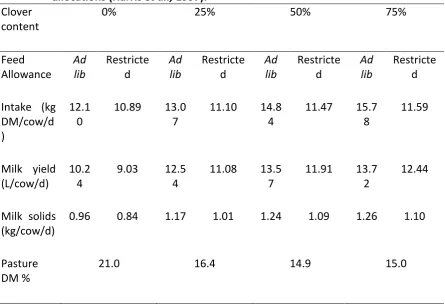
by the high growth rate of perennial ryegrass. Harris et al., (1997) showed the effects on
7
clover content of 0%, 25%, 50% or 75% (Table 2.1). Cows were given two different feed
allowances; restricted (25 kg DM/cow/day) or ad lib (50kg DM/cow/day). Pasture intake
of cows grazing ad lib on 50% (14.8 kg DM/cow/d) and 75% (15.8 kg DM/cow/d) clover
pasture was higher (P < 0.05) than cows grazing 0% (12.1 kg DM/cow/d) clover pasture.
Under the ad lib feed allowance, cows grazing 25% clover pastures had a 22% increase in
milk yield when compared with 0% clover pastures. Cows grazing 50% and 75% clover
pastures had a 33% greater milk yield than 0% pastures. Under restricted allowances,
milk yield was lower than fully fed cows; however responses to increases in clover
content were similar in percentage terms. These results indicate that milk production
continued to increase until clover content reached about 50%. Above this level, the
decrease in dry matter production from increasing clover content leads to a decrease in
energy intake of grazing animals. This suggests that an increase in clover content in early
spring would lead to greater milk production.
Table 2.1: Pasture intake, DM%, milk yield (L/cow/d) and milk solid production (kg MS/cow/d) of cows fed 0, 25, 50 and 75% clover under two different feed allocations (Harris et al., 1997).
Clover content
0% 25% 50% 75%
Feed Allowance Ad lib Restricte d Ad lib Restricte d Ad lib Restricte d Ad lib Restricte d
Intake (kg DM/cow/d )
12.1 0
10.89 13.0
7
11.10 14.8
4
11.47 15.7
8
11.59
Milk yield (L/cow/d)
10.2 4
9.03 12.5
4
11.08 13.5
7
11.91 13.7
2
12.44
Milk solids (kg/cow/d)
0.96 0.84 1.17 1.01 1.24 1.09 1.26 1.10
Pasture DM %
8
Advances in plant breeding have led to increases in the clover content of perennial
ryegrass/white clover pastures (Woodward et al., 2003). This is due to plant breeders
focusing on improving the stolon density, leaf area and cool season growth of new
cultivars. Cooper et al., (1997) summarised the characteristics of the white clover cultivar
‘Challenge’, the most recent cultivar at the time of publication. They noted increased
stolon densities and cool season growth made ‘Challenge’ suitable for rotationally grazed
pastures. ‘Challenge’ white clover was used in the trial summarised by Woodward et al.,
(2003). They compared the production and economic farm surplus on farmlets using
either ‘recent’ or ‘old’ ryegrass and white clover cultivars. Pastures sown with recent
white clover cultivars (‘Challenge’ and ‘Sustain’) had increased clover content compared
with ‘old’ white clover cultivars. For example, in the 2001/02 season, ‘recent’ white
clover cultivars sown with either ‘recent’ or ‘old’ perennial ryegrass cultivars had clover
contents of 27.4% and 29.0%, respectively. In comparison, white clover cultivars from the
1960s with ‘recent’ and ‘old’ ryegrass cultivars had clover contents of 15.3% and 21.2%
respectively (LSD = 4.3%). Of note is the fact that none of these pastures reached the 50%
clover content that Harris et al., (1997) noted as optimal for milk production. This is likely
due to excessive rates of perennial ryegrass being used in pasture mixes, resulting in too
much competition and consequently poor establishment of clover species (Hurst et al.,
2000).
Interestingly, the use of ‘new’ or ‘old’ ryegrass showed no difference in clover content
when used with the ‘new’ clover. This highlights the slow genetic gains made by plant
breeders with ryegrasses (Woodward et al., 2003). Increases in ryegrass yields did not
occur until the introduction of novel endophytes. These endophytes increased yields by
decreasing the insect pressure on perennial ryegrass from pests such as Argentine stem
weevil (Listronotus bonariensis) (ASW), which resulted in greater persistence and
therefore increased yields (Milne, 2007).
Large leaved clover cultivars were shown to be more productive than small leaved
cultivars in rotationally grazed ryegrass pastures. This is because large leaved cultivars
have a greater ability to elongate petioles, meaning leaves were placed above the
9
growth. Brock (1988) showed the dry matter production under set stocking and rotational
grazing of four white clover cultivars with different leaf sizes. ‘Kopu’ had a leaf area of
5.57 cm², compared with 2.75 cm² for ‘Huia’. ‘Kopu’ produced 590 kg DM/ha under
rotational grazing, which was 31% more than ‘Huia’. This information shows that large
leaved clover cultivars will probably be more productive in rotationally grazed dairy
pastures than small leaved cultivars.
2.2.3 Legumes as a tool for keeping production costs low.
Increasing clover contents of pastures can help maximise gross margins and increase milk
solid production on dairy farms (Clark & Harris, 1996). Increasing clover content allows
for lower nitrogen fertilizer inputs due to nitrogen fixation. Further, the higher nutritive
value of white clover increases the quality of the pasture. This can bring increases in milk
solid production if pasture yields can be kept constant while increasing clover content.
Clark & Harris (1996) used UDDER, a dairy farm simulation model, to find the optimum
combination of clover content and nitrogen fertilizer use. They noted a 50% clover
pasture would need to produce 14.2 t DM/ha/year to generate the same gross margin as
a 20% clover pasture yielding 16.2 t DM/ha/year. They noted an optimum system to
include clover contents of 40% and nitrogen fertilizer inputs of 100-200 kg N/ha/year.
This is lower than the optimum levels of 50-65% noted by Harris et al., (1997). The reason
for the slightly higher optimum clover content suggested by Harris et al., (1997) was
possibly due to differences in stocking rate or nitrogen fertilizer application rates
between the two trials. The optimums stated in both papers are considerably higher than
the clover contents estimated by Harris et al., (1997) of 10-20% in most pastures. This
shows that increasing clover contents of pasture is likely to lead to increases in
profitability of farms, but doing so in practice is difficult.
Perennial ryegrass pastures are hungry for extra nitrogen in spring (Fasi et al., 2008). This
is because nitrogen often becomes the most limiting factor for plant growth due to
replenished soil moisture levels. As temperatures warm and soil moisture begins to drive
plant growth, more nitrogen is required to maintain a plant nitrogen content of around
10
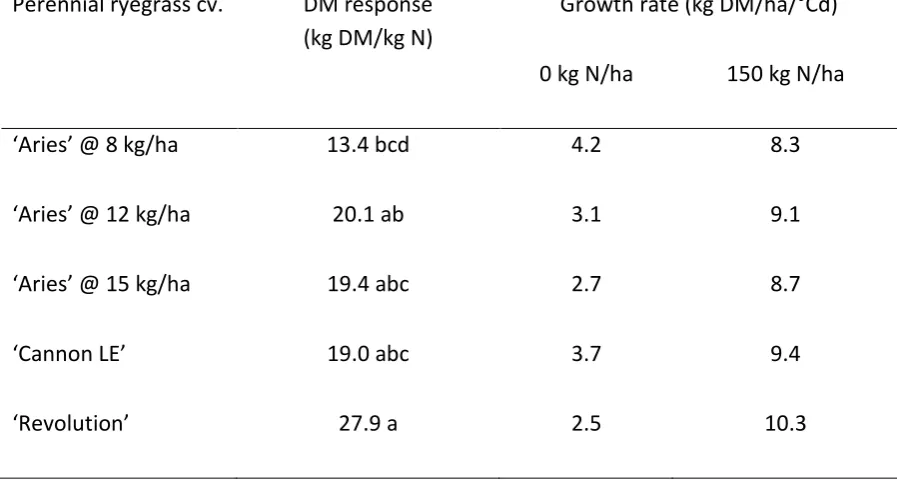
levels on the growth of perennial ryegrass pastures in spring (Table 2.3). Pastures with
150 kg N/ha applied grew 8.3-10.3 kg DM/ha/°Cd compared with 2.5-4.2 kg DM/ha/°Cd
(P < 0.05). Dry matter accumulation in response to added nitrogen ranged from 13.4 kg
DM/kg N (‘Aries’, sown at 8 kg/ha) to 27.9 kg DM/kg N (‘Revolution’). These nitrogen
responses were similar to the 24 kg DM/kg N shown by Gillingham et al., (1998) and 24.8
kg DM/kg N by Ball et al., (1976).
Table 2.2: DM response (kg DM/kg N) and growth rate (kg DM/ha/°Cd) of ‘Revolution’, ‘Cannon LE’ and ‘Aries’ (sown at 8, 12 and 15 kg/ha) perennial ryegrass (Fasi et al., 2008).
Perennial ryegrass cv. DM response
(kg DM/kg N)
Growth rate (kg DM/ha/°Cd)
0 kg N/ha 150 kg N/ha
‘Aries’ @ 8 kg/ha 13.4 bcd 4.2 8.3
‘Aries’ @ 12 kg/ha 20.1 ab 3.1 9.1
‘Aries’ @ 15 kg/ha 19.4 abc 2.7 8.7
‘Cannon LE’ 19.0 abc 3.7 9.4
‘Revolution’ 27.9 a 2.5 10.3
Increasing legumes in pasture can also reduce fertilizer costs on farms by fixing
atmospheric nitrogen (Lucas et al., 2010). Legumes form a symbiotic relationship with
Rhizobium bacteria. These bacteria allow atmospheric nitrogen fixation through root
nodules in legumes. Fixed nitrogen is then released into the soil, where it becomes
available for other non-legume pasture species to use, which results in increased growth.
Lucas et al., (2010) estimated the amount of N in subterranean and white clovers that
was derived from the atmosphere (fixed nitrogen) in an experiment at Lincoln University.
They showed both species of clover to fix 28 kg N/ t clover DM (+/- 0.7 kg N).
11
clover. Assuming a Urea cost of $476/ t (Ravensdown, 2017), a tonne of legume herbage
fixing 28 kg N/ha would be fixing $29 worth of N/ t DM. For an average dairy farm of 144
ha (Dairy NZ, 2014), growing ryegrass/ clover pastures producing 16.4 t DM/ha with a
25% clover content (Harris et al., 1997), this would equate to $17,106 worth of fixed
nitrogen.
2.2.4 Limitations of white clover in dairy pastures.
2.2.4.1 Growing season
The early spring legume content of dairy pastures is limited by the growth season of
white clover. Dairy farms require high quality, high yielding pastures from the beginning
of lactation. On most dairy farms, lactation begins in early August (Dairy NZ, 2014). White
clover growth rates decrease due to cooling temperatures from May, with the lowest
growth rates in August (Smetham, 1972). Growth rates then begin to increase with
warming temperatures in September and October. Smetham (1972) showed the growth
rate of two white clover cultivars from April through to October at a range of
experimental sites. White clover produced 15.1 g DM/plant in May, before growth rates
decreased to produce 8.63 g DM/plant in August. Growth rates then increased, producing
13.3 and 26.0 g DM/plant in September and October, respectively. The slow growth rates
in August are a limitation of white clover in dairy pastures. Lactating cows need high
quality feed from the beginning of lactation to maximize milk production. However, white
clover cannot fill this need until growth rates increase in September/October. This
creates a need for a high quality, winter active pasture species to be added to dairy
pastures.
2.2.4.2 Clover root weevil (Sitona lepidus).
Another issue effecting white clover content in dairy pastures is insect pressure, in
particular from clover root weevil (CRW). CRW is a palaearctic species that was first
detected in the upper North Island in 1996, gradually moving south until it reached the
bottom of the South Island in 2010 (Hardwick et al., 2016). Adult weevils feed on the
root-12
feeding larvae cause the most damage by reducing nitrogen fixation and root growth,
weakening or killing the plant. CRW damage is estimated to cost NZ$ 2.4 billion p.a. CRW
is biologically controlled to economically sustainable levels with a parasitic wasp that lays
eggs inside adult CRW. Once hatched, the larvae eat the insides of the CRW. Further,
once parasitized, adult CRW instantly become sterile, meaning they cannot produce more
larvae. Hardwick et al., (2016), estimated the parasitoid to be worth $2.3 million p.a to
Southlandadairyafarms.
Subterranean clover was shown to be more resistant to CRW when compared with white
clover (Crush et al., 2007). This was due to high concentration of isoflavnoids in the roots
and shoots of subterranean clover. Isoflavonoids are thought to act as a deterrent to
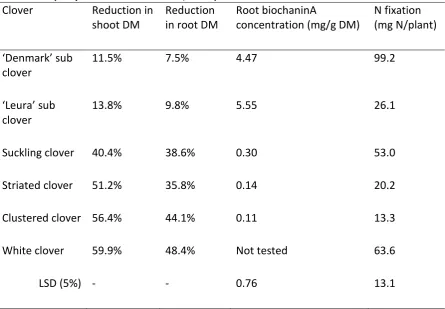
CRW feeding. Crush et al., (2007) showed the effects of CRW presence on ‘Denmark’ and
‘Leura’ subterranean clover, striated clover (Trifolium striatum), cluster clover (T.
glomeratum), suckling clover (T. dubium) and white clover in a glasshouse experiment.
‘Denmark’ subterranean clover root and shoot dry matter were reduced by 7.5% and
11.5%, respectively (Table 2.7). This compared with reductions in white clover root and
shoot dry matter of 48.4% and 59.9%. Nitrogen fixation was also higher (P < 0.01) in
subterranean clover than all other clover species when CRW was present. ‘Denmark’
subterranean clover fixed 99.2 mg N/plant, compared with 63.6 mg N/plant for white
clover (LSD = 13.1). Isoflanovoid concentrations were higher (P < 0.001) in subterranean
clover than other clover species. Root biochaninA levels in ‘Denmark’ and ‘Leura’
subterranean clover were 4.47 and 5.55 mg/g DM, respectively. In comparison, root
biochaninA concentrations were 0.30, 0.11 and 0.14 mg/g DM for striated, clustered and
suckling clover, respectively (LSD = 0.76). These results show the greater resistance of
subterranean clover compared with white clover, which points to the potential for its use
as a pasture legume in areas where CRW causes significant damage on white clover
13
Table 2.3: Root BiochaninA concentration (mg/g DM), N fixation (mg N/plant) and reductions in shoot and root dry matter (%) of clovers subjected to CRW (adapted from Crush et al., 2007).
Clover Reduction in
shoot DM
Reduction in root DM
Root biochaninA
concentration (mg/g DM)
N fixation (mg N/plant)
‘Denmark’ sub clover
11.5% 7.5% 4.47 99.2
‘Leura’ sub clover
13.8% 9.8% 5.55 26.1
Suckling clover 40.4% 38.6% 0.30 53.0
Striated clover 51.2% 35.8% 0.14 20.2
Clustered clover 56.4% 44.1% 0.11 13.3
White clover 59.9% 48.4% Not tested 63.6
LSD (5%) - - 0.76 13.1
2.3 Subterranean clover.
Because of the limitations of white clover, caused by its susceptibility to clover root
weevil and limited growth in early spring, there is a need for another legume species to
be added to dairy pastures. Subterranean clover is a winter annual legume that
germinates in autumn, then produces high quality legume herbage in early spring before
flowering and setting a seed in late spring, after which the plant dies. This allows the
plant to avoid the summer dry period, making it a useful legume in dryland farming
systems. If established, subterranean clover could provide high value feed for dairy cows
in early spring, bridging the gap between the start of lactation and when white clover
growth increases in October.
No literature has been published on the use of subterranean clover as a legume in dairy
pastures. All data on subterranean clover in this review comes from dryland farming
systems. This means data must be interpreted in a dairy farming context to be able to
14
subterranean clover may not suit a dairy system, which is what this research is designed
to investigate.
2.3.1 History.
Subterranean clover was first recognised in New Zealand in the early 1900s, when it was
found growing near Auckland (Smetham, 2003). The species was regarded as a weed until
the mid-1920s, after which it became a popular annual legume used in easier hill country.
However, the popularity of lucerne that began in the 1960s meant little research was
carried out on the plant in New Zealand until the late 1990s. More extensive recent
research has been carried out, including the use of subterranean clover in the nine year
‘Max-Clover’ experiment at Lincoln University (Brown et al., 2006). Due to the favourable
New Zealand climate and large variability between subterranean clover cultivars, there
are still many areas that require further research (Scott, 1971). These include further
evaluations on current cultivars as well as areas of potential use, such as it being an
additional legume in dairy pastures.
2.3.2 Cultivar choice
Subterranean clover has three main sub species; brachycalycinum, subterraneum and
yanninicum (Wright, 2015). Sub species yanninicum, and subterraneum are typically
found in slightly acidic soils (pH 5.5 – 6.5), whereas brachycalycinum is typically found in
neutral soils (pH 6.5 – 7.5). Yanninicum was also reported to have a greater tolerance to
waterlogging than brachycalycinum or subterraneum. From use in a dairy farming system,
any of the three sub species would be suitable, providing soils are light (e.g. silt loams).
However, where there are deep, heavy soils with high rainfall, the yanninicum sub species
could provide greater tolerance to waterlogging.
In a dryland system, subterranean clover cultivar choice should not be based solely on dry
matter production due to the need for the plant to set sufficient amounts of seed in
spring to allow it to persist the following season (Scott, 1971). Subterranean clover needs
to flower and set seed before the plant dies off once moisture stress occurs. Moisture
15
flowering cultivar that has sufficient moisture to flower and set seed in Napier (annual
rainfall 800 mm) might struggle to do so in North Canterbury (650 mm). Scott (1971)
evaluated dry matter and seed yields of six different cultivars sown in Wakari (annual
rainfall <800 mm). He showed that the earlier flowering cultivars such as ‘Geraldton’
(1638 kg DM/ha) grew less spring dry matter than late flowering cultivars such as
‘Tallarook’ (3572 kg DM/ha). However, ‘Geraldton’ set more seeds/m² (P < 0.05) than all
other cultivars (Table 2.4). In a dairy system, seed set is a secondary priority compared
with herbage production. This means cultivar choice can be based on herbage production
alone.
Table 2.4: Seed production and dry matter yield of early and late flowering subterranean clover cultivars. Adapted from Scott (1971).
Cultivar (earliest to latest flowering)
Seeds/m² Spring dry matter yield (kg
DM/ha)
Geraldton 1,774 a 1639 c
Yarloop 273 d 3576 b
Wogenellup 863 b 5777 a
Clare 749 bc 6655 a
Mt Barker 573 c 4135 b
Tallarook 272 d 3752 b
S.E Mean +/- 98 356
2.3.3 Herbage production
Later flowering subterranean clover cultivars produce greater herbage yields than early
flowering cultivars, given adequate moisture and a successful seedling establishment the
previous autumn (Widdup & Pennel, 2000). This is because late flowering cultivars
16
& Pennel (2000) showed the herbage yields of 20 subterranean clover cultivars, ranging
from early to late flowering. They showed a strong relationship (r²= 0.70) between
flowering time and herbage yields in the first growth season. Spring herbage yields
ranged from 2,500 kg DM/ha for early flowering cultivars to >7000 kg DM/ha. However in
following seasons, herbage yields became more dependent on factors such as seed set,
hard seed levels and seedling establishment. This highlights the importance of
appropriate cultivar selection when aiming to maximise the persistence of subterranean
clover. No connection was made in this paper between the time of flowering and the
timing of growth. However, Richardon (2003) showed eight subterranean clover cultivars
to have similar base temperatures, which indicates that growth is likely to begin when
temperature allows, as opposed to a relationship between flowering time and growth.
These findings are important in a dairy system, as farmers would be looking to bridge a
feed gap from early August to mid-October. If the timing of growth was dependent on
flowering time (e.g. early flowering = early growth, late flowering = late growth), then
farmers would need to choose cultivars that have a growth pattern that fits into the feed
gap. The findings by Richardon (2003) mean that farmers can choose cultivars based
solely on herbage production, as the timing of growth will depend on temperature. If
seed was to be sown every year, farmers also would not need to factor seed set into their
choice of cultivar. Large leaved, mid-late flowering cultivars such as ‘Woogenellup’ and
‘Antas’ (Lucas & Moot, 2016) would most likely be best suited to maximise herbage
production on dairy farms.
Subterranean clover also showed higher cool season growth compared with lucerne
(Medicago sativa L..) and a resident pasture (Smetham & Jack, 1995). Subterranean
clover has a low base temperature, meaning it will keep accumulating thermal time
through winter, especially in areas with mild winters. To calculate thermal time
requirements for different stages of crop growth, Richardon (2003) used 0 °C as the base
temperature for subterranean clover. Smetham & Jack (1995) showed the dry matter
accumulation of 18 different subterranean clover cultivars in a trial at Lincoln University.
These cultivars were compared with lucerne and a resident pasture made up of striated
clover clustered clover and hairgrass (Vulpia spp). Six of the pure subterranean clover
17
3310 kg DM/ha for lucerne and 764 kg DM/ha for the resident pasture over the same
period. Smetham & Jack (1995) noted that the low lucerne yield was due to lower than
normal rainfall over autumn and winter. This highlights the ability of subterranean clover
to utilise soil moisture in cooler months before it runs out in early spring in drought
situations. In a dairy system, moisture deficit in early spring is not a common issue, as
most dairy farms either have reliable irrigation in spring or high rainfall.
Cocksfoot with subterranean clover pastures have been shown to have greater dryland
production than other grass based pastures (Mills et al, 2008). This is due to the ability of
both species to persist in drought or low moisture conditions. Further, the cool season
growth of subterranean clover complements the warm season growth of cocksfoot. This
cool season growth is what makes subterranean clover appealing for use in dairy systems.
In contrast, the summer dormancy of subterranean clover prevented the large leaved
cocksfoot from competing with the clover for light interception. In a dairy system, this
summer period is when white or red clover (Trifloium pratense) would be expected to be
in full production.
Herbage production was shown to increase with earlier sowing. This is due to a greater
thermal time accumulation in earlier sown swards resulting in greater growth. Moot et
al., (2003) showed subterranean clover that germinated in March yielded 7000 kg DM/ha
by mid-September, compared with 1800 kg DM/ha for plants that germinated in May.
Although Moot et al., (2003) did not show any data on difference in seed set between
germination dates, higher yielding swards likely had more reproductive sights, which
would likely have resulted in greater seed set. The information for seed set isn’t fully
relevant for subterranean clover in a dairy system, as seed could be re-sown each year.
However, results showing greater herbage yields from earlier sowing are of importance,
as maximising yields would be the main aim when adding subterranean clover into a dairy
pasture. Most dairy farms would also not have to worry about false strike (germination
from drought season rain), as irrigation removes any moisture deficit from spring through
18
The temporal pattern of yield and botanical composition of different clover was
summarized for six dryland pastures over five years in an experiment at Lincoln University
(Mills et al., 2008). The pastures included cocksfoot (cf)/subterranean clover (sub),
cf/white clover (wc), cf/balansa clover (Trifolim michelianum) (bal), cf/Caucasian clover
(Trifloium ambiguum) (cc), perennial ryegrass (rg)/wc and pure lucerne. Cf/sub pastures
were shown to be the highest yielding grass based pasture in terms of dry matter
production over the course of the experiment (Figure 2.1). This was due to subterranean
clover producing herbage in the cool season when moisture levels were high. In a dairy
system, sub clover could still increase early spring yields, while the summer production of
ryegrass/white clover pastures would not be moisture limited as they were in this
experiment. Cf/sub pasture yields were greater (P < 0.05) or similar to all other grass
based pastures over each of the five growing seasons. Cf/sub pastures grew 8.3 kg
DM/ha/°Cd in spring, which was greater (P < 0.05) than the 6.5 kg DM/ha/°Cd for all
other grassed based pastures. These results show that subterranean clover pastures were
the highest yielding dryland grass-based pasture. If successfully established, the cool
season growth of subterranean clover could suit a dairy system well, without causing
changes in grazing management in spring.
Figure 2.3.1:Total accumulated annual dry matter (DM) production of CF/Sub, CF/Bal,
19
2.3.4 Seed production and seed set.
Overstocking subterranean clover in late spring can reduce seed set (Ates et al. 2006).
This is because subterranean clover requires periods of low grazing pressure during seed
set in late spring to allow burrs to form. Under heavy grazing, tips of runners can be
grazed off, leaving fewer sites for burrs to form. Ates et al. (2006) compared the effects
of sheep stocking rate on subterranean clover persistence in a tall fescue pasture mix at
the Ashley Dene dryland research farm. Ewes were stocked at 20 and 10 ewes per ha
with twin lambs. Results showed 62% fewer burrs per m² under high stocking rates
compared with low stocking rates. This experiment was carried out over a spring in which
drier than normal conditions were experienced meaning the subterranean clover plants
wilted about four weeks earlier than normal. This would have had a negative effect on
runner length and the number of burrs produced. Therefore it is possible that the
subterranean clover would have coped under higher stocking rates had it not also been
under moisture stress. The conclusions drawn by Ates et al. (2006) were backed up by
Smetham & Dear (2003). They measured the effects of hard, lenient and no grazing on
seed yield of three pure subterranean clover swards (Table 2.6). Hard grazing produced
71 kg of seed per ha, 94% lower than the 1,254 kg produced by the sward with no
grazing. Lenient and hard grazing both had post grazing herbage residuals of 1,613 and
1,405 kg DM/ha, however lenient grazing produced 253 kg/ha more seed than hard
grazing. These results show the negative effects of grazing too hard during seed set.
However, cattle graze higher from the ground than sheep, meaning they are less likely to
graze burr sites. This suggests dairy grazing could allow some seed set, although this
would not be the main aim for subterranean clover in dairy pastures. Instead, it may be
profitable to re-sow seed every year if sufficient herbage was produced to increase milk
production and nitrogen fixation. This means any seed that is set and regenerates the
20
Table 2.5: Effect of three levels of grazing on herbage mass in spring, and seed yield the following autumn, of subterranean clover (Smetham & Dear, 2003).
Grazing intensity Seed yield (kg/ha) Herbage mass (kg/ha)
Nil 1,254 5,587
Lenient 324 1,613
Hard 71 1,405
2.3.5 Subterranean clover establishment.
For subterranean clover to increase spring legume content of pastures, successful
establishment is critical. In dryland systems, the timing of moisture (autumn rainfall) and
seed set the previous season are two important factors determining seedling
regeneration. However, in a dairy system, false strike (germination as a result of drought
season rainfall) wouldn’t be a problem due to the use of irrigation. Seed set would also be
unlikely to be an issue, as it could be profitable for seed to be sown each year. In a dairy
system, the main factors influencing successful establishment would most likely be
germination percentage and competition of established pasture species after emergence.
When over-drilling is the method of sowing, as is the case in this research (Section 3.1.4),
rapid establishment is critical to prevent seedlings from being out-competed for
resources by established pasture species.
2.3.5.1 Germination.
The germination percentage of subterranean clover is influenced by temperature and
moisture (Hampton et al., 1987). This is because germination starts by the seed imbibing
water, which occurs after the break down of the seed coat. This activates enzymes within
the seed. Temperature affects the rate of activity in these enzymes, therefore affecting
21
clover germination was inhibited when soil moisture levels were below 10-15%. Murray
(2012) noted that subterranean clover didn’t germinate in soil temperatures above 20 °C.
Moot et al., (2000) showed that subterranean clover required 45 °Cd to germinate and
120 °Cd to emerge (assuming a base temperature of 0 °C). In a dairy system, the
information from Hampton et al., (1987) would be irrelevant, as moisture is not often
limited due to irrigation. However, the information by Murray (2012) and Moot et al.,
(2000) can be used to determine a sowing date. Ideally, sowing should occur once soil
temperatures are below 20 °C.
2.3.5.2 Soil fertility.
Soil fertility is important for establishing seedlings. Nutrient deficiencies can cause
restrictions to root growth. This can result in establishing plants being out-competed for
resources, leading to poor establishment.
Increasing phosphorus levels in the soil has been shown to increase legume production
(Gillingham et al., 1998). Legumes are generally more responsive to phosphorus
applications than non-legume species. This is because plants will only be limited by their
most limiting factor. Non-legume species are often limited by soil moisture or nitrogen
availability due to fibrous roots and their inability to fix atmospheric nitrogen. However,
legumes such as subterranean clover that have tap-roots and are self-sufficient for
nitrogen due to fixation are more likely to be limited by phosphorus. This means when
phosphorus is applied, legumes can respond quickly. In contrast, non-legume species that
are limited by nitrogen won’t respond to phosphorus applications until increased
nitrogen fixation removes the nitrogen limitation. Gillingham et al., (1998) showed the
effects of applying phosphorus on the production and botanical composition of
grass/clover pastures on hill country in southern Hawke’s Bay. Pastures with low P
application produced 316 kg clover DM/ha, compared with the 1111 kg clover DM/ha in
the high P treatment (P < 0.001). Clover content in the low P pastures was 17%,
compared with 31% in the high P treatments. In dairy pastures, soil fertility is typically
high. Plant available phosphorus (Olsen P) is normally around 30-40 (Rowarth et al.,
22
subterranean clover growth would more likely be due to competition from other pasture
species.
Acidic soils were shown to have a negative effect on the herbage production and nitrogen
fixation of subterranean clover (Hayes et al., 2008). Acidic soils (pH < 5.2) have increased
concentrations of exchangeable aluminium (Al). High concentrations of exchangeable Al
can cause Al toxicity in plants. This can lead to symptoms such as horizontal root growth,
decreased root dry matter, decreased nodulation in legumes as well as a general
decrease in plant productivity. Hayes et al., (2008) showed the effects of lime application
on the growth and nitrogen fixation of subterranean, balansa and gland clover. This
experiment was carried out in NSW, Australia. Liming increased soil pH, resulting in
herbage production of all clovers increasing by 18-22%. Liming also increased the amount
of herbage N derived from nitrogen fixation by 29-40% in subterranean clover. These
results were primarily due to increased root growth and nodulation, which was a result of
lower exchangeable Al levels in the soil. Due to the high fertility and the easier
application of lime in comparison to hill country soils, soil acidity isn’t a problem on dairy
soils.
2.3.5.3 Waterlogging.
Waterlogging of soil was shown to decrease the root and shoot growth of subterranean
clover. This is because waterlogging fills soil pores with water, reducing the oxygen levels
in the soil. This leads to a decrease in root respiration, therefore decreasing root density
and depth. Francis and Devitt (1969) showed the effects of 21 days of waterlogging on six
week old subterranean clover seedlings. They showed herbage growth to be reduced by
26%, while root growth was decreased by 44%. While waterlogging is rare in dryland
pastures in New Zealand, the potential for waterlogging in dairy pastures is comparatively
greater. This is due to irrigation maintaining soil moisture levels, meaning that excessive
rainfall in autumn could result in waterlogging of soil. Waterlogging during autumn would
coincide with when subterranean clover is establishing in a dairy pasture, and could
23
2.4 Methods for increasing clover content in spring.
2.4.1 Over-drilling as a method for increasing yield.
Over-drilling subterranean clover into established dryland pastures increased spring
yields and legume content (Ates et al., 2010). This is because the cool season growth of
subterranean clover increased pasture growth rates in late winter and early spring.
During this period, other pasture species have little growth. This means, once established,
there was little competition for subterranean clover to grow. Ates et al., (2010)
over-drilled subterranean clover into permanent perennial ryegrass or cocksfoot based
pastures at Ashley Dene. Data around pasture production and the variables that
accounted for growth (moisture and temperature) were presented. In September 2007,
pastures over-drilled with subterranean clover grew 37 kg DM/ha/day more (P < 0.01)
than those without subterranean clover. Ryegrass-sub pastures grew 30% more (P <
0.001) than cocksfoot-sub pastures. When moisture was non-limiting in early spring,
ryegrass/sub pastures grew 8.4 kg DM/ha/°Cd compared with 6.1 kg DM/ha/°Cd for
ryegrass pastures without subterranean clover. These results show the effectiveness of
over-drilling subterranean clover into established pastures. However there was no
discussion of the potential for a similar method to be used in irrigated/high rainfall areas.
2.4.1.1 Issues with over-drilling subterranean clover.
Over-drilling straight into established pasture means that there is no physical control (e.g
cultivation) of pasture pests such as slugs (Deroceras reticulatum) and grass grub
(Costelytra zealandica). Slugs thrive in moist environments such as those found in a
typical dairy pasture. This means they could be a problem during the establishment phase
of over-drilled subterranean clover.
Slugs were shown to prefer to feed on white clover seedlings compared with ryegrass
seedlings (Barker, 1991). This has been linked to the height and horizontal aspect of
clover leaves compared with ryegrass. Barker (1991) showed the effects of slug numbers
and sowing rate on the preference of slugs grazing newly established ryegrass/white
24
were present over the entire eight week trial period. In comparison, slugs had no effect
on the weight of ryegrass seedlings after the first four weeks of the trial. Barker (1991)
linked this to the slower establishment and vertical growth of white clover in the first
eight weeks of establishment in comparison with ryegrass. They also linked these results
to slugs preferring the horizontal aspect of clover leaves as opposed to vertical ryegrass
tillers. This information shows that if slugs are present in a pasture, they are more likely
to graze on clover than on ryegrass. Further, when seeds are over-drilled into existing
pastures, they will likely be preferred by slugs than other pasture species as they will be
lower in the sward than established pasture species.
2.4.2 Gibberellic acid.
Gibberellic acid (GA) is a plant hormone that activates dormant enzyme systems.
Application of GA can stimulate out of season growth, or increase growth through the
mobilisation of plant reserves. GA is also known to promote leaf and stem elongation, as
well as promoting flowering (Matthew et al., 2009). This occurs by GA triggering the
degradation of DELLA repressor proteins. DELLA repressors restrain plant growth
(Schwechheimer, 2008). Degradation of DELLA repressors relieves plant restraints, which
increases growth. Excessive rates of GA application (25-700 g/ha) have been shown to be
uneconomic and also depressed plant growth after the initial increase from application
(Matthew et al., 2009). However, application rates of 5-10 g/ha have proven to be more
economic and have shown less negative side effects (van Rossum, 2013). GA application
could potentially be used to stimulate plant growth during early lactation on dairy farms.
GA increased spring dry matter accumulation and clover content (van Rossum, 2013).
This is because GA promotes cell expansion, resulting in greater leaf area and stem
development. This can lead to quicker canopy development in the sward, meaning
greater light interception. van Rossum (2013) studied the effects of GA application on
botanical composition, yield and nutritive value of perennial ryegrass/ white clover
pastures in autumn and spring. Pasture height was 40% taller in pastures treated with 20
g ProGibb SG/ha in spring compared with pastures left untreated. GA application
25
pastures were 1009 kg DM/ha, compared with 666 kg DM/ha in untreated pasture, 28
days after GA application in early August 2012.
Gibberellic acid caused a change in the chemical composition of treated plants (Blacklow
& McGuire, 1971). This was because the plants failed to synthesise compounds (e.g.
chlorophyll and crude protein) at a sufficient rate to maintain concentrations within the
plant. Blacklow & McGuire (1971) found a decrease in chlorophyll concentration of
30-35% in tall fescue when GA was applied, resulting in chlorosis. Brown et al., (1963) said
that a reduction in crude protein content was the most consistent effect GA had on
chemical composition (no data given). They also concluded that the reduction in crude
protein was usually offset by an increase in yields, resulting in an increase in crude
protein per hectare. However, reduced crude protein levels have been shown not to have
an effect on milk yield. Reid et al., (2015) showed the effect of varying dietary crude
protein levels on milk solid yield. Cows were fed on high CP (302 g CP/kg DM), medium CP
(202 g CP/kg DM) or low CP (101 g CP/kg DM) diets. There was no difference (P > 0.05) on
milk solid yield between the different diets. Further, Bryant et al., (2016) showed
combining nitrogen fertilizer with GA application to ryegrass pastures nullified the
negative effects on pasture quality that are associated with GA. This indicates that the
nitrogen fixation from legumes could allow legumes to maintain pasture quality with GA
application. This means that GA application could increase clover DM yields without
26
2.5 Conclusions.
Increasing energy intake of dairy pastures can increase milk solid production of
dairy cows.
Increasing clover content can increase the nutritive value of dairy pastures,
therefore increasing milk solid production.
Increasing clover content will increase nitrogen fixation by about 28 kg N/ t
legume DM.
White clover is limited in dairy pastures due to low early spring growth and
susceptibility to clover root weevil attack.
The high early spring growth of subterranean clover makes it a potential pasture
species to bridge the gap in legume growth from the beginning of lactation until
white clover grows in October.
No literature on the use of subterranean clover in irrigated pastures has been
published. However, many of the limitations of subterranean clover that have
been identified in dryland environments such as persistence due to seed set,
moisture stress in late spring and soil fertility would not apply in dairy pastures.
Over-drilling subterranean clover would be a simple way of adding it to a dairy
pasture. However, this could leave establishing seedlings susceptible to slug
damage.
Gibberellic acid could potentially be used to promote clover dry matter in early