1067
Mimo_Ofdm Efficient Channel Estimation Systems
In Mobility Sensing
M. Sanobar Fathima, Dr. M.V.R. Vittal PG Scholar, Associate Professor
Abstract : Another methodology of channel approximation aimed at multi-reception apparatus frameworks is advanced in this broadsheet, which container be embraced in high-portability circumstances, for example, rapid trains. The channel motivation reaction is preoccupied as three areas to improve displaying precision. Mutually the time-area introduction and the recurrence space pilot remain received in the orthogonal frequency division multiplexing (OFDM) outline. In the first place, the preparation in the time area is misused to acquire the fractional basic help of the channel. At that point, the pilot area advanced through the hereditary calculation is utilized to construct the system of organized compressive detecting and recuperate the channel. A tale compressive recuperation calculation of inadequate channel estimation for various sources of info numerous yield OFDM frameworks is proposed to take care of the issue. It is shown in the reenactment that the plan in this broadsheet beats the customary ones in mutually recuperation likelihood, mean square blunder, also bit mistake rate terminated the twice as particular station through small computational unpredictability.
Keywords: MIMO-OFDM, channel estimation, twice as selective channel, structured compressive sensing (SCS).
————————————————————
1.
INTRODUCTION
As the correspondence necessity is developing significantly, numerous information various yields (MIMO), which advantages from the property of enormous limit, has applied colossal interest to both the scholarly world and industry. At the same time, the framework limit can likewise be expanded by embracing ing the strategy of symmetrical recurrence division multiplexing (OFDM). Thus, the previously mentioned two systems are typically consolidated as MIMO-OFDM, which has points of interest to the presentation of interchanges. MIMO-OFDM isn't just individual of the greatest principal methods at present and a potential strategy after time. To keep up framework execution, it is imperative to accomplish channel assessment through great exactness. In any case, precise channel approximation for the MIMO-OFDM framework is trying because of the different radio wires. For each gets receiving a wire in a MIMO-OFDM framework, a lot of channel data must be recuperated from the majority of the transmitting closes. Therefore, the time and recurrence space overhead are commonly a lot bigger than that in a solitary reception apparatus framework. The preparation more often than excludes the time-space introduction [1] or recurrence area pilot [2]. The vast majority of the customary plans utilize symmetrical preparing with a low limit, whose integer increases through the convey receiving wires directly.
Aside from that, a high phantom productivity channel guesstimate plan was projected [3], whose preparation is non-symmetrical. All things considered, direct estimation conspires in high-portability circumstances, for example, fast prepares [4], [5] are not profoundly explored in a large portion of the customary workings also it is another field. Aside commencing the recurrence choosiness brought about through the multi-way impact, the station exhibits the time choosiness too when the portable terminal is moving at rapid. The divert guesstimate in this sort of compound channel, which is identified as a particularly specific channel, is very exhausting, especially for MIMO-OFDM. A large amount of correspondence frameworks might experience the ill effects of the doubly specific channel, for example, long haul development rail [6] for a rapid train also the track intellectual radio [7], and so on. In this situation, the channel recognizes commencing one another amongst various examples. Hence, the channel coefficients to be recouped is exceptionally enormous in sum. Underneath these conditions, heaps of period otherwise recurrence preparing remain expected to execute station valuation contrasted and the time-invariant network, which resolve prompt the ghastly productivity decline. When we play out the twice as specific channel approximation for single info single yield (SISO) framework, writing [8] measured the channel varieties as an alternate model, whereas writing [9] disconnected the divert in test area through using a source expansion model (BEM). As the investigation of compressive detecting (CS) is turning into an examination hotspot [10]–[13], another point of view for channel guesstimate is to exploit the channel sparsity [14]– [22]. Written works [14]–[17] used CS hypothesis to play out the direct estimation in SISO frameworks. In spite of the fact that the time and recurrence preparing are considered in these sorts of writing, the procedure must stay accomplished underneath the time-invariant channel for SISO frameworks. Doubly particular divert estimation issues in MIMO frameworks can't be explained straightforwardly utilizing these strategies. For different receiving wire draws near, various information single yield (MISO) channel estimation plan dependent on the non-symmetrical pilots in the recurrence area is examined in [18]. Both the pilots' area also power remained planned by limiting the lucidness of the related Fourier sub matrix. Two unique moderations were genius presented to take care of the non-raised issue, which
_______________________
1068 was the principal completely deterministic pilot structure in a
MISO/multi-client situation through shared pilot subcarriers [18]. Literary works [19]–[21] measured the MIMO-OFDM station approximation issue, which stretched out the system of CS to the organized CS (SCS). The spatial relationship amongst various convey reception apparatuses is utilized, which shows a lot of basic nonzero support in the SCS structure. In any case, just recurrence specific channel is tended to. In [22] also [23], the twice as specific channel estimation was achieved utilizing the SCS model, whereas a difference synchronous symmetrical coordinating interest (DSOMP) [24] calculation and organized appropriated compressive detecting (SDCS) [25] remained additionally planned. A channel estimation plot inside numerous images was given in [26]. Nonetheless, the pilot design also the edge arrangement were not completely considered in these plans which container be additionally advanced. Writing [27] used the nuclear standard minimization to implement doubly particular divert estimation in SISO frameworks, whereas writing [28] embraced the square meager Bayesian learning (BSBL) to comprehend SISO doubly specific channel estimation issue. Writing [29] utilized the estimations external the bury square obstruction (IBI) open locale to tackle the channel approximation issue, anyway, the recurrence area pilots were not measured. All in all, greatest prevailing works lead non-far reaching learning on doubly specific channel valuation for MIMO-OFDM framework. Thusly, the applicable study effort is exceptionally huge. In this paper, in heavy-versatility conditions, some other methodology for estimating channels is developed. The MIMO-OFDM model receives together the Time-and Frequency-Domain Training (TFDT). As three rooms, the channel is concerned. Right off the bat, for the tap-based CIRs, many square meager vectors are acquired due to the indistinguishable channel-impulse response (CIRs) backups for multiple instances. In addition, the instance set up by CIRs container be extended to a limited bases. Third, the wire-based CIRs getting remain continuously nil or non-nil.The time-space pseudo-randomNoise (PN) grouping gives the data of fractional regular help (PCS), though the recurrence area pilot area improved by a hereditary calculation (GA) is advanced to acquire the SCS system by exploiting the spatial connection. After the cyclic remaking of the OFDM outline, the channel data container be gained operating the versatile help mindful square symmetrical coordinating interest (ASA-BOMP) calculation. It tends to be approved in the re-enactment that our plan has predominant execution than the conventional ones with lower multifaceted nature. ⊗· Notation: In th"i·s article," lower as well as higher boldface letters represent segment vectors also networks, individually. (•)T , (•)H,*, E(.), || .||2, mod(), also diag(.) indicate transfer, conjugate transpose, the round complication, the desire for an irregular variable, the A2-standard of a vector, the modulo activity, also altering a vector hooked on a slanting framework, individually. [•]i,j as well as [•]p,q indicate the (I, j)- th component of a framework, also a sub matrixthrough line lists p as well as section lists q, individually. I(k) N is a N × N stage grid, whose components in I-th push what's more, (I + k)- th section remain loaded up through 1 (0 ≤ I < N ) also others be situated each of the 0s.
2.
SYSTEM MODEL
A) Frame Structure for MIMO-TFDT-OFDMSystems
B) The arrangement aimed at single OFDM outline in the time-space is indicated as t = [yT ,xT ]T . It comprises of the information square x also the gatekeeper interim (GI) y. The fundamental motivation behind the GI is to counteract the information hinder starting actuality meddled through the past casing. In this article, the GI, which is loaded up through the introduction, has additional critical capacity of station approximation. In the situation of MIMO, OFDM outlines commencing variation convey receiving wires can remain indicated by utilizing an additional subscript,
C) e.g.,
ti= [yT , xT]T(1)
Where ti is the OFDM outline since the ith conduct receiving wire also 0 I <Nt. The relating length-M introduction as well as length-N information square container be spoken to as
yi=[yi,0,yi,1, .. .,yi,M−1]T,andxi=[xi,0,xi,1,. . .,xi,N−1]T, correspondingly.
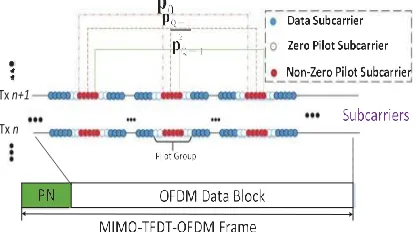
It appeared in Fig. 1 that mutually the pilots as well as PN (pseudo-irregular clamor) arrangement are designed in every TFDT-OFDM outline. The PN succession ci container be viewed as one class of the time-area introduction, which is the equivalent on behalf of various edges. From one perspective, the PN arrangement is used to acquire PCS because of its prevalent normal for auto-relationship. Then again, few recurrence subcarriers are cushioned through pilots, which is utilized for acquiring precise data of the channel along these lines.
Fig. 1. The MIMO-TFDT-OFDM edge through the PN sequence also pilots.
1069
s 0 0
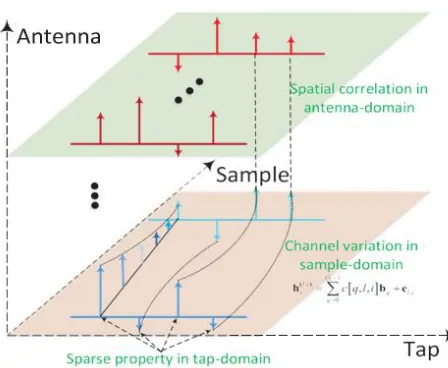
paper as insufficient on behalf of MIMO-OFDM. The channel is concerned separately with 3 areas, i.e., test, tap, as well as radio wire. Bolt agreements are channel CIR gains. Each bolt refers to the CIR's non-null element. For a MIMO structure, the figure demonstrates a lot of four-tap channels.
h(m,i) = [h[m, 0, i], h[m, 1, i],..., h[m, L − 1,i]]T. (2)
H(mt, I is considered to be scanty with non-zero S elements as the channel duration is usually much larger than the identifiable tap quantity[30]. S is generally denoted to as the
rate of sparsity. The non-zero underpins on behalf of h(m, I remain considered equivalent on the basis that after an OFDM overview length the channel changes gradually[31]. In addition, the channels between different radio cables will generally have a spatial connection property [3],[30][32] in view of the reality that the time postponements for altogether transmit-get reception devices are indistinguishable around[33][34].This document characterizes the spatial link since there are standardized non-zero underpins but also distinctive non-zero breadths also phases aimed at the CIRs depending on the tap. As required, the tap-based CIR vectors h(m, I (0 m < N,0 I <Nt) appear to have a mutually scanty property. The CIR based instance is formed as
hs (l, i) = [h[0,l,i],h[1,l,i],………….,h[N-1,l,i]](3)
The OFDM frame for the I transmit antenna is comprised of the l-th suspensions commencing each single tap-based CIR. Since the channel varies gently through the duration of the OFDM frame, Q (Q < L) bases will develop h (l, I (0 < l < L)[9 ],
hs(l,i) = (4)
Fig. 2. The channel modeling in three domains
where c[q,l,i], bq ∈ CN, also el,i∈ CNsignify the q-th BEM
coefficient, the consistent BEM source aimed at the l-th channel tap also the i-th convey antenna, as well as the modelling mistake correspondingly.
3.
THE PROPOSEDSCHEME
The consistently divided pilot example will prompt a huge estimation of square intelligence [35], which will bring about the disappointment of the scanty sign recuperation. Appropriately, the irregular area of pilots is more suitable for inadequate sign recuperation. In any case, its exhibition can be flighty. To plan a problematic pilots area, the regular streamlining strategies incorporates the stochastic successive hunt in [35], the cross entropy improvement in [36], as well as the greedy method of the pilot part in[ 37-38]. Each measurement, however, depends on the pilot improvement plot in the static channel SISO structure. In this situation, it is possible to reorder the enhancement problem to the cyclic-difference-set-(C.D.S) or near differential sets (ADS). In this paper, the GA for pilot instance setup is suggested for the dually particular divert in MIMO situation, which is shown as follows.
Proposed Block Diagram:
Fig 3: Block diagram of proposed system
Algorithm: GA (Genetic Algorithm) for Pilot Pattern Design.
Inputs:
1) ―subcarrier_numberN‖ ; 2) ―BEM_coefficientQ‖; 3) ―Pilot_groups numberG‖:
4) ―Number of transmit_antennasNt;‖ 5) ―The crossover_probabilitypc;‖
6) ―Individual number for each_generationnd;‖ 7) ―Maximum_simulation_generations number ng;‖
8) ―A discrete_probability_distribution P for individual selection;‖ 1: ―First generation_initialization for nd individuals.‖
2: ―while simulation_generation does not reach ng do‖ 3: ―Calculate the fitness values of current_generation individuals and sort themdescending.‖
4: ―Distribute the selection_probability throughP‖ allowing to the fitness worth of the individuals. 5: ―for iiter = 0 :nd/2 -1do‖
6: ―Select two_individuals based on theselection probability.‖
7: ―For the chromosome_pairs selected, determine whether to be exchanged based on pc.‖ 8:‖ If the new entities are together obtainable, they will include part of the next_generation. Else, reoccurrence to Step 6‖
9: ―end for‖
10: ―Obtain a new_generation.‖ 11: ―end while‖
―Output: Individual with smallest_fitness value.‖
1070 this manner, the people container remain produced through
haphazardly acquiring G figures commencing 1 to Y. At that point the G various numbers which contain the inside area data resolve be converted hooked on paired code. While playing out the interpreting procedure, the paired code could be converted into G numbers as indicated through the coding law. Also after that, sort the figures in rising request. On behalf of the ith number Yi, it compares the Yi + Q + (2Q − 1) (I −1)th subcarrier.
The people container stay planned to a detecting lattice Φˆ as per Step-3. The wellness estimation of the person, which is the limitation to remain streamlined, is the square cognizance of the representing detecting grid.
In the calculation, the hybrid likelihood pc container be set as 0.5 aimed at an equalization of trading components of people. The likelihood circulation P is discrete as well as isolated into nd parts, where the non-uniform appropriation container be accessible. Subsequently nd people be present created, every separable is conveyed through a choice likelihood as per the wellness worth and P.
After choice, we play out the hybrid for each component of the two people all together. Based on the specific definition, the estimations of single components are in the arrangement of
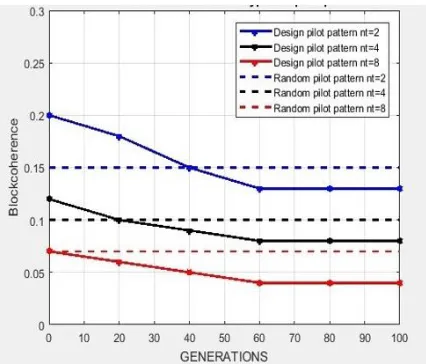
Fig 4: Block coherence for different types of pilot patterns
{1,−1}, which is advantageous on behalf of the hybrid. The hybrid is an activity of trading a component of the 2 people. Proper hybrid likelihood is imperative to maintain a strategic distance from the wellness esteem since working to nearby union.
The circle of the projected GA finishes later the people of another age remain no different or the reproduction age arrives at ng. Around then, an advanced individual with little square cognizance will be acquired, which can be decoded to a problematic areas of pilot focuses.
3. Simulation Results and Discussion
In the accompanying, we mimic our planned twice as particular channel guesstimate plot also assess the presentation. Aimed at the receiving wires, the azimuth angles of arrival (AoA) as well as angles of departure (AoD) are accepted to takings consistent qualities, i.e., not quantized, besides are consistently appropriated in [0, 2π]. The limitations in the
recreations be situated recorded in Table I. Utilizing the choosiness of mutually period also recurrence spaces, the even more specific channel aimed at a solitary reception apparatus container be mimicked. On behalf of various radio wires, initially, the non-zero backings are indistinguishable for various channels as per the property of the spatial relationship. Besides, the amplitudes of the taps are autonomous. In this way, for the particular example record, free channel taps are arranged aimed at the channels commencing various receiving wires.
A. Influence of Pilot GroupLocation
The square lucidness of various kinds of pilot examples is represented in Fig. 4. Aside commencing the pilot bunch area structured by the proposed GA in Algorithm 1 (pc = 0.5, nd = ng = 100, also P is the Geometric dissemination with the regular proportion of 0.95), the arbitrary pilot gatherings of a pilot example is likewise shown as a standard. Nt = 2, 4, and 8 are considered, separately. The square rationality for a consistently dispersed pilot example is incredibly more noteworthy than that of the arbitrary one, which isn't outlined in the figure. It very well may be perceived that the square cognizance for the irregular pilot example is a lot bigger than the projected lone, which demonstrates that the structured pilot example is increasingly reasonable on behalf of the scanty channel recuperation. By and large, the proposed GA can effectively diminish the estimation of square lucidness. It ought to be noticed that the detecting lattice with bigger Nt will, in general, have a littler estimation of square intelligibility, which is strange. As the quantity of radio wires rises, the extra section vectors will break the symmetry of the squares, which may prompt an expansion of the neighborhood square rationality (between two squares). Be that as it may, the square intelligence is the limit of the nearby square cognizance’s. For the most extreme worth, there is more pertinence than symmetry. This implies when the size of the squares builds, the extra segment vector will be bound to decrease the importance. In this manner, the detecting framework with the biggest Nt has the littlest square cognizance, and Fig. 4 outlines this perception.
B. Performance ofPAPR
The normal top to-average power proportion (P.A.P.R) on behalf of 10000 unique edges is reproduced. G = 80 also Q = 3 are arranged. The normal PAPR aimed at the suggested plan is 8.9751, whereas the normal PAPR intended for the regular plan in [20] is 9.2333. The projected plan level beats the ordinary single in PAPR on the grounds that the quantity of nonzero pilots is bigger also the intensity of the pilots is fewer changeable. It shows that the projected pilot example plan won't debase the PAPR execution, which is strongly fundamental for the framework strength.
C. Presentation of ChannelApproximation
1071 well as OMP, separately. The adjusted BOMP is set to be
10dB which is not exactly the earlier techniques. The enhancements begin from the earlier data of the got PCS and the usage of the square inadequate trademark.
Fig 5: Accurate retrieval prospects comparison with SNR= 20dB in a 4*4 MIMOsystem
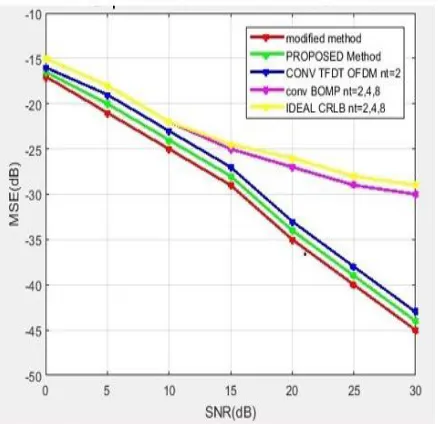
Fig. 6 outlines the mean/square/error-(M/S/E) reproductions for Nt = 2, 4, also 8. G = 80 is designed on behalf of exact approximation. The MSE execution examination under the speed of 240 km/h between various plans in place of an alternate amount of transmitting receiving wires of the channel.
Fig 6: The MSE performance comparison underneath speed of 240km/hr amongst dissimilar amount of transfer
antennas.
The ordinary BOMP [21] is recreated on the further hand, while the Cramer-Ra-lower-bound-(C.R.L.B) in the perfect case is additionally assessed as a kind of perspective.Our plan has a preferable presentation over the conventional BOMP due to the helper data of nonzero support. In addition, the intensity of the estimations is a lot bigger than that in [22] because of additional nonzero pilots, which additional increases the exhibition. It tends to stay perceived that the
ASA-BOMP calculation has 1.5, 1.8, also in excess of 5 dB increases thought about the customary BOMP when the MSE of 10−2 is measured in place of Nt = 2, 4, and 8, separately.
Fig 7: The MSE performance comparison under speed of 30km/hr among different number of transmit antennas.
The MSE moves towards the CRLB and is at a distance below 0.5 dB above the 25 dB SNR level. In addition, the traditional invariant time divert estimation approach of TFDT-MIMO-OFDM in[ 3] is mimicked. Only Nt= 2 is shown for better implementation. It appears to be realized that the usual TFDT-OFDM channel assessment scheme neglected to recuperate the twice-specific station, showing the prominence also upside of our suggested structure. To sum up, the modified plan beats the usual structures aimed at MIMO-OFDM.Fig. 7 Illustrates efficiency in mild mobility situations, simulating 30 km / h. The conventional
Fig 8: BER presentation comparison through 256QAM and 16 QAM constellation
1072 restrained versatility situations with a remarkable execution.In
Fig.8, the BER is evaluated when the Low-Density-Parity-Check-Code-(L.D.P.C) is adopted [46] in a 4 MIMO scheme. The duration of code is 7493, the levels of application be situated 0.4 plus 0.8, whereas assemblages are 256 QAM as well as 16 QAM. Also regarded to be the perfect BER to show the lower bound. On the one side, under the doubly specific channel, elevated-order modulations such as 256 QAM can be well endorsed in our system. Low-order modulations including 16 QAM, on the other side, have outstanding output to low SNR requirements. Our strategy, when the BER is 10−3 for 256 QAM also 16 QAM alternatively, has gains of 0.9 dB as well as 0.7 dB associated to conventional BOMP. In addition, our system is reaching and only approximately 0.2 dB from either the lower limit. There is improved performance in the altered 256 QAM and 16QAM than the suggested one in this document.
CONCLUSION
Another effective direct estimation conspires in high-versatility circumstances is considered for various reception apparatus frameworks in this article. The station is disconnected as 3 areas to portray the even more particular belongings. Together the PN succession also the flyers remain utilized in our plan. The PN arrangement is received toward acquire the PCS, although the pilots at long last recuperate the channel-dependent on the SCS ideal through using the upgraded pilot area by means of GA besides the spatial relationship amongst radio wires. An enhanced inadequate channel estimation calculation BOMP on behalf of MIMO-OFDM frameworks is projected aimed at precise CIR procurement. It is exhibited in the recreations that our plan has preferable presentation over the customary ones using lesser multifaceted nature also resolve be a hopeful procedure later on MIMO-OFDM frameworks.
REFERENCES
[1] H. Minn and N. Al-Dhahir, ―Optimal training signals for
MIMO-OFDM channel estimation,‖ IEEE Trans. Wireless Commun., vol. 5, no. 5, pp. 219– 224, May 2006.
[2] Y. C. Eldar, P. Kuppinger, and H. Bolcskei, ―Block- sparse
signals: Un- certainty relations and efficient recovery,‖ IEEE Trans. Signal Process., vol. 58, no. 6, pp. 3042– 3054, Jun.2010.
[3] W. Ding, F. Yang, S. Liu, X. Wang, and J. Song, ―Non- orthogonal time- frequency training-sequence-based CSI acquisition for MIMO systems,‖ IEEE Trans. Veh. Technol., vol. 65, no. 7, pp. 5714–5719, Jul.2016.
[4] Y. Fu,C.X. Wang, A.Ghazal,e.-H.M.Aggoune,and M. M. Alwakeel, ―Performance investigation of spatial modulation systems under non-stationary wideband high-speed train channel models,‖ IEEE Trans. Wireless Commun., vol. 15, no. 9, pp. 6163–6174, Sep. 2016.
[5] H.Ghazzai, T. Bouchoucha,A.Alsharoa,E.Yaacoub,M. S. Alouini.T. Y. Al-Naffouri, ―Transmit power minimization and base station planning for high-speed trains with multiple moving relays in OFDMA systems,‖ IEEE Trans. Veh. Technol., vol. 66, no. 1, pp. 175–187, Jan. 2017.
[6] Int. Union Railways, ―LTE/SAE–the future railway mobile
radio system? long-term visions on railway
mobileradiotechnologies,‖Int.UnionRail-ways,Paris, France, Tech. Rep. V 0.4 Draft, Nov. 2009.
[7] A. Amanna, M. Gadnhiok, M. J. Price, J. H. Reed, W. P.
Siriwongpairat, and T. K. Himsoon, ―Railway cognitive radio,‖ IEEE Veh. Technol. Mag., vol. 5, no. 3, pp. 82– 89, Sep.2010.
[8] J. Fu, C. Pan, Z. Yang, and L. Yang, ―Low-complexity
equalization for TDS-OFDM systems over doubly selective channels,‖ IEEE Trans. Broad- cast., vol. 51, no. 3, pp. 401–407, Sep.2005.
[9] Z. Tang, R. C. Cannizzaro, G. Leus, and P. Banelli,
―Pilot-assisted time- varying channel estimation for OFDM systems,‖ IEEE Trans. Signal Process., vol. 55, no. 5, pp. 2226–2238, May2007.
[10] D. Donoho, ―Compressed sensing,‖ IEEE Trans. Inf.
Theory,vol.52,no.4,pp.1289–1306, Apr. 2006.
[11] Z. Han, H. Li, and W. Yin, Compressive Sensing for Wireless Networks. Cambridge, U.K.: Cambridge Univ. Press,2013.
[12] J. Meng, W. Yin, Y. Li, N. T. Nguyen, and Z. Han, ―Compressive sensing based high-resolution channel estimationforOFDM system,‖ IEEE J. Sel. Topics Signal Process., vol. 6, no. 1, pp. 15–25, Feb.2012.
[13] X. Ma, F. Yang, S. Liu, J. Song, and Z. Han, ―Doubly
selective channel estimation for MIMO systems based on structured compressive sensing,‖ in Proc. 2017 13th Int. Wireless Commun. Mobile Comput. Conf., Jun. 2017, pp.610–615.
[14] F. Yang, W. Ding, L. Dai, and J. Song, ―Joint time-
frequency channel estimation method for OFDM systems based on compressive sensing,‖ in Proc. 2014 31st URSI Gen. Assembly Sci. Symp., Aug. 2014, pp. 1– 4.
[15] W. Ding, F. Yang, C. Zhang, L. Dai, and J. Song, ―Simultaneous time- frequency channel estimation based on compressive sensing for OFDM system,‖ in Proc. 2014 IEEE Global Commun. Conf.,Dec.2014,pp. 3573– 3578.
[16] W. Ding, F. Yang, C. Pan, L. Dai, and J. Song, ―Compressive sensing based channel estimation for OFDM systems under long delay channels,‖ IEEE Trans. Broadcast., vol. 60, no. 2, pp. 313–321, Jun. 2014.
[17] L. Dai, J. Wang, Z. Wang, P. Tsiaflakis, and M. Moonen, ―Spectrum- and energy-efficient OFDM based on simultaneous multi-channel reconstruction,‖ IEEE Trans. Signal Process., vol. 61, no. 23, pp. 6047–6059, Dec.2013.
[18] R. Mohammadian, A. Amini, and B. H. Khalaj, ―Deterministic pilot design for sparse channel estimation in a MISO/multi-user OFDM systems,‖ IEEETrans. Wireless Commun., vol. 16, no. 1, pp. 129–140,Jan. 2017.
[19] W. Ding, F. Yang, S. Liu, and J. Song, ―Structured
compressive sensing- based non-orthogonal time- domain training channel state information acquisition for multiple input multiple output systems,‖ IET Commun., vol. 10, no. 6, pp. 685–690, Apr. 2016.
[20] Z. Gao, L. Dai, W. Dai, B. Shim, and Z. Wang, ―Structured
compressive sensing-based spatio-temporal joint channel estimation for FDD massive MIMO,‖ IEEE Trans. Commun., vol. 64, no. 2, pp. 601–617,Feb. 2016.
[21] W. Hou and C. W. Lim, ―Structured compressive channel
estimation for large-scale MISO-OFDM systems,‖ IEEE Commun. Lett., vol. 18, no. 5, pp. 765– 768, May2014.
[22] P. Cheng et al., ―Channel estimation for OFDM systems
1073 [23] A. Kalakech, M. Berbineau, I. Dayoub, and E. P. Simon,
―Time-domain lmmse channel estimator based on sliding window for OFDM systems in high-mobility situations,‖ IEEE Trans. Veh. Technol., vol. 64, no. 12, pp. 5728– 5740, Dec.2015.
[24] X. Zhang, L. Gui, Q. Qin, and B. Gong, ―Dynamic sparse
channel estimation over doubly selective channels: Differential simultaneous orthogonal matching pursuit,‖ in Proc. 2016 IEEE Int. Symp. Broadband Multimedia Syst. Broadcast., Jun. 2016, pp.1–6.
[25] Q. Qin, B. Gong, L. Gui, X. Ren, and W. Chen, ―Structured distributed sparse channel estimation for high mobility OFDM systems,‖ in Proc. Int. Workshop High Mobility Wireless Commun., Oct. 2015, pp.56–60.
[26] Q. Qin, L. Gui, B. Gong, X. Ren, and W. Chen, ―Structured distributed compressive channel estimation over doubly selective channels,‖ IEEE Trans. Broadcast., vol. 62, no. 3, pp. 521–531, Sep. 2016.
[27] S. Pejoski and V. Kafedziski, ―Estimation of sparse time
dispersive channels in pilot aided OFDM using atomic norm,‖ IEEE Wireless Commun. Lett., vol. 4, no. 4, pp. 397–400, Aug.2015.
[28] O.E.Barbu,C.N.Manchn,C.Rom, T. Balercia,andB.H. Fleury, ―OFDM receiver for fast time-varying channels using block-sparse bayesian learning,‖ IEEE Trans. Veh. Technol., vol. 65, no. 12, pp. 10 053–10 057, Dec. 2016.
[29] G. Dziwoki and J. Izydorczyk, ―Iterative identification of