ISSN: 2231-5381
http://www.ijettjournal.org
Page 2366Stability of Voltage using Different Control
strategies In Isolated Self Excited Induction
Generator for Variable Speed Applications
Shilpa G.K#1, Plasin Francis Dias*2
#1
Student, Department of E&CE, VDRIT ,#2 Asst Prof, department of E&CE&VDRIT Haliyal, Karnataka, India
Abstract-In this paper analysis of the operation of a standalone self-excited induction generator and its control of voltage and frequency for variable speed applications has been made. The limitation of standalone wind energy conversion system with self-excited induction generator is poor voltage regulation which occurs with change in speed and load condition.
Keywords-wind, SEIG, Excitation, Capacitor bank, VSI, Universal bridge.
I. INTRODUCTION
Among the different renewable energy systems, wind energy appears as the most promising one, due to both technical and economic factors. Important progress in wind energy conversion technologies has been achieved and more efficient and more powerful wind generators are now available. The selection of the generator depends upon many factors such as type of application, machine characteristics, cost, maintenance etc. Currently induction machines are more popular compared to other machines. However its major disadvantage is the requirement of excitation power. The induction generator is the most common generator in wind energy system applications due to its simplicity and ruggedness. The main drawbacks in induction generator are its lower efficiency and the need for reactive power to build up the terminal voltage.
There are two types of induction generators:
1) Normal type (non isolated), where excitation required are provided by an external A.C source. 2) Isolated type (self excited) in which excitation is provided by a terminal capacitor. In the first type, the frequency and voltage are equal to that of system. However, in the second type, the synchronous frequency and induced voltage change with speed, excitation capacitor, load impedance
and its associated power factor. The frequency of the induced voltage is always less than the frequency (corresponding to input shaft speed). The generators used in wind energy applications should be simple to use with low maintenance, and have low initial cost. Induction generator satisfies most of these requirements. In this paper comparison between series compensation and power electronic converter has been made to control both voltage and frequency.
II. Wind Power
Wind energy is a form of solar energy produced by heating of the earth’s surface. As a power source, wind power is less predictable than solar power, but it is also typically available for more hours in a given day. Wind resources are influence by the type of the land surface and the elevation of the land surface. Generally, if the land is in high elevation then it is good for wind energy conversion and viceversa. Since the wind speed is extremely important for the amount of energy a wind turbine can convert it to electricity.
The power in the wind can be defined as follows:
= 1 2 (1)
Where ρ : Air density, kg/m3.
A:Cross sectional area of wind parcel, m2.
V:The wind speed, m/sec.
ISSN: 2231-5381
http://www.ijettjournal.org
Page 2367the generator and transmission losses so that useful electric power cannot be produced. At rated wind speed the power input to the wind turbine will reach the limit for continuous operation (rated power). When the wind speed exceeds this level the excess power in the wind must be discarded by varying the pitch angle of the blades to prevent the turbine overloading. The power is maintained at its rated value until a maximum wind speed is reached the cut-off wind speed (Vcut-off) then the turbine will shut down.
III. ANALYSIS OF OPERATION OF SELF EXCITED INDUCTION GENERATOR
Fig1.Block diagram of SEIG
If an appropriate capacitor bank is connected across the terminals of an induction machine which is driven externally and if the residual magnetism in the rotor is sufficient, the machine windings will be induced with an EMF. The excitation will be provided by the capacitor. If the EMF is sufficient it would circulate leading currents in the capacitors. The residual magnetism will be assisted by theflux produced by the currents. This would increase the machine flux and larger EMF will be induced. So that both the currents and the flux will increase. The induced current and the voltage will continue to rise untill the VAR supplied by the capacitor is balanced by the VAR demanded by the machine,a condition which is essentially decided by the saturation of the magnetic circuit.
IV. CONTROL STRATEGIES
Control strategies adopted in Series capacitor and
Power electronic converters are as follows.
A. Series capacitor
Series capacitors are the cheap means for control of voltage and they are connected in series between the load and SEIG. A series capacitor in SEIG-IM system will cause Sub Synchronous Resonance leading to voltage which will be excessive and also excessive current. This leads to unstable oscillations in speed and torque of the IM. Sub Synchronous Resonance can be avoided by selecting an optimum combination of the excitation capacitors for a series compensated short-shunt Self Excited Induction Generator and a successful starting of the Induction Motor as a dynamic load on the SEIG can be achieved.
The SEIG has been driven by the prime mover at a desired speed. Across the stator terminals of the SEIG an appropriate value of shunt excitation capacitors are switched to initiate self excitation process and to generate the rated voltage at no-load. The voltage build up will be initiated by the residual magnetism in the rotor which is augmented by the capacitive currents of the shunt capacitor bank. The capacitive currents enhance the air gap flux further and the induced stator voltage will rise continuously untill the magnetic saturation in the machine arrests the voltage. Since stator EMF is induced by the stator coils and the relative motion of the air-gap flux, the stator frequency is proportional to the rotor speed. If a squirrel cage IM is suddenly switched across the SEIG terminals without any series capacitor, its terminal voltage collapses.SEIG is not capable of suppling additional reactive power needed for the starting of IM. For the successful starting of an IM from a SEIG a series capacitor bank of appropriate capacitance values is connected between the SEIG and an IM.
B. Power electronic converters
ISSN: 2231-5381
http://www.ijettjournal.org
Page 2368can be varied so that the reactive power flow can be varied. Here the theme is to maintain constant dc across link.
Fig1. A voltage control scheme for SEIG
The induction machine for DC link voltage control sin modeled in stationary reference frame. A 24V battery is used for a period of 2s for supplying the magnetizing current through a pulse width modulated voltage source inverter to establish flux in the airgap required for self excitation. A dc link capacitor connected in parallel with the diode maintains the voltage at set value. The voltage across the dc link capacitor is sensed and compared with the reference output voltage and passed through a discreet PI controller. The output of PI controller is converted to three phase reference waveforms and compared with a 5KHZ triangular carrier to generate the sinusoidal modulated gate pulses. The voltage source inverter acts as a reactive power compensator. The power flow to dc link capacitor is through a three phase diode bridge converter and the input power to SEIG is through a three leg IGBT converter.
C. For varying wind speed SEIG feeding DC motor through universal bridge.
The main winding terminal is connected with consumer load of resistive and reactive nature and induction generator controller in parallel. A diode universal bridge converts the AC voltage into equivalent DC voltage. The output DC is connected with dump load resistance. The voltage amplitude is compared with the reference and processed through sample based controller. The obtained output is compared with reference wave through a relational operator to obtain a modulated pulse of suitable duration. This pulse is given to the pulse generator of universal bridge.
Fig1. Simulink model of SEIG feeding dc drive with controller
ISSN: 2231-5381
http://www.ijettjournal.org
Page 2369 Fig 2. Active and reactive power flow of SEIGFig 3. Output voltage, DC load voltage, and current of SEIG
From the results its observed that load is fed by the constant dc. The SEIG take some for the voltage build up. The controller maintains the output voltage. Some harmonics are present in the waveform during the voltage build up.
D. Under varying wind speed SEIG feeding an induction motor through VSI
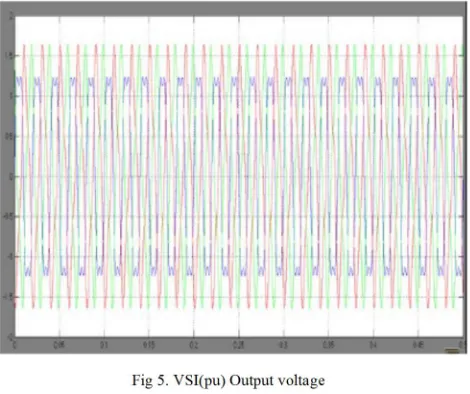
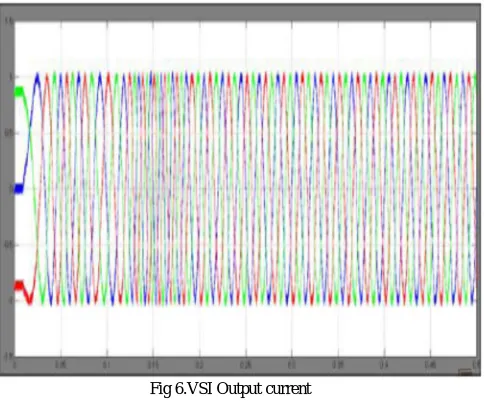
In the simulink diagram a space vector modulate voltage source inverter is shown. It is connected in between the induction motor and the universal bridge. The switching sequence of the VSI is based on SVM technique. Based on the variation of the terminal voltage the pulses will be generated by the SVM to maintain both constant voltage and frequency.
Fig 4. Voltage Source Inverter feeding Induction Motor simulink diagram
Fig 5. VSI(pu) Output voltage
ISSN: 2231-5381
http://www.ijettjournal.org
Page 2370 Fig 6.VSI Output currentIV. CONCLUSION
The main advantages of renewable energy are clean, low cost and continuous energy. The reasons for choosing induction generator in wind energy system are that its very reliable tends to be comparitively inexpensive, light weight and low maintenance cost. The generator also has some mechanical properties which are useful for wind turbines. So, the induction generator is the most common generator in wind energy system applications due to its simplicity and ruggedness.
In the control of load voltage of Self Excited Induction Generator, appropriate selection of capacitors maintains constant voltage. The power electronic converters gives good results for both load voltage and frequency control of SEIG. The above results with DC and AC motors justifies it and also the control of DC and AC loads is possible at a time.Finally it can be concluded that eventhough series compensation is cheap the use of power electronic converters gives wide range of applications, operation and control.
REFERENCES
[1] R.C.Bansal “Three Phase Self-Excited Induction Generator:An Overview”,IEEE transactions on Energy conversion vol.20,no.2,pp.292-299,June 2005.
[2] C.Grantham,D.Sutanto and B.Bismail, “Steady state and Analysis of Self-Excited Induction Generators,”IEE Proceedings on Electric Power Applications,vol.136,no.2, pp.61-68,March 1989.
[3] O.Ojo, “Minimum Air Gap Flux Linkage Requirement for Self-Excitation in Stand alone Induction Generators.”IEEE Transactions on Energy Conversion, vol.10,no.3,pp.484-492,september1995.
[4] G.V.Jayaramaiah and B.G.Fernandes, “Novel Voltage Controller for Stand-alone Induction Generator using PWM-VSI,” IEEE Conference on Industry Applications vol.1,pp.204-208 October2006.