INTERNATIONAL JOURNAL OF PHARMACEUTICAL, CHEMICAL AND BIOLOGICAL SCIENCES
Available online atwww.ijpcbs.com
FORMULATION AND EVALUATION OF FAST DISSOLVING TABLETS OF
RISPERIDONE SOLID DISPERSION
Santhosh R Iyer*, R. Sivakumar, P. Siva and CI. Sajeeth
Department of Pharmaceutics, Grace College of pharmacy, Palakkad - 678004, Kerala, India.
INTRODUCTION6
Solid dispersion are defined as dispersion of one ormore active ingredients in an inert carrier matrix at solid-state prepared by themelting (fusion), solvent or melting- solvent method. Several insoluble drugs have been shown to improve their dissolution character when
incorporated into solid dispersion.Solid
dispersion technique has been widely employed to improve the dissolution rate, solubility and oral adsorption of poorly water soluble drugs. Preparation techniques of solid dispersions:
A. Solvent evaporation method B.Melting method (Fusion method) C.Kneading method
D.Melting solvent method E.Supercritical fluid methods
Solvent evaporation method
In this method, physical mixture of two components are dissolved in a common solvent and followed by the evaporation of solvent. The advantages of this method are low temperature requirement for the preparation of dispersion and thermal decomposition of drugs and carriers can be prevented.
Swallowing problem is also common in young individuals because of their under developed muscular and nervous system. Other groups
that may experience problems using
conventional oral dosage forms include mentally ill and the developmentally disabled. In some cases such as motion sickness, sudden episodes of allergic attack or coughing and
unavailabilityof drinking water,
swallowingconventional tablet maybe difficult. Recent advances in novel drug deliverysystems (NDDS) aim to enhance safety and efficacy of drug molecule by formulation and to achieve better patient compliance. One such approach is ‘mouth dissolving tablets’, which disintegrate or dissolve in saliva and are swallowed without water as tablet disintegrate in mouth, this could enhance the clinical effect of drug through pre gastric absorption from the mouth, pharynx, oesophagus. This leads to an increase in the
bioavailabilitybyavoiding first pass liver
metabolism. Mouth dissolving is also called as oro-dispersible tablets, melt-in-mouth, and fast dissolving tablet, rapimelts, porous tablets, quick dissolving or rapidly disintegrating tablets.
Research Article
ABSTRACT
In the present investigation, an attempt was made to improve the solubility and dissolution rate of a poorly soluble drug, Risperidone by
solid dispersion method using
Beta-cyclodextrin, crospovidone and croscarmellose as carrier. The solid dispersions were formulated as fast dissolving tablets by using Doshion-P544 resin (C), a taste masking agent with different superdisintegrants such as Croscarmellose and crospovidone.
MATERIALS AND METHODS Materials
Risperidone (Micro Labs,Bangalore),
Crospovidone,croscarmellose and β -cyclodextrin (Yarrow Chem Products,Mumbai). Doshion P-544 C resins (Doshion ltd,
Ahmedabad), Aspartame
(ChetanaPhamaceuticals, Thrissur). All the
other raw materials used were of
Pharmacopoeial grade.
Methods
Preparation of solid dispersion of
Risperidone2
Solid dispersion of Risperidone was prepared by solvent evaporation method. The drug was weighed and taken in china dish, dissolved in methanol and then the carrier was added in the ratio1:1, 1:3, 1:7and 1:9.The solvent was evaporated at room temperature and dried in hot air oven at 500C for 4 hours. The resultant
mass was passed through sieve no-120 and stored in desiccator.
Evaluation of Solid Dispersion2
Fourier Transform Infra-Red Spectroscopy
FTIR transmission spectra were obtained using
a Fourier Transform infrared
spectrophotometer (FTIR, Shimadzu, Japan). Samples were prepared in KBr disks by means of hydrostatic press. The scanning range was
500 to 4000cm-1.The characteristic peak was
recorded.(Fig:5,6,7,8)
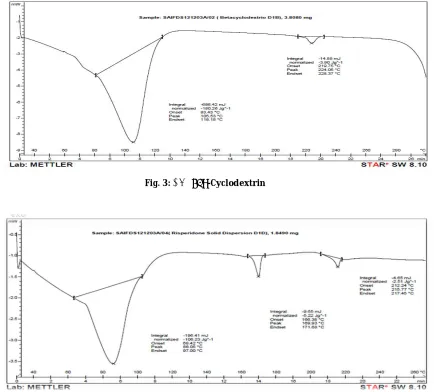
Differential Scanning Calorimeter (DSC)
Differential Scanning Calorimetry study was
performed using Differential Scanning
Calorimeter (Mettler Toledo DSC 822e) using
crucible Al 40μL, at of 100c/min heating rate,
under nitrogen environment. The temperature range used was 0 – 4000c (Fig: 2, 3, 4 )
Scanning Electron Microscopy
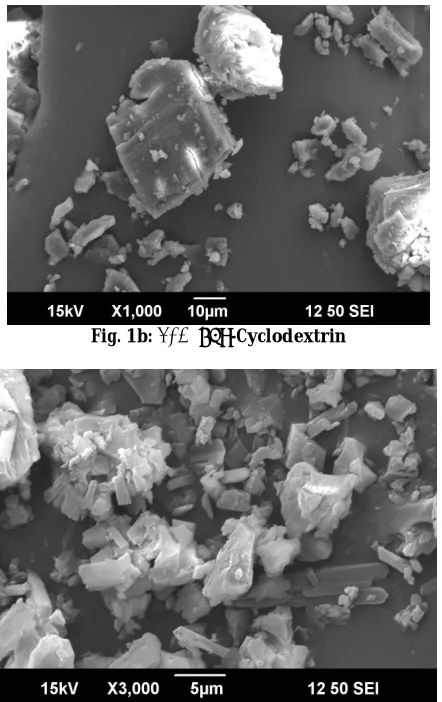
Shape and surface morphology characterization of risperidone, BCD and SD formulations was performed by scanning electron microscopy (SEM, JSM-6390 LV, JEOL, Tokyo, Japan)
measured at the working distance of 15mm and an accelerated voltage of 20 kV.(Fig:1a,1b,1c)
Drug Content
A quantity of solid dispersion equivalent to 4mg of Risperidone was accurately weighed and dissolved in 0.1N HCl in a 100 ml volumetric flask.Then the volume was made upto 100ml with 0.1N HCl. From this serial dilution were made with 0.1NHCl.Theabsorbance of the resulting solution was measured at 239nm against blank (0.1N HCl).
In-vitro Dissolution Studies
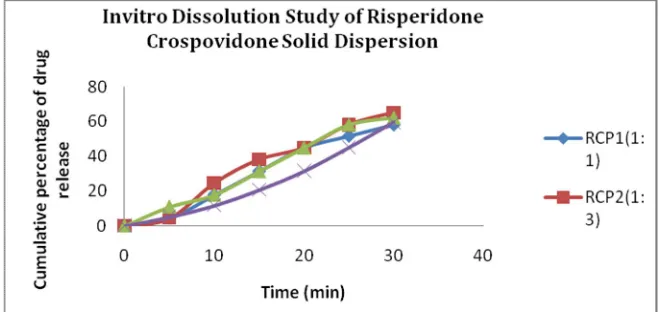
Dissolution studies were carried in USP Apparatus II. Solid dispersion equivalent to 4mg of drug were added to 900ml of phosphate buffer pH6.6 stirred at 75rpm.Aliquotes of 5ml were withdrawn at specified time intervals and analyzed at 277nm.(Fig:9,10,11)
Preparation of fast dissolving tablets
containing solid dispersions of Risperidone1
Fast dissolving tablets containing 4 mg of
risperidone were prepared by direct
compression method and the formula used in the study are shown in Table 1.Different superdisintegrants such as Crosprovidone and Croscarmellose were used. Doshion-P544 resin (C), a taste masking agent was used to mask the bitter taste of Risperidone. Mannitol and aspartame were used as sweetening agent.
Risperidone was mixed in geometric
proportions with sweeteners, diluents and lubricants. Blend was screened and compressed on rotary punching machine.(Table:1)
Evaluation of Fast Dissolving Tablets1
All the tablets were evaluated for different parameters such as weight variation, hardness, friability, uniformity of weight, disintegration time, wetting time, drug content and in vitro dissolution study.(Table:2)
Weight variation
Twenty tablets were randomly selected from each formulation and average weight was
determined.Then individual tablet were
weighed and individual was compared with average weight.
Friability
The friability of tablets was determined using friability test apparatus (Biolinkz, India). The tablets were weighed (Winitial) and placed in
friabilator. The friabilator was operated at 25rpm for 4 minutes or 100revolutions. The tablets were dedusted and weighed again (Wfinal).The percentage friability was calculated
F = Winitial -Wfinal x 100 Wfinal
Hardness
The hardness of tablet was determined using Pfizer Hardness tester. It was expressed in
kg/cm2
Thickness
Twenty tablets were randomly selected from formulations and thickness was measured individually by Screw gauge. It was expressed in millimeter.
Disintegration Test
The disintegration time of fast dissolving tablets was determined using Disintegration test apparatus. (Fig: 13)
Wetting time
The wetting time of the tablets can be measuredusing a simple procedure. Five circular tissue papersof 10 cm diameter were placed in a petri dish witha 10 cm diameter. 10 ml of water was poured on the tissue paper placed in the petridish. A tablet is
carefully placed on the surface of the tissue paper.The time required for water to reach upper surfaceof the tablet is noted as a wetting time.
In-vitro dissolution study
In-vitro dissolution study was done using USP type II apparatus which was rotated at 50rpm. Phosphate buffer pH (6.8) was taken as dissolution medium. Temperature of dissolution medium was maintained at 37±0.50c. Aliquotes
of dissolution medium were withdrawn at specific time interval, filtered and was
determined by Shimadzu Double beam
spectrophotometer at 277nm.Dissolution
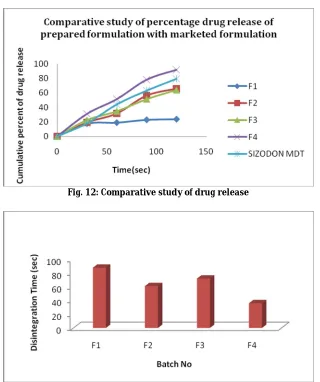
studies of all formulations were done as presented in Fig: 12
Determination of Drug Content
Ten tablets were weighed and taken in mortar and crushed to make powder. A quantity of powder weighing equivalent to 4 mg of Risperidone was taken in 100 ml volumetric flask and 0.1 N HCl was added. Then the solution
was filtered using membrane filter 0.45μm and
then the solution was diluted up to 10μg and
absorbance was measured at 277 nm. Then the amount of drug present was calculated using standard graph.
RESULTS AND DISCUSSION
Risperidone solid dispersions were prepared by solvent evaporation method in different drug – polymer concentrations and it was evaluated. FT-IR spectroscopic studies were conducted for possible drug: carrier interactions. FT-IR spectra of pure drug Risperidone and solid dispersions are shown indicating no significant evidence of chemical interaction between drug and carrier, which confirms the stability of drug with its solid dispersion. When guest molecules
are incorporated in the ß‐cyclodextrin cavity or
in the crystal lattice, their melting, boiling, and sublimation points usually are shifted to a different temperature or disappear within the temperature range in which the ß‐cyclodextrin
lattice is decomposed. In Risperidone - β
cyclodextrin inclusion complex DSC plot, two melting ranges were obtained. In one peak,
melting process started at 106.380c and
completed at 117.680c. In another peak, process
was started at 212.24 0c and completed at
217.450c was suggested that Risperidone and β
cyclodextrin used for the formulation was nothing but a mixture of both.SEM photograph was shown in figure 1. Drug content of all Solid dispersions was in the range of 90.1 to 99.8% which was in accordance with USP standards. In vitro dissolution Studies of all the formulations were performed and the cumulative percentage drug release was found increase from that of pure drug.
The different batches of Risperidone fast dissolving tablets were prepared by direct
compression method using optimized
Risperidone Solid Dispersion (1:3), various superdisintegrants like crospovidone and croscarmellose and it was evaluated.
Total of three formulations with fixed concentration of different super disintegrants and one control formulation without the addition superdisintegrants were prepared and evaluated. Weight variation of all formulations was observed which were within acceptable limit for uncoated tablets as per USP. Hardness of tablets was determined and was found to be in the range of 2.13 to 2.56kg/cm2.Friability was
observed between 0.18 to 0.34% which was within acceptable limits. The wetting times for all formulations from F1 to F4 were found to be 90 to 19 seconds respectively. The tablets were
subjected for evaluation of in vitro
Table 1: Formulation design of fast dissolving tablet of Risperidone Solid dispersion Tablet Ingredients (mg) F1 F2 F3 F4
Risperidone β-cyclodextrin solid dispersion (1:3)
16 16 16 16
Doshion-P544C 25 25 25 25
Mannitol 128 120 103 95
Camphor 5 5 5 5
Ac-di-sol - 8 - 8
Aspartame 20 20 20 20
Crospovidone - - 25 25
Magnesium Stearate 2 2 2 2
Talc 2 2 2 2
Aerosil 2 2 2 2
Total 200 200 200 200
Table 2: Evaluation of Fast Dissolving Tablets Parameter F1 F2 F3 F4
Thickness(mm) 2.42 2.36 2.4 2.47
Friabilty(%) 0.32 0.27 0.34 0.18
Disintegration Time(sec) 88 61 72 36
Hardness(kg/cm2) 2.56 2.31 2.32 2.13
Wetting Time(sec) 90 63 69 19
Table 3:Preformulation Studies of Blends Parameter F1 F2 F3 F4
Bulk density 0.43 0.41 0.45 0.40
Tapped density 0.58 0.58 0.66 0.66
Carrs index 26.19 29.25 31.83 39.9
Hausner’s Ratio 1.35 1.41 1.46 1.66
Angle of repose 490 05” 54002” 54012” 50020”
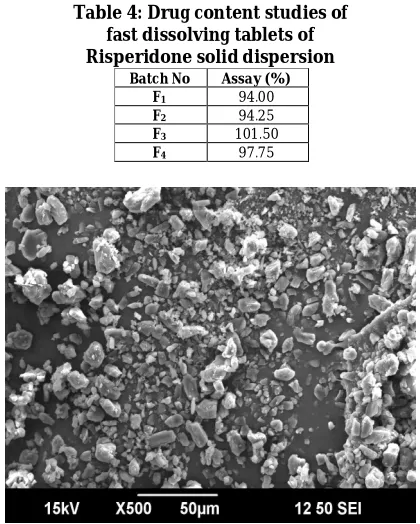
Table 4: Drug content studies of fast dissolving tablets of Risperidone solid dispersion
Batch No Assay (%)
F1 94.00
F2 94.25
F3 101.50
F4 97.75
Fig. 1b: SEM of β-Cyclodextrin
Fig. 1c: SEM of Risperidone:β-Cyclodextrin Solid dispersion(1:3) SEM photomicrographs of Risperidone, B-CD and SDformulations
Fig. 3: DSC of β-Cyclodextrin
Fig. 4: DSC of Risperidone Solid Dispersion
Fig. 6: FT-IR spectra of Risperidone +Crospovidone
Fig. 7: FT-IR spectra of Risperidone + β-Cyclodextrin
Fig. 9: In-vitro Dissolution Study of Risperidone: Crospovidone Solid dispersion
Fig. 10: In-vitro Dissolution Study of Risperidone: Croscarmellose Solid dispersion
Fig. 12: Comparative study of drug release
Fig. 13: Disintegration time (sec) of various batches containing differentsuperdisintegrants and its combination
CONCLUSION
It may be concluded that from the DSC, FT-IR, drug content and in vitro dissolution studies,
solid dispersion of Risperidone with β
-cyclodextrin(1:3) prepared by solvent
evaporation method is the best formulation. Fast dissolving tablets of poorly soluble drug, Risperidone solid dispersion showed enhanced dissolution, which may lead to improved
bioavailability and hence better patient
compliance.
REFERENCES
1. Rahman Z, 2010. Risperidone solid
dispersion for orally disintegrating tablet: its formulation design and non-destructive methods of evaluation,Int J Pharm. Nov 15; 400(1-2):49-58.
2. Md. Tariqueiquebal, 2012.
Enhancement of solubility for
risperidone fast dissolving tablets,
International journal of universal pharmacy and life sciences 2(3): May-June, 394 – 408.
3. Sanjay Jain, 2012. Formulation and
characterization of fast disintegrating
tablets containing Cefdinir solid
dispersion,Int. J. of Pharm. & Life Sci. (IJPLS), Vol. 3, Issue 12: December:, 2190-219.
4. Dali Shukla, 2009. Mouth Dissolving
Tablets I: An Overview of Formulation Technology, Sci Pharm.; 77; 309–326.
5. Punit P. Shah, 2008.Development and
Evaluation of Artemether Taste Masked Rapid Disintegrating Tablets with Improved Dissolution Using Solid
Dispersion Technique,AAPS
PharmSciTech,June, Volume 9, Issue 2, 494-500.
6. Raghavendraraon.g, 2010. Comparative
used In the Formulation Of Felodipine fast Dissolving tablets, International
Journal of Pharmacy and
Pharmaceutical Sciences,Vol 2, Suppl 2, 153 – 159.
7. Yunxia B, 2006. Evaluation of rapid
disintegration tablets prepared by direct compression method.Drugdevind pharm;25:571.
8. Dandag p,2006.Rapidly disintegrating
Domperidonetablets,Indian drugs;43(7)
594-597.
9. Khan .M.A,2000.Stability
characterization of controlled release co-precipitates and solid dispersions J. Controlled release 63,1-6.
10. Liu.C,2006.Enhancement of dissolution
of Cyclosporine A using solid dispersion
with polyoxyethylene
stearate,pharmazie,61,681-684.
11. Kalaiselvan R,2010.Studies on