Structural approaches to protein
sequence analysis
by David Tudor Jones
Department of Biochemistry and Molecular Biology
University College
Gower Street
London
WCIE 6BT
This thesis is submitted in fulfilment of the requirements
for the degree of Doctor of Philosophy from the
University of London.
All rights reserved
INFORMATION TO ALL USERS
The quality of this reproduction is dependent upon the quality of the copy submitted.
In the unlikely event that the author did not send a complete manuscript and there are missing pages, these will be noted. Also, if material had to be removed,
a note will indicate the deletion.
uest.
ProQuest 10045889
Published by ProQuest LLC(2016). Copyright of the Dissertation is held by the Author.
All rights reserved.
This work is protected against unauthorized copying under Title 17, United States Code. Microform Edition © ProQuest LLC.
ProQuest LLC
789 East Eisenhower Parkway P.O. Box 1346
Abstract
Various protein sequence analysis techniques are described, aimed at improving the
prediction of protein structure by means of pattern matching.
To investigate the possibility that improvements in amino acid comparison matrices could
result in improvements in the sensitivity and accuracy of protein sequence alignments, a
method for rapidly calculating amino acid mutation data matrices from large sequence
data sets is presented. The method is then applied to the membrane-spanning segments of
integral membrane proteins in order to investigate the nature of amino acid mutability in
a lipid environment.
W hilst purely sequence analytic techniques work well for cases where some residual
sequence similarity remains between a newly characterized protein and a protein of known
3-D structure, in the harder cases, there is little or no sequence similarity with which to
recognize proteins with similar folding patterns. In the light of these limitations, a new
approach to protein fold recognition is described, which uses a statistically derived
pairwise potential to evaluate the compatibility between a test sequence and a library of
structural templates, derived from solved crystal structures. The method, which is called
optimal sequence threading, proves to be highly successful, and is able to detect the common TIM barrel fold between a number of enzyme sequences, which has not been
achieved by any previous sequence analysis technique.
Finally, a new method for the prediction of the secondary structure and topology of
membrane proteins is described. The method employs a set of statistical tables compiled
from well-characterized membrane protein data, and a novel dynamic programming
algorithm to recognize membrane topology models by expectation maximization. The statistical tables show definite biases towards certain amino acid species on the inside,
In many ways this section was the hardest of all to write. It seems that 1 have received
help and encouragement in one way or another from just about everyone 1 have met
during my PhD course. Unfortunately, due to the limits of both space and memory, 1 can
only hope to mention a fraction of those who have played an important part in the
completion of this project. My sincerest apologies to anyone 1 have omitted.
It goes without saying that 1 wouldn’t be writing this were it not for the help, encourage
ment, trust, friendship and of course education 1 have received from my two supervisors.
Professor Janet Thornton and Dr Willie Taylor. In many senses, it is hard for a PhD
student to actually choose a supervisor (let alone TWO supervisors) - they are pretty much
chosen for you by the constraints of geography, project availability, timing, luck and of
course whether or not the supervisor in question actually wants you to work on their
project. All 1 can say is that if 1 could have chosen from every supervisor in the field, 1
could not have made a better choice. 1 greatly look forward to our continued friendship
and collaboration in the future.
Thanks to the following:
Dr Christine Orengo for all the general help, encouragement, technical discussions on
algorithms over the years. Above all, thanks for never physically ejecting me from your
office when I ’ve been looking for someone to talk to and you’ve had a desk-full of work
to do!
Dr Tom Flores for all the help and advice, and the many discussions w e’ve had on topics
too numerous to mention - most of which left me out of my depth after about 2
Acknowledgements
Dr Mark Swindells for the coffee, ice-cream, The Simpsons™, extremely stimulating
technical arguments, and humour beyond the call of duty. D on’t stay in Japan for ever!
Dr Simon Hubbard for even more coffee, ice-cream, discussions, the brilliant wit, and
keeping a grip on reality even when the rest of the world appeared to be auditioning for
a part in a sequel to One Flew Over the Cuckoo's Nest.
Dr Nigel Brown for teaching me about Un*x, and the world of real computers.
Dr Richard Mott for much helpful advice on statistics and many useful suggestions.
Dr Tom Kirkwood for making me welcome in the Laboratory of Mathematical Biology
at the National Institute for Medical Research (NIMR), where some of this work was
carried out.
And the following people for help, discussion, computer code, jokes but above all just for
making my workplace fun to be in: Dr Andras Azodi, Steve Gardner, Dr Michael Green,
Dr Gail Hutchinson, Dr Axel Kowald, Dr Roman Laskowski, Malcolm Mac Arthur, Dr
Laurence Pearl, Frances Richardson, Dr Jus Singh, Helen Stirk, Dr Dek Woolfson, and
Dr Marketa Zvelebil.
This work was supported by a SERC CASE studentship with the MRC National Institute
Contents
Abstract...
2
Acknowledgements...
3
Contents ...
6
List of F ig u re s... 10
List of T ables... 13
Commonly used abbreviations ... 15
Standard amino acid c o d e s... 15
Chapter 1 - Pattern Matching Methods in Protein Structure P rediction
16
1.1 Protein structure prediction from first p rin c ip le s... 171.2 Pattern matching methods in the prediction of protein structure and f u n c tio n ... 18
1.3 Consensus methods ... 23
1.4 Regular e x p re s s io n s ... 31
1.5 Specific structural p a tte rn s... 32
1.6 Pattern a s s e s s m e n t... 34
1.7 Prediction of progress at l a s t ... 36
Chapter 2 - The Calculation of New Amino Acid Comparison M atrices
40
2.1 In tro d u ctio n ... 412.3 Construction of the raw PAM matrix ... 44
2.4 Calculation of relative m u ta b ilitie s... 45
2.5 Calculation of the mutation probability m a tr ix ... 46
2.6 Calculating the log-odds m a t r i x ... 48
2.7 Automating the p ro c e d u re ... 48
2.8 Program im p lem en tatio n ... 54
2.9 R e s u l t s ... 54
2.10 S u m m ary ... 61
2.11 Alignment parameter optimization ... 64
2.12 A mutation data matrix for transmembrane p r o t e i n s ... 70
2.13 D isc u ssio n ... 77
Chapter 3 - Protein Tertiary Structure Prediction by Fold Recognition ... 84
3.1 In tro d u ctio n ... 85
3.2 A limited number of f o l d s ... 88
3.3 The fold l i b r a r y ... 97
3.4 The modelling process ... 104
3.5 Evaluating the m o d e ls ...106
3.6 Statistically derived pairwise p o te n tia ls... 107
3.7 Optimal sequence th re a d in g ...112
3.8 Formulating a model evaluation function ... 115
3.9 Calculation of p o te n tia ls ...124
3.10 A sequence similarity potential ... 130
3.11 The final evaluation f u n c ti o n ...132
3.12 Accommodating structural variation ...133
Contents
4.3 Residue selection for sequence-structure a lig n m e n ts ...165
4.4 Double dynamic programming s u m m a ry ... 167
4.5 Threading large s tru c tu re s ... 171
4.6 Non-native threading of large structures ... 177
4.7 Identifying chain folds ... 181
4.8 Elastase ... 186
4.9 C -P hycocyanin... 187
4.10 TIM b a r r e ls ...191
4.11 Lactate dehydrogenase ... 193
4.12 S te lla c y a n in ... 194
4.13 Cytochrome B562 ... 195
4.14 Trypsin inhibitor DE-3 ... 197
4.15 CD4 and chaperonin p a p D ... 198
4.16 70 kD heat shock cognate protein and hexokinase ... 201
4.17 Other examples ...202
4.18 Future d ev elo p m en ts... 207
4.19 C o n c lu sio n s...210
Chapter 5 - A Model Recognition Approach to the Prediction of Membrane
Protein Structure and Topology ...212
5.1 In tro d u ctio n ... 213
5.2 Implementational d e t a i l s ... 229
5.3 Program im p lem en tatio n ... 229
5.4 R e s u l t s ...231
5.5 D iscu ssio n ...246
5.6 Future p ro sp e c ts... 248
Appendix A - Publications arising during the course of the project ...267
In d ex ...270
Though it may be hard to believe, the unusual random pattern on the final page is in fact a stereogram, which
can be viewed by defocussing the gaze in a way similar that used for normal stereograms. Stereo glasses will
not work in this case, however.
Materials in cover pocket
1. Taylor, W.R. & Jones, D.T. Templates, consensus patterns and motifs. (1991) Curr. Opin. Struct.
Biol. 1, 327-333.
2. Jones, D.T., Taylor, W.R. & Thornton, J.M. (1992) The rapid generation of mutation data matrices
from protein sequences. Comput. Applic. Bio set. 8, 275-282.
3. Jones, D.T., Taylor, W.R. & Thornton, J.M. (1992) A new approach to protein fold recognition.
List of Figures
1.1 The size of the PIR databank plotted against the speed o f commonly
available computers ... 22
1.2 Typical accessibility patterns for three common classes o f secondary structural e le m e n t... 38
2.1 A plot showing the relationship between the heuristic triplet similarity score, and the scores obtained from a number of rigorous a lig n m e n ts...52
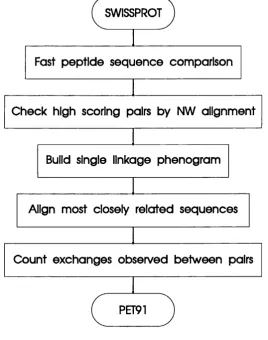
2.2 An outline of the described method for generating mutation data matrices ... 53
2.3 The general trends in amino acid residue similarity shown in the PET91 relatedness odds m a t r i x ...63
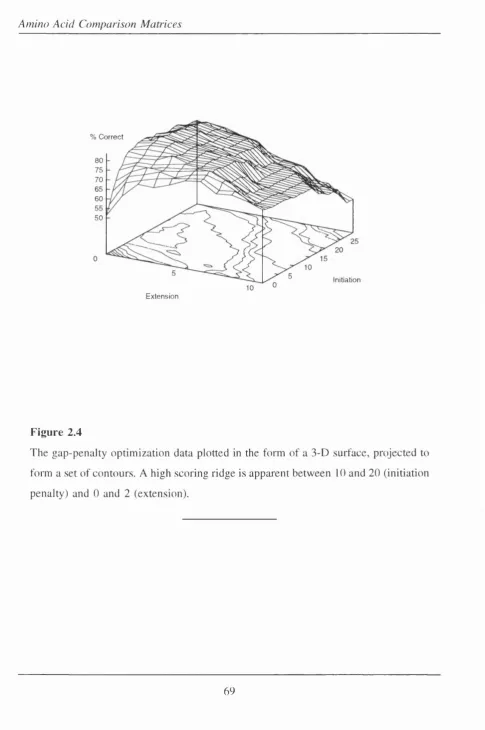
2.4 The gap-penalty optimization data plotted in the form of a 3-D su rfa c e ... 69
2.5 Changes in relative mutability between general proteins and integral membrane p r o te in s ...80
2.6 Projections of the log-odds matrices, and UPGMA dendrograms for transmembrane and general sequence s e t s ...82
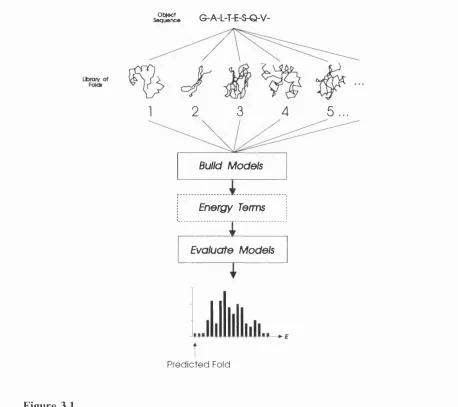
3.1 Diagrammatic representation of a possible approach to protein structure prediction by fold recognition ... 96
3.2 Model of myoglobin constructed on a polyhedral fra m e w o rk ... 98
3.3 Manually derived alignment of triose phosphate isomerase (TIM) with lactate dehydrogenase based on residue environments ... 114
3.4 Uncertainty coefficient plots for residue id e n titie s... 122
3.5 Distance distributions for accessible and inaccessible residue p a i r s ... 124
3.6 Sample pairwise p o te n tia ls... 125
3.7 Solvation potentials for the 20 standard amino a c i d s ... 130
3.8 Diagram illustrating the exhaustive threading procedure ... 141
3.9 Exhaustive threading energy histograms for repressor 1 R 6 9 ... 142
4.1 Diagram illustrating the exhaustive threading procedure ... 155
4.2 An outline of the double dynamic programming algorithm ... 162
4.3 The initial residue selection process ... 166
4.4 The calculated residue selection matrix for hemerythrin ... 168
4.5 Locally equivalent pairs scoring over 1.5 standard deviations above the mean ...169
4.6 The final state of the high level matrix, showing the accumulated low-level p a th s ...170
4.7 A depiction of how solvation terms and contact terms constrain the matching of a sequence to a structure in different w a y s ... 174
4.8 Optimal threading of yellow lupin leghemoglobin on the structure of sperm whale myoglobin ...179
4.9 Optimal threading of rhodanese domain 2 sequence on the structure of rhodanese domain 1 ... 180
4.10 Threading histograms for the trial fold recognition se a rc h e s...182
4.11 A ribbon drawing (a) and topology diagram (b) of the structure of bovine trypsin ... 187
4.12 Ribbon diagram of C-phycocyanin and m y o g lo b in ...189
4.13 The alignment of sea hare myoglobin with C-phycocyanin p chain from Mastigocladus laminosus, found by optimal th re a d in g ...190
4.14 A ribbon drawing (a) and topology diagram (b) of triosephosphate isomerase ... 192
4.15 A ribbon drawing (a) and topology diagram (b) of pseudoazurin ...195
4.16 A ribbon drawing of m y o h em ery th rin ...196
4.17 A ribbon drawing of interleukin I p ...198
4.18 A ribbon drawing (a) and topology diagram (b) of Bence-Jones protein variable-lambda domain ...199
List o f Figures
4.22 Ribbon diagram of leucine-isoleucine-valine (LIV) binding p ro te in ...206
5.1 The 5 structural states defined for a typical transmembrane p ro te in ...215
5.2 Plots of the topogenic parameters for single-spanning s e g m e n ts ... 222
5.3 Plots of the topogenic parameters for multi-spanning segments ... 223
5.4 A hypothetical score matrix for 3 transmembrane helices ... 230
5.5 The predicted structure and topology relating to the optimal path shown in Figure 5 . 4 ... 231
Table 2.1
Table 2.2
Table 2.3
Table 2.4
Table 2.5
Table 2.6
Table 2.7
Table 2.8
Table 2.9
Table 3.1
Table 3.2
Table 3.3
Table 3.4
Table 4.1
Table 4.2
Table 5.1
Table 5.2
The 250 PAM PET91 Matrix ... 58
PET91 Mutation Probability Matrix for an evolutionary distance
of 1 P A M ... 58
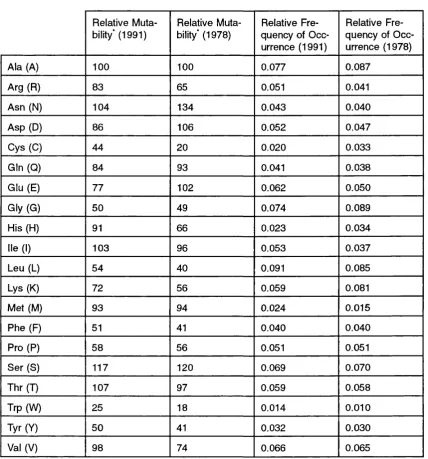
Relative mutabilities and normalized frequencies of occurrence
for the 20 amino acid residues ... 59
The difference matrix (PET91y - MDM78y) between the 250 PAM
PET91 matrix and the MDM78 matrix ... 62
The protein chain pairs used to optimize the alignment parameters
for the PET91 m a trix ...66
The gap-penalty optimization matrix for the PET91 m a trix ... 68
Relative mutabilities and frequencies for the 20 amino acid
residues: transmembrane data compared with PET91 values . . 73
The 250 PAM transmembrane protein exchange m a t r i x ... 76
Mutation Probability Matrix for transmembrane segments ... 76
A summary of currently known examples of proteins sharing little
sequence similarity, but which have highly similar folds . . . . 94
The 102 chain folds used in this w o r k ... 103
An evaluation of the potentials by fitting sequences onto every
contiguous section of a set of stru c tu re s...139
The exhaustive native threading results for a number of small folds 149
Results of native sequence threading for large structures ...176
Summary of results of a set of trial fold recognition s e a rc h e s 185
Multi-spanning protein sequences used to calculate topogenic
p a ra m e te rs ...217
Composition of data sets used to calculate topogenic
List o f Tables
Table 5.4 Topogenic parameters for multi-spanning transmembrane segments . 221
Table 5.5 Results of predicting the location of a set of multi-spanning
loop segments using the multi-spanning segment topogenic
p a ra m e te rs ...226
Table 5.6 Results of predicting the location of a set of single-spanning
loop segments using the single-spanning segment
topogenic p a ra m ete rs... 226
Table 5.7 Results of predicting the structure and topology of 83 proteins
 Angstrom
ATP Adenosine triphosphate
C -term inal Carboxy terminal
DNA DeoxyriboNucleic Acid
M D M Mutation Data Matrix
N -term inal Amino terminal
NW Needleman & Wunsch
RM SD Root Mean Square Deviation
U PM Unitary Protein Matrix (identity matrix)
Standard amino acid codes
Ala (A) Alanine Leu (L) Leucine
Arg (R) ArginiA.€ Lys (K) Lysine
Asn (N) Asparagine Met (M) Methionine
Asp (D) Aspartic acid Phe (F) Phenylalanine
Cys (C) Cysteine Pro (P) Proline
Gin (Q) Glutamine Ser (S) Serine
Glu (E) Glutamic acid Thr (T) Threonine
Gly (G) Glycine Trp (W) Tryptophan
His (H) Histidine Tyr (Y) Tyrosine
Chapter 1
Introduction
Pattern Matching Methods in Protein
Structure Prediction
D eep in the sea all molecules repeat the patterns o f one another till complex new ones are formed. They make others like themselves and a new dance starts.
Growing in size and complexity living things
m asses o f atoms DNA, protein
dancing a pattern ever more intricate.
1.1 Protein structure prediction from first principles
Evidence for a direct relationship between the primary structure of a protein and higher
levels was first presented by Anhnsen et a l (1961). It is generally thought that the amino acid sequence contains all the information required to permit a polypeptide to ’self-
assemble’ itself into a biologically active three-dimensional structure. Though this folding
of the protein is context sensitive, in that its correct execution is highly dependent on the
ambient conditions and the possible presence of cofactors or even ’molecular chaperones’,
the mechanisms that decode the structural information are in principle very simple. The
structure of a folded protein is maintained through a complex interplay between a handful
of physico-chemical forces: electrostatic effects, hydrogen bonding, hydrophobic effects,
solvent entropie effects, salt bridging and so on. Most of these forces are well defined and
have a solid backbone of theory behind them. In theory, the effects of hydrogen bonding
can be modelled by simply solving the relevant quantum mechanical equations, solvent
effects modelled by molecular dynamics, the list could continue. Predicting the structure
and function of a protein sequence is therefore conceptually simple. A set of differential
equations could be constructed where each physical force is simulated and the folding
process itself simulated as a result. Given a sufficiently powerful computer an acceptable
solution could be found. However, the number of these simultaneous equations that must
be solved to predict the final protein conformation is astronomical. Though the number
of atoms in the polypeptide chain itself is small, it is also necessary to consider the
multiple interactions between the surrounding solvent molecules and the chain. By using
suitable simplifications some progress has been made along these lines, however even
where theoretical solutions have been within reach, it has proven difficult to find the
correct energy functions and even more difficult to find functions that allow a convergent
solution to be found (Levitt, 1976; Robson & Osguthorpe, 1979). Suffice it to say that
though a direct theoretical approach to solving the folding problem could be envisaged,
Introduction
Given that we cannot now, and may never be able to predict protein structure from first
principles, other ’heuristic’ methods must be found. An obvious approach to solving vastly
complex systems of equations is to merely observe the macroscopic properties exhibited
by a wide range of different final solutions. In this case, a sensible approach is to analyze
the final folded states of different proteins statistically. Amongst the attempts at analyzing
the relationship between protein sequence and structure statistically were those of Chou
& Fasman (1974) and Gamier et al. (1978). These attempts were strictly aimed at predicting the secondary structure of proteins. The basic idea behind these techniques is
to assign a stmctural ’propensity’ to either individual residues (e.g. Chou & Fasman) or
short sequence segments (Gamier et a l). Though in a sense a degree of pattem matching is being carried out in these methods, they are not strictly pattem matching approaches.
For a review of these essentially statistical approaches see Taylor (1987).
1.2 Pattern matching methods in the prediction of protein structure and function
Taylor (1988b) explains that the applicability of different pattem matching methods to
given situations depends on the degree of homology found between the sequence under
scrutiny and the database of known stmctures. For cases where the percentage identity
(percentage of conserved residues between sequences) is 50% or above, the case is clear-
cut. The function of a protein will in all probability have been identified by the location
of such a close homologue. The structure will also follow closely, using the available
techniques for modelling homologous proteins (e.g. Blundell et a l, 1988). Highly conserved residues can be spotted easily by the construction of suitable conservation plots,
and using this information to ’pin’ the unknown structure to the known stmctural
’template’, a reasonable model can be produced. This approach is currently the most
successful stmcture prediction method known.
W here a significant degree of homology (> 50% identity) exists between two sequences,
comparison techniques exist: one based on the concept of dynamic programming, the other based on the identification of common subsequences. Dynamic programming provides the
most general and rigorous solution to this particular problem. The application of dynamic
programming methods to the alignment of biological sequences was first described by
Needleman and Wunsch (1970), and improved upon by other groups (Sankoff, 1972;
Sellers, 1974; Smith & Waterman, 1981; Gotoh, 1982). Alignment begins by the
construction of a similarity matrix thus:
A C D E F 6 H L A l O O O O O O O D O O I O O O O O D O O I O O O O O E O O O I O O O O F O O O O I O O O G O O O O O l O O P O O O O O O O O
In this simple case exact residue matches are given a score o f 1, and any other match a
score of zero. More ’lenient’ scoring schemes are commonly used, particularly that of
Dayhoff (1968, 1978).
The Needleman & Wunsch method continues by the dynamic calculation of all possible
paths through the matrix starting at the bottom right hand comer, finishing at top left.
Values in the similarity matrix are replaced by the maximum score obtainable from that point on. At the end of the summing procedure a maximum value should be found along
the top row or the leftmost column^ which indicates the starting point for the optimal
alignment path (the optimal ahgnment path for the above matrix is shown by the
Introduction
which prevents the insertion of a ridiculous number of gaps in order to maximize the
overall score.
Dynamic programming, though providing a rigorous, optimal alignment, suffers from a
severe lack of speed, even when implemented on a fast computer architecture. Though
several attempts have been made to improve the performance of the standard Needleman
& Wunsch methods (see Taylor, 1988a), faster approximate alignment techniques are
more commonly used for ’front-line’ pattem matching with large databases. These
approximate techniques are all based on the identification of common subsequences or
’tuples’. The original technique based on tuple comparison was the crude but effective
’dot-matrix’ technique (Staden, 1982 - review). In this technique, the two sequences are
written along the x and y axes respectively of a matrix, and a dot placed at each location
where the corresponding residue pairs match. The resulting matrix is inspected visually
in order to detect diagonal runs of dots which are indicative of homologous stretches between the two sequences. Though the output from the dot-matrix technique is nicely
visual, it is obviously not an automatic technique.
Automatic tuple comparison programs have been produced, notably by W ilbur and
Lipman (1983) and Lipman and Pearson (1985). The FASTx programs of Lipman and
Pearson (Pearson, 1990 - review) have become a de facto standard in the front-line database searching field. In all these methods the principle is simple. Each sequence is
split into its respective tuples (subsequences of lengths 2..n) and these subsequences stored
in a single hashed lookup table. The structure of this table is such that tuples found to be
in both sequences are stored in a linked list. An alignment is produced by locating
significant diagonals, which are simply the diagonals of the dot-matrix that have an above-average number of common tuple matches. As already stated, the main advantage
of these methods is their speed: performance being around 40-50 times greater than that
of dynamic programming approaches. The major disadvantage with tuple methods is that
they rely on finding a fairly high number of common tuples, which in the case of fairly
difficulty in providing a decent ’similarity’ scoring scheme where amino-acid similarity
is scored, rather than amino-acid identity.
More recently a very rapid, and relatively sensitive, databank searching program (BLAST
- Basic Local Alignment Search Tool) has been described (Altschul et a l, 1990). Though the speed of BLAST is impressive (searching around 500,000 amino-acid residues per
second on a SUN 4/280), and its statistical properties are well characterized (Karlin &
Altschul, 1990), it still falls far short of dynamic programming with respect to sensitivity.
An interesting question that often arises when considering future developments in
databank searching is whether or not priority should be given to the sensitivity of the
method over the speed at which it executes. Heuristic methods are only worthwhile if a
rigorous search is impractical using available computing resources. Extremely powerful
computers are now readily available, and it is presently the case that a modem workstation
can perform a rigorous dynamic programming search of the protein sequence databank in
a few hours of CPU time. W hether this will remain the case is a matter of debate, though
a glance at Figure 1.1 suggests that at the time of writing information technology is
Introduction
94
Sequences CPU speed
84
O 00 63 O) o 42 o re CL 22 w 00 <D
00 OO) C \ J
en O)
O 00
Y e a r
Figure 1.1
The size of the PIR databank (George et a i, 1992) is plotted against the speed of commonly available computers i.e. computers which would be readily available to the average biochemist. Values are shown relative to the state in 1980.
Simple pairwise alignment methods as described above are good at compaiing sequences
where the homology exceeds 50% or so. In some cases two sequences may in fact have
an overall homology much less than 50% and yet have a common segment with extremely high homology. Terminal and loop regions may well be highly vaiiable in sequence, or
may even be deleted or extended across a single protein family. In these cases a global alignment across the full length of both sequences may fail to provide a significant result.
Both the dynamic programming and tuple alignment techniques have been modified to
allow the identification of regions of maximum local homology. In the case of dynamic programming, the single-stietch best local alignment method of Smith and Waterman
allows multiple subsequences to be detected in one operation. For an example of tuple-
based local alignment see Waterman (1986).
1.3 Consensus methods
As the degree of homology between two sequences drops below 50% it becomes difficult
to locate the biologically optimum pairwise alignment between them. Usually, however, more than two sequences are available. Given several examples from a single family of
proteins it is possible to construct a consensus alignment between them. The principle of consensus methods is seen mirrored in many fields of science and mathematics. In an
abstract sense, consensus alignment is simply an example of statistical sampling. The basic idea is that instead of a single amino-acid code at each alignment position, a
histogram is constructed where the numbers of each of the 20 amino acids occurring at
that position are tallied. This allows each sequence to ’vote’ for the appropriate residue
at any given alignment position. Usually the total alignment is iterated, using the
consensus patterns built in the previous pass to direct the alignments of the following
pass. The concept of consensus pattem matching will be discussed in more detail later.
Multiple consensus alignment techniques are useful for average homologies above around
30% at which point all alignments become statistically insignificant. The 30% identity cut
off very roughly marks the outermost boundary of the so-called ’Twilight Zone’ (Doolittle
et a i, 1986). The Twilight Zone is simply defined as the region of homology where an optimal alignment between random sequences is found to be no worse or better than the
alignment between the trial protein sequences. It is unfortunate that in many documented
cases useful alignments lie well inside the Twilight Zone. The problem is simply down
to the extreme variability of protein sequence even where the higher levels of structure
Introduction
located amid the extreme evolutionary ’noise’. The number of key residues may well be
very small in comparison to the lengths of the sequences, but methods have been
developed to enable such residues to be rapidly located. See Taylor (1988a, 1990) for a
complete description of consensus alignment techniques.
The methods employed to detect remote homology between sequences are the truest forms
of pattem matching. The earliest example of a strictly pattem matching approach to
sequence comparison was that of the helical wheels of Schiffer and Edmundson (1967,
1968). Schiffer and Edmundson studied the distribution of hydrophobic residues along the
lengths of a-helical sequence segments by plotting each residue in a circular fashion
corresponding to the pitch of the helix, a-helical regions generally exhibit clustering of
hydrophobic residues along a single sector of the wheel. Though of some vintage, this
technique remains a powerful means for identifying and comparing a-helical regions. The
method of helical wheels was refined by Palau and Puigdomenech (1974) who analyzed
the zonal distribution of hydrophobic residues in helical regions. They found that in
helical regions hydrophobic residues at sequence offsets n, n-hl and n+4 or n, n-i-3, n+4
acted to stabilize the helices.
Shortly after Palau and Puigdomenech’s article two articles by Lim (1974a,b) were published. The first of Lim ’s article presented a general study of the stereochemistry of
globular proteins, showing which residue types could be associated with regular (a or 13)
or irregular protein conformations. In the second article, observations made on proteins
article, were distilled into 22 rules. These rules tended to be verbose and highly general.
For example, Rule 3 for a-helix formation is as follows:
"Let the hydrophobic pair (1-2) or the hydrophobic triplet (1-2-5) formed from positions (i, i+1) and (i, i+1, i+4) respectively, and position i+7
contain phenylalanine. Such a hydrophobic pair (1-2) or a hydrophobic triplet (1-2-5) ... will be a-helical if Phe situated in position i+1 forms within the limits o f the obtained a-helix a hydrophobic-hydrophilic pair (1-5) with Gi which is situated in position i-3. "
Lim claimed a prediction accuracy of 80-85% when these rules were applied to the same
structures on which the rules were based. Though the accuracy of Lim’s method is
certainly not as high as 80% when applied to proteins absent from the original data set,
it does in fact score higher, on average, than many of the more popular statistical
techniques. Not surprisingly rules of this type were not easy to convert into computer
code, which contributed to their lack of popularity. Taylor (1988b) points out that modem
logic based languages seem to be suitable vehicles for encoding Lim’s rules, and that
work along these lines has been started by C. Rawlings and R Stockwell (personal
communication).
All the above pattern matching methods are concerned with detecting simple patterns
primarily designed to predict secondary structure. The trend in protein sequence pattern
matching has moved towards the construction of more complex templates, capable of
matching higher levels of structure than basic a-helices or 6-sheet regions. Given that
long-range interactions play an important part in the direction of protein folding, even at
the purely secondary structural level, the necessity for these complex patterns is
reasonably obvious. Nagano (1977) first described the use of a super-secondary structural
motif, where the 6 a6 unit was analyzed. Following on from this work Nagano (1980)
Introduction
( 3 x 1 1 boxes) rather than the 3D atomic coordinate space. The nub of the method is
simple in that each pentapeptide is labelled as being a or 6 depending on the total of a
statistically determined secondary structure propensity for each. Likely 6 a6 units are then
located by considering pentapeptide patterns that neighbour strongly predicted a or B
segments, with an appropriate distance filter that excludes B-a/a-B pairs that are too far
apart on the grid. An important part of this method was a combinatorial analysis of all the
possible permutations of predicted structural segments, this is analogous to scanning
through all the possible three-dimensional packings given a mixture of well-defined and
ill-defined structural units, except that in this case packing is performed on a 2D grid.
Richmond and Richards (1979) described a fairly involved technique for tertiary structure
prediction. Though the method used a wide range of techniques outside the realm of
pattern matching, a pattern matching approach was used at the core of the method to
identify hydrophobic residues important for the packing of secondary structural elements.
The number of packing permutations matching the given patterns tended to be enormous,
though this number was quickly reduced by means of simple distance filters applied in
particular to the ends of helices. Richmond and Richards only considered proteins in the
a a folding class (e.g. myoglobin) where the hydrophobic patterns were well defined, and
the distance filters easy to construct and apply. Cohen et a l (1980, 1982, 1986) extended this combined pattern-matching and packing technique to BB and Ba folding types. This
extension demanded the construction of hydrophobicity patterns for B structure similar to
those already well-recognized for a-helices. Success in this case depended on the
provision of some external knowledge to the prediction problem. The fundamental
limitation here is the lack of accuracy in secondary structure prediction. Of course, given
knowledge of the protein’s folding type, secondary structure prediction can be weighted
towards reasonable accuracy, and indeed where this information is available, the method
of Cohen et a l provides at least a fair guess at the overall protein topology.
such any uncertainties in the elements playing a part in the prediction process are grossly
magnified by the time a complete tertiary structure is produced. Reducing the vast number
of possible packing permutations relies on the provision of suitable filters applied to the
component secondary structural elements. If the secondary structural elements are ill-
defined (or rather mis-predicted) then we should not be surprised if the final predicted
state is far from reality. These techniques are guilty of building skyscrapers on top of
wooden foundations.
Taylor and Thornton (1983) attempted to improve the accuracy of secondary structure
prediction by constructing templates capable of detecting super-secondary structural
elements, or more specifically (but not exclusively) the 6 a6 unit. Using 62 examples of
the 6a6 unit from the Brookhaven database (Bernstein et ah, 1977) an ideal secondary structure sequence template was constructed. This ideal 6 a6 pattern was matched at each
residue position of the test sequence matching the template profiles to the Gamier
secondary structure prediction probability profiles (Gamier et a l, 1978; Gibrat et a l,
1987), and a score calculated. Different length variants of the ideal template were created
by scaling the master template so as to accommodate the length variations observed in the
available examples. Apart from the statistical sequence template, templates were also
constmcted for matching pattems of hydrophobicity (as in Lim ’s method) - one template
scored highly for buried 13 regions, the other for a-helical regions. The strongest fitting
template was selected, and other matching templates selected according to various mles
(for example forbidding overlapping a and 13 regions). On a test set of 16 13/a proteins,
a prediction score of 70% was achieved, bettering the raw GOR secondary stmcture
prediction technique by some 7.5%.
As an extension to the work on 13al3 templates, Taylor (1986a) went on to produce a
generalized consensus template method. The first major improvement to the original
Introduction
given a suitably well-defined sequence alignment. The method starts with a seed
alignment, generally based on available structural information. A consensus pattern is
created from this initial alignment such that each alignment position contains a count of
each of the 20 amino acids. This ties back to the earlier discussion of multiple sequence
alignments using consensus methods. One important advantage of consensus pattems is
that they are insensitive to the odd misalignment. Consider the case where, for example,
in 10 alignments a glycine residue is found at a particular alignment position and in the
eleventh, due to a misalignment, a proline is aligned with the glycine consensus.
Evidently, the proline match will be recorded, but in future alignments, the proline will
be scored 10 times lower than the glycines - the ’glycine-like’ tendency of that particular
template position will be more-or-less conserved.
The initial consensus template, preferably solidly based on structural knowledge, is then
used to collect further matching sequences from the sequence database. The new set of
sequences is then aligned to the consensus, to produce a new expanded consensus
template, ready for a further cycle of sequence collection, alignment, and template
generation. W hen no new sequences are collected, the alignment cycle is exited and the
final minimal set template constructed. The nature of this final template is totally different
from the consensus templates used to direct the collection/alignment cycle. Rather than
recording the number of each of the 20 amino acids observed at each position, the
observed amino acid identities are used to pick a minimal covering class of amino acid
from a Venn diagram. This Venn diagram comprises three major sets: Hydrophobic, Polar
and Small (with subsets Aromatic, Aliphatic, Tiny, Charged and Positive). The smallest
subset that contains all the residues observed at a particular alignment position is selected,
and is recorded in the final template at the corresponding position. There are two main
advantages to using minimal covering classes over consensus pattems. Firstly, minimal
covering class pattems are predictive in that they are able to predict possible amino acid substitutions that may not have been observed in the limited data set that was used in the
template’s constmction. The second advantage is that bias in the data-set is eliminated.
glycines. If this alignment proves to be valid and indeed a proline is a valid residue at that position then in the final template we do not wish to score it lower than the more common glycine residues. Indeed, it may turn out that the sequences that contributed the
10 glycines at that position were in fact highly homologous and that, were the sample of
sequences less biased we might observe just as many cases where proline is present as
glycine. Taylor’s method concludes by aligning each of the contributing sequences against
the final template using a set-based scoring scheme rather than a consensus-based scheme.
If the whole process has been successful then we expect the set-based alignment to concur
with the consensus alignment.
Pearl and Taylor (1987) used the above consensus template program suite to identify
common features in the retroviral protease and aspartyl protease families. The method was
able to detect the few conserved residues that formed the proposed active site even though
the sequences were extremely non-homologous with respect to normal alignment methods.
A method (’profile analysis’) similar in many respects to the template method of Taylor
has been devised independently by Gribskov et al. (1987; 1990 - review). An important aspect of the profile analysis method, which has led to its popularity, is the reliability of
the underlying statistics. In particular, the use of Z-scores (see page 134) calculated for
different profile length ranges, not only provides a useful measure of statistical
significance, but also highlights matches that might otherwise go unnoticed were the raw
match scores to be used.
To enhance their previous work on secondary structural packing, a pattern matching
approach to predicting structure in 8 /a proteins was formulated by Cohen et al. (1983). Their algorithm concentrated on turn prediction, achieving a prediction score of 98%,
though by using the reliable turn prediction a complete structure prediction was produced
Introduction
involves locating turns by their characteristically high polar residue content. These
predicted turn regions delimit independent sequence segments that are to be assigned as
a , 13 or ’null’ (null structures can be irregular, or just isolated regular structures that do not interact with the central 13-sheet). Using a large array of small pattems, each delimited
region is analyzed, and labelled as possibly a or 13 depending on the overall pattern
matching score (ABGEN module). The next stage attempts to label some segments as
being definitely a , 6 or null (ADEF, BDEF and NULLDEF modules) by using pattern combinations (for example if a segment has been previously labelled as a potential a -
helical segment and the hydrophobic diamond pattern ’S’ matches, then the segment is
assigned as definitely a). Remaining uncertainty in the prediction is resolved by the
application of high-level ’expert system’ rules containing well-founded knowledge on the
stmcture of 6/ a proteins (ADJUST module). Processing continues (DELIMIT module) by
using specific N and C terminal pattems to try to accurately determine the boundaries of
the secondary structural elements now known to be contained in the ’definite’ segments
(for example a ’stop signal’ for a-helices might well be one or more prolines or three
hydrophobic residues). The final prediction is achieved by means of a scoring and ranking
procedure (SCORE module) and by another expert system analysis of all the remaining
combinatorial possibilities of definite segments and possibles (COMBINATORICS
module). This combinatorial step is somewhat similar to the method of Nagano (1980) as
described previously. The final icing is provided by filtering out the remaining statistical
anomalies (OUTLIER module).
The method of Cohen et at. described above is complicated, but is interesting in that it uses earlier pattem matching approaches, using a rigorous artificial intelligence approach
to handle ambiguous predictions. Another very interesting aspect is the use of expert mles
to direct the global prediction process. Such a combination of methods will no doubt play
a vital part in successful future prediction schemes, drawing predictive power from both
blind pattem matching methods, and the hard-earned knowledge of experts in the rules of
protein structure. From current evidence it would appear that prediction techniques
scores of 60-70% or so. See also King & Sternberg (1990) for a more recent example of
an artificial intelligence system applied to the problem of structure prediction - in this case
using a machine learning algorithm.
1.4 Regular expressions
Another type of protein sequence pattem that has recently become popular is that based
on regular expressions. A regular expression is simply a linear sequence pattem that permits the use of wildcards (matching any residues), set closures (matching residues in
a particular set), gaps (matching a number of residues or none at all). To fit in with the
complete definition of a regular expression, it must also be possible to define nested sub-
pattems. For example in the pattem XYZ(P(QR))XYZ, the possible matches are
XYZPQRXYZ or the sub-pattem PQR, or the sub-sub-pattem QR.
Probably the earliest example of tm e regular expressions being used for matching complex
biological sequence pattems was the QUEST system designed by Abarbanel et at. (1984). QUEST is a rapid search tool that implements a concise pattem language, very closely
modelled on the syntax of the Unix EGREP (Extended Global Regular Expression search
and Print) program. QUEST was designed to be able to handle the kinds of pattems
thought useful in sequence analysis and stmcture prediction, and allowed pattems to be
defined in terms of named or explicitly defined sub-pattems. For example in tum-
prediction a sub-pattem would simply be the set of single residues with a predilection for
tum-formation ([PGQNSTEDRKH]) called for example ’tphilic’. A further sub-pattem
would be [YPGQNSTEDRKH] (tphilic plus tyrosine) called ’ytum philic’. A QUEST
meta-pattem for a tum could then be defined as "tphilic{3} ytumphilic", or in English :
Introduction
pattem system is known as PLANS (Pattem Language for Amino and Nucleic acid
Sequences), and was coded in Lisp. With the convenience of a well-tailored pattem
matching language, Cohen et a l analyzed tum pattems in all structural classes of proteins : a a , 1313, 6/ a and 6+ a. By virtue of the QUEST/PLANS meta-pattem capabilities, the
pattern library was greatly extended and a high prediction accuracy was achieved (95%
over all examples, 90% on homologous proteins extracted from the sequence database).
On the debit side, this accuracy was achieved by the inclusion of many parameters based
on global knowledge extracted from all available protein structures, so until a sufficiency
of new structures becomes available on which to test the algorithm in an unbiased fashion,
the true accuracy remains uncertain. Nevertheless, the current indications are that this
method may very well provide an impressively powerful means for tum prediction
(especially if the folding type of the protein can be independently determined).
1.5 Specific structural patterns
All the above methods are essentially generally applicable automatic methods for protein
pattem analysis. Although some of the methods are more generally applicable than others,
none of them attempt to apply rigid pattem matching mles based on comprehensive
stmctural knowledge. O f course, pattern matching of this sort requires one of two things:
either the stmctural unit is extremely simple, or the stmctural unit is fairly high-level (but
then limited to a specific family of proteins).
The earliest analysis of a specific protein fold was that of the dehydrogenase nucleotide
binding fold by Wootton (1974). The subject of nucleotide binding motifs has been
repeatedly studied time after time. Well known work in this area includes the ATP
binding pattems of Walker et a l (1982), and the 6a6 dinucleotide binding m otif of W ierenga and Hoi (1983). Other ’macro-pattems’ include calcium-binding pattems (for
example the EF-hand helix-loop-helix pattem analyzed by Kretsinger, 1980), DNA binding
A library of such pattems is now being compiled in the form of the PROSITE database
(Bairoch, 1991). To provide a useful tool for sequence and structure analysis, pattem
matching methods must be linked to reliable and comprehensive libraries of pattem data,
and PROSITE represents a first step in providing such a data resource. PROSITE is a
weU-documented library of semi-automatically generated protein sequence pattem s (of the
regular expression class), now integrated into the SWISS-PROT protein sequence
database, and distributed by EMBL. Pattem libraries such as PROSITE will almost
certainly play an important part in the identification and analysis of the vast number of
sequences that will be produced as the various large-scale sequencing efforts begin to bear
fruit.
Another approach to pattem analysis is to closely examine the sequence preferences for
sub-stmctures at an extreme level of detail. This is the approach that has been followed
by Thomton et al. (1988 - review) where the tums and loops between 6-sheets and a - helices have been rigorously classified into different structural groups, and then analyzed
for sequence preferences at each position in the resulting pattems.
At the other end of the spectmm, Bashford, Chothia and Lesk (1987) have studied the
pattem of sequence preference for a very large-scale sub-stmcture: the globin fold. Having
comprehensively analyzed the stmctural features of the globin family, a pattem matching
approach was use to correlate conserved sequence pattems with the known structural roles
of each position in the fold. Conservation of amino-acid properties formed the core of the
pattem method (comparable to the set method of Taylor, 1986a, 1986b). The resulting
pattems derived from the globin analysis were as might be expected, highly specific to
globins managing to accurately discriminate between globins and non-globins when
applied to the available NBRF-PIR sequences. This method of laboriously constructing
pattems manually from structural studies of protein families contrasts sharply with the
Introduction
problems of multiple alignment that can cause problems for the automatic methods to be
circumvented, and produce pattems with a true structural significance.
1.6 P attern assessment
The ’quality’ of patterns is currently an ill-defined parameter. Certainly to date every
pattern matching study has considered to a degree the sensitivity and specificity of the
pattern under discussion, but few attempts have been made to quantify this information in a rational fomn. By sensitivity we mean the ability of a pattem to extract all the
sequences used in its construction, and by specificity we mean the ability of a pattern to match the constituent sequences and no others. A straightforwai'd approach is to consider a pattern as a collection of statistically independent strings of symbols, and to evaluate
the expected frequency of occunence of the total pattern. Hodgman (1989) shows how such probabilities can be calculated for pattems based on amino-acid property sets (e.g. Taylor, 1986a, 1986b).
An attempt at accurately quantifying the statistical significance of automatically generated protein sequence patterns forms an important part of the work by Smith and Smith (1990)
on the PLSEARCH package. The automatic pattern method of Smith and Smith is a somewhat simpler version of the pattern generation scheme of Taylor (1986a). In place
of a Venn diagram, in this method a sti ictly hierarchical grouping of amino-acids is used,
subdividing the set of amino-acids into small mutually exclusive property sets. Whereas
Taylor uses a seed alignment to initiate a cyclic alignment/clustering process, the method of Smith and Smith attempts to boot-strap the pattern creation by aligning each sequence
in a clustered family of sequences to a rigid non-consensus pattern string, according to a binai-y tree ordered by the pairwise similarity score between each sequence and all
others. The examples of the PLSEARCH pattern generation algorithm quoted in the paper ai'e all relatively trivial, in that the alignments are fairly clear-cut. How such a rigid
is an interesting question. The danger of misalignment is present when the alignment is
performed without the use of consensus pattems. In a sense the method pre-empts the
problem by using an insensitive clustering scheme to collect sequences together into
families.
Rooman and Wodak (1988,1990) analyzed the predictive power of sequence motifs in an
attempt to gain some insight into the current limitations in structure prediction accuracy.
Their work involved the generation of short motifs that regularly occur in identical
conformations. By extracting such motifs from different sized data-sets they surmise that
the current lack of success for pattem based structural prediction is simply due to the
limited size of the current structural database. Though within the scope of the study the
results are valid enough, it may be unduly pessimistic in that it does not consider the
possibilities of combinations of different prediction techniques. For example there is the
possibility of using logic based expert knowledge to fill in gaps in the current database
(e.g. Cohen et a i, 1983).
Following on from this, Rooman et al. (1989) analyzed the predictive power of recurrent tum motifs (Thomton et a l , 1988) in a similar way to that of Rooman and W odak’s study of automatically generated motifs. The general conclusion of the study was yet again
disappointingly pessimistic showing their standalone predictive power to be poor. On a
positive note the study demonstrates a sound statistically based method for validating
consensus pattems, which is certainly an area of pattem generation and matching that
Introduction
1.7 Prediction of progress at last^
Recently, some significant developments have been made with respect to pattem matching
and protein structure. Two important new research avenues have been identified by a
number of groups: the idea o f fo ld recognition, and the extraction of secondary structural information from aligned fam ilies o f protein sequences.
It is now well-known that proteins with no obvious sequence similarity can show
remarkable similarities in their native folds. Examples of such proteins include the various
TIM barrel enzymes, interleukin 1 (3/soybean trypsin inhibitor, and actin/hexokinase. Tlie
rate at which newly solved protein structures are perceived to have previously observed
folds suggests that the number of protein topologies may be limited. Indeed, some
estimates put the number of observed topologies at 50% of the total number of naturally
occurring topologies. Given the significant possibility that a newly sequenced protein will
have a previously observed fold, it is clearly useful to be able to recognize protein folds
in sequences.
The methods described earlier for recognizing protein folds have been based purely on
sequence information. These sequence analytic techniques work well for cases where some
residual sequence similarity remains between the newly characterized protein and a protein
of known 3-D structure. In the harder cases, such as those mentioned earlier, there is little
or no sequence similarity with which to recognize proteins with similar folding pattems.
In the light of these limitations, a number of groups have developed new approaches to
protein fold recognition which work by evaluating the compatibility between a test
sequence and a library of stmctural pattems derived from either known crystal stmctures
(Bowie et a l, 1991; Jones et a l, 1992b), or hypothetical model folds (Finkelstein and
Reva, 1991). As much of the work described herein is concerned with this topic, further
discussion will be left until later.
Often, rather than a single sequence a whole family of related sequences is available for
analysis. By multiply aligning the sequence family, additional information may be
obtained from the observed sequence conservation pattems, and the location of insertions
and deletions. A prime example of the power of multiple sequence data was the successful
secondary structure prediction of the cAMP-dependent kinases by Benner and Gerloff
(1991). At the most basic level, the likely location of loop regions in the sequence data
can be derived by observing where insertions and deletions occur. This process, which
Benner and Gerloff call parsing, neatly circumvents the problems of traditional secondary stmcture prediction algorithms which are notably inaccurate in predicting the exact end
points of secondary structures. Further information can be obtained by observing that the
most conserved regions of a protein sequence are those regions which are either
functionally important, and/or buried in the protein core. Conversely, the more variable
regions can be fairly confidently assumed to be on the surface of the protein, where few
constraints are imposed on the nature of the amino acids in question, save a bias towards
hydrophilic species. By clustering the sequences in an aligned family, and assessing the
degree of sequence variability observed between very similar pairs, Benner and Gerloff
demonstrate that the solvent accessibility (Lee and Richards, 1971; Chothia, 1976) of an
amino acid residue can be predicted. Using these predicted degrees of accessibility,
secondary structure can be predicted by comparing the accessibility pattems generally
associated with specific secondary stmctures when packed against a hydrophobic protein
core (Figure 1.2).
Limited topological information for proteins with a definite biological activity can be
obtained from the observation that conserved polar residues tend to be functionally
Introduction 100 BO 80 40 20 0
1 2 3 4 5 6 7 8 S 10 11 12 13
P o s itio n
Surface helix
1 2 3 4 5 s 7 8 9 10 11 12 13
P o s itio n
Buried strand
î: 100 80 40 20 0
1 2 3 4 5 8 7 8 9 10 11 12 13
P o s itio n
Surface strand
Figure 1.2
Typical accessibility pattems for three common classes of secondary
structural element. Buried helices infrequently occur, but are difficult to
distinguish from buried strands.
W hilst it is clear that additional information is available from analyzing multiple sequence
alignments, the quality and quantity of this information remain ill-determined. The fact
that many very similar protein sequence pairs are required to apply the method reliably
is bom out by the lack of success in more recent predictions (Benner et a l 1992; Robson & Gamier, 1993), which have been performed on families with far fewer close pairs than
that of the cAMP dependent kinases.
With the work now being done to sequence entire genomes, the imbalance between the
number of known sequences and the number of known stmctures will become greater over
developed as part of the project described in the next few chapters will play a vital role
in the utilization of the available data. One day it is hoped that we will have a full
understanding of just how proteins fold into a uniquely determined 3-D structure, but even
Chapter 2
The Calculation of New Amino Acid
Comparison Matrices
It is comparison that makes men miserable.
2.1 Introduction
Despite the great diversity of methods devised for the alignment and comparison of
protein sequences, all of these depend at some point on the simple comparison of two
amino acid residues. The most popular method for measuring the similarity between
amino acids is to use a scoring matrix of some form. At it/simplest, a typical scoring
matrix comprises 20 x 20 elements, each element representing some metric that relates
two residues. In view of this central dependence on a scoring matrix, a reasonable route
towards possibly increasing the sensitivity of standard sequence analysis methods is to
investigate improvements to the matrix itself, rather than the algorithms. It was this
assumption that instigated the work presented in this chapter.
2.2 Types of scoring matrix
The least sophisticated matrix is the ’Unitary Protein M atrix’ (UPM), also known as the
’identity matrix’. The UPM scores a 1 for exactly matching residues and a 0 for every
other combination. Obviously this matrix lacks sensitivity, being unable to detect the
possibility of phenotypically "quiet" mutational events between two sequences. One
advantage of the UPM is that it is wholly unbiased, providing a very easily understood
alignment metric. The ’percentage identity’ between two sequences is often offered as a
universal means of describing the mutual degree of ’homology’ between them. Though
a low identity score can in no way prove or disprove the existence of homology, it has
proved easier to provide rules of thumb for identity scoring than for any other scheme.
In general for two sequences of reasonable length (say 50 residues or more), a percentage
identity of greater than 20% points to a significant structural homology between them.