A Scheme for Collaboratively Processing Nearest
Neighbor Queries in Oblivious Storage
Keith B. Frikken
1, Shumiao Wang
2, Mikhail J. Atallah
2,∗ 1Miami University, Oxford2Purdue University, West Lafayette
Abstract
Security concerns are a substantial impediment to the wider deployment of cloud storage. There are two main concerns on the confidentiality of outsourced data: i) protecting the data, and ii) protecting the access pattern (i.e., which data is being accessed). To mitigate these concerns, schemes for Oblivious Storage (OS) have been proposed. In OS, the data owner outsources a key-value store to a cloud server, and then can later execute get, put, and remove queries, by collaboration with the server; furthermore, both the data and the access pattern are hidden from the server. In this paper, we extend the semantics of OS by proposing an oblivious index that supports nearest neighbor queries. That is, finding the nearest keys to the query in the key-value store. Our proposed index structure for supporting nearest-neighbor has similar performance bounds to previous OS schemes that did not support nearest-neighbor, in terms of client storage, server storage and rounds of communication.
Keywords: Collaborative Cloud Storage, Oblivious Storage, Collaboration in Cloud Computing
1. Introduction
The benefits of cloud storage are well documented, but a significant impediment to larger-scale use is concern for confidentiality of the data and of access patterns to the data. Organizations are reluctant to collaborate with cloud servers for storage when the data involved is supposed to be kept confidential. Some service providers offer premium services with features that mitigate the confidentiality problem, such as servers that are inside national borders and are “hardened” against network attacks, system administrators that have specified characteristics (e.g., of citizenship, levels of security clearance), etc. Not only are such approaches expensive, but the sensitive data remains vulnerable to (e.g.) rogue employees of the cloud service provider, a break-in or malware/spyware at the remote server, etc. This paper belongs to the body of work that seeks to design client-server collaborative schemes that obviate the need for using the above-mentioned premium services, even as they provide better security: They provide clients with access to their data, while protecting from the server both the data and the access patterns to it. A case can be made for using such techniques even when the data is stored at a trusted server, as a form of compartmentalization
∗
Corresponding author. Email:[email protected]
and “defense in depth” whereby the damage from compromise of a trusted server is less widespread and is confined to that server. In addition to the security advantages to such compartmentalization, there are also economic advantages: It makes it less necessary to get high security clearances for individuals at the trusted server’s end, and also less necessary to spend money on the expensive physical isolation or tamper-proofing of hardware and software (because they no longer have access to the sensitive information – they “use it without seeing it”).
A well known technique for protecting access patterns is oblivious RAM (ORAM) [4]. In ORAM, the server has a sequence of memory locations, and the client can read or write the content from any of the memory locations. In ORAM, the data is protected and the server does not learn the access pattern. That is, the server learns something was accessed, but does not know what was accessed; the server doesn’t even learn when the client accesses the same data repeatedly. While this work is very promising, many distributed storage techniques do not take the form of a RAM. To ameliorate this problem, [2] introduced the concept of Oblivious Storage (OS), where the storage is that of a key-value store, which is a more widely used data model for cloud storage (for example HBase[1] can be viewed as such a key value store). The operations provided by OS are: get, insert, and remove.
1
Research Article
on Collaborative Computing
Received on 11 July 2014, accepted on 23 July 2014, published on 20 October 2014
Copyright © 2014 Keith B. Frikken et al., licensed to ICST. This is an open access article distributed under the terms of the Creative Commons Attribution licence (http://creativecommons.org/licenses/by/3.0/), which permits unlimited use, distribution and reproduction in any medium so long as the original work is properly cited.
doi: 10.4108/ cc.1.2.e3
EAI Endorsed Transactions on Collaborative Computing 06 -10 2014 | Volume 01 | Issue 2 | e3
The primary goal of this work is to extend the semantics of oblivious storage. Previous work on OS has assumed that the client has some information about the keys that are present in the OS. An exception to this was the miss-tolerant solution in [7] where a client could perform lookups for non-existent keys. In this case the server would not learn that the key was a miss, and the client learns that the specific key does not exist. This interface makes it difficult to answer queries such as “give me all values where the key is in the range [a, b]”, especially since it is possible that neither a nor b is in the dataset. This paper makes a significant step towards solving this problem, by providing an oblivious index that supports nearest neighbor queries including directional queries that are for nearest neighbor larger than (or smaller than) the query item. The non-directional version is simply: Given a key, find the keys that are closest to the given key. Note that the directional version can easily be used to find all keys in a range [a, b], by finding the nearest successor to a (let it be x), then finding the nearest successor tox, etc. (In fact we can do much better than such a naive “follow the successor” approach, as will become apparent later in the paper.)
The rest of the paper is organized as follows: Section
2 describes related work. Section 3 gives the problem definition and defines the building blocks used in the paper. Section4describes the main result of this paper. Finally, section5concludes the paper.
2. Related Work
Oblivious RAM was introduced in [4]. In ORAM, the server has a sequence of values (pages in memory),
v1, . . . , vn. The client (who is also the data owner) can
access an arbitrary value. Almost all of the solutions for ORAM provide an amortized performance guarantee. For example, in one solution proposed in [4] the cost of an access is O(√n) on average, but is O(n) in the worst case. Many other schemes have been proposed to improve the efficiency of ORAM, including: [3,5,6,10,
12,13,15]. The scheme in [6] is particularly interesting, because its worst case access time is sublinear.
In [2], a different model for oblivious outsourced storage was proposed called Oblivious Storage (OS), and this work was extended in [7]. In OS, the data store is a key-value store, which is a more natural framework than the RAM model. Another constraint of Oblivious Storage is to avoid increasing the server’s storage by a multiplicative factor, as this will increase the cost of outsourcing significantly.
There is a growing list of papers in the framework of storage outsourcing (e.g.[8, 14], and others). [14] introduced the paradigm in which the service provider hosts the database as a service, and allows clients to store and access their own databases at the host
site, which is similar to the framework in this paper. [8] describes several architectures that combine recent and non-standard cryptographic primitives in order to build a secure cloud storage service, and surveys the benefits such an architecture would provide to both customers and service providers.
The nearest neighbor search problem (also called the post-office problem by Knuth [9]) is a classic problem, and here we only review the related work of this problem in the secure outsourcing setting. Traditional encryption methods could hide the data from an untrusted server, but that would also prevent the client from doing queries like nn search or range queries, but prefix-preserving encryption (PPE) [11,16] could help in handling nnsearch due to the fact that the longest common prefix of any two ciphertexts is of the same length as the longest common prefix of the corresponding plaintexts. However, the security is weakened since some prefix information is leaked to the server if PPE is used to encrypt the dataset.
Another recent work on similarity search [17] provides solutions for generic distance metrics (Lp
norm) of multidimensional data with interesting trade-offs between query cost and accuracy, but it does not consider hiding the access patterns from the server. Several other related transformation-based techniques and hierarchy-based searches (using an encrypted R-tree to represent the database and then searching it for query point level by level) are proposed in location-based service (LBS) systems [18] which have the same issue of leaking access patterns.
3. Preliminaries
In this section, we begin by describing the notation used in this paper. The interval (x, y) includes all integers from x to y exclusive, and when the parenthesis are replaced by brackets (i.e., [ or ]) then the interval is inclusive. Given a value x∈ {0,1}n, we define
P ref ixm(x) to be themmost significant bits ofx.
Our schemes utilize a pseudorandom function(PRF) F :{0,1}n× {0,1}n → {0,1}n. We utilize the textbook
definition for a PRF in that for all PPT distinguishing algorithms D, |P r[DFk(·)(1n) = 1]−P r[Df(·)(1n) = 1] is
negligible in n where f is a random function. Our scheme utilizes a PRF that takes in variable length input tuples. This is easily accommodated by an encoding scheme that pads all messages to the same length. For example, all strings up tonbits long can be converted into a string of length n+ logn by pre-pending the length and padding with 0’s.
Finally, our scheme utilizes CPA-secure encryption schemes (KeyGen, Enc, Dec) where an adversary cannot distinguish one of two ciphertexts given oracle access to
Enc.
2 EAI Endorsed Transactions on
Collaborative Computing 06 -10 2014 | Volume 01 | Issue 2 | e3
3.1. Framework/Problem Definition
We are assuming an honest but curious server, which means it will collaborate with the client and perform specified computations, but try to learn information about the client’s data or access pattern. A data owner (client) that publishes a data set on the server, and the data owner wants to be able to query its own data while protecting the data from the server. This includes protecting both the content and the data access pattern. Previous work [2, 7] has introduced the concept of oblivious storage. In oblivious storage, the data owner publishes a key-value store on the server. More specifically, the server stores a set of tuples S={(k1, v1), . . . ,(kn, vn)} where n≤N for some
size thresholdN, the keys,ki, are unique and are drawn
from a key domain [0, D−1], and the values, vi, are
drawn from a domain of values where each value has the same bit size (alternatively the values could be padded to have the same size).
The schemes in [2, 7] give protocol for functions: get(k), put(k, v), and remove(k). In [7] oblivious stores are described as either miss-intolerant or miss-tolerant. In a miss-tolerant data store, the server does not learn whether a query is in the dataset or not, but this information is revealed to the server in a miss-intolerant oblivious store.
We seek to extend previous work in oblivious storage by adding the semantics of a nearest neighbors that returns the nearest predecessor and nearest successor of a key. Informally, this takes as input a value in [0, D−1],
and returns a tuple (np, ns) where np(resp. ns) is the largest (resp. smallest) key in S that is smaller (resp. no smaller) than the input. The efficiency goals are to minimize: i) the communication, ii) the computation, iii) the number of communication rounds, iv) the server storage, and v) the client storage.
Formally, our goal is to define an oblivious index structure that supports the following operations:
1. insert(k) that takes a value k∈[0, D−1] and
inserts it into the structure.
2. remove(k) that removes a valuek∈[0, D−1] from
the structure.
3. nn(k) returns (np, ns) wherenpis the largest value in the data set such that np < k, and ns is the smallest value such thatns≥k.
In case there is no predecessor (resp. successor) we want to return special symbols that represent values−∞
(resp.∞), so that there is always an answer to this query.
We also assume that there is an upper boundN on the number of keys in the oblivious store. The store should be oblivious in that the server should not learn which items are being accessed (that is the server should not be able to tell two access patterns apart). Furthermore, the
insert and remove queries should be miss-tolerant, in
that the server should not learn when an item is actually inserted or removed.
3.2. Details of Previous Protocol for Oblivious
Storage
In this section we describe the high level details of previous work for miss-intolerant oblivious store. The previous work [7] has two phases: i) a query phase, and ii) a rebuilding phase. During the query phase, the client asks get, insert, and remove queries, and afterMqueries, the rebuilding phase starts. During the rebuilding phase, query execution is suspended, and the server’s storage is rebuilt.
The server stores N regular tuples and M dummy tuples. Each regular tuple corresponds to a key value pair, (k, v) and has the form (Ff k(k), Encek(v)) whereF
is a pseudorandom function and Enc is a CPA-secure encryption scheme, andf kis a pseudorandom function key that changes during the rebuilding phase andekis a key for the encryption scheme that does not change during the rebuilding phase. The dummy items are of the form (Ff k(−i), Encek(FAKE)) for each valuei∈[1, M]
whereFAKE is some padded dummy value. The items are stored in a random order.
The client has local storage of size O(M) that keeps track of all queries made during the current query phase along with the answers to the queries (initially this local store starts out empty). These are stored in a data structure that allowsO(1) amortized insertions and searches by key.
To process a queryget(q), the client first searches its local store forq, and then:
• If q is in the local storage: The client sends a dummy query to the server. That is, the client sendsFf k(−j) to the server where this is the jth
dummy query sent to the server.
• Otherwise: The client sendsFf k(q) to the server.
In either case the server obtains a value from the client that is in its dataset that has not been queried before. The server finds the value in its data set that matches the query, and sends the corresponding message back to the client. The server also removes this key-value pair from its data store. The client then stores this value in its local store and returns the result.
To process a queryinsert(k, v), the client first issues a queryget(k) and then changes the value in its local store associated with keyktov. To process a queryremove(k), the client issues a query get(k), and then removes the key-value pair from its local storage (note that it was already removed from the server). In both cases, the server only sees agetquery and all other changes affect the client’s local storage only. Note that this is for a miss-intolerant solution, and that this leaks to the server
3 EAI Endorsed Transactions on
Collaborative Computing 06 -10 2014 | Volume 01 | Issue 2 | e3
when a value was replaced or inserted, and for removals the server learns when a value was actually removed.
After M queries, the rebuilding phase starts. In this phase the client reshuffles the values in the server storage, changes the pseudorandom function key, and re-encrypts the values. The values are randomly permuted to prevent the server from inferring information about the queries between two different query phases. The details of this shuffling process are in [7].
During the query phase the client and server perform O(1) computation and communication per query. The server storage isO(N). The cost of the rebuilding phase isO(N), but the amortized cost per query isO(MN). The client storage is O(M). The number of communication rounds per query isO(1). The base scheme in [7] setsM to
√
N, and thus the amortized cost isO(
√
N) and the client’s storage isO(
√
N).
3.3. Observation
Providing a nearest neighbors oblivious index is at least as hard as providing miss-tolerance forgetin the original data store. That is, suppose we have a miss-intolerant oblivious store, and a client queries get(k). Simply call (np, ns)←nn(k) andget(ns) (Ifnsis∞then
useget(np)). Thegetwill always be a hit, and the client can determine ifkwas a hit by testing ifk=? ns.
4. Nearest Neighbors Oblivious Index
In this section, we present the main result of this paper: an oblivious index structure for nearest neighbors. We utilize many of the ideas in the previous work on obvious storage. LetN denote the upper bound on the number of keys, let M denote the number of queries in the query phase, and let [0, D−1] denote the key
domain.
4.1. A straightforward protocol
The miss-intolerant data store in the previous section can be used to provide answers tonnqueries. The client builds a balanced binary search tree over the key values to produce a tree with heighth(Clearlyh=O(logN)). Each node in the tree is given a unique label, and the root node’s label is a known constant. Each node in the tree has its children’s labels along with the search value. The client can then perform a binary search to find the smallest key value that is not less than the query and the largest key that is not larger than the query. If the client finds the value in an intermediate node, or reaches a leaf node with height smaller than h, then the client performs the appropriate amount of extra queries to pad the number of queries toh(these extra queries can be repeated queries from before). This is necessary to
make each query look identical to the server, otherwise the server would learn something about each query.
Furthermore, if insertions and removals can be performed while changing at mostO(h) nodes, then this can support insertion and removals using theinsertand
removequeries.
Suppose we set M=
√
N. The tree clearly has at most N nodes, and thus the server’s storage is O(N), the clients storage is O(
√
N), the query cost and communication isO(logN), and the number of rounds isO(logN). Finally, the amortized cost/communication isO(logN
√
N). The main goal in the rest of this paper is to reduce the number of rounds toO(1).
4.2. Server Storage
We are now ready to describe one of the main ideas of our proposed approach. Given S, the client partitions the key domain into a set of unique prefixes. Specifically a prefix, p, is interesting if all key values that share the prefix have the same nearest neighbors, but this is not true for any shorter prefix of p. More formally, p is interesting if |{nn(m) :P ref ix|p|(m) =p}|= 1 and |{nn(m) :P ref ix|p|−1(m) =P ref ix|p|−1(p)}|>1. For each
interesting prefix p with nearest predecessor np and nearest successorns, the client creates a key value pair
(p,(np, ns)). The client stores all such pairs on the server
just as the key value pairs are stored in a miss-intolerant OS. That is the client stores (Ff k(p), Encek((p, np, ns))
on the server where f k is a key for a pseudorandom function and ek is a key for a CPA-secure encryption scheme.
Let d denote the number of bits used to represent a value in the dataset. The following theorem places an upper bound on the number of interesting prefixes (and hence on the size of server storage).
Theorem 1.There are at mostN d+ 1 interesting prefixes.
Proof: Let T(n, k) denote the maximum number of interesting prefixes if there arenvalues andkbits. First note that T(n, k) is well defined if and only if 2k ≥n
(otherwise there are notnvalues withkbits). Obviously,T(0, k) = 1 and the claim holds.
Now, we show that T(1, k)≤k+ 1. Obviously, this
is true for k= 0. Now consider, T(1, k). The value is either starts with a 0 or a 1. The half that does not contain the value all have the same nearest neighbors. ThusT(1, k)≤1 +T(1, k−1), and the claim follows by
induction.
Consider T(2, k). Now, T(2,1) = 2 and so the claim holds for the base case. Now either both values start with the same bit, or they are both diff er-ent. Hence, T(2, k)≤max{2T(1, k−1), T(2, k−1) + 1}.
By induction, T(2, k)≤max{2k,2(k−1) + 1} ≤2k+ 1,
and the claim holds.
4 EAI Endorsed Transactions on
Collaborative Computing 06 -10 2014 | Volume 01 | Issue 2 | e3
Now consider T(n, k) for n≥3. Now, T(n,dlogne)≤
2dlogne <2n+ 1 (the last part assumes n≥3. Now
considering larger values of k, for some constant c, there will be c values with a 0 prefix andn−c values
with a 1 prefix. Thus T(n, k) =T(c, k−1) +T(n−c, k−
1). By induction, T(n, k)≤c(k−1) + 1 + (n−c)(k−1) +
1 =nk−n+ 2≤nk+ 1. The claim follows. 2
The server will thus store N d+ 1 + 2M tuples. If there are` interesting prefixes, there will be ` tuples for these prefixes, N d+ 1−`dummy prefixes (so that
the server does not learn how many interesting prefixes there are), and 2M dummy prefixes that will be used to generate fake hits (the full details are described in a later section).
The main idea to process a query q is to issue a query for each prefix of q (i.e., to issue the query P ref ix1(q), . . . , P ref ixd(q) i.e. by sending
Ff k(P ref ix1(q)), . . . , Ff k(P ref ixd(q)) to the server.
Exactly one of these queries will result in a hit and thus revealing the number of hits to the server does not reveal anything. The server will find the one tuple that is a match and send the value back to the client. Note that the above interaction can be done in a single communication round.
Example Suppose d= 4 (i.e., the keys consists of 4 bit values) and that N = 4. Suppose that following four keys are in S: 2, 6, 7, and 11. In Figure 1 we show the tree based representation of the key space and have highlighted the nodes corresponding to the interesting prefixes. In this case, the server would store the following key-value pairs: (000,(−∞,2)),
(0010,(−∞,2)), (0011,(2,6)), (010,(2,6)), (0110,(2,6)),
(0111,(6,7)), (10,(7,11)), and (11,(11,∞)). The server
would also store 9 dummy values so that the server is storing 17 values. If the client issued the query nn(8), then the client would issue queries 1, 10, 100, and 1000. Notice that the query 10 is a match, and that the client would learn that prefix 11 is a match, and the nearest predecessor is 7 and the nearest successor is 11.
However, these values should be permuted before sending them to the server to prevent leaking which prefix length is a match. There are some complications including: i) over M queries many prefixes will be queried repeatedly and this will leak information to the server, ii) it is possible that two different queries will result in the same hit and thus we need to avoid this leakage, and iii) insertions and removals need to be handled.
We finish by giving the details of a pair of algorithms that will be used later. The first algorithm,
PREFIXSPLIT(x, y), partitions the interval [x, y] into its
set of prefixes that minimally cover the entire interval. The main idea is that if you view the interval as part of a tree where the leaves range form [0, D−1] then the
minimum number of nodes in the tree that covers the interval correspond to the offpath vertices on the paths
from the nearest common ancestor ofxandy toxand y. The straightforward details for splitting an interval into interesting prefixes are presented in Algorithm1.
Algorithm 1SP LIT(x=x1· · ·xd, y =y1· · ·yd))
1: P ← {}
2: c←0
3: {Find common prefix} 4: whilexc=ycdo 5: c←c+ 1
6: end while
7: {Sincex < y,xc+1= 0 andyc+1 = 1} 8: i←d+ 1
9: whilexi−1= 0do 10: i←i−1
11: end while
12: I ←I∪ {x1· · ·xi−1} 13: forj=i−2 toc+ 2do
14: ifxj = 0then
15: I ←I∪ {x1· · ·xj−11}
16: end if 17: end for 18: i←d+ 1
19: whileyi−1= 1do 20: i←i−1
21: end while
22: I ←I∪ {y1· · ·yi−1}
23: forj=i−2 toc+ 2do
24: ifyj= 1then
25: I ←I∪ {y1· · ·yj−10} 26: end if
27: end for 28: return I
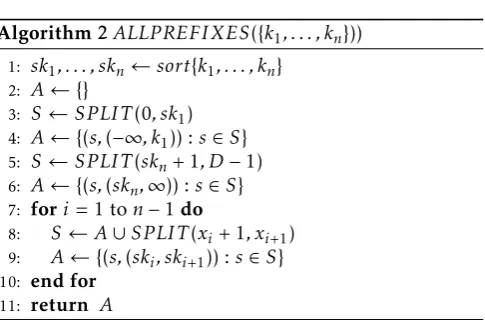
We now turn our attention to generating all interesting intervals for a set of key values K =
{k1, . . . , kn}. If we assume these keys are sorted, then
this partitions the key space into intervals [0, k1],[k1+
1, k2], . . . ,[kn−1+ 1, kn],[kn+ 1, D−1]. Notice that all
points in the interval [ki+ 1, ki+1] all share the same nearest predecessor and successor. This algorithm simply sorts the points and calls the previous algorithms to find all interesting prefixes. The details are in Algorithm2.
4.3. Data Structure 1: Avoiding duplicate queries
Two problems with the previous approach involve the client asking duplicate queries when processing two distinct nn queries. To be able to overcome the problems, the client needs to be able to determine (for the current query): i) the longest common prefix with any previously issuednnquery in the query phase, and ii) has the prefix group of the current query already been obtained.
5 EAI Endorsed Transactions on
Collaborative Computing 06 -10 2014 | Volume 01 | Issue 2 | e3
Figure 1. Interesting prefixes for {2,6,7,11} shown as the grey nodes
Algorithm 2ALLP REFIXES({k1, . . . , kn}))
1: sk1, . . . , skn ←sort{k1, . . . , kn} 2: A← {}
3: S ←SP LIT(0, sk1)
4: A← {(s,(−∞, k1)) :s∈S}
5: S ←SP LIT(skn+ 1, D−1)
6: A← {(s,(skn,∞)) :s∈S}
7: fori= 1 ton−1do
8: S ←A∪SP LIT(xi + 1, xi+1)
9: A← {(s,(ski, ski+1)) :s∈S}
10: end for 11: return A
Specifically, we desire a data structure with the following three operations:
1. insert(q, mp, np, ns) this inserts the results of a
previous query nn(q). This stores: i) mp: the matching prefix ofq, ii)npthe nearest predecessor ofq, and iii)nsthe nearest successor ofq.
2. get(q) this returns a tuple (L, nn) where L is the length of the longest common prefix between q and any previous query, andnnis null if the prefix group containing q has not been queried, but is the nearest neighbors, (np, ns), for q if the query group has been found.
3. initializeCommonQuery() This initializes the data
structure to an empty structure.
The following theorem states this requires the ability to find the nearest successor and predecessor of the current query over all previously asked queries.
Theorem 2.Given a set of queries S ={s1, . . . , sn} and
a query q, the longest common prefix of q to any query inSis eitherq’s nearest predecessor or successor. Furthermore, if any query in S is in the same prefix group ofq, thenq’s nearest successor or predecessor is also in the same prefix group asq.
Proof:Given two bit sequencesxandy, letLCP(x, y) denote the longest common prefix between x and
y. First we show that if x≤y < z, that |LCP(x, y)| ≥ |LCP(x, z)|. Denote LCP(y, z) as c1· · ·cp. Now since
y < z, it must be that y starts with c1· · ·cp0 and
z with c1· · ·cp1. Since x≤y, x cannot start with
the prefix c1· · ·cp1, and thus |LCP(x, z)| ≤p. Now
consider, LCP(x, y), there are two cases to consider: i)
|LCP(x, y)| ≤p, in which caseLCP(x, y) =LCP(x, z), and
ii) |LCP(x, y)|> p, in which case LCP(x, y)> LCP(x, z).
In either case, the claim holds.
A symmetrical argument can be made that when
x < y≤z, that|LCP(y, z)| ≥ |LCP(x, z)|. Combining these
two things together implies that the longest common prefix in the set is either the nearest successor or the nearest predecessor of the query. This proves the first part of the theorem. The second part follows because if two queries belong to the same prefix group, then the longest common prefix in the set must also be in the
same prefix group. 2
The client maintains a local data structure that stores values of the form (q, mp, np, ns) where q is the query, mpis the prefix of theq’s prefix group,npisq’s nearest predecessor, andnsisq’s nearest successor. These values are stored in a balanced binary search tree organized by query. Given this structure the client can find the nearest neighbors of a specific query inO(logM) time.
ExampleSuppose that we use the example in Figure
1. Suppose that in a query phase a client first issues a query for 8, then the the client searches for prefixes 1, 10, 100, and 1000. It finds a match at prefix 10, and learns the nearest neighbors are (7,11). Suppose that the client then asks query ns(13). In this case the prefixes would be 1, 11, 110, and 1101. The client must avoid asking for the query 1, since the client has already asked this query in this phase. Thus the client asks for 11, 110, and 1101 along with a fake miss. The prefix 11 is the only match, and the client learns that 13’s nearest neighbors are (11,∞). Finally, suppose that the client
issues query ns(9). The prefix groups would then be 1,10,100,1001. The first three of these groups have been asked by the client. Furthermore, the prefix group 10 is in the setS, and it indicates the nearest neighbors of 9 are (7,11). Thus the client issues queries 1001, two fake
6 EAI Endorsed Transactions on
Collaborative Computing 06 -10 2014 | Volume 01 | Issue 2 | e3
misses, and a fake hit. The fake hit is necessary to ensure that the server sees exactly one match in its dataset.
4.4. Data Structure 2: Handling Changes
The purpose of this data structure is to keep track of changes that have been made during a query phase. There are two main challenges: i) returning the correct answers in the rest of the query phase, ii) including the updates in the stored data in the rebuilding phase.
The main idea is that the client will keep track of all intervals where it knows the answer. That is, for everynn(q) query, the client learns an interval (np, ns] that containsq, and each value in (np, ns] has the same nearest neighbors. Furthermore, all points outside of the interval (np, ns] do not have the exact same nearest neighbors. This data structure will keep track of all such intervals that the client learns during the query phase. When modifying the dataset, the client will modify the local data structure, but leave the server’s data (and its data from the first data structure unchanged). Hence, if this second data structure contains information about a specific interval. then this is considered more current than the values stored at the server. One could think of this data structure as a change log during the query phase.
We now give the details of insert and delete at a high level. To process a queryinsert(q), first the client performs a nn(q) query. Thus the interval containing this value will be in the local storage. Suppose that this interval is (np, ns]. The inserted value splits this interval into at most two intervals, and these intervals will replace the previous interval. That is, the process creates the intervals (np, q] and (q, ns].
To processremove(q), the client will query the server for the removed value, and will thus have the interval containing the removed value in its local storage. Suppose this interval is (np, ns]. Ifq,ns, then nothing has to be done. However, ifq=ns, then the client will have to mark the value ns as removed. A difficulty arises when a client queries a point inside of an interval where the end point has been removed, e.g., if the client later issued a query in the interval (np, ns] afternswas removed. In this case, the client would know that the answer provided by the server is stale, but would not know the correct answer. To overcome this problem, the client first checks the second data structure to determine if this will be a problem. If so, then the client issued a query for the next interval. That is, in our example, the client would issue a querynn(ns+ 1) instead of nn(q), and this will return the new nearest successor.
Specifically, the data structure will keep track of a set of intervals. An interval [x, y] means that any point in the interval (x, y] has x as its nearest predecessor and y as its successor. An interval is either marked
valid or invalid. An interval is valid if y has not been removed and is invalid otherwise. Note that we ensure that the only points that are removed are endpoints of some interval in the client’s structure. There are several operations that we want to perform with this structure, including:
1. (ns, np, valid)←lookup(x): This searches the
interval list to find the interval containingxin the structure. If no such interval exists, then return null. Otherwise, if x is in a valid interval [y, z], then return (x, y, true). Otherwise, if x is in an invalid interval [y, z], then return (x, y, f alse).
2. insertP oint(x): This has a precondition that there
exists a valid interval containingx, let this interval be (y, z]. This interval is replaced with two valid intervals (y, x] and (x, z].
3. removeP oint(x): This has a precondition that there
exists a valid interval containingx, let this interval be (y, z]. If x,z, then do nothing. Otherwise, mark this interval as invalid.
4. insertInterval(x, y) This assumes that the interval
(x, y] does not overlap any current interval. If there is an invalid interval (z, x], then this replaces this interval with a single valid interval (z, y]. Otherwise, this adds a single valid interval (x, y].
5. The existence of an iterator function that allows us to iterate over all intervals in the structure (touching each interval once). This is encapsulated by the functionsf irst() which starts the iterator, and next() which returns the next interval (and null if no such interval exists).
6. An initialization method, initIntervalDS() that initializes an empty data structure.
The above data structure is straightforward to build using a balanced binary search tree (sorted by interval end point). If there are M intervals, then this structure has size O(M). In this case lookup, insertions, and removals can be processed inO(logM) time. Furthermore, iterating over all intervals requires O(M) time.
4.5. Putting Pieces Together
We are now ready to put all of the pieces together and give a detailed description of the system. We begin by highlighting the main ideas:
1. The data owner stores all interesting prefixes and their nearest predecessors and successors for that prefix, using similar techniques as [7]. That is, for the tuple (p,(p, np, ns)) we store
(Ff k(p), Encek(p, np, ns)) at the server. To process a
7 EAI Endorsed Transactions on
Collaborative Computing 06 -10 2014 | Volume 01 | Issue 2 | e3
query, the data owner will query all prefixes of the query in parallel.
2. The data owner uses the data structure outlined in section 4.3 to maintain information about previous queries. This is used to prevent the data owner for asking about the same prefix multiple times, and to know when a dummy record needs to be queried (i.e., has the interesting prefix for the query already been queried).
3. The data owner uses the data structure outlined in section 4.4to maintain information about the changes that have been made during the query phase. This is used during the query phase to ensure that the responses include the recent changes.
4. During the rebuild phase, all of the changes in the second data structure are stored on the server. Like [7] all of the values are randomly permuted (using the Buffer Shuffle techniques) to obfuscate the relationship between queries in different query phases.
Table1describes the notation used in the protocols. It is worth discussing the various input values for the PRF that are used. Specifically, we use a PRFF:{0,1}κ×
{REAL, DUMMY , MISS, PAD} × ∪Q
i=1{0,1}i → {0,1}κ. That is, the PRF takes a message type and a variable length message (up to Q bits) as its second input. Here the value of Q is chosen such that 2Q≥
max{D, NlogD, M, MlogD}. Such a PRF can be
con-structed with an appropriate encoding scheme. We assume that encryption pads message of variable length to the same size (in this case 3 logDis sufficient), and we assume the existence of a fake messageFAKEthat can be used for padding and dummy values.
We begin with the initialization algorithm. This algorithm is done once when the system is setup. The details are in Algorithm3. The first steps (lines 1-2) is to set up the long-term encryption key and the query phase pseudorandom function key. In lines 3-13, the client generates the values that the server will store, which will consist of the PRF of a key and an encrypted message body. Specifically, lines 3-7, add all interesting prefixes to the server storage set. Since there will be at most N items, then there will be at most NlogD+ 1 interesting prefixes (see Theorem1), and thus lines 8-10 add padding to the list. Finally, 2M dummy values are added to the server set in lines 11-13. A random permutation of these values is stored in line 15. Finally, lines 15-18 initialize global variables used by the rest of the algorithms.
We now turn to the server’s main algorithm (we also require the server can stream all tuples in its data store to the data ownerMat a time). This algorithm receives
Algorithm 3IN IT(K ={k1, . . . , kn})
1: f k← {0,1}κ
2: ek←KeyGen(1κ)
3: S← {}
4: {Store values on server}
5: LetIP ←ALLP REFIXES(k1, . . . , kn)
6: for all(p,(np, ns))∈IP do
7: S←S∪ {Ff k(REAL, p), Encek((p, np, ns))}
8: end for
9: fori= 1 toNlogD+ 1− |IP|do
10: S←S∪ {Ff k(PAD, i), Encek(FAKE)}
11: end for
12: fori= 1 to 2Mdo
13: S←S∪ {Ff k(DUMMY , i), Encek(FAKE)}
14: end for
15: PermuteSand send to server.
16: DS1←InitalizeCommonQuery()
17: DS2←InitalizeIntervals()
18: queries, dumU sed, misU sed←0
a set of keys (key values that have the PRF applied to it). The server simply looks up all matching keys that are inS, and returns the messages associated with the keys. The server also returns the query index for each match, so that the client knows which queries were a match. Note that this leaks to the server the number of hits, so this can only be used when the number of hits is controllable (i.e., always the same). The details are in Algorithm4.
Algorithm 4SERV ERP ROCESS(`1, . . . , `m)
1: R← {}
2: fori= 1 tomdo 3: if∃(`i, ri)∈Sthen
4: R←R∪ {(i, ri)}
5: remove (`i, ri) fromS 6: end if
7: end for 8: return R
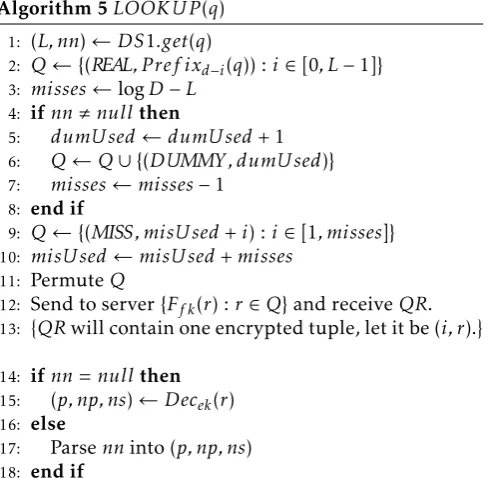
We now turn to a nearest neighbor algorithm for static data. This is used as a building block by the actual nearest neighbor algorithm. The details are in Algorithm5. The first step is to determine the longest common prefix with previous queries and to determine if the answer is known already. This is done usingDS1 in line 1. Line 2 creates the list of the longestLprefixes that have not been queried before. Lines 4-8, handle the case where the prefix group containing the query is already known. In this case, one of the misses must be a hit (in order to ensure that the server always sees a single hit), and so a dummy is added to Q, and the number of misses is decremented. Lines 9-10 add the appropriate number of misses to the query set, so that
8 EAI Endorsed Transactions on
Collaborative Computing 06 -10 2014 | Volume 01 | Issue 2 | e3
Table 1. Notation
Name Description
N Upper bound on number of keys (constant) M Queries in the query phase (constant) κ Security parameter (constant)
D Key domain size (constant and power of 2) DS1 Reference to Data Structure in section4.3
DS2 Reference to Data Structure in section4.4
f k Key for pseudorandom functionF
ek Encryption key for CPA-secure encryption
queries # of queries made during query phase.
dumU sed # of dummy queries used during query phase.
misU sed # of fake misses used during query phase.
|Q|= logD. Lines 11-12 permute the queries and send
the PRF values for each query inQto the server. If the query answer was unknown before asking the query, then lines 15 sets the nearest neighbor as the decrypted result from the server. Otherwise, line 17, uses the previous value fromDS1. In either case,DS1 is updated and the nearest neighbors are returned.
Algorithm 5LOOKU P(q)
1: (L, nn)←DS1.get(q)
2: Q← {(REAL, P ref ixd−i(q)) :i∈[0, L−1]}
3: misses←logD−L
4: ifnn,nullthen
5: dumU sed←dumU sed+ 1
6: Q←Q∪ {(DUMMY , dumU sed)}
7: misses←misses−1
8: end if
9: Q← {(MISS, misU sed+i) :i∈[1, misses]}
10: misU sed←misU sed+misses
11: PermuteQ
12: Send to server{Ff k(r) :r∈Q}and receiveQR.
13: {QRwill contain one encrypted tuple, let it be (i, r).}
14: ifnn=null then
15: (p, np, ns)←Decek(r)
16: else
17: Parsenninto (p, np, ns) 18: end if
19: DS1.insert(q, p, np, ns)
20: return (np, ns)
We now introduce the main algorithm, i.e., the nearest neighbor algorithm. This takes a query, and returns the nearest predecessor and successor of the query; the details are in Algorithm6. In line 1, this looks up the query in the interval data structure to determine if the interval of the query is already known. Note that it may be that this value is more recent than the values stored in the server, since all updates affect onlyDS2
until the rebuild phase. If the interval is known, but the interval is invalid, then this means that the nearest successor has been removed. Thus, the answer returned from the server fromq will be stale, andDS2 does not contain the correct nearest successor. To resolve this problem, line 3 changes the query to the one more than the stale nearest successor. Then line 5 either looks up the query or the modified query, using Algorithm 5. This new interval is added toDS2, which means that a valid interval containing q is now in DS2. Thus we lookupq in DS2 (in Line 7). Finally, we increment the number of queries and return the appropriate nearest predecessor and successor.
Algorithm 6N N(q)
1: (np, ns, valid)←DS2.lookup(q)
2: if(np, ns, valid),nullANDvalid=f alsethen
3: q←ns+ 1
4: end if
5: (np0, ns0)←LOOKU P(q)
6: DS2.insertInterval(np0, ns0)
7: (np0, ns0, valid)←DS2.lookup(q)
8: queries←queries+ 1
9: return (np0, ns0)
The algorithm for insertion (resp. removal) are given in Algorithm7(resp.8). In both algorithms, the client uses the nearest neighbor algorithm. Then insertion simply inserts the new point into DS2, and removal simply removes the query fromDS2. Note that in both cases the precondition is met, because N N(q) ensures that a valid interval containingqis inDS2.
Algorithm 7Insert(q)
1: N N(q)
2: DS2.insertP oint(q)
9
We now turn our attention to the rebuilding phase
(this is triggered when
queries
= M). We first present
EAI Endorsed Transactions on Collaborative Computing 06 -10 2014 | Volume 01 | Issue 2 | e3
Algorithm 8Remove(q)
1: N N(q)
2: DS2.removeP oint(q).
a helper algorithm that ensures all intervals in the interval structure, DS2, are valid. This is important, because any invalid interval corresponds to a situation where an endpoint has been removed, but the client doesn’t know what the actual endpoint should be. Lines 1-6 iterate through all intervals inDS2 and for every invalid interval, it adds a query to Q that will make the interval valid (once we know the interval for the query). To hide the number of invalid intervals from the server, lines 8-10, pad the query set with to containM points (there are at mostM invalid intervals, because each remove can invalidate at most one interval). The padded points are dummy points, because they need to be hits on the server. This is the reason for needing 2M dummies,M to answer queries and andM for the rebuild phase. The client computes the PRF of all points inQand sends them to the server in a random order in line 11. Lines 12-15, process each non-dummy return value by adding it toDS2. This will validate all intervals inDS2.
Algorithm 9V alidateAllIntervals()
1: DS2.f irst()
2: Q← {}
3: while((x, y, valid)←DS2.next()),null)do
4: ifvalid = falsethen
5: Q←Q∪ {(REAL, y+ 1)}
6: end if 7: end while
8: fori= 1 toM− |Q|do
9: Q←Q∪ {(DUMMY , dumU sed+i)}
10: end for
11: Send{Ff k(q) :q∈Q}to server in random order.
12: for allEntry (i, ri) corresponding to non-dummydo
13: (p, np, ns)←Decek(ri)
14: DS2.insertInterval(np, ns)
15: end for
The main idea of the rebuild phase is to rewrite all NlogD+ 1 + 2M values to the server and then to reshuffle all of the buffers (the reshuffling is the same as in traditional OS). The client suspends execution of queries, and then chooses a new PRF key (lines 1-3). The client initializes some values, including:pref ixSet which is a set of prefixes to be written and padW rite which is how much padding has been written (lines 4-5). The client then validates all intervals in DS2 (line 6). After this has been done, the client streams (by streams we mean that the client obtains M records at a time from the server, in order to prevent the
client from having to store more thanO(M) things) the remainingNlogD+ 1 entries from the server. For each entry, there are several cases: i) the interval specified by the prefix is not contained in DS2, i) the interval specified by the prefix is contained in DS2, iii) the tuple is a dummy or padding tuple. In the first case (line 27), the client simply re-encrypts the tuple (as it has not changed). In the other cases, the client throws the old tuple away, and builds a new tuple. To build this new tuple, the client first writes out all interesting prefixes in DS2. After all of these values have been written, then padding is written. After going through all NlogD+ 1 tuples, the server has all interesting prefixes and the appropriate amount of padding. Then 2M dummy values are written (lines 31-33). After writing all of these entries, global variables are re-initialized (lines 36-38). All of the values are permuted using the techniques of [7], and then query processing is resumed.
4.6. Analysis
The client’s storage is determined by the size ofDS1 and DS2. For each nearest neighbor query, there is at most 1 thing inDS1, and thus its size isO(M). Furthermore, DS2 has at most 2M intervals, and thus its size isO(M). The client has to storeO(logD) bits, and thus its total storage isO(MlogD).
The server has to store O(NlogD+M) items, and each has size O(max{κ,logD}). Since κ is a constant
and M << N, then the server’s total bit storage is
O(Nlog2D).
The communication to process an insert, remove, or nn query is O(1) for both the client and the server. Furthermore, the communication isO(1).
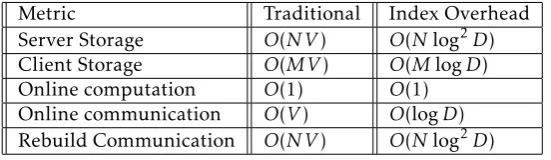
The computational cost of the rebuilding phase is O(NlogD), and the communication cost isO(Nlog2D). It is worth comparing this solution to the original cost of OS, to determine the overhead of the nearest neighbor capabilities. HereV is the size of the messages associated with the keys. It is clear from the table that the overhead is dictated by the relationship betweenV and log2D. There are many application with small key size (for example a key size of 8 bytes may be sufficient in many contexts). However, in many applications the sizes of the messages are large (the simulations used in [7] varied V from 1KB to 64 KB). In either case the O(Nlog2D) is dominated by O(N V). Hence, the overhead added by the current approach is modest when compared to OS.
5. Summary
In this paper, we introduced an oblivious index that extends oblivious storage to support nearest neighbor queries. In realistic settings, the proposed index
10 EAI Endorsed Transactions on
Collaborative Computing 06 -10 2014 | Volume 01 | Issue 2 | e3
Table 2. Comparison between the Original Scheme and the Index Overhead
Metric Traditional Index Overhead
Server Storage O(N V) O(Nlog2D) Client Storage O(MV) O(MlogD) Online computation O(1) O(1) Online communication O(V) O(logD) Rebuild Communication O(N V) O(Nlog2D)
Algorithm 10rebuild()
1: {Triggered whenQUERIES=M} 2: Suspend query processing
3: f k0←P RF.Gen(1κ)
4: pref ixSet← {}
5: padW rite←0
6: validateIntervals()
7: DS2.f irst()
8: {Start streaming remaining records from server} 9: for all(Encek(p, np, ns) in Server storagedo 10: Decrypt to obtain (p, np, ns)
11: if (p,np,ns)=FAKE OR DS2.containsPoint(ns) then
12: ifpref ixSet={}then
13: interval←DS2.next()
14: ifinterval,nullthen
15: pref ixSet←SP LIT(interval)
16: end if 17: end if
18: ifpref ixSet,{}then
19: Pick (p2, np2, ns2) frompref ixSet
20: pref ixSet←pref ixSet− {(p2, np2, ns2)}
21: (k, v)←((REAL, p2),(p2, np2, ns2))
22: else
23: padW rite←padW rite+ 1
24: (k, v)←((PAD, padW rite), FAKE)
25: end if 26: else
27: (k, v)←(p, np, ns)
28: end if
29: Send server (Ff k0(k), Enc
ek(v)) 30: end for
31: fori= 1 to 2Mdo
32: (k, v)←((DUMMY , i), FAKE)
33: Send (Ff k0(k), Encek(v)) to server.
34: end for 35: f k ←f k0
36: queries, dumU sed, misU sed←0
37: DS1←InitalizeCommonQuery()
38: DS2←InitalizeIntervals()
39: Shuffle servers storage as in [7]
40: {Note the above changes the value off k} 41: Resume query processing
introduces a small overhead, when compared to the original oblivious data store. Future work includes:
1. Implementing the index and determining actual overhead for realistic loads.
2. Extending a miss-intolerant OS to a miss-tolerant OS using these techniques. It is straightforward to do this for get, but less so for insert and remove.
3. Extending the semantics further to include range queries, range count and aggregate queries. A straightforward way to do range queries is based on nn query: the client partitions the key domain into O(
√
N) intervals, stores a key value pair for each one as (lef t_endpoint,
(values_inside_interval, right_endpoint)), and
builds the nn search index over all the left endpoints. To query for a range [a, b], the client queries for the nearest left endpoint of a and gets all the values in the interval, and continues fetching the next interval by a nn query for the current interval’s right_endpoint+ 1 until exceedingb. Range count and aggregate queries could also be done in a similar way. However, this will increase the local storage at the client toO(N0.75) , so future work could focus on these semantics without increasing the storage.
5.1. Acknowledgements
Portions of this work were supported by National Sci-ence Foundation Grants CPS-1329979, CNS-0915436, Science and Technology Center CCF-0939370; by an NPRP grant from the Qatar National Research Fund; and by sponsors of the Center for Education and Research in Information Assurance and Security. The statements made herein are solely the responsibility of the authors.
References
[1] Apache Software Foundation (2014) Apache HBase home. URLhttp://hbase.apache.org/.
[2] Boneh, D.,Mazieres, D.andPopa., R.A.(2011)Remote
oblivious storage: Making oblivious RAM practical. Tech. rep., CSAIL, MIT.
11 EAI Endorsed Transactions on
Collaborative Computing 06 -10 2014 | Volume 01 | Issue 2 | e3
[3] Gentry, C.,Goldman, K.,Halevi, S.,Julta, C.,Raykova, M.andWichs, D.(2013) Optimizing ORAM and using it efficiently for secure computation. InPrivacy Enhancing Technologies(Springer Berlin Heidelberg),7981, 1–18. [4] Goldreich, O. (1987) Towards a theory of software
protection and simulation by oblivious rams. In
Proceedings of the 19th annual ACM Symposium on Theory
of Computing, STOC ’87 (New York, NY, USA: ACM):
182–194.
[5] Goodrich, M.T.andMitzenmacher, M.(2011) Privacy-preserving access of outsourced data via oblivious RAM simulation. InProceedings of the 38th International Conference on Automata, Languages and Programming -Volume Part II, ICALP’11 (Berlin, Heidelberg: Springer-Verlag): 576–587.
[6] Goodrich, M.T., Mitzenmacher, M., Ohrimenko, O. andTamassia, R.(2011) Oblivious ram simulation with efficient worst-case access overhead. InProceedings of the 3rd ACM workshop on Cloud computing security workshop, CCSW ’11 (New York, NY, USA: ACM): 95–100.
[7] Goodrich, M.T., Mitzenmacher, M., Ohrimenko, O. andTamassia, R.(2012) Practical oblivious storage. In
Proceedings of the 2nd ACM Conference on Data and
Application Security and Privacy, CODASPY ’12 (New
York, NY, USA: ACM): 13–24.
[8] Hacigümüs, H., Mehrotra, S. and Iyer, B.R. (2002) Providing database as a service. In 18th International Conference on Data Engineering(IEEE): 29–38.
[9] Knuth, D.E. (1973) The Art of Computer Programming,
Volume III: Sorting and Searching(Addison-Wesley). [10] Kushilevitz, E.,Lu, S.andOstrovsky, R.(2012) On the
(in)security of hash-based oblivious RAM and a new balancing scheme. In Proceedings of the 23rd Annual
ACM-SIAM Symposium on Discrete Algorithms, SODA ’12
(SIAM): 143–156.
[11] Li, J.andOmiecinski, E. (2005) Efficiency and security trade-off in supporting range queries on encrypted databases. In Data and Applications Security XIX
(Springer): 69–83.
[12] Shi, E., Chan, T., Stefanov, E. and Li, M. (2011) Oblivious RAM with ø(log3n) worst-case cost. In
Advances in Cryptology-ASIACRYPT’11(Springer), 197–
214.
[13] Stefanov, E.,van Dijk, M.,Shi, E.,Fletcher, C.,Ren, L., Yu, X.andDevadas, S.(2013) Path ORAM: An extremely simple oblivious ram protocol. In Proceedings of the 2013 ACM Conference on Computer and Communications
Security, CCS ’13 (New York, NY, USA: ACM): 299–310.
[14] Vimercati, S.D.C.D.,Foresti, S.,Jajodia, S.,Paraboschi, S. and Samarati, P. (2007) Over-encryption: Manage-ment of access control evolution on outsourced data. In
Proceedings of the 33rd International Conference on Very
Large Data Bases(VLDB endowment): 123–134.
[15] Williams, P.,Sion, R.andCarbunar, B.(2008) Building castles out of mud: practical access pattern privacy and correctness on untrusted storage. In Proceedings of the 15th ACM Conference on Computer and Communications
Security, CCS ’08 (New York, NY, USA: ACM): 139–148.
[16] Xiao, L. and Yen, I.L. (2012) Security analysis and enhancement for prefix-preserving encryption schemes.
IACR Cryptology ePrint Archive2012: 191.
[17] Yiu, M.L., A., I., Jensen, C.S. and Kalnis, P. (2012) Outsourced similarity search on metric data assets.IEEE Trans. Knowl. Data Eng.24(2): 338–352.
[18] Yiu, M.L.,Ghinita, G.,Jensen, C.S.andKalnis, P.(2009) Outsourcing search services on private spatial data. In
25th International Conference on Data Engineering(IEEE): 1140–1143.
12 EAI Endorsed Transactions on
Collaborative Computing 06 -10 2014 | Volume 01 | Issue 2 | e3