www.pjbt.org ISSN Online: 2312-7791
BEHAVIOURIAL STUDY ON RC BEAM WITH SEA SHELL AS A FINE AGGREGATE SUBJECTED TO REVERSE CYCLIC LOADING
S. Veeradhithyan1 and S. Deepa Shri2
1Department of Civil Engineering, Karpagam college of Engineering, Coimbatore, Tamil Nadu, India.
[email protected], 2Department of Civil Engineering, SNS college of Technology,
Coimbatore, Tamil Nadu, India.
Article accepted 9.6.2018, Revised 18.8.2018, Accepted 27.8.2018
ABSTRACT
Concrete is the widely used material after water in the world. The word concrete denotes the coarse aggregate, fine aggregate, water and cement. There are several researches going on in the present world in the field of concrete technology. This project aims to find a solution for the exploitation of river sand and to replace with the other abundant and cost-effective material as the fine aggregate for the betterment of our society and the construction Industry. The viability of using grinded sea shell as the fine aggregate are investigated in the project. The grinded sea shell is replaced in the place of river sand in the percentage of 20,40%,60%,80%,100%. There is promising increasing in the strength of the specimen in all the percentage when compared to that of the conventional. The maximum strength is obtained for the replacement of 80%. The further investigation is carried with the aid of RC Beam subjected to Reverse cyclic loading. The optimum percentage (80% Sea shell + 20% river sand) is found out and the beam is cast and subjected to loading and the corresponding deflection is noted down. The parameters like ultimate load carrying capacity, energy absorption, ductility factor, stiffness and the maximum deflection is studied.
Key Words: Sea shell, River sand, Ductility, Energy absorption
I- INTRODUCTION
India is a developing country and its popula-tion is increasing day by day. This causes the cit-ies and town to develop and change into concrete buildings. The development causes the depletion of the ingredients of the concrete which are avail-able naturally like river sand (Fine aggregate) and stones (Coarse aggregate) beneath the earth. The exploration of gravel or coarse aggregate causes severalassociatedproblemslike minor earth quake, landslides, land subsidence etc. [Chakravarthy and Mutusva, 2015] The depletion of river sand causes day to day problem in our lifestyle and habits. It is roughly estimated by government of India that about 90% of the construction works happening in India are using river sand as the fine aggregate. The forceful depriving of river sand causes the water to runoff without infiltrating into the surf-ace. The illegal mining of sand causes revenue loss for the government. Moreover, the process of accumulation of sand on the banks of river are million years old, the greed of development cau-ses to deplete the invaluable resource within a
short time-frame. There is a popular saying “
Any-thing in the world is enough for man’s need but not for man’s greed”. It is turn of Engineers to suggest an alternative for the river sand. It is feet that, this this project will serve as an alternative for the river sand.
The project attempted to replace the grinded sea shell as the replacement as a fine aggregate in concrete. The sea shell obtained is taken from the
coast of Arabian sea at Kerala, India. The appea-rance of sea shell before grinding are shown in the figure-1.
Fig-1: Sea shell before grinding
ine ion which gets stick to it due to the constant contact of sea water. We have managed to grind the shell at a rice mill.
II-EXPERMENTAL PROGRAM
The grinded sea shell is made to size below 4.75mm. The colour of the shell after grinding is of dirty white. The texture observed after grinding is Flaky and elongated and not round as in the case of river sand. The sieve analysis test is carried, and it is found that the grinded sea shell confining to Zone-II aggregate. The other parame-ters like Specific Gravity, Fineness Modulus, per-centage of Water absorption are 2.21, 2.95, 1.3% respectively. The chemical composition of the grinded sea shell obtained are given below:
Table-1: Composition of Sea Shell
Generally, the sand is used to fill the voids of the bonded coarse aggregate and acts as the filler materials in concrete. The elongated shape of the grinded sea shell helps to fill the internal voids of the concrete in the effective way. On considering the chemical properties of the sea shell, the major portion of the weight is made up of calcium oxide. As the proportion by weight of the grinded sea shell is largely composed of CaO, it helps in the reaction with water (H2O), forming the C-S-H gel thus in turn help in the increase in the strength of the concrete. Yet there is the fact that size of the particles is inversely proportional to strength dev-eloped due to the formation of C-S-H gel [Mages-wari, et al., 2016]. It is believed that there will be considerable increase in the strength of the speci-men on replacespeci-ment.
III- TEST SPECIMENS: The plan is to replace the grinded sea shell as fine aggregate in concrete in 0%,20%, 40%,60%, 80%, 100% in the specimens like cube, cylinder and prism. The 0% denotes the conventional spe-cimen used to compare the properties with the rest of the
specimens. The cube specimen of size
150x150x150mm are cast to find out the charac-teristic compressive strength (fck) of concrete. The cylindrical specimen of 300x150 mm (l/d ratio is 2) are cast to find out the split-tensile strength of the concrete. The prism of size 500 x 100 x 100mm are cast to flexural strength of concrete. The optimum mix proportion is found out and that concrete mix is used to cast as the RC beam. The RC beam is of length 1.5 m, brea-dth 100mm and
depth 150mm. The G+5 storey equal bay commercial building is analysed and designed using the software STAAD Pro and MS Excel respectively as per IS 456, IS 13920 and the loading conditions are as per the IS 875. The prototype is scaled down to 1/5 th of the size as per law of simulation to suit the specimen to be tested in the laboratory [Ramadevi and Deepa Shri, 2015]. The reinforcement diagram of the beam which are used are given in figure-2.
Fig-2: Reinforcement diagram of the beam
IV- TEST SETUP
The RC beam specimen is made to test under two-point loading in the loading frame of capa-city 100 tonne. The mechanical method of load-ing is given to the beam. The mechanical jack is made to fix with the proving ring of 500 kN Capacity and the load is distributed to the length / 3 rd point of the beam by a I section placed under the proving ring and then the load from the I – Section is transferred by specially welded plate with the reinforced bar. The deflection is measured by means of the LVDT and by dial gauge. The illustration diagram of the load setup and arrangement to note down the load vs defection is given in the figure-3.
Fig-3: Test setup of the beam
V-CASTING AND CURING: The concrete mix of ratio 1:2.6:4 is arrived based on the mix design. To optimize the cost of the concrete the cement content is reduced to about 320 kg/m3. The water/ cement ratio is designed as 0.5. The grinded sea shell is replaced in 20%, 40%, 60%, 80%, 100% Composition Percentage of weight
CaO 63.21
SiO2 18.55
Al2O3 6.13
in the specimens of cube, cylinder and prism. The curing method adopted is water bath curing met-hod. The look of the specimens at curing is given in the figure-4
Fig -4: Curing of cube specimens
VI- TESTING OF SPECIMENS
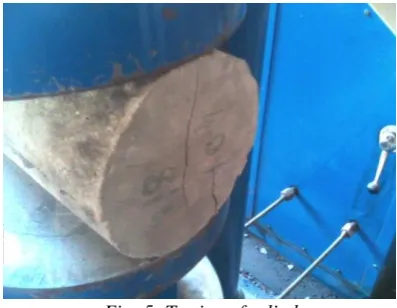
The cube, cylinder and the prism are tested, and the optimum replacement value is found to be at the replacement of grinded sea shell of about 80%. The addition in the sea shell reacts with the concrete at minute quantity and thus showed the increase in the strength. Moreover, the angular aggregate help in the effective filler of voids of the concrete which can also be said as the reason for the increase in the strength. The testing of the Cylinder to find out the split-tensile strength is shown in the figure -5
Fig -5: Testing of cylinder
The test result shows that the 80% replacem- ent of the sea shell in the place of river sand have acquired more strength than that of the other pro-portions. The RC Beam is cast with the 80% repl-aced sea shell as per the reinforcement details given in the figure-2. The real time image of the beam testing under the loading frame is shown in figure-6.
Fig -6: Testing of RC Beam (80% Sea sand)
Load- Deflection: The conventional beam and the
beam with 80% replaced sea shell are cast and are made to test under the loading frame. The load is given manually, and the corresponding deflection is obtained and noted down. This project aims to test the specimen to the abnormal loads hence the beam is tested for reverse cyclic loading subjected to earthquake. The load vs defection of the conv-entional beam under reverse cyclic loading for every cycle is marked with colour variation is given in figure-7.
Fig-7: Load- Deflection curve for conventional beam under reverse cyclic loading.
The load- deflection curve for the reverse cyclic loading is obtained for the specimen with the 80% sea shell as the fine aggregate and it is given in the figure-8
The inferred values which are taken from the load vs deflection curve are made for easy comparison are given below:
The Ultimate load of
Conventional beam : 43.5kN
S-80 beam : 51kN
Initial crack load of
Conventional beam : 20kN
S-80 beam : 21kN
Energy Absorption: The area enclosed in the
hysteresis loop is the measure to find out the energy absorption capacity. The cumulative energy absorption is given by the summation of the total energy absorption in each cycle.
The Cumulative energy absorption of
Conventional beam : 258kN-mm
S-80 beam : 382kN-mm
There is a very good increase in the value of the energy absorption in the beam with 80% repla-ced sea shell. The chart showing the cumulative energy absorption for the beam with 80% replaced sea shell are explained in figure-9.
Fig-9: Cumulative energy absorption curve for S80 beam
Stiffness: Stiffness is defined as the load required
to cause unit deflection. The stiffness is obtained by the slope of the load-deflection curve.
The Stiffness of
Conventional beam : 6.1 kN/mm
S-80 beam : 5.7 kN/mm
Ductility Factor: Ductility is the ability of the
material to undergo inelastic deformation after the yield point without the sudden failure. In the ear-thquake analysis the ductility plays an important role as it is the factor which gives amble warning for the people to come out of the house.
Ductility factor of
Conventional beam : 9.08
S-80 beam : 9.83
Deflection: Deflection is the strain that the
specimen is subjected to when the load is acting on specimen the specimen.
Maximum Deflection of
Conventional beam : 11.25 mm
S-80 beam : 12.98 mm
Failure Pattern Study: The failure pattern of both
the case of the beam appear to be same i.e flexural failure [Thenmozhi and Deepa Shri, 2012]. The several flexural cracks start to appear after the initial crack load. On reaching the ultimate load the beam attained a concavity upwards bending. In both the cases the flexural crack dominated with very minor shear cracks starts to appear while reaching the ultimate load. The failure pattern of the conventional beam is shown in the figure-10.
Fig-10 Failure pattern of the conventional beam
VII- CONCLUSIONS
This project, replacement of sea shell as fine aggregate has finally resulted in the increase in the strength of concrete to a high extend. The strength increases in found not only in compression, but it follows the same in split-tensile and in flexural strength. The max % of successful replacement is found in 80% which mark the maximum strength value in all three forms of strength (viz) compres-sion, split-tensile, flexural. This increase in stren-gth clearly shows, the sea shell not only acts as the binder in the concrete, but it starts to react with the cement which is understood by the rapid increase in the strength. It is observed the speci-mens especially beam was subjected to calcina-tion. It is being concluded that addition of sea shell increases strength in all replacement and this could be done practical solution to avoid the exp-loitation of river sand.
REFERENCES
Agbede, O.I. and J. Manasseh, Suitability of peri-winkle shell as partial replacement for river gravel in concrete. Leonardo Electron. J. Pract. Technol. 15: 59–66 (2009).
Bharathi, R.Y., S. Subhashini, T. Manvitha and S. H. Lessly, Experimental study on partial repl- acement of coarse aggregate by seashell & partial replacement of cement by flyash. Int. J. Latest Res. Eng. Technol. 2(3): 69–76 (2016). Chakravarthy H.G.N. and T. Mutusva, Investiga-
tion of properties of concrete with seashells as a coarse aggregate replacement in concrete. Int. J. Sci. Technol. 1(1): 285–295 (2015).
Mageswari, M., C.R. Manoj, M. Siddarthan, T.P. Saravanan and G. Princepatwa, To increase the strength of concrete by adding seashell as admixture. Int. J. Adv. Res. Civil Struct. Envi-ron. Infrastruct. Eng. Dev. 2(2): 165–174 (2016).
Ramadevi, K. and S. Deepa Shri, Flexural behave- our of hemp fiber reinforced concrete beams. ARPN J. Eng. Appl. Sci. 10: 1819–6608 (2015)