Journal
of
Education
&
So
cial
Sciences
ISSN: 2410-5767 (Online) ISSN: 2414-8091 (Print)
Academic Research in Collaborative Learning
Environment: Evidence from a Developing
Country
Affiliation:
Farwa Abbas
Senior Lecturer, Bahria University, Karachi. E-mail: [email protected] Syed Tehseen Jawaid
Assistant Professor / Research Economist, Applied Economics Research Centre, University of Karachi, Karachi. E-mail: [email protected]
Manuscript Information
Submission Date: September 29, 2019
Acceptance Date: November 20, 2019
Publication Date: December 24, 2019
Citation in APA Style:
Abbas, F., & Jawaid, S. T. (2019). Academic Research in Collaborative Learning En-vironment: Evidence from a Developing Country,Journal of Education & Social Sci-ences, 7(2), 47-66.
DOI:https://doi.org/10.20547/jess0721907204
Academic Research in Collaborative Learning Environment: Evidence
from a Developing Country
Farwa Abbas∗ Syed Tehseen Jawaid†
Abstract:Research is getting enormously important to compete with rival institutes for ranking, finan-cial funding, students enrollment. However, there still exist numerous gaps in our understanding of creating a knowledge generating environment that will produce superior quality research. With the initiation of web 2.0 technology, a model of social networking sites has become increasingly famous. With ever increasing popularity, these social media have been used by researchers and academicians as well to enrich the learn-ing outcome and academic performance. However, OSNS have been a debatable topic in academia with its impact on the academic performance of the students. In this study, the impact of OSNS is investigated on the research performance of students in Pakistan. The survey questionnaire technique is used to gather the data from a sample of 212 research students. And to testify the hypothesis, factor analysis and regression analysis technique are used. The results showed a contradiction in the perception and behavior of the research students. Perceived usefulness of OSNS, information quality and media sharing via OSNS have proved to have a positive impact on the researcher’s performance whereas collaboration has a negative impact; perceived behavior and facilitation support have an insignificant impact on researcher’s performance. It is suggested to the researcher and supervisor both to consider the implication of OSNS in research work for better research output.
Keywords:Social media, research, Facebook, Web 2.0 technology, educational research.
Introduction
Research is getting enormously important to compete with rival institutes for ranking, financial funding, students enrollment. Cheol Shin, Jeung Lee, and Kim (2013) resem-ble the competition among the universities for better ranking with the competition in Olympics and articulate that quality research has become an indicator in the matter of global rankings and topnotch universities. Similarly, Fussy (2019) states that research are the prominent agenda at the global, regional and national policies and reforms plat-forms due to the fact that it bridges the gap between academic fraternity and community services. M.-C. Yu, Wu, Alhalabi, Kao, and Wu(2016) also mention that research perfor-mance has become more important than ever before for academic institutions to compete for ranking, funding and students’ enrollment.
∗
Senior Lecturer, Bahria University, Karachi. E-mail: [email protected] †
Assistant Professor / Research Economist, Applied Economics Research Centre, University of Karachi, Karachi. E-mail: [email protected]
Sekaran and Bougie(2016) define research as a systematic and objective investigation conduct to obtain valid facts, draw conclusions and establish principles about an iden-tifiable problem in some field of knowledge. Schmidt and Graversen(2018) argue that there still exist numerous gaps in our understanding of creating a knowledge generating environment that will produce superior quality research, also mention that research excel-lence is achieved when researcher’s skills are combined with enabling research environ-ment that includes networking, cooperation, funding etc. However in doing research, a researcher has to face certain hurdles which include obtaining required literature, access-ing the target respondents for data collection, collaborataccess-ing with the fellow researchers, for expert opinions on a certain topic or on data analysis issues.
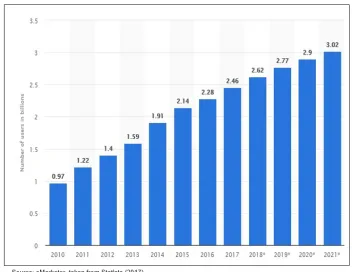
With the initiation of web 2.0 technology, a model of social networking sites has be-come increasingly famous (A. Y. Yu, Tian, Vogel, & Kwok,2010). The impact of online social networking sites (OSNSs) is profound in every aspect of society. In a report on the topic of 2018 social media latest trends, (Lau,2017) mentions that there are almost 2.5 bil-lion users of social media, businesses can no longer ignore the importance of social media, videos are the popular content to share, and user generated content can help in increasing the access and reach to the audience etc. Figure 1 shows the number of active users of social media over the years which are expected to be 3 billion by 2021.
Figure 1
Every field of work now demands a worker with social media knowledge (Preston, 2012). With the ever increasing popularity, these social media have been used by re-searchers and academicians as well to enrich the learning process. Alqahtani and Issa (2018) articulate that social networking sites have been used as academic tools to assist in creating dedicated learning groups, sharing of ideas and learning material etc. Clark, Logan, Luckin, Mee, and Oliver(2009) say these social networking sites are blurring the demarcation between the formal and informal learning.
Therefore, numbers of researches have been done to investigate the impact of these social networking sites in the field of academics. Students were found to score better in the exams when they were taught by mixed teaching methodology of traditional teach-ing method and use of Whatsapp (Nura & Ibrahim,2017). Students heavily rely on these communication technologies in order to build connections, sharing and seeking learning material, joining groups of interest. Studies depict that social networking tools provide support in the field of education by making interaction, collaboration, critical thinking, knowledge and resource sharing convenient (Mazman & Usluel,2010). In order to con-nect with each other and remain updated about university and class affairs, Facebook is being used for establishing student societies, sporting societies, and class groups (Bosch, 2009).
On the contrary there are certain researches that explore the negative correlation be-tween the academic performance and the use of OSNSs. It is argued that over-usage of social media by students may adversely affect academic performance (J. Al-Menayes, 2014;Skiera, Hinz, & Spann,2015). Students can get distracted with other entertainment content that is available on such OSNSs while using them for study purpose (Cassidy, 2006).
It is needed to place focus of research on students’ learning with commonly used tech-nologies taking social media development into account (DeBoer, Ho, Stump, & Breslow, 2014;Greenhow, Robelia, & Hughes,2009;Reich, Murnane, & Willett,2012). Recent edu-cational researches have called to focus on changing scholars practices in the era of tech-nological advancements (Greenhow, Gleason, Marich, & Willet,2017).
Majoka and Khan (2017) discuss the higher education and research in Pakistan and say that the Education Policy (2009) recommends to emphasize on research that may bring economic development to the country; encouraging universities to initiate basic re-search and development activities and endowment of rere-search grants etc. In addition, it is also recommended in the policy to integrate information and communication technolo-gies (ICTs) in teaching, learning and research to improve the communication between the teachers and researchers; enhance the distant education and easy access to scholarly material and technical resources.
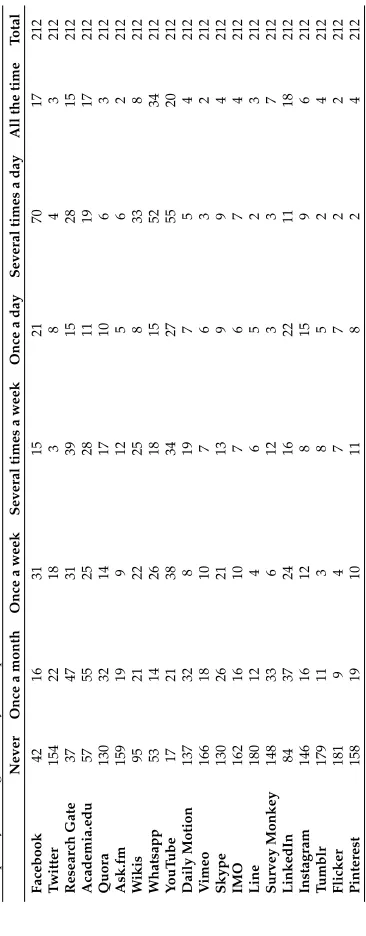
YouTube in greater frequency as compared to Twitter, Academia.edu, Qoura, LinkedIn.
Literature Review
In this section, theoretical review is elaborated, which then follows the empirical review of the related literature and development of hypothesis.
Theoretical Review
Considering all the potential benefits and short comings of the OSNSs, what makes the people use new innovative communication technologies is a question which was an-swered by the technology acceptance model (TAM) developed by Davis (1985). TAM is an extension of the earlier work ofFishbein and Ajzen(1977) who proposed the theory of reasoned action. Davis(1985) says that any individual accepts and uses new technol-ogy on the basis of its perceived usefulness and perceived ease of use. When individuals find various useful features in any application or technology, they more likely to accept it and use it. Hence, TAM is the underpinning theory in our current study. TAM permits us to investigate the perceived ease of use and perceived usefulness of OSNSs in relation with research work.
Foremost Educationist Dewey(2007) theorized that in the process of learning, stu-dents’ experiences are the significant elements. Therefore, pedagogical learning doctrine of active learning is the supporting theory for the research. Active learning is referred as collaborative learning, sharing of knowledge, self-paced and interactive learning.
Empirical Literature Review
Online Social Networking Sites (OSNS) and Academic Performance
Social media is defined by several scholars in numerous ways. Terry(2009) loosely de-fines social media as user-generated content using internet based transmitting technolo-gies, unlike traditional print and broadcast media. Similarly,Grosseck(2009) defines so-cial media as ways of communication, collaboration and sharing of information virtually through user generated content. However, there are many other definitions in different disciplines, which have attempted to define social media. Social media includes Facebook, Twitter, Google+, Whatsapp, Instagram, YouTube, Skype, Academia.com, ResearchGate, Wikis etc., these all are the platforms that offer opportunity to the users to search content, share experiences and establish relationships to serve purposes like educational or social (Jiao, Gao, & Yang,2015).
A lot of studies can be found about the association of internet and OSNSs and aca-demic performance of students with respect to class learning, sharing material and infor-mation for core courses or extra-curricular activities.
to the power users. Then the rising wave of social media took over the entire sight of researchers to focus their work on various impacts of OSNSs on the real-world affairs (Asur & Huberman,2010) with no exception to academia (Greenhow,2011;Lambi´c,2016). Lambi´c(2016) worked to identify the association between the use of Facebook for aca-demic purposes and acaaca-demic performance. Results revealed a positively moderate cor-relation between the usage of Facebook for learning. Similarly,Kirschner and Karpinski (2010) studied the impact of Facebook on the academic performance and results indicated that Facebook users had lower GPA and spent fewer hours in studying as compared to non-users. Lau(2017) worked to find out the impact of social media usage and social media multitasking on the academic performance of university students.
Communication with peers regarding educational matters, new collaborations to en-hance learning process and information sharing influence the use of Facebook for the study purpose (S´anchez, Cortijo, & Javed,2014). Hsiao, Shu and Huan (accepted manusc-ript) examined the social media and its likely effect on academic performance. They con-sidered course grades as a benchmark of academic performance and to surprise no neg-ative relation was identified between the variables. On the contrary,Al-Rahmi, Othman, and Yusuf(2015) investigated the dimensions of social media addiction among Kuwaiti students in order to identify the association with the academic performance. Results re-vealed the negative association between the social media addiction and academic perfor-mance which was measured via GPA. SimilarlyPaul, Baker, and Cochran(2012) reached on a finding that there is a negative association between the time spent on social media and academic performance.
Junco (2012) considered only Facebook to study its impact on students’ overall GPA and again a negative relation is established between the time spent on Facebook and the GPA. Though, Estus(2010) in an experimental research found that Facebook is a help-ful learning tool that enhances the class room learning experience. Mingle and Adams (2015) probed the students and heads of senior high school to find out the relation of in-volvement with social networking sites and students’ performance in terms of grammar, spelling mistakes and their grades. Results specified a negative impact on the mentioned variables. However, it was also discovered that social media can be used for educational purposes like discussion about exams, topics etc. Likewise YouTube and its use in per-forming arts was stated a useful learning tool along with the traditional learning methods (DeWitt et al.,2013).
Similarly,Michikyan, Subrahmanyam, and Dennis(2015) investigated the use of Face-book and its likely impact on academic performance. In this study the nature of FaceFace-book posts were examined over a span of 18 weeks. Researchers said that positive or negative posts by students and commenting on these posts indicate the learning experiences of students. Results showed that students tend to project their academic lives on Facebook. Students with higher GPAs project themselves positively whereas students with lower GPAs are more inclined towards negative Facebook statuses and updates in order to take out their negative learning experiences.
learn-ing methods however one of the groups was additionally provided with YouTube videos. Result depicted that, students who were given YouTube videos as an added learning aid had better concept retention as compared to the group who came across with traditional learning methods merely. It was also discovered that when YouTube videos were intro-duced as an additional learning tool, students’ passing rate increased as compared to previous years.
OSNS and Research
Sussex(2008) discussed the role of communication technologies in the supervision of re-mote research students. It was elucidated in detail that in pre internet age there were only two modes of communication possible telephone and fax to discuss the research af-fairs. But advancement in technology has made it possible to communicate in a fast and inexpensive fashion. Hence a remote research student can communicate with his/her su-pervisor at relatively faster pace and can employ rich media for communication. These technologies have made it possible to record the voice or video and retrieve it later as well. These technologies have lessened the remoteness of the remote student. Similarly, University of Arizona’s Learning Technologies Center uses wikis to assist the students who were enrolled remotely in information course from across the USA (Glogoff,2006).
At the State University of New York, the Geneseo Collaborative Writing Project de-ploys wikis for students to work together to interpret texts, author articles and essays, share ideas, and improve their research and communication skills collectively. Using wikis in this way provides the opportunity for students to reflect and comment on either their work or others (Anderson, 2006). Researchers are required to abolish the various obstacles in accessing the general public and fellow researchers. Cheol Shin et al.(2013) expressed that collaboration among researchers particularly between disciplines provide a broader perspective due to alliance of intelligence; also the rate of citation is higher for those researches that have been written with international collaboration. However, it gets difficult at times to collaborate (Page & Reynolds,2015).
Academic social networking sites like ResearchGate and Academia.edu assist the re-searchers to establish collaboration with fellow research scholars, make their own work accessible (Ebrahim,2017).
Kenchakkanavar, Hadagali, and Kashappanavar (2016) studied the Facebook usage by research scholars. This study was conducted on the research scholars belonging to faculty of Sciences. Data was collected through a questionnaire. Descriptive statistics were used to analyze the data, 70% of the research scholars agreed that Facebook has made a positive influence on their research work. It was reported that they find useful links and information related to the respective interest area on Facebook.
couple of years from print to electronic format; websites like ResearchGate, Academia.edu, LinkedIn and Google scholar etc. are developed by the researchers or academic institu-tions to foster the collaboration among the research scholars and sharing the research outcomes to gain peer recognition (M.-C. Yu et al.,2016).
Greenhow et al.(2017) used mixed methodologies to investigate the relation between social media and researchers, study was conducted on the 1st year doctoral students and it was explored that doctorate students have positive perceptions of using Twitter in or-der to seek new knowledge in the field of interest. Social media can offer opportunities to build up a network, generate and update knowledge however time investment may threaten the doctoral student’s performance. Sadruddin(2019) on the other hand, nar-rated his personal learning experience with the use of two ICT tools in post graduate distance learning program. It was mentioned that ICT tools develop the critical thinking and also facilitated the collaborative learning.
Moving further,Pirani and Hussain(2019) reported that teachers and parents recom-mend the application of technology in class room that bring multi-faceted benefits to the students. Cen, Ruta, Powell, Hirsch, and Ng(2016) discussed that computer supported collaborative learning environment signifies a new pedagogical learning approach which is delineated as enrichment of learning and knowledge of participants via technology driven communication tools. Lambi´c (2016) argued that cooperation among students helps them to transfer the knowledge and identify the deficient knowledge. These OS-NSs have made it possible to collaborate and connect synchronously or asynchronously with peers for the transference of the knowledge. Greenhow et al.(2017) considered the social scholarship of discovery in connection with open and digital technologies of com-munication (i.e. OSNSs) that facilitate the peer reviewing of published or in progress research work.
Social media serves as a broader review platform for research scholars. By posting or sharing a piece of literature with the wider audience of different genre (e.g. other scholars, teachers, policy makers, students etc.) helps to get re-sharing, commenting or criticism that ultimately transfer the knowledge or improve the knowledge. Similarly J. J. Al-Menayes(2015) investigated the effects of social media on the academic perfor-mance of researchers in an environment of collaborative learning. Data was collected through a questionnaire from a sample of researchers. Analysis revealed that introvert researchers perceive OSNSs a great help to seek collaborative learning in their research work. Also Pearson’s correlation showed that researcher’s academic performance has positive and significant correlation with perceived ease of use, with collaborative learn-ing and with perceived usefulness. At last researchers suggested employlearn-ing the OSNSs at higher education level.
In the light of previous researches and increased trend of using OSNSs to connect with faculty and establish relations with the peers, (Sheeran & Cummings, 2018) examined the relatedness of Facebook groups and students’ engagement with faculty, peers etc. Results revealed that officially designed Facebook groups improve the relationship with faculty whereas Facebook groups that have been created officially or unofficially support the students to create their connection with peers.
re-search, therefore following hypothesis is developed:
Hypothesis: Online social networking sites (OSNS) significantly impact the researcher’s per-formance.
Methodology
For this study quantitative approach has been used to explore the impact of OSNSs on the performance of a researcher. Data have been collected through a research survey questionnaire from 212 research students who are either enrolled or completed 18 years education or above and have studied research methodology course. Moreover it has been made sure that respondents must have completed one of their qualifications from Pak-istan i.e. MPhil/PhD or equivalent.
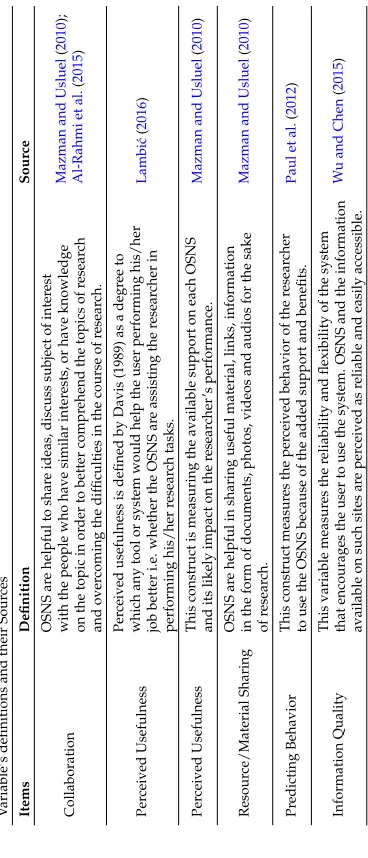
Independent variables included in the study have been adapted from earlier researches, the operational definitions and their sources are given in Table 2. On the other hand, to measure researcher’s performance GPA (marks range) in Research Methodology or rele-vant course is taken as a proxy.Al-Rahmi et al.(2015);Lambi´c(2016) have used the same procedure to determine the students’ academic performance. Later at analysis stage, an average of each marks range is calculated.
Regression Model
To estimate the effects of the OSNSs on the researcher’s performance, following regression equation has been developed,
RP =α0+β1COL+β2P U+β3F S+β4M S+β5P B+β6IQ+
Whereα0is the constant,is the error term, RP is the researcher’s performance, COL
is collaboration, PU is referring to perceived usefulness, FS is representing facilitation support, MS is media sharing, PB is perceived behavior, and IQ is information quality.
Estimations and Results
In current section demographics of respondents, data analysis procedure and results will be discussed.
Demographics
i.e. 120 whereas 56 and 36 respondents belong to Social Sciences and Natural Sciences respectively.
Table 3
Demographics of respondents
Description Frequency
Qualification
18 years of education/MPhil- Completed 60 18 years of education/MPhil- Enrolled 89
PhD-Completed 5
PhD-Enrolled 58
Gender
Male 116
Female 96
Discipline of education
Management Sciences 120
Social Sciences 56
Natural Sciences 36
Reliability Analysis
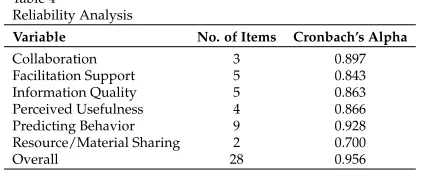
To measure the reliability of instrument and data, Cronbach’s alpha is a valid statistical tool, which determines the consistency of the items that make up a construct of interest. And make it evident that all the items within a construct are measuring the same thing. Hair, Black, and Babin(2010) say that Cronbach’s values above 0.6 are satisfactory. Ques-tionnaire that has been designed for this study contains 28 items in total (excluding items that either have low factor loading or cross loaded). Table 2 depicts the alpha values of each individual construct and overall instrument. The alpha value of each construct is in good range and the overall reliability is 0.956 which is a smart value and make it credible to go for further estimations.
Kaiser-Meyer-Olkin and Bartlett’s Tests of Sampling Adequacy
To check the adequacy of the sample collected, Kaiser–Meyer–Olkin (KMO) and Bartlett’s tests are used. KMO test measures whether each factor is having sufficient number of items to make an appropriate group.Morgan, Leech, and Barrett(2005) say that to make an appropriate group each item in a factor must have value above 0.5 else it would be assumed that number of items to make a proper group is insufficient. And for the current study as shown in table 3, KMO value is greater than 0.7 which proves that sufficient numbers of items are included in each construct to make an appropriate group.
Table 4
Reliability Analysis
Variable No. of Items Cronbach’s Alpha
Collaboration 3 0.897
Facilitation Support 5 0.843
Information Quality 5 0.863
Perceived Usefulness 4 0.866
Predicting Behavior 9 0.928
Resource/Material Sharing 2 0.700
Overall 28 0.956
Table 5
Results of KMO & Bartlett’s Tests
KMO measure of sampling adequacy 0.935
Bartlett’s test of sphericity
Approximate chi-square 4117.403
Degree of freedom 378
Probability 0.000
Total Variance Explained
Total variance explained is the indicator of useful factors (Gaur & Gaur,2006) and it shows that how much total variance explained is distributed in 6 factors. For a factor to be useful in a study the general criterion is that eigenvalues must be greater than 1.0, which shows that a factor is explaining the maximum information. Table 5 shows the percentage of variance and cumulative variance after extraction. All the six factors that have been employed in this study are explaining 70% variance approximately.
Table 6
Total Variance Explained
Items % of Variance Cumulative %
COL 46.44 46.440
PU 6.065 52.505
FS 4.913 57.418
PB 4.750 62.168
IQ 4.116 66.284
MS 3.451 69.735
*COL= Collaboration, PU= Perceived usefulness, FS= Facilitation Support, PB= Perceived Behavior, IQ= Information quality, MS= Media sharing.
Factor Analysis
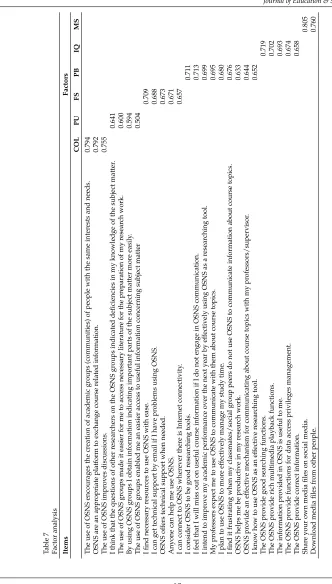
Factor analysis is a useful technique of data analysis therefore, for this study principal component method is applied. A total 34 Likert scale items were used in the questionnaire to analyze the association of social media with the researcher’s performance.
to connect with researchers and subject matter experts and discuss the matters of interest with each other, factor 2 contains items that measure the perception of a researcher about social media benefits for research, factor 3 contains 5 items that are measuring the sup-port and assistance that OSNSs offer, factor 4 includes items about researcher’s perceived behavior towards using OSNSs for the course of research, factor 5 contains items that are measuring the quality of information that a researcher gets from these OSNSs and lastly factor 6 contains the items about resource/media sharing via OSNSs.
Regression Analysis
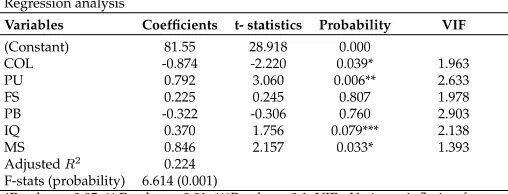
Linear regression technique is applied to test the hypothesis that has been established ear-lier. Table 7 shows the results of regression analysis, it is found that perceived usefulness and media sharing are positively and significantly associated with the dependent variable i.e. researcher’s performance as the prob. value is less than 0.001 and 0.05 with an inten-sity of 0.792 and 0.846 respectively. Whereas collaboration is significantly and negatively affecting the researcher’s performance with a value 0.874 which shows that collaboration has very strong negative impact on the researcher’s performance. On the other hand in-formation quality has significant and positive impact on the researchers performance as prob. value<0.1. However, perceived behavior and facilitation support are insignificant and have no profound impact on researcher’s performance.
Hence out of six hypotheses, three hypotheses are found statistically significant and have positive impact on researcher’s performance, however one hypothesis is statistically significant with negative impact on researcher’s performance. On the other hand, two hypotheses are found to be statistically insignificant.
Discussion
This study is conducted in the Pakistani context with an aim to identify the perception of Pakistani students regarding the acceptance of new technologies of communication in their research work. As it is very much evident that OSNSs have shorten the distances, people located at dispersed locations can collaborate with each other, discuss the prob-lems related to research projects, can collect data, may seek help from various subject matter experts in the analysis phase or in the development of the model etc. Hence we could say that OSNS may put a negative impact on the student’s academic performance at school or high school level as many researches deduce (Al-Rahmi et al.,2015;Kirschner & Karpinski,2010;Mingle & Adams,2015) but as far as research work is concerned it may be said that OSNSs are playing a positive role and a researcher could perform well when he/she has an access to OSNSs (Ebrahim,2017;Kenchakkanavar et al.,2016).
Table 8
Regression analysis
Variables Coefficients t- statistics Probability VIF
(Constant) 81.55 28.918 0.000
COL -0.874 -2.220 0.039* 1.963
PU 0.792 3.060 0.006** 2.633
FS 0.225 0.245 0.807 1.978
PB -0.322 -0.306 0.760 2.903
IQ 0.370 1.756 0.079*** 2.138
MS 0.846 2.157 0.033* 1.393
AdjustedR2 0.224
F-stats (probability) 6.614 (0.001)
*P value<0.05; ** P value<0.01; ***P value<0.1; VIF= Variance inflation factor.
The prime reason for these contradictory results of perceived usefulness and perceived behavior might be that, in Pakistan people do like to talk in person with their teach-ers/supervisor and peers to enhance the learning satisfaction. Technology acceptance is not much welcomed right away and people in Pakistan require time to get along with any new technology. Besides, research supervisors, subject matter experts or senior fac-ulty members are not very active users of OSNSs in Pakistan, another reason for this could be the differing levels of knowledge of these technology driven communication tools that supervisor and supervisee possess.
Therefore, regardless of the perceived usefulness of the OSNSs, the trend of using these sites in research is not substantial. As a result collaboration is found significant but negatively impacting the researcher’s performance as well. One possible reason for this might be the fear of ideas stealing and lack of trust by researchers on fellow researchers which make them collaborate less via OSNSs. This contradictory result of the study may be understood in the light ofCheol Shin et al.(2013) who concluded in his work that the rate of collaboration among academics is higher in developed higher education systems as compared to developing higher education systems. Furthermore, research teacher may anticipate that collaborating via OSNSs may bring workload to them due to the ease of access at any time.
Conclusion and Recommendations
Researchers and their supervisors/teachers are suggested to use OSNSs proficiently and constructively in different phases of research work, as researchers perceive OSNSs useful in their work. Proficient use of OSNSs includes establishing personal accounts on OSNSs, joining and visiting relevant research groups and platforms frequently, uploading and exchanging the useful resources and knowledge with fellow researchers. It may also help to collaborate with international researchers, in tracing out grant opportunities and call for paper opportunities in international journals.
References
Al-Menayes, J. (2014). The relationship between mobile social media use and academic performance in university students.New Media and Mass Communication,25, 23–29. Al-Menayes, J. J. (2015). Social media use, engagement and addiction as predictors of
academic performance.International Journal of Psychological Studies,7(4), 86–94. Alqahtani, S., & Issa, T. (2018). Barriers to the adoption of social networking sites in Saudi
Arabia’s higher education.Behaviour & Information Technology,37(10-11), 1072–1082. Al-Rahmi, W., Othman, M. S., & Yusuf, L. M. (2015). The role of social media for
col-laborative learning to improve academic performance of students and researchers in Malaysian higher education. International Review of Research in Open and Distance
Learning,16(4).
Anderson, T. (2006). Higher education evolution: Individual freedom afforded by educa-tional social software. Nova Science Publishers.
Asur, S., & Huberman, B. A. (2010). Predicting the future with social media. InProceedings of the 2010 ieee/wic/acm international conference on web intelligence and intelligent agent
technology-volume 01(pp. 492–499).
Bosch, T. E. (2009). Using online social networking for teaching and learning: Facebook use at the University of Cape Town.Communicatio: South African Journal for
Commu-nication Theory and Research,35(2), 185–200.
Cassidy, J. (2006). Me media: How hanging out on the internet became big business. The
New Yorker,82(13), 50.
Cen, L., Ruta, D., Powell, L., Hirsch, B., & Ng, J. (2016). Quantitative approach to collabo-rative learning: performance prediction, individual assessment, and group compo-sition. International Journal of Computer-Supported Collaborative Learning,11(2), 187– 225.
Chen, Y.-F., & Peng, S. S. (2008). University students’ internet use and its relationships with academic performance, interpersonal relationships, psychosocial adjustment, and self-evaluation.CyberPsychology & Behavior,11(4), 467–469.
Cheol Shin, J., Jeung Lee, S., & Kim, Y. (2013). Research collaboration across higher edu-cation systems: maturity, language use, and regional differences. Studies in Higher
Education,38(3), 425–440.
Chtouki, Y., Harroud, H., Khalidi, M., & Bennani, S. (2012). The impact of youtube videos on the student’s learning. In2012 international conference on information technology
based higher education and training (ITHET)(pp. 1–4).
Clark, W., Logan, K., Luckin, R., Mee, A., & Oliver, M. (2009). Beyond web 2.0: Mapping the technology landscapes of young learners. Journal of Computer Assisted Learning,
25(1), 56–69.
Davis, F. D. (1985).A technology acceptance model for empirically testing new end-user
informa-tion systems: Theory and results(Unpublished doctoral dissertation). Massachusetts
Institute of Technology.
DeBoer, J., Ho, A. D., Stump, G. S., & Breslow, L. (2014). Changing “course” reconceptual-izing educational variables for massive open online courses. Educational Researcher,
Dewey, J. (2007). Experience and education (original edition 1938). New York: Simon and Schuster.
DeWitt, D., Alias, N., Siraj, S., Yaakub, M. Y., Ayob, J., & Ishak, R. (2013). The poten-tial of youtube for teaching and learning in the performing arts. Procedia-Social and
Behavioral Sciences,103, 1118–1126.
Ebrahim, N. A. (2017).Researchgate and academia: Networks for researchers to improve research
impact.doi: 10.6084/m9.figshare.4580485.v1
Estus, E. L. (2010). Using Facebook within a geriatric pharmacotherapy course.American
Journal of Pharmaceutical Education,74(8), 1-5.
Fishbein, M., & Ajzen, I. (1977). Belief, attitude, intention, and behavior: An introduction to
theory and research. Reading, MA: Addison- Wesley.
Fussy, D. S. (2019). The hurdles to fostering research in Tanzanian universities. Higher
Education,77(2), 283–299.
Gaur, A. S., & Gaur, S. S. (2006). Statistical methods for practice and research: A guide to data
analysis using SPSS. USA: Sage.
Glogoff, S. (2006). The LTC wiki: Experiences with integrating a wiki in instruction.Using
Wiki in education.
Greenhow, C. (2011). Youth, learning, and social media. Journal of Educational Computing
Research,45(2), 139–146.
Greenhow, C., Gleason, B., Marich, H., & Willet, K. B. S. (2017). Educating social schol-ars: Examining novice researchers’ practices with social media. Qwerty-Open And
Interdisciplinary Journal Of Technology, Culture And Education,12(2), 30–45.
Greenhow, C., Robelia, B., & Hughes, J. E. (2009). Learning, teaching, and scholarship in a digital age: Web 2.0 and classroom research: What path should we take now?
Educational Researcher,38(4), 246–259.
Grosseck, G. (2009). To use or not to use web 2.0 in higher education? Procedia-Social and
Behavioral Sciences,1(1), 478–482.
Hair, J., Black, W., & Babin, B. (2010). Multivariate data analysis. New Jersey: Pearson
Prentice Hall.
Jiao, Y., Gao, J., & Yang, J. (2015). Social value and content value in social media: Two ways to flow. Journal of Advanced Management Science,3(4), 299-306.
Junco, R. (2012). The relationship between frequency of Facebook use, participation in Facebook activities, and student engagement. Computers & Education, 58(1), 162– 171.
Kenchakkanavar, A. Y., Hadagali, G. S., & Kashappanavar, R. (2016). Attitudes of research scholars on Facebook: A study of Karnatak University, Dharwad.International
Jour-nal of Information Sources and Services,3(1), 73–79.
Kirschner, P. A., & Karpinski, A. C. (2010). FacebookR and academic performance.
Com-puters in Human Behavior,26(6), 1237–1245.
Kubey, R. W., Lavin, M. J., & Barrows, J. R. (2001). Internet use and collegiate academic performance decrements: Early findings.Journal of Communication,51(2), 366–382. Lambi´c, D. (2016). Correlation between facebook use for educational purposes and
Lau, W. W. (2017). Effects of social media usage and social media multitasking on the academic performance of university students.Computers in Human Behavior,68, 286– 291.
Majoka, M. I., & Khan, M. I. (2017). Education policy provisions and objectives. A review of pakistani education policies.Italian Journal of Sociology of Education,9(2), 104-125. Mazman, S. G., & Usluel, Y. K. (2010). Modeling educational usage of Facebook.
Comput-ers & Education,55(2), 444–453.
Michikyan, M., Subrahmanyam, K., & Dennis, J. (2015). Facebook use and academic performance among college students: A mixed-methods study with a multi-ethnic sample. Computers in Human Behavior,45, 265–272.
Mingle, J., & Adams, M. (2015). Social media network participation and academic perfor-mance in senior high schools in Ghana. Library Philosophy and Practice, 1.
Morgan, G., Leech, N., & Barrett, K. (2005). SPSS for intermediate statistics: Use and
inter-pretation. New York: Lawrence Erlbaum Associates.
Nura, B., & Ibrahim, A. A. (2017). Using whatsapp to extend learning into undergradu-ate students’digital lives: Measuring its effects on academic performance in general studies. ATBU Journal of Science, Technology and Education,4(3), 64–71.
Page, K. L., & Reynolds, N. (2015). Learning from a wiki way of learning.Studies in Higher
Education,40(6), 988–1013.
Paul, J. A., Baker, H. M., & Cochran, J. D. (2012). Effect of online social networking on student academic performance.Computers in Human Behavior,28(6), 2117–2127. Pirani, S., & Hussain, N. (2019). Technology is a tool for learning: Voices of teachers and
parents of young children. Journal of Education & Social Sciences,7(1), 55–66.
Preston, J. (2012). If twitter is a work necessity. The New York Times. Retrieved from http://www.nytimes.com
Reich, J., Murnane, R., & Willett, J. (2012). The state of wiki usage in US K–12 schools: Leveraging Web 2.0 data warehouses to assess quality and equity in online learning environments. Educational Researcher,41(1), 7–15.
Sadruddin, M. M. (2019). Use of asynchronous discussion forum (ADF) and Compendi-umLD (CLD) as a learning strategy in a distance learning online course-a reflective narrative. Journal of Education & Social Sciences,7(1), 28-38.
S´anchez, R. A., Cortijo, V., & Javed, U. (2014). Students’ perceptions of facebook for academic purposes. Computers & Education,70, 138–149.
Schmidt, E. K., & Graversen, E. K. (2018). Persistent factors facilitating excellence in research environments.Higher Education,75(2), 341–363.
Sekaran, U., & Bougie, R. (2016). Research methods for business: A skill building approach. John Wiley & Sons.
Sheeran, N., & Cummings, D. J. (2018). An examination of the relationship between facebook groups attached to university courses and student engagement. Higher
Education,76(6), 937–955.
Sussex, R. (2008). Technological options in supervising remote research students. Higher
Education,55(1), 121–137.
Terry, M. (2009). Twittering healthcare: social media and medicine. Telemedicine and
e-Health,15(6), 507–510.
Thelwall, M., & Kousha, K. (2015). Research gate: Disseminating, communicating, and measuring scholarship? Journal of the Association for Information Science and Technol-ogy,66(5), 876–889.
Wu, C.-H., & Chen, S.-C. (2015). Understanding the relationships of critical factors to Facebook educational usage intention. Internet Research,25(2), 262–278.
Yu, A. Y., Tian, S. W., Vogel, D., & Kwok, R. C.-W. (2010). Can learning be virtually boosted? An investigation of online social networking impacts.Computers & Educa-tion,55(4), 1494–1503.