Research article Available online www.ijsrr.org
ISSN: 2279–0543
International Journal of Scientific Research and Reviews
Self-Esteem and Alienation in Parents Having Children with Intellectual
Disability
Ahmed Abdella M. Osman
1*, M. Shamim
1, Fowzi Omer Elamin
1and M. Osman
Elamin Bushara
1.
1
Health Education & Promotion Department, Faculty of Public Health and Health Informatics, Umm Al-Qura University, Kingdom of Saudi Arabia.
ABSTRACT
Intellectual disability is a complex, multidimensional health problem posing adverse social and psychological impacts on the parents having children with intellectual disability. This study investigates the impact of intellectual disability on the families having children with intellectual disability in terms of their alienation (social isolation) from the rest of the society and impact on their self-esteem. This is a cross sectional study in which 4X2X2 factorial design with categories of degree of retardation at two levels, age groups at 4 levels, and gender at two levels were used. Parents having children with intellectual disability were approached personally and tools standardized on Indian population Self Esteem and Alienation Inventories were administered on them. Scores of the subjects who had children with intellectual disability on Self Esteem was very high signifying negative self-esteem. Also, Alienation scores of the subjects were found to be more than the average, thus implying that there was a high degree of alienation of the parents who had children with intellectual disability from the society. We concluded that the intellectual disability is a condition which causes alienation of the parents having children with intellectual disability from the rest of the society and adversely affects their self-esteem.
KEYWORDS:
Alienation, Intellectual Disability, Parents, Self-Esteem.* Corresponding author
Ahmed Abdella Mohammad Osman
Assistant Professor, Faculty of Public Health and Health Informatics,
Umm Al-Qura University, General Alaziziah Street, Makkah, KSA.
INTRODUCTION
World Health Organization (WHO) reports that the prevalence of people with intellectual
disability (formerly known as mental retardation) has reached up to 3% of the total population of the
world 1. In India, people with intellectual disability accounts for 2 - 3% 2, 3, 4, 5 out of which majority of them (approximately 85%) are people with mild intellectual disability 6.
Intellectual Disability
There are several definitions of intellectual disability. One of them which is widely accepted and
has been given by the American Association on Intellectual and Developmental Disability which defines
intellectual disability as “a disability characterized by significant limitations both in intellectual
functioning (reasoning, learning, problem solving) and in adaptive behavior, which covers a range of
everyday social and practical skills. This disability originates before the age of 18”7.
Classification of Intellectual Disability
During the last century, many development have taken place to classify or categorize people with
intellectual disability on the basis of certain characteristics such as causal factors i.e. etiology such as
genetics, environmental, and unknown factors, timing of the causation (prenatal, perinatal and
postnatal), the degree of intellectual retardation on the basis of IQ (boarder line, mild, moderate, severe,
or profound) and functioning level (educable, trainable and custodial). Medical Scientists focused on
defining the causal factors i.e. etiology (genetic, environmental and unknown), timing of the event
(prenatal, perinatal and postnatal). While Behavioral Sciences emphasis on the current level of
functioning and the age of the child with intellectual disability with view to classify them in
pre-primary, pre-primary, secondary, pre-vocational and vocational levels 8.
In WHO International Classification of Diseases version 10 Guide for intellectual disability and
the levels of intellectual disabilities are indicated by IQ Ranges; each range i.e. category is based on the
IQ scores obtained after administrating the standardized psychological scales to measure the "General
Intellectual Functioning" of the individual. These categories are Mild intellectual disability (50-69),
Moderate intellectual disability (35-49), Severe intellectual disability (20- 35) and any person with IQ
Causes of Intellectual Disability
Intellectual disability has many causes. It may be due to genetic or environmental factors. Some of
the examples of genetic disorders associated with intellectual disability are: Down's Syndrome,
Klinefelter Syndrome, Tay-Sach disease, Galactosmia, Microcephaly, Congenital Hypothyroidism,
etc. Antenatal factors associated with intellectual disability are like Rhesus Incommutability, Neural
Tube Defect, Infections, Drugs and Irradiation etc. Perinatal factors linked to this condition are like birth
injuries, hypoxia, and Cerebral Palsy. Postnatal factors associated with intellectual disability are head
injuries, encephalitis, accidents, chemical and physical agents, etc. Also, others factors contribute in
causation of intellectual disability like Maternal malnutrition, Protein Energy Malnutrition, iodine
deficiency, consanguineous marriage and late pregnancy after the age of 40 years 10.
Clinical Presentation
Usually, the prominent clinical presentations in children having intellectual disability are seen with
delay in receptive and expressive language skills acquisition. There are usually delay in developmental
milestones, such as social skills, motor skills, and cognitive skills are also observed 8. There is a link between the presentation of significant delay in gross motor, cognition, fine motor, personal and social,
speech and language, daily living activities of children and the intellectual disability 11.
Diagnosis
Intellectual disability can be diagnosed by obtaining a careful prenatal, natal and postnatal history,
concepts formation, academic history, family history, present history, including the demographic history
of the person. This is helpful for comprehensive understanding of this condition particularly from
medical, behavioral, special educational and therapeutic perspectives in making diagnosis and further
decision about the person. A complete physical examination of the person is also useful in the diagnosis,
in case if there are any associated conditions such as sensory and physical impairments. Sometimes it is
advised to request a chromosomal analysis specially Fragile X Testing to show if there is a chromosomal
abnormalities. The diagnosis of intellectual disability is completed by applying Standardized
Measurement of Intelligence and Adaptive Skills to diagnose and to classify intellectual disability in
Self-Esteem and Alienation
Self-esteem is a term used to describe an individual’s perception of his or her own worth. Francis
offered a definition of significant self-awareness which states: ''Self-esteem is positive or negative way
an individual views himself or herself. It also entails the desire to be held in high esteem by others''12. Alienation is "a condition in social relationships reflected by a low degree of integration or common
values and a high degree of distance or isolation between individuals, or between an individual and a
group of people in a community or work environment"13.
The Social and Psychological Impact of Intellectual Disability
Living with a child having disability has profound effects on the entire family, parents, siblings,
and extended family members. On the positive side, this condition can attract the family members to
look on their strengths and can broaden family horizons, enhance family cohesion and bonds, and build
a network connection with the community or religious institutions. On the other side, there is increase in
financial costs and time consuming, along with emotional and physical demands. The impacts of having
children with intellectual disability most likely depend on the severity of the condition , the emotional,
physical, the financial status of the family and the resources that are available to the impacted families as
well 14. For parents, having a child with intellectual disability may experience stress while they are thinking about the mental and physical health of their children, and some cases they may face
difficulties to find accessible and appropriate child care, and these issues may affect their decisions
about work, education and training. It might also impact families to plan to get more children, and
increase the dependence on public support. It may be associated with guilt, blame, or reduced
self-esteem 14. According to one view, having a child with special needs causes a crisis in the family. A lot of clinical observations demonstrate that parents having children with intellectual disability usually
exhibit ambivalence, guilt, disappointment, anger, frustration, sorrow and shame. The parents of
children having intellectual disability are not satisfied with their marriages and they have low social
support, less physical well-being in comparison to the parents having normal children 15. And these parents are in higher risk of developing several social problems within their family along with
experiencing many emotional difficulties 6.
Loss of Self-Esteem
Parents having children with intellectual disability experience a psychological and emotional stress
self esteem and they view themselves as a source of disability in their children 16. They strife to deal with the financial costs; parents also are confronted with new and unexpected experiences. Parents
having children with disabilities are at risk of developing stress and lower their levels of wellbeing than
that of the parents having normal children 17. The personal or intra-psychic coping resources (self-esteem) are predicting depression significantly in both parents of children with developmental delays 18. A similar finding was reported by studying the mothers of deaf children 19. They found that self-esteem can predict stress in parents of children having intellectual disability. Lower self-esteem levels in the
mothers of children having intellectual disabilities are reported 20, 21. Attitude of people towards families of children having intellectual disabilities frequently results in stigmatization and contributes to feelings
of alienation or social isolation 22.
The aim of this study was to examine the self-esteem and alienation of the parents having children
with intellectual disability in relation to age group and sex of the child with intellectual disability. Focus
was to investigate the effects of gender and age on the self esteem and alienation because of limited of
the literature availability on these issues. So, this study was carried out with a view to assess the social
and psychological impact of having children with intellectual disability on their parents in Indian
context.
MATERIALS AND METHODS
Study Design:
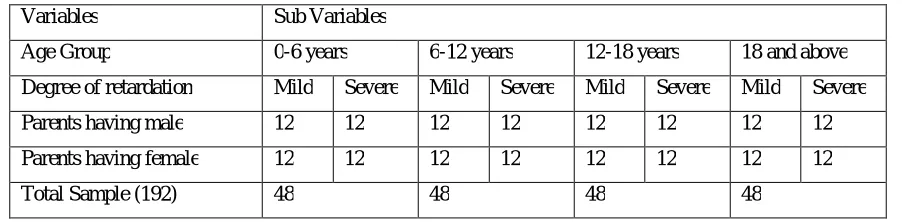
This is a cross sectional study designed by using 4x2x2 factorial design. It was dividedinto age groups at 4 levels, categories of degree of retardation at two levels and gender at two levels as
shown in table 1.
Table 1: Sample Size and Research Design with the Main Variables:
Variables Sub Variables
Age Group 0-6 years 6-12 years 12-18 years 18 and above
Degree of retardation Mild Severe Mild Severe Mild Severe Mild Severe
Parents having male 12 12 12 12 12 12 12 12
Parents having female 12 12 12 12 12 12 12 12
Total Sample (192) 48 48 48 48
The Participant:
Parents having a child with Mild/Severe intellectual disability in the family wereincluded in this study. A sample of 192 respondents was selected from the voluntary agencies (5
gather the data considering the objective of the study. The respondents (i.e. parents of children with
mild/severe intellectual disability) were drawn from the list of persons with intellectual disability
registered for daycare and home-based services in these non-governmental organizations included in this
study. Parents having children with intellectual disability who had been diagnosed with either mild or
severe degree of retardation were approached personally for the interviews.
Tools:
A questionnaire that contained demographic variables and the Self Esteem Inventory which wasdeveloped by Prasad and Thakur 23 was used to gather the data. This inventory takes into account personally perceived self and socially perceived self. Therefore, there were three possibilities; (1) person
having positive self in which the personally perceived score is higher than the socially perceived score
(2) person having negative self in which personally perceived score is lower than the socially perceived
score; and (3) balanced self-esteem there is no difference between the two. And this test showed a high
validity and reliability; Split half reliability co-efficient were calculated for both the sets of the inventory
which came out to be 0.82 and 0.78 for personally perceived self and socially perceived self respectively
. Retest reliability co efficient were found for both the tests were 0.9 and 0.66 respectively for personally
perceived self and socially perceived self.
The Alienation scale developed by Patil 24 was used to gather data in order to measure the degree of alienation of parents having children with intellectual disability from the society. The split half
reliability (correlating the odd-even items) of the test Spearman -Brown formula for doubling the length
was found to be 0.88, with an index of reliability of 0.943. The test retest reliability was found to be
0.82, with an index of Reliability of 0.897. All the values are highly significant at 0.01 level of
confidence. Regarding the validity of the scale, only diagnostic items are included in the scale following
item analysis. The upper and lower 25% served as criteria groups' .The coefficient of correlation of the
Scale with Reddy Mall's Alienation scale and Kureshi and Dutta's. The Alienation scale are found to be
0.76 and 0.73 (N=100) respectively.
Ethical Approval
The authors declare that this manuscript does not contain clinical studies or patient data.
Informed Consent
RESULTS AND DISCUSSION
This study reports the impact of having a child with intellectual disability on self-esteem and
alienation of the parents.
Table 2: Mean and SD Scores on Self-Esteem & Alienation:
Variables PP SP TS AL
Mean 129.35 134.17 263.52 44.47
SD 13.03 6.63 15.11 7.15
PP = Personally Perceived Self Esteem, SP = Socially Perceived Self Esteem, TS = Total Self
Esteem, AL = Alienation.
The personally perceived self-esteem and socially perceived self-esteem of the subjects having children
with intellectual disability was found to be very high signifying negative self-esteem. Also, the
alienation score was found more than the average, indicating that the subjects are highly alienated from
the rest of the society. Similar findings have been reported 25, 26. Subjects tend to develop negative self due to multiple reasons: the societal attitudes towards persons with intellectual disability add to their
agonies, the presence of a child with intellectual disability is treated as an additional burden on the
family, the parental expectations are not fulfilled by their children with intellectual disability they tend
to develop psychosomatic disorders. All these factors contribute in subjects and they develop negative
self which ultimately leads to their alienation from the rest of the society.
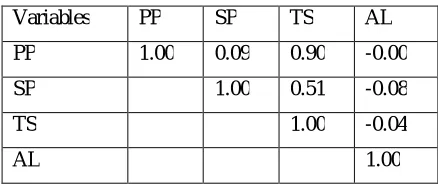
Table 3: Inter Correlations Matrix of Entire Sample on All Variables:
Variables PP SP TS AL
PP 1.00 0.09 0.90 -0.00
SP 1.00 0.51 -0.08
TS 1.00 -0.04
AL 1.00
The personally perceived esteem was found to be positively correlated with socially perceived
self-esteem and total self-self-esteem. Socially perceived self-self-esteem was found to be positively correlated with
total self-esteem and negatively correlated with alienation. Total self-esteem was also found to be
negatively correlated with alienation. It indicates the parents having low self-esteem will be alienated
Table 4: Analysis of Variance Alienation (Category X Gender X Age):
Df SS MSS F Value
Category 1 1900.083 1900.083 64.03549
Gender 1 130.021 130.021 438189
Age 3 1855.625 618.542 20.84573
Category X Gender 1 3.521 3.521 .011866
Category X Age 3 149.042 49.681 1.67430
Gender X Age 3 33.854 11.285 0.38031
Category X Gender X Age 3 481.437 160.479 5.40837
Residuals 176
The two categories (Mild and Severe) intellectual disability differs significantly from each other
on alienation. Observation of mean values depicts that the subjects having children with severe
intellectual disability obtained higher mean value than those subjects having children with mild one.
Also, the subjects having male and female children with intellectual disability differed significantly on
alienation with preference to the female side. All the four groups of different age groups of intellectual
disability obtained very high and significant F ratio on alienation and it indicates that subjects having
children with intellectual disability of all the age groups differ from each other on alienation. The F ratio
for gender X age is found to be statistically insignificant, so, the gender is independent of ages. It
implies that the sex levels when interact with different age groups do not differ significantly on
alienation. The F ratio for three factor interaction effect category X gender X age emerged to be
statistically significant, indicating that all the three main effects when interacting with each other exerts
significant effect on alienation. Similar findings have been reported 25.So, it can be inferred that alienation is affected by the collective interactive effect of all the main effects.
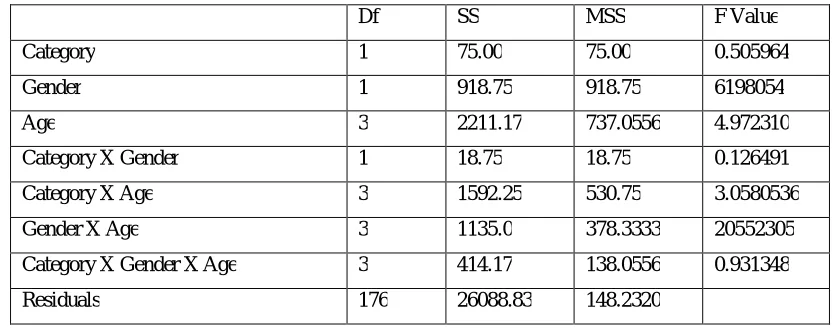
Table 5: Analysis of Variance Personally Perceived Self (Category X Gender X age):
Df SS MSS F Value
Category 1 75.00 75.00 0.505964
Gender 1 918.75 918.75 6198054
Age 3 2211.17 737.0556 4.972310
Category X Gender 1 18.75 18.75 0.126491
Category X Age 3 1592.25 530.75 3.0580536
Gender X Age 3 1135.0 378.3333 20552305
Category X Gender X Age 3 414.17 138.0556 0.931348
The F ratio is found to be statistically insignificant on personally perceived self-esteem. It
implies that the subjects having mild and severe children with intellectual disability do not differ from
each other on personally perceived self-esteem. The F ratio for gender is found to be statistically
significant on personally perceived self-esteem. It implies that the subjects having male and female
children with intellectual disability are differing from each other on personally perceived self-esteem.
Also, it implies that the subjects having children with intellectual disability of different age group are
differing from each other on personally perceived self-esteem. It is found that the personally perceived
self-esteem of the subjects having children intellectual disability of 12-l8 years was the highest followed
by 0-6, 6-12 and18 years and above. Hence, the mean difference was observed to be the real difference
on this variable. The F ratio for two interaction effect category x gender is statistically found
insignificant It leads us to conclude that the effect of subjects having mild and severe children with
intellectual disability is independent of gender on personally perceived self-esteem. The F ratio for
gender x age is statistically found to be insignificant on personally perceived self-esteem. It implies that
the effect of subjects having male and female children with intellectual disability is independent of
different age groups on personally perceived self-esteem. The F ratio for the three factor interaction
effect for category x gender x age is found to be insignificant. It can be said that all the three main
effects of the study when interacting with others do not affect significantly on the personally perceived
self-esteem of the subjects having children with intellectual disability.
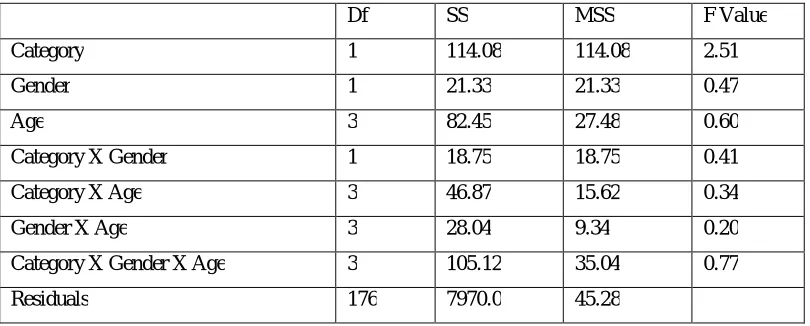
Table 6: Analysis of Variance Socially Perceived Self-Esteem (Category X Gender X Age):
Df SS MSS F Value
Category 1 114.08 114.08 2.51
Gender 1 21.33 21.33 0.47
Age 3 82.45 27.48 0.60
Category X Gender 1 18.75 18.75 0.41
Category X Age 3 46.87 15.62 0.34
Gender X Age 3 28.04 9.34 0.20
Category X Gender X Age 3 105.12 35.04 0.77
Residuals 176 7970.0 45.28
The F ratio for the categories seems to be statistically insignificant. It implies that the subjects
having mild and severe children with intellectual disability effect on gender are independent of the
and it implies that the effects of subjects having mild and severe intellectual disability are independent
of different age groups of children. Similarly F ratio for "gender X age" is also found to be statistically
insignificant. It implies, the difference between subjects having male and female children is
approximately same regardless of their age groups on socially perceived self-esteem.
The F ratio for the three factor interaction effect (category x gender x age) is also found to be
statistically insignificant for socially perceived self-esteem. It can be said that all the three main effects
of the study when interacting with others do not affect significantly on the socially perceived self-esteem
of the subjects.
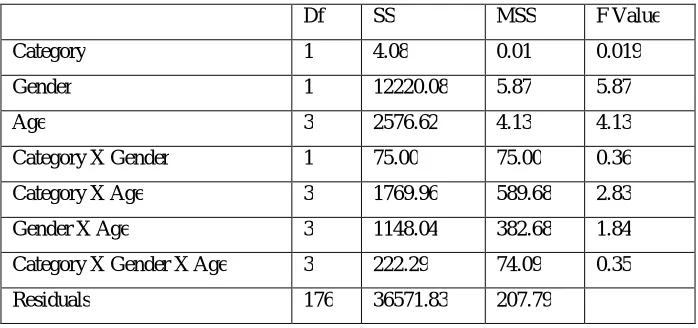
Table 7: Analysis of Variance Total Self (Category X Gender X Age):
Df SS MSS F Value
Category 1 4.08 0.01 0.019
Gender 1 12220.08 5.87 5.87
Age 3 2576.62 4.13 4.13
Category X Gender 1 75.00 75.00 0.36
Category X Age 3 1769.96 589.68 2.83
Gender X Age 3 1148.04 382.68 1.84
Category X Gender X Age 3 222.29 74.09 0.35
Residuals 176 36571.83 207.79
The data imply that the subjects having mild and severe children with the intellectual disability
do not differ from each other on total self-esteem. The F ratio for gender is found to be statistically
significant on total self-esteem and it implies that the subjects having male and female children with
intellectual disability do differ from each other on total self-esteem. The F ratio for two factor
interaction effect "Category x Gender" on total self is found to be statistically insignificant. It implies
that the difference between subjects having mild and severe children with intellectual disability is
approximately same regardless of different age groups. The insignificant F ratio was also obtained for
Gender x Age on total self-esteem. It implies that the effect of subjects having male and female children
with intellectual disability is independent of age groups. The F ratio for the three factor interaction effect
"Category x Gender x age" on total esteem is found to be statistically insignificant on total
self-esteem. It implies that all the three main effects of the study when interacting with others do not affect
CONCLUSION
The present study concludes that the self-esteem of the parents having children with intellectual
disability is negative and the alienation of the parents having children with intellectual disability was
found to be highly alienated from the rest of the society.
Study further finds that the parents having children with mild intellectual disability are comparatively
less alienated from the society, than the parents having children with severe intellectual disability.
Similarly, the parents having female children with intellectual disability were found to be more alienated
than the parents having male children with intellectual disability. And this implying the Intellectual
disability exerts its negative social impacts on these families.
ACKNOWLEDGMENT
The authors are grateful to Dr. Renuka Joshi, Associate Professor and The Head Department of
Psychology, DAV College, Dehradun, Hemvati Nandan Bahuguna Central University, Garhwal, India
for her guidance and support in carrying out this research work.
Conflict of Interest
The authors declare that there are no conflicts of interest.
REFERENCES
1. Juyal SL. Impact of parental attitude on adjustment pattern of their mentally handicapped
children. J PERS CLIN STUD. 2012; 181(2): 97-104.
2. Venkatesan S. and Vepuri V G. D. Mental Retardation in India: A Bibliography. New Delhi:
Concept Pub. Co, 1995. Print.
3. Raina, SK, Sushil R, and Renu N. Prevalence of Mental Retardation among Children in RS Pura
Town of Jammu and Kashmir. ANN INDIAN ACAD NEUROL. 2012; 15(1): 23-26.
4. Agrawal S, Vijay R, Kausik M, Rashmi K, and Shubha R. Aetiologic Spectrum of Mental
Retardation and Development Delay in India. INDIAN J MED RES. 2012; 13(6): 436-444.
5. Bhagya B and Ramakrishna A. Prevalence of Mental Retardation among children in
Mangalore. Nitte UNIV J HEALTH SCI. 2013; 3(4): 63-66.
6. Karasavvidis S, Avgerinou C, Lianou E, Priftis D, Lianou A and Siamaga E. Mental Retardation
7. Katz G and Lazcano-Ponce E. Intellectual disability: definition, etiological factors,
classification, diagnosis, treatment and prognosis. Salud Pública De México. 2012; 50: 132 –
141.
8. Johnson C P, Walker W O, Palomo-González S A, and Curry C J. Intellectual disability:
Diagnosis, Management, and Family Support. CUR PROB PEDIATR ADOLSCENT
HEALTHC. 206; 36(4): 126-165.
9. World Health Organization. WHO ICD-10 guide for mental retardation. 1996: 1.
10.Park K. Handicapped Children. In Parks Text Book of Preventive and Social Medicine. Jabalpur:
M/s Banarsidas Bhanot. 2005; 18th ed., 428.
11.Majnemer A, Shevell MI. Diagnostic yield of the neurologic assessment of the developmentally
delayed child. J Pediatr.1995; 127: 193.
12.Francis L and Jones S. Social class and self-esteem. J SOC PSYCHOL. 1995; 136: 405-406.
13.Ankony C. The Impact of Perceived Alienation on Police Officers' Sense of Mastery and
Subsequent Motivation for Proactive Enforcement, Policing. INT J POLICE STRATEGIES
MANAGE. 1999; 22(2): 120–32.
14.Reichman NE, Corman H, and Noonan K. Impact of Child Disability on the Family. MATERN
CHILD HEALTH J. 2008; 12(6): 679-683.
15.Ravindranadan, V and Raju S. Adjustment and Attitude of Parents of Children with Intellectual
disability. J INDIAN ACAD APPLIED PSYCH. 2007; 33(1): 137 -141.
16.Hidangmayum N and Khadi B. Parenting stress of normal and mentally challenged children.
KARNATAKA J AGR SCI. 2012; 252: 256-259.
17.Rangaswamy K and Bhavani K. Impact of disability on the family and needs of families of
disabled children, J. Commu. Guid. Res. 2008; 251: 121- 130.
18.Trute B. Gender Differences in the Psychological Adjustment of Parents of Young,
Developmentally Disabled Children. J PSYCHOL PSYCHIATR. 1995; 36: 1225–1242.
19.Konstantareas M and Lampropoulou V. Stress in Greek Mothers with Deaf Children: Effects of
Child Characteristics, Family Resources and Cognitive Set. AM ANN DEAF. 1995; 140: 264–
270.
20.Davis H and Spurr P. Parent Counseling: An Evaluation of A Community child Mental Health
21.Hoare P, Harris M, Jackson P, and Kerley S. A Community survey of children with severe
intellectual disability and their families: Psychological adjustment, career distress and the effect
of respite care. J INTELL DISABI RES. 1998; 42: 218–227.
22.Padeliadu S, Papadioti E, Prokovas X and Sandravelis A. Mothers of children with special needs:
Factors of stability and instability in performing the parental role. In Proceedings of the
Panhellenic Conference “Family and Family Policy in a Changing World”. Athens: National
Providence Organization.1996; 349–369.
23.Prasad MS, and Thakur GP. Manual and Directions for Self-Esteem Inventory. AGRA
PSYCHOL RES CELL. 1977.
24.Patil RV. Manual for Alienation Scale. AGRA PSYCHOL RES CELL, 1989.
25.Roos P. Parents of Mentally Retarded People. INT J MENTAL HEALTH. 1979; 6(1): 96-119.
26.Argyrakouli E and Zafiropoulou M. Self-Esteem of Greek Mothers of Children with Intellectual