Page 187
BULGARIAN SCHOOLS IN THRACE DURING THE LATE OTTOMAN PERIOD AND THE EARLY YEARS OF THE REPUBLIC (1851-1948)
Edip Durmaz
Kırklareli University, Turkey
Abstract
In 1830s, Bulgarians accelerated the process of building their own ethno-cultural identity. Bulgarian language became the medium of instruction after 1835. Bulgarian communities living in Thrace were also affected by all these developments. First modern Bulgarian schools were opened in Edirne in 1851 and in Kırklareli in 1853. By the 1910s the number of Bulgarian schools in Thrace was over twenty. However due to the changes in ethnic and socio-economic structure in Thrace, last Bulgarian schools in Kırklareli and Edirne continued their educational activities until 1936 and 1948 respectively.
Key words: Bulgarian schools, Thrace, Late Ottoman and Early Republic periods
1. INTRODUCTION
Ottoman Empire governed the nations with different religious, ethnic and cultural identities for many years under the “millet system” which it established and kept these components with different features alive and together protecting their identities and differences. Ottoman Empire was a multicultural structure nourished by Iran, Islamic and Byzantine political tradition and should be considered in the nature of empire. There are researchers looking at the Ottoman Empire from an opposite angle and considering the Ottoman Empire as dominated by Islamic approach that is against the local and cultural values and uniform political structure.1 Another approach distinct than these two approaches
advocates that Ottoman Empire became a multicultural state by force only after the Hatt-ı Sharif of Gülhane.2 Despite these different views about Ottoman Empire the general consensus is for the
Ottoman Empire was a multicultural state.3
The Bulgarians also lived for many years under the “millet system” of the Ottoman Empire After the conquest of Istanbul, Fener Greek Patriarch involved not only Greeks but also Slavic, Albanian, Georgions and Arabian elements.4 In a more clearly saying, Fener Greek Patriarch represented
Ortodox Greek, Serbian, Roman, Albenian, Bulgarian and Arabs. 5 Naturally also the Bulgarians were
connected to Fener Greek Patriarch for religion and sect issues (marriage, education, divorce, heritage, legal needs etc.) 6 after the conquest of Istanbul.7 In the late period of Suleiman the Magnificent,
Ortodox Patriarchate was started on behalf of the Serbians and Bulgarians in Peç-İpek by Mehmed Pasha Sokolovic’s efforts. The Peç Patriarchate was proscribed in 17628 or 17669 and its Christian
vassals were connected to Greek Orthodox Patriarchate again.10 Firstly, the Bulgarians who lived with
other nations as part of “Orthodox Nation” quite a long period of time speeded up the process of building their own ethno-cultural identity after Greece separated from the Ottoman Empire and emerged as an independent state. Bulgarian was excluded from the fields of Orthodox religion and
1Maria Todorova, Balkanlar’daki Osmanlı Mirası, L. Carl Brown (Ed.), “İmparatorluk Mirası, Balkanlarda ve Ortadoğu’da
Osmanlı Damgası”, İletişim Yayınları, İstanbul, 2000, p. 72-76.
2Evangelia Balta, “Osmanlı Devleti’nde Din ve Vicdan Hürriyeti”, Ensar neşriyat, Osmanlı Devleti’nde Rum Millet ve
Ekonomik Gelişmişlikleri, p. 231,232.
3Evangelia Balta, ibid, p. 232. 4Evangelia Balta, ibid, p. 232.
5 Aleksandr Dugin, Rus Jaopolitiği Avrasyacı Yaklaşım, Çev. Vügar İmanov, Küre Yayınları, İstanbul, 2010, p. 218. 6 Enver Ziya Karal, Osmanlı Tarihi, Vol. VII, TTK Basımevi, Ankara, 1988, p. 84.
7 Ortaylı İlber, Osmanlı İmparatorluğu’nda İktisadi va Sosyal Dağişim – Makaleler – 1, Turhan Kitabevi, Ankara, 2000, p.
282-283; Ali Güler, Osmanlıdan Cumhuriyete Azınlıklar, Berikan yayınevi, Ankara, 2003, p. 111-112.
8 Ahmet Cevdet Paşa, Tarih-i Cevdet, Vol. 11, p. 116.
Page 188
education except village churches with the influence of Fener Greek Executives and dominant Greek in Education.11 Exclusion of Bulgarian from the fields of Orthodox religion and education won a
political foundation in 1800 with a circular which Fener Greek Patriarch sent to the metropolitans. In accordance with the circular; Bulgarian church schools were closed, religion books only in Greek could be read in churches and Bulgarian Schools. In this way traces of Old Bulgarian Literature were also erased under a religious outlook.12 On the one hand Bulgarian was becoming language of
education for Bulgarian people after 183513, on the other hand with the translation of Bible into
Bulgarian language by Neophytos in 184014 and the establishment of Bulgarian Exarchate
(Patriarchate) in 187015 a Bulgarian church independent in religious issues was established 16and
Bulgarian gained its genuine position. Bulgarian communities living in Thrace was also severely affected by all these developments.
Before giving a look at the Bulgarian schools in Thrace it is important to state that; Kırklareli was a sanjak of Edirne province until 1924. After 1924 till today Kırklareli has been a separate city. The number of the modern Bulgarian schools, which opened firstly in the city center of Edirne in 1851-1852 and then in Kırklareli in 1853-1854 parallel with Turkish Modernization starting with the Hatt-ı Sharif of Gülhane and part of which was under the control of The Ottoman Ministry of Education, grew towards the end of the year.
Number of the Bulgarian Schools in Thrace during 1910s was close to 30. After the Balkan Wars, First World War and Independence War, the ethnic and socio- economic situation in Thrace fairly changed. In the beginning of the Republic number of the Bulgarian Schools in Thrace dropped to 4 in Edirne and to 1 in Kırklareli. Last Bulgarian School in Kırklareli closed in 1936 and in Edirne it continued education until 1948.
2. BULGARIAN SCHOOLS IN THRACE DURING THE OTTOMAN PERIOD
In terms of Bulgarian Schools in Thrace, Edirne Taydanof Bulgarian Ortodox Primary School which started education in Rumi 1267 (Gregorian: 1851-1852) is the first Bulgarian School according to official records. It appears that although this school started education in 1851-1852, it obtained official license in 21.12.1896.17 On the other hand Ayas Peridof Bulgarian Ortodox Primary School which
started education in 1853-1854 is the first Bulgarian school in Kırklareli and it also obtained official license in 21.12.1896.18 It is known that some foreign and non-Muslim schools operated in unlicensed
and illegal way during the second half of 1800s in the Ottoman Empire. The governments of the Ottoman Empire and official governmental agencies relevant with education approached this issue with leniency, and turned a blind eye to the activities of the schools operating illegally. This issue can be traced and researched in “The logbooks of the schools opened without authorization" in the Prime Ministry Ottoman Archives.19
11İlber Ortaylı, “Osmanlı İmparatorluğu’nda Millet”, Tanzimattan Cumhuriyet’e Türkiye Ansiklopedisi, İletişim Yayınları,
İstanbul, 1985, 996-1001, p.999.
12Halil İnalcık, Tanzimat ve Bulgar Meselesi (Doktora Tezinin 50. Yılı) 1942-1992, Eren Yayıncılık ve Kitapçılık,
İstanbul, 1992, p. 19-20.
13 Aşkın Koyuncu, “Osmanlı Kimliği Üzerine Bazı Düşünceler”, Türkiyat Araştırmaları, Hacettepe Üniversitesi Türkiyat
Araştırmaları Enstitüsü, No:1, Autumn 2004, p. 207.
14 Halil İnalcık, ibid, p. 20-23. 15E. Ziya Karal, ibid, p. 93.
16 Aleksandr Dugin, ibid, p. 227-228.
17Salname-i Nezâret-i Maârif-i Umumiye, Birinci sene, 1316 sene-i hicriyesine mahsustur. Darülhilafetülaliye: Matba-i
Amire, 1316, p. 796-797; Salname-i Nezâret-i Maârif-i Umumiye, Dördüncü sene, 1319 sene-i hicriyesine mahsustur. Darülhilafetülaliye: Matba-i Amire, 1319, p. 320-321; Ratip Kazancıgil, Nilüfer Gökçe, Ender Bilar, Edirne’nin Eğitim Tarihi, (İlk – Orta öğretim) 1361- 2005, Türkiye Cumhuriyeti Edirne Valiliği Yayınları, Edirne, 2006, p. 153.
18Salname-i Nezâret-i Maârif-i Umumiye, Dördüncü sene, 1319 sene-i hicriyesine mahsustur. Darülhilafetülaliye: Matba-i
Amire, 1319, p. 320-321.
19 Nuri Güçtekin, “Kırklareli (Kırkkilise) Rum Mektebi’nden Vali Faik Üstün İlkokulu’na Bir Eğitim Binasının Hikâyesi
Page 189
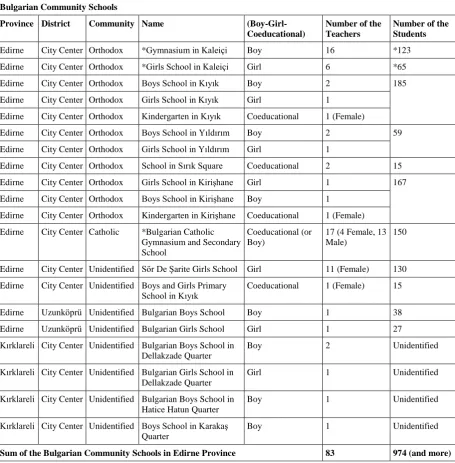
Year 1903 is going to be a good start to take a collective photo of Bulgarian Schools in today’s Edirne province.20 Because the Bulgarian Schools were legally connected to separate institutions. Therefore,
in the last years of the Ottoman Empire, 1902-1903- the last mutual date for both the Ministry of Education and Edirne Governor's Office to publish official data simultaneously seems to be the most appropriate date for the photograph. For this reason, today’s Thrace in Turkey during 1902-1903 will be taken into consideration for Bulgarian schools during the Ottoman period.
Table 1. Bulgarian Schools Remaining in Edirne Province inside the Borders of Turkey during the years 1902-1903.21
Bulgarian Community Schools
Province District Community Name
(Boy-Girl-Coeducational)
Number of the Teachers
Number of the Students
Edirne City Center Orthodox *Gymnasium in Kaleiçi Boy 16 *123
Edirne City Center Orthodox *Girls School in Kaleiçi Girl 6 *65
Edirne City Center Orthodox Boys School in Kıyık Boy 2 185
Edirne City Center Orthodox Girls School in Kıyık Girl 1
Edirne City Center Orthodox Kindergarten in Kıyık Coeducational 1 (Female)
Edirne City Center Orthodox Boys School in Yıldırım Boy 2 59
Edirne City Center Orthodox Girls School in Yıldırım Girl 1
Edirne City Center Orthodox School in Sırık Square Coeducational 2 15
Edirne City Center Orthodox Girls School in Kirişhane Girl 1 167
Edirne City Center Orthodox Boys School in Kirişhane Boy 1
Edirne City Center Orthodox Kindergarten in Kirişhane Coeducational 1 (Female)
Edirne City Center Catholic *Bulgarian Catholic Gymnasium and Secondary School
Coeducational (or Boy)
17 (4 Female, 13 Male)
150
Edirne City Center Unidentified Sör De Şarite Girls School Girl 11 (Female) 130
Edirne City Center Unidentified Boys and Girls Primary School in Kıyık
Coeducational 1 (Female) 15
Edirne Uzunköprü Unidentified Bulgarian Boys School Boy 1 38
Edirne Uzunköprü Unidentified Bulgarian Girls School Girl 1 27
Kırklareli City Center Unidentified Bulgarian Boys School in Dellakzade Quarter
Boy 2 Unidentified
Kırklareli City Center Unidentified Bulgarian Girls School in Dellakzade Quarter
Girl 1 Unidentified
Kırklareli City Center Unidentified Bulgarian Boys School in Hatice Hatun Quarter
Boy 1 Unidentified
Kırklareli City Center Unidentified Boys School in Karakaş Quarter
Boy 1 Unidentified
Sum of the Bulgarian Community Schools in Edirne Province 83 974 (and more)
20 “1319 Edirne Vilayet-i Celilesi Salnamesi” is the equivalent of 1903 according to Gregorian Calender and “1319 Yılı
Maarif Nezareti Salnamesi” is the equivalent of 1902 according to Gregorian Calender.
21 Edirne Vilâyet-i Celilesi Salnamesi, Edirne Vilâyet Matbaası, 1319, p. 680-682; Salname-i Vilâyet-i Edirne, Edirne
Vilâyet Matbaası, 1317, p. 85-86; Salname-i Nezâret-i Maârif-i Umumiye, Dördüncü sene, 1319 sene-i hicriyesine mahsustur. Darülhilafetülaliye: Matba-i Amire, 1319, p. 320-321.
Table 1 was compiled from the publications above.
Page 190
Schools Under Ministry of Education
Province District Community Name
(Boy-Girl-Coeducational)
Number of the Teachers
Number of the Students
Edirne City Center Orthodox Taydanof (Naydanof) Secondary School
Boy Unidentified 114
Edirne City Center Orthodox Hıristo Misrof Secondary School
Girl Unidentified 56
Kırklareli City Center Orthodox Ayasperidof Primary School
Boy Unidentified 75
Kırklareli Tırnova Orthodox Mavkrodi Primary School Boy Unidentified 168
Sum of the Bulgarian Schools in Edirne Province (Connected to Ministry of Education)
Unidentified 313
Sum of the Bulgarian Schools in Edirne Province (Schools Connected to Bulgarian Communities and Ministry of Education)
83 (and more) 1.287 (and more)
Statistical table shows us that 1287 students in Thrace were studying at different level Bulgarian Schools in 1319 Hijri or 1901-1902 Gregorian Year. Also the number of the teachers working in these schools was nearly 83. The number of the students and teachers look higher than that can be accessed but it’s really hard to make a correct prediction. For now, it will certainly be enough that the number of the students and teachers is above these numbers.
According to 1319 Salname of Edirne Central Province; there were 5 Bulgarian Schools continuing education and training activities in Kırklareli District Center.22 It is obvious in the table above that four
of these schools were primary school and community school and the other was Ayasperidof Boys Primary School which was under Ministry of Education.23 But the statistical data about Tırnova town
in Kırklareli District isn’t very clear. According to statistics Ayasperidof Boys Primary School was the Bulgarian School in this town. However, as it is mentioned on page 294 of 1319 Salname of Edirne Central Province, “4 Separate private Bulgarian catholic and orthodox schools for boys and girls in both central province of Tırnova and the villages…” it is understood that there were 4 Bulgarian schools24 continuing education and training activities in Tırnova town during the academic year
1900-1901. Although there isn’t further detailed information it is understood that at least one of these schools was in the villages. Yet the Bulgarian Schools in Tırnova aren’t mentioned in the statistical charts of the same publication. Only Mavkrodi Boys Primary School is mentioned in 1319 Salname of Ministry of Education.25
According to 1905-1908 education statistics there were 19 primary coeducational Bulgarian schools in Edirne and 4 primary coeducational Bulgarian schools in Kırklareli.26 According to 1912-13
educational statistics there were totally 5 private Bulgarian schools and maximum 283 students consisting of 152 boys and 131 girls in Edirne province (s. 172)27. It’s not possible to give an exact
number of the students because student number is specified as “other communities” in the statistics. The number of the teachers looks maximum 9 consisting of 2 men and 7 women.28
22Edirne Merkez Vilâyeti Salnamesi H. 1319-M. 1901 C. 2, Ratip Kazancıgil, Nilüfer Gökçe, Musa Öncel, Edirne Valiliği
Kültür Yayınları, İstanbul, 2014, p. 290.
23Salname-i Nezâret-i Maârif-i Umumiye, Dördüncü sene, 1319 sene-i hicriyesine mahsustur. Darülhilafetülaliye: Matba-i
Amire, 1319, p. 320-323.
24 Edirne Merkez Vilâyeti Salnamesi H. 1319-M. 1901 C. 2, Ratip Kazancıgil and the others, Edirne Valiliği Kültür
Yayınları, İstanbul, 2014, p. 290.
25Salname-i Nezâret-i Maârif-i Umumiye, Dördüncü sene, 1319 sene-i hicriyesine mahsustur. Darülhilafetülaliye: Matba-i
Amire, 1319, p. 322-323.
26 Mehmet Ö. Alkan, Tanzimat’tan Cumhuriyet’e Modernleşme Sürecinde Eğitim İstatistikleri 1839-1924, Türkiye
Cumhuriyeti Başbakanlık Devlet İstatistik Enstitüsü Yayını, Ankara, 2000, p. 123.
Page 191
3. BULGARIAN SCHOOLS IN THRACE DURING REPUBLICAN ERA
According to Ministry of Education Statistics, 1926-1927, which are accepted as the first statistical data on education during the republican era, the Bulgarian School in the town center of Edirne provided primary level of education and there were fifty primary school students consisting of thirty-six boys and fourteen girls and fifteen kindergarten students were all boys during the academic year 1926-1927. The number of Bulgarian schools in Edirne in 1926 dropped incomparably with the Ottoman Period. In 1926 there was just one Bulgarian school which provided both primary and kindergarten education. In parallel with historical development line of Edirne, in Kırklareli also the number of Bulgarian schools dropped dramatically and there was just one school providing education during the academic year 1926-1927 in Kırklareli. It is seen that the Bulgarian school in Kırklareli didn’t have any kindergarten students and it had 75 primary school students consisting of forty-one boys and thirty-four girls.29 Of all the teachers working at Bulgarian school in Edirne, two were
Muslim, four were Orthodox, four were man and two were woman; in Kırklareli two were Muslim, five were Orthodox, four were man and three were woman. One of the teachers in Edirne and three of in Kırklareli were university graduates. Three of the university graduates were from a university outside of Turkey and one was from İstanbul Darülfünun (İstanbul University). Of the teachers working in Kırklareli, two graduated from Teachers College, one graduated from high school or secondary school, and one graduated from an unidentified type school. Similarly, in Edirne two graduated from high school or secondary school, and one graduated from an unidentified type school.30 It may be said that the Bulgarian School in Edirne offered six years of education because
according to Ministry of Education Statistics, 1926-1927, there were seven day students –a girl and six boys- attending school in the sixth grade. A new practice during the Republican Era is that Bulgarian schools were also coeducational like their Turkish counterparts. A striking feature of Bulgarian School in Edirne is that it had a boarding kindergarten, and eleven kindergarten students were boarders and four were day students. No sixth grade students were found in Bulgarian School in Kırklareli during the academic year 1926-1927. The issue that Bulgarian School in Edirne offered six years of education must be approached with precaution.31 But fifty-one 6th grade students in the Bulgarian School in
Beyoğlu –İstanbul- during the academic year 1926-1927 convince us to believe otherwise.32 On the
other hand in another important official statistical publication it is mentioned that Foreign Primary Schools offered five years of education but Greek Primary Schools as school of minorities offered six years of education (Ulusal Eğitim Hareketleri, 1927-1966, p. 9)33. As for the income status of
Bulgarian Schools; The Bulgarian School in Edirne made 100 Turkish Liras from donations, and 3920 Turkish Liras from other resources and spent 3627 Turkish Liras on teachers’ salaries, 80 Turkish Liras on heating and lighting and 432 Turkish Liras on janitor salaries. The Bulgarian School in Kırklareli made 126 Turkish Liras from student tuitions, 243 Turkish Liras from donations and was funded 3590 Turkish Liras by The State of Republic of Turkey and spent 3627 Turkish Liras on teachers’ salaries, 100 Turkish Liras on heating and lighting and 180 Turkish Liras on janitor salaries (p. 173).34
According to Ministry of Education Statistics, 1932-1933, it was clearly stated that Bulgarian Schools in Edirne and Kırklareli were both coeducational. The Bulgarian School in Edirne didn’t have any kindergarten students and it only offered primary education. Since 1927 the number of students dropped from 50 to 32 -19 boys and 13 girls- in the Bulgarian School in Edirne. Since it stopped offering kindergarten education, there weren’t any boarders (Maarif Nezareti İstatistikleri, 1932-1933, p. 89).35 In parallel with student number, the number of teachers also dropped from 6 in 1927 to 4 in
1933. All of the teachers were boys. Only one teacher was a university graduate and three teachers graduated from other schools. In the Bulgarian School in Kırklareli also the drop of teacher and
29Türkiye Cumhuriyeti Maarif Vekâleti 1926-1927 İstatistik Yıllığı, Vol. 4, Devlet Matbaası, 1929, p. 166-167. 30 Türkiye Cumhuriyeti Maarif Vekâleti, ibid, p. 172.
31 Türkiye Cumhuriyeti Maarif Vekâleti, ibid, p. 166-167. 32 Türkiye Cumhuriyeti Maarif Vekâleti, ibid, p. 163.
33Milli Eğitim Haraketleri 1927-1966, Devlet İstatistik Enstitüsü Yayını, Ankara, 1967, p. 9. 34 Türkiye Cumhuriyeti Maarif Vekâleti, ibid, p. 173.
Page 192
student numbers was remarkable. The number of teachers dropped from 7 in 1927 to 2 in 1933. One of these teachers was permanent and the other was alternate and permanent teacher was man and the other was woman. Both of these teachers weren’t a university graduate (Maarif Nezareti İstatistikleri, 1932-1933, p. 159).36 There isn’t clear information about the school they graduated. The number of
students dropped from 75 in 1927 to 9 in 1933. Although it was coeducational there were only boy students and all of them were day students. Besides there weren’t any 1st grade students during the
Academic Year 1932-1933 (Maarif Nezareti İstatistikleri, 1932-1933, p. 89).37 In contrast of Ministry
of Education Statistics, 1926-1927, Ministry of Education Statistics, 1932-1933 gave information about teachers’ graduation but they gave no detailed information about the teachers’ religion or sect under the heading “origin” (Maarif Nezareti İstatistikleri, 1932-1933, p. 159).38
As for the income status of Bulgarian Schools during 1932-1933; The Bulgarian School in Edirne was funded 3400 Turkish Liras from akar (real estate rental incomes) and 292 Turkish Liras from donations and spent 3192 Turkish Liras on teachers’ salaries and 500 Turkish Liras on other expenses. The Bulgarian School in Kırklareli was funded 10 Turkish Liras from student tuitions, 80 Turkish Liras from akar and 1404 Turkish Liras from donations and spent 1224 Turkish Liras on teachers’ salaries, 20 Turkish Liras on construction and renovation, and 250 Turkish Liras on other expenses (p. 169).39
Ministry of Education Statistics, 1933-1934, includes some really different evaluations and information from the previous years’ statistics. During the academic year 1933-1934, Bulgarian Primary School in Edirne offered education for seven years and in Kırklareli for five years. Also it is found that Bulgarian Primary School in Edirne had four and the one in Kırklareli had two classrooms (Ministry of Education Statistics, 1933-1934, p. 96).40 Three of the teachers working at Bulgarian
School in Edirne taught multigrade classes and one teacher taught a single grade class. Both of the teachers working at Bulgarian School in Kırklareli taught multigrade classes. While the building of Bulgarian School in Edirne was classified as concrete and masonry in Kırklareli it was classified as mixed structure (concrete, masonry, adobe brick and wood). The room number of the Bulgarian School in Edirne was between 10 and 15 and in Kırklareli it was between 5 and 10 and also both Bulgarian schools had a small but insufficient garden and a winter playground.41 Apart from these the
Bulgarian School in Edirne had its own library, and in that library there were 55 books written in Turkish Language with Latin Alphabet, 25 books written in Turkish Language with Arabic Alphabet, and 994 books written in a foreign language ( Bulgarian and other European Languages). In the same way, the Bulgarian School in Kırklareli also had its own library, and in that library there were 24 books written in Turkish Language with Latin Alphabet, and 611 books written in a foreign language ( Bulgarian and other European Languages).42 There were 4 male permanent teachers working at The
Bulgarian School in Edirne and 1 male and 1 female permanent teacher working at The Bulgarian School in Kırklareli.43
As for the income status of Bulgarian Schools during 1933-1934; The Bulgarian School in Edirne was funded 3000 Turkish Liras from akar (real estate rental incomes) and 280 Turkish Liras from donations and spent 3180 Turkish Liras on teachers and officers’ salaries and 100 Turkish Liras on other expenses. The Bulgarian School in Kırklareli was funded 15 Turkish Liras from student tuitions
44, 1090 Turkish Liras from akar and 250 Turkish Liras from donations and spent 1320 Turkish Liras
on teachers and officers’ salaries, 30 Turkish Liras on education and equipment, 60 Turkish Liras on construction and renovation, and 30 Turkish Liras on other expenses.45
36 Başvekâlet İstatistik Umum Müdürlüğü, ibid, p. 159. 37 Başvekâlet İstatistik Umum Müdürlüğü, ibid, p. 89. 38 Başvekâlet İstatistik Umum Müdürlüğü, ibid, p. 159. 39 Başvekâlet İstatistik Umum Müdürlüğü, ibid, p. 169.
40Başvekâlet İstatistik Umum Müdürlüğü Maarif 1933-1934 İstatistiği, Devlet Matbaası, İstanbul, 1935, p. 96. 41 Başvekâlet İstatistik Umum Müdürlüğü, ibid, p. 96-97.
42 Başvekâlet İstatistik Umum Müdürlüğü, ibid, p. 96-97. 43 Başvekâlet İstatistik Umum Müdürlüğü, ibid, p. 211.
Page 193
When it comes to school size of Bulgarian School in Edirne; 4 male students enrolled in the 1st grade
during the Academic Year 1933-1934, on the other hand 2 students dropped out of the school in the same year. 4 male 1st graders, 2 male and 4 female 2nd graders, 2 male 3 female 3rd graders, 3 male 3
female 4th graders and 5 male 2 female 5th graders, totally 28 students – 16 males and 12 females-
studied at school. As for the students’ parents; 4 parents were farmer, 13 parents were worker, 10 parents were craftsmen and 1 was an officer.46
In case of the Bulgarian School in Kırklareli; When it comes to school size of Bulgarian School in Edirne; 1 male 2 female students enrolled in the 1st grade during the Academic Year 1933-1934, on the
other hand there was no student drop out in the same year. There weren’t any 2nd graders or 4th graders
but there were 5 male 3rd graders, and 4 male 5th graders studying at school. Totally there were 12
students -10 males and 2 females- at the school. As for the students’ parents; 3 parents were farmer, 3 parents were worker, and 2 parents were craftsmen.
The Bulgarian Primary Schools kept bleeding during the Academic Year 1935 – 1936. At the Bulgarian Primary School in Edirne the number of the teachers dropped from 4 to 3 (2 male and 1 female) but in Kırklareli 2 permanent teachers (1 male and 1 female) kept their jobs.47 The student
drop outs are much more significant. Number of the students dropped from 28 to 9 in the Bulgarian Primary School in Edirne and from 12 to 8 in the Bulgarian Primary School in Kırklareli since the previous year. At the same time, while there were just 2 new student enrollments to the school in Kırklareli, there weren’t any new student enrollments to the school in Edirne during the Academic Year 1935-1936. In spite of 2 new enrollments, 2 students left the school in the same year.48 There was
a decline in schools’ income and expenses as well. The income and the expense of the schools in Edirne and Kırklareli dropped from 3280 Turkish Liras to 2487 Turkish Liras and from 1435 Turkish Liras to 1310 Turkish Liras respectively since the last year.49 The last information about the Bulgarian
School in Kırklareli is relevant to the Academic Year 1935-1936. After this year just the Bulgarian School in Edirne continues education in Thrace.50
The Academic Year 1937-1938 is the first year after the closure of Bulgarian School in Kırklareli and the last year before the World War II and that makes this year special. As for the details about the Bulgarian School in Edirne during the Academic Year 1937-1938; the number of the teachers at Bulgarian Primary School in Edirne dropped from 4 to 3; 2 male teachers were permanent and the female teacher was substitute.51 A rise can be observed in the number of the students along with the
closure of the Bulgarian Primary School in Kırklareli. While the number of the students in Bulgarian School in Edirne was 9 during the academic year 1935-1936, with the closure of the Bulgarian Primary School in Kırklareli this number rose to 13. During the Academic Year 1937-1938 there weren’t any 1st grade enrollments to the school in Edirne, due to these reasons it can be deduced that
the students from the school in Kırklareli were transferred to the Bulgarian School in Edirne. In a local quality publication called “Trakya İstatistik Yıllığı (Annual Statistics of Thrace)” it could be clearly seen that the student number rose to 13 and the teacher number declined to 2 male permanent teachers.52 Under the examination of official resources of the period, it can be seen that at least 4
students from the Bulgarian School in Kırklareli were transferred to the school in Edirne. 1937-1938 Eğitim - Öğretim Yılı’nda ise bu sayı, mezun olan öğrencilerin etkisiyle 13’ten 10’a gerilemiştir.53 The
total income of the Bulgarian School in Edirne which was 2487 Turkish Liras during tne Academic Year 1935-1936, fell back to 1470 Turkish Liras during 1937-1938. This year’s income was recorded
46 Başvekâlet İstatistik Umum Müdürlüğü, ibid, p. 188-189.
47Başbakanlık İstatistik Genel Direktörlüğü Kültür 1935-1936 İstatistiği, Ankara, 1937, p. 114. 48 Başbakanlık İstatistik Genel Direktörlüğü, ibid, p. 102-103.
49 Başbakanlık İstatistik Genel Direktörlüğü, ibid, p. 131.
50İstatistik Genel Direktörlüğü Trakya Umum Müfettişliği İstatistik Bürosu Trakya İstatistik Yıllığı, 1939 Vol. 2, p.
197.
51Başvekâlet İstatistik Umum Müdürlüğü, Maarif 1937-1938 İstatistiği, Devlet Matbaası, İstanbul, 1939, p. 128. 52 İstatistik Genel Direktörlüğü Trakya Umum Müfettişliği İstatistik Bürosu, ibid, p. 197.
Page 194
under the heading of “other income” and the total expenses of the school were also 1470 Turkish Liras.54
When the Bulgarian School in Edirne during the Academic Year 1942-1943 which were mid-war years during the Second World War is examined in detail, the number of teachers was permanently two and both of these teachers were permanent and male.55 The decrease in the number of the students
was much more dramatic and unclear. The number of the students which was 10 during the Academic Year 1937-1938 rose to 16 during the Academic Year 1942-1943 in spite of the all side effects of war years. All the more amazing the number of the students rose during the Academic Year 1940-1941. During the Academic Year 1940-1941 the student number reached to 17 with a serious rise compared to 1938.56 The rise in the number of the students during the Second World War is really interesting and
confusing. Because the economic, social and political situation in Thrace during these years was quite troubled. Thousands of people had to emigrate from Thrace to Anatolia.57 The education in Thrace
became troubled because of the extraordinary conditions of the Second World War. The class end date of the schools in Edirne during the Academic Year 1940-1941 was 16th April 194158and school
closure date was 15th May 1941.59 Existing government wasn’t content with these precautions and
decided to transfer some of the schools in the city center of Edirne to the appropriate places in Anatolia.60 For this reason it is really hard to explain the rise in student number of Bulgarian School in
Edirne in Thrace suffering under heavy conditions of Second World War. Most likely these students came from West Thrace in Greece where living conditions got harder because of war to the Bulgarian School in Edirne. The famine in Greece61, Turkey’s offer to Greece about giving education to nearly
1000 children between the ages of 13 and 1662, and refuge area in Uzunköprü district of Edirne for the
refugees coming from Greece 63 during this period support this presumption. On the other hand, some
students left school probably because of hard living conditions during the Academic Year 1942-1943. 3 students in Bulgarian School in Edirne left school that year.64 The total income of the Bulgarian
School in Edirne which was 1470 Turkish Liras during 1937-1938, reached to 2100 Turkish Liras during the Academic Year 1942-1943. Although it seems that there is a 50% of increase in school’s income, in fact it is a deception because the inflation was terribly high in Turkey65 and Thrace 66
during these years. Merchandise prices rose from 100 to 590 with a 500% of increase in Turkey.67
After all the school spent 2100 Turkish Liras during the Academic Year 1942-1943.68
54Başvekâlet İstatistik Umum Müdürlüğü Maarif 1937-1938 İstatistiği, Devlet Matbaası, İstanbul, 1939, p. 148. 55Başbakanlık İstatistik Genel Müdürlüğü Milli Eğitim İstatistikleri 1942-1943, Ankara, 1945, p. 135. 56Başvekâlet İstatistik Umum Müdürlüğü, Maarif İstatistiği 1940-1941, Ankara, 1943, p. 108-109.
57 Bülent Bakar, “ İkinci Dünya Savaşı’nda İstanbul ve Trakya’dan Anadolu’ya Göç ve Paniğe Karşı Propoganda”, İ. Ü.
Atatürk İlkeleri ve İnkılâp Tarihi Enstitüsü Yakın Dönem Türkiye Araştırmaları Dergisi, Year: 6/2007, No:12, p.18. “Bu makalede İstanbul ve Trakya’dan Anadolu’ya geçenlerin sayısının 16 bin aile ve 50.000’e yakın olduğu belirtilmektedir.
58 Bülent Bakar, “ İkinci Dünya Savaşı’nda İstanbul ve Trakya’dan Anadolu’ya Göç ve Paniğe Karşı Propoganda”, İ. Ü.
Atatürk İlkeleri ve İnkılâp Tarihi Enstitüsü Yakın Dönem Türkiye Araştırmaları Dergisi, Year: 6/2007, No:12, p.15.
59 Altan Öymen, Bir Dönem Çocuk, Doğan Kitap, İstanbul, 2002, p. 255, Sabit Çetin, “ İkinci Dünya Savaşı’nda İstanbul Ve
Trakya’nın Tahliye Edilmesi”, Ankara Üniversitesi Türk İnkılâp Tarihi Enstitüsü Atatürk Yolu Dergisi, No: 52, Autumn 2013, Ankara, p. 774.
60 Sabit Çetin, “ İkinci Dünya Savaşı’nda İstanbul Ve Trakya’nın Tahliye Edilmesi”, Ankara Üniversitesi Türk İnkılâp
Tarihi Enstitüsü Atatürk Yolu Dergisi, No: 52, Autumn 2013, Ankara, p. 774.
61 Barbara Jelavich, tercüme: Hatice Uğur, Balkan Tarihi 20. Yüzyıl 2, Küre Yayınları, İstanbul, 2009, p. 293.
62 Bülent Bakar, “Zor Zamanlarda İyi Komşuluk Örneği: İkinci Dünya Savaşı’nda Türkiye’den Yunanistan’a Yapılan
Yardımlar”, Atatürk Araştırma Merkezi Dergisi, No: 71, July 2008, p. 429-430.
63 Ulvi Keser, Uluslararası Sosyal Araştırmalar Dergisi The Journal of International Social Research
Volume 3 / 11 Spring 2010, p. 390.
64Başbakanlık İstatistik Genel Müdürlüğü Milli Eğitim İstatistikleri 1942-1943, Ankara, 1945, p. 108.
65 Şefik Bilkur, “Türk Ekonomisinin 1943‟teki Manzarası Sınai İstihsal ve Fiyatlar”, Ulus, 06 Nisan 1944; Edward
Weisband, İkinci Dünya Savaşı’nda İnönü’nün Dış Politikası, çev. M. Ali Kayabal, İstanbul, 1974, s. 94-101.; L. Hilal Akgül, Ekonomide Kurtuluş Savaşımı, Altın Kitaplar, İstanbul, 2006, p. 90-91.
66 Edip Durmaz, İkinci Dünya Savaşı’nda Trakya Ekonomisi, Basılmamış Doktora Tezi, Marmara Üniversitesi Türkiyat
Araştırmaları Enstitüsü, İstanbul, 2015, p. 252-253; Acar‟ın Ağabeysi müstear isimli, “ Nazariyelere Göre Hayatın Ucuzlaması Şart Fakat …”, Edirne Postası, “8 Eylül 1943.
67 Memduh Yasa and the others (Unidentified ), Cumhuriyet Dönemi Türkiye Ekonomisi (1923-1978), Akbank Kültür
Yayını, İstanbul, 1980, p. 125.
Page 195
It is obvious that the number of teachers stabilized in the Bulgarian School in Edirne during the Academic Year 1944-1945 after the Second World War. The only difference between the Academic Years 1942-1943 and 1944-1945 is that one of the two teachers was female in Bulgarian School in Edirne during the Academic Year 1944-1945.69 Student number dropped to a similar level before war.
On the contrary of the increase in the beginning of war, student number dropped to 8 in the last years of war.70 While the number of the students was 10 during 1937-1938, it gradually increased and
reached 16 students during 1942-1943 in spite of all the side effects of war. It looks that the schools income and expenses rose to 2705 Turkish Liras. However, the inflation in Turkey was 22,8% in 1944 and 54,1% in 1945.71 In other words an item which cost 100 Turkish Liras in 1943 cost 189 Turkish
Liras in 1945.72 In sum the income of the Bulgarian School in Edirne decreased by 50% throughout
1943-1945 period. With the end of the Second World War, while Turkey and the world are relaxing it is hard to say that the same optimistic atmosphere applies to Bulgarian Primary School in Edirne as well. That is to say, during the Academic Year 1945- 1946 the number of the teachers73 and students74
didn’t change. The fall in the school’s income and expenses is remarkable. The school’s income and expenses dropped from 2705 Turkish Liras to 1578 Turkish Liras.75 In the last Academic Year when
the Bulgarian School in Edirne is open, in 1947-1948, the number of the teachers 76 didn’t change but
the student number dropped to 7 with a missing student.77 As for the income of the school, school’s
expenses and income doubled startlingly year on year and it rose to 3268 Turkish Liras.78 The
Academic Year 1947-1948 is the last year that we can obtain information about the Bulgarian School in Edirne from official government publications. The following statistical publication is in 1948-1949 and it doesn’t include any information about the Bulgarian School in Edirne.79 But on page 274 of this
statistical publication where the income and expenses of the minority schools in Turkey are given in detail, there is an expression about Bulgarian School in Edirne that says “Closed due to lack of teachers”.80
4. RESULTS
Bulgarian schools in Thrace whose starting go back to 1851, withdrew from educational life in 1947 following the closure of Bulgarian School in Kırklareli in 1936 and then Bulgarian School in Edirne in 1947. In official documents there aren’t any reasons given about why Bulgarian School in Kıklareli was closed, but on the other hand, as a reason of closure of Bulgarian School in Edirne it is enounced in an official document that it was closed due to lack of teachers to teach students. Of course that official expression must be true. In other respects population movements in Thrace, Balkan Wars, World War 1, Independence War, the Second World War, remarkable economic developments in the region and finally emigration from Thrace to Anatolia and İstanbul need to be taken into account. Particularly it should be kept in mind that the population of Edirne City Center during Ottoman Period
69 Başbakanlık İstatistik Genel Müdürlüğü Milli Eğitim İlk Öğretim İstatistikleri 1944-1945, Pulhan Matbaası
(İstanbul), 1947, p. 215.
70 Başbakanlık İstatistik Genel Müdürlüğü Milli Eğitim İlk Öğretim İstatistikleri 1944-1945, Pulhan Matbaası
(İstanbul), 1947, p. 138-139.
71 İstatistik Göstergeler, Devlet İstatistik Enstitüsü, Ankara, 1996; Erdinç Tokgöz, Türkiye Cumhuriyeti Tarihi II, Atatürk
Kültür, Dil Ve Tarih Yüksek Kurumu Atatürk Araştırma Merkezi, Ankara, 2007, p. 329.
72 It was calculated from the data in Erdinç Tokgöz, Türkiye Cumhuriyeti Tarihi II, Atatürk Kültür, Dil Ve Tarih Yüksek
Kurumu Atatürk Araştırma Merkezi, Ankara, 2007, p. 329.
73 Başbakanlık İstatistik Genel Müdürlüğü Milli Eğitim İlk Öğretim İstatistikleri 1944-1945, Pulhan Matbaası
(İstanbul), 1947, p. 215.
74 Başbakanlık İstatistik Genel Müdürlüğü Milli Eğitim İlk Öğretim İstatistikleri 1944-1945, Pulhan Matbaası
(İstanbul), 1947, p. 139.
75 Başbakanlık İstatistik Genel Müdürlüğü Milli Eğitim İlk Öğretim İstatistikleri 1944-1945, Pulhan Matbaası
(İstanbul), 1947, p. 233.
76Başbakanlık İstatistik Genel Müdürlüğü Milli Eğitim İlk Öğretim İstatistikleri 1947-1948, İstanbul, 1949, p. 247. 77Başbakanlık İstatistik Genel Müdürlüğü Milli Eğitim İlk Öğretim İstatistikleri 1947-1948, İstanbul, 1949, p. 220. 78Başbakanlık İstatistik Genel Müdürlüğü Milli Eğitim İlk Öğretim İstatistikleri 1947-1948, İstanbul, 1949, p. 265. 79 Başbakanlık İstatistik Genel Müdürlüğü Milli Eğitim İlk Öğretim İstatistikleri 1948-1949, Ankara, 1950, p.
222-231,252-256.
Page 196
was almost the same as the total population of whole Edirne Province in 1945, at the end of Second World War.
The findings about the income of Bulgarian Primary School in Edirne evoke the idea that economic factors were also effective on the closure of this school. While the school’s real estate rental incomes were about 3400 Turkish Liras in 1927, before the Second World War, and it constituted the largest part of school’s income, the school’s real estate rental incomes were suddenly cut just before the war, beginning from the Academic Year 1935-1936. There don’t seem any real estate rental incomes among the incomes of the school anymore until the school closes. It is revealed in official publications that the State of Turkish Republic which was established after the Ottoman Empire subsidized the Bulgarian School in Kırklareli with a great amount of cash briefly. The Bulgarian School in Kırklareli was subsidized with a great amount of money by the State of Turkish Republic during the Academic Year 1926-1927 but unfortunately this subsidy didn’t continue regularly and could not prevent the closure of the Bulgarian School in Kırklareli. Bulgarian schools in Thrace serve as a model of both multiculturalism and two neighboring nations’ ability to live together for the historians researching Thrace and Turkey of the late history. This study grew out of the desire to make a start about the Bulgarian Schools in Thrace and Turkey. In the following academic studies about or parallel to Bulgarian Schools, more detailed and satisfying information and documents are going to be obtained.
REFERENCES
Acar‟ın Ağabeysi müstear ismiyle, “Nazariyelere Göre Hayatın Ucuzlaması Şart Fakat …”, Edirne Postası, “8 Eylül 1943.
Ahmet Cevdet (Paşa), Tarih-i Cevdet, Dersaadet, 1301 (1885), C. 11.
Alkan, Mehmet Ö., Tanzimat’tan Cumhuriyet’e Modernleşme Sürecinde Eğitim İstatistikleri 1839-1924, Türkiye Cumhuriyeti Başbakanlık Devlet İstatistik Enstitüsü Yayını, Ankara, 2000.
Akgül, L. Hilal, Ekonomide Kurtuluş Savaşımı, Altın Kitaplar, İstanbul, 2006.
Akyüz, Yahya, Türk Eğitim Tarihi, M.Ö. 1000 – M.S. 2014, Pegem Akademi, 2014, Ankara. Bakar, Bülent, “İkinci Dünya Savaşı’nda İstanbul ve Trakya’dan Anadolu’ya Göç ve Paniğe Karşı Propoganda”, İ. Ü. Atatürk İlkeleri ve İnkılâp Tarihi Enstitüsü Yakın Dönem Türkiye Araştırmaları Dergisi, Yıl: 6/2007, Sayı:12.
Bakar, Bülent, “Zor Zamanlarda İyi Komşuluk Örneği: İkinci Dünya Savaşı’nda Türkiye’den Yunanistan’a Yapılan Yardımlar”, Atatürk Araştırma Merkezi Dergisi, S. 71, Temmuz 2008. Balta, Evangelia, Osmanlı Devleti’nde Din ve Vicdan Hürriyeti, Ensar Neşriyat, Osmanlı Devleti’nde
Rum Millet ve Ekonomik Gelişmişlikleri, İstanbul, 2000.
Bilkur, Şefik, “Türk Ekonomisinin 1943‟teki Manzarası Sınai İstihsal ve Fiyatlar”, Ulus, 06 Nisan 1944.
Çetin, Sabit, “İkinci Dünya Savaşı’nda İstanbul Ve Trakya’nın Tahliye Edilmesi”, Ankara Üniversitesi Türk İnkılâp Tarihi Enstitüsü Atatürk Yolu Dergisi, S. 52, Güz 2013, Ankara.
Dugin, Aleksandr, Rus Jeopolitiği Avrasyacı Yaklaşım, Küre Yayınları, Çev. Vügar İmanov, İstanbul, 2010.
Durmaz, Edip, İkinci Dünya Savaşı’nda Trakya Ekonomisi, Basılmamış Doktora Tezi, Marmara Üniversitesi Türkiyat Araştırmaları Enstitüsü, İstanbul, 2015.
Edirne Vilayet-i Celilesi Salnamesi, Edirne Vilayet Matbaası, 1319.
Page 197
Güler, Ali, Osmanlıdan Cumhuriyete Azınlıklar, Berikan yayınevi, Anakara, 2003.
İnalcık, Halil, Tanzimat Ve Bulgar Meselesi (Doktora Tezinin 50. Yılı) 1942- 1992, Eren Yayıncılık ve Kitapçılık, İstanbul, 1992, s. 19-20.
İstatistik Göstergeler, Devlet İstatistik Enstitüsü, Ankara, 1996.
Jelavich, Barbara, tercüme: Hatice Uğur, Balkan Tarihi 20. Yüzyıl 2, Küre Yayınları, İstanbul, 2009. Karal, Enver Ziya, Osmanlı Tarihi, C. VII, Türk Tarih Kurumu Basımevi, Ankara, 1988.
Kazancıgil, Ratip ve diğerleri, Edirne’nin Eğitim tarihi (İlk – Orta öğretim) 1361 – 2005, Türkiye Cumhuriyeti Edirne Valiliği Yayınları, Edirne, 2006.
Kazancıgil, Ratip ve diğerleri, Edirne Merkez Vilâyet Sâlnâmesi H. 1319 – M. 1901 Cilt 2, Edirne Valiliği Kültür Yayınları, İstanbul, 2014.
Keser, Ulvi, Uluslararası Sosyal Araştırmalar Dergisi The Journal of International Social Research
Volume 3 / 11 Spring 201.
Koyuncu, Aşkın, Osmanlı Kimliği Üzerine Bazı Düşünceler, Türkiyat Araştırmaları, Hacettepe Üniversitesi Türkiyat Araştırmaları Enstitüsü, Sayı. 1, Güz 2004.
Kültür 1935-1936 İstatistiği, Başbakanlık İstatistik Genel Direktörlüğü, Ankara, 1937.
Salnâme-i Nezâreti-i Maârif-i Umumiye, Birinci sene, 1316 sene-i hicriyesine mahsustur. Darülhilafetülaliye: Matba-i Amire, 1316.
Salnâme-i Nezâreti-i Maârif-i Umumiye, Dördüncü sene, 1319 sene-i hicriyesine mahsustur. Darülhilafetülaliye: Matba-i Amire, 1319.
Salname-i Vilayet Edirne, Edirne Vilayet Matbaası, 1317.
Maarif İstatistiği 1940-1941, Başvekâlet İstatistik Umum Müdürlüğü Ankara, 1943.
Maarif 1932-1933 İstatistiği, Başvekâlet İstatistik Umum Müdürlüğü, Devlet Matbaası, İstanbul, 1934.
Maarif 1933-1934 İstatistiği, Başvekâlet İstatistik Umum Müdürlüğü, Devlet Matbaası, İstanbul,
1935.
Maarif 1937-1938 İstatistiği, Başvekâlet İstatistik Umum Direktörlüğü, Devlet Matbaası, İstanbul,
1939.
Milli Eğitim İlk Öğretim İstatistikleri 1945-1946, Başbakanlık İstatistik Genel Müdürlüğü, Pulhan Matbaası (İstanbul), 1947.
Milli Eğitim İlk Öğretim İstatistikleri 1944-1945, Başbakanlık İstatistik Genel Müdürlüğü, Pulhan Matbaası (İstanbul), 1947.
Milli Eğitim İstatistikleri 1942-1943, Başbakanlık İstatistik Genel Müdürlüğü, Ankara, 1945.
Milli Eğitim İlk Öğretim İstatistikleri 1948-1949, Başbakanlık İstatistik Genel Müdürlüğü, Ankara, 1950.
Milli Eğitim İlk Öğretim İstatistikleri 1947-1948, Başbakanlık İstatistik Genel Müdürlüğü, İstanbul, 1949.
Türkiye Cumhuriyeti Maarif Vekâleti 1926 – 1927 İstatistik Yıllığı, Cilt:4, Devlet Matbaası, 1929.
Milli Eğitim Hareketleri 1927-1966, Devlet İstatistik Enstitüsü Yayını, Ankara, 1967.
Ortaylı, İlber, “Osmanlı İmparatorluğu’nda Millet”, Tanzimattan Cumhuriyet’e Türkiye Ansiklopedisi, İletişim Yayınları, İstanbul, 1985, 996-1001.
Page 198
Öymen, Altan, Bir Dönem Çocuk, Doğan Kitap, İstanbul, 2002.
Todorova, Maria, Balkanlar’daki Osmanlı Mirası, L. Carl Brown (Ed.),” İmparatorluk Mirası, Balkanlarda ve Ortadoğu’da Osmanlı Damgası”, İletişim Yayınları, İstanbul, 2000.
Tokgöz, Erdinç, Türkiye Cumhuriyeti Tarihi II, Atatürk Kültür, Dil Ve Tarih Yüksek Kurumu
Atatürk Araştırma Merkezi,Ankara, 2007.
Trakya İstatistik Yıllığı 1939 2. Cilt, İstatisitik Genel Direktörlüğü Trakya Umum Müfettişliği İstatistik Bürosu, Ankara, 1939, s. 197.
Weisband, Edward, İkinci Dünya Savaşı’nda İnönü’nün Dış Politikası, çev. M. Ali Kayabal, Milliyet Yayınları, İstanbul, 1974.
Yasa, Memduh ve diğerleri, Cumhuriyet Dönemi Türkiye Ekonomisi (1923-1978), Akbank Kültür