Baghdad Science Journal
Vol.15(4)2018
DOI:http://dx.doi.org/10.21123/bsj.2018.15.4.0436
A Comparative Study on the Electrical Characteristics of Generating Plasma by
Using Different Target Sources
Sarah K. Taha
1Sabah N. Mazhir
1*
Mohammed K. Khalaf
2Received 3/3/2018, Accepted 8/11/2018, Published 9/12/2018
This work is licensed under a Creative Commons Attribution 4.0 International License.
Abstract:
In this research, the electrical characteristics of glow discharge plasma were studied. Glow discharge plasma generated in a home-made DC magnetron sputtering system, and a DC-power supply of high voltage as input to the discharge electrodes were both utilized. The distance between two electrodes is 4cm. The gas used to produce plasma is argon gas which flows inside the chamber at a rate of 40 sccm. The influence of work function for different target materials (gold, copper, and silver), - 5cm in diameter and around 1mm thickness - different working pressures, and different applied voltages on electrical characteristics (discharge current, discharge potential, and Paschen’s curve) were studied. The results showed that the discharge current and potential increase by increasing the applied voltage ranging between 300-700 V. Discharge current increased as working pressure increased in the beginning, and then semi-stabilized (slight increase) starting from 1×100 mbar, while discharge potential decreased at the beginning as working pressure increased and then semi-stabilized at the same point at which discharge current stabilized. The Paschen’s curves were compared with each other. It was concluded that the lower breakdown voltage was associated with lower work function of the (Au, Cu, and Ag) cathode material. Breakdown voltages were (395, 398, and 420) for Ag, Cu and Au respectively.
Keywords: DC sputtering, Glow discharge, Paschen's law, Plasma discharges.
Introduction:
The plasma state of matter can be defined as the mixture of ions, electrons and neutral atoms which constitute a macroscopic electrically neutral medium that responds to the electric and magnetic fields in a collective manner. A particular characteristic of plasmas is the collective response to external perturbations. The long range electromagnetic forces in plasmas also spread the perturbations affecting the motion of large number of charged particles. The response to the perturbations of electromagnetic fields are collective; which include massive numbers of charged particles. The multi-component plasmas constitute of a mixture of different kinds of charged particles. Additionally, the dusty plasmas also include charged solid Micro particles. The large mass and electric charge obtained by these dust grains introduce new properties in these physical systems (1-3). The plasma glow discharge is usually obtained using DC or high frequency AC excitation inside a low-pressure gas chamber (4,5).
1Department of Physics, College of science for Women,
University of Baghdad, Iraq
2
Ministry of Science and Technology, Materials Researches Directorate, Baghdad, Iraq
*Corresponding author: [email protected]
plasmas. The heavy particle temperature is low, but the electrons are at much higher temperatures, because they are light and easily accelerated by the applied electromagnetic fields. The high electron temperature gives rise to inelastic electron collisions, leading to excitation and ionization (7). The excitation collisions, followed by de-excitations with the emission of radiation, are responsible for the characteristic name of the ‘glow’ discharge. The ionization collisions create new electrons and ions. The ions are accelerated by the electric field toward the cathode, where they release new electrons through ion induced secondary electron emission (7- 10).
The breakdown voltage of the plasma generated by gaseous discharge can be found using the following equation (11, 12):
𝑉𝐵 = 𝑎𝑝𝑑
{ln(𝑝𝑑) + b} (1 )
where:
𝑝𝑑 = 𝑒1−𝑏
𝑉𝑝: Breakdown voltage, 𝑝: Gas pressure,
𝑑: The distance between the anode and cathode
𝑎, 𝑏 : Constants
By differentiating equation 1 with respect to pd, and setting the derivative to zero, the minimum voltage can be calculated with the expression pd = e 1-b. It has been shown that for air at a standard atmospheric pressure of 760 Torr, a = 43.6*106 V/atm-m and b = 12.8. This yields and predicts the minimum arc voltage of 137 Volts for argon at larger than 12 micrometers.
From equation (1), it is clear that the breakdown voltage depends on the multiplication of the gas pressure and the distance between the poles, as well as on the nature of the cathode material when both the pressure and the distance are constant (13).
Materials and Methods:
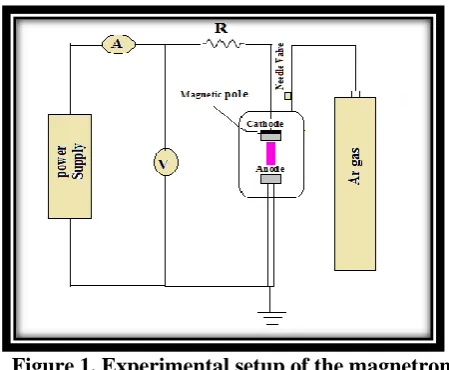
The DC glow discharge system includes two electrodes located in a cylindrical chamber. The cathode faces the anode, which provides an electric field for the gas discharge. Three targets were used in this work: gold, silver and copper, while the diameter of each target is 2cm. Discharge occurs by using argon gas with a flow rate of 40sccm when the distance between two electrodes is 4cm. The chamber was evacuated using a rotary pump
Discharge potential and discharge current measured by digital multi-meter.
In this work the influence of different working pressures and different applied voltages on breakdown voltage, the behavior of potential, and current discharges were studied.
Figure 1. Experimental setup of the magnetron sputtering system
Result and Discussion:
The electrical characteristics of discharge plasma, such as dependencies of discharge current on the applied voltage and gas working pressure inside the vacuum chamber as well as Paschen's curve, are of importance to introduce the homogeneity of the generated plasma.
In Figs. (2, 3), the discharge current and the discharge potential were calculated as a function of applied voltage for constant inter-electrode spacing d=4 cm. The results demonstrate the increase of applied voltage leads to an increase in discharge current and discharge potential. This is because the electric field accelerates the ion and the electron, and as a result they collide with the atom of working gas. This generates new free electrons and positive ions (14). Since the visible glow already covers the entire work surface with increasing applied voltage (an increase in the cathode fall), an increase in current density will now be accompanied by an increase in voltage drop through the resistance of the glow discharge (i.e increases discharge current and discharge potential with increasing in applied voltage) (7).
0.5 1.0 1.5 2.0 2.5 3.0 3.5 0
2 4 6 8 10 12 14 16 18 20
discha
rge current (m
A)
working pressure (mbar)
Au Cu Ag
electrons and ions, reducing the electron mean free path and leading to more negative bias (15).
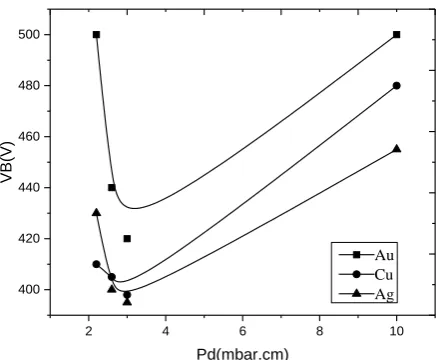
Figure (6) shows the breakdown voltage as a function of different targets, gold being the highest, silver being the lowest, and copper has a breakdown voltage in between both, which related to the work function. Gold is high (5.1ev), silver
(4.26ev), and copper in between (4.65 ev), as indicated in the periodic table (16-18).
Due to the ion impact, secondary electron emission increases accompanied by a decreasing work function that in turn increases the secondary electron numbers, which causes the ionization of neutral gas atoms of molecules that stile the metal surface (19,20).
Figure2. The discharge current as a function of applied voltage
Figure3. The discharge potential as a function applied voltage in argon gas discharge plasma
Figure4. The discharge current as a function of working pressure in argon gas discharge plasma
Figure5. The discharge potential as a function of working pressure in argon gas discharge plasma 300 350 400 450 500 550 600 650 700
300 400 500 600 700 800
discha
rg
e p
ote
ntia
l (V)
applied voltage (V)
Au Cu Ag
300 350 400 450 500 550 600 650 700 2
4 6 8 10 12 14 16 18 20 22
discha
rg
e cu
rr
en
t (
mA)
applied voltage (V)
Au Cu Ag
0.5 1.0 1.5 2.0 2.5 3.0 3.5 250
300 350 400 450 500 550 600 650
discha
rge potential (V)
working pressure (mbar)
Figure 6. influence of target materials on the Panchen’s curve
Conclusion:
From I-V characteristics we conclude that the produced plasma – by using a DC-magnetron sputtering system – is operating in an abnormal glow discharge region because the voltage increases significantly with the increasing total current to force the cathode current density above its natural value and provide the desired current. We also investigated the effect of changing the working pressure and applied voltage on electrical characteristics (discharge current, discharge voltage and breakdown voltage). The results showed that the discharge current and discharge voltage increase with increasing applied voltage, and increasing working pressure while discharge voltage decreases with increasing working pressure. The breakdown voltage takes an ascending order starting with silver, copper and gold.
Conflicts of Interest: None.
References:
1. Conde L. An Introduction to Plasma Physics and its
Space Applications. Department of Applied Physics ETS Ingenieros Aeronáuticos Universidad Politécnica de Madrid, 2104.
2. Mazhir S N, Hadi F W, Mazher A N, Alobaidy L H.
Texture Analysis of smear of Leukemia Blood Cells after Exposing to Cold Plasma, B. S. Journal, 2017; 14(2): 403-410.
6. Shelley J T, Wiley J S, Chan G C Y, Schilling G D,
Ray S J, Hieftje G M. Characterization of Direct-Current Atmospheric-Pressure Discharges Useful for Ambient Desorption/ Ionization Mass Spectrometry,
J. Am. Soc. Mass Spectrum, 2009; 20(5):3395-3397.
7. Bogaerts A. Gas discharge plasmas and their
applications. Spectroch. Acta B: AAS Spectroscopy, 2002; 57(4): 609-658.
8. Brown S C. Introduction to Electrical Discharges in
Gases, John Wiley, New York, 1966;301.
9. Mazhir S N, Spectroscopic Study of
(TiO2)1-x(CuO)x Plasma Generated by Nd:YAG Laser,
ARPN JEAS.2018; 13(3):864-869.
10.Wasfi A S, Humud H R, Ismael M E. Spectroscopic
Measurements of The Electron Temperature in Low Pressure Microwave 2.45 GHz Argon Plasma. IJAP, 2015; 13(27):14-24.
11.Torres C, Reyes P G, Castillo F,Martínez H. Paschen
law for argon glow discharge. Journal of Physics Conference Series 2012; 370:1-4.
12.David B, Pohlman D. A mathematical model of the
modified Paschen's curve for breakdown in micro scale gaps. J. Appl. Phys., 2010; 107: 103303.
13.Schutze A, Jeong J Y, Babayan S E, Park J, Selwyn
G S, Hicks RF. Theatmospheric-pressure plasma jet: A review and comparison to other plasma sources, IEEE Trans Plasma Sci., 1998; 26:1685-1694.
14.Chiad B T, Al-Zubaydi T L, Khalaf M K, Kkudair A
I. Characterization of Low Pressure of Plasma-dc
Glow Discharges (Ar, SF6 and SF6/He) for Si
Etching", IJPAP, 2010;48:723-730.
15.Khalaf M K, Chiad B T, Ahmed A F, Mutlak F H.
Thin Film Technique for Preparing Nano-Zno gas
2 4 6 8 10
400 420 440 460 480 500
VB
(V)
Pd(mbar.cm)
18.Brillson L J. Surfaces and Interfaces of Electronic Materials", Printed in the Federal Republic of Germany,2010.
19.Bogaerts A. Plasma diagnostics and numerical
simulations: insight into the heart of analytical glow
discharges, J Anal At Spectrom,2007; 22:13.
20.Adim K A. Detection of laser-produced tin plasma
emission lines in atmospheric environment by optical
emission spectroscopy technique, Photonic
Sens.,2017; 7:6–7.
ةفلتخم فادهأ نم ةدلوتملا امزلابلل ةيئابرهكلا صئاصخلل هنراقم ةسارد
هط ريضخ ةراس
1رهزم يرون حابص
1
فلخ سامخ دمحم
2
1
مسق ءايزيفلا ،دادغب ،دادغب ةعماج ،تانبلل مولعلا ةيلك ، .قارعلا
2
داوملا ثوحب زكرم ،
ايجولونكتلاو مولعلا ةرازو ،دادغب ،
قارعلا .
ةصلاخلا
:
ينورتنكاملا ذيذرتلا ةموظنم مادختساب يجهوتلا غيرفتلا امزلابل ةيئابرهكلا صئاصخلا ةسارد ثحبلا اذه يف مت رمتسملا رايتلا تاذ
قفدت لدعمب امزلابلا جاتنلا نوكرلاا زاغ مدختسأ كلذك .غيرفتلا امزلاب ديلوتل عنصلا ةيلحملا Sccm
40 رادقمب باطقلاا نيب ةلصاف ةفاسمبو
cm 4 ةيتلوفلا يلاع ةردق زهجم مادختسابو .
)ساحن ، ةضف ،بهذ( ةفلتخم فادهلا لغشلا ةلاد نم لك ريثأت ةسارد مت
رطقب 5 كمسو مس 1
ملم نم لاك نا جئاتنلا ترهظأ .)نشاب ىنحنمو دوثاكلا دهج ،غيرفتلا رايت( ةيئابرهكلا صئاصخلا ىلع ليغشتلا طغضو ةطلسملا ةيتلوفلا ىلع
نيب حوارتي يذلاو ةطلسملا ةيتلوفلا ةدايزب دادزي دوثاكلا دهجو غيرفتلا رايت 300
-700 يف طلسملا طغضلا ةدايز عم دادزي غيرفتلا رايت نا .
بلا نم أدتبا ) ةليئض ةدايز( طغض دنع َايبسن رقتسي مث ةياد mbar
1 ةطقنلا سفن يف رقتسي مث طلسملا طغضلا ةدايز عم دوثاكلا دهج لقي امنيب .
بتري رايهنلاا دهج نا جاتنتسلاا متو .فدهلا ةدام عون ىلع دامتعلااب اهضعب عم نشاب تاينحنم تنروق دقل.غيرفتلا رايت اهيف رقتسا يتلا دب ط
ةلا
.ساحنلاو ةضفلاو بهذلا نم لكل لغشلا
:ةيحاتفملا تاملكلا