AN INITIAL STUDY OF THE SELECTIVITY OF METHANE OVER CARBON DIOXIDE AND INERT
GASES USING A Y
HabibaShehu, EdidiongOkon, Mohammed Kajama, NgoziNwogu, IfyOrakwe and
Robert Gordon University, IDEAS Research Institute, Rive
ARTICLE INFO ABSTRACT
Gaseous hydrocarbons that are prevalent under increased pressure include solute ion gases that are found in oil reservoirs. These hydrocarbon gases are usually conserved but in some cases
are considered uneconomical and thus they are flared. The impact of flaring on the environment cannot be over emphasised and therefore to increase the capacity for transporting a higher volume rather than flaring, an efficient separation of the
natural gas varies extensively from one gas field to another, the major component of natural gas is methane with inert gases and carbon dioxide. Hence, all natural gas must undergo some treatment with about
There is on
mixtures hence making it one of the emerging technologies that is growing f
zeolite membrane have a transport mechanism that will be highly selective for methane and be used for the treatment of natural gas? A methodology based on the use of dip
membrane was developed. Nitrogen phys
hysteresis isotherm of the membrane corresponding to type IV and V that is indicative of a mesoporous membrane. The surface area and the pore size was determined using the Barrett, Joyner, Halenda (B
out at the ambient temperature of 298 K and a pressure range of 0.01 to 0.1 MPa. The permeance of CH4 was in the range of 1.44 x 10
of 2.04 at 293 K and 0.2 MPa.The results obtained have shown that it is possible to use a zeolite membrane to selectively remove carbon dioxide from methane to produce pipeline quality natural gas. There is a need for further
through the membrane as this is essential for the separation of other hydrocarbons that could be present as impurities.
Copyright © 2015 Habiba Shehu et al. This is an open access
distribution, and reproduction in any medium, provided the original work is properly cited.
INTRODUCTION
NATURAL gas is an important fuel gas that can be used as a power generation fuel and as a basic raw material in petrochemical industries. Its composition varies extensively from one gas field to another; a particular field might have about 95% methane, with small quantities of other hydrocarbons, nitrogen, carbon dioxide, hydrogen sulphide and water vapor, while another field may have about 10% of lower hydrocarbons like propane, butane or ethane as well as high carbon dioxide contents (White, 2010). Although there is variation in the composition from source to source, the major component of natural gas is methane with other hydrocarbo and unwanted impurities. Hence, all natural gas must undergo some treatment with about 20% requiring extensive treatment before transportation via pipelines as regulations are in place to
*Corresponding author: Edward Gobina,
Robert Gordon University, Centre for Process Integration and Membrane Technology, Garthdee Road, Aberdeen, UK
ISSN: 0975-833X
Available online at http://www.journal
Article History:
Received 23rd January, 2015
Received in revised form 24th February, 2015 Accepted 16th March, 2015
Published online 30th April,2015
Key words:
Hysteresis, Membrane, Natural gas,
Peremeance and Zeolite.
RESEARCHARTICLE
INITIAL STUDY OF THE SELECTIVITY OF METHANE OVER CARBON DIOXIDE AND INERT
GASES USING A Y-TYPE ZEOLITE MEMBRANE
HabibaShehu, EdidiongOkon, Mohammed Kajama, NgoziNwogu, IfyOrakwe and
*
Edward Gobina
Robert Gordon University, IDEAS Research Institute, Riverside East, Garthdee Road, Aberdeen, UK
ABSTRACT
Gaseous hydrocarbons that are prevalent under increased pressure include solute ion gases that are found in oil reservoirs. These hydrocarbon gases are usually conserved but in some cases
are considered uneconomical and thus they are flared. The impact of flaring on the environment cannot be over emphasised and therefore to increase the capacity for transporting a higher volume rather than flaring, an efficient separation of the gases is essential. Although the composition of natural gas varies extensively from one gas field to another, the major component of natural gas is methane with inert gases and carbon dioxide. Hence, all natural gas must undergo some treatment with about 20% of total reserves requiring extensive treatment before transportation via pipelines. There is on-going research on the use of composite mesoporous membranes to separate gaseous mixtures hence making it one of the emerging technologies that is growing f
zeolite membrane have a transport mechanism that will be highly selective for methane and be used for the treatment of natural gas? A methodology based on the use of dip
membrane was developed. Nitrogen physisorption measurements were carried out which showed the hysteresis isotherm of the membrane corresponding to type IV and V that is indicative of a mesoporous membrane. The surface area and the pore size was determined using the Barrett, Joyner, Halenda (BJH) desorption method. Single gas permeation test using a membrane reactor was carried out at the ambient temperature of 298 K and a pressure range of 0.01 to 0.1 MPa. The permeance of
was in the range of 1.44 x 10⁻⁶ to 3.41 x 10 -6 mols-1m-2Pa-1 and
of 2.04 at 293 K and 0.2 MPa.The results obtained have shown that it is possible to use a zeolite membrane to selectively remove carbon dioxide from methane to produce pipeline quality natural gas. There is a need for further study of the ambient conditions needed to achieve capillary condensation through the membrane as this is essential for the separation of other hydrocarbons that could be present as impurities.
is an open access article distributed under the Creative Commons Attribution License, which distribution, and reproduction in any medium, provided the original work is properly cited.
gas is an important fuel gas that can be used as a power generation fuel and as a basic raw material in tries. Its composition varies extensively from one gas field to another; a particular field might have about 95% methane, with small quantities of other hydrocarbons, nitrogen, carbon dioxide, hydrogen sulphide and about 10% of lower hydrocarbons like propane, butane or ethane as well as high . Although there is variation in the composition from source to source, the major component of natural gas is methane with other hydrocarbons and unwanted impurities. Hence, all natural gas must undergo some treatment with about 20% requiring extensive treatment before transportation via pipelines as regulations are in place to
Centre for Process Integration and Membrane Technology, Garthdee Road, Aberdeen, UK
tightly regulate the composition of the natural gas transported to the pipelines. Membrane technology has only about 5% of the market for processing natural gas in the Un
percentage is expected to rise as better carbon dioxide selective membranes are developed
Lokhandwala, 2008). High pressures in the range of 3.45 10.34MPa are usually required to transport natural gas to a gas processing plant and for a membrane to be used to remove impurities and to minimize recompression cost, the membrane must remove the impurities from the gas into the permeate stream. This requirement determines the type of membrane that can be suitable (Richard W. Baker, 2012
The current technology that is being used for the removal of water vapour from natural gas is glycol absorption
et al.,1994). Water is an easily condensable compound hence;
there are many membranes with high water permeability as well as high water/methane selectivity. The use of glycol absorption is quite prominent and it has a low operational cost.
Available online at http://www.journalcra.com
International Journal of Current Research
Vol. 7, Issue, 04, pp.14986-14990, April, 2015
INTERNATIONAL
OF CURRENT RESEARCH z
INITIAL STUDY OF THE SELECTIVITY OF METHANE OVER CARBON DIOXIDE AND INERT
HabibaShehu, EdidiongOkon, Mohammed Kajama, NgoziNwogu, IfyOrakwe and
st, Garthdee Road, Aberdeen, UK
Gaseous hydrocarbons that are prevalent under increased pressure include solute ion gases that are found in oil reservoirs. These hydrocarbon gases are usually conserved but in some cases exploration are considered uneconomical and thus they are flared. The impact of flaring on the environment cannot be over emphasised and therefore to increase the capacity for transporting a higher volume gases is essential. Although the composition of natural gas varies extensively from one gas field to another, the major component of natural gas is methane with inert gases and carbon dioxide. Hence, all natural gas must undergo some treatment 20% of total reserves requiring extensive treatment before transportation via pipelines. going research on the use of composite mesoporous membranes to separate gaseous mixtures hence making it one of the emerging technologies that is growing fast. The question is can a zeolite membrane have a transport mechanism that will be highly selective for methane and be used for the treatment of natural gas? A methodology based on the use of dip-coated Y-type zeolite isorption measurements were carried out which showed the hysteresis isotherm of the membrane corresponding to type IV and V that is indicative of a mesoporous membrane. The surface area and the pore size was determined using the Barrett, Joyner, JH) desorption method. Single gas permeation test using a membrane reactor was carried out at the ambient temperature of 298 K and a pressure range of 0.01 to 0.1 MPa. The permeance of and a maximum CH4/CO2 selectivity
of 2.04 at 293 K and 0.2 MPa.The results obtained have shown that it is possible to use a zeolite membrane to selectively remove carbon dioxide from methane to produce pipeline quality natural gas. study of the ambient conditions needed to achieve capillary condensation through the membrane as this is essential for the separation of other hydrocarbons that could be
ribution License, which permits unrestricted use,
tightly regulate the composition of the natural gas transported to the pipelines. Membrane technology has only about 5% of the market for processing natural gas in the United States. This percentage is expected to rise as better carbon dioxide selective membranes are developed (White, 2010; Baker and . High pressures in the range of 3.45 – 10.34MPa are usually required to transport natural gas to a gas ocessing plant and for a membrane to be used to remove impurities and to minimize recompression cost, the membrane must remove the impurities from the gas into the permeate stream. This requirement determines the type of membrane that
ard W. Baker, 2012).
The current technology that is being used for the removal of water vapour from natural gas is glycol absorption (Graham
For membranes technology to be competitive, it must cut down the rate of loss of methane with the permeate water. Offshore platforms glycol units are not suitable due to space hence the use of membranes can be competitive (Baker, 2002).The specification of inert gases in the natural gas pipelines is less than 4%, gas reserves having higher contents are of low quality, although gas containing about 10% inert gases can be blended with low nitrogen content gas to achieve pipeline quality gas (Baker, 2002). The economic importance of the content of nitrogen in natural gas is high. In the United States, the value of shut-in gas containing 10 to 15% nitrogen is about $30 billion (Tannehill et al., 1999); as a result there are numerous processes that have been evaluated for the removal of nitrogen. The current technology that is used now in large scale is the cryogenic plants. Membranes can be used to achieve these separations, the challenge being to develop membranes with high methane/nitrogen separation efficiency. The membrane system as compared to the cryogenic plant reduces the concentrations of water, hydrocarbons like propane and butane to a very low level as these components permeate preferentially to the membrane (Baker, 2002).
A typical plant for the removal of carbon dioxide from natural gas uses adsorption technology. This consist of two towers where the first tower contains the feed gas at high pressure and an absorbent liquid flowing counter current to each other. The absorbent liquid that contains the absorbed carbon dioxide and heavy hydrocarbons is removed from the bottom of the tower (Baker and Lokhandwala, 2008). Membrane technology is competitive against absorption for the removal of carbon dioxide from natural gas (Kohl and Nielsen, 1997) as the high pressure absorber tower is an expensive, large thick walled heavy vessel. The mass of the components absorbed is related to the size of the tower. Furthermore, these absorbance units are quite difficult to maintain and corrosion is an important maintenance problem (Baker and Lokhandwala, 2008). Membrane technology could offer a more competitive method for the removal of carbon dioxide from natural gas.
Modern membrane technology can be a technique of implementing Process intensification (PI) which is an innovative design method that is aimed at decreasing production cost, waste generated and size of equipment used as well as utilizing energy (Dautzenberg and Mukherjee, 2001). Gas separations using membranes is a pressure driven process that has different industrial applications that represent a small percentage of the potential application in chemical and petro chemical industries as well as refineries (Bernardoet al.,2009). In recent years there is an increase in demand for light hydrocarbons for petrochemical feed stocks and for fuel. This has been met to a large extend by the recovery of these components from petroleum gases such as natural gas and deproponizer overhead mixtures (Ahmed and Theydan, 2014). The use of membranes for gas separations is growing at a slow but steady rate (Baker, 2002). Baker in 2002 made an estimate that the market scale of gas separations using membrane technology by the year 2020 will be five times that of year 2000 (Baker, 2002). There are many opportunities for membrane gas separations as many efforts have been made in the last couple of years to develop an effective method for the separation and subsequent removal of impurities from natural
gas. There are ongoing researches on the use of nano-composite membranes to separate gaseous mixtures hence making it one of the emerging technologies that is growing fast. The membrane to be used for crude oil and natural gas processes have to be selective for hydrocarbon vapours and be chemically and thermally stable (Degrèveet al., 2001).
Micro porous inorganic membranes having pore sizes of less than 1 nm have been studied extensively for gas separation applications because of their good resistance to harsh chemicals, good thermal and mechanical stability as well as stability under high pressure when compared to polymeric membranes (Anderson et al., 2012). Today much of the research work is being directed towards the investigation of new membrane material and the development of new membrane structures that exhibit both higher selectivity and permeability of the target gases (Bernardo et al., 2009). Zeolite crystals have been seen from literature to act as a separation membrane as they have regular pore size and structure.
The separation of gases in membranes is possible due to the difference in the movement of the different species through the membrane. For membranes having large pore sizes of 0.1 to 10 μm, the gases permeate via convective flow and there is no separation of the gases observed. For mesoporous membranes, separation is based on the collision amongst the molecule and hence molecular diffusion is dominant and the mean free path of the gas molecules is greater than the pore size. The diffusion here is governed by Knudsen mechanism and it follows the kinetic theory of gases that the rate of transport of any gas is inversely proportional to the square root of its molecular weight that is Graham’s law of diffusion (Basile, 2013). However, for a microporous membrane with pore size less than 2 nm, separation of gases is based mostly on molecular sieving. The transport mechanism in these membranes is often complex and involves surface diffusion that occurs when the permeating species exhibit a strong affinity for the membrane surface thus adsorbing on the walls of the pores (Basile, 2013)
A membrane’s permeability and selectivity has an influence on the economics of a gas separation process (Bernardoet
al.,2009). Permeability is the rate at which a substance
permeates through a membrane and it is dependent on thermodynamic factors which is the partitioning of species between feed phase and membrane phase and kinetic factors which in a dense membrane is diffusion and in a micro porous membrane is surface diffusion. The selectivity of a membrane is the fundamental parameter to achieving high product purity as well as high recoveries; hence for the potential growth of membrane gas separation process, the production of highly selective membranes for the desired gas is essential. The development of inorganic membranes like silica and zeolite has increased the potential of membrane gas separation applications as they can withstand aggressive chemicals as well as high temperatures. However, there are drawbacks of the use of such membranes, which is their high cost, modest
reproducibility, brittleness, low membrane area, low
efficacy of the membrane in terms of the selectivity of the membrane to methane. The choice of membrane material greatly affects the permeation flux and selectivity of different materials as they move through the membrane. The morphology of the zeolite membrane was determined using the Scanning Electron Microscope (SEM). The pore network and structure of the two materials as well as the specific surface area was determined using gas adsorption and desorption techniques. When using nitrogen physisorption measurements to characterize a membrane material, the physisorption isotherms shown in figure 3 together with a variety of mathematical models are used to determine the pore size of the material.
Fig.1. Physisorption isotherms adapted from (Sing, 1985)
The most important isotherms in Figure 1 for porous ceramic are type I which corresponds to microporous materials and types IV and V which corresponds to mesoporous materials (Sing, 1985).
The permeance and selectivity are some of the parameters that are used to determine a membrane’s performance. The
permeance P with the unit (mol.m-2.s-1.Pa-1) represents the
proportionality coefficient with the flux at steady state of a particular gas through a membrane:
=
. ……….(1)
Where Q is the molar gas flow (mol.m-1) rate through the
membrane, A is the membrane surface area (m2) and Δp is the
pressure difference across the membrane (Pa). The permeance is a measure of the quantity of a component that permeates through the membrane (Freemanet al.,2006).
The ideal gas selectivity which is the ratio of the permeability coefficients of two different gases as they permeate independently through the membrane is given by:
= ………(2)
Where Pi and Pj is the permeance of the single gases through
the membrane. The selectivity is the measure of the ability of a
membrane to separate two gases and it is used to determine the purity of the permeate gas as well as determine the quantity of product that is lost.
Procedure
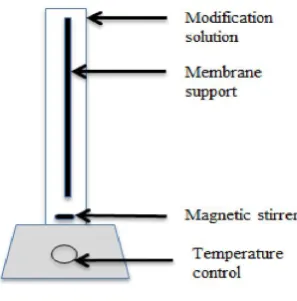
[image:3.595.355.504.283.434.2]As shown in Fig. 2 the membrane was prepared by the dip-coating method. A solution containing Silicone oxide, aluminum oxide, sodium oxide and deionized water was prepared and homogenized at room temperature for 20 hours. Zeolite crystals were rubbed on alumina support then dipped into the solution and kept for 20 hours at 343 K. The membrane was washed with deionized water and the pH of the rinse water was monitored. When the rinse water pH was neutral the membrane was air dried for 20 minutes and thermally treated in the oven at 338 K for 2 hours prior to permeation test. The modification solution was composed of silicone oxide, aluminum oxide, sodium oxide and deionized water in the ratio 1:10:14:798 respectively.
Fig. 2. Membrane preparation process
[image:3.595.342.525.541.612.2]Nitrogen physisorption measurements were carried out at 77.35 K using a quantachrome adsorption gas analyser. The optimum operating conditions are given in Table 1.
Table 1. Operating conditions of the quantachrome gas analyzer
Area (A2/mol) 16.2
Non-Ideality (1/mmHg) 6.58E-05
Sample cell type (mm) 12
Analysis time (mins) 237
Mol weight (g/mol) 28.0134
Ambient temperature (K) 300
Bath temperature (K) 77
Permeation test were carried out using the following gasses:
CH4, CO2, N2, He and C3H8. The permeation test was carried
at the temperature of 293 K. The pressure was in the range of 104 to 105 Pa.
RESULT AND DISCUSSION
Fig. 3 shows the permeance which was calculate using (2) of
CO2, N2, CH4, He and C3H8 against the gauge pressure through
a Y-type zeolite membrane.
14988 International Journal of Current Research, Vol. 7, Issue, 04, pp.14986-14990, April,2015
Fig. 3. Permeation test of y-type zeolite membrane at 293k
The zeolite membrane showed permeance in the range of 10 mol.m-2.s-1.Pa-1 for CO2, CH4, He and N2, but in the range of
10-7 for propane. These permeances are relatively high when
compared to values obtained from (Basile
permeance decreased with increase in feed pressure, propane has the lowest permeance and the highest molecular weight and He has the lowest molecular weight and the highest permeance although at lower pressure of 0. MPa the permeance of methane is higher. The selectivity for this membrane to methane over carbon dioxide and at various pressures was calculated using (1) and Fig. 4 is the graph of the e
[image:4.595.43.287.59.186.2]pressure on the selectivity.
Fig. 4. Effect of pressure on the selectivity of methane over carbon dioxide
From Fig. 4, it can be observed that the selectivity of methane in the zeolite membrane was at its maximum at the pressure of about 0.2 Pa. There is a slight decrease in the selectivity with the decrease in pressure. The Knudsen selectivity was calculated using (3)
=√
√ ………..
Where αkis the Knudsen selectivity, M1
molecular weights of the gases to be separated. It can be seen form Fig.4 the selectivity of methane over carbon dioxide using a zeolite membrane is higher than the Knudsen selectivity calculated. The zeolite membrane from nitrogen physisorption measurements have been seen to have a pore radius of 5.68 nmhence it is expected to follow the Knudsen mechanism for the separation of gases (Wang et al., 2012).
Fig. 5 attempts to explain if the mechanism followed by membrane could be molecular sieving.
type zeolite membrane at 293k
The zeolite membrane showed permeance in the range of 10-6
, but in the range of for propane. These permeances are relatively high when Basile, 2013). The permeance decreased with increase in feed pressure, propane has the lowest permeance and the highest molecular weight and ar weight and the highest permeance although at lower pressure of 0. MPa the permeance of methane is higher. The selectivity for this membrane to methane over carbon dioxide and at various pressures was calculated using (1) and Fig. 4 is the graph of the effect of
Effect of pressure on the selectivity of methane over
From Fig. 4, it can be observed that the selectivity of methane in the zeolite membrane was at its maximum at the pressure of Pa. There is a slight decrease in the selectivity with the decrease in pressure. The Knudsen selectivity was
………..(3)
and M2 are the molecular weights of the gases to be separated. It can be seen form Fig.4 the selectivity of methane over carbon dioxide using a zeolite membrane is higher than the Knudsen selectivity embrane from nitrogen physisorption measurements have been seen to have a pore radius of 5.68 nmhence it is expected to follow the Knudsen mechanism for
Fig. 5 attempts to explain if the mechanism followed by the
Fig. 5. Effect of kinetic diameter on gas permeance at 293 K and 104 Pa
The order of the kinetic diameter is given as
He<CO2<N2<CH4<C3H8. A zeolite membrane has generally
been seen as a molecular sieve and
is expected to follow the order of the kinetic diameter. Fig. 5 shows the permeance (molm
membrane at 293 K. The mean molecular diameters of the
gases He, CO2, N2, CH4 and C
0.378 and 0.43 nm respectively. The gases helium, nitrogen and propane followed the expected mechanism for their permeation. Carbon dioxide and methane deviated from the expected pattern. This could indicate the presence of inter crystalline defects in the zeolite membrane
et al., 2006). According to (Basile
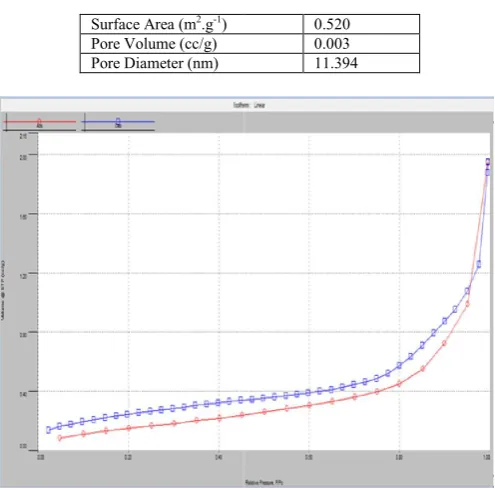
[image:4.595.46.288.366.496.2]the optimum pore size that a membrane should have for the separation of CO2 from CH4 is 0.4 nm because they permeate through different mechanisms in a membrane. The pore size of the membrane used in this work was determined by Nitrogen physisorption measurements using the Barrett, Joyner, Halenda (BJH) desorption method and the desorption summary is given in Table 2.
Table 2. Desorption summary of the zeolite membrane
Surface Area (m2.g-1)
Pore Volume (cc/g) Pore Diameter (nm)
Fig. 6. Physisorption isotherm of the zeolite membrane Effect of kinetic diameter on gas permeance at 293 K and
104 Pa
The order of the kinetic diameter is given as
zeolite membrane has generally been seen as a molecular sieve and the permeance of the gases is expected to follow the order of the kinetic diameter. Fig. 5
shows the permeance (molm-2.s-1.Pa-1) of a Y-type zeolite
membrane at 293 K. The mean molecular diameters of the
and C3H8 are 0.265, 0.330, 0.364,
0.378 and 0.43 nm respectively. The gases helium, nitrogen and propane followed the expected mechanism for their permeation. Carbon dioxide and methane deviated from the expected pattern. This could indicate the presence of
inter-in the zeolite membrane (Freeman Basile, 2013; Wang et al., 2012),
the optimum pore size that a membrane should have for the separation of CO2 from CH4 is 0.4 nm because they permeate mechanisms in a membrane. The pore size of the membrane used in this work was determined by Nitrogen physisorption measurements using the Barrett, Joyner, Halenda (BJH) desorption method and the desorption summary is given
summary of the zeolite membrane
0.520 0.003 11.394
[image:4.595.308.556.492.737.2]The hysteresis isotherms in Fig. 6 correspond to type IV and V; this implies the membrane is mesoporous and could undergo capillary condensation. The zeolite shows a separation between methane and CO2, although the membrane had a pore radius of 5.68 nm, better separation could be obtained if the pore size of the membrane is reduced and this could be archived by the modification of the membrane.
Acknowledgment
The authors are thankful to the Centre For process Integration and Membrane Technology at the Robert Gordon University for providing the test facilities used in conducting these experiments.
REFERENCES
Ahmed MJ, Theydan SK. Modeling of propane separation from light hydrocarbons by adsorption on 4A molecular sieve zeolite. Journal of Natural Gas Science and
Engineering.2014; 18:1-6.
Anderson M, Wang H, Lin Y. Inorganic membranes for carbon dioxide and nitrogen separation. 2012.
Baker RW, Lokhandwala K. Natural gas processing with membranes: an overview. Industrial & Engineering
Chemistry Research.2008; 47(7):2109-2121.
Baker RW. Future directions of membrane gas separation technology. Industrial & Engineering Chemistry Research, 2002; 41(6):1393-1411.
Baker RW. Future directions of membrane gas separation technology. Industrial & Engineering Chemistry Research, 2002; 41(6):1393-1411.
Basile A. Handbook of Membrane Reactors: Fundamental
Materials Science, Design and Optimisation. : Elsevier;
2013.
Basile A. Handbook of Membrane Reactors: Fundamental
Materials Science, Design and Optimisation. : Elsevier;
2013.
Bernardo P, Drioli E, Golemme G. Membrane gas separation: a review/state of the art. Industrial & Engineering
Chemistry Research.2009; 48(10):4638-4663.
Dautzenberg F, Mukherjee M. Process intensification using multifunctional reactors. Chemical Engineering Science, 2001; 56(2):251-267.
Degrève J, Everaert K, Baeyens J. The use of gas membranes for VOC-air separations.Filtration & Separation.2001; 38(4):48-54.
Freeman B, Yampolskii Y, Pinnau I. Materials science of
membranes for gas and vapor separation. : John Wiley &
Sons; 2006.
Graham J, Krenek M, Maxon D, Peirson J, Thompson J. Natural Gas Dehydration: Status and Trends. Gas Research
Institute Report GRI-94-099. 1994.
Kohl A, Nielsen R. Gas purification.5th Gulf, Houston,
TX.1997
Richard W. Baker. Membrane Technology and Applications. 3rd edition ed. United Kingdom: John Wiley and Sons Ltd; 2012.
Sing KS. Reporting physisorption data for gas/solid systems with special reference to the determination of surface area and porosity (Recommendations 1984). Pure and Applied
Chemistry,1985; 57(4):603-619.
Tannehill CC, Raven M, Brown K. Nitrogen Removal
Requirements from Natural Gas: Topical Report. : Gas
Research Institute; 1999.
Wang Z, Achenie LE, Khativ SJ, Oyama ST. Simulation study of single-gas permeation of carbon dioxide and methane in hybrid inorganic–organic membrane. Journal of Membrane
Science, 2012; 387:30-39.
White LS. Evolution of natural gas treatment with membrane systems.Membrane Gas Separation.2010; 313.
*******
14990 International Journal of Current Research, Vol. 7, Issue, 04, pp.14986-14990, April,2015