AN EFFICIENT ALGORITHM FOR FINDING MIXED NASH EQUILIBRIA IN 2
Raytheon Canada Limited,
ARTICLE INFO ABSTRACT
This paper presents an algorithm for calculating mixed Nash equilibria
algorithm is based on the mathematical equivalence between the expected payoff function of bi matrix games and the fuzzy average. It was proved that the expected payoff function of 2 games is identical to the fuzzy average of
with the consequence matrix, the strategy sets are replaced with term sets in linguistic variables. This paper proves that the new algorithm can compute mixed NE in 2
time for any types of bi computing mixed NE in 2
Copyright © 2015 Lunshan. This is an open access article distributed under the Creative Commons Att distribution, and reproduction in any medium, provided the original work is properly cited.
INTRODUCTION
Recent sequence of papers shows that computing one NE is PPAD (Polynomial Parity Arguments on Directed graphs) for two, three, or four player games in strategic form [7] [8] [14] [15]. Chen and Deng [8] show that computing NE for two pl games is PPAD-complete. Daskalakis et al.
[15] independently show that calculating NE for three player games is PPAD
time in the worst case. Chen et al. [9] show that the problem of computing a (1/n)
PPAD-complete. Daskalakis and Papadimitriou presented a polynomial time approximation scheme (PTAS) for NE in anonymous games. In [16] the authors described a PTAS for finding an
two pure strategies with a certain order of running time. The PTAS in [16] depends on the existence of an
consisting of integer multiples of2. Daskalakis [13] presented improved PTAS from the running time view of point. This improved PTAS is based on the existence of an
players play mixed strategies, or al players who mix play the same mixed strategy. In [17] the authors extended the PTAS with bounded number of pure strategies with running time
where U denotes the number of bits required to describe the payoff. Daskalakis and Papadimitriou's PTAS [13] [16] [ algorithms that enumerate a set of mixed strategy profiles which is independent of the input game as candidates for approxima NE, that is, the game is used only to verify if a given mixed strategy profile is an
oblivious algorithms [18]. Daskalakis and Papadimitriou showed that these type of PTAS for anonymous games must have running time exponential in1 [18]. They also proposed a non
Chen et al. [10] presented that the problem of computing a et al. [9] showed that the problem of finding an
complete.
*Corresponding author: Lunshan (Shaun) GAO
Raytheon Canada Limited, 400 Phillip Street, Waterloo, ON. Canada N2L6R7
ISSN: 0975-833X
Vol.
Article History: Received 11th August, 2015 Received in revised form 27th September, 2015 Accepted 13th October, 2015 Published online 30th November,2015 Key words:
2-player games, Nash Equilibria, P-complete, The fuzzy average, Linguistic variables, Fuzzy number, Hessian matrix.
Citation: Lunshan (Shaun) GAO, 2015. “An efficient algorithm for finding mixed nash equilibria of Current Research, 7, (11), 23350-23361.
RESEARCH ARTICLE
AN EFFICIENT ALGORITHM FOR FINDING MIXED NASH EQUILIBRIA IN 2
*Lunshan (Shaun) GAO
Raytheon Canada Limited, 400 Phillip Street, Waterloo, ON. Canada N2L6R7
ABSTRACT
This paper presents an algorithm for calculating mixed Nash equilibria
algorithm is based on the mathematical equivalence between the expected payoff function of bi matrix games and the fuzzy average. It was proved that the expected payoff function of 2 games is identical to the fuzzy average of two linguistic values when the payoff matrix is replaced with the consequence matrix, the strategy sets are replaced with term sets in linguistic variables. This paper proves that the new algorithm can compute mixed NE in 2
time for any types of bi-matrix games. We claim that there is a fully polynomial time scheme for computing mixed NE in 2-player games.
is an open access article distributed under the Creative Commons Attribution License, which distribution, and reproduction in any medium, provided the original work is properly cited.
Recent sequence of papers shows that computing one NE is PPAD (Polynomial Parity Arguments on Directed graphs) for two, three, or four player games in strategic form [7] [8] [14] [15]. Chen and Deng [8] show that computing NE for two pl
[14] show that finding NE for four player games is PPAD complete. Papers [7] and [15] independently show that calculating NE for three player games is PPAD-complete. All known algorithms require exponential [9] show that the problem of computing a (1/n)-well-supported NE in polymatrix game is Daskalakis and Papadimitriou presented a polynomial time approximation scheme (PTAS) for
anonymous games. In [16] the authors described a PTAS for finding an
-approximation NE in an anonymous game with two pure strategies with a certain order of running time. The PTAS in [16] depends on the existence of an. Daskalakis [13] presented improved PTAS from the running time view of point. This improved PTAS is based on the existence of an
-approximation NE satisfying the following conditions: either at most players play mixed strategies, or al players who mix play the same mixed strategy. In [17] the authors extended the PTAS withwith running time ng U
) 1 ,
( for some function g of
, number of pure strategies anddenotes the number of bits required to describe the payoff. Daskalakis and Papadimitriou's PTAS [13] [16] [ algorithms that enumerate a set of mixed strategy profiles which is independent of the input game as candidates for approxima NE, that is, the game is used only to verify if a given mixed strategy profile is an
-approximatioblivious algorithms [18]. Daskalakis and Papadimitriou showed that these type of PTAS for anonymous games must have running [18]. They also proposed a non-oblivious PTAS for two-strategy anonymous games.
[10] presented that the problem of computing a1 -will-supported NE in a polymatrix game is PPAD
[9] showed that the problem of finding an
-approximation NE in an anonymous game with seven pure strategies is PPAD*Corresponding author: Lunshan (Shaun) GAO,
Raytheon Canada Limited, 400 Phillip Street, Waterloo, ON. Canada N2L6R7
International Journal of Current Research Vol. 7, Issue, 11, pp.23350-23361, November, 2015
INTERNATIONAL
An efficient algorithm for finding mixed nash equilibria in 2-player games
AN EFFICIENT ALGORITHM FOR FINDING MIXED NASH EQUILIBRIA IN 2-PLAYER GAMES
400 Phillip Street, Waterloo, ON. Canada N2L6R7
This paper presents an algorithm for calculating mixed Nash equilibria in 2-player games. The algorithm is based on the mathematical equivalence between the expected payoff function of bi-matrix games and the fuzzy average. It was proved that the expected payoff function of 2-player
two linguistic values when the payoff matrix is replaced with the consequence matrix, the strategy sets are replaced with term sets in linguistic variables. This paper proves that the new algorithm can compute mixed NE in 2-player games within polynomial matrix games. We claim that there is a fully polynomial time scheme for
ribution License, which permits unrestricted use,
Recent sequence of papers shows that computing one NE is PPAD (Polynomial Parity Arguments on Directed graphs)-complete for two, three, or four player games in strategic form [7] [8] [14] [15]. Chen and Deng [8] show that computing NE for two player [14] show that finding NE for four player games is PPAD complete. Papers [7] and complete. All known algorithms require exponential supported NE in polymatrix game is Daskalakis and Papadimitriou presented a polynomial time approximation scheme (PTAS) for
-approximation approximation NE in an anonymous game with two pure strategies with a certain order of running time. The PTAS in [16] depends on the existence of an
-approximation NE . Daskalakis [13] presented improved PTAS from the running time view of point. This approximation NE satisfying the following conditions: either at most O(13) players play mixed strategies, or al players who mix play the same mixed strategy. In [17] the authors extended the PTAS with any, number of pure strategies and 1, denotes the number of bits required to describe the payoff. Daskalakis and Papadimitriou's PTAS [13] [16] [17] are algorithms that enumerate a set of mixed strategy profiles which is independent of the input game as candidates for approximation approximation NE. The PTAS is called oblivious algorithms [18]. Daskalakis and Papadimitriou showed that these type of PTAS for anonymous games must have running
nonymous games.
supported NE in a polymatrix game is PPAD-complete. Chen approximation NE in an anonymous game with seven pure strategies is
PPAD-INTERNATIONAL JOURNAL OF CURRENT RESEARCH
The application of fuzzy theory to decision making problems initiated by Bellman and Zadeh [2] in 1970. Butnariu [5] did fundamental research on fuzzy games. Chakeri and Sheikholeslam [6] show a method of finding fuzzy NE in Crisp and fuzzy games, Garagic et al. [23] extend the concept of non cooperative game theory to fuzzy non cooperative games under uncertainty phenomena. Wu and Soo [35] applied fuzzy game theory to multi-agent coordination.
In this article, we use fuzzy theory as a tool to apply the fuzzy average to 2-player games. This paper represents a revised algorithm for computing mixed NEs in 2-player games [20] [21]. This algorithm is based on the relationship between the expected payoff function of 2-player games and the mathematical representation of the fuzzy average of two linguistic values. Based on author’s understanding, the problem of computing mixed NE in 2-player games in normal form has not been proved in P-complete class. We prove that the new algorithm can compute mixed NEs in 2-player games in polynomial time for any types of 2-player games in normal form. We claim that there is a fully polynomial time scheme for 2-player games in normal form.
This article is organized as follows. Section 2 discusses the preliminaries. Section 3 describes the algorithm for calculating mixed NEs in 2-player games in details. Associated with the algorithm, a theorem, which indicates the main result in this article, and its proof are represented in this section. Section 4 provides examples. Section 5 is the conclusion and future study.
PRELIMINARIES
2-player games in normal form
2-player games in normal form are also called bi-matrix games. A 2-player game is denoted byG(2, {Si}i2, {ui}i2), where )
,..., ,
( 11 12 1
1 s s sk
S ,S2 (s21,s22,...,s2l) is a set of strategies for player 1, player 2 respectively; the expected payoff function 1
u
of player 1, 2u
of player 2 is as follows.)
1
.
2
(
)
,
(
)
,
(
1 21 2 1 2 2
2 12 1 2 1 1
T T
P
A
P
P
P
u
P
A
P
P
P
u
whereP1 {p11,..., p1k}
(
)
:
{(
,
,...,
)
|
11
;
10
(
1
,
2
,...,
)}
11 12 11
1
p
p
p
p
p
i
k
P
i ik
i k
k
represents the probability distribution overS1;P2 {p21,..., p2l}l(P2)represents the probability distribution overS2; A12 ,A21 is
k
l
payoff matrix,l
k
payoff matrix, of player 1, player 2, respectively.Optimal values of function f(x, y)
Let us review the Taylor expansion of a two variable function. Suppose that function f(x, y) is an infinitely differentiable, and (a, b)
is a critical point of f(x, y), with
f
x(
a
,
b
)
=f
x(
a
,
b
)
= 0. Function f(x, y)’s Taylor expansion is as follows.)
)(
,
(
)
)(
,
(
)
,
(
)
,
(
x
y
f
a
b
f
a
b
x
a
f
a
b
y
b
f
x
y
T
O
H
b
y
a
x
b
a
f
b
y
b
a
f
a
x
b
a
f
xx yy(
,
)(
)
xy(
,
)(
)(
)
.
.
2
1
)
)(
,
(
2
1
2 2
(high order terms for short)In the case that (a, b) is a critical point, the first derivatives
f
x(
a
,
b
)
andf
x(
a
,
b
)
are zero, the above equation becomesT
O
H
b
y
a
x
B
b
y
C
a
x
A
b
a
f
y
x
f
(
)
(
)(
)
.
.
2
1
)
(
2
1
)
,
(
)
,
(
2
2
where
A
f
xx,B
f
yyandC
f
xy. We can ignore the high order terms when (x, y) sufficiently close to (a, b). We rewrite the result as)
2
.
2
(
2
1
)
(
2
1
)
,
(
)
,
(
h
Hh
b
y
a
x
C
B
B
A
b
y
a
x
b
a
f
y
x
f
T
where
h
T
(
x
a
,
y
b
)
, the matrix H is called Hessian matrix, the representation on right hand is called quadratic form.D=Det H
C
B
B
A
=yy xy
xy xx
f
f
f
f
=
f
xxf
yy
(
f
xy)
2 is the determinant of Hessian matrix.There are three cases we need to consider.
1) If (a, b) is local minimum value, then the right hand side of (2.2) must be positive for all (x, y) in a neighborhood of (a, b), such as
H
0
for all (x, y) in a neighborhood of (a, b). Based on linear algebra, if the two eigenvalues of matrix H are positive, thenH
0
.2) If (a, b) is local maximum, then the right hand side of (2.2) must be negative, such as such as
H
0
for all (x, y) in a neighborhood of (a, b). Based on linear algebra, if the two eigenvalues of matrix H are negative, thenH
0
.3) If (a, b) is a saddle point, then the right hand side of (2.2) is either positive or negative depending on the values in neighborhood of (a, b). According to linear algebra, when two eigenvalues of matrix H are nonzero and have opposite sigh, point (a, b) is a saddle point.
The above inferences can be rephrased for two variable functions as follows. 1) If D > 0 and A > 0, then f(a, b) is a local minimum of f(x, y);
2) If D > 0 and A < 0, then f(a, b) is a local maximum of f(x, y); 3) If D < 0, then (a, b) is a saddle point of f(x, y);
4) If D = 0, then no conclusion can be drawn. 1.1 Fuzzy Numbers
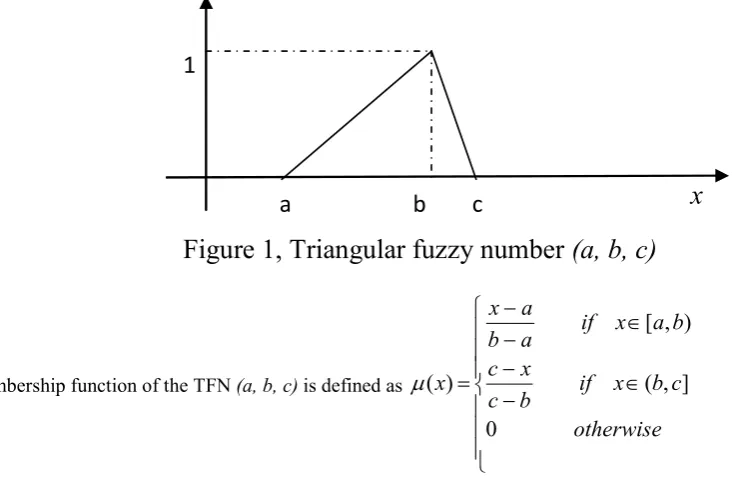
A fuzzy number is a fuzzy set which is defined in R. There are some types of fuzzy numbers [27]. For example, triangular fuzzy numbers (TFNs), trapezoid fuzzy numbers, and etc. We only review TFNs in this paper.
The definition of a TFN:
A TFN is denoted as (a, b, c), where
a
R
;
b
R
;
c
R
and(
a
b
c
)
. The TFN (a, b, c) is described in Figure 1.
The membership function of the TFN (a, b, c) is defined as
otherwise
c
b
x
if
b
c
x
c
b
a
x
if
a
b
a
x
x
0
]
,
(
)
,
[
)
(
There are two special TFNs. One is (a, a, c), such as a = b, and the otheris (a, c, c), such as b = c. Suppose the membership function of TFN (a, a, c), (a, c, c) is
(x),
(x), respectively. Then one has the following.1
[image:3.595.70.444.449.690.2]a
b
c
a
c
c
x
a
c
x
1
)
(
; (a <c ),a
c
a
x
a
c
x
1
)
(
; (a <c ).The Fuzzy Average
The fuzzy average [22] is defined with the average of linguistic values of a linguistic variable (x, T(x), U, G, M)[36] [37], where x the name of the variable; T(x) is the term set of x, U is the universe of discourse which is usually defined as interval [0, 1]; G is the syntactic rule which generates the terms in T(x); M is a semantic rule which is usually a mapping from the set T(x) to a set of fuzzy numbers defined in U. The fuzzy average of two values of a linguistic variable was described as follows.
Suppose that the two values of a linguistic variable are as follows. (x,T1(x),U1,G1,M1) and(y,T2(y),U2,G2,M2).
},
,...,
,
{
)
(
:
1 1 21
T
x
A
A
A
nM
M
2:
T
1(
y
)
{
B
1,
B
2,...,
B
m},
whereA
i(i=1,…,n) andB
j(j=1, 2,…,m) are triangularfuzzy numbers (TFNs) which are defined onU1 [0, 1]andU2 [0, 1],
Ai(
x
)
and
Bj(
y
)
are the membership functions of TFNsA
i andB
j, respectively. The fuzzy average is defined as:)
(
)
(
)
(
)
(
1 1
,
y
x
r
x
R
y
x
u
n ij A Bi A B
m
j i j
where
))
(
(
)
(
)},
(
),...
(
),
(
{
)
(
1 1 12
1
x
x
x
x
x
x
A A A A n AA
n
;))
(
(
)
(
)},
(
),...
(
),
(
{
)
(
1 1 12
1
y
y
y
y
y
y
B B B B m BB
m
.1
U
x andyU2 ; n is the number of entries inT1(x); m is the number of entries inT2(y);
R
(
r
ij)
is an
m
matrix, which is called the consequence matrix [22]. It was proved that the fuzzy average converges to arithmetic mean under specific conditions [22].)
(
x
i
A
is interpreted as the weight of elementx
i
T
1(
x
)
. For a givenxU1andyU2 , the vector
A(x) ,
B(y) is interpreted as probability distribution overT1(x),T2(y), respectively.In game theory, the set of strategies
S
i
(
s
i1,...,
s
ik)(
i
1
,
2
,...
n
)
can be interpreted as the term setT
(
S
i)
in the concept of linguistic variables. For example, for a rock-scissors-paper game, a player’s strategy setS
(
r
,
s
,
p
)
can be considered as term set of {rock, scissors, paper} in linguistic variables, such asT1(S) {r,s,p}.For two player games in normal form, when player’s strategy set is represented by the term set, and the payoff matrix is same as the consequence matrix, it was proven that the expected payoff function is identical to the fuzzy average [20].
The algorithm of computing Nash Equilibria in 2-player games
This new algorithm is an extension of the algorithm [20] [21] for 2-player games. The main idea is the relationship between the expected payoff function of 2-player games in strategic form and the concept of the fuzzy average. Paper [20] proved that the expected payoff function of 2-player games in strategic form is identical to the fuzzy average of two linguistic values when the strategy sets in 2-player games are represented with the term sets in linguistic variables, the payoff matrix is replaced with the consequence matrix, and the probability distribution over strategy set for each player is represented with the semantic rule M in linguistic variables. The algorithm in this paper improves the algorithm which was published in [20] from the point of simplicity. The requirement of dividing strategy domains is no longer required for 2-player games in normal form. The algorithm is as follows.
2) DefineUi [0, 1](i1,2), and suitable TFNsEi(i1,2,...,k)andHi(i1,2,...,l), and their membership functions )
,... 2 , 1 )(
(x i k
i
xU1andi(y)(i1,2,...,l) yU2, respectively.
3) Define proper semantic rules M i :T (Si) Pi(i 1,2) where
P
i is defined as)
1
.
3
(
)
)
(
)
(
,...,
)
(
)
(
,
)
(
)
(
(
)
(
1 1
2
1 1 1
k
j j
k k
j j
k
j j
x
x
x
x
x
x
x
P
)
2
.
3
(
)
)
(
)
(
,...,
)
(
)
(
,
)
(
)
(
(
)
(
1 1
2
1 1 2
l
j j l k
j j k
j j
y
y
y
x
y
y
y
P
It is clear that P1k and P2l.
2. Construct the expected payoff function (2.1) by using the given payoff matrices, and the probability distributions which are defined in (3.1) and (3.2).
3. Solve (3.3).
) 3 . 3 ( 0
) , (
0 ) , (
2 1 2 2
1 2 1 1
P P P u
P P P u
3. Verify that the solution
(
P
1*,
P
2*)
of (3.3) satisfies the conditions: Pi*;(i1,2) or xU1;yU24. Examine the point
(
P
1*,
P
2*)
by using Hessian matrix as follows. 5.1. For 2-player games, one can calculate the following.* 2 2
* 1 1
2 1
2 1 1 2 1
)
,
(
P P
P P
P
P
P
u
A
,* 2 2
* 1 1
2 1
2 1 1 2 1
)
,
(
P P
P P
P
P
P
P
u
B
, and* 2 2
* 1 1
2 2
2 1 1 2 1
)
,
(
P P
P P
P
P
P
u
C
* 2 2
* 1 1
2 2
1 2 2 2
2
)
,
(
P P
P P
P
P
P
u
A
,* 2 2
* 1 1
1 2
1 2 2 2
2
)
,
(
P P
P P
P
P
P
P
u
B
, and* 2 2
* 1 1
2 1
1 2 2 2
2
)
,
(
P P
P P
P
P
P
u
C
5.2. Calculate
D
i
A
iC
i
B
i2(
i
1
,
2
)
.If Di0, then
(
,
)
* 2 * 1P
P
is a saddle point of ui(Pi,Pi);If Di0 andAi 0, then, ui(Pi,Pi) reaches a local maximum value at
(
,
)
* 2 * 1
P
P
;If Di0 andAi 0, then ui(Pi,Pi)reaches a local minimum value at
(
,
)
* 2 * 1
P
P
;If Di0, then no decision can be made.
This algorithm is able to calculate mixed NEs in 2-player games within polynomial time. We give the following theorem.
Theorem 1
For a given 2-player game in normal form, when probability distributions of player 1 and player 2 are defined with (3.1) and (3.2), then the algorithm can find mixed NEs in the 2-player game in polynomial time.
Proof:
when P1(x)andP2(y) are defined with (3.1) and (3.2), then (3.3) becomes the following.
)
4
.
3
(
0
)
(
)
(
)
,
(
0
)
(
)
(
)
,
(
1 21 2 2 1 2 2 2 12 1 1 2 1 1
T Tx
P
A
dy
y
dP
P
P
P
u
y
P
A
dx
x
dP
P
P
P
u
According to the property of TFNs, we can define
j(
x
),
(
j
1
,
2
,...,
k
,
x
U
1)
and
j(
y
),
(
j
1
,
2
,...,
l
,
y
U
2)
as follows.j j j
(
x
)
a
x
b
,
j(
y
)
c
jy
d
j, wherea
j
R
,b
j
R
,c
j
R
andd
j
R
are constant.Then the sum of
j(
x
)
,
j(
y
)
is calculated respectively.l k l l k l l k l
b
x
a
x
1 1 1
)
(
)
(
, lk l l k l l k l
d
y
c
y
1 1 1
)
(
)
(
(3.1) and (3.2) become as follows.
)
)
(
)
(
,...,
)
(
)
(
,
)
(
)
(
(
)
(
1 1 2 1 1 1x
x
x
x
x
x
x
P
l k l k l k l l k l
)
)
(
,...,
)
(
,
)
(
(
1 1 1 1 2 2 1 1 1 1 l k l l k l k k l k l l k l l k l l k lb
x
a
b
x
a
b
x
a
b
x
a
b
x
a
b
x
a
.)
)
(
)
(
,...,
)
(
)
(
,
)
(
)
(
(
)
(
1 1 2 1 1 2y
y
y
y
y
y
y
P
l k l l l k l l k l
)
)
(
,...,
)
(
,
)
(
(
1 1 1 1 2 2 1 1 1 1 l k l l k l k k l k l l k l l k l l k ld
y
c
d
y
c
d
y
c
d
y
c
d
y
c
d
y
c
.Then the derivative ofP1(x), P2(y)is the following.
)
)
)
((
,...,
)
)
((
,
)
)
((
(
)
(
2 1 1 1 1 2 1 1 1 2 1 2 2 1 1 1 1 1 1 1 l k l l k l l k l k l k l k l k l l k l l k l l k l l k l l k l l k l l k lb
x
a
a
b
b
a
b
x
a
a
b
b
a
b
x
a
a
b
b
a
dx
x
dP
)
)
)
((
,...,
)
)
((
,
)
)
((
(
)
(
2 1 1 1 1 2 1 1 1 2 1 2 2 1 1 1 1 1 1 2 l k l l k l l k l k l k l k l k l l k l l k l l k l l k l l k l l k l l k ld
y
c
c
d
d
c
d
y
c
c
d
d
c
d
y
c
c
d
d
c
dy
y
dP
EXAMPLES
Three examples are described in this section.
Example 1 - Rock- Scissors-Paper game. Find mixed NEs for a Rock-Scissors-Paper Game with the following payoff bi-matrix.
)
0
,
0
(
)
1
,
1
(
)
1
,
1
(
)
1
,
1
(
)
0
,
0
(
)
1
,
1
(
)
1
,
1
(
)
1
,
1
(
)
0
,
0
(
scissors
paper
rock
scissors
paper
rock
This is a 2-player symmetric game. The payoff matrices of player 1 and player 2 are as follows.
0
1
1
1
0
1
1
1
0
12
A
, 21 120
1
1
1
0
1
1
1
0
A
A
T
.We build two linguistic values
(
S
i,
T
i(
S
i),
U
i,
G
i,
M
i)(
i
1
,
2
)
. Ti(Si)(rock,scissors ,paper),U
i
[
0
,
1
](
i
1
,
2
)
,and semantic ruleMiis defined as follows.
) , , ( ) , ,
( ) (
: 1 1 1 2 3
1 T S rock scissors paper E E E
M
) , , ( ) , ,
( ) (
: 2 2 1 2 3
2 T S rock scissors paper H H H
M , whereEi, Hi(i1,2,3)is a TFN defined inU1,U2, respectively. We defineE1(0,0,1), E2 E3 (0,1,1), and H1 H2 (0,0,1), H3 (0,1,1). Then, the sum of membership functions
) (x
i
, i(y) of Ei, Hi is as follows.
1
)
(
31
x
x
l l
, ly
y
l
2
)
(
31
.)
1
,
1
,
1
1
(
)
(
1
x
x
x
x
x
x
x
P
, and)
)
1
(
1
,
)
1
(
1
,
)
1
(
2
(
)
(
2 2
2 1
x
x
x
dx
x
dP
,)
2
,
2
1
,
2
1
(
)
(
2
y
y
y
y
y
y
y
P
, and)
)
2
(
2
,
)
2
(
1
,
)
2
(
1
(
)
(
2 2
2 2
y
y
y
dy
y
dP
.One can solve the following system of linear equations.
0
1
0
1
1
1
0
1
1
1
0
)
2
,
1
,
1
(
)
(
)
(
)
,
(
0
1
1
0
1
1
1
0
1
1
1
0
)
1
,
1
,
2
(
)
(
)
(
)
,
(
2 1
21 2
2 2 2 2
1 2
12 1
1 1 1 1
x
x
x
K
x
P
A
dy
y
dP
P
P
P
u
y
y
y
K
y
P
A
dx
x
dP
P
P
P
u
T T
where
) 2 ( ) 1 (
1
2 1
y x
K
and
) 1 ( ) 2 (
1
2 2
x y K
The solution is
[
0
,
1
]
2
1
x
,[
0
,
1
]
2
1
y
. The mixed NE(P1*,P2*)with probability distributions)
3
1
,
3
1
,
3
1
(
* 1
P
and)
3
1
,
3
1
,
3
1
(
* 2
P
.Let us examine the solution (P1*,P2*)for player 1 by using Hessian matrix or step 5 described in the algorithm.
0
)
(
)
(
)
,
(
2 1
2 1 2
12 2
1 2
2 1
2 1 1 2
1
* 1 1
* 2 2
x
y T P
P P
P
dx
A
P
y
x
P
d
P
P
P
u
A
,9 16 )
( )
( )
, (
2 1
2 1 2
12 1
2 1
2 1 1 2 1
* 1 1
* 2 2
x y T P
P P
P dy
y dP A
dx x dP P
P P P u
B .
0
2 1 1 1
1
A
C
B
D
. Therefore, point(
P
1*,
P
2*)
is a saddle point of u1(P1,P2).Let us examine the solution ( , 2*) * 1 P
P for player 2.
(
)
0
)
(
)
,
(
2 1
2 1 1
21 2
2 2
2 2
1 2 2 2
2
* 1 1
* 2 2
x
y T P
P P
P
dy
A
P
x
y
P
d
P
P
P
u
A
9 16 )
( )
( )
, (
2 1
2 1 1
21 2
2 1
1 2 2 2 2
* 1 1
* 2 2
x y T P
P P
P dx
x dP A
dy y dP P
P P P u
B .
0
2 2 2 2
2
A
C
B
D
. Thus, point(
P
1*,
P
2*)
is a saddle point ofu2(P2,P1).Example 2 - Find mixed NEs in the following 2-player game. Player
3 2 2 2 1
2
s
s
s
Player
)
1
,
0
(
)
4
,
0
(
)
3
,
3
(
)
3
,
8
(
)
5
,
2
(
)
4
,
2
(
)
2
,
2
(
)
1
,
3
(
)
1
,
1
(
3 1
2 1
1 1
s
s
s
0
0
3
8
2
2
2
3
1
12
A
,
1
3
2
4
5
1
3
4
1
21
A
We define two linguistic values(S,T(Si),Ui,Gi,Mi)(i2), whereUi [0, 1],
T
(
S
i)
{
s
i1,
s
i2,
s
i3}
(i=1, 2). The semantic rules M i (i=1, 2) are defined as follows.} , , { ) (
: 1 1 2 3
1 T S E E E
M ,
} , , { ) (
: 2 1 2 3
2 T S H H H
where TFNs Ei,Hi(i1,2,3)are defined as follows,E1 (0,0,1),E2 E3 (0,1,1); H1 H2 (0,0,1),
H
3
(
0
,
1
,
1
)
. Then, we have
3 1
1
)
(
i ix
x
and
3 1
2
)
(
i iy
y
.The probability distribution Pi over Ui(i=1, 2) is as follows.
)
1
,
1
,
1
1
(
)
)
(
)
(
,
)
(
)
(
,
)
(
)
(
(
)
(
3 1 3 3 1 2 3 1 1 1x
x
x
x
x
x
x
x
x
x
x
x
x
P
i i i i i i
,)
2
,
2
1
,
2
1
(
)
)
(
)
(
,
)
(
)
(
,
)
(
)
(
(
)
(
3 1 3 3 1 2 3 1 1 2y
y
y
y
y
y
y
y
y
y
y
y
y
P
i i i i i i
Then, we have
)
)
1
(
1
,
)
1
(
1
,
)
1
(
2
(
)
(
2 2 2 1x
x
x
dx
x
dP
, ) ) 2 ( 2 , ) 2 ( 1 , ) 2 ( 1 ( ) ( 2 2 2 2 y y y dy y dP One can solve the following system of linear equations.
0
1
1
3
2
4
5
1
3
4
1
)
2
,
1
,
1
(
)
,
(
0
1
1
0
0
3
8
2
2
2
3
1
)
1
,
1
,
2
(
)
,
(
2 2 2 2 2 1 1 1 1 1x
x
x
K
P
P
P
u
y
y
y
K
P
P
P
u
where ) 1 ( ) 1 ( 1 2 1 y x K and ) 1 ( ) 1 ( 1 2 2 x y K .The solution is
[
0
,
1
]
5
1
x
,[
0
,
1
]
5
1
y
. This 2-player game has a mixed NE (P1*,P2*)with probability distribution)
6
1
,
6
1
,
3
2
(
* 1
P
and)
9
1
,
9
4
,
9
4
(
* 2
P
.Let us examine this solution for player 1.
0
)
(
)
(
)
,
(
5 1 5 1 2 12 2 1 2 2 1 2 1 1 2 1 * 1 1 * 2 2
x y T P P PP
dx
A
P
y
x
P
d
P
P
P
u
A
2916 4375 ) ( ) ( ) , ( 5 1 5 1 2 12 1 2 1 2 1 1 2 1 * 1 1 * 2 2 x y T P P P P dy y dP A dx x dP P P P P u B0
2 1 1 11
A
C
B
D
. Therefore, point(
P
1*,
P
2*)
is a saddle point of u1(P1,P2).Let us examine the solution for player 2.
0
)
(
)
(
)
,
(
5 1 5 1 1 21 2 2 2 2 2 1 2 2 2 2 * 1 1 * 2 2
x y T P P PP
dy
A
P
y
486 1250 ) ( ) ( ) , ( 5 1 5 1 1 21 2 2 1 1 2 2 2 2 * 1 1 * 2 2 x y T P P P P dx x dP A dy y dP P P P P u B
0
2 2 2 22
A
C
B
D
. Thus, point(
P
1*,
P
2*)
is a saddle point ofu2(P2,P1).Example 3 - Find mixed NEs for the following bi-matrix game. Player
4 3
2
1
a
a
a
a
Player
0)
0,
(
(-1,-1)
0)
0,
(
1)
-1,
(
0)
0,
(
1,-1)
(
0)
(-1,
1,-1)
(
1)
(-1,
1)
0,
(
(-1,-1)
0)
1,
(
0)
0,
(
0)
1,
(
1)
0,
(
1)
(-1,
0)
(-1,
1)
1,
(
1,-1)
(
0)
0,
(
5 4 3 2 1s
s
s
s
s
0
1
0
1
0
1
1
1
1
0
1
1
0
1
0
1
1
1
1
0
12A
,
0
0
1
0
0
1
1
1
0
1
0
0
1
1
1
1
1
0
1
0
21A
We build two linguistic values(Si,Ti(Si),Ui,Gi,Mi)(i2).T1(S1)(s1,s2,s3,s4,s5)onU1[0, 1].
) , , , ( )
( 2 1 2 3 4
2 S a a a a
T onU2[0, 1], and the semantic rule Miis defined as follows. ) , , , , ( ) , , , , ( ) (
: 1 1 1 2 3 4 5 1 2 3 4 5
1 T S s s s s s E E E E E
M
) , , , ( ) , , , ( ) (
: 2 2 1 2 3 4 1 2 3 4
2 T S a a a a H H H H
M
whereEi(i1,2,3,4,5)andHi(i1,2,3,4)are TFNs defined inU1andU2as follows.
) 1 , 0 , 0 ( 2 1 E
E , E3 E4 E5 (0,1,1)andH1(00,1), H2 H3 H4 (0,1,1). Then, we have
5 1
2
)
(
i ix
x
and
4 12
1
)
(
i iy
y
. The probability distributionP
i overU
i(i=1, 2) is as follows.)
2
,
2
,
2
,
2
1
,
2
1
(
)
)
(
)
(
,
)
(
)
(
,
)
(
)
(
,
)
(
)
(
,
)
(
)
(
(
)
(
5 1 5 5 1 4 5 1 3 5 1 2 5 1 1 1x
x
x
x
x
x
x
x
x
x
x
x
x
x
x
x
x
x
x
x
x
P
i i i i i i i i i i
,)
2
1
,
2
1
,
2
1
,
2
1
1
(
)
)
(
)
(
,
)
(
)
(
,
)
(
)
(
,
)
(
)
(
(
)
(
4 1 4 4 1 3 4 1 2 4 1 1 2y
y
y
y
y
y
y
y
y
y
y
y
y
y
y
y
y
P
i i i i i i i i
Then, we have
) ) 2 ( 2 , ) 2 ( 2 , ) 2 ( 2 , ) 2 ( 3 , ) 2 ( 3 ( ) ( 2 2 2 2 2 1 x x x x x dx x dP , ) ) 2 1 ( 1 , ) 2 1 ( 1 , ) 2 1 ( 1 , ) 2 1 ( 3 ( ) ( 2 2 2 2 2 y y y y dy y dP .