© 2019, IRJET | Impact Factor value: 7.211 | ISO 9001:2008 Certified Journal
| Page 7202
SOLAR POWERED WATER PUMPING FRAMEWORK USING INDUCTION
MOTOR
M. PAMEELA
1, R. SHANMUGALAKSHMI
21
M.E Second Year & Government College of Technology, Coimbatore
2
Professor& Government College of Technology, Coimbatore
---***---Abstract -This Project concentrates on the photovoltaic array fed, sustained water pumping framework utilizing three phase induction motor. The objective of this project is to design a Zeta converter with Sinusoidal Pulse Width Modulation (SPWM) technique and an Intelligent fuzzy based Maximum Power Point Tracking (MPPT) control technique is utilized. The benefits of the Zeta converter over the other conventional converters include lower output-voltage ripple and easier compensation.
The proposed work consists of solar panel, MPPT controller, zeta converter, three phase inverter and three phase induction motor. The zeta converter is used to achieve the maximum power from the PV array and get constant DC output. The DC bus voltage is maintained by controlling the motor speed. The centrifugal pump is driven by three phase induction motor. The size of the PV array and motor rating are selected such that the water can also be pumped during the varying temperature and irradiance level. The simulation results are obtained using MATLAB/SIMULINK environment and validated for the effectiveness of the study.
Key Words: Fuzzy MPPT Controller, Induction Motor,
Inverter, V/F control, Zeta Converter, water pumping
1. INTRODUCTION
The reduction in the cost of power electronic devices in near future invites to use the solar photovoltaic generated electrical energy for various applications. The water pumping, a standalone application of the solar photovoltaic array-generated electricity, is receiving wide attention nowadays for irrigation in the fields, household applications, and industrial use. The zeta converter in association with an induction motor is found to be good technique to develop renewable energy based water pumping system.
The zeta converter has been used in some other SPV-based applications [1]–[3]. Moreover, a topology of SPV array-fed Induction motor-driven water pump with zeta converter has been reported and its significance has been presented more or less in [4]. Nonetheless, an experimental validation is missing and the absence of extensive literature review and comparison with the existing topologies has concealed the technical contribution and originality of the reported work.
The advantages of both zeta converter and induction motor can contribute to develop a Solar PV array-fed water pumping system possessing a potential of operating
satisfactorily under dynamically changing atmospheric conditions. The induction motor has high efficiency, high reliability, high inertia/torque ratio, low radio frequency interference and noise, improved cooling, and requires practically very less maintenance [5].
A zeta converter exhibits the following advantages over the conventional buck, boost, buck–boost converters, and Cuk converter when employed in SPV-based applications. Belonging to a family of buck–boost converters, the zeta converter may be operated either to increase or to decrease the output voltage. Unlike a classical buck-boost converter [10], the zeta converter has a continuous output current. The output inductor makes the current continuous and ripples free
Fig-1: proposed frame work
2. CONFIGURATION OF PROPOSED SYSTEM
The structure of proposed solar powered water pumping framework is shown in Figure 1. The proposed system consists of (left to right) a Solar PV array, a zeta converter, a VSI, a induction motor and a water pump. V/F control of induction motor, fuzzy MPPT controller.
3. OPERATION OF PROPOSED SYSTEM
© 2019, IRJET | Impact Factor value: 7.211 | ISO 9001:2008 Certified Journal
| Page 7203
coming out from solar PV array which appears as an input source for the VSI. In practice, due to the various losses associated with a DC-DC converter, slightly less amount of power is transferred to feed the VSI. The FUZZY-MPPT controller uses voltage and current as feedback from solar PV array and generates an optimum value of duty cycle. Further, it generates actual switching pulse by comparing the duty cycle with a high frequency carrier wave. In this way, the maximum power extraction and hence the efficiency optimization of SPV array is accomplished. The VSI, converting DC output from a zeta converter into AC, feeds the induction motor to drive a water pump coupled to its shaft. V/F control for the induction motor implemented for good performance. The efficiency of the proposed system is improved and high frequency switching losses are eliminated.
Fig-2: V/F control of induction motor
3.1 Design of zeta converter
The zeta converter design consists of an estimation of various components such as input inductor L1, output inductor L2 and intermediate capacitor C1. These components are designed such that the zeta converter always operates in CCM resulting in reduced stress on its components and devices. An estimation of the duty cycle, D initiates the design of zeta converter which is estimated as [6]
D = (1)
Where vdc is an average value of output voltage of zeta converter (DC link voltage of VSI) equal to DC voltage rating of induction motor. Average current flowing through the dc link of VSI is given by
= (2)
LI, L2 and c1 are estimated as,
= D * (3)
= (1-D) * (4)
= (5)
Where fsw is the switching frequency of IGBT switch of zeta converter, is the amount of permitted ripple in the current flowing through L1, same as IL1 = Impp, IL2 is the amount of permitted ripple in the current flowing through L2, same IL2 = Idc, is the amount of permitted ripple in the voltage across C1, same as Vc1 = Vdc.
4. CONTROL OF PROPOSED SYSTEM
4.1 Fuzzy MPPT Controller
There are various algorithms that have been used to track maximum power point, this work proposed fuzzy controller to track MPP of PV system. Fuzzy logic deals with uncertainty in engineering by attaching degrees of certainty to the answer to a logical question. Commercially, fuzzy logic has been used with great success to control machines and consumer products. Fuzzy logic systems are simple to design, and can be understood and im-plemented by non-specialists in control theory. Another advantage of these controllers in the field of MPPT that there output has minimal oscillations with fast convergence around the desired MPP. This technique allows perturbation in either the duty cycle or solar PV array voltage. The earlier application uses a PI (Proportional-Integral) controller to generate a duty cycle [8] for the zeta converter, which increases the complexity.
© 2019, IRJET | Impact Factor value: 7.211 | ISO 9001:2008 Certified Journal
| Page 7204
Fig-4: Fuzzy rules for MPPT of PV system
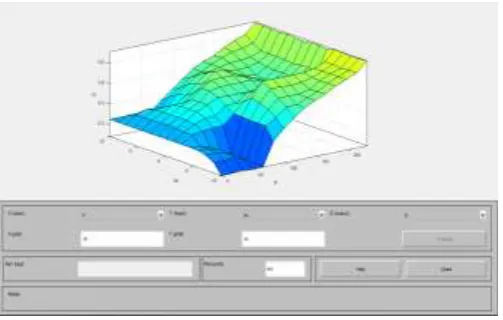
Fig-5: Fuzzy surface structure for MPPT of PV system
4.2 V/F control of Induction Motor
Synchronous speed can be controlled by varying the supply frequency. Voltage induced in the stator is 1∝ Ф𝑓where Ф is the air-gap flux and f is the supply frequency. As we can neglect the stator voltage drop we obtain terminal voltage
𝑉1∝Ф𝑓. Thus reducing the frequency without changing the supply voltage will lead to an increase in the air-gap flux which is undesirable. Hence whenever frequency is varied in order to control speed, the terminal voltage is also varied so as to maintain the V/f ratio constant. Thus by maintaining a constant V/f ratio, the maximum torque of the motor becomes constant for changing speed. As can be seen, when V/f Control is implemented, for various frequencies inside the operating region, the maximum torque remains the same as the speed varies. maximum torque while control in the speed as per our requirement.
5. RESULTS AND DISCUSSION
5.1 simulation of PV panel
Fig -6: Simulink model of PV panel
5.2. Zeta converter output result
TIMES (S)
Fig- 7: output voltage waveform
5.3 Inverter output voltage
TIMES (S)
[image:3.595.33.296.48.307.2] [image:3.595.312.556.317.476.2] [image:3.595.37.289.336.496.2] [image:3.595.312.554.517.695.2]© 2019, IRJET | Impact Factor value: 7.211 | ISO 9001:2008 Certified Journal
| Page 7205
5.4 Simulation Results for Induction Motor
TIMES (S)
Fig-8: motor output waveform of speed N(rpm)
6. CONCLUSION
The PV powered Induction Motor drive can be utilized to drive the pump. This drive utilizes VSI inverter for changing over the DC voltage obtained from the PV array to the sinusoidal AC voltage which is acquired by operating the MOSFET switches specifically designed with the assistance of SPWM pulses produced with help of Sine-triangle PWM system. To get the maximum power from the PV array the fuzzy MPPT controller is utilized for actualizing the MPPT calculation. For the better operation of the Induction motor V/F control procedure is likewise executed. From this work, it can be concluded that for rural zones where there is no power, there for satisfying the demand of water for irrigation and general use the PV supplied water pumping framework can be introduced. The PV fed water pumping system with the control techniques discussed in this project can be considered as an efficient system.
REFERENCES
[1] E. Drury, T. Jenkin, D. Jordan, and R. Margolis, “Photovoltaic investment risk and uncertainty for residential customers,” IEEE J. Photovolt.,vol.4, no. 1, pp. 278–284, Jan. 2014.
[2] E. Muljadi, “PV water pumping with a peak-power tracker using a simplesix-step square-wave inverter,” IEEE Trans. Ind. Appl., vol. 33, no. 3, pp. 714–721, May/Jun. 1997.
[3] U. Sharma, S. Kumar, and B. Singh, “Solar array fed water pump-ing system using induction motor drive,” in Proc. 1st IEEE Intern. Conf. Power Electron., Intell. Control Energy Syst., Delhi, India, 2016, pp. 1–6.
[4] T. Franklin, J. Cerqueira, and E. de Santana, “Fuzzy and PI con-trollers in pumping water system using photovoltaic electric genera-tion,” IEEE Trans. Latin Amer., vol. 12, no. 6, pp. 1049–1054, Sep 2014.
[5] R. Kumar and B. Singh, “BLDC motor-driven solar PV array-fed wa-ter pumping system employing zeta converter,” IEEE Trans. Ind. Appl., vol. 52, no. 3, pp. 2315–2322, May/Jun. 2016.
[6] S. Jain, A. K. Thopukara, R. Karampuri, and V. T. Somasekhar, “A single-stage photovoltaic system for a dual-inverter-fed open-endwinding induc-tion motor drive for pumping applications,”IEEE Trans. Power Electron., vol. 30, no. 9, pp. 4809–4818, Sep. 2015.
[7] J. Caracas, G. Farias, L. Teixeira, and L. Ribeiro, “Implementation of a high-efficiency, high-lifetime, and low-cost converter for an autonomous photovoltaic water pumping system, ”IEEE Trans. Ind. Appl., vol. 50, no. 1, pp. 631–641, Jan./Feb. 2014.
[8] R. Antonello, M. Carraro, A. Costabeber, F. Tinazzi, and M.Zigliotto, “Energy-efficient autonomous solar water-pumping system for permanent-magnet synchronous motors,” IEEE Trans. Ind. Electron., vol. 64, no. 1, pp. 43–51, Jan. 2017.
[9] M. Calavia1, J. M. Peri´ e1, J. F. Sanz, and J. Sall´ an, “Comparison of MPPT strategies for solar modules,” inProc. Int. Conf. Renew. Energies Power Quality, Granada, Spain, Mar. 22–25, 2010, pp. 1440–1445.
[10] Trishan Esram and P. L. Chapman, “Comparison of photovoltaic array maximum power point tracking techniques,”IEEE Trans. Energy Con-vers., vol. 22, no. 2, pp. 439–449, Jun. 2007.
[11] B. Subudhi and R. Pradhan, “A comparative study on maximum power point tracking techniques for photovoltaic power systems,”IEEE Trans. Sustain. Energy, vol. 4, no. 1, pp. 89–98, Jan. 2013.
[12] A. Garrigos, J. Blanes, J. Carrascoa, and J. Ejea, “Real time estima-tion of photovoltaic modules characteristics and its application to max-imum power point operation,” Renew. Energy, vol. 32, pp. 1059–1076, 2007.
[13] B. Singh, S. Kumar, and C. Jain, “Damped-SOGI-based control algorithmfor solar PV power generating system,”IEEE Trans. Ind. Appl., vol. 53, no. 3, pp. 1780–1788, May/Jun. 2017.
© 2019, IRJET | Impact Factor value: 7.211 | ISO 9001:2008 Certified Journal
| Page 7206
[15] R. Bhat, A. Pittet, and B. S. Sonde, “Performanceoptimization of induction motor-pump system using photovoltaic energy source,” IEEE Trans. Ind. Appl.,
[16] Y. Yao, P. Bustamante, and R. Ramshaw, “Improvement of induction mo-tor drive systems supplied by photovoltaic arrays with frequency con-trol,” IEEE Trans. Energy Convers., vol. vol. IA-23, no. 6, pp. 995–1000, Nov. 1987.
[17] U. Sharma, B. Singh, and S. Kumar, “Intelligent grid interfaced solar water pumping system,”IET Renewable Power Gener., vol. 11, no. 5, pp. 614– 624, Mar. 2017.