© 2019, IRJET | Impact Factor value: 7.211 | ISO 9001:2008 Certified Journal
| Page 7876
Durable Concrete by Packing Density Method with Dolomite Powder as
Partial Replacement to Cement
Aswathi E
1, Dr.Susan Abraham
21
P G Student
,Department of Civil Engineering SNGCET, Payyannur, Kannur, Kerala, India
2
Associate professor
,Department of Civil Engineering SNGCET, Payyannur, Kannur, Kerala, India
---***---Abstract -Packing density is new mix design method used to design various types of concrete. To optimize the particle packing density of concrete, the particles should be selected to fill up the voids between larger particles with smaller particles and so on, in order to get a dense and stiff particle structure. Higher degree of particle packing leads to minimum voids, maximum density and cement and water requirement will be less. In this project, durable concrete is produced by packing density method with dolomite powder as partial replacement to cement.
The reduction in the consumption of cement will not only reduce the cost of concrete but also the emission of carbon dioxide into atmosphere. Dolomite powder is obtained by powderising the sedimentary rock Dolostone. Dolomite powder has some similar characteristics of cement. Using dolomite powder in concrete we can reduce the cost of concrete and increase the strength. The replacement percentages tried were 0%, 5%, 10% and 15% by weight of cement. The compressive strength, flexural strength and split tensile strength of concrete with dolomite powder was compared with those of the reference specimens. The results indicates that replacement of cement with dolomite powder will increase the compressive strength,split tensile strength and flexural strength of concrete.
Key Words:Packing Density, Dolostone, Dolomite powder.
1.INTRODUCTION
There are different methods are available to proportionating various types of concrete. Packing density method of mix design is used for prenormal concrete, high strength concrete, no-fines concrete and self-compacting concrete etc. The subject of optimizing the concrete composition by selecting the right amounts of different materials has already aroused interest for more than a century. To optimize the particle packing density of concrete, the particles should be selected to fill up the voids between larger particles with smaller particles and so on, in order to obtain a dense and stiff particle structure. Initially the researchers, engaged on the packing of aggregates and proposed methods to design an ideal particle size distribution. Geometrically based particle packing models will facilitate to predict the water demand of concrete, and thus the material properties. The cement paste has to fill up the voids between aggregate particles and the “excess” paste
will then disperse the aggregate particles to produce a thin coating film of paste surrounding each aggregate for lubricating the concrete mix. In general, the higher the packing density of the aggregate, the lower will be the volume of voids to be filled and larger will be the amount of paste in excess of void for lubrication. The carbon dioxide emission from cement production adversely affect the natural environment. By the replacement of cement with Dolomite powder, we can reduce the use of cement and thus the emission of carbon dioxide into atmosphere.
1.1 Dolomite Powder
Dolomite powder obtained by pulverising the sedimentary rock Dolostone. Dolomite is a carbonate material composed of calcium magnesium carbonate CaMg(CO3)2.It has some similar characteristics of cement. Dolomite is a rock forming mineral which is noted for its remarkable wettability and dispersibility.Dolomite has a good weathering resistance. Dolomite is preferred for construction material because of its higher surface hardness and density. Asphalt and concrete construction applications prefer dolomite as a filler material due to its higher strength and hardness. By the effective utilization of dolomite powder, the objective of reduction of cost of concrete can be met.
2. MATERIALS AND METHODS
The materials used and methods followed in the present study are described below.
2.1. Materials
© 2019, IRJET | Impact Factor value: 7.211 | ISO 9001:2008 Certified Journal
| Page 7877
mixes. Mix proportion of M20 grade was used to produce the mixes. Packing density method of mix design was used for preparation of specimens.
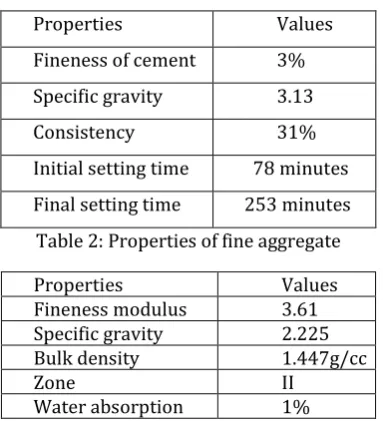
Table 1: Properties of cement
Properties Values
Fineness of cement 3% Specific gravity 3.13
Consistency 31%
[image:2.595.67.259.161.372.2]Initial setting time 78 minutes Final setting time 253 minutes Table 2: Properties of fine aggregate
Properties Values
Fineness modulus 3.61 Specific gravity 2.225
Bulk density 1.447g/cc
Zone II
Water absorption 1%
Table 3: Properties of coarse aggregate
Chart 1: Dolomite Powder
Table 4: Properties of dolomite powder
Properties Values
Fineness of cement 4% Specific gravity 2.85
Consistency 29%
Initial setting time 80 minutes Final setting time 268 minutes
2.2. Methods
Packing density method of mix design was used for preparation of specimens. The packing density of aggregate mixture was defined as the solid volume in a unit total volume. The aim of obtaining packing density is to combine aggregate particles in order to minimize the porosity, which allows the use of least possible amount of binder.
Cubical specimens of size 150mm x150mm x 150mm were casted for testing of compressive strength and cylindrical specimens of 150 mm diameter and 300 mm length were casted for split tensile test and beam specimens of 700mm x 150mm x 150mm were casted for flexural strength test. The moulds were cleaned and oiled properly before every pouring. The concrete was filled in the moulds in three layers, each layer being tamped with tamping rod. The specimens were allowed to remain in the steel mould for the first 24 hours at ambient condition. The specimens were demoulded with care so that no edges were broken and were placed in the curing tank at the ambient temperature for curing. At the end of every curing period, the samples were taken and were tested.
2.3. Experimental Investigation
[image:2.595.62.276.406.658.2]The aim of the present investigation was to experimentally study the suitability of using dolomite powder as partial replacement to cement by using packing density mix design method. The scope of this study includes the determination of the mechanical properties i.e. compressive strength, split tensile strength and flexural strength of dolomite concrete. The investigation was done by replacing 0%, 5%, 10% and 15% replacement of cement with dolomite powder for M20 concrete .Comparison of Indian standard code method and Packing density method were carried out. Based on the prepared mix design, cubes, cylinders and beams were casted. The mix proportion obtained by IS method was given in Table 5 and mix proportion obtained by packing density method was given in Table 6.
Table 5: Mix proportion of M20 concrete by IS method
Water Cement Fine aggregate Coarse aggregate 192 L 383.16 kg 599.56 kg 1233.43 kg
0.5 1 1.56 3.22
Properties Values
Fineness modulus 3.89
Specific gravity 2.905
Bulk density 1.563g/cc
© 2019, IRJET | Impact Factor value: 7.211 | ISO 9001:2008 Certified Journal
| Page 7878
Table 6: Mix proportion of M20 concrete by packing density method
2.3.1 Workability Test
Concrete slump test was used to determine the workability of concrete. The slump test was carried out as per procedures mentioned in IS: 1199 – 1959 in India. Equipments required for concrete slump test were slump cone, non-porous base plate, measuring scale and tamping rod. The results obtained from slump test were given in Table7 and Chart 2 shows the percentage replacement vs slump value curve.
Table 7: Slump Values
Percentage
replacement Slump (mm)
0 100
5 97
10 96
15 93
Chart 2: Percentage replacement vs slump value
It is observed that the slump decrease with increase in the percentage of dolomite powder in the concrete mix. The decrease of workability may be due to higher water absorption and very fine binders.
2.3.2 Compressive Strength Test of Concrete
The compressive strength test was conforming to IS 516-1959.The cubical moulds of size 150mmx150mmx150mm were used. The concrete mix was poured in the mould and tampered properly so as not to have any voids. After 24 hours these moulds were removed and the test specimen cured in water for 28 days. The top surface of these specimens were made even and smooth. These specimens were tested by compression testing machine. The load should be applied
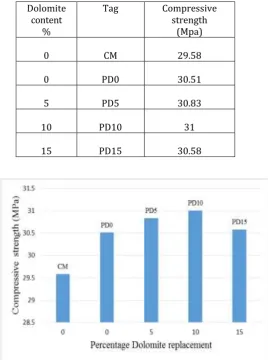
[image:3.595.60.264.331.565.2]gradually at the rate of 140kg/cm² per minute till the specimen fails. Load at the failure divided by area of specimen gives the compressive strength of concrete. The failure load and strength obtained for all mixes, CM (control mix-IS method),PD0 (0%dolomite), PD5 (5%dolomite), PD10 (10%dolomite) and PD15 (15%dolomite) on 28 days test was given in Table 8.Chart 3 showing percentage replaced versus compressive strength obtained for replacement of cement with dolomite for 28 days test .
Table 8: Compressive strength at 28 days
Dolomite content
%
Tag Compressive
strength (Mpa)
0 CM 29.58
0 PD0 30.51
5 PD5 30.83
10 PD10 31
15 PD15 30.58
Chart 3: Percentage replaced vs compressive strength obtained for 28 days test.
The 28 days compressive strength increases with increase in percentage replacement up to 10 percentage replacement and after that compressive strength decreases. Compressive strength of specimens prepared by packing density method was more than that of IS method.
2.3.3. Split Tensile Strength Test
The split tensile strength obtained for different replacement percentage of cement with dolomite powder on Water Cement Fine aggregate Coarse aggregate
188.7 L 377.41 kg 708 kg 1061.26 kg
© 2019, IRJET | Impact Factor value: 7.211 | ISO 9001:2008 Certified Journal
| Page 7879
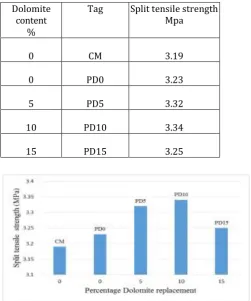
[image:4.595.306.576.62.270.2]28 days test was given in Table 9.Chart 4 shows split tensile strength vs percentage replacement at 28 days test.
Table 9: Split Tensile Strength at 28 days
Chart 4: Percentage replaced vs split tensile strength obtained for 28 days test.
2.3.4. Flexural Strength Test
The flexural strength was expressed as modulus of rupture and was determined by three point loading test. The flexural strength obtained for different percentage replacement of cement with dolomite powder on 28 day test was given in Table 10.Chart 5 shows the variation of flexural strength with replacement percentage.
Table 10: Flexural Strength at 28 days
Chart 5: Flexural strength vs percentage replaced dolomite powder
The 28 days flexural strength increases with increase in percentage replacement up to 10 percentage replacement and after that flexural strength decreases. Flexural strength of specimens prepared by packing density method was more than that of IS method.
2.4. Summary
The effect of using dolomite powder as partial replacement to cement in concrete was investigated. Replacement percentages of 0, 5, 10 and 15% were adopted. Physical properties like specific gravity and gradation were determined. The influence of replacement of dolomite to cement on workability and mechanical properties of concrete were investigated. Comparison of packing density and IS method of mix design were carried out.
3. CONCLUSIONS
From the experimental investigation it can be concluded that,
i. The strength obtained by packing density method is more than that of IS method of mix design.
ii.The cement content reduced by using packing density method and also by replacing cement with dolomite powder.
iii.There is an enhancement in the strength of concrete up to 10% replacement of cement with dolomite powder.
iv.The 28 days compressive strength increases with increase in percentage replacement up to 10 percentage replacement and after that compressive strength decreases. The compressive strength obtained at 10 % replacement is 31 MPa.
v. The 28 days split tensile strength increases with increase in percentage replacement up to 10 percentage Dolomite
content %
Tag Split tensile strength Mpa
0 CM 3.19
0 PD0 3.23
5 PD5 3.32
10 PD10 3.34
15 PD15 3.25
Dolomite content
% Tag Flexural strength strength Mpa
0 CM 4.47
0 PD0 5.43
5 PD5 5.58
10 PD10 5.7
[image:4.595.35.287.153.455.2]© 2019, IRJET | Impact Factor value: 7.211 | ISO 9001:2008 Certified Journal
| Page 7880
replacement and after that split tensile strength decreases. The split tensile strength obtained at 10% replacement is 3.34 MPa.
vi. The 28 days flexural strength increases with increase in percentage replacement up to 10 percentage replacement and after that flexural strength decreases. The flexural strength obtained at 10 % replacement is 5.7 MPa.
REFERENCES
[1]Narasimha Raj, Suresh G Patil and B. Bhattacharjee, “Concrete Mix Design by Packing Density Method”, Journal of Mechanical and Civil Engineering (IOSR-JMCE), Volume 11, Issue 2, April 2014.
[2]S.K.Dhawan, Itias,Dhareppagoal,B.Bhattacharjee,“Durable concrete by packing density method”,The Indian Concrete Journal,Volume 91,Issue 5,May 2017.
[3] Sudarshan D. Kore, A.K.Vyas,”Packing Density Approach for Sustainable Development of Concrete”, Journal of Materials and Engineering Structures, Volume 4, 2017.
[4] Walhekar Gaurav Pradip, Dr. M. R. Wakchaure ,“Experimental study of M20 grade concrete using packing density method”,International journal of Emerging Research and Development,Volume 1,Issue 5, 2018.
[5]S.Gopinath,A. Ramachandra Murthy, D. Ramya, Nagesh R. Iyer, “Optimised Mix Design For Normal Strength And High Performance Concrete Using Particle Packing Method”, Archives Of Civil Engineering, 2011.
[6] Dr.S.S.Patil, A.S.Sajane, R.B.Ladage, “Effect of Packing Density of aggregate on characteristics of Self Compacting Concrete”, International Research Journal of Engineering and Technology (IRJET), Volume 04, Issue 05 ,May 2017.
[7] Preethi G, Prince Arulraj G, “Effect of Replacement of Cement with Dolomite Powder on the Mechanical Properties of Concrete”, International Journal of Innovative Science, Engineering & Technology, Volume 2, Issue 4, April 2015.
[8] L.Ranjith Kumar,J.Kiran,P.Rangarajan,“Properties of Concrete Incorporating Dolomite Powder”, IOSR Journal of Mechanical and Civil Engineering, Volume 14, Issue 2, March 2017.
[9]AthulyaSugathan,“Experimental Investigation on partial Replacement of Cement with dolomite powder”, International Journal of Innovative Research in Science,Engineering and Technology, Volume 6, Issue 7, July 2017.