Word Alignment with Synonym Regularization
Hiroyuki Shindo, Akinori Fujino, and Masaaki Nagata
NTT Communication Science Laboratories, NTT Corp. 2-4 Hikaridai Seika-cho Soraku-gun Kyoto 619-0237 Japan
{shindo,a.fujino}@cslab.kecl.ntt.co.jp [email protected]
Abstract
We present a novel framework for word alignment that incorporates synonym knowledge collected from monolingual linguistic resources in a bilingual proba-bilistic model. Synonym information is helpful for word alignment because we can expect a synonym to correspond to the same word in a different language. We design a generative model for word alignment that uses synonym information as a regularization term. The experimental results show that our proposed method significantly improves word alignment quality.
1 Introduction
Word alignment is an essential step in most phrase and syntax based statistical machine translation (SMT). It is an inference problem of word cor-respondences between different languages given parallel sentence pairs. Accurate word alignment can induce high quality phrase detection and trans-lation probability, which leads to a significant im-provement in SMT performance. Many word alignment approaches based on generative mod-els have been proposed and they learn from bilin-gual sentences in an unsupervised manner (Vo-gel et al., 1996; Och and Ney, 2003; Fraser and Marcu, 2007).
One way to improve word alignment quality is to add linguistic knowledge derived from a monolingual corpus. This monolingual knowl-edge makes it easier to determine corresponding words correctly. For instance, functional words in one language tend to correspond to functional words in another language (Deng and Gao, 2007), and the syntactic dependency of words in each lan-guage can help the alignment process (Ma et al., 2008). It has been shown that such grammatical
information works as a constraint in word align-ment models and improves word alignalign-ment qual-ity.
A large number of monolingual lexical seman-tic resources such as WordNet (Miller, 1995) have been constructed in more than fifty languages (Sagot and Fiser, 2008). They include word-level relations such as synonyms, hypernyms and hyponyms. Synonym information is particularly helpful for word alignment because we can ex-pect a synonym to correspond to the same word in a different language. In this paper, we explore a method for using synonym information effectively to improve word alignment quality.
In general, synonym relations are defined in terms of word sense, not in terms of word form. In other words, synonym relations are usually con-text or domain dependent. For instance, ‘head’ and ‘chief’ are synonyms in contexts referring to working environment, while ‘head’ and ‘forefront’ are synonyms in contexts referring to physical po-sitions. It is difficult, however, to imagine a con-text where ‘chief’ and ‘forefront’ are synonyms. Therefore, it is easy to imagine that simply replac-ing all occurrences of ‘chief’ and ‘forefront’ with ‘head’ do sometimes harm with word alignment accuracy, and we have to model either the context or senses of words.
We propose a novel method that incorporates synonyms from monolingual resources in a bilin-gual word alignment model. We formulate a syn-onym pair generative model with a topic variable and use this model as a regularization term with a bilingual word alignment model. The topic vari-able in our synonym model is helpful for disam-biguating the meanings of synonyms. We extend HM-BiTAM, which is a HMM-based word align-ment model with a latent topic, with a novel syn-onym pair generative model. We applied the pro-posed method to an English-French word align-ment task and successfully improved the word
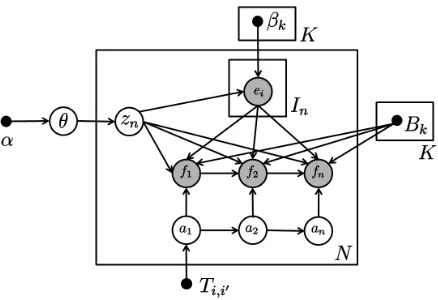
Figure 1: Graphical model of HM-BiTAM
alignment quality.
2 Bilingual Word Alignment Model
In this section, we review a conventional gener-ative word alignment model, HM-BiTAM (Zhao and Xing, 2008).
HM-BiTAM is a bilingual generative model with topic z, alignment a and topic weight vec-tor θ as latent variables. Topic variables such as ‘science’ or ‘economy’ assigned to individual sentences help to disambiguate the meanings of words. HM-BiTAM assumes that the nth bilin-gual sentence pair,(En, Fn), is generated under a given latent topiczn ∈ {1, . . . , k, . . . , K}, where
K is the number of latent topics. Let N be the number of sentence pairs, and In andJn be the lengths ofEnandFn, respectively. In this frame-work, all of the bilingual sentence pairs{E, F}=
{(En, Fn)}Nn=1are generated as follows.
1. θ∼Dirichlet(α): sample topic-weight vector
2. For each sentence pair(En, Fn)
(a) zn∼M ultinomial(θ): sample the topic
(b) en,i:In|zn ∼ p(En|zn;β): sample English
words from a monolingual unigram model given topiczn
(c) For each positionjn= 1, . . . , Jn
i. ajn ∼p(ajn|ajn−1;T): sample an align-ment linkajnfrom a first order Markov
pro-cess
ii. fjn ∼ p(fjn|En, ajn, zn;B): sample a
target word fjn given an aligned source
word and topic
where alignment ajn = idenotes source wordei
and target word fjn are aligned. α is a
parame-ter over the topic weight vectorθ, β = {βk,e} is the source word probability given the kth topic:
p(e|z=k). B = {Bf,e,k}represents the word
translation probability from eto f under the kth topic: p(f|e, z=k). T ={Ti,i′
}
is a state tran-sition probability of a first order Markov process. Fig. 1 shows a graphical model of HM-BiTAM.
The total likelihood of bilingual sentence pairs
{E, F} can be obtained by marginalizing out la-tent variablesz,aandθ,
p(F, E; Ψ) =∑
z
∑
a
p(F, E, z, a, θ; Ψ)dθ, (1)
whereΨ = {α, β, T, B}is a parameter set. In this model, we can infer word alignmentaby max-imizing the likelihood above.
3 Proposed Method
3.1 Synonym Pair Generative Model
We design a generative model for synonym pairs
{f, f′} in language F, which assumes that the synonyms are collected from monolingual linguis-tic resources. We assume that each synonym pair (f, f′)is generated independently given the same ‘sense’ s. Under this assumption, the probability of synonym pair(f, f′)can be formulated as,
p(f, f′)∝∑ s
p(f|s)p(f′|s)p(s). (2)
We define a pair (e, k) as a representation of the sense s, where e and k are a word in a dif-ferent languageE and a latent topic, respectively. It has been shown that a word e in a different language is an appropriate representation of s in synonym modeling (Bannard and Callison-Burch, 2005). We assume that adding a latent topickfor the sense is very useful for disambiguating word meaning, and thus that(e, k)gives us a good ap-proximation ofs. Under this assumption, the syn-onym pair generative model can be defined as fol-lows.
p({f, f′};Ψe
)
∝ ∏
(f,f′)
∑
e,k
p(f|e, k;Ψ)e p(f′|e, k;Ψ)e p(e, k;Ψ)e ,(3)
whereΨe is the parameter set of our model.
3.2 Word Alignment with Synonym Regularization
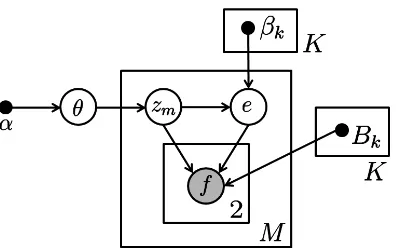
Figure 2: Graphical model of synonym pair gen-erative process
correspond to the same word in a different lan-guage, thus they make it easy to infer accurate word alignment. HM-BiTAM and the synonym model share parameters in order to incorporate monolingual synonym information into the bilin-gual word alignment model. This can be achieved via reparameterizingΨe in eq. 3 as,
p
(
fe, k;Ψe
)
≡ p(f|e, k;B), (4)
p
(
e, k;Ψe
)
≡ p(e|k;β)p(k;α). (5)
Overall, we re-define the synonym pair model with the HM-BiTAM parameter setΨ,
p({f, f′}; Ψ)
∝ ∑1
k′αk′
∏
(f,f′)
∑
k,e
αkβk,eBf,e,kBf′,e,k. (6)
Fig. 2 shows a graphical model of the synonym pair generative process. We estimate the param-eter values to maximize the likelihood of HM-BiTAM with respect to bilingual sentences and that of the synonym model with respect to syn-onym pairs collected from monolingual resources. Namely, the parameter estimate, Ψ, is computedˆ as
ˆ
Ψ = arg max
Ψ
{
logp(F, E; Ψ) +ζlogp({f, f′}; Ψ)},
(7)
where ζ is a regularization weight that should be set for training. We can expect that the second term of eq. 7 to constrain parameter set Ψ and avoid overfitting for the bilingual word alignment model. We resort to the variational EM approach (Bernardo et al., 2003) to inferΨˆ following HM-BiTAM. We omit the parameter update equation due to lack of space.
4 Experiments
4.1 Experimental Setting
For an empirical evaluation of the proposed method, we used a bilingual parallel corpus of English-French Hansards (Mihalcea and Pedersen, 2003). The corpus consists of over 1 million sen-tence pairs, which include 447 manually word-aligned sentences. We selected 100 sentence pairs randomly from the manually word-aligned sen-tences as development data for tuning the regu-larization weight ζ, and used the 347 remaining sentence pairs as evaluation data. We also ran-domly selected 10k, 50k, and 100k sized sentence pairs from the corpus as additional training data. We ran the unsupervised training of our proposed word alignment model on the additional training data and the 347 sentence pairs of the evaluation data. Note that manual word alignment of the 347 sentence pairs was not used for the unsuper-vised training. After the unsuperunsuper-vised training, we evaluated the word alignment performance of our proposed method by comparing the manual word alignment of the 347 sentence pairs with the pre-diction provided by the trained model.
We collected English and French synonym pairs from WordNet 2.1 (Miller, 1995) and WOLF 0.1.4 (Sagot and Fiser, 2008), respectively. WOLF is a semantic resource constructed from the Princeton WordNet and various multilingual resources. We selected synonym pairs where both words were in-cluded in the bilingual training set.
We compared the word alignment performance of our model with that of GIZA++ 1.03 1 (Vo-gel et al., 1996; Och and Ney, 2003), and HM-BiTAM (Zhao and Xing, 2008) implemented by us. GIZA++ is an implementation of IBM-model 4 and HMM, and HM-BiTAM corresponds toζ = 0in eq. 7. We adoptedK = 3topics, following the setting in (Zhao and Xing, 2006).
We trained the word alignment in two direc-tions: English to French, and French to English. The alignment results for both directions were re-fined with ‘GROW’ heuristics to yield high preci-sion and high recall in accordance with previous work (Och and Ney, 2003; Zhao and Xing, 2006). We evaluated these results for precision, recall, F-measure and alignment error rate (AER), which are standard metrics for word alignment accuracy (Och and Ney, 2000).
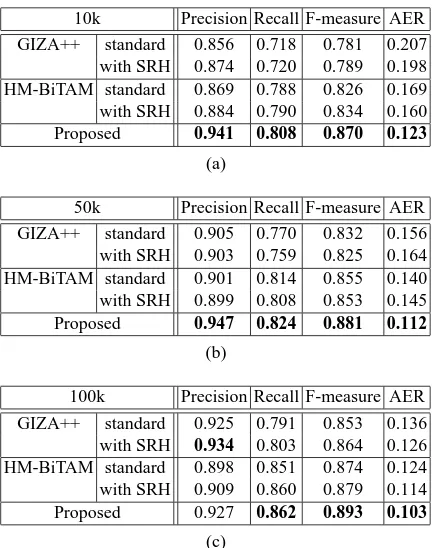
10k Precision Recall F-measure AER GIZA++ standard 0.856 0.718 0.781 0.207 with SRH 0.874 0.720 0.789 0.198 HM-BiTAM standard 0.869 0.788 0.826 0.169 with SRH 0.884 0.790 0.834 0.160 Proposed 0.941 0.808 0.870 0.123
(a)
50k Precision Recall F-measure AER GIZA++ standard 0.905 0.770 0.832 0.156 with SRH 0.903 0.759 0.825 0.164 HM-BiTAM standard 0.901 0.814 0.855 0.140 with SRH 0.899 0.808 0.853 0.145 Proposed 0.947 0.824 0.881 0.112
(b)
100k Precision Recall F-measure AER GIZA++ standard 0.925 0.791 0.853 0.136 with SRH 0.934 0.803 0.864 0.126 HM-BiTAM standard 0.898 0.851 0.874 0.124 with SRH 0.909 0.860 0.879 0.114 Proposed 0.927 0.862 0.893 0.103
[image:4.595.74.292.60.334.2](c)
Table 1: Comparison of word alignment accuracy. The best results are indicated in bold type. The additional data set sizes are (a) 10k, (b) 50k, (c) 100k.
4.2 Results and Discussion
Table 1 shows the word alignment accuracy of the three methods trained with 10k, 50k, and 100k ad-ditional sentence pairs. For all settings, our pro-posed method outperformed other conventional methods. This result shows that synonym infor-mation is effective for improving word alignment quality as we expected.
As mentioned in Sections 1 and 3.1, the main idea of our proposed method is to introduce la-tent topics for modeling synonym pairs, and then to utilize the synonym pair model for the regu-larization of word alignment models. We expect the latent topics to be useful for modeling poly-semous words included in synonym pairs and to enable us to incorporate synonym information ef-fectively into word alignment models. To con-firm the effect of the synonym pair model with latent topics, we also tested GIZA++ and HM-BiTAM with what we call Synonym Replacement Heuristics (SRH), where all of the synonym pairs in the bilingual training sentences were simply re-placed with a representative word. For instance, the words ‘sick’ and ‘ill’ in the bilingual sentences
# vocabularies 10k 50k 100k English standard 8578 16924 22817
[image:4.595.312.524.61.117.2]with SRH 5435 7235 13978 French standard 10791 21872 30294 with SRH 9737 20077 27970
Table 2: The number of vocabularies in the 10k, 50k and 100k data sets.
were replaced with the word ‘sick’. As shown in Table 2, the number of vocabularies in the English and French data sets decreased as a result of em-ploying the SRH.
We show the performance of GIZA++ and HM-BiTAM with the SRH in the lines entitled “with SRH” in Table 1. The GIZA++ and HM-BiTAM with the SRH slightly outperformed the standard GIZA++ and HM-BiTAM for the 10k and 100k data sets, but underperformed with the 50k data set. We assume that the SRH mitigated the over-fitting of these models into low-frequency word pairs in bilingual sentences, and then improved the word alignment performance. The SRH regards all of the different words coupled with the same word in the synonym pairs as synonyms. For in-stance, the words ‘head’, ‘chief’ and ‘forefront’ in the bilingual sentences are replaced with ‘chief’, since (‘head’, ‘chief’) and (‘head’, ‘forefront’) are synonyms. Obviously, (‘chief’, ‘forefront’) are not synonyms, which is detrimented to word align-ment.
The proposed method consistently outper-formed GIZA++ and HM-BiTAM with the SRH in 10k, 50k and 100k data sets in F-measure. The synonym pair model in our proposed method can automatically learn that (‘head’, ‘chief’) and (‘head’, ‘forefront’) are individual synonyms with different meanings by assigning these pairs to dif-ferent topics. By sharing latent topics between the synonym pair model and the word alignment model, the synonym information incorporated in the synonym pair model is used directly for train-ing word alignment model. The experimental re-sults show that our proposed method was effec-tive in improving the performance of the word alignment model by using synonym pairs includ-ing such ambiguous synonym words.
sen-tence pairs and the evaluation data were selected from the Hansards data set. These experimental results show that a larger number of sentence pairs was more effective in improving word alignment performance when the sentence pairs were col-lected from a homogeneous data source. However, in practice, it might be difficult to collect a large number of such homogeneous sentence pairs for a specific target domain and language pair. One direction for future work is to confirm the effect of the proposed method when training the word alignment model by using a large number of sen-tence pairs collected from various data sources in-cluding many topics for a specific language pair.
5 Conclusions and Future Work
We proposed a novel framework that incorpo-rates synonyms from monolingual linguistic re-sources in a word alignment generative model. This approach utilizes both bilingual and mono-lingual synonym resources effectively for word alignment. Our proposed method uses a latent topic for bilingual sentences and monolingual syn-onym pairs, which is helpful in terms of word sense disambiguation. Our proposed method im-proved word alignment quality with both small and large data sets. Future work will involve ex-amining the proposed method for different lan-guage pairs such as Chinese and English-Japanese and evaluating the impact of our pro-posed method on SMT performance. We will also apply our proposed method to a larger data sets of multiple domains since we can expect a fur-ther improvement in word alignment accuracy if we use more bilingual sentences and more mono-lingual knowledge.
References
C. Bannard and C. Callison-Burch. 2005. Paraphras-ing with bilParaphras-ingual parallel corpora. In Proceed-ings of the 43rd Annual Meeting on Association for Computational Linguistics, pages 597–604. Asso-ciation for Computational Linguistics Morristown, NJ, USA.
J. M. Bernardo, M. J. Bayarri, J. O. Berger, A. P. Dawid, D. Heckerman, A. F. M. Smith, and M. West. 2003. The variational bayesian EM algorithm for in-complete data: with application to scoring graphical model structures. In Bayesian Statistics 7: Proceed-ings of the 7th Valencia International Meeting, June 2-6, 2002, page 453. Oxford University Press, USA.
Y. Deng and Y. Gao. 2007. Guiding statistical word alignment models with prior knowledge. In Pro-ceedings of the 45th Annual Meeting of the As-sociation of Computational Linguistics, pages 1–8, Prague, Czech Republic, June. Association for Com-putational Linguistics.
A. Fraser and D. Marcu. 2007. Getting the struc-ture right for word alignment: LEAF. In Pro-ceedings of the 2007 Joint Conference on Empirical Methods in Natural Language Processing and Com-putational Natural Language Learning (EMNLP-CoNLL), pages 51–60, Prague, Czech Republic, June. Association for Computational Linguistics.
Y. Ma, S. Ozdowska, Y. Sun, and A. Way. 2008. Improving word alignment using syntactic depen-dencies. In Proceedings of the ACL-08: HLT Sec-ond Workshop on Syntax and Structure in Statisti-cal Translation (SSST-2), pages 69–77, Columbus, Ohio, June. Association for Computational Linguis-tics.
R. Mihalcea and T. Pedersen. 2003. An evaluation exercise for word alignment. In Proceedings of the HLT-NAACL 2003 Workshop on building and using parallel texts: data driven machine translation and beyond-Volume 3, page 10. Association for Compu-tational Linguistics.
G. A. Miller. 1995. WordNet: a lexical database for English. Communications of the ACM, 38(11):41.
F. J. Och and H. Ney. 2000. Improved statistical align-ment models. In Proceedings of the 38th Annual Meeting on Association for Computational Linguis-tics, pages 440–447. Association for Computational Linguistics Morristown, NJ, USA.
F. J. Och and H. Ney. 2003. A systematic comparison of various statistical alignment models. Computa-tional Linguistics, 29(1):19–51.
B. Sagot and D. Fiser. 2008. Building a free French wordnet from multilingual resources. In Proceed-ings of Ontolex.
S. Vogel, H. Ney, and C. Tillmann. 1996. HMM-based word alignment in statistical translation. In Proceedings of the 16th Conference on Computa-tional Linguistics-Volume 2, pages 836–841. Asso-ciation for Computational Linguistics Morristown, NJ, USA.
B. Zhao and E. P. Xing. 2006. BiTAM: Bilingual topic admixture models for word alignment. In Pro-ceedings of the COLING/ACL on Main Conference Poster Sessions, page 976. Association for Compu-tational Linguistics.