Evolutionary optimization of a fed-batch penicillin
fermentation process
ZHANG, H. <http://orcid.org/0000-0002-7718-021X>, ZHANG, Z. and LAN, L.
H.
Available from Sheffield Hallam University Research Archive (SHURA) at:
http://shura.shu.ac.uk/2525/
This document is the author deposited version. You are advised to consult the
publisher's version if you wish to cite from it.
Published version
ZHANG, H., ZHANG, Z. and LAN, L. H. (2010). Evolutionary optimization of a
fed-batch penicillin fermentation process. In: 2010 International Symposium on
Computer, Communication, Control and Automation, Tainan, 5-7 May 2010. p. 403.
Copyright and re-use policy
See
http://shura.shu.ac.uk/information.html
Sheffield Hallam University Research Archive
Evolutionary Optimization of a Fed-batch Penicillin Fermentation Process
Hongwei Zhang
Department of Engineering and Mathematics
Sheffield Hallam University Sheffield, UK [email protected]
Ze Zhang
Department of Automation Inner Mongolia University
Hohhot, China [email protected]
Le Hung Lan
Faculty of Electrical and Electronic Engineering
Uni. of Transport & Communication Hanoi, Vietnam
Abstract
—
This paper presents a genetic algorithms approach for the optimization of a fed-batch penicillin fermentation process. A customized float-encoding genetic algorithm is developed and implemented to a benchmark fed-batch penicillin fermentation process. Off-line optimization of the initial conditions and set points are carried out in two stages for a single variable and multiple variables. Further investigations with on-line optimization have been carried out to demonstrate that the yield can be significantly improved with an optimal feed rate profile. The results have shown that the proposed approaches can be successfully applied to optimization problems of fed-batch fermentation to improve the operation of such processes.Keywords-Optimization; process control; genetic algorithms; fed-batch fermentation
I. INTRODUCTION
The operation and optimization of fermentation processes has great importance in the biotechnology industry. To achieve high performance operation, the optimization of the factors influencing the fermentation process becomes a significant task. The initial conditions and set points of the main variables of the fermentation processes have a very important role to play in the operation of the process. These optimizations can be carried out off-line before the start of the batch. Furthermore, online optimization is usually done on the substrate feed rate, a key manipulated variable in operation, and the usual objective is to maximize either the biomass or the metabolite production. Determining the optimal control policy to produce the maximum yield is a challenging task, since the fed-batch fermentation processes are nonlinear and include some physical constraints. Therefore, robust and powerful optimization techniques are required to solve fed-batch fermentation optimization problems.
So far, there have been mainly three types of optimization techniques employed for fed-batch fermentation optimization. These are Pontryagin’s Maximum Principle (PMP), non-linear programming and evolutionary algorithms.
The limitation of PMP to yield a complete solution to singular control optimization decided it is impractical to implement PMP as an online scheme at the beginning of each batch [1]. The determination of
the optimal substrate feed rate also has a problem of singular control because PMP fails to provide a complete solution [2].
Non-linear programming also finds difficulties in dealing with models with non-convex solution regions, and cannot be guaranteed to find the optimum. In the meantime, it has a high demand on computational resources [3]. These reasons make nonlinear programming impractical for use online.
In the absence of an analytical solution to the optimization problem, numerical solutions are unavoidable. One technique that has been demonstrated to be suitable for the optimization of constrained, non-linear functions is evolutionary computation, and in particular genetic algorithms.
Among all the Evolutionary Algorithms (EAs), Genetic Algorithms (GAs) have placed a much stronger emphasis than their counterparts on global, as opposed to local, search and optimization. Since its emergence, GAs have been successfully applied in various fields and have been used to solve many control engineering problems such as optimal controller tuning, robust stability analysis, system identification and fuzzy control. In all the applications of EAs to the optimization of fed-batch fermentation processes, it is found that GAs have attracted the most interest [4][5]. While many applications have only considered using a single manipulated variable, i.e. the feed rate, to optimize a single objective – the production, multi-objective optimization and multivariable problems have also been addressed [6][7][8]. All the successful applications of GAs to the optimization of fed-batch fermentation processes have demonstrated GAs can successfully be used within an optimal online control scheme. However, in doing so, customized genetic operators and encoding methods should be designed to fit for any particular application.
This paper deals with applying a customized genetic algorithm to optimize a fed-batch penicillin fermentation process. A benchmark fed-batch penicillin fermentation process is described in Section II. Section III presents the details of the genetic algorithms being designed and employed in the application. In Section IV, the initial conditions and set-points are firstly optimized off-line and this is followed by an on-line optimization of feed rate in an
2010 International Symposium on Computer, Communication, Control and Automation
978-1-4244-5567-6/10/$26.00 ©2010 IEEE 3CA 2010
optimal control scheme. The optimization results are provided at the end of this section. The paper ends with concluding remarks.
II. A BENCHMARK FED-BATCH PENICILLIN FERMENTATION PROCESS
Secondary metabolites such as antibiotics, and in particular penicillin, have important added value, and therefore improvements in their production are of great interest to industry. For this reason there has been a great deal of research conducted during the last decade on all aspects of penicillin production. The work described in this paper is concerned with off-line and on-line optimization in the production of penicillin. The simulation of a penicillin fermentation process (Pensim) developed by the Process Modeling, Monitoring and Control Research Group at the Illinois Institute of Technology [9] has been used in this paper as a case study.
This simulator is based on the unstructured mechanistic model of Bajpai and Reuss [10] and is capable of simulating a controlled fed-batch fermentation system. The load variables are: aeration rate, agitator power, substrate feed rate and substrate feed temperature; the manipulated variables are: acid/base and heating/cooling water flow rates; the internal state variables are: culture volume, generated heat, carbon dioxide, dissolved oxygen, biomass, penicillin and substrate feed concentrations; and the controlled variables are: pH and bioreactor temperature. In a typical penicillin production process, the bioreactor is switched to the fed-batch mode of operation after about 40 hours of batch growth phase when the cells enter their stationary phase.
III. FLOAT-ENCODED GENETIC ALGORITHM AND GENETIC OPERATIONS
The procedure for the float-encoded genetic algorithm [11], used in this paper, is described as follows:
A. Encoding
In the FGA employed in this work, each design parameter is represented as a floating-point decimal number with 15 digits.
B. Selection
Rank Selection is applied which orders the individuals in terms of their fitness and then performs processing depending upon their position in this order.
C. Reproduction
The effect of reproduction is to improve the average fitness of the population of possible solutions. The reproduction probability, P(x), of the individual whose rank is expressed as Rn is given below:
( )
[(
)
] /1
Pop Rn
P x Min Max Min Pop
Pop
−
= + −
− (1) where Pop is the population size, Max∈
( )
0, 2 ,2
Max+Min= , rank x( )=1, 2,,Pop.
In this work, a modified selection operation is used whereby rank selection eliminates the last m solutions, and the middle pop-2m solutions are reproduced once and the first m solutions are reproduced twice. This operation can guarantee a fixed population size which can reduce computing effort and reduce the chance of the algorithm becoming trapped in local minima.
D. Crossover
Crossover consists of taking two selected chromosomes as parents and merging them with a certain probability to create two new children which enter into the new population. In this paper, the methods described by (2) are introduced.
(
)
(
)
1
2
( , ) 1 ( , ) 1
g a b a b
g a b b a
α β
β α
= − ⋅ + ⋅
= − ⋅ + ⋅ (2) where α β, are random numbers in the interval (0, r).
E. Mutation
Mutation allows new areas to be explored in the search space. In this work it was found that the following modified form of mutation was more effective and simpler to use:
(
)
(
)
, 0
, 1
c k R c rand
c
c k c L rand
γ γ
+ ⋅ − ⋅ =
′ =
− ⋅ − ⋅ =
®
¯
ҏҏҏҏҏҏҏҏҏ(3)where 0, 1 represent the two mutation directions, γ is a random number in the interval
( )
0,1 , k∈(0,1) is a constant coefficient, rand represents a function that generates 0 or 1 randomly.IV. OPTIMIZATION PROBLEM AND RESULTS
A. Model of the fed-batch penicillin fermentation
process
The process model used in this work is based on the unstructured model developed by Birol et al. [9] Interested readers please refer to the paper.
B. Optimization problem
The overall objective in an optimization of fermentation process, in general, is to maximize the biomass quantity or the productivity. Therefore, during the off-line optimization stage, the objective function is simply as follows:
*
J =P V (4)
where P is the concentration of product in the fermenter when it is harvested, V is the volume of contents in the fermenter at the end-point of the batch.
For the on-line optimization stage, however, to prevent excessive moves of the feed rate, a penalty is included in the cost function as described in (5).
( )
( ) ( )
2*
i P i V i ti
J t =β t t −
λ
Δ
u
(5) where β is a weighting factor for the yield, Δurepresents the change of feed rate between two steps, λ is a weighting factor chosen to prevent excessive control moves.
C. Off-line optimization results
FGA is applied to the optimization problem using (4) as the objective function. In the first stage of off-line optimization, each time one initial condition or set point is optimized to generate the highest yield.
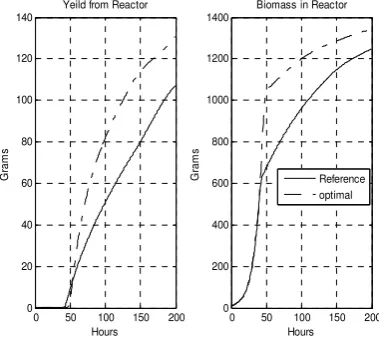
The standard yield for the original settings in Pensim is 106.03 grams of penicillin. It's found that there are 4 variables that have significantly improved the yield. These variables are: substrate concentration; initial biomass concentration; substrate feed rate and pH level. The other variables returned results that are relatively close to the benchmark indicating they have little impact on improving the yield. Fig. 1 is the response of Pensim to the optimal substrate concentration of 25 g/L with all other conditions set at the reference values. This has had the largest effect upon the resulting yield this is mainly the result of the penicillin concentration being improved by a substantial amount.
[image:4.595.323.518.104.705.2]This first stage of optimization has produced a good insight for the investigation work. In the next stage, when more variables are optimized at the same time, some factors are disregarded as they are used to stabilize the starting environment for fermentation and therefore can remain at a pre-set level.
Fig. 2 shows the results of running Pensim with the optimal values of 25 g/L and 0.2 g/L for the substrate concentration and initial biomass respectively. These are plotted against the reference results for direct comparison. The effect of increasing the initial biomass has shifted the point at which the feed rate starts, the higher the initial biomass the sooner the feeding starts. This is effectively the same as giving the process more time to run. The yield achieved is 135.9 grams of penicillin which is an improvement of around 6 grams on substrate on its own and 30grams on the original values.
[image:4.595.330.520.110.282.2]Fig. 3 shows the results of running Pensim with the optimal values of 5.3 and 0.06 L/H for the combined pH level and feed rate respectively. The combined pH has contributed to the yield increase when combined with the optimal feed rate, of 0.06 liters per hour, it has produced 123 grams of penicillin. This draws to the conclusion that the combined pH level holds a tight relationship to the feed rate and it’s a significant positive as shown in Fig 3. This result is a different outcome to the other results that were combined with the pH level.
Figure 1. Substrate concentration optimisation
Figure 2 Substrate concentration v initial biomass optimal results
Figure 3 Feed rate v combined pH optimal results
0 50 100 150 200
0 20 40 60 80 100 120 140
Hours
Gr
a
m
s
Yeild from Reactor
0 50 100 150 200
0 200 400 600 800 1000 1200 1400
Hours
Gr
a
m
s
Biomass in Reactor
Reference optimal
0 50 100 150 200 0
50 100 150
Hours
Gr
a
m
s
Yeild from Reactor
0 50 100 150 200 0
500 1000 1500
Hours
Gr
a
m
s
Biomass in Reactor
Reference optimal
0 50 100 150 200 0
50 100 150
Hours
Gr
a
m
s
Yeild from Reactor
0 50 100 150 200 0
500 1000 1500 2000
Hours
Gr
a
m
s
Biomass in Reactor
Reference optimal
[image:4.595.342.486.471.695.2]Figure 4 Optimal profile of feed rate determined by FGA
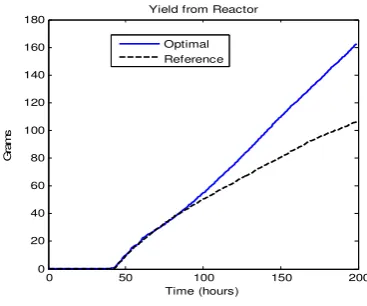
Figure 5 Optimal result of the yield from the reactor
D. On-line optimization results
Using the cost function (5), on-line optimization to determine the optimal feed rate is carried out. The substrate concentration and the initial biomass values are set at the optimal values as determined in the off-line optimization, i.e. 25 g/L and 0.2 g/L respectively. The pH is kept at 5.3 with a PID controller and the optimal profiles of feed flow rates are determined at the fixed time interval of 0.5h. Although there are random disturbances (PRBS signals) being introduced in the Pensim simulation, the adapted FGA is able to determine the optimal profiles of feed rate to maximize the yield. For a typical batch, the optimal profile is shown in Fig 4. During such a batch, the yield of reactor comparing with the reference yield is shown in Fig. 5. It can be seen that significant improvement has been made to have a yield of about 160 grams at the end of batch. This is the joint effort of optimized initial conditions and the optimal feed rate profile.
V. CONCLUSIONS
This paper presented a genetic algorithms approach for the optimization of a fed-batch penicillin fermentation process. A benchmark fed-batch penicillin fermentation simulation was used as a case study. Off-line optimization of the initial conditions and set points were carried out in two stages for a single variable and multiple variables. Optimization results obtained show that the significant improvement can be achieved from
off-line optimization alone. Further investigations with on-line optimization demonstrated that the yield can be further maximized with an optimal feed rate profile being calculated and employed. The proposed approaches can be extended to other important optimization problems in fed-batch fermentation to improve the operation of such processes. The method proposed is capable of solving nonlinear industrial dynamic optimization problems.
ACKNOWLEDGEMENTS
Hongwei Zhang and Ze Zhang would like to thank The Ministry of Education of P R China’s Chunhui Project for financial support under grant No. Z2007-1-01041 in completion of this work.
REFERENCES
[1] A. K Hilaly., M. N. Karim and D. Guyre, "Optimization of an industrial microalgae fermentation," Biotechnology and Bioengineering, vol.43(4), 1994, pp.314-320
[2] D. Sarkar and J. M. Modak, "Optimisation of fed-batch bioreactors using genetic algorithms," Chemical Engineering Science, vol.58(11), 2003, pp.2283-2296.
[3] R. Luus, "Optimal control of batch reactors by iterative dynamic programming," Journal of Process Control, vol.4(4), 1994, pp.218-226.
[4] J. Li and R. R. Rhinehart, "Heuristic random optimization," Computers & Chemical Engineering, vol.22(3), 1998, pp.427-444.
[5] J. G. Na, Y. K. Chang, B. H. Chung. and H.C. Lim, "Adaptive optimization of fed-batch culture of yeast by using genetic algorithms," Bioprocess and Biosystems Engineering, vol.24, 2002, pp.299-308.
[6] F. S. Wang and W. M. Cheng, "Simultaneous optimization of feeding rate and operation parameters for fed-batch fermentation processes," Biotechnology Progress, vol.15(5), 1999, pp.949-952.
[7] H. Halsall-Whitney, D. Taylor and J. Thibault, "Multicriteria optimization of gluconic acid production using net flow," Bioprocess and Biosystems Engineering, vol.25(5), 2003, pp.299-307.
[8] B. Andres-Toro, J. M. Giron-Sierra, P. Fernandez-Blanco, J. A. Lopez-Orozco and E. Besada-Portas, "Multiobjective optimization and multivariable control of the beer fermentation process with the use of evolutionary algorithms," Journal of Zhejiang University: Science, vol.5(4), 2004, pp.378-389.
[9] G. Birol, C. Undey and A. Cinar, "A Modular Simulation Package for Fed-batch Fermentation: Penicillin Production," Computers and Chemical Engineering, vol.26(11), 2002, pp.1553-1565.
[10] R. K. Bajpai and M. Reuss, "A Mechanistic Model for Penicillin Production," Journal of Chem Tech and Biotechnology, vol.30, 1980, pp.332-344.
[11] H. Zhang , B. Lennox, P. R. Goulding. and A. Y. T. Leung, "A float-encoded genetic algorithm technique for integrated optimization of piezoelectric actuator and sensor placement and feedback gains," Smart Materials and Structure, vol.9, 2000, pp. 552-557
0 20 40 60 80 100 120 140 160 180 200
0 0.02 0.04 0.06 0.08
Controller Output
Time (hours)
0 50 100 150 200
0 20 40 60 80 100 120 140 160 180
Time (hours)
Gr
a
m
s
Yield from Reactor
Optimal Reference