Open Peer Review
Discuss this article
(0) Comments
RESEARCH ARTICLE
A 4-week, lifestyle-integrated, home-based exercise training
programme elicits improvements in physical function and lean
mass in older men and women: a pilot study [version 1; referees:
1 approved]
Jessica Cegielski
,
Matthew S. Brook, Jonathan I. Quinlan, Daniel J. Wilkinson,
Kenneth Smith, Philip J. Atherton, Bethan E. Phillips
MRC-ARUK Centre for Musculoskeletal Ageing Research, School of Medicine, University of Nottingham, Derby, UK
Abstract
Background: Developing alternative exercise programmes that can alleviate certain barriers to exercise such as psychological, environmental or socio-economical barriers, but provide similar physiological benefits e.g. increases in muscle mass and strength, is of grave importance. This pilot study aimed to assess the efficacy of an unsupervised, 4-week, whole-body
home-based exercise training (HBET) programme, incorporated into daily living activities, on skeletal muscle mass, power and strength.
Methods: Twelve healthy older volunteers (63±3 years, 7 men: 5 women, BMI: 29±1 kg/m²) carried out the 4-week “lifestyle-integrated” HBET of 8 exercises, 3x12 repetitions each, every day. Before and after HBET, a number of physical function tests were carried out: unilateral leg extension 1-RM (one- repetition maximum), MVC (maximal voluntary contraction) leg extension, lower leg muscle power (via Nottingham Power Rig), handgrip strength and SPPBT (short physical performance battery test). A D -Creatine method was used for assessment of whole-body skeletal muscle mass, and ultrasound was used to measure the quadriceps cross-sectional area (CSA) and vastus lateralis muscle thickness.
Results: Four weeks HBET elicited significant (p<0.05) improvements in leg muscle power (276.7±38.5 vs. 323.4±43.4 W), maximal voluntary contraction (60°: 154.2±18.4 vs. 168.8±15.2 Nm, 90°: 152.1±10.5 vs. 159.1±11.4 Nm) and quadriceps CSA (57.5±5.4 vs. 59.0±5.3 cm ), with a trend for an increase in leg strength (1-RM: 45.7±5.9 vs. 49.6±6.0 kg, P=0.08). This was despite there being no significant differences in whole-body skeletal muscle mass, as assessed via D -Creatine.
Conclusions: This study demonstrates that increases in multiple aspects of muscle function can be achieved in older adults with just 4-weeks of “lifestyle-integrated” HBET, with a cost-effective means. This training mode may prove to be a beneficial alternative for maintaining and/or improving muscle mass and function in older adults.
Referee Status:
Invited Referees
version 1 published 26 Jul 2017
1
report
, University of Glasgow, Stuart Gray
UK 1
26 Jul 2017, :1235 (doi: )
First published: 6 10.12688/f1000research.11894.1
26 Jul 2017, :1235 (doi: )
Latest published: 6 10.12688/f1000research.11894.1
v1
3
2
Bethan E. Phillips ( ) Corresponding author: [email protected]
: Investigation, Writing – Original Draft Preparation, Writing – Review & Editing; : Investigation, Writing –
Author roles: Cegielski J Brook MS
Review & Editing; Quinlan JI: Investigation, Writing – Review & Editing; Wilkinson DJ: Conceptualization, Investigation, Writing – Review & Editing; Smith K: Conceptualization, Writing – Review & Editing; Atherton PJ: Conceptualization, Writing – Review & Editing; Phillips BE: Conceptualization, Writing – Review & Editing
Competing interests:No competing interests were disclosed.
Cegielski J, Brook MS, Quinlan JI
How to cite this article: et al.A 4-week, lifestyle-integrated, home-based exercise training programme elicits improvements in physical function and lean mass in older men and women: a pilot study [version 1; referees: 1 approved]
2017, :1235 (doi: )
F1000Research 6 10.12688/f1000research.11894.1
© 2017 Cegielski J . This is an open access article distributed under the terms of the , which
Copyright: et al Creative Commons Attribution Licence
permits unrestricted use, distribution, and reproduction in any medium, provided the original work is properly cited. Data associated with the article are available under the terms of the Creative Commons Zero "No rights reserved" data waiver (CC0 1.0 Public domain dedication).
We would like to thank MRC-ARUK for providing centre funding (MRC: MR/K00414X/1 and ARUK: 19891) and supporting this Grant information:
work. The stable-isotope analysis in this work was funded by Medical Research Council Confidence in Concept Awards (CiC12019 and CiC2014035). The Abbeyfield Research Foundation, charity number 1167685 (RGS117347) supports PJA, BEP and KS at the University of Nottingham.
The funders had no role in study design, data collection and analysis, decision to publish, or preparation of the manuscript.
26 Jul 2017, :1235 (doi: )
Introduction
Older age is associated with the loss of skeletal muscle mass. Termed sarcopenia, age-related muscle wasting is associated with loss of muscle strength (dynapenia), increased morbidity, loss of independence and premature mortality (Rudrappa et al., 2016). There are however proven means by which to offset these detri-mental progressive declines. For example, structured and fully-supervised progressive resistance exercise training (RET) has been shown to improve both muscle mass (Phillips et al., 2012) and func-tion (Liu & Latham, 2009).
Despite the established effects of RET on muscle mass and func-tion, compliance is difficult to achieve, due to perceived (and real) socio-economic, psychological and environmental factors (Zlot
et al., 2006). Almost all current evidence for the efficacy of RET is based on 2–3 sessions each week, for up to 12 weeks, at a gym or with specialist equipment, reflecting current physical activity guidelines for adults of 2–3 days per week RET for each of the major muscle groups (Bull et al., 2010). However, compliance to physical activity recommendations is poor, with recent data suggesting that they are only achieved by 38% of UK adults
(Department of Health, Physical Activity, 2011), a figure that is
lesser still in older adults (Jefferis et al., 2014). As a result, home-based exercise training (HBET) programmes have been suggested as an alternative to overcome some of the barriers associated with poor compliance to exercise (Hong et al., 2017; Silveira
et al., 2013), whilst also providing a platform to develop the benefits of RET for (pre-) sarcopenic individuals (Maruya et al.,
2016).
The majority of HBET studies to date, have focussed on pre- or rehabilitation for specific clinical groups (Bassett & Prapavessis,
2007; Chang et al., 2017). A small number of studies have
specifi-cally investigated the efficacy of HBET on skeletal muscle func-tion in the elderly, although the focus of these studies has mainly been on lower limb exercises to improve walking and balance
(Ito et al., 2015; Yamauchi et al., 2009) in relation to fall and
fracture prevention. Other studies in older adults have incorpo-rated the use of specialist aids e.g. dumbbells (Plotnikoff et al., 2010), elastic bands (Jette et al., 1999; Ribeiro et al., 2009) or ankle weights (Gardner et al., 2001) to provide resistance for HBET; rather than attempting to incorporate exercise into tasks of daily living, as is done herein. To date, no studies have attempted to investigate the efficacy of incorporating whole-body exercise into activities of daily living on muscle mass and function in older adults. Consequently, in this pilot study we aimed to assess the effects of a 4-week, progressive, whole-body HBET fully inte-grated into activities of daily living, on muscle mass and function in healthy older individuals. We also aimed to utilise a recently re-introduced (Clark et al., 2014) and underexploited creatine method to estimate whole-body muscle mass in humans.
Materials and methods
Ethical statement and recruitment of study participants Twelve healthy older male and female volunteers (63±3 y, 7 men: 5 women, BMI: 29±1 kg/m2) with no previous chronic disease his-tory were recruited via an advertisement on a local radio station. Before enrolment into the study, all volunteers had an assessment
of previous medical history and an ECG to check for any subclinical arrhythmias. The ECG’s were approved by a clinically qualified physician. All volunteers provided written informed con-sent prior to the start of this study. This study was approved by The University of Nottingham Medical School Ethics Committee (B28102015 SoMS GEM BBC) and conformed to The Declaration of Helsinki.
Study procedures
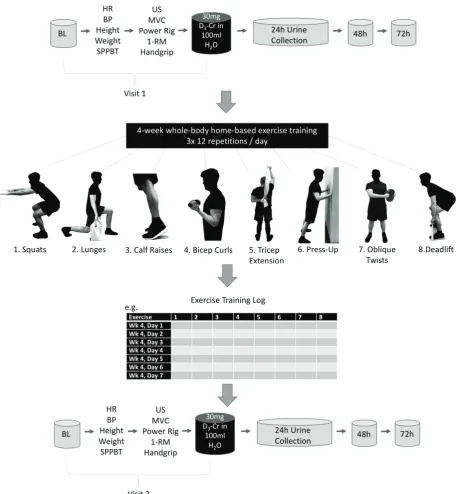
The study involved two visits by the study participants, before and after the 4-week HBET (Figure 1), to the University of Nottingham Medical School, at the Royal Derby Hospital. All assessments at these visits were conducted by researchers from the MRC-ARUK Centre for Musculoskeletal Ageing Research. At each visit, volunteers provided a baseline urine sample for the muscle mass assessment by D3-Creatine before undergoing meas-ures of height, weight (Marsden Weighing Group, UK), resting heart rate and blood pressure (Omron M5-1 digital BP monitor, Omron, UK). Each volunteer had the thickness, fascicle length (Lf) and pennation angle (θpen) of their vastus lateralis muscle, and the cross-sectional area (CSA) of their quadriceps measured by ultrasound (Mylab 70, Esaote Biomedica, Genova, Italy), using the protocol described by Franchi et al. (2014). Volunteers then completed a number of muscle function assessments:
• maximal voluntary contraction (MVC) for seated leg extension and flexion using an isokinetic dynamometer (Isocom; Isokinetic Technologies, Eurokinetics, UK),
• leg extension 1-repetition maximum (1-RM; ISO leg extension, Leisure Lines Ltd., GB),
• leg power (Nottingham Power Rig; Bassey & Short, 1990),
• handgrip strength (Grip D 5401; Takei Scientific Instruments Co. Ltd., Japan); and
• a short physical performance battery test (SPPBT; Guralnik
et al., 1994).
MVC was measured at two knee angles (60 and 90°), whilst isokinetic (eccentric/concentric) contractions were measured over a 70° range (20–90°) at three different speeds (60, 180 and 240°/sec). For both measures, horizontal seated leg extension was set at 0°. Following the muscle function assessments, volunteers ingested 30mg of D3-Creatine dissolved in 100ml H2O for muscle mass assessment, before providing a pooled 24h urine collection and single urine samples at 48 and 72 h post consumption (Clark
et al., 2014).
Home-based exercise training programme (HBET)
increased resistance or time-under-tension was encouraged once the full complement of repetitions could be completed. Compli-ance to exercise was measured by self-report (see self-report log in
Figure 1). An exercise would only be marked as complete if 3 sets
of 12 repetitions had been performed within a day.
Measurement of whole-body muscle mass using D3 -creatine
Using a creatine-tracer measure of muscle mass (Clark et al., 2014), D3-creatine and D3-creatinine enrichment, plus unlabelled creatine and creatinine in the urine was measured using high-performance liquid chromatography/mass spectrometry (HPLC/MS), as detailed in (Stimpson et al., 2012). Total muscle mass was calculated using the following equation:
Total
muscle 3 3
3
( ( ) ( ))
4.3( / ) (
Unlabelled
labelled
MW
Amount of D Cr dosed g Amount of D Cr excreted g MW
g kg mean steady state D Creatineenrichment ratio
× − − −
= ÷
− −
mass (Clark et al., 2014),
where MWUnlabelled and MWlabelled represents the molecular weights of both unlabelled and labelled creatine, respectively. The estimated creatine pool size is then divided by 4.3 g/kg, which reflects the concentration of creatine in wet muscle.
Statistical analysis
Descriptive statistics were carried out on all datasets and checked for a normal distribution using the Shapiro-Wilk normality test. Datasets were analysed using paired Student’s t test to assess the effect of HBET, with GraphPad Prism Software v5 (La Jolla, CA, USA). All data is presented as mean ±SEM. Significance was set at P<0.05.
Results
Compliance, body weight and cardiovascular parameters Using data from the self-report training logs, overall compliance to the HBET was 87.3±3.0% over the 4-week period of training. Adherence to each individual exercise was >86%, with the calf-raisesbeing the most completed exercise (91%). No significant changes were found following HBET for body weight (79.3±4.7 vs. 78.9±4.6 kg), resting heart rate (71.9±3.1 vs. 71.4±3.9 bpm) or blood pressure (systolic: 144.4±3.4 vs. 140.7±4.2, diastolic: 92.2±2.5 vs. 89.0±2.4; average of 3 measurements).
Muscle function
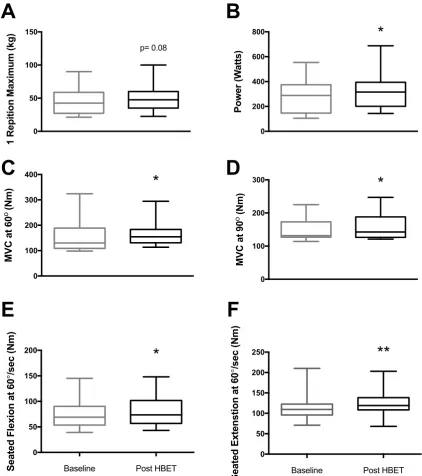
HBET did not elicit significant changes in leg extension 1-RM, handgrip strength or SPPBT; there was however, a trend for an increase in leg extension 1-RM (45.7±5.9 vs. 49.6±6.0 kg, P=0.08;
Figure 2A). HBET did elicit significant increases in leg power
(276.7±38.5 vs. 323.4±43.4 W, P<0.05; Figure 2B) and MVC at 60° (154.2±18.4 vs. 168.8±15.2 Nm, P<0.05; Figure 2C) and 90° (152.1±10.5 vs. 159.1±11.4 Nm, P<0.05; Figure 2D). There were also significant increases in peak torque recorded at 60°/sec during both seated flexion (74.7±8.3 vs. 80.8±8.6 Nm, P<0.05; Figure 2E) and extension (114.9±10.2 vs. 123.8±9.4 Nm, P<0.01; Figure 2F) after HBET.
Muscle architecture
CSA of the thigh at 50% of thigh length significantly increased (57.5±5.4 vs. 59.0±5.3 cm2, P<0.05; Figure 3A) after HBET. How-ever, there was no significant increase in muscle thickness, fasci-cle length (Lf) or pennation angle (θpen) of the m. vastus lateralis. There was a trend for an increase in muscle thickness (25.0±1.6 vs. 25.5±1.7 mm, P=0.08; Figure 3B) after HBET.
Whole-body muscle mass measured by D3-Creatine Corresponding with no significant change in body weight, there was no significant difference in whole-body muscle mass as estimated by D3-Creatine (Figure 3C) after HBET (23.9±2.1 vs. 22.8±2.2 kg).
Dataset 1. Raw data supporting the findings in this study
http://dx.doi.org/10.5256/f1000research.11894.d170288
Sheet 1: Maximum Voluntary Contraction (MVC) at 60° and 90°, pre- and post 4-weeks of home-based whole-body exercise training.
Sheet 2: Seated leg extension measures at 60, 180 and 240 deg/sec pre- and post 4-weeks of home-based whole-body exercise training
Sheet 3: Seated leg flexion at 60, 180 and 240 deg/sec pre- and post- 4-weeks of home-based whole-body exercise training Sheet 4: Handgrip strength, single-leg 1-RM leg extension, SPPBT (short physical performance battery tests) and leg muscle power, measured pre- and post- 4-weeks of home-based whole-body exercise training
Sheet 5: Participant characteristics. Heart rate (HR), systolic and diastolic blood pressure (BP) and body weight, pre- and post- 4-weeks of whole-body home-based exercise training.
Sheet 6: Quadriceps cross-sectional area (CSA), vastus lateralis muscle thickness, fascicle length and pennation angle measured by ultrasound pre- and post- 4-weeks of whole-body home-based exercise training.
Sheet 7: Muscle mass measured by using D3-creatine, pre- and post- 4 weeks of whole-body home-based exercise training.
Discussion
In this pilot study, we show that lifestyle-integrated, whole-body HBET has the potential to meaningfully improve muscle function in older adults. We have shown that this training mode can increase leg power by 16.9% in just 4-weeks. Although lower than the 37% power increase demonstrated in a solely lower-extremity focused HBET programme, this study was conducted over an 8-week period
(DeBolt & McCubbin, 2004), suggesting that if the magnitude of
increase was to continue at a constant rate, our training mode may elicit similar improvements. Additionally, we demonstrate increases in muscle strength (via MVC at 60°) similar to that observed in response to a 6-week, fully-supervised, gym-based training study
(Brook et al., 2016). Furthermore, despite no significant increase,
0 50 100 150 1 R ep iti on M ax im um (k g) p= 0.08 0 200 400 600 800 Po w er (W at ts )
*
A
B
Baseline
Post
0 100 200 300 400 M VC a t 6 0 o (N m )*
Baseline
Post
0 100 200 300 M VC a t 9 0o (N
m )
*
C
D
E
F
Baseline
Post
0 50 100 150 200 250 Se at ed E xt en st io n at 6 0 ¡ /s ec (N m )**
Baseline Post HBET
Baseline
Post
0 50 100 150 200 Se at ed F le xi on a t 6 0 ¡ /s ec (N m )*
Baseline Post HBET
[image:6.612.82.505.137.614.2]Figure 3. A) quadriceps cross-sectional area (CSA; 57.5±5.4 vs. 59.0 ± 5.3 cm2); B) m. vastus lateralis (VL) thickness (25.0±1.6 vs. 25.5±1.7
mm, P=0.08); C) whole-body muscle mass, before and after home-based exercise training (HBET) (23.9±2.1 vs. 22.8±2.2 kg). (mean ± SEM), *=p<0.05, baseline vs. post-HBET.
specialist equipment), our data support the notion that just 4-weeks of a ‘lifestyle-integrated’ HBET meaningfully improves muscle function.
Despite these positive results, no changes in handgrip strength were found, a similar result to Nelson et al. (2004), who imple-mented a 6-month home-based whole-body exercise programme in 70 male and female elderly individuals. This may be due to a lack of exercises specifically targeting the forearm flexors. Indeed, although it is well-established that extant grip strength represents a biomarker of muscle function in older adults
(Bassey & Harries, 1993), our data suggests that it is an
insensitive biomarker for important functional and mass gains in other muscle groups (e.g. the legs) following certain exercise interventions.
Importantly, increases in thigh CSA (and a trend towards increased muscle thickness), which may partly explain the functional improve-ments, were observed. Measures of thigh CSA by ultrasound
have been positively correlated with those by MRI (Reeves et al., 2004), therefore suggesting (leg) muscle hypertrophy in this study. However, since this occurred in the absence of detect-able changes in whole-body muscle mass as measured by D3-Creatine, we speculate i) that preferential hypertrophy of leg muscles occurred, but remained undetectable on a whole-body level; or ii) that measurement of whole-body muscle mass was below the detection threshold for the D3-creatine method.
We acknowledge limitations to our study design. The use of validated physical activity monitors (e.g. Actiheart, CamNtech, Cambridge, UK) to assess compliance to exercise would have provided greater information on the adoption of, and adherence to our exercise programme. Similarly, the use of interactive tech-nologies (e.g. training applications for tablets/smartphones) for motivation and/or instruction may have improved adherence
(Silveira et al., 2013). The lack of improvements in SPPBT were
To conclude, our findings demonstrate that significant increases in muscle mass, maximal voluntary contraction, maximal power and isokinetic strength can be achieved with just 4-weeks of unsupervised, lifestyle-integrated HBET in older adults. These improvements were achieved via cost-effective means, without the requirement for specialist equipment, facilities or supervi-sion (DeBolt & McCubbin, 2004; Jette et al., 1996; Zion et al., 2003). With high compliance and beneficial physiological effects in only a 4-week period, this study highlights the potential for lifestyle-integrated HBET to improve skeletal muscle ‘health’ in older adults. As increases in muscle mass and strength are posi-tively correlated with overall physical function (Liu & Latham, 2009), this novel training mode may be of particular benefit to older frail/(pre-) sarcopenic adults.
Data availability
Dataset 1: Raw data supporting the findings in this study.
Sheet 1: Maximum Voluntary Contraction (MVC) at 60° and 90°, pre- and post 4-weeks of home-based whole-body exercise training.
Sheet 2: Seated leg extension measures at 60, 180 and 240 deg/sec pre- and post 4-weeks of home-based whole-body exercise training
Sheet 3: Seated leg flexion at 60, 180 and 240 deg/sec pre- and post- 4-weeks of home-based whole-body exercise training Sheet 4: Handgrip strength, single-leg 1-RM leg extension, SPPBT (short physical performance battery tests) and leg muscle power, measured pre- and post- 4-weeks of home-based whole-body exercise training
Sheet 5: Participant characteristics. Heart rate (HR), systolic and diastolic blood pressure (BP) and body weight, pre- and post- 4-weeks of whole-body home-based exercise training.
Sheet 6: Quadriceps cross-sectional area (CSA), vastus lat-eralis muscle thickness, fascicle length and pennation angle measured by ultrasound pre- and post- 4-weeks of whole-body home-based exercise training.
Sheet 7: Muscle mass measured by using D3-creatine, pre- and
post- 4 weeks of whole-body home-based exercise training.
DOI, 10.5256/f1000research.11894.d170288 (Cegielski et al.,
2017).
Competing interests
No competing interests were disclosed.
Grant information
We would like to thank MRC-ARUK for providing centre fund-ing (MRC: MR/K00414X/1 and ARUK: 19891) and supportfund-ing this work. The stable-isotope analysis in this work was funded by Medical Research Council Confidence in Concept Awards (CiC12019 and CiC2014035). The Abbeyfield Research Founda-tion, charity number 1167685 (RGS117347) supports PJA, BEP and KS at the University of Nottingham.
The funders had no role in study design, data collection and analysis, decision to publish, or preparation of the manuscript.
References
Bassett SF, Prapavessis H: Home-based physical therapy intervention with adherence-enhancing strategies versus clinic-based management for patients
with ankle sprains. Phys Ther. 2007; 87(9): 1132–43.
PubMed Abstract |Publisher Full Text
Bassey EJ, Short AH: A new method for measuring power output in a single leg
extension: feasibility, reliability and validity. Eur J Appl Physiol Occup Physiol.
1990; 60(5): 385–390.
PubMed Abstract |Publisher Full Text
Bassey EJ, Harries UJ: Normal values for handgrip strength in 920 men and women aged over 65 years, and longitudinal changes over 4 years in 620
survivors. Clin Sci (Lond). 1993; 84(3): 331–337.
PubMed Abstract
Brook MS, Wilkinson DJ, Mitchell WK, et al.: Synchronous deficits in cumulative muscle protein synthesis and ribosomal biogenesis underlie age-related
anabolic resistance to exercise in humans. J Physiol. 2016; 594(24): 7399–7417.
PubMed Abstract |Publisher Full Text |Free Full Text
Bull FC, Biddle S, Buchner D, et al.: Physical activity guidelines in the U.K.:
Review and Recommendations. School of Sport, Exercise and Health Sciences,
Loughborough University, 2010; 1–72.
Reference Source
Cegielski J, Brook M, Quinlan J, et al.: Dataset 1 in: A 4-week
Chang CF, Lin KC, Chen WM, et al.: Effects of a Home-Based Resistance Training Program on Recovery From Total Hip Replacement Surgery:
Feasibility and Pilot Testing. J Nurs Res. 2017; 25(1): 21–30.
PubMed Abstract |Publisher Full Text
Clark RV, Walker AC, O'Connor-Semmes RL, et al.: Total body skeletal muscle
mass: estimation by creatine (methyl-d3) dilution in humans. J Appl Physiol
(1985). 2014; 116(12): 1605–13.
PubMed Abstract |Publisher Full Text |Free Full Text
DeBolt LS, McCubbin JA: The Effects of Home-Based Resistance Exercise on
Balance, Power, and Mobility in Adults with Multiple Sclerosis. Arch Phys Med
Rehabil. 2004; 85(2): 290–297.
PubMed Abstract |Publisher Full Text
Department of Health, Physical Activity, H.I. and P.: Start Active, Stay Active - A report on physical activity for health from the four home countries’ Chief Medical Officers. 2011.
Reference Source
Franchi MV, Atherton PJ, Reeves ND, et al.: Architectural, functional and molecular responses to concentric and eccentric loading in human skeletal
muscle. Acta Physiol (Oxf). 2014; 210(3): 642–54.
PubMed Abstract |Publisher Full Text
Gardner MM, Buchner DM, Robertson MC, et al.: Practical implementation
battery assessing lower extremity function: association with self-reported
disability and prediction of mortality and nursing home admission. J Gerontol.
1994; 49(2): M85–94.
PubMed Abstract |Publisher Full Text
Hong J, Kim J, Kim SW, et al.: Effects of home-based tele-exercise on sarcopenia among community-dwelling elderly adults: Body composition and
functional fitness. Exp Gerontol. 2017; 87(Pt A): 33–39.
PubMed Abstract |Publisher Full Text
Ito S, Hashimoto M, Aduma S, et al.: Effectiveness of locomotion training in a home visit preventive care project: one-group pre-intervention versus
post-intervention design study. J Orthop Sci. 2015; 20(6): 1078–1084.
PubMed Abstract |Publisher Full Text
Jefferis BJ, Sartini C, Lee IM, et al.: Adherence to physical activity guidelines in older adults, using objectively measured physical activity in a
population-based study. BMC Public Health. 2014; 14(1): 382.
PubMed Abstract |Publisher Full Text |Free Full Text
Jette AM, Harris BA, Sleeper L, et al.: A Home-based Exercise Program for
Nondisabled Older Adults. J Am Geriatr Soc. 1996; 44(6): 644–649.
PubMed Abstract |Publisher Full Text
Jette AM, Lachman M, Giorgetti MM, et al.: Exercise--It’s never too late: The
strong-for-life program. Am J Public Health. 1999; 89(1): 66–72.
PubMed Abstract |Publisher Full Text |Free Full Text
Liu CJ, Latham NK: Progressive resistance strength training for improving
physical function in older adults. Cochrane Database Syst Rev. 2009;
3(CD002759): 1–227.
PubMed Abstract |Publisher Full Text |Free Full Text
Maruya K, Asakawa Y, Ishibashi H, et al.: Effect of a simple and adherent home exercise program on the physical function of community dwelling adults sixty
years of age and older with pre-sarcopenia or sarcopenia. J Phys Ther Sci.
2016; 28(11): 3183–3188.
PubMed Abstract |Publisher Full Text |Free Full Text
Nelson ME, Layne JE, Bernstein MJ, et al.: The Effects of Multidimensional
Home-Based Exercise on Functional Performance in Elderly People. J Gerontol
A Biol Sci Med Sci. 2004; 59(2): 154–60.
PubMed Abstract |Publisher Full Text
Phillips B, Williams J, Atherton P, et al.: Resistance exercise training improves age-related declines in leg vascular conductance and rejuvenates acute leg
blood flow responses to feeding and exercise. J Appl Physiol (1985). 2012;
112(3): 347–53.
PubMed Abstract |Publisher Full Text
Plotnikoff RC, Eves N, Jung M, et al.: Multicomponent, home-based resistance
training for obese adults with type 2 diabetes: a randomized controlled trial. Int
J Obes (Lond). 2010; 34(12): 1733–41.
PubMed Abstract |Publisher Full Text
Reeves ND, Maganaris CN, Narici MV: Ultrasonographic assessment of human
skeletal muscle size. Eur J Appl Physiol. 2004; 91(1): 116–118.
PubMed Abstract |Publisher Full Text
Ribeiro F, Teixeira F, Brochado G, et al.: Impact of low cost strength training of dorsi- and plantar flexors on balance and functional mobility in
institutionalized elderly people. Geriatr Gerontol Int. 2009; 9(1): 75–80.
PubMed Abstract |Publisher Full Text
Rudrappa SS, Wilkinson DJ, Greenhaff PL, et al.: Human Skeletal Muscle Disuse Atrophy: Effects on Muscle Protein Synthesis, Breakdown, and Insulin
Resistance-A Qualitative Review. Front Physiol. 2016; 7: 361.
PubMed Abstract |Publisher Full Text |Free Full Text
Silveira P, van de Langenberg R, van Het Reve E, et al.: Tablet-based strength-balance training to motivate and improve adherence to exercise in
independently living older people: a phase II preclinical exploratory trial. J Med
Internet Res. 2013; 15(8): e159.
PubMed Abstract |Publisher Full Text |Free Full Text
Stimpson SA, Turner SM, Clifton LG, et al.: Total-body creatine pool size and
skeletal muscle mass determination by creatine-(methyl-D3) dilution in rats.
J Appl Physiol (1985). 2012; 112(11): 1940–1948.
PubMed Abstract |Publisher Full Text
Yamauchi J, Nakayama S, Ishii N: Effects of bodyweight-based exercise training
on muscle functions of leg multi-joint movement in elderly individuals. Geriatr
Gerontol Int. 2009; 9(3): 262–269.
PubMed Abstract |Publisher Full Text
Zion AS, De Meersman R, Diamond BE, et al.: A home-based resistance-training program using elastic bands for elderly patients with orthostatic hypotension. Clin Auton Res. 2003; 13(4): 286–292.
PubMed Abstract |Publisher Full Text
Zlot AI, Librett J, Buchner D, et al.: Environmental, Transportation, Social,
and Time Barriers to Physical Activity. J Phys Act Health. 2006; 3(1): 15–21.
Open Peer Review
Current Referee Status:
Version 1
08 August 2017 Referee Report