715
©IJRASET: All Rights are Reserved
Virtual Machine Placement Optimization in Cloud Environment: A
Survey
Swasthi Shetty C S
BMS College of Engineering
Abstract: Energy conservation in data centers has been an active research area in cloud computing in recent times. Effective energy conservation can be achieved using server consolidation, which aims at utilizing server resources efficiently and minimizing the number of active Physical Machines (APMs) running in a data center. Effective placement of virtual machines is necessary to optimize server consolidation. Virtual machine placement techniques provide a suitable mapping of hosts to VMs to reduce energy consumption and minimize SLA violation in data centers. This paper presents a comprehensive survey of different Virtual Machine placement techniques utilized in cloud computing, revealing the advantages and limitations of the algorithms. Keywords: VM Placement, VM consolidation, Data Centers, Virtual Machines, SLA Violation
I. INTRODUCTION
Cloud computing provides access to on demand computing resources to the users in a pay-as-you-use pricing model. Three different models are being offered by cloud service providers such as IaaS (Infrastructure as a service), PaaS (Platform as a service) and SaaS (Software as a service). One of the significant challenges for cloud service providers is to reduce energy consumption in data centers. The cloud service providers spend a significant amount in setting up data centers in the beginning. They have to incur data center management costs later to maintain data centers. This includes power costs, software and hardware maintenance costs etc. According to a recent study [1], 13% of the overall data center management cost is incurred by power consumption. So, it is essential to optimize power consumption in data centers to reduce the operational cost for cloud service providers. To prevent wastage of resources in data centers, Virtual Machines (VM) are packed on to the fewest possible physical machines and idle physical machines are later shut down, thereby reducing energy consumption. This process of consolidating VMs on to the servers is called server consolidation. It comprises of 4 steps: 1) Host underload detection, where hosts with utilization under a certain threshold are selected, all the VMs on the host are migrated to other servers, and underloaded hosts are shutdown. 2) Host overload detection, where hosts with utilization greater than a certain threshold are detected and some of the VMs are migrated to other hosts. 3) VM selection, where appropriate VMs are selected for migration from over utilized hosts. 4) VM placement, where VMs selected for migration in the 3rd step is mapped to different Physical Machines (PM). In this paper, we focus on Virtual Machine Placement algorithms. Virtual machine placement (VMP) is the process of mapping Virtual machines to Physical machines in order to reduce energy consumption and minimize SLA violation in data centers. VMP has been an active research area in cloud computing throughout the last decade. Many VMP algorithms have been proposed to maximize utilization and to reduce power consumption, in turn reducing operational costs in data centers. VMP algorithms can be traffic-aware, load-aware, application-aware, power-aware or a combination of these. To achieve better performance, VMs are migrated to other hosts when servers become over utilized or underutilized. So, when the resource demands of a Virtual machine cannot be fulfilled by the physical machine on which the VM is hosted, VMs are migrated to another PM for the fulfillment of the demands. . VMs are migrated from over utilized hosts to prevent Service level Agreement violation. In the case of underutilized hosts, all the VMs hosted on the PM are migrated and the host is shut down. The remainder of this paper is organized as follows. Section II describes the classification of VM placement algorithms. Section III presents a detailed discussion of different approaches used in VM placement algorithms and Section IV presents concluding remarks and future research directions.
II. VMPLACEMENTCLASSIFICATION
A. Power and Quality of Service
1) Power based: The objective of power based virtual machine placement algorithm is to map virtual machines to physical machines in a manner to reduce energy consumption in data centers. Virtual machines are aggressively packed in physical machines and underutilized physical machines are shut down to reduce power consumption [2].
716
©IJRASET: All Rights are Reserved
B. Dynamicity
1) Static VM Placement: VMs are mapped to PMs during the initial placement and reallocation is not considered for a long period of time. The VM-PM mapping is fixed throughout the lifetime of a VM
2) Dynamic VM Placement: This technique is used to modify VM placement on regular time intervals depending on load, energy consumption etc. Dynamic VM allocation requires more resources compared to static allocation as dynamic solutions are implemented for shorter timescales and could also affect the performance of applications running on virtual machines. Dynamic VM placement techniques can be further classified into two types [4]:
a) Reactive: VM reallocation is implemented after the systems reach a certain state. After the initial placement of VMs on PMs, changes are done only when hosts become underloaded or overloaded.
b) Proactive: After the initial placement, reallocation of VMs are done at regular intervals before the system reaches a certain state. It aims at preventing overloading or underloading of servers and reallocation is carried out before the servers are overloaded. This approach is better than reactive placement as this prevents SLA violation.
C. Optimization Strategy
1) Heuristic: Heuristic algorithms are problem dependent solutions that can provide a satisfactory solution to a specific problem in limited time and cost. Greedy algorithm is one such example for heuristic algorithms that has been implemented in many VM placement strategies. Heuristic algorithms run fast and hence can be applied in various online VM placement techniques. 2) Metaheuristic: Metaheuristic algorithms are problem independent solutions, that can be applied to a wide range of problems.
These algorithms need more time to execute and find solutions in comparison to heuristic algorithms. ACO (Ant Colony Optimization), genetic algorithms, honeybee foraging algorithms are examples of metaheuristic algorithms that have been used in VM placement techniques to deal with load balancing. These algorithms have been found to provide better load balancing compared to heuristic algorithms.
3) Hybrid: In hybrid algorithms, both heuristic and metaheuristic approaches are combined to come up with an optimal solution. In some cases, heuristic algorithms are used for initial placement of VMs and metaheuristic algorithms are used to optimize VM placement during VM migration. Alternatively, metaheuristic algorithms can be used to provide solutions to a set of problems and heuristic algorithms can be used to find an optimized solution based on these solutions. Hybrid algorithms increase implementation complexity but at the same time reduce time and cost to arrive at the solution.
III. VMPLACEMENTALGORITHMS
A. Bin Packing-based VM Placement
VM placement can be seen as a bin packing problem where Physical machines are considered as bins with minimum resource capacity and Virtual machines are objects that need to be packed into these bins. Requirements of virtual machines are to be met by the PMs. Aggressive packing of virtual machines on to physical machines will allow idle physical machines to be shut down, in turn reducing power consumption in data centers. Bin packing algorithms can be classified as follows:
1) First Fit: This greedy based approach allocates Virtual machine to the first PM that has enough resources required by VM. As and when a new VM arrives, the algorithms start to find a PM that has enough capacity to host the VM. A new PM is switched on, in case it fails to find a PM that has enough capacity [3,4,5].
2) Next Fit Method: In this technique, an initial VM is placed on the first PM that has adequate resources. For the second VM, the search starts from the Physical machine that hosted the first VM. For the next VM, search starts from the physical machine that hosted the previous VM.
3) Random Fit: A physical machine is chosen in a random manner for Virtual machine allocation [6]. If the physical machine chosen does not have enough resources, another physical machine is chosen randomly for the Virtual Machine to be placed 4) Best Fit Decreasing: This technique sorts all the PMs in decreasing order of their utilization and selects PM with the highest
utilization for VM allocation [7]. If PM with the highest utilization has no adequate resources to host a VM, PM with the second highest utilization is taken into consideration. This technique ensures aggressive packing of VMs on to the PMs and allows PMs with lower utilization to be shut down after migrating VMs to the higher utilized servers. This algorithm has been proven to be better than first fit, next fit and random fit algorithms.
717
©IJRASET: All Rights are Reserved
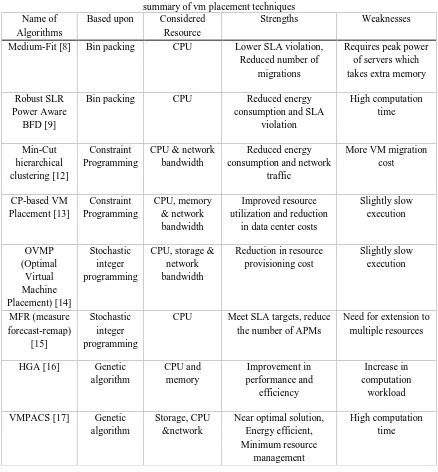
allocation. MF algorithm performs lesser number of VM migrations and lowers SLA violation compared to other VM placement algorithms [8]. Lianpeng et al. proposed a RobustSLR Power-Aware Best fit decreasing (RPABFD) algorithm for VM placement where future host load is predicted using Robust Simple Linear Regression (RobustSLR) algorithm. Overloaded and underloaded hosts found using RobustSLR algorithm is excluded from the list for VM placement. According to the author, this algorithm has reduced SLA violation rates by 99.16% and energy consumption by 25.43% [9]. Hui et al. proposed Space Aware Best fit decreasing algorithm for VM placement, where the host with minimum available MIPS (Millions of Instructions Per Second) is selected for placement. This algorithm has outperformed Power-Aware Best fit decreasing algorithm both on assuring SLA and energy conservation [10].
B. Constraint Programming
VM placement problem can be solved using constraint programming technique where the solution must satisfy the constraints on relations between variables. The goal of this technique is to maximize global utility function that is finalized based on SLA and operational cost. The virtual machine placement can be seen as a complex combinatorial problem that can be solved using constraint programming techniques in two stages. The first stage is to arrive at local decisions associated with each application hosted on the cloud. The second part is to feed local decisions of all applications to a global decision module that maps VMs to PMs based on the CPU load [11]. Dong et al. proposed a two stage VM scheduling scheme. In the first stage, the authors proposed a static VM placement scheme minimizing active servers and network elements to reduce energy consumption. They combined best fit algorithm with minimum cut hierarchical clustering. In the second stage, they used local search algorithms during VM migration to optimize VM allocation and to minimize Maximum link Utilization (MLU) in VMs and at the same time, to reduce link congestion [12]. Yu et al. proposed a virtual machine placement algorithm by formulating the VM placement problem as a Constraint satisfaction problem. The objective of this algorithm was to cut operational costs and increase resource utilization with lesser number of servers. They used Choco software library as a constraint solver [13].
C. Stochastic Integer Programming (SIP)
This mathematical optimization technique is used when future demands and cost of resources are unknown and expected distributions can be calculated or are known. This technique is used in VM placement optimization as the future demands of VM utilization are unknown. This technique aims to minimize the operational cost when future demands are unknown [7].
Sivadon Et al. proposed an Optimal VM placement (OVMP) algorithm to minimize the cost plan for renting resources from cloud providers. OVMP makes a decision based on the optimal solution of SIP in a multi cloud environment where future demands of resources are unknown. The proposed algorithm is carried out in 2 stages. First, the number of VMs in the reservation phase are defined. In the second stage, actual number of VMs required and actual rent are defined by the providers. This algorithm reduces the cost of resource provisioning in cloud data centers [14]. Bobroff et al. proposed a VM consolidation and migration technique that operates in 3 steps. The first step is to measure historical data of VM and PM utilization. Second step is to predict future demands and then mapping VMs to PMs based on the predicted data. Hence it is also called as Measure-Forecast-Remap algorithm. This algorithm reduces the capacity demands of the server and thereby reducing the operational cost [15].
D. Genetic Algorithm
718
©IJRASET: All Rights are Reserved
[image:4.612.87.525.114.586.2]All the above stated VM placement algorithms are summarized in the table below. Table 1 also lists the strengths and weaknesses of all the algorithms.
TABLE I
summary of vm placement techniques Name of
Algorithms
Based upon Considered Resource
Strengths Weaknesses
Medium-Fit [8] Bin packing CPU Lower SLA violation, Reduced number of
migrations
Requires peak power of servers which takes extra memory
Robust SLR Power Aware
BFD [9]
Bin packing CPU Reduced energy consumption and SLA
violation High computation time Min-Cut hierarchical clustering [12] Constraint Programming
CPU & network bandwidth
Reduced energy consumption and network
traffic
More VM migration cost CP-based VM Placement [13] Constraint Programming CPU, memory & network bandwidth Improved resource utilization and reduction
in data center costs
Slightly slow execution OVMP (Optimal Virtual Machine Placement) [14] Stochastic integer programming
CPU, storage & network bandwidth
Reduction in resource provisioning cost Slightly slow execution MFR (measure forecast-remap) [15] Stochastic integer programming
CPU Meet SLA targets, reduce the number of APMs
Need for extension to multiple resources
HGA [16] Genetic algorithm CPU and memory Improvement in performance and efficiency Increase in computation workload
VMPACS [17] Genetic algorithm
Storage, CPU &network
Near optimal solution, Energy efficient, Minimum resource management High computation time IV. CONCLUSION
719
©IJRASET: All Rights are Reserved
REFERENCES
[1] Beloglazov, A. and Buyya, R. (2012), Optimal online deterministic algorithms and adaptive heuristics for energy and performance efficient dynamic consolidation of virtual machines in Cloud data centers. Concurrency Computat.: Pract. Exper., 24: 1397-1420. doi:10.1002/cpe.1867
[2] Song, W., Xiao, Z., Chen, Q. and Luo, H., 2014. Adaptive resource provisioning for the cloud using online bin-packing. Computers, IEEE Transactions on, 63(11), pp.2647-2660.
[3] Beloglazov, A. and Buyya, R., 2013. Managing overloaded hosts for dynamic consolidation of virtual machines in cloud data centers under quality of service constraints. Parallel and Distributed Systems, IEEE Transactions on, 24(7), pp.1366-1379.
[4] M. Masdari et al. /Journal of Network & Computer Applications 66 (2016) 106–127.
[5] Gupta RK, Pateriya R. Survey on virtual machine placement techniques in cloud computing environment. Int J Cloud Comput: Serv Archit 2014.
[6] Choudhary, A., Rana, S., & Matahai, K. (2016). A Critical Analysis of Energy Efficient Virtual Machine Placement Techniques and its Optimization in a Cloud Computing Environment. Procedia Computer Science, 78, 132-138. doi:10.1016/j.procs.2016.02.022
[7] Kaur et al., International Journal of Advanced Research in Computer Science and Software Engineering 6(5), May- 2016, pp. 521-526.
[8] Moges, F., Abebe, S. Energy-aware VM placement algorithms for the OpenStack Neat consolidation framework. J Cloud Comp8, 2 (2019) doi:10.1186/s13677-019-0126-y
[9] L. Li, J. Dong, D. Zuo and J. Wu, "SLA-Aware and Energy-Efficient VM Consolidation in Cloud Data Centers Using Robust Linear Regression Prediction Model," in IEEE Access, vol. 7, pp. 9490-9500, 2019. doi: 10.1109/ACCESS.2019.2891567
[10] H. Wang and H. Tianfield, "Energy-Aware Dynamic Virtual Machine Consolidation for Cloud Datacenters," in IEEE Access, vol. 6, pp. 15259-15273, 2018. doi: 10.1109/ACCESS.2018.2813541
[11] Zoha Usmani and Shailendra Singh / Procedia Computer Science 78 ( 2016 ) 491 – 498.
[12] J. Dong, H. Wang and S. Cheng, "Energy-performance tradeoffs in IaaS cloud with virtual machine scheduling," in China Communications, vol. 12, no. 2, pp. 155-166, Feb. 2015. doi: 10.1109/CC.2015.7084410
[13] Yu Y., Gao Y. (2012) Constraint Programming-Based Virtual Machines Placement Algorithm in Datacenter. In: Shi Z., Leake D., Vadera S. (eds) Intelligent Information Processing VI. IIP 2012. IFIP Advances in Information and Communication Technol ogy, vol 385. Springer, Berlin, Heidelberg [14] S. Chaisiri, Bu-Sung Lee and D. Niyato, "Optimal virtual machine placement across multiple cloud providers," 2009 IEEE Asia-Pacific Services Computing
Conference (APSCC), Singapore, 2009, pp. 103-110. doi: 10.1109/APSCC.2009.5394134
[15] N. Bobroff, A. Kochut and K. Beaty, "Dynamic Placement of Virtual Machines for Managing SLA Violations," 2007 10th IFIP/IEEE International Symposium on Integrated Network Management, Munich, 2007, pp. 119-128. doi: 10.1109/INM.2007.374776
[16] Tang, M. & Pan, S. Neural Process Lett (2015) 41: 211. https://doi.org/10.1007/s11063-014-9339-8