Performance Analysis of a Wireless CDMA
Transmission System with Receiver Diversity
Schemes
Md. Shahidul Islam1, Md. Abdul Mukib2, A. K. M. Bellal Hossain3
1, 2, 3
Department of CSE, Department of CSE, Department of CS and Information System Hamdard University Bangladesh, Hamdard University Bangladesh, King Khaled University
Abstract: To carryout performance analysis of a DS-CDMA wireless communication system with single transmitter and multiple receiver (SIMR). Analysis includes the effect of pre-coding at the transmitter and RAKE-receiver at the receiving stations. BER expression is developed considering the MRRC combining technique. Performance results are evaluated by numerical computations.
Keywords: Multi-access interference, CDMA, Diversity Scheme, pre-Rake, multiuser detection
I. INTRODUCTION
Multipath-induced Multi-access interference (MAI) severely degrades performance of bandwidth efficient CDMA systems [15], [17], [20]. While receiver-based multiuser detection (MUD) techniques are suitable for the uplink, Tx-based MAI cancellation techniques have been proposed for the downlink to shift computational complexity and power consumption from the Mobile Station (MS) to the base station (BS), where they can be afforded. However, these methods are complex since MAI cancellation filters need to be updated continuously as fading coefficients vary [18].
CDMA technology greatly benefits from exploiting the multipath diversity of the channel [16]. Pre-RAKE diversity combining are proposed for the downlink channel to achieve multipath diversity without the burden of the RAKE receiver at the mobile. In [19], space-time pre-RAKE (STPR) technique was investigated for transmitter antenna diversity systems. The ideal performance of this method approaches that of the maximal ratio receiver combining (MRRC) of all space and frequency diversity branches. Although the performance of an wireless CDMA system with transmit diversity is reported with Pre-RAKE space time coding, it is important to evaluate overall channel bit error rate performance results considering the effect of multi-path fading for different receiver diversity and combining techniques.
II. PRE-RAKE FILTERING
First, consider the downlink of the synchronous DS/CDMA system with K active users and a single transmitter antenna. The transmitted equivalent low pass signal x(t) at the BS station is
x(t) =
K
k1 A
kbksk(t), 0 ≤ t ≤ Tb, for the kth user.
Where, Ak is the amplitude, bk Є {-1,1}is the data bit, sk(t) is the unit energy normalized signature waveform and Tb is the bit
duration. We assume the observation interval 0 ≤ t ≤ Tb throughout the paper. The transmitted signal can be expressed in vector
notation as x(t)=sTAb, where A=diag(Ak)KxK is the diagonal amplitude matrix, b=[b1,……….,bK]T is the vector of the data bits of
K users, and s=[s1(t)…sK(t)]T is the vector of signature waveforms. Binary phase shift keying (BPSK), or alternatively, Quadrature
Phase Shift Keying (QPSK) is employed. The passband energy of kth user’s bit is given by Ek = Ak2/2.
The frequency selective channels associated with different users are assumed to be independent and identically distributed (i.i.d.) multipath Rayleigh fading. If there are L resolvable paths, the impulse response of the kth user’s channel is given by:
hk(t) =
1
0 L
l h
klδ(t-lTc)………(2.1)
Where, hkl is the time varying complex Gaussian fading coefficient corresponding to the lth path of the kth user, and Tc is the chip
rk(t)= Ajbjhklsj(t-lTc)+nk(t),
Where nk(t), k=1…K are i.i.d. complex valued zero-mean white Gaussian Noise processes (AWGN) with power spectral density
(PSD) N0. The signal to noise ratio (SNR) per bit for user k is (Ak2/2)N0. Similarly, for the uplink CDMA system, the received
signal the the BS is r(t)=Akbkhklsk(t-lTc)+n)t), where n(t) is AWGN with PSD N0 [24].
We assume synchronous transmission for both the uplink and the downlink. In the downlink, the spreading codes associated with different users are generated to be orthogonal to each other and the transmission is synchronous. For the multipath DS-CDMA channel, the delay spread is on the order of several chip intervals, and Tc<<Tb. Thus, the inter symbol interference (ISI) and the MAI
due to adjacent symbol intervals are negligible. As a result, the MAI and self-interference are mostly due to the effects of the multipath in the current symbol interval, and the synchronous model is appropriate. The uplink signal is often asynchronous in practice. However, we use the uplink model primarily for performance comparison with the proposed downlink methods, so the synchronous assumption is sufficient.
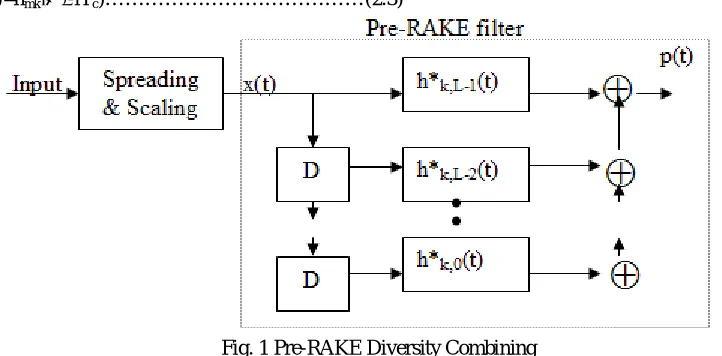
We utilize the pre-RAKE filtering method [16] at the BS to achieve performance of the RAKE receiver, while employing a single matched filter at the MS. The block diagram of the method is shown in Fig.1, where D is a delay of Tc seconds. The transmitted signal for the kth user is:
Pk(t)=1/|hkj|2xAkbkh*k(L-1-j)sk(t-jTc) ………(2.2)
These signals are summed and sent to individual users. The receiver of the kth user employs a filter matched to sk(t-(L-1)Tc). For
ideal spreading codes (when multipath-induced interference is not present), the output signal achieves full Maximal Ratio Combining (MRC) diversity benefit without using the RAKE receiver at the MS.
The channel model in (2.1) can be easily extended to multiple transmitter antenna systems. Assume there are M transmitter antennas and a single receiver antenna. The channel associated with each antenna is given by:
[image:2.612.117.478.348.526.2]hmk(t)=hmklδ(t-lTc)………(2.3)
Fig. 1 Pre-RAKE Diversity Combining
We assume that the channels are i.i.d. Rayleigh fading with the same characteristics as in (2.1). In [19], the pre-RAKE filter was extended to multiple transmitter antenna systems. In this case, a pre-RAKE filter specific to each antenna is applied prior to transmission. This system achieves the gain of MRC for MxL diversity branches for ideal spreading codes.
III.SYSTEM MODEL and LINEA MAI CANCELLATION METHODS for MULTIPATH FADING CHANNELS
The performance of the conventional single-user RAKE receiver and the pre-RAKE filter degrades due to multipath-induced MAI. Linear multiuser detectors for multipath fading channels include the Multipath Decorrelating Detector (MDD) [15] and the RAKE Decorrelating Detector (RDD) [23]. RDD achieves the optimum performance over all linear multiuser detectors for multipath signals of unknown energy [23]. MDD has slightly worse performance, but lower complexity than RDD.
For these methods, inversion of KxK matrices is necessary. The elements of these matrices depend on the CSI, so recalculation of the inverse matrix is required at the rate of variation of the channel fading.
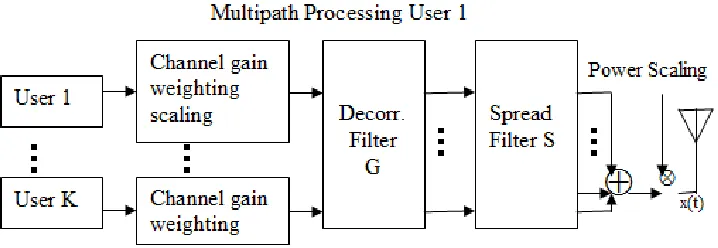
A block diagram of a Multiuser DS-CDMA transmitter with pre-RAKE precoding method was proposed in [24] (Fig.2). in this method, the functions of the pre-RAKE filtering and multiuser precoding are separated and the multiuser cancellation matrix is independent of channel fading. First, the tap delay line filter as in the pre-RAKE structure (Fig. 1) is applied to the no-spread input signal of each user, i.e., L delayed components of the input signal are created and weighted appropriately. The linear multiuser Decorrelating filter G then processes jointly the KL outputs of these filters. The resulting signal is spread using a bank of KL spreading filters of all users expressed in the matrix form as:
S = [s1…..sK]1xKL, where
s=[sk(t-(L-1Tc….sk(t)))] ………(3.1)
The outputs of the spreading filters are summed, the resulting signal is scaled to keep the total transmitted power normalized and the resulting signal is sent to all mobile stations. The Decor relating filter G removes all multipath-induced interference. For rapidly varying fading channels, the pre-RAKE coefficients and scaling factors need to be updated for each transmitted symbol. However, the Decor relating matrix depends only on the signature sequences and the number of multipath components, not on channel gains [24]. Thus the matrix inverse does not have to be updated as the channel gains vary at the fading rate, and the complexity is much lower than for linear precoders in [18] and for the pre-RDD method [6]. Note that the structure of this precoder is related to that of the low complexity MDD receiver [15].
[image:3.612.129.488.368.492.2]All linear recoding methods require scaling of transmitter signals to normalize the transmitter power. Therefore, performance of these techniques is degraded by the scaling factor, similarly to the noise enhancement in the receiver-based MUDs. Expressions for the BER of the precoding methods and MUDs discussed above result from averaging the corresponding BER for the AWGN. This AWGN BER is given by the Q-function with the argument that depends on the received SNR and the scaling factor or the enhanced noise variance for linear precoders and MUDs, respectively.
Fig. 2 Block diagram of a Multiuser DS-CDMA transmitter with Pre-RAKE Precoding.
It was shown in [17], [20] that combining linear multiuser detection with multiple receiver antennas improves the BER performance for multipath fading multiuser CDMA channels. In [17], the MDD structure [15] is extended to multiple antennas. First, the MAI at each antenna is removed through Decorrelating. Then the resulting signals from all antennas are whitened and optimally combined using MRC. In [25] the optimal combining of received signals is performed first, followed by multiuser decorrelation, resulting in the extension of the RDD receiver [23].
MUD with multiple antennas is suitable for the uplink channel, given the limitations of the MS. Alternatively, multiuser precoding can be extended to multiple antennas to achieve similar gains for the downlink.
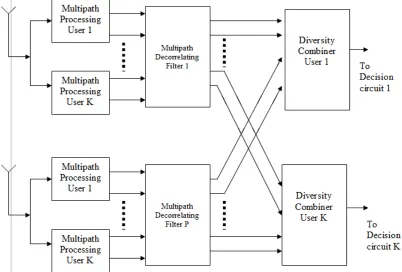
The front-end of the optimal multiuser receiver consists of a bank of P matched filters, each implemented as a RAKE structure, for each active user. A linear, zero-forcing multiuser receiver, referred to as Decorrelating detector, completely eliminates MAI from the sufficient statistics at the expense of noise correlation and enhancement, the effect that can be controlled by code design. When Decorrelating operation is performed on the in-phase and the quadrature components of the received signal, Decorrelating receiver does not require the knowledge of amplitudes and phases of all users and both coherent and differentially coherent reception can be established.
diversity channels are independently fading, the Decorrelating operation can be performed on KL signals for each antenna, as shown in Fig.3.
Fig. 3 Block Diagram of a Multiuser DS-CDMA Receiver with Pre-RAKE multiuser precoding.
IV. ANALYSIS of BIT ERROR RATE (BER)
Assume multiple transmitter antenna channels. Consider the transmitter for the proposed precoding method shown in Fig. 3. Antenna-specific pre-RAKE multiuser precoding is applied prior to transmission at each antenna. The transmitted signal at the mth antenna is given by:
Xm(t) = SfSGCmHA’b ………(4.1)
Where G is the KLxKL matrix and S is the resulting signal. The pre-RAKE weighting matrix for the mth antenna is:
…… (4.2)
Where the vector hmk = [hmk,o,…., hmk,L-1]H, and A’=SpA is the scaled version of the diagonal amplitude matrix A. the diagonal pre-RAKE scaling matrix Sp be the
The transmitted signal Xm(t) is convolved with the channel response for each m, and the received signals are superimposed at the each MS. The receiver of the kth user employs a filter matched to sk(t-(L-1))Tc. To normalize the transmitter power, the scaling
factor is given by:
Kk 1
Ak2 /2
Sf2 =
h
1m0 … 0
0 h
2m… :
C
mH= : : : 0
[
Ak2 /2 …… (4.3)
M m K k 1 1
M j L l 1 1 0|hklj|2
for the kth user, the output of the matched filter at the receiver is
Yk = Sf √ (
M m L l 1 1 0 |hklm|2)Akbk + nk. …… (4.4)
Then the instantaneous probability of error for user k is given by:
Pk (x)= Q (√(
M m L l 1 1 0 |hklm|2Sf2Ak2 x2/N0) …… (4.5)
Where x be the number of samples. Then the probability density function pdf of the system is:
xL-1 exp(-x/τc)
f(x)= …… (4.6) (L-1)!τcL
Where, τc = Average SNR/bit/channel, L be the number chips per bit. Bit Error Rate of the system is:
BER = Pk(x)
f(x) …… (4.7)Note that for an ideal system without MAI, this BER is equivalent to MRC with MxL-order of diversity and the precoder reduces the space-time pre-RAKE method. The performance degradation is caused by Sf and depends on the autocorrelation and cross-correlation properties of the spreading codes. For a single antenna system, this precoding technique reduces to the pre-RAKE multiuser precoding.
V. RESULT AND DISCUSSION
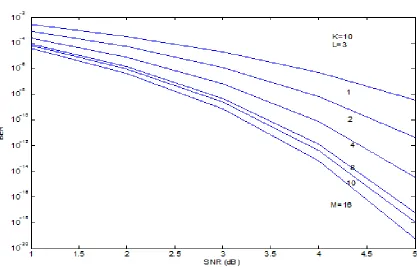
The Bit error rate (BER) performance as a function of SNR and probability density function (pdf) of a wireless CDMA transmission system with receiver diversity schemes for several values. We use the multiuser precoding technique. We can see the Bit Error rate performance from the Fig. 4 to Fig. 8 by using different values. In the figure from Fig. 4 to Fig. 8 the different parameters are used. In all figure the Bit Error Rate (BER) is in the Y axis and Signal to Noise Ratio (SNR) is in the X axis. The parameters are
K=The Number of users L=Number of chips per bit M=Number of receiving antennas Ak = Amplitude
bk = data bit
nk = the noise factor
hkl = the time varying complex Gaussian fading coefficient corresponding to the path and user.
In evaluating results, data is precoded at the transmitter side. The total average channel power is normalized to one. The BER of MRC in the plots evaluated analytically and gives the lower bound on the BER of all methods and diversity for each plot is given by the number of paths times the number of receiver antennas.
In figure Fig.4 to Fig. 6, we investigate the performance of linear multiuser precoding methods described in section III for single transmitter antenna system. BER performance of receiver based MUD schemes and transmitter based precoding methods is compared. The BER of the RAKE receiver with MRC is determined by numerical computation.
Fig. 4 Bit Error Rate (BER) performances versus SNR when L=2
[image:6.612.92.509.432.699.2]
Fig.6 Bit Error Rate (BER) performances versus SNR when L=4
By observing the above condition, we can say that by varying the number of chips per bit, L, and keeping the other parameters same we can easily improve the performance of BER of a system.
Now we will evaluate a system numerically:
A simulation based on the DS-CDMA, the parameters are given below:
In this system we use the number of user k = 10, we can increase the number of user also. The number of receiving antennas vary by, m=1, 2, 4, 8, 10, 16. We can also increase the number of antennas also and the number of antennas vary with the number of chips per bit, l = 2, 3, 4, 5, 6. We can also increase the number of chips per bit. Amplitude value can be taken at any range but in this work we have taken the amplitude value Ak as:
Ak = [0.02 0.04 0.06 0.18 0.002 0.021 0.0312 0.014 0.0416 0.0218 0.0062 0.0216 0.0123 0.00123 0.0031].
The data or information may be any value but in this work the information we taken as: bk = [0.25 0.25 0.25 0.25 0.25 0.25 0.25 0.25 0.25 0.25 0.25 0.25 0.25 0.25 0.25].
The noise value can be taken as any value but all time smaller is best and we take the noise value, nk as:
nk = [0.002 0.0012 0.01212 0.0352 0.01242 0.01221 0.01032 0.002153 0.00126 0.02109 0.0124 0.0052 0.004512 0.00362 0.00182].
For this work, we taking 15 samples and SNR value are 2 4 6 8 10 in dB. The number of Bit Error Rate (BER) is equal to the number of SNR for this system. By converting the SNR values from dB to normal we calculate the different parameters.
We take the value of the time varying complex Gaussian fading coefficient in matrix form and all the element of the matrix hkl is
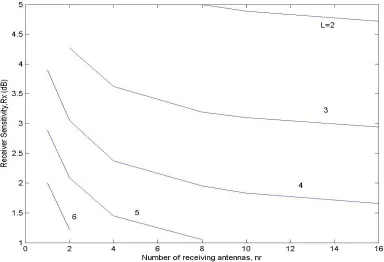
Fig. 7 Plots of Receiver sensitivity versus number of receiving antennas for different values of L, at BER = 10-6
[image:8.612.112.496.419.681.2]By comparing figures Fig.7 and Fig. 8 we can see that when BER is low, then the receiver sensitivity (Rx) starts from its highest
value. For lowest value of BER we can found more and more values so that the performance of receiver sensitivity (Rx) is easily
understandable for us that the receiver sensitivity (Rx) perform better performance.
VI. CONCLUSION
From the numerical computational performance or results we can conclude that the system is optimum and by using the same parameters we can increase the number users at both transmitting and receiving sides and the system achieves better performance.
REFERENCES
[1] S. M. Alamouti, “A simple transmit diversity technique for wireless communications”, IEEE Journal on select areas in communications, vol. 16, No. 8, October 1998.
[2] J. Ramos, M. D. Zoltowski, and H. Liu, “A low-complexity space-time RAKE receiver for DS-CDMA communications”, IEEE signal processing letters, vol.4, No.9, September 1997.
[3] K. Li and H. Liu, “A new blind receiver for downlink DS-CDMA communications”, IEEE communications letters, vol. 3, No. 7, July 1999.
[4] J. Cheng, N. C. Beaulieu, “Accurate DS-CDMA Bit-error probability calculation in Rayleigh fading”, IEEE transactions on wireless communications, vol. 1, No. 1, January 2002.
[5] K. Yano, S. Hirose, and S. Yoshida, “Effect of antenna element separation on the performance of MAI canceller with adaptive array antenna for DS-CDMA”, the 25th Symposium on Information Theory and Its applications (SITA2002) Ikaho, Gunma, Japan, Dec. 10-13, 2002.
[6] S. Guncavdi and A. Duel-Hallen, “Transmitter Diversity and multiuser Pre-coding for Rayleigh fading Code division multiple access (CDMA) channels”, Ph.D Thesis, North Carolina State University, May 2003.
[7] K. Jeong, M. Yokoyama, and H. Uehara, “Improvement in a performance of MAI cancellation in a fading DS/CDMA channel”, International Symposium on Information Theory and its Applications, ISITA2004, Parma, Italy, October 10-13, 2004.
[8] K. Huang, F. Adachi, Y. Huat Chew, “A more accurate analysis of interference for Rake combining on DS-CDMA forward link in mobile radio”, IEICE Trans. Commun., vol. E88-B, No.2 February 2005.
[9] B. H. Liu, N. Bulusu, H. Pham, S. Jha, “A self-Organizing, Location-Aware Media Access Control Protocol for DS-CDMA Sensor Networks”, The University of New South Wales and Oregon Health and Sciences University.
[10] P. J. Bouvet, V. L. Nir, M. Helard, R. L. Gouable, “Spatial Multiplexed coded MC-CDMA with iterative receiver”, France Telecom R&D, 4 rue du clos courtel 35512 Cesson-Sevigne, France.
[11] X. Gu and S. Olafsson, “A simplified and accurate method to analyze a code division multiple access performance”, Complex Systems Unit, BT Adastral Park, UK.
[12] M. C. Reed, “A low complexity DS/CDMA acquisition technique for large frequency offsets”, Applicable Research and Technology, Gewerbepark, Magenwil CH-5506, Switzerland.
[13] B. Dong, and S. D. Blostein, “Low complexity PN code acquisition with tree search in Wideband CDMA multipath channels”, Queens’s University, Kingston, Ontario, Canada K7L 3N6.
[14] L. T. Berger, and Laurent Schumacher, “Modified space-time transmission in DS-CDMA downlink facilitating MISO channel equalization”, Aalborg University, Denmark.
[15] Z. Zvonar, and D. Bardy, “Suboptimum multiuser detector for synchronous CDMA frequency-selective Rayleigh fading channels”, Proc. Of Globecom 1992, pp. 82-85.
[16] R. Esmailzadeh, E. Sourour, M. Nakagawa, “Pre-RAKE diversity combining in time division duplex CDMA mobile communication”, Sixth IEEE Int. Symp. On personal, Indoor and mobile radio comm., pp. 431-435, 1995.
[17] Z. Zvonar, “Combined multiuser detection and diversity reception for wireless CDMA systems”, IEEE transactions on vehicular technology, vol. 45, no.1, pp. 205-211, February 1996
[18] M. Brandt-pearce, and A. Dharap, “Transmitter-based multiuser interference rejection for the downlink of a wireless CDMA system in a multipath environment”, IEEE journal on selected areas of comm., vol. 18, pp. 407-417, March 2000.
[19] S. Gancavdi, and A. Duel Hallen, “A space-time pre-RAKE transmitter diversity method for W-CDMA using long range prediction”, proceedings of CISS’01, vol.01, pp.32-37, March 2001.
[20] O. Ertug, and B.Baykal, “Space-time-frequency multiuser detection over fast-fading multipath channels for synchronous DS-CDMA system”, vehicular technology conference, vol. 2, pp. 1503-1507, spring 2001
[21] T. S. Rapport, “Wireless communication principles and practice” [22] X. Wang, and V. Poor, “Wireless Communication Systems”.
[23] H.C. W. Huang, and S.C. Schwartz, “A comparative analysis of linear multiuser detectors for fading multipath channels”, Proc. Of Globecom 94, pp.11-15, vol.1.
[24] S. Guncavdi, and A. Duel-Hallen, “Pre-RAKE Multiuser Transmitter Precoding for DS/CDMA Systems”, conference on Information sciences and systems, John Hopkins University, March 2003.