R E S E A R C H
Open Access
Performance evaluation of space-time-frequency
spreading for MIMO OFDM-CDMA systems
Haysam Dahman
*and Yousef Shayan
Abstract
In this article, we propose a multiple-input-multiple-output, orthogonal frequency division multiplexing, code-division multiple-access (MIMO OFDM-CDMA) scheme. The main objective is to provide extra flexibility in user multiplexing and data rate adaptation, that offer higher system throughput and better diversity gains. This is done by spreading on all the signal domains; i.e, space-time frequency spreading is employed to transmit users’signals. The flexibility to spread on all three domains allows us to independently spread users’data, to maintain increased system throughput and to have higher diversity gains. We derive new accurate approximations for the probability of symbol error and signal-to-interference noise ratio (SINR) for zero forcing (ZF) receiver. This study and simulation results show that MIMO OFDM-CDMA is capable of achieving diversity gains significantly larger than that of the conventional 2-D CDMA OFDM and MIMO MC CDMA schemes.
Keywords:code-division multiple-access (CDMA), diversity, space-time-frequency spreading, multiple-input multi-ple-output (MIMO) systems, orthogonal frequency-division multiplexing (OFDM), 4th generation (4G)
1. Introduction
Modern broadband wireless systems must support mul-timedia services of a wide range of data rates with rea-sonable complexity, flexible multi-rate adaptation, and efficient multi-user multiplexing and detection. Broad-band access has been evolving through the years, start-ing from 3G and High-Speed Downlink Packet Access (HSDPA) to Evolved High Speed Packet Access (HSPA +) [1] and Long Term Evolution (LTE). These are exam-ples of next generation systems that provide higher per-formance data transmission, and improve end-user experience for web access, file download/upload, voice over IP and streaming services. HSPA+ and LTE are based on shared-channel transmission, so the key fea-tures for an efficient communication system are to max-imize throughput, improve coverage, decrease latency and enhance user experience by sharing channel resources between users, providing flexible link adapta-tion, better coverage, increased throughput and easy multi-user multiplexing.
An efficient technique to be used in next generation wireless systems is OFDM-CDMA. OFDM is the main
air interface for LTE system, and on the other hand, CDMA is the air interface for HSPA+, so by combining both we can implement a system that benefits from both interfaces and is backward compatible to 3G and 4G systems. Various OFDM-CDMA schemes have been proposed and can be mainly categorized into two groups according to code spreading direction [2-5]. One is to spread the original data stream in the frequency domain; and the other is to spread in the time domain.
The key issue in designing an efficient system is to combine the benefits of both spreading in time and fre-quency domains to develop a scheme that has the potential of maximizing the achievable diversity in a multi-rate, multiple-access environment. In [6], it has been proposed a novel joint time-frequency 2-dimen-sional (2D) spreading method for OFDM-CDMA sys-tems, which can offer not only time diversity, but also frequency diversity at the receiver efficiently. Each user will be allocated with one orthogonal code and spread its information data over the frequency and time domain uniformly. In this study, it was not mentioned how this approach will perform in a MIMO environ-ment, specially in a downlink transmission. On the other hand, in [7], it was proposed a technique, called space-time spreading (STS), that improves the downlink
* Correspondence: [email protected]
Department of Electrical Engineering, Concordia University, Montreal, QC, Canada
performance, however they do not consider the multi-user interference problem at all. It was assumed that orthogonality between users can somehow be achieved, but in this article, this is a condition that is not trivially realized. Also, in [8], multicarrier direct-sequence code-division multiple-access (MC DS-CDMA) using STS was proposed. This scheme shows good BER perfor-mance with small number of users and however, the performance of the system with larger MUI was not dis-cussed. Recently, in [9], they adopted Hanzo’s scheme [8], which shows a better result for larger number of users, but both transmitter and receiver designs are complicated.
In this article, we propose an open-loop MIMO OFDM-CDMA system using space, time, and frequency (STF) spreading [10]. The main goal is to achieve higher diversity gains and increased throughput by indepen-dently spreading data in STF with reasonable complex-ity. In addition, the system allows flexible data rates and efficient user multiplexing which are required for next generation wireless communications systems. An impor-tant advantage of using STF-domain spreading in MIMO OFDM-CDMA is that the maximum number of users supported is linearly proportional to the product of the S-domain, T-domain and the F-domain spreading factors. Therefore, the MIMO OFDM-CDMA system using STF-domain spreading is capable of supporting a significantly higher number of users than other schemes using solely T-domain spreading. We will show through this article, that STF-domain spreading has significant throughput gains compared to conventional schemes. Furthermore, spreading on all the signal domains pro-vides extra flexibility in user multiplexing and schedul-ing. In addition, it offers better diversity/multiplexing trade-off. The performance of MIMO OFDM-CDMA scheme using STF-domain spreading is investigated with zero-forcing (ZF) receiver. It is also shown that larger diversity gains can be achieved for a given number of users compared to other schemes. Moreover, higher number of users are able to share same channel resources, thus providing higher data rates than conven-tional techniques used in current HSPA+/LTE systems.
2. System model
In this section, joint space-time-frequency spreading is proposed for the downlink of an open-loop multi-user system employing single-user MIMO (SU-MIMO) sys-tem based on OFDM¬CDMA syssys-tem.
A. MIMO-OFDM channel model
Consider a wireless OFDM link with Nfsubcarriers or tones. The number of transmit and receive antennas are Ntand Nr, respectively. We assume that the channel has L’taps and the frequency-domain channel matrix of the
qth subcarrier is related to the channel impulse response as [11]
Hq= L−1
l=0
H(l)e
−j2πlq
Nf , 0≤q<Nf−1, (1)
where theNr ×Ntcomplex-valued random matrix H(l) represents thelth tap. The channel is assumed to be Rayleigh fading, i.e., the elements of the matrices H(l)(l= 0, 1, . . . , L−1) are independent circularly symmetric complex Gaussian random variables with zero mean and variance σ2
l , i.e., [H(l)]ij∼CN(0,σl2).
Furthermore, channel taps are assumed to be mutually independent, i.e., E[H(l)H(k)∗] = 0, the path gains σ2 l
are determined by the power delay profile of the channel. Collecting the transmitted symbols into vectors
xq= [x(0)q x (1) q . . .x
(Nt−1)
q ]T (q= 0, 1, . . . ,Nf −1) with x(qi) denoting the data symbol transmitted from the ith
antenna on the qth subcarrier, the reconstructed data vector after FFT at the receiver for the qth subcarrier is given by [12,13]
yq=EsHqxq+nq, k= 0, 1, . . . , Nf −1, (2)
where
yq= [y(0)q y (1) q . . .y
(Nr−1)
q ]T(q= 0, 1, . . . , Nf−1) with y(qi) denoting the data symbol received from the jth
antenna on the qth subcarrier, nq is complex-valued
additive white Gaussian noise satisfying
E{nqnHl }=σn2INrδ[q−l]. The data symbols x
(i)
q are
taken from a finite complex alphabet and having unit average energy (Es= 1).
B. MIMO OFDM-CDMA system
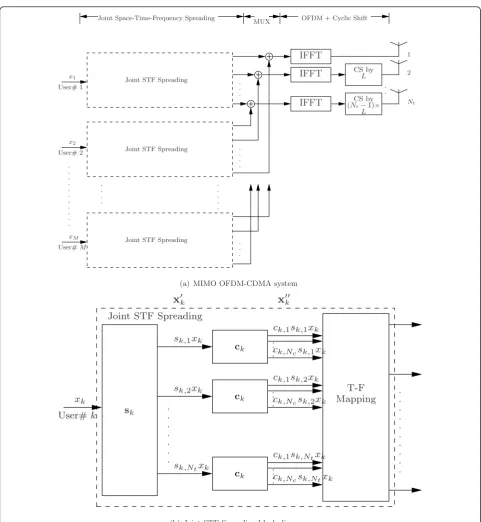
We will now focus on the downlink of a multi-access system that employs multiple antennas for MIMO OFDM-CDMA system. As shown in Figure 1a, the sys-tem consists of three different stages. The first stage employs the Joint Spatial, Time, and Frequency (STF) spreading which is illustrated in details in Figure 1b. The second stage is multi-user multiplexing (MUX) where all users are added together, and finally the third stage is IFFT to form the OFDM symbols. Then cyclic shifting is applied on each transmission stream. Specifi-cally as shown in Figure 1, the IFFT outputs associated with theith transmit antenna are cyclicly shifted to the right by (i- 1)LwhereLis a predefined value equal or greater to the channel length.
time-frequency mapping is applied to ensure signal independency when transmitted and hence maximizing achievable diversity [14] on the receiver side.
1) Spatial spreading
Lets denotexkas the transmitted symbol from userk. It will be first spread in space domain using orthogonal
code such as Walsh codes or columns of an FFT matrix of sizeNt, as they are efficient short orthogonal codes. Let’s denotex’k as the spread signal in space for userk
x’k = skxk
= [xk,1,xk,2, . . . , xk,Nt], k= 1, 2, . . . , M
(3)
L
IFFT
IFFT
IFFT
1
2
Nt
User# 1
x1
xM
User#M x2 User# 2
Joint STF Spreading
Joint STF Spreading
Joint STF Spreading
CS by OFDM + Cyclic Shift Joint Space-Time-Frequency Spreading MUX
(NCS byt−1)× L
(a) MIMO OFDM-CDMA system
ck
sk
ck
ck Mapping
T-F
sk,2xk
User#k
ck,1sk,Ntxk
ck,Ncsk,Ntxk ck,1sk,2xk
ck,Ncsk,2xk xk
ck,Ncsk,1xk
sk,Ntxk
x
k
x
k
Joint STF Spreading
sk,1xk
ck,1sk,1xk
(b) Joint STF Spreading block diagram
whereM is the number of users in the system, and
sk= [sk,1,sk,2, . . . , sk,Nt]
T is orthogonal code with size
Ntfor userk.
2) Time Spreading
Then each signal in x’k is spread in time domain with
ckorthogonal code for user kwith sizeNc. Let’s denote
x”k as spread signal in time,
x”k,i = ckxk,i,
= [xk,i,1,xk,i,2, . . . ,xk,i,Nc]
T, i= 1, 2, . . . ,N t
(4)
where xk,i,n is the transmitted signal for userkfrom antennaiat timen.
3) Time-Frequency mapping
The output of the space-time spreading is then mapped in time and frequency before IFFT. Figure 2 describes the Time-Frequency mapping method used in this system for user 1 at a particular transmit antenna. Without loss of generality all users will use the same mapping method at each antenna. Let’s consider the mapping for x”k,1 and assume xk,1,1 occupies OFDM symbol 1 at subcarrier
K1,xk,1,2occupies OFDM symbol 2 at subcarrierK2,..., andxk,1,Nc occupies OFDM symbolNcat subcarrierKNc.
The next transmitted symbol xk,1,1 occupies OFDM sym-bol 1 at subcarrier K1+ 1,xk,1,2occupies OFDM symbol 2 at subcarrierK2 + 1,..., and xk,1,N
c occupies OFDM
symbolNcat subcarrier KNc+ 1. Next symbols x
k,i are
spread in the same manner as symbols 1 and 2.
The assignment for each OFDM subcarrier is calcu-lated from the fact that the IFFT matrix for our OFDM
transmitted data for symbol 1 is
F= [fK1,fK2, . . . ,fKNc]
H with sizeNc × Nf, where FH ⊂ FFT matrix with size Nf. F matrix in this paper is a WIDE matrix Nc×Nf where the rows are picked from an FFT matrix and complex transposed (Hermitian). For this matrix to satisfy the orthogonality condition and to maintain independence, those rows needs to be picked as everyNf/Nc column, so then and ONLY then, each column and row are orthogonal. The max rank cannot
be more than Nc. The frequency spacing or jump intro-duced, made it possible to achieve the max rank, where each row and column is orthogonal within the rank. In order to achieve independent fading for each signal and hence maximizing frequency diversity, we need to have
FHF = I. FHF= I is only possible if FH is constructed from every Nf/Nc columns of the FFT matrix,
F= [f1,fNf
Nc,f2Nf
Nc, . . . ,f(Nc−1)Nf
Nc]
H
. Therefore, if K1= 1, thenK2=Nf/Nc,..., and KNc = (Nc−1)Nf
Nc.
3. Receiver
A. Received signal of SU-MIMO system
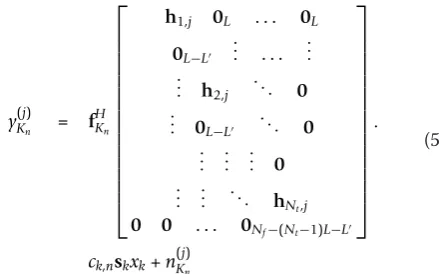
On the receiver side, let us consider the detection of symbolxk at receive antenna j. Let y(Kjn) be the received signal of theKn-th subcarrier at thej-th receive antenna. Note thatKnis theK-th subcarrier at timen(n= 1, 2,..., Nc).
y(Kjn) = fHKn
⎡ ⎢ ⎢ ⎢ ⎢ ⎢ ⎢ ⎢ ⎢ ⎢ ⎢ ⎢ ⎢ ⎢ ⎢ ⎣
h1,j 0L . . . 0L
0L−L ... . . . ...
..
. h2,j . .. 0
..
. 0L−L . .. 0
..
. ... ... 0
..
. ... . .. hNt,j
0 0 . . . 0Nf−(Nt−1)L−L
⎤ ⎥ ⎥ ⎥ ⎥ ⎥ ⎥ ⎥ ⎥ ⎥ ⎥ ⎥ ⎥ ⎥ ⎥ ⎦ .
ck,nskxk+n(Kjn)
(5)
Stacking y(Kj)n in one column, we have ⎡ ⎢ ⎢ ⎢ ⎢ ⎢ ⎢ ⎢ ⎣
y(Kj1)
.. .
y(Kjn)
.. .
y(Kj)Nc
⎤ ⎥ ⎥ ⎥ ⎥ ⎥ ⎥ ⎥ ⎦
y(j) = ⎡ ⎢ ⎢ ⎢ ⎢ ⎢ ⎢ ⎢ ⎣
fHK1ck,1
.. .
fHKtck,n
.. .
fHK
Ncck,Nc
⎤ ⎥ ⎥ ⎥ ⎥ ⎥ ⎥ ⎥ ⎦ Fc ⎡ ⎢ ⎢ ⎢ ⎢ ⎢ ⎢ ⎢ ⎢ ⎢ ⎣
h1,jsk,1
0L−L h2,jsk,2
0L−L
.. .
hNt,jsk,Nt
0Nf−(Nt−1)L−L
⎤ ⎥ ⎥ ⎥ ⎥ ⎥ ⎥ ⎥ ⎥ ⎥ ⎦ hs j
xk+nj
(6)
K2
K1 Nf
KNc
Symbol 1
Symbol 2
SymbolNc
Here, fKn stands for theKn-th column of the (Nf×Nf)
FFT matrix,Lis the cyclic shift on each antenna where L > L’ (L’is the channel length), and hi,jis the impulse response from the i-th transmit antenna to the j-th receive antenna. Here, cyclic shifting in time has trans-formed the effective channel response j-th receive antenna to hsj as shown in Equation (6) instead of the addition of all channel responses. This will maximize the number of degrees of freedom from 1 toNt.
In our scheme, we assumed that all users transmit on same time and frequency slots. As shown in Figure 1, we have the ability to achieve flexible scheduling in both time and frequency. This will contribute in more flexible system design for next-generation wireless systems as compared to other schemes.
B. Achievable Diversity in SU-MIMO
Let us assume thatx, andx’are two distinct transmitted symbols from user k, andy(j), y’(j)are the corresponding received signals at receive antenna j, respectively. To calculate diversity, we first calculate the expectation of the Euclidian distance between the two received signals E[||y’(j)-y(j)||2], wherey(j)is defined by Equation (6),
E[||y(j)||2] = E[||Fchsj||2|x|2]
= E[hsHj FHcFchsj|x|2]
= E[hsHj F˜chsj|x|2]
(7)
In Equation (7), F˜c is a toeplitz matrix (Nf×Nf) where
it is all zero matrix except for the r where
r=Nc
t=1ck,n 2
, and all non-zero values are spaced Nc entries apart, where
˜
Fc =
⎡ ⎢ ⎣
1 . . . 1 ..
. . .. ... 1 . . . 1
⎤ ⎥ ⎦⊗
⎡ ⎢ ⎣
r 0
. ..
0 r
⎤ ⎥ ⎦
= 1Nf
Nc⊗rINc
(8)
The rank of the F˜c matrix is found as,
rank(F˜c) =Nc (9)
Since the maximum achievable degrees of freedom for the transmitter is equal to NtL’, diversity can be found asd = min(Nc, NtL’) [15]. For this reason, in order to achieve maximum spatial diversity, we need to choose time spreading lengthNc≥NtL’.
C. Receiver Design
Now, let’s assume all the users send data simultaneously where each user is assigned different spatial spreading code sk and time spreading code ck generated from a
Walsh-Hadamard function.
yKn =
M
k=1
(HKnck,nsk)xk+nKn, 1≤Kn≤Nf (10)
wherekstands for user index and Knis theK-th sub-carrier at timen(n= 1, 2,...,Nc).
Stacking yKn in one column, we have
⎡ ⎢ ⎢ ⎢ ⎣
yK1 yK2 .. .
yK
Nc
⎤ ⎥ ⎥ ⎥ ⎦
y
= H˜s˜1x1+H˜s˜2x2+. . .+H˜˜sMxM+n
= Hˆ1 Hˆ2 . . . HˆM
G
x+n
(11)
where H˜ is the modified channel matrix for theNc subcarriers, Hˆkis the effective channel (NcNr × 1) for
user k, and s˜k=ck⊗sk is the combined spatial-time
spreading code, where ˜
H=diagHK1,HK2, . . . , HKNc
(12)
˜
sk=
⎡ ⎢ ⎢ ⎢ ⎣
ck,1sk ck,2sk
.. .
ck,Ncsk
⎤ ⎥ ⎥ ⎥
⎦ (13)
At the receiver, the despreading and combining proce-dure with the time-frequency spreading grid pattern corresponding to the transmitter can not be processed until all the symbols within one super-frame are received. Then by using a MMSE or ZF receiver, data symbols could be recovered for all users [16,17]
ˆ
x = (GHG + σ2I)−1GHy (MMSE) (14)
ˆ
x = (GHG)−1GHy (ZF) (15)
where xˆ=xˆ1,xˆ2, . . . , xMˆ
, and M is the number of users.
property of avoiding poor channel quality using space, time and frequency spreading. Without the loss of gen-erality, the signal from first user is regarded as the desired user and the signals from all other users as interfering signals. With coherent demodulation, the decision statistics of user 1 symbol is given as,
ˆ x1 = (Hˆ
H
1Hˆ1)−1Hˆ
H
1y
=
˜ sH1H˜
H˜
H˜s1
−1
˜ sH1H˜
H˜
H˜s1x1+H˜˜s2x2+. . .+H˜˜sMxM+n
(16)
Then, the desired signal, multiple access interference (MAI) and the noise areS,I,h, respectively.
S = x1 (17)
I = ˜sH1H˜HH˜s˜1 −1M
k=2
˜
sH1H˜HH˜s˜k
xk (18)
η = s˜H1H˜HH˜˜s1 −1
˜
sH1H˜Hn (19)
To compute signal-to-interference noise ratio (SINR), which is defined asΓ, we will assumeS, I,hare uncor-related,
H˜ =
E|S2| E[|η|2] +E[|I|2]
= E[S
2]
σ2 I + ση2
(20)
where,xk(MAI) are assumed to be mutually indepen-dent, therefore input symbols {xk}Mk=1 are assumed Gaus-sian with unit variance. The expectation is taken over the user symbolsxk,k= 1,...,Mand noisek.
Since the effective channel is denoted as Hˆn=H˜˜sk,
then ˆ
HHkHˆl=s˜HkH˜ H˜
H˜sl (21)
Desired signal average power is defined as,
E[S2] = 1 (22)
Multiple access interference (MAI) is defined as,
σ2
I = E
˜
sH1H˜HH˜s˜1 −2M
k=2
s˜H1H˜HH˜s˜k 2
= E
HˆH1Hˆ1
−2M
k=2 HˆH1Hˆk
2
(23)
where HˆH
1Hˆk is the projection of Hˆ1on Hˆk. Without
loss of generality, let’s assume in Equation (23) that ˆ
H1=
ˆ
HH1HˆkPe1, where P is any permutation matrix, ande1 is the 1-st column of theIidentity matrix,
σ2
I = E
HˆH1Hˆ1
−2M
k=2
HˆH1Hˆ1eH1(PHHˆk)
2
= E
HˆH1Hˆ1
−1M
k=2
eH1PHHˆk
2
=
1
M−1
M
k=2 zˆk
2 1
NtNc
NcNt
m=1 xˆm
2
(24)
where zkˆ 2 and ˆxm2 are chi-squared random vari-ables, as Equation (21) shows that Hˆk is gaussian
ran-dom variable ~CN(0, 1)
Noise average power is defined as,
σ2
η = E
˜
sH1H˜HH˜s˜1 −2
˜
sH1H˜HnnHH˜s˜1
= E
HˆH1Hˆ1
−2 ˜
sH1H˜HH˜s˜1 σ2
= E
HˆH1Hˆ1
−1
σ2
= σ2
1
NtNc
NcNt
m=1 xmˆ 2
(25)
Therefore, the probability of error can be simply given by
P(e) =Q(√) (26)
From Equations (22), (24), and (25), we can obtain SINR
= E[S
2]
σ2 I +ση2
= 1
1
M−1 M
k=2 zkˆ2
1
NtNc
N
cNt
m=1 xˆm
2
+ σ
2
1
NtNc
N
cNt
m=1 ˆxm
2
= ! 1
1Fa,b
"
+!σ2χ2"
(27)
MUI dominates channel noise, Equation (27) can be approximated asΓ=Fa,b
Now, by assuming all users are scheduled to transmit at similar symbol ratesRs at a time instance, we could calculate BER using Equation (26) by statistically aver-aging over the probability density function ofFa,b (see Appendix), i.e., by substituting Equation (27) in Equa-tion (26).
Pe =
#
p(Fa,b)Q(
Fa,b)dFa,b
≤ (P
σ2)b
aabb
β(b,a)
# ∞
0
ya−1
!
(Pσ2)b+ay"a+b
1 6e
−y+1
2e
−43y
dy
(28)
In Equation (28) y is SINR defined in Equation (27), P/s2 is the signal-to-noise ratio (SNR),a is equal to NtNc, and b=M- 1.
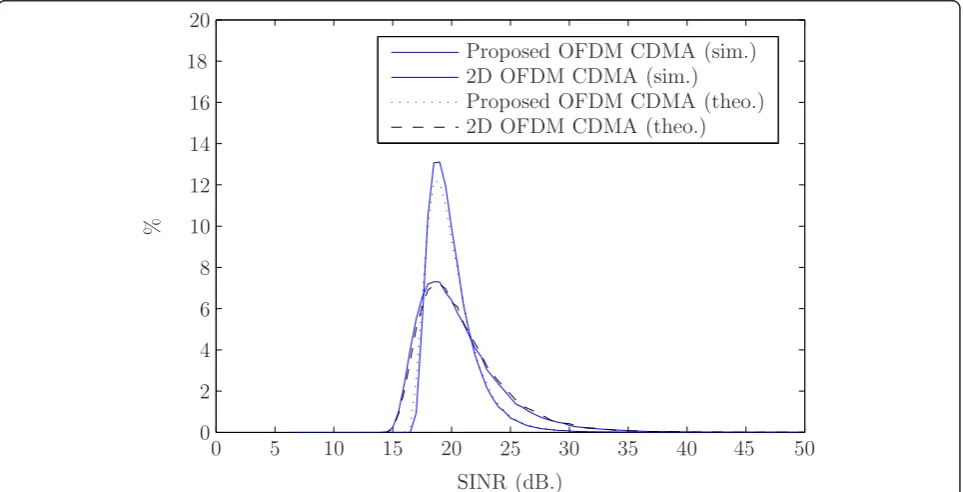
In Figure 3, we compare the SINR PDFs for our pro-posed scheme defined by Equation (27) and 2D OFDM-CDMA [6]. It is clear that the probability of SINR has higher values in our proposed OFDM-CDMA system compared to 2D OFDM-CDMA system, which means that the average SINR for our proposed system will be more likely to be higher than that of the 2D OFDM-CDMA system. This is confirmed by numerically evalu-atingP(SINR<20 dB) for our proposed system and 2D OFDM-CDMA system, which are 0.6479 and 0.5468 respectively. This improvement will lead to better multi-user diversity gains. In Figure 4, the PDF curves of the proposed scheme with various number of users are
provided. From Figures 3 and 4, it can be seen that the SINR PDF curve of the proposed scheme with 32 users is close to that of the 2D scheme with 16 users. This shows that the proposed scheme supports twice the number of users in a system with 4 transmit and 4 receive antennas. It is also interesting to note that the simulated results match well with our analytical results provided by Equation (27). Figure 4 shows that the aver-age SINR is 20 dB for all users, and the most probable SINR decreases as the number of users increases.
E. Complexity
The process of spreading each bit on space, time and frequency in a parallel manner was considered to be a complicated issue [20]. However, the proposed OFDM-CDMA has efficient mapping in bit allocation in space, time and frequency without degrading overall system performance, and therefore it is less complex. In other OFDM-CDMA systems, RAKE receiver is widely used to take advantage of the entire frequency spread of a particular bit, that adds to overall system hardware com-plexity. In our proposed open-loop MIMO OFDM-CDMA, RAKE receiver is not needed as each bit is spread in time and frequency, occupying different time and frequency slots, where each bit is spread to ensure frequency independence as shown in Figure 2. Also, other systems that use space-time-frequency (STF) cod-ing as in [16], has more complexity than our proposed system. Their spreading technique uses space-time block
SINR (dB.)
%
Proposed OFDM CDMA (sim.)
2D OFDM CDMA (sim.)
Proposed OFDM CDMA (theo.)
2D OFDM CDMA (theo.)
0
5
10
15
20
25
30
35
40
45
50
0
2
4
6
8
10
12
14
16
18
20
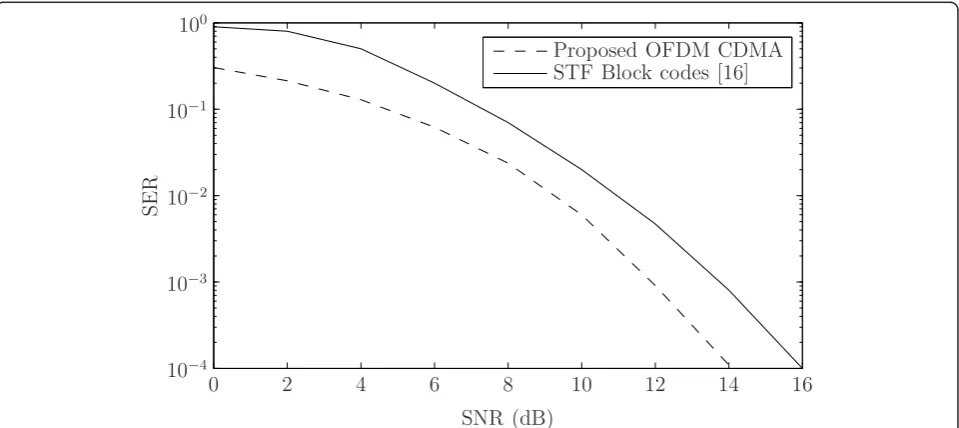
codes or space-time trellis codes and then uses subcar-rier selectors to map signals to different OFDM fre-quency subcarriers. Our proposed STF spreading method does not involve coding or precoding, just bit spreading to maintain signal orthogonality and maxi-mize diversity at receiver side. Figure 5 shows that our proposed system has better performance than [16], by improving both diversity and coding gains.
4. Simulation results
Computer simulations were carried out to investigate the performance gain of the proposed open-loop MIMO OFDM-CDMA system with joint space-frequency-time spreading. The channel is a multipath channel modelled as a finite tapped delay line withL= 4 Rayleigh fading paths. Walsh-Hadamard (WH) codes are utilized for both space and time spreading. Different codes are
SINR (dB.)
%
64 Users
32 Users
16 Users
8 Users
1 User
1 User
64 Users
0
5
10
15
20
25
30
35
40
45
50
0
5
10
15
20
25
30
35
40
45
50
Figure 4Probability density function for SINR forEs/s2= 20 dB for our proposed scheme with different number of users.
SNR (dB)
SER
Proposed OFDM CDMA
STF Block codes [16]
0
2
4
6
8
10
12
14
16
10
−410
−310
−210
−110
0assigned to different users. The OFDM super-frame contains 16 OFDM symbols, which is equal to the length of the time spreading codeNc = 16, where each OFDM symbol has 128 subcarriers. The channel estima-tion is assumed to be perfect, quadrature phase-shift keying (QPSK) constellation is used. We assume a MIMO channel withNt= 4 transmit antennas andNr= 1, 2, 4 receive antennas. It is assumed that the mean power of each interfering user is equal to the mean power of the desired signal. The maximum number of users allowed by the system isNc(min(Nt,Nr)).
Figure 6 shows the Bit error rate (BER) performance of OFDM-CDMA versus the averageEs/N0 with differ-ent number of active users with slow fading channel for 4 transmit and 4 receive antennas, where the solid lines stand for our proposed scheme, while the dotted line stands for the double-orthogonal coded (DOC)-STFS-CDMA scheme proposed in [9]. It is clear that our scheme has better resiliency to the frequency selectivity of the channel due to the inherent property of avoiding poor channel quality using the proposed space, time and frequency spreading.
Figure 7 shows the Block error rate (BLER) perfor-mance of OFDM-CDMA versus the averageEs/N0 with different number of active users with slow fading chan-nel for 4 transmit and 4 receive antennas, where the solid lines stand for our proposed scheme, while the dotted line stands for the 2D OFDM-CDMA. It is obvious that when we spread our signal on space, time,
and frequency, we had better performance as we were able to maintain maximum achievable spatial diversity on the receiver side.
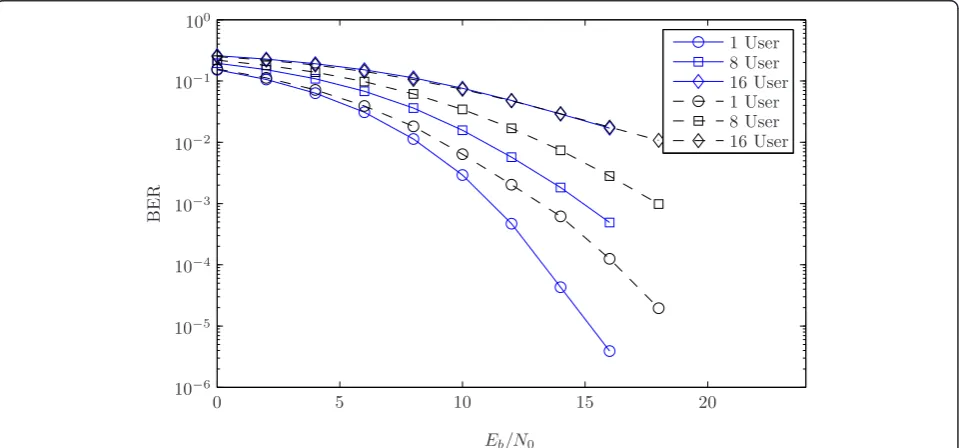
Figures 8 and 9 show the BER performance of OFDM-CDMA versus the average Eb/N0 for 1 and 2 receive antennas, respectively. In our simulations, we compare our proposed scheme with 2D OFDM-CDMA described in [6]. The maximum number of users allowed in Fig-ures 8 and 9 are 16, and 32 users, respectively. Simula-tion results show that our proposed system has better performance, but as the number of users increases to max, diversity advantages are decreased due to the fact of diversity/multiplexing trade-off. On the other hand, when we decrease the number of receive antennas to one, our proposed scheme is superior because we are able to maintain maximum possible spatial diversity on the receiver side, but the other scheme is not able to compensate when reducing the number of receive antennas to one. Comparing both figures, our scheme has greater gains when reducing receive antennas from 2 to 1, offering better diversity/multiplexing trade-off. Also, Figure 8 confirms that the results shown for SINR pdf in Figure 3 holds for 1 receive antenna, as BER curves for the 2D OFDM-CDMA with 4 users coincides with our proposed system but with 8 users. Therefore, our proposed scheme has twice the throughput with the same BER performance.
Figure 10 shows system user throughput. The pro-posed system is able to have higher number of users
E
b/N
0(dB)
BER
1 User
16 User
32 User
48 User
1 User
16 User
32 User
48 User
0
2
4
6
8
10
12
14
16
18
20
10
−710
−610
−510
−410
−310
−210
−110
0because we are able to fully exploit the spatial dimen-sion of the channel. This leads to lower BLER, and higher diversity gains, that will contribute to increased number of users without degrading the system perfor-mance as shown in the SINR pdf graphs in Figure 3. The system is able to maintain reliable communication with reasonable super-frame drops up to 32 users, as compared to 2D OFDM-CDMA. Also, we are able to
maintain double number of users with same BLER per-formance. At 32 users, the system is able to fully utilize the channel at SNR = 10 dB.
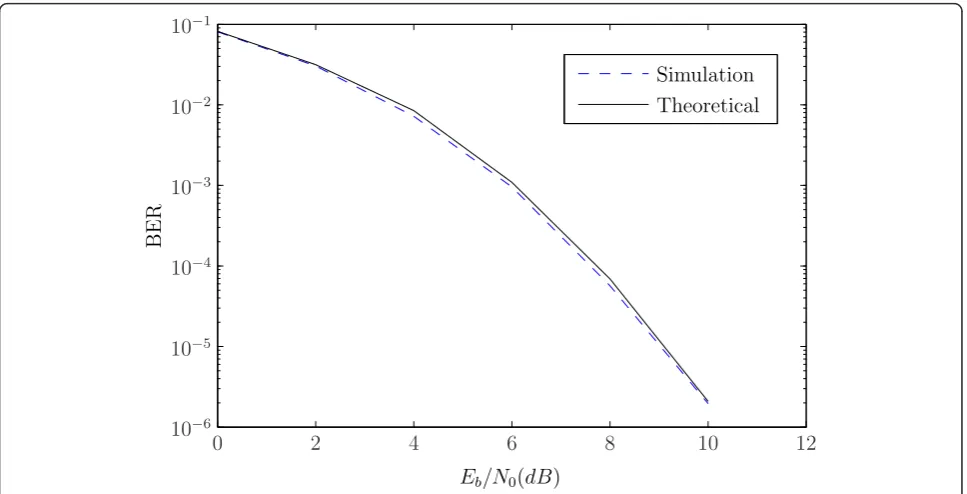
In Figure 11, we compare the upper-bound result in Equation (28) with simulation result. It is clear that the tight bound we proposed matches our simulated results perfectly.
SNR dB
FE
R
1 User
8 Users
16 Users
32 Users
64 Users
1 User
8 Users
16 Users
32 Users
64 Users
0
2
4
6
8
10
12
14
16
18
20
22
10
−610
−510
−410
−310
−210
−110
0Figure 7BLER comparison for OFDM-CDMA system with 4Tx, 4Rx with our proposed scheme (solid) and 2D OFDM-CDMA (dotted) in a slow fading frequency-selective environment.
Eb/N0
BER
1 User 8 User 16 User 1 User 8 User 16 User
0 5 10 15 20
10−6
10−5
10−4
10−3
10−2
10−1
100
5. Conclusion
In this paper, we have proposed an open-loop MIMO OFDM-CDMA scheme using space-time-frequency spreading (STFS), in the presence of frequency-selective Rayleigh-fading channel. The BER and BLER perfor-mance of the OFDM-CDMA system using STFS has been evaluated taking into consideration diversity/
multiplexing trade-off over frequency-selective Rayleigh-fading channels.
We showed that our proposed system gives the advan-tage of maintaining maximum achievable spatial diversity on the receiver side in the case of slow frequency-selective Rayleigh-fading channels. Also, by appropriately selecting the system parameters Nt, andNc, the OFDM-CDMA
Eb/N0
BER
1 User 12 User 16 User 32 User 1 User 12 User 16 User 32 User
0 2 4 6 8 10 12 14 16 18 20 22
10−6
10−5
10−4
10−3
10−2
10−1
100
Figure 9BER comparison for OFDM-CDMA system with 4Tx, 2Rx of the proposed scheme (solid) and 2D OFDM-CDMA (dotted) in a slow fading frequency-selective environment.
SNR dB
Num
b
er
of
Users
Proposed OFDM-CDMA
2D OFDM-CDMA
0
2
4
6
8
10
12
14
16
0
10
20
30
40
50
60
system using STFS is rendered capable of achieving higher number of users than other schemes. System throughput has increased as our proposed system was capable of achieving higher SINR than other schemes at similar SNRs. Higher diversity gains than other systems were shown, when number of receive antennas are reduced to one, as our system was able to maximize the number of degrees of freedom, by exploiting the spatial dimension of the channel. Our system showed great improvements, in system performance and throughput compared to other systems without sacrificing complexity.
Appendix
Upper bound forPe
In this section, we will show the numerical evaluation that led to Equation (28). WhenM is large enough, the interference component will be the dominant compo-nent, !M1−1" Mk=2zˆk
2
> σ2 and Equation (27) can be expressed as follows
SINR=y= P
σ2
(1x) (29)
wherexisfa,b-distribution witha=NtNcand b=M -1 degrees of freedom, the probability density functionfa, b(x) is defined as
fa,b(x) = aabb β(a,b)
xa−1
(b+ax)a+b (30)
Substituting Equation (30) into Equation (29), we obtain the probability density function for SINR as,
f(y) = $
(Pσ2)baabb β(b,a)
%
ya−1
!
(Pσ2)b+ay"a+b (31) As mentioned earlier, probability of error is defined as,
Pe= # ∞
0
f(y)Q(√y)dy (32)
In [21], it was shown that erfc(.) can be approximated to a tighter bound than Chernoff-Rubin bound,
Q(√y)≤ 1 6e
−y+1
2e
−43y (33)
By substituting Equations (31) and (33) into Equation (32), we obtain the probability of errorPe,
Pe≤ (Pσ2)b
aabb β(b,a)
#∞
0
ya−1
!
(Pσ2)b+ay"a+b
1 6e
−y+1 2e
−4 3y
dy (34)
Competing interests
The authors declare that they have no competing interests.
Received: 12 February 2011 Accepted: 23 December 2011 Published: 23 December 2011
E
b/N
0(
dB
)
BER
Simulation
Theoretical
0
2
4
6
8
10
12
10
−610
−510
−410
−310
−210
−1References
1. 3rd Generation Partnership Project; Technical Specification Group Radio Access Network; Physical layer–General description, 3GPP TS 25.201, (May 2008)
2. R Prasad, S Hara, An overview of multi-carrier CDMA. inProc IEEE 4th Int Symp Spread Spectrum Techniques and Applications, Mainz, 107–114 (September 1996)
3. S Kaiser, K Fazel, A flexible spread-spectrum multi-carrier multiple-access system for multi-media applications. inProc 1997 Int Symp Personal, Indoor and Mobile Radio Communications, Helsinki Finland, 100–104 (September 1997)
4. S Kaiser, OFDM code-division multiplexing in fading channels. IEEE Trans Commun.50, 1266–1273 (2002). doi:10.1109/TCOMM.2002.801460 5. PK Frenger, N Arne, B Svensson, Decision-directed coherent detection in
multicarrier systems on Rayleigh fading channel. IEEE Trans Veh Technol. 48, 490–498 (1999). doi:10.1109/25.752573
6. K Zheng, G Zeng, W Wang, Performance analysis for OFDM-CDMA with joint frequency-time spreading. IEEE Trans Broadcast.51, 144–148 (2005). doi:10.1109/TBC.2004.839609
7. CB Papadias, B Hochwald, TL Marzetta, A transmitter diversity scheme for wideband CDMA systems based on space-time spreading. IEEE J Sel Areas Commun.19, 48–60 (2001). doi:10.1109/49.909608
8. L-L Yang, L Hanzo, Performance of broadband multicarrier DS-CDMA using spacetime spreading-assisted transmit diversity. IEEE Trans Wirel Commun. 4, 885–894 (2005)
9. Z Luo, J Liu, M Zhao, M Yuanan Liu, J Gao, Double-orthogonal coded space-time-frequency spreading CDMA scheme. IEEE J Sel Areas Commun. 24(6), 1244–1255 (2006)
10. H Dahman, Y Shayan, X Wang, Space-time-frequency spreading and coding for multi-user MIMO-OFDM systems. inProc IEEE Int Conf Communications, Beijing, China, 4537–4542 (May 2008)
11. J Wang, X Wang, Optimal linear spacetime spreading for multiuser MIMO communications. IEEE J Sel Areas Commun.24(1), 113–120 (2006) 12. GG Raleigh, JM Cioffi, Spatio-temporal coding for wireless communication.
IEEE Trans Commun.46(3), 357–366 (1998). doi:10.1109/26.662641 13. H Bölcskei, AJ Paulraj, Space-frequency coded broadband OFDM systems. in
Proc IEEE Wireless Commun Network Conf, 1–6 (2000)
14. D Tse, P Viswanath, L Zheng, Diversity multiplexing tradeoff in multiple-access channels. IEEE Trans Inf Theory.50, 1859–1874 (2004). doi:10.1109/ TIT.2004.833347
15. DGH Bölcskei, AJ Paulraj, On the capacity of OFDM-based spatial multiplexing systems. IEEE Trans Commun.50(2), 225–234 (2002) 16. Z Liu, Y Xin, GB Giannakis, Space-time-frequency coded OFDM over
frequency-selective fading channels. IEEE Trans Signal Process.50(10), 2465–2476 (2002). doi:10.1109/TSP.2002.803332
17. D Tse, P Viswanath,Fundamentals of Wireless Communication(Cambridge University Press, New York, NY, 2005)
18. L Hanzo, L-L Yang, E-L Kuan, K Yen,Single- and Multi-Carrier DS-CDMA: Multi-User Detection, Space-Time Spreading, Synchronization, Standards and Networking(IEEE Press/Wiley, New York, 2003)
19. S Verdú,Multiuser Detection(Cambridge University Press, Cambridge, UK, 1998)
20. M Jankiraman,Space-Time Codes and MIMO Systems(Artech House, 2004) 21. M Chiani, D Dardan, Improved exponential bounds and approximation for
the Q-function with application to average error probability computation. inProc IEEE Global Telecommunications Conference (GLOBECOM’02), Taipei, Taiwan, 1399–1402 (November 2002)
doi:10.1186/1687-6180-2011-139
Cite this article as:Dahman and Shayan:Performance evaluation of
space-time-frequency spreading for MIMO OFDM-CDMA systems.
EURASIP Journal on Advances in Signal Processing20112011:139.
Submit your manuscript to a
journal and benefi t from:
7Convenient online submission 7Rigorous peer review
7Immediate publication on acceptance 7Open access: articles freely available online 7High visibility within the fi eld
7Retaining the copyright to your article
 ina slow fading frequency-selective environment.](https://thumb-us.123doks.com/thumbv2/123dok_us/1143997.1143534/9.595.57.539.459.702/figure-comparison-proposed-scheme-fading-frequency-selective-environment.webp)