Performance Analysis of MSVM Classifier based
Botanical Leaf Disease Detection System
Samiksha Devi1, Ritika2, Bhanu Gupta3 1, 2
Department of ECE, SSCET, IKGPTU,
3
Department of R&D, FCSC, Jammu Tawi
Abstract: Agriculture is the backbone of the nation as it provides food and job opportunity to the humankinds and directly contributes to the economic growth of the nation. In agriculture, plant disease identification is more important one. If the diseases can be prevented early that would be more to helpful to farmers to save the crops. This paper presents as system for identification of disease of the plant by using symptoms on leaves. There are several methods reported in the literature to identify the disease. Moreover, many researchers paid their attention in identification of plant leaf disease and some of them used image processing and machine learning techniques to perform the disease prediction. This work presents a review on identification of plant disease using image processing and recognition. Disease detection involves the steps like image acquisition, image pre-processing, image segmentation, feature extraction and classification. Image processing is a method to covert an image into digital form and performs some operation on it. Feature extraction start from an initial set of measured data and builds derived values (features) intended to be informative and non–redundant, facilitating the subsequent learning and generalization steps, and in some cases leading to better human interpretation. The system applies GLCM, LBP and MSVM for plant disease feature extraction using MATLAB.
Keywords: Botanical Leaf Disease, GLCM, LBP, MATLAB
I. INTRODUCTION
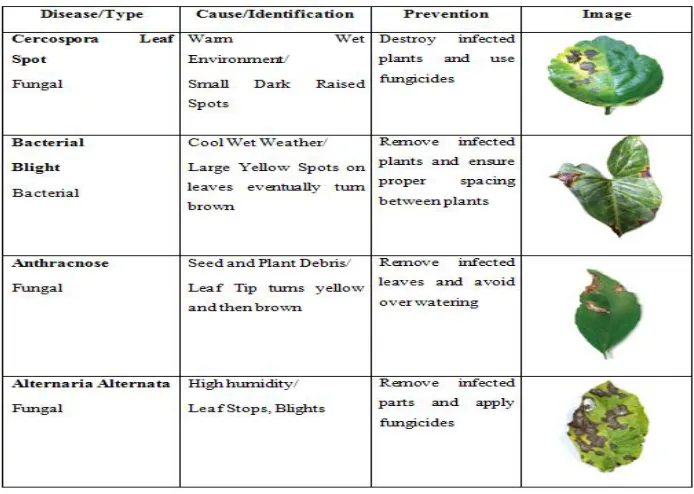
[image:1.612.138.485.473.720.2]In an India 10% to 30 % of the total vegetable crop is destroyed yearly by diseases. To achieve good accuracy and efficiency of disease detection and classification is challenging task. Traditional method of human eyes observation of plant is unpredictable for proper drug treatments. Using different techniques of Image processing leaf diseases will be identify and classify accurately. Continue observation of leaf is crucial and effective for exact disease identification. It goes toward proper drug treatment to crop which is helpful for farmer. The most common plant diseases are Alternaria Alternata, Anthracnose, Bacterial Blight, Cercospora Leaf Spot, Powdery Mildew, Downy Mildew and Rust. The examples of some plant leaf diseases are shown in figure below.
The main part of plant to examine the plant diseases is leaf. The detection and classification of leaf diseases accurately is the key to prevent the agriculture loss. Different plant leaf bears different diseases. The major categories of plant leaf diseases are based on viral, fungal and bacteria. The naked eye observation of experts is the main approach used in practice for detection and identification of plant diseases. But, this needs continuous monitoring of experts. When there is a large farm, this approach might be prohibitively expensive. Further, in some developing countries, farmers may have to go long distances to contact experts, this makes consulting experts too expensive and time consuming and moreover farmers are unaware of non-native diseases. Automatic detection of plant diseases is an important research topic as it may prove benefits in monitoring large field of crops, and thus automatically detect diseases from symptoms that appear on plant leaves. Thus automatic detection of plant disease with the help of image processing technique provides more accurate and robot guidance for disease management. Comparatively, visual identification is less accurate and time consuming [1].
In the proposed work the automatic disease detection of leaf is done using image processing techniques. The automated plant leaf disease detection system is performed by five main steps:
A. Botanical Leaf Image Acquisition.
B. Botanical Leaf Image Pre-processing
C. Botanical Leaf Image Segmentation
D. Botanical Leaf Feature Extraction
E. Botanical Leaf Disease Classification
II. LITERATUREREVIEW
Kamlesh Golhani et. al. review advanced Neural Network (NN) techniques available to process hyper-spectral data, with a special emphasis on plant disease detection. Firstly, we provide a review on NN mechanism, types, models, and classifiers that use different algorithms to process hyper-spectral data. Then we highlight the current state of imaging and non-imaging hyper-spectral data for early disease detection. The hybridization of NN hyper-spectral approach has emerged as a powerful tool for disease detection and diagnosis. Spectral Disease Index (SDI) is the ratio of different spectral bands of pure disease spectra. Subsequently, we introduce NN techniques for rapid development of SDI. We also highlight current challenges and future trends of hyper-spectral data [2]. Aarju Dixit et. al. in this paper is highlighting the outliers about the wheat leaf disease detection. India is the second larger producer of wheat after china. The wheat diseases are harmful to wheat production, but there are algorithms that can effectively identify common diseases of wheat leaves. The wheat diseases are generally viral, bacterial, fungal, insects, rust etc. There are many types of disease which are presents in wheat leaf. Recently, wheat disease detection through leaf image and data processing techniques are used extensively and in expensive system especially for assisting farmers in monitoring the big plantation area. Machine learning techniques are described for wheat leaf disease detection and its classification also. The key issues and challenges in wheat leaf disease detection are also highlighted. A vast collection of papers, books and standards are listed in the reference list, which gives useful information to the researchers and farmers in agriculture [3].
T. Thamil Azhagi et. al. The main objective of this paper is detection of diseases at the early stage. In this paper, we mainly focus on image processing techniques. This includes a series of steps from capturing the image of leaves to identifying the disease through the implementation in Raspberry PI. Raspberry PI is used to interface the camera and the display device along which the data is stored in the cloud. Here the main feature is that the crops in the field are continuously monitored and the data is streamed lively. The captured images are analyzed by various steps like acquisition, preprocessing, segmentation, clustering. This in turn reduces the need for labor in large farm lands. Also the cost and efforts are reduced whereas the productivity is increased [4].
Sridhathan C et. al. publish that economy of a country depends on agricultural productivity. Identification of the plant diseases is the key for preventing the losses in the productivity and improving the quality of the agricultural product. Traditional methods are reliable but require a human resource for visually observing the plant leaf patterns and diagnose the disease. Traditional method consumes more time, tedious work for labors. In big farm lands, early stage detection of plant disease by using automated techniques will reduce the loss in productivity. In this paper, we propose a vision based automatic detection of plant disease detection using Image Processing Technique. Image processing algorithms are developed to detect the plant infection or disease by identifying the color feature of the leaf area. K mean algorithm is used for color segmentation and GLCM is used for diseases classification. Vision based plant infection showed efficient result and promising performance [6].
Ramya. R et. al. In this paper, it mainly focus on detection and analysis of plant infections which is present in crop fields and storage of information about the agricultural land and details about farmers in database and retrieving the information using Cloud computing. There are lot of plant diseases which occur due to the environmental conditions, mineral specifications, and insects in the farm land and many other miscellaneous factors. The detected information from the crop field is identified by image processing and stored in the database. It also aims to provide the farmer with required inputs for the fields at correct period of intervals by continuous sensing of plants [7].
S. Ramesh et. al. in this work, explain a framework for early detection of diseases in rice crops from visual symptoms. We target rice crops owing to their extensive use in the Indian subcontinent. Existing literature lists several algorithms that can be used in detection, classification, and quantification of crop diseases by analysis images. However, the evaluation process is tedious, time consuming and more over very much subjective. Infrastructure for image acquisition, communication, and processing is lacking in rural areas owing to lesser technological penetration. In this work, we develop a user-friendly IoT reference architecture to provide on-field disease detection and prediction using cloud analytics [8].
III.METHODOLOGY
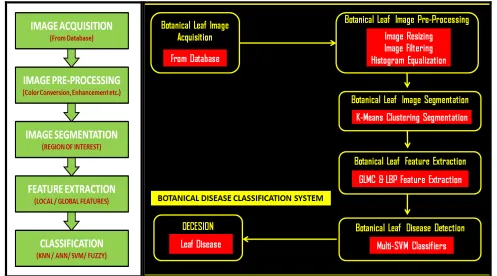
[image:3.612.63.560.442.718.2]The entire proposed framework is illustrated in Fig.2. The proposed automated botanical leaf disease detection system is performed by five main steps: image acquisition, image preprocessing, segmentation, feature extraction and classification. Diseased leaf images are captured and stored for experiment. Then images are applied for preprocessing for image enhancement. Captured leaf images are segmented using Means clustering method to form clusters. GLCM and LBP features are extracted after applying K-Means and MSVM has been used for classification and detection of plant leaves diseases namely Bacterial Blight, Cercospora Leaf Spot, Powdery Mildew and Rust.
The proposed work aims towards application of image processing techniques for detection of botanical leaf diseases. The proposed methodology that applied in this work follows the following steps:
A. Botanical Leaf Image Acquisition from available database.
B. Botanical Leaf Pre-processing: Resizing, Filtering and Histogram Equalization.
C. Botanical Leaf Segmentation: Leaf Segmentation into 3 regions using K-Means Clustering.
D. Botanical Leaf Feature extraction: Features extracted using GLCM and LBP methods
E. Botanical Leaf Disease Classification: Sample images were tested and classified by MSVM classifier for disease type and percentage of disease.
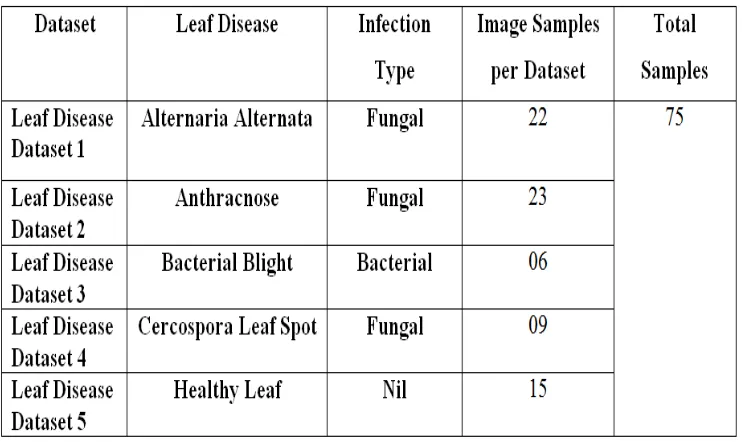
[image:4.612.127.498.499.720.2]Preprocessing step is to improve image data by removing background, noise and also suppressing undesired distortions. It enhances image features for processing and analysis. The images stored in RGB format are resized to standard size. These resized RGB images are then converted to HSV format. The median filter is used for image smoothing, removal of noises and highlighting some information. Image enhancement is carried out for increasing the contrast. The histogram equalization which distributes the intensities of the images is applied on the image to enhance the plant disease images. Image segmentation is applied to simplify the illustration of image with segments so that it can be easily analyzed. Image segmentation is performed to segment the disease affected and unaffected portions of the leaf. K-Means clustering method is used for partitioning of images into clusters in which at least one part of cluster contain image with major area of diseased part. The k-Means clustering algorithm is applied to classify the objects into K number of classes according to set of features. Grey Level Co-occurrence Matrices is a statistical method. It is an old and used feature extraction method for texture classification. It has been an important feature extraction method in the domain of texture classification that computes the relationship between pixel pairs in the image. The textural features can be calculated from the generated GLCMs, e.g. contrast, correlation, energy, entropy and homogeneity. Extract the disease symptoms by calculating the GLCM texture feature values of Skewness, Standard Deviation, Homogeneity, Contrast, Smoothness, Correlation, Kurtosis, Energy, Entropy, Mean, Variance, RMS, and IDM. Local Binary Pattern (LBP) is also a type of texture feature used for classification in computer vision. LBP is the case of the Texture Spectrum model. A local binary pattern is called uniform if the binary pattern contains at most two 0-1 or 1-0 transitions. This gives the feature vector for the window. With the help of texture features, plant diseases are classified into different types. After extracting color and texture features, the classification is performed by using Multiclass Support Vector Machine (MSVM). The training and validation processes are among the important steps in developing an accurate process model using MSVM. The dataset for training and validation processes consists of two parts: the training feature set which are used to train the MSVM model and the testing features sets are used to verify the accuracy of the trained SVM model. Finally disease type with accuracy value is analyzed and percentage of disease affected region is evaluated by the ratio of disease data and leaf data. The details of Botanical Leaf Disease Dataset used for testing the application are shown in figure below.
IV.RESULTS
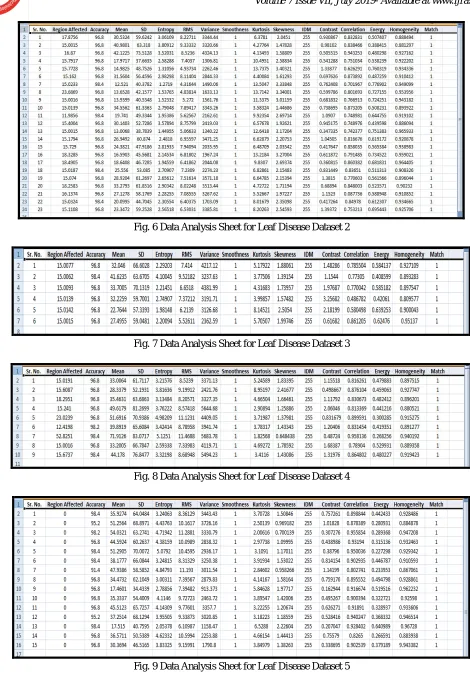
[image:5.612.76.542.126.428.2]The snapshot of Application Graphical User Interface for Botanical Leaf Disease System which was developed using MATLAB GUIDE Tool is shown in figure below. It consists of 07 buttons which have been assigned different functions to be performed by the application. The display for images and results are provisioned in the same window in this GUI.
Fig. 4 Application Graphical User Interface for Botanical Leaf Disease System
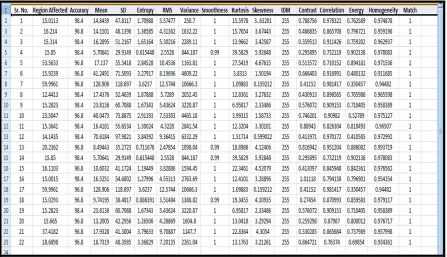
The Analysis sheet snapshots for different Datasets are shown as under.
[image:5.612.89.536.467.724.2]Fig. 6 Data Analysis Sheet for Leaf Disease Dataset 2
Fig. 7 Data Analysis Sheet for Leaf Disease Dataset 3
Fig. 8 Data Analysis Sheet for Leaf Disease Dataset 4
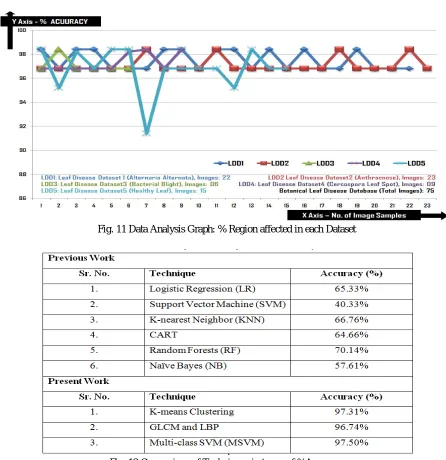
The graphical comparative parameter analysis for different Leaf Disease Datasets is shown as under.
Fig. 10 Data Analysis Graph: % Region affected in each Dataset
[image:7.612.85.531.261.721.2]Fig. 11 Data Analysis Graph: % Region affected in each Dataset
Fig. 13 Analysis Graph: Comparison of Techniques in terms of %Accuracy (Previous Work versus Present Work)
V. CONCLUSIONS
The classification of diseased plant leaves performance of various classification techniques which have been analyzed for the 75 input leaf images. The performance evaluated for the classification techniques which have been used in this paper from the confusion matrix of their respective classifier. In SVM classification, 22 images are of Alternaria Alternata disease are correctly classified. The correct classification rate for Alternaria Alternata disease is 100%. For Anthracnose disease, 23 samples are correctly classified. For Bacterial Blight disease, 06 samples are correctly classified. The correct classification for Bacterial Blight disease is 100%. For Cercospora Leaf Spot disease, 09 samples are correctly classified. The correct classification for Cercospora Leaf Spot disease is 100%. For Healthy Leaf, all 15 samples are correctly classified. So the correct classification for Healthy Leaf is 100%. In case of SVM, the best accuracy is obtained under cubic kernel. From the experimental result it can be observed that best accuracy is achieved for SVM classifier. For all classifiers 10-folds cross validation is considered. From the above results, the proposed system is efficient enough for detection and classification of botanical leaf diseases.
REFERENCES
[1] K. Mohanapriya, M. Balasubramani, “A Study on Identification of Unhealthy Plant Leaves using Image Processing with PCA, LDA Techniques”, Indo-Iranian Journal of Scientific Research (IIJSR) ISSN: 2581-4362,Volume 2, Issue 4, pp. 37-42, 2018.
[2] Gaganpreet Kaur, Sarvjeet Kaur, Amandeep Kaur, “Plant Disease Detection: a Review of Current Trends”, International Journal of Engineering & Technology, 7, (2018), pp. 874-881.
[3] Yin Min Oo, Nay Chi Htun, “Plant Leaf Disease Detection and Classification using Image Processing”, International Journal of Research and Engineering ISSN: 2348-7860 (O), 2348-7852 (P), Vol. 5, No. 9, September-October 2018, pp. 516-523.
[4] Kamlesh Golhani, Siva K. Balasundram, Ganesan Vadamalai, Biswajeet Pradhan, “A review of neural networks in plant disease detection using hyper-spectral data”, Information Processing in Agriculture ISSN 2214-3173, Volume 5, Issue 3, pp. 354-371, 2018.
[5] Aarju Dixit, Sumit Nema, “Wheat Leaf Disease Detection Using Machine Learning Method- A Review”, International Journal of Computer Science and Mobile Computing ISSN 2320–088X, Vol.7 Issue.5, pp. 124-129, May- 2018.
[6] T. Thamil Azhagi, K. Swetha, M. Shravani, A.T. Madhavi, “Plant Pathology Detection and Control using Raspberry Pi”, International Journal of Engineering Sciences & Research Technology (IJESRT) ISSN: 2277-9655, pp. 519-525, 2018.
[7] Vinaya Mahajan, N.R. Dhumale, “Leaf Disease Detection Using Fuzzy Logic”, International Journal of Innovative Research in Science, Engineering and TechnologyISSN (Online): 2319-8753, Vol. 7, Issue 6, pp. 6801-6807, June 2018.