warwick.ac.uk/lib-publications
Original citation:Dombrovsky, Leonid A., Dembele, Siaka and Wen, Jennifer X.. (2016) Shielding of fire
radiation with the use of multi-layered water mist curtains : preliminary
estimates. Computational Thermal Sciences : An International Journal, 8 (4). pp. 371-380.
Permanent WRAP URL:
http://wrap.warwick.ac.uk/84536
Copyright and reuse:
The Warwick Research Archive Portal (WRAP) makes this work by researchers of the University of Warwick available open access under the following conditions. Copyright © and all moral rights to the version of the paper presented here belong to the individual author(s) and/or other copyright owners. To the extent reasonable and practicable the material made available in WRAP has been checked for eligibility before being made available.
Copies of full items can be used for personal research or study, educational, or not-for-profit purposes without prior permission or charge. Provided that the authors, title and full
bibliographic details are credited, a hyperlink and/or URL is given for the original metadata page and the content is not changed in any way.
Publisher’s statement:
Published version :
http://www.dl.begellhouse.com/journals/648192910890cd0e,1e6659ad3a62cac6,38f69f0e2 e9039e0.html
A note on versions:
The version presented here may differ from the published version or, version of record, if you wish to cite this item you are advised to consult the publisher’s version. Please see the ‘permanent WRAP URL’ above for details on accessing the published version and note that access may require a subscription.
SHIELDING OF FIRE RADIATION WITH THE USE
OF MULTI-LAYERED WATER MIST CURTAINS: PRELIMINARY ESTIMATES
Leonid A. Dombrovsky1,2,§, Siaka Dembele3, and Jennifer X. Wen4
1Joint Institute for High Temperatures, Krasnokazarmennaya Str. 17A, Moscow 111116, Russia 2Tyumen State University, Semakov 10, Tyumen, 625003, Russia
3Fire, Explosion and Fluid Dynamics Research Group,
School of Mechanical and Automotive Engineering, Kingston University, London SW15 3DW, UK 4School of Engineering, University of Warwick, Coventry CV4 7AL, UK
§
Correspondence author. Email: [email protected]
ABSTRACT An approximate solution for the complete problem of attenuation of fire radiation by
water mist is presented. This solution is based on simplified approaches for the spectral radiative
properties of water droplets, the radiative transfer in the absorbing and scattering mist, and transient
heat transfer taking into account partial evaporation of water mist. An analysis of the example
problem makes it possible to recommend a decrease in the size of supplied water droplets with the
distance from the irradiated surface of the mist layer. This can be achieved with the use of
multi-layered mist curtain. The advantage of this engineering solution is also confirmed by numerical
calculations.
NOMENCLATURE
a droplet radius (µm) Greek symbols
d thickness of the mist layer (m)
absorption coefficient (m-1)
D radiation diffusion coefficient (m) extinction coefficient (m-1)
c heat capacity (J kg-1K-1) , coefficients in Eq. (1a) ( - )
C coefficient in Eq. (1a) ( - ) index of absorption ( - )
v
f volume fraction of droplets ( - ) density (kg m-3)
F droplet size distribution (µm-1) wavelength (μm)
H height of the mist layer (m) scattering coefficient (m-1)
I spectral radiation intensity (W m-2 µm-1) Subscripts and superscripts g spectral irradiance (W m-2 µm-1) a absorption
m complex index of refraction ( - ) b blackbody
n index of refraction ( - ) g gas
q spectral radiative flux (Wm-2µm-1) rad radiative
Q efficiency factor ( - ) s scattering, saturation
T temperature (K) t total (integral)
x diffraction parameter ( - ) tr transport
* The present paper is a revised version of the conference paper presented at 8th International Symposium on Radiative Transfer (June 6–9, Cappadocia, Turkey, 2016).
INTRODUCTION
The radiation shielding applications using water mist curtains have received considerable attention
of researchers working in the field of radiative and combined heat transfer. An overview of the
earlier radiative transfer studies can be found in review paper by Sacadura (2005). Obviously, the
oversimplified Beer–Lambert law used in (Ravigururajan and Beltran, 1989) is inapplicable for the
transmittance calculations in the problem under consideration. Therefore, the two-flux model was
employed in more recent papers (Copalle et al, 1993; Dembele et al, 2000; Buchlin, 2005; Tseng
and Viskanta, 2007) for the transmittance calculations. These studies show that smaller droplets in
high concentration provide better attenuation of the spray at the same volume fraction of water.
However, the important phenomena such as mass transfer and droplets evaporation were not
considered in these papers.
More detailed description of radiative transfer based on the discrete ordinates method, finite volume
method and even Monte Carlo simulation were also used in computational models of water mists
(Dembele et al, 1997; Berour et al, 2004; Collin et al, 2005, 2007, 2008, 2010; Boulet et al, 2006;
Hostika and McGrattan, 2006). Some of these studies have coupled the radiation, heat, mass and
momentum transfer in sprays using the combined Eulerian–Lagrangian approach for both dynamic
and thermal non-equilibrium of droplets and ambient gas. The current literature clearly shows the
advances in modelling and improving the understanding of water spray/mist curtain in fire radiation
mitigation. However, the complexity of these models is a serious obstacle to the systematic analysis
of various engineering solutions and the resulting practical recommendations. There is a need
nowadays to develop engineering models for water mist curtain, which retains the physics of the
problem and at the same time offers acceptable computing cost. The present study aims to achieve
such a goal.
The objective of the present paper is two-fold: (1) to suggest a simplified but complete model for
the combined heat transfer in a semi-transparent layer of water droplets used as a shield for
radiation of fires and (2) to continue computational study of a recent work by the authors
(Dombrovsky et al, 2016a) and outline some preliminary recommendations on possible use of
multi-layered water mist curtains in engineering solutions for fire protection. The methodology of
the presented study is based on a combination of a set of 1-D solutions for the radiative transfer
problem and a simplified heat transfer model for heating and evaporation of water droplets. The
water droplets with the distance from the irradiated surface of the mist layer. The quality of the
recommended multi-layered mist layer is estimated using a series of numerical calculations.
SPECTRAL PROPERTIES OF WATER DROPLETS
Both absorption and scattering of radiation by spherical water droplets can be calculated using the
Mie theory (Bohren and Huffman, 1983; Hergert and Wriedt, 2012). Following (Dombrovsky et al,
2016a), only two dimensionless optical properties of particles are used: the efficiency factor of
absorption, Qa, and the transport efficiency factor of scattering, Qstr. The values of Qa and Qstr
depend on both the complex index of refraction mni and the diffraction (size) parameter
a
x2 , where a is the droplet radius and is the radiation wavelength. Note that spectral
indices of refraction and absorption, n and , of pure water are well known (Hale and Querry,
1973). The Mie calculations are time-consuming especially for large droplets with x1.
Therefore, according to (Dombrovsky et al, 2016a), the following analytical approximations
suggested by Dombrovsky (2002) are used (see also monograph (Dombrovsky and Baillis, 2010):
n
x
n
Q 1 exp 4
1 4
2
a
5 when 5 5 when 5 trs
С
Q (1a)
1
exp 15
5.
1
nn
С 2x
n1
1.4exp
80
(1b)These relations give sufficiently accurate results in the spectral range of a weak absorption
(Dombrovsky et al, 2016a). An increasing error of Eq. (1a) for Qstr at the absorption band of water
(3µm) is not important because tr a
s Q
Q in this spectral range.
The real mists contain water droplets of different sizes in every small volume of the mist. Therefore,
the following relations for the spectral absorption coefficient and transport scattering coefficient of
the mist (hereafter the subscript is omitted for brevity) are used:
0 2 tr s a 30 v tr 0.75 ,, Q Q a F a da
a f
(2)
where fv is the volume fraction of water droplets, F
a is the size distribution function, and
0 0ij a F a da a F a da
a i j (3)
In the case of i j1, the values of aij are the average radii of droplets. The integration according
approximation when all the particles are assumed to have the same Sauter radius, a32, is often
applicable (Godoy and Des Jardin, 2007; Dombrovsky and Baillis, 2010):
32 a v
75 .
0 f Q a
32
tr s v tr 0.75f Q a
(4)
It should be noted that the above consideration is based on the widely used hypothesis of
independ-ent scattering (Mishchenko, 2014). It means that each droplet is assumed to absorb and scatter the
radiation in exactly the same manner as if other droplets did not exist. In addition, there is no
systematic phase relation between partial waves scattered by individual droplets during the
observation time interval, so that the intensities of the partial waves can be added without regard to
phase. In other words, each particle is in the far-field zones of all other particles, and scattering by
individual particles is incoherent.
RADIATIVE TRANSFER MODEL
To choose relatively simple but physically sound radiative transfer model, consider the main
characteristics of the real problem. First of all, the optical thickness of the mist layer should not be
too small for a significant attenuation of the incident flame radiation. Therefore, the problem under
consideration is characterized by multiple scattering at least in the range of water semi-transparency
where the scattering cannot be neglected. In the case of multiple scattering, the details of scattering
phase function are not important and one can use the transport approximation (Dombrovsky, 1996;
Dombrovsky and Baillis, 2010; Dombrovsky and Lipiński, 2010; Dombrovsky, 2012).
It would be also good to use a set of local 1-D problems instead of much more complicated
multi-dimensional radiative transfer problem. The use of 1-D solutions is not only the obvious way to
simplify the mathematics. It is important that 1-D problems can be solved with sufficient accuracy
using simple differential approximation without any additional computing overheads. Note that a
similar approach based on a set of 1-D solutions in the case of relatively small 2-D effects has been
recently used in (Dombrovsky et al, 2015, 2016b).
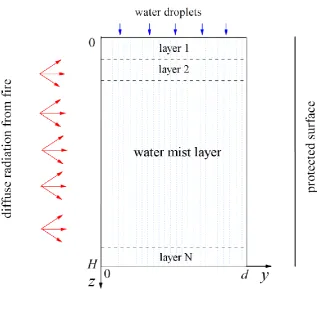
The schematic presentation of the problem in Fig. 1 makes clear some other assumptions of the
computational model: (1) The mist of water droplets is generated by a set of nozzles at the top of
the mist layer; (2) The flat mist layer of constant thickness is considered in the model; (3) One
surface of the mist layer is diffusely irradiated by the flame which is also flat but a variation of
radiative flux with the height is included in the model. We assume also that a protected wall is
transfer model is used for several horizontal layers of the mist curtain. It is assumed that there is no
radiative transfer between the neighboring layers. As a result, the radiation model is z-direction is
similar to the Large-Cell Model suggested in (Dombrovsky, 2007) and employed in papers
(Dombrovsky, 2009; Dombrovsky et al, 2009).
The polarization effects due to scattering of radiation by water droplets are negligible, and one can
use the scalar radiative transfer theory. With the use of transport approximation, the 1-D radiative
transfer equation (RTE) across the mist layer can be written as follows (Dombrovsky and Baillis,
2010; Howell et al, 2010; Modest, 2013):
1 1 tr tr ,2
I I y d
y I
cos 0yd (5)
where I
y, is the spectral radiation intensity at point y in direction (after the integration overthe azimuth angles), tr tr is the transport extinction coefficient. The boundary conditions at
two surfaces of the mist layer are written as follows:
0, 2 fIb
TfI I
d,
0 0 (6)where Ib is the Planck function. The above boundary condition at the irradiated surface of the mist
denotes that we use the simplest assumption of an optically gray fire radiation. In other words, the
external spectral radiative flux is assumed to be directly proportional to the blackbody radiation at
temperature Tf. The coefficient f is the conventional hemispherical emissivity of the flame. It
means that integral radiative flux from unit surface area of the flame is expressed as follows:
4f 0 f 0 f b f
f I T d T
q
(7)
where 0 is the Stefan–Boltzmann constant. This approach is often used in engineering calculations
of fire radiation (de Ris et al, 2000). It was shown in recent paper by Parent et al (2016) that
assumption of optically gray flame radiation may lead to significant computational errors and the
real emission spectrum should be taken into account. The physical explanation of this effect is the
reabsorption of thermal radiation emitted by water vapor at the absorption band in a part of the mist
layer containing significant volume fraction of steam. The latter can be done in the frame of the
present approach, but this effect is not considered in the present paper.
The diffuse irradiation of the mist makes the problem much simpler than the problem of shielding
a separate consideration of directed and diffuse radiation and the two-flux method can be employed
immediately (not only to the diffuse component of the radiation field):
0 , 0 , 2, f b f
y J y J T I y
I (8)
After integration of the RTE over two hemispheres, one can obtain the following boundary-value
problem for the dimensionless spectral irradiance g
y J
y J
y (Dombrovsky and Baillis,2010):
0 Dg g D1
4tr
(9a)0
y , Dg
g2
2 yd, Dgg 2 (9b)where D1
4tr
is the spectral radiation diffusion coefficient. The dimensionless spectralradiative flux from the shadow side of the mist layer is
d
2 fIb
Tf
g
d 2q
q (10)
The normalized profile of integral (over the spectrum) radiation power absorbed in the mist and the
integral transmitted radiative flux are determined as follows:
0 d y w yW w
y y g y
0 f b f
t 2 qI T d
q (11)
The radiative transfer calculations of (Dombrovsky et al, 2016a) showed that the mist containing
relatively small droplets looks more promising because of greater attenuation of the flame radiation
but the volumetric absorption of the radiation near the irradiated surface of the mist and small
velocities of the falling droplets will lead to high rate of the mist evaporation. In the opposite case
of very large droplets, the radiation is not practically reflected from the mist because of low
transport scattering and a considerable attenuation of the fire radiation can be reached only in the
case of a geometrically thick mist layer with high flow rate of water. Of course, the latter variant is
also not the optimal one. Most likely, the droplets of an average size may be a good choice.
One should recall that thermal conditions near the irradiated surface of the mist and the conditions
at the opposite shadow side of the mist are quite different. This makes interesting the use of more
sophisticated engineering solution with a variable size of supplied water droplets across the mist
layer. It is natural to have relatively large droplets at the irradiated side and much smaller droplets at
TRANSIENT HEAT TRANSFER MODEL
Strictly speaking, the heat transfer model for water mist exposed by thermal radiation from fire
should be based on CFD modeling of the flow field and convective heat transfer in combination
with radiative transfer modeling. The general problem is too complicated especially because of
possible dynamic and thermal non-equilibrium of evaporating water droplets. On the other hand, the
practical sense of detailed modeling is not obvious at the moment because of great uncertainty in
many parameters of particular processes. Therefore, a simplified problem statement is considered
without some details which can be ignored at this stage of the research.
First of all, it is assumed that the shape of the main stream region can be presented as a
plane-parallel layer (see Fig. 1) and the effects of viscous interaction with ambient air can be ignored.
Following the above principal suggestion and preliminary computational results of recent paper
(Dombrovsky et al, 2016a) for the two-layers mist, we consider a multi-layered mist with droplet
size decreasing from the flame side. For simplicity, the variation of size of water droplets is
assumed to be linear. Some special features of the mist flow in the entrance region and also in the
vicinity of the ground surface are not considered. This is a natural assumption because the region of
the mist formation may be positioned at a greater height that the fire and the part of fire
character-ized by a significant thermal radiation is usually observed at some distance from the ground. In
other words, we consider a middle part of the long mist layer. The following modes of heat transfer
are included in the computational model: the heating of water droplets by external radiation from
fire, partial evaporation of these droplets, and the downward flow of the mist. It is assumed that
water droplets are isothermal and their temperature is the same as that of ambient gas. It means that
radiation power is spent to heat both droplets and gas and also to evaporate the droplets. The
simplest equilibrium evaporation model is considered and the evaporation at temperatures less than
the saturation temperature at normal atmospheric conditions, Ts 373K, is neglected. Possible
overheating of water droplets is also not considered in the model. Strictly speaking, the assumption
of negligible evaporation rate at TTs is acceptable only in the case of 100% relative humidity of
ambient air. The latter value is expected to be sufficiently high at every cross section of the
quasi-steady water mist layer. Therefore, the simplified evaporation model is not expected to be critical
for the reliability of the computational results. The recent paper by Talbot et al (2016) can be
recommended to study the transient evaporation process of a spherical water droplet in more detail.
The nonuniform volumetric heating of large water droplets and more accurate analysis of droplet
some comprehensive models can be found in the literature (Dombrovsky and Sazhin, 2004;
Dombrovsky, 2004; Sazhin, 2006; Tseng and Viskanta, 2006; Miliauskas and Sabanas, 2006;
Brewster, 2015). The evaporation is treated as the only effect resulting in a significant change of the
droplet size. In other words, possible effects of agglomeration or fragmentation of droplets are also
not considered.
In the case of negligible turbulent heat transfer across the mist layer, the approximate mathematical
formulation of a heat transfer problem for every horizontal layer is as follows:
W
yH y T y T y u
с j 1 j rad,j
j
T1
y T0 j1,...,N1 (12a)where
y u
u u
y du 1 1 2
с j с g fv,j
y c w (12b)Equation (11a) can be considered as a result of the use of an explicit finite-difference scheme for
the obvious differential equation. In the case of Tj1
y Ts, the value of Tj1 is the real temperatureand Tj1
y Tj1
y . When the formal calculation gives Tj1
y Ts, it is assumed that Tj1
y Ts.As to the current volume fraction of water droplets, it can be estimated using the following relation:
j v v T T T T y u H L y W y f y f 1 j s 1 j j rad, g j , 1 j, ( ) 1 (13)
It was assumed that a variation of volumetric heat capacity of gas mixture due to evaporation of
water is insignificant, the local volume fraction of water droplets is small ( fv,j 1), and the initial
variation of the average radius of droplets across the mist layer can is described by the following
linear function:
y a
a a
y da32 32(1) 32(1) 32(2) (14)
SOLUTION TO THE EXAMPLE PROBLEM
The following values of input parameters were used: H 10m, d1m, T0 300K, Tf 1500K,
9 . 0
f
, w 103kg m-3, g 1kg m-3, 4 1 , v 10
f , cw 4.18kJ kg-1 K-1, cg 1kJ kg-1 K-1,
26 . 2
L MJ kg-1. Note that the radiative flux from the flame is equal to 4 258
f 0 f inc
t, T
q kW m
-2
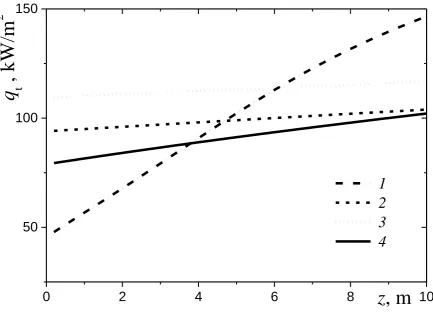
One can see in Fig. 2 that sufficient protection with the use of a uniform mist layer (curve 2) is
possible only in the case of relatively large droplets with radius about 100 μm and great water
supply rate, whereas the same effect can be reached using the multi-layered mist curtain at much
smaller flow rate values (curves 3 and 4, see the parameters for these curves in the figure caption).
The drawback of the mist layer containing relatively small droplets with radius about 30 μm is
obvious from curve 1 in Fig. 3. These small droplets are evaporated too fast and cannot be used for
radiation shielding in the case of a significant height of the flame. The latter is additionally
confirmed by relatively high values of radiative flux at z7m for curve 1 in Fig. 2.
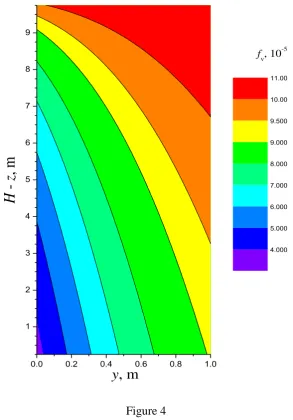
A general view of spatial variation for the volume fraction of water droplets is presented in Fig. 4.
The decrease in the value of fv in the lower part of the mist layer is explained by evaporation of
water droplets. As one can expect, this effect is especially strong at the irradiated side of the mist
layer.
One can see that the results obtained appear to be realistic and physically sound. At the same time,
it should be recalled that the model developed is based on several assumptions, and some of them
may lead to considerable quantitative errors. It would be good to obtain the experimental results for
the multi-layered mist curtains and to suggest some corrections to the approximate computational
model.
CONCLUSION
A simplified theoretical model for attenuation of fire radiation by water mist has been developed.
This spectral model is based on the computed absorption and scattering characteristics of water
droplets, the local 1-D solutions for radiative heat transfer through the mist layer, and transient heat
transfer model taking into account heating and evaporation of the droplets. The example problem
for the fire radiation protection by water mist showed that the suggested decrease in size of supplied
water droplets with the distance from the hot side of the mist layer leads to a significant economy in
the required water supply rate.
The model developed is based on several assumptions, and some of them may lead to considerable
recommended to examine the predicted advantages of this engineering solution and to correct the
approximate computational model.
ACKNOWLEDGEMENTS
This study was supported by the UK Royal Academy of Engineering (Grant DVF1415/2/22) and
the Russian Foundation for Basic Research (Grant No. 16-08-00157a). The authors are also grateful
to Pascal Boulet, Vladimir Solovjov, and Anouar Soufiani for useful discussions.
REFERENCES
Berour, N., Lacroix, D., Boulet, P., and Jeandel, G. [2004], Radiative and conductive heat transfer
in a nongrey semitransparent medium. Application to fire protection curtains, J. Quant. Spectr.
Radiat. Transfer, Vol. 86, No. 1, pp 9-30.
Bohren, C.F. and Huffman, D.R. [1983], Absorption and Scattering of Light by Small Particles,
Wiley, New York.
Boulet, P., Collin, A., and Parent, G. [2006], Heat transfer through a water spray curtain under the
effect of a strong radiative source, Fire Safety J., Vol. 41, No. 1, pp 15-30.
Brewster, M.Q. [2015], Evaporation and condensation of water mist/cloud droplets with thermal radiation”, Int. J. Heat Mass Transfer, Vol. 88, pp 695-712.
Buchlin, J.-M. [2005], Thermal shielding by water spray curtain, J. Loss Prevent. Proc. Indust.,
Vol. 18, No. 4-6, pp 423-432.
Collin, A., Boulet, P., Lacroix, D., and Jeandel, G. [2005], On radiative transfer in water spray
curtains using the discrete ordinates method, J. Quant. Spectr. Radiat. Transfer, Vol. 92, No. 1, pp
85-110.
Collin, A., Boulet, P., Parent, G., and Lacroix, D. [2007], Numerical simulation of water spray – radiation attenuation related to spray dynamics”, Int. J. Thermal Sci., Vol. 46, No. 9, pp 856-868.
Collin, A., Boulet, P., Parent, G., Vetrano, M.P., and Buchlin, J.-M. [2008], Dynamics and thermal
Collin, A., Lechêne, S., Boulet, P., and Parent, G. [2010], Water mist and radiation interactions:
Applications to a water curtain used as a radiative shield, Numer. Heat Transfer A, Vol. 57, No. 8,
pp 537-553.
Coppalle, A., Nedelka, D., and Bauer, B. [1993], Fire protection: water curtains, Fire Safety J., Vol.
20, pp 241-255.
Dembele, S., Delmas, A., and Sacadura, J.-F. [1997], A method for modeling the mitigation of
hazardous fire thermal radiation by water spray curtains, ASME J. Heat Transfer, Vol. 119, No. 4,
pp 746-753.
Dembele, S., Wen, J.X., and Sacadura, J.-F. [2000], Analysis of the two-flux model for predicting
water spray transmittance in fire protection application, ASME J. Heat Transfer, Vol. 122, No. 1,
pp 183-186.
Dombrovsky, L.A. [1996], Approximate methods for calculating radiation heat transfer in dispersed
systems, Thermal Engineering, Vol. 43, No. 3, pp 235-243.
Dombrovsky, L.A. [2002], Spectral model of absorption and scattering of thermal radiation by
droplets of diesel fuel”, High Temp., Vol. 40, No. 2, pp 242-248.
Dombrovsky, L.A. [2004], Absorption of thermal radiation in large semi-transparent particles at
arbitrary illumination of the polydisperse system, Int. J. Heat Mass Transfer, Vol. 47, No. 25, pp
5511-5522.
Dombrovsky, L.A. [2007], Large-cell model of radiation heat transfer in multiphase flows typical
for fuel–coolant interaction”, Int. J. Heat Mass Transfer, Vol. 50, No. 17-18, pp 3401-3410.
Dombrovsky, L.A. [2009], Thermal radiation modeling in multiphase flows typical of melt-coolant interaction”, Chapter 4 in the book “Advances in Multiphase Flow and Heat Transfer”, edited by L.
Cheng and D. Mewes, Bentham Sci. Publ., Vol. 1, pp 114-157.
Dombrovsky, L.A. [2012], The use of transport approximation and diffusion-based models in
radiative transfer calculations, Comput. Therm. Sci., Vol. 4, No. 4, pp 297-315.
Dombrovsky, L.A. and Sazhin, S.S. [2004], Absorption of external thermal radiation in
asymmetri-cally illuminated droplets, J. Quant. Spectr. Radiat. Transfer, V. 87, No. 2, pp 119–135.
Dombrovsky, L.A. and Baillis, D. [2010], Thermal Radiation in Disperse Systems: An Engineering
Approach, Begell House, New York.
Dombrovsky, L.A. and Lipiński, W. [2010], A combined P1 and Monte Carlo model for
multi-dimensional radiative transfer problems in scattering media, Comput. Thermal Sci., Vol. 2, No. 6,
Dombrovsky, L.A., Davydov, M.V., and Kudinov, P. [2009], Thermal radiation modeling in
numerical simulation of melt-coolant interaction”, Comput. Thermal Sci., Vol. 1, No. 1, pp 1-35.
Dombrovsky, L.A., Dembele, S., and Wen, J.X. [2016a], A simplified model for the shielding of
fire radiation by water mists, Int. J. Heat Mass Transfer, Vol. 96, pp 199-209.
Dombrovsky, L.A., Reviznikov, D.L., and Sposobin, A.V. [2016b], Radiative heat transfer from
supersonic flow with suspended particles to a blunt body, Int. J. Heat Mass Transfer, Vol. 93, pp
853-861.
Dombrovsky, L.A., Solovjov, V.P., and Webb, B.W. [2011], Attenuation of solar radiation by water
mist and sprays from the ultraviolet to the infrared range, J. Quant. Spectr. Radiat. Transfer, Vol.
112, No. 7, pp 1182-1190.
Dombrovsky, L.A., Timchenko, V., Pathak, C., Piazena, H., Müller, W., and Jackson, M. [2015],
Radiative heating of superficial human tissues with the use of water-filtered infrared-A radiation: A
computational modeling”, Int. J. Heat Mass Transfer, Vol. 85, pp 311-320.
Godoy, W.F. and Des Jardin, P.E. [2007], Efficient transmission calculation for polydisperse water
sprays using spectral scaling, J. Quant. Spectr. Radiat. Transfer, Vol. 108, pp 440-453.
Hale, G.M. and Querry, M.P. [1973], Optical constants of water in the 200nm to 200m wavelength region”, Appl. Optics, Vol. 12, No. 3, pp 555-563.
Hergert, W. and Wriedt, T. [2012] The Mie Theory: Basics and Applications, Springer, Berlin.
Hostikka, S. and McGrattan, K. [2006], Numerical modeling of radiative heat transfer in water
sprays, Fire Safety J., Vol. 41, No. 1, pp 76-86.
Howell, J.R., Siegel R., and Mengüç, M.P. [2010], Thermal Radiation Heat Transfer, CRC Press,
New York.
Miliauskas, G. and Sabanas, V. [2006], Interaction of transfer processes during unsteady
evapora-tion of water droplets, Int. J. Heat Mass Transfer, Vol. 49, No. 11-12, pp 1790-1803.
Mishchenko, M.I. [2014], Electromagnetic Scattering by Particles and Particle Groups: An
Introduction, Cambridge Univ. Press, Cambridge (UK).
Modest, M.F. [2013], Radiative Heat Transfer, Third edition, Acad. Press, New York.
Parent, G., Morlon, R., Acem, Z., Fromy, P., Blanchard, E., and Boulet, P. [2016], Radiative
shielding effect due to different water sprays used in a real scale application, Int. J. Thermal Sci.,
Ravigururajan, T.S. and Beltran, M.R. [1989], A model for attenuation of fire radiation through
water droplets, Fire Safety J., Vol. 15, No. 2, pp 171-181.
de Ris, J.L., Wu, P.K., and Heskestad, G. [2000], Radiation fire modeling”, Proc. Combust. Inst.,
Vol. 28, pp 2751-2759.
Sacadura, J.-F. [2005], Radiative heat transfer in fire safety science, J. Quant. Spectr. Radiat.
Transfer, Vol. 93, No. 1-3, pp 5-24.
Sazhin, S. [2006], Advanced models of fuel droplet heating and evaporation, Prog. Energy
Combust. Sci., Vol. 32, No. 2, pp 162-214.
Talbot, P., Sobac, B, Rednikov, A., Colinet, P., and Haut, B. [2016], Thermal transients during the
evaporation of a spherical water drop”, Int. J. Heat Mass Transfer, Vol. 97, pp 803-817.
Tseng, C.C. and Viskanta, R. [2006], Enhancement of water droplet evaporation by radiation
absorption, Fire Safety J., Vol. 41, No. 3, pp 236-247.
Tseng, C.C. and Viskanta, R. [2007], Absorptance and transmittance of water spray/mist curtains”,
Figure captions
Figure 1. Scheme of the problem.
Figure 2. Radiative flux transmitted through the water mist layer: 1 – a32(1) a32(2) 30μm,
2 . 0
2 1u
u m s-1; 2 – a32(1)a32(2) 100μm, u1u23m s-1; 3 – a32(1)100μm, a32(2) 30μm, u13m s
-1
, u20.2m s-1; 4 – a32(1)60μm, a32(2) 30μm, u11m s-1, u20.2m s-1.
Figure 3. Volume fraction of water at the lower cross section of the mist layer. The designations
see in Fig. 2.
Figure 4. Volume fraction of water in the computational region. Calculations for the variant of
60
) 1 ( 32
0
2
4
6
8
10
50
100
150
1
2
3
4
z
, m
q
t,
kW/m
[image:17.595.82.516.101.435.2]2
0.0
0.2
0.4
0.6
0.8
1.0
10
-510
-41
2
3
4
y
, m
f
v0.0 0.2 0.4 0.6 0.8 1.0 1
2 3 4 5 6 7 8 9
H
-
z
, m
y
, m
4.000 5.000 6.000 7.000 8.000 9.000 9.500 10.00 11.00
f
[image:19.595.151.445.91.512.2]v, 10 -5