Short Retraction Notice
The paper does not meet the standards of "Open Journal of Optimization".
This article has been retracted to straighten the academic record. In making this decision the Editorial Board follows COPE's Retraction Guidelines. The aim is to promote the circulation of scientific research by offering an ideal research publication platform with due consideration of internationally accepted standards on publication ethics. The Editorial Board would like to extend its sincere apologies for any inconvenience this retraction may have caused.
Editor guiding this retraction: Prof.
Moran Wang
(EiC of TEL)ISSN Online: 2325-7091 ISSN Print: 2325-7105
A Rule Based Evolutionary Algorithm for
Intelligent Decision Support
Wissam M. Alobaidi
1*, David J. Webb
2, Eric Sandgren
1*1Systems Engineering Department, Donaghey College of Engineering & Information Technology, University of Arkansas at Little Rock, Little Rock, AR, USA
2Axalta Coating Systems, Front Royal, VA, USA
Abstract
Genetic or evolutionary search algorithms seek and exploit the structure of a problem by operating on an encoding which represents the problem variables. The algorithms employed are generally designed to handle a wide variety of problems and while exploitation and progress can be rapid at the initial stages, the algorithms ultimate convergence rate can be slow. In order to speed up the solution process as well as produce a more refined solution, a rule based en-coding is proposed. The rule based structure injects domain specific knowledge into the optimization process. This allows for an intuitive encoding and mimics the process utilized in many decision support applications such as scheduling. The encoding for the approach is often reduced in size as well. Specific rules for a particular problem class are coded into the formulation. This requires ad-ditional programming effort, but is valuable for specific applications which are repeated over time. During the solution process, a record is maintained con-cerning which rules or sequences of rules were successfully applied. This al-lows the rules to be continuously updated over time. An approach for imple-menting rules within the design encoding is demonstrated and several simple game problems are solved using this technique. The results are compared to a solution generated by a traditional encoding.
Keywords
Decision Support Systems, Planning, Scheduling, Learning
1. Introduction
One of the many practical applications of genetic or evolutionary algorithms is in the area of decision support. Generating a solution to this class of problems in-volves the ordered selection of a large number of individual decisions, each of which is influenced by every decision made up to that point. Common examples of decision support problems include routing [1], scheduling [2], bin packing [3]
and game strategy [4]. Genetic algorithms are particularly well suited for solving
How to cite this paper: Alobaidi, W.M., Webb, D.J. and Sandgren, E. (2017) A Rule Based Evolutionary Algorithm for Intelli-gent Decision Support. Open Journal of Optimization, 6, 47-64.
https://doi.org/10.4236/ojop.2017.62005
Received: April 11, 2017 Accepted: June 13, 2017 Published: June 16, 2017
Copyright © 2017 by authors and Scientific Research Publishing Inc. This work is licensed under the Creative Commons Attribution International License (CC BY 4.0).
decision support problems as they seek a global, rather than a local optimum and can easily handle integer and discrete variables which are commonly required in the problem formulation. Significant hurdles are inherent, however, due to the presence of a large number of decision variables. This can result in slow final convergence and the potential of “noise” or unwanted characteristics appearing in the final solution. Unwanted characteristics could include two small batch runs of a part separated by a run of another part in a manufacturing schedule or a void in a packing problem that could easily have been filled. Evolutionary algorithms pos-sess the trait of discovery [5], but the discovery process is heavily dependent upon randomness built into the search algorithm. For most decision support applica-tions, specific domain knowledge is available which, if embodied in the problem encoding, could be used to greatly enhance both the convergence of the solution process and the quality of the final strategy.
In practice, most decision support activities are highly dependent upon human intervention. Some success in the application of evolutionary algorithms to various decision support application areas has been achieved by several investigators [5] [6], but the problem is far from being resolved. Factories are scheduled by produc-tion planners who have a wealth of experience and understanding of the intricacies of day to day operations. Truck scheduling and routing is directed by a dispatcher who has a knowledge base which is also difficult to emulate with a brute force op-timization approach. On the other hand, this knowledge base is local in nature and often works against system level goals and objectives. Additionally, it is difficult to maintain a high level of human performance on a day in and day out basis [7]. For these reasons, it makes sense to add a level of computational support to aid the human in making key decisions. The idea of a self-evolving decision support sys-tem has been a goal for a considerable length of time [8]. The structure of the support, however, must be better aligned with the existing process which relies heavily on a knowledge based approach. This can be accomplished to some extent through the implementation of expert systems. On the other hand, a rule based genetic or evolutionary approach has the potential to deliver a knowledge driven process within the framework of a traditional optimization setting. A knowledge or rule based approach holds the promise of not only improving the effectiveness of the decisions being made, but also in capturing the knowledge to allow for the possibility of obtaining improved performance each day, every day.
knowledge within the broad framework of genetic algorithms has been attempted, but these efforts have generally been focused on modification of the genetic oper-ators or in searching for rules that predict outcomes in data sets [11]. Rule mining for multi-objective association has been implemented in this area [12]. Chaotic sequences and cultural algorithms have also been employed to improve the per-formance of an evolutionary algorithm [13][14][15]. All of these approaches are designed to improve the performance of the evolutionary algorithm by guiding the evolution of the population based on the knowledge obtained during previous iter-ations.
The next logical step is to implement a genetic encoding which executes rules in the fundamental sense of being contained in the problem encoding itself. A rule based version of an evolutionary algorithm which implements this concept was constructed and applied to the area of structural design [16]. A trade-off exists between the amount of coding required by the user in order to solve a particular problem. If the problem is solved repeatedly over time, such as a factory schedule, the coding of specific rules can be justified. A generalization of this approach to the decision support problem is presented herein and several example problems are solved using this concept.
2. Genetic Formulation
A traditional nonlinear programming formulation employs a set of design varia-bles which are modified through a search strategy. Success is measured by a com-bination of an objective function value(s) and the satisfaction of a set of con-straints. This formulation, for a single objective search, is expressed mathemati-cally as follows:
T1 2
Minimize f x ; where x x x, , ,xn (1) Subject to
0; 1, 2,3, , jg x j J
(2)
0; 1, 2, , kh x k K (3) With
low high
i i i
x x x
(4) A design configuration or a decision strategy to a genetic algorithm is repre-sented by an encoded string of information which is analogous to a chromosome in a living organism. Each position or gene in the string represents a specific de-sign or decision characteristic which is directly linked to a specific application. The collection of all possible gene states represents the number of possible design or decision strings. If the encoding is thought of as a replacement for the vector of design variables in Equations (1)-(4), the relationship between a standard nonline-ar programming and genetic optimization approach can be clenonline-arly seen. There nonline-are, however, several key distinctions which differentiate the two approaches. Among these distinctions are:
gene values composing the chromosome.
(ii)A population of designs or decision strings is considered rather than a single design or decision point.
(iii)The transition from one set of designs or decisions to the next are probabilis-tic rather than determinisprobabilis-tic.
(iv)The algorithm operates in a discrete rather than a continuous design or deci-sion space.
These differences may not seem that dramatic, but they produce an algorithm which is more globally oriented in its search and is less likely to be trapped by lo-cal minima compared to other traditional approaches.
The overall suitability of a chromosome is termed its fitness. The property of fitness may be related to any function or functions of the design performance or the outcome of a decision strategy. This fitness is the characteristic which deter-mines the probability of a particular chromosome to be selected. The selected chromosomes become parents for the next generation. The chromosomes pos-sessing the greatest fitness have the highest probability of becoming parents. Even the least fit member, however, has a finite probability of being selected. The par-ent strings are combined using a variety of genetic operators in order to produce offspring. The process is repeated with the expectation that both the average fit-ness of the population as well as the best fitfit-ness contained in the population will improve.
In order to initiate the solution process, an initial population is generated ran-domly. The rules which govern how parents are selected and combined to produce offspring are also defined. Special operators such as mutation are included in order to guard against the loss of important design or decision information. This is nec-essary as the population represents only a small subset of the design or decision space. The search requires no gradient information and produces a number of de-sign or decision alternatives. Alternatives can be useful when considering multiple design or decision criteria and accounting for unforeseen events. The process re-lies on the randomness present in natural selection, but exploits information gath-ered in order to produce a viable solution in a reasonable amount of time. The par-allel nature of the solution process allows for the solution of problems requiring significant simulation times to access the outcome of a decision strategy. It also al-lows for solutions of problems that require large populations due to the size of the de-cision matrix. Additional detail concerning conventional genetic algorithms is given by Goldberg [17] and Davis [18].
3. A Rule Based Encoding
sense of discovery can be captured by observing what structural changes are made to the encoding during the process. There is no reason why this same approach cannot be extended to allow for design or decision rules which directly modify the genetic encoding. This process allows the genetic operators to manipulate the original problem encoding structure utilizing the rules, or to actually alter the rules themselves. This allows for a natural capture of knowledge or intelligence or even corporate memory concerning the problem solution as well as the computational path to the solution. The rules may be applied to a population of decision encod-ings which have been created randomly or through the application of a traditional genetic algorithm.
The implementation of a rule based encoding must be done carefully in order to provide as much flexibility as possible while avoiding the creation of a local search algorithm. Some randomness must be maintained in the execution of the rule base in order to preserve a global view. There must also be a mechanism for simultaneously firing multiple rules in order to transform a single decision string to a better state. Utilizing multiple rules simultaneously is essential, as in many cases, no one rule in itself is sufficient to improve the overall performance. Ideal-ly, all of these features should be built into a standard genetic encoding structure. There are a number of encoding strategies that might be implemented and only one possibility is presented herein. The goal is not to generalize the concept, but to demonstrate the capability of such an approach.
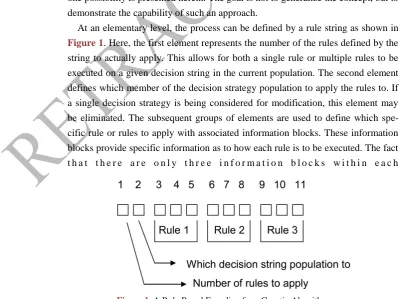
[image:6.595.139.541.367.666.2]At an elementary level, the process can be defined by a rule string as shown in
Figure 1. Here, the first element represents the number of the rules defined by the
string to actually apply. This allows for both a single rule or multiple rules to be executed on a given decision string in the current population. The second element defines which member of the decision strategy population to apply the rules to. If a single decision strategy is being considered for modification, this element may be eliminated. The subsequent groups of elements are used to define which spe-cific rule or rules to apply with associated information blocks. These information blocks provide specific information as to how each rule is to be executed. The fact t h a t t h e r e a r e o n l y t h r e e i n f o r m a t i o n b l o c k s w i t h i n e a c h
Figure 1. A Rule Based Encoding for a Genetic Algorithm.
The rules, as structured, are applied to a conventional encoding string which represents a member of the design or decision support population. For example, in a manufacturing scheduling example, the problem encoding being operated upon could represent the individual job priorities. The priorities could be fed into a sim-ulation, would provide the performance metrics with which to evaluate the effec-tiveness of the decision string. The rules would then operate on the job priority encoding and could include concepts such as:
Increase job priority on a job which is delivered late.
Decrease job priority on a job which is ready early.
Alter a priority of a selected job (as specified in the rule encoding).
Switch priorities between two jobs (each specified in the rule encoding).
Divide a product batch order into two separate orders or jobs for separate pro-cessing.
Combine two product batch orders so they are processed together.
A number of other potentially effective rules could be implemented as well. The rule based encoding operates on the decision encoding population to modify the overall schedule. Good or bad rules will be identified by the process. Good rules will be exploited while bad rules will eventually evolve out of the rule population. This allows for a straightforward capture of knowledge.
The process may now be thought of as a two phase process. The first phase in-volves the generation of a population of decision strategies. A traditional genetic optimization can be executed to form this population. Alternatively, it could be formed through a random selection, much as the population for the first generation in a conventional genetic solution process. A subset (one or more) of this popula-tion could then be subsequently processed by the rule based encoding. There are many possibilities to move between the phase one and phase two processes. Care must be taken not to have such specific rules as to eliminate the global nature of the search. This is why generic rules such as the one to alter a priority of a selected job or switch the priorities of two jobs are included. This allows the algorithm to select a schedule as part of the genetic selection process which is then subse-quently influenced by the application of rules. One final point of note is the rela-tive size of the design or decision encoding. The original problem encoding may involve hundreds or thousands of elements while the rule based encoding will typically involve tens of elements. The reduction in overall solution time relies on the fact that solving a set of smaller problems sequentially is far more efficient than solving a very large problem. This has a significant impact on convergence and the computational time required.
4. A Simple Example—The Summation Game
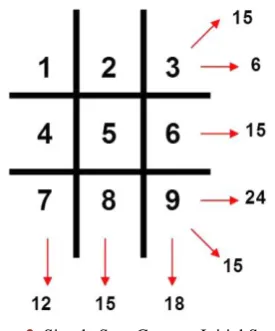
and diagonal and are seen to be far from equal or optimal. The objective function utilized in this example will be the difference between the highest and lowest sum of any row, column or diagonal. The row, column and diagonal sums are shown for the initial placement of integers in Figure 2 by the small numbers following the red arrows. For this initial placement, the objective function is eighteen (dif-ference of lower row sum of twenty four and upper row sum of six). In this in-stance, the integers are simply placed in order by rows. Certainly, this placement does not represent a solution to the game.
Using a conventional genetic optimization algorithm, there are many ways to formulate this problem for solution. Remarkably, even a simple problem like this is not easily solved. The approach considered here is to compare a traditional, brute force approach, with a rule based decision support approach. A conventional approach would consist of implementing a nine element encoding where each el-ement in the encoding is allowed to take on an integer value from one to nine. Each position of the encoding string translates directly to a position in the sum game, starting at the top left corner and proceeding across and down. The sums of the rows, columns and diagonals are easily calculated and provide a means of evaluating an appropriate objective function. In this example, the objective func-tion is taken to be the difference between the largest and smallest of the sums. If this difference is zero, then all of the sums are equal and a potential solution has been located. The term potential is used as there is no guarantee in this formula-tion that each integer value is utilized once and only once. For example, if any in-teger value were repeated nine times, all sums would be zero, but it would not represent a solution to this particular game.
[image:8.595.304.442.500.666.2]In order to guarantee that each encoding position represents a unique integer at the end of the search process, a constraint is added to the formulation which suc-cessively penalizes the multiple use of an integer in the encoding string. This is not the only way to avoid the multiple value issue, but it represents an easily
Figure 2. Simple Sum Game at Initial Setting.
Minimize Maximum , , Minimum , ,
i j k
i j k
f x Sum row Sum column Sum diagonal
Sum row Sum column Sum diagonal
(5)
where
1, 2, 3, , 9
; 1 i 9 and i
integer
x x x x x x x (6)
i = 1, 3
j = 1, 3
k = 1, 2 and
1 dup
g x N
(7) where
dup
N = total number of repetitions of integers in x
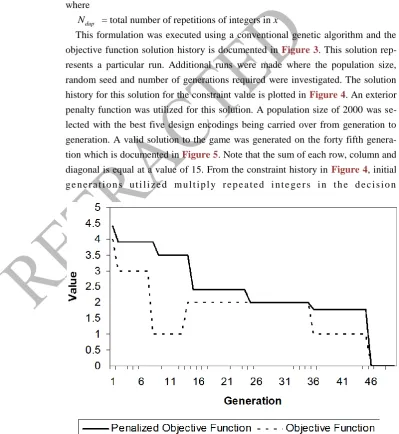
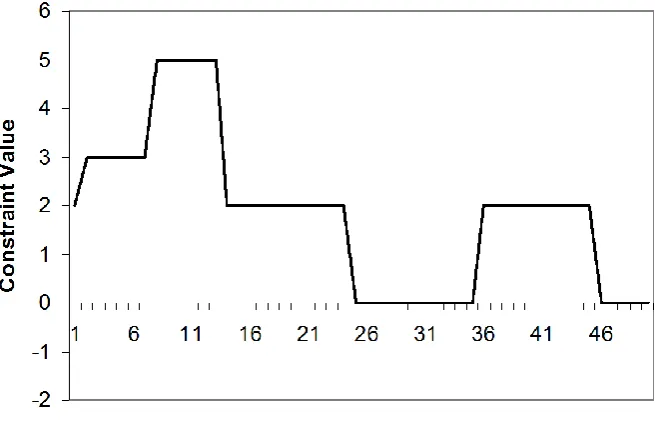
[image:9.595.141.541.244.679.2]This formulation was executed using a conventional genetic algorithm and the objective function solution history is documented in Figure 3. This solution rep-resents a particular run. Additional runs were made where the population size, random seed and number of generations required were investigated. The solution history for this solution for the constraint value is plotted in Figure 4. An exterior penalty function was utilized for this solution. A population size of 2000 was se-lected with the best five design encodings being carried over from generation to generation. A valid solution to the game was generated on the forty fifth genera-tion which is documented in Figure 5. Note that the sum of each row, column and diagonal is equal at a value of 15. From the constraint history in Figure 4, initial g e n e r a t i o n s u t i l i z e d m u l t i p l y r e p e a t e d i n t e g e r s i n t h e d e c i s i o n
Figure 4. Constraint Value Solution History for Sum Game.
Figure 5. Solution Developed for the Sum Game.
string, but by generation 45, all integer values in the best decision string were unique. Note that there are multiple solutions to the game which can be seen by simple switching the first and third rows or columns. This issue is not considered here, as any valid solution to the game is being sought.
[image:10.595.210.538.71.286.2]Certainly there is a benefit in linking the problem formulation and the encoding of the decision string as closely as possible to the physical nature of the problem it-self. This strategy can often be developed for decision support problems through consideration of how an expert might approach the problem and mimicking their solution strategy. This leads naturally to a rule based formulation and encoding of the problem.
The initial encoding and solution approach is valid in that it did generate the de-sired solution. On the other hand, it may be regarded as a brute force approach where the encoding captures little of the strategy of solving the game from a given initial placement of integers. When a decision support task is being envisioned, the lack of capture or understanding of the strategy is a distinct disadvantage. A rule based encoding of the problem can be implemented in order to provide the link which leads to a viable decision support formulation. For the sum game, consider how a human player would work toward a solution to the game. It is most likely that a hand solution to the game would involve assigning the integers 1 through 9 to various positions in the game matrix. The user would then start exchanging the position of pairs of numbers in the game matrix to improve the larger differences among the various row, column and diagonal sums. Using this approach, some explicit strategy or rule set is applied in order to decide which game matrix posi-tions to exchange. A positive outcome of this approach is that only feasible solu-tions can be generated in that no replication of integers can occur during the pro-cess. This exact approach may be built into the rule based encoding.
Care must be taken so as not to reduce the global search characteristic of the genetic approach, but other than this caution, virtually any rule encoding will work. In this particular case, the caution revolves around locating a temporary placement of the integers for which no single swap of two integers will improve the difference in the sums. This situation may be avoided by a number of strate-gies, including the implementation of a simulated annealing algorithm in order to accept intermediate designs which are not as good as the current one, particularly in the early stages of the search. Another approach would be to include some ran-domness in the rule set, which enhances the global nature of the algorithm. In this case, the rule encoding itself will be created so that the local minimum situation can be overcome by allowing the solution process to apply a number of simulta-neous moves at any iteration.
For this example from one to three exchanges will be allowed. The number of ex-changes is specified in the encoding and thus controlled by the genetic algorithm. Taking into account the above considerations, a rule based encoding for the simple sum game may be expressed as follows:
,1a, 1a, 2a, 2a,1b, 1b, 2b, 2b, 1c, 1c, 2c, 2c
x N r c r c r c r c r c r c
where
N indicates the number of exchanges to execute. and
r1a, c1a, r2a, c2a represent the first pair of positions to exchange (row, column)1 =
(r1a, c1a) with (row, column)2 = (r2a, c2a)
and
r1b, c1b, r2b, c2b, r1c, c1c, r2c, c2c represent the other two exchange possibilities.
This form of the encoding string is directly in line with the general structure pre-sented in Figure 2.
As an example, consider the current game matrix configuration to be given by: 1 2 3
Matrix 4 5 6 7 8 9
and let the encoding string by set at.
2, 2, 3,1, 2, 2,1, 3, 3,1,1, 3, 2
x
the current game matrix would be altered to the form given by 1 6 3
Matrix 9 5 2 7 8 4
The operation switches (row2, column3) with (row1, column2), which exchanges
the 6 and 2 integer values. The encoding also switches (row2, column1) with (row3,
column3) which exchanges the 4 and 9 integer values. The last possible exchange
of (row1, column1) with (row3, column2) is not executed since the number of rules
specified to be executed, N, is two. Whether or not this new configuration is ac-cepted is a function of the objective function which is formulated as the difference between the maximum and minimum row, column and diagonal sum as defined in the first formulation.
Figure 6. Solution History for Sum Game Using a Rule Based Approach.
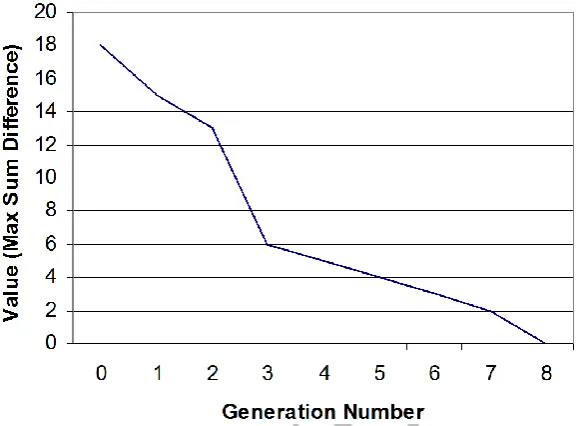
seen in Figure 6 that the solution was located by the eighth generation with a population size of 200. While additional coding was required to implement the rule interpretation and to modify the game matrix accordingly, the number of function evaluations required to solve the problem was reduced by a factor of al-most 50. This is a significant difference and indicates the potential promise in a rule based approach for more difficult decision support problems.
5. A More Challenging Problem: The Maze
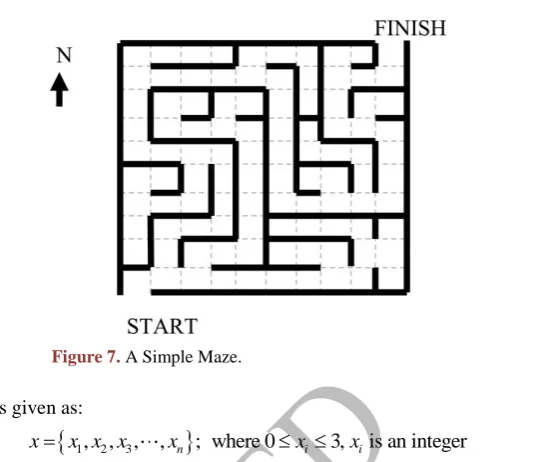
The solution of an arbitrary maze is a good representation for most decision sup-port problems. Here, however, the simple rule based genetic algorithm will be considered. For a given maze configuration, the goal is to develop a sequence of moves that will lead from the starting point to the designated end point. A simple maze with one starting point and one exit point will be considered. The success of each move is dependent upon all moves made previously and as such which it shares with virtually any form of decision support application. The data file re-quired to describe a particular maze must define the size of the maze (assumed here to be rectangular), and have some mechanism to define feasible and non-feasible moves from each block in the maze. The possible move directions are simple north, east, west and south which requires four potential move states be built into the encoding for each successive move through the maze. A sample maze is shown in Figure 7 which will be utilized to demonstrate the approach. In
Figure 7, the walls are delineated by solid lines, while the individual matrix
loca-tions are shown in lighter, dashed lines. Both a traditional genetic formulation and a rule based formulation will be considered. It should be noted that the solution could be potentially be generated using another type of evolutionary algorithm such as ant colony or swarm optimization [19][20][21].
Figure 7. A Simple Maze.
encoding is given as:
1, 2, 3, , n
; where 0 i 3, iis an integerx x x x x x x
(8) Here, n represents the total number of moves allowed for the decision support. The constraint of not being able to travel through a wall may be handled in a number of ways. Here it is arbitrarily dealt with by not allowing a move which passes through a wall. For example, if a north move is specified and this move would pass through a wall in the maze, the move is disallowed and the next move in the decision encoding is considered.
The objective function may also take on a number of forms as long as an indi-cation of success is measured within the function. For this example, the objective function will be the distance from the position in the maze after executing every move specified in the decision encoding and the desired end point. The goal is to minimize this distance, with a value of zero being the limit which indicates a solu-tion has been generated. This objective funcsolu-tion may be expressed as follows:
2
2
12current final current final
Minimize f x x x y y (9) This objective function has a problem when a path is found which terminates near the endpoint but is a dead end. This solution will be rated better than other members of the population which do not progress as far through the maze, but re-main on productive tracts. Some penalty may be assigned to a dead end situation. This moves directly into the realm of problem specific knowledge and leads natu-rally into the rule based approach. For this example, the objective function defined above will be implemented without consideration to dead paths.
approach-es. Several different mazes of the same size were tested, and the results presented here on a single one of those tested. The results from the other maze solution at-tempts were similar in the performance of the algorithms. The goal here was not to make a detailed study on the comparative utility of the methods [22], but to demonstrate how the rule based method can be implemented.
The formulation developed above was executed using a standard genetic algo-rithm with a population of 500 with each decision string having a length of fifty elements. This resulted in the evaluation of 50,000 decision strings. The results from several runs started with different random seeds are shown in Figure 8. As can be readily seen, the final distance to the exit point in the maze was not located. This continued to be the case for larger population sizes and for larger numbers of generations. The best paths found terminated at local dead ends, which is not un-expected. By dramatically expanding the population size and executing many more generations, this difficulty could potentially be resolved. For a problem such as this, where the evaluation of the objective function is relatively inexpensive, this may represent a viable approach. As the objective function becomes increas-ingly expensive, however, this approach is not attractive.
From the rule based perspective, starting from an initial path or set of paths de-fined identically as in the previous formulation, the object is to execute a dede-fined rule set in order to improve the path(s). The rule set for this problem consists of five separate rules. These rules are defined as follows:
1) Group all successful moves at the beginning of the encoding string.
2) For a selected group of encoding string positions, randomly alter the values. 3) For a selected move in the encoding string, alter the direction as specified. 4) For the first successful move in the encoding string after a specified position,
try the same direction for the next number of specified moves (encoding posi-tions).
[image:15.595.138.530.298.692.2]5) Rectify the first specified number of back/forth moves, starting from a speci-fied position in the encoding string.
Figure 8. End Points for Conventional Genetic Algorithm Solution.
the maze. The second rule alters a set of encoding positions to random values. This rule was inserted in order to allow for a global search. The third rule operates on the same principle as does rule 2, but it only alters a single position to a value specified in the information segment of the rule encoding string. The fourth rule seeks to take advantage of the situation where a series of moves can be made in the same direction and the final rule eliminates situations where a move is directly countered by an opposite direction move (i.e. north followed immediately by south). These rules are easily implemented and while they insert some problem specific knowledge, they are very general in scope. More specific rules dealing with situations such as dead ends could be included, but they require additional code for the identification of such conditions.
The rule encoding for this example takes on a form very similar to that pictured
in Figure 2. For this example, a maximum of five rules was allowed, each of
which was assigned two informational positions in the string. The first position defines the number of rules to execute and the second defines which portion of the path to modify. This requires a total of 17 string positions to define the maximum length rule set (5 sets of three positions plus the first two). Note that this is a con-siderably smaller encoding string than for the conventional genetic solution ap-proach which required a decision string of 50 elements.
Ten initial paths were generated by executing a conventional genetic algorithm. Only one generation was executed, with a population of 500 designs. Ten paths were selected based both of the distance to the end point of the maze and the dif-ference among the paths traveled. This portion of the solution process is termed the phase one search. The second phase, executes the rules to modify the paths as described in the rule based approach. A population of 500 was maintained for the phase two search. The process was terminated as soon as the distance to the end point of the maze was reduced to zero. The rule based algorithm located the solu-tion after 12 generasolu-tions and required less than one third of the funcsolu-tion evalua-tions for the failed searches of the conventional algorithm. The solution was con-sistently generated from multiple starting point groups.
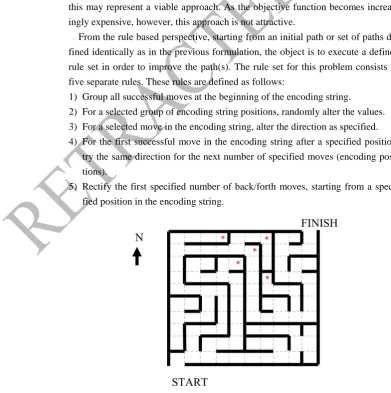
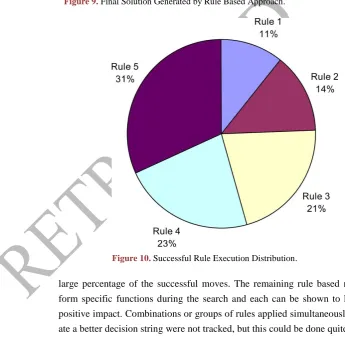
The final path and prescribed moves are shown in Figure 9. Note that there are a few back and forth moves present in the final solution. As implemented, there is nothing in the formulation which seeks to avoid this situation. Figure 10 docu-ments the success frequency of each of the five rules. This success frequency is based upon the number of times a specific rule was executed successfully. Infor-mation such as this can be utilized to improve or alter the rule set. Note that all five of the rules were used successfully, although rules 3 and 4 and particularly rule 5 accounted for the largest number of successful moves. This makes some sense as the first rule, once executed, moves all successful moves to the front of the decision string and has little impact beyond that point.
Final String = ENNEENNNWWWEWNNNEEEEESSSSSEEENSENNNWWNNNEWSEENSNSN
Figure 9. Final Solution Generated by Rule Based Approach.
Figure 10. Successful Rule Execution Distribution.
large percentage of the successful moves. The remaining rule based moves per-form specific functions during the search and each can be shown to have had a positive impact. Combinations or groups of rules applied simultaneously to gener-ate a better decision string were not tracked, but this could be done quite easily.
6. Summary and Conclusions
[image:17.595.148.494.255.594.2]combinations of a conventional genetic search with a rule based approach. Phase one is utilized to locate suitable decision strings to operate upon. Phase two con-tains the execution of the rule based method. Hybrid methods, which automate the rule updates, as well as other genetic parameters during the solution, may be pos-sible.
In both problems considered, significant improvement in both solution effi-ciency and efficacy were noted. The problems are simplistic in nature, but the concept may be implemented as presented for the solution of more difficult and significant applications. The comparison was only made to a standard generic al-gorithm, and there are other evolutionary methods that could be applied to the problems tested. The purpose herein was not to present the rule based method as a better approach to any other, but to demonstrate the basic approach as an impetus to consider more relevant applications. The ability to incorporate problem specific knowledge is of significant interest and potential benefit to any decision support problem.
The ability to determine which rules are being exploited successfully is also demonstrated and this feature can be further exploited to improve the rule base over time. The successes of the rules implemented were presented, but no effort was made to leverage this information on the problems tested. The balance be-tween discovery based on randomness and a rule directed search is important. If randomness is removed completely, the search will be local which may not be very effective. The impact on the rules allowing for discovery in the genetic algo-rithm can be seen by looking at the rules which were successfully applied in the search. Extensions to other problem classes including the traveling salesman, manufacturing scheduling and structural design are currently being investigated.
References
[1] Kumar, S. (2016) Selection of Optimal Path in Routing Using Genetic Algorithm. In-ternational Journal of Latest Trends in Engineering and Technology, 7, 259-263. [2] Jensen, M.T. (2003) Generating Robust and Flexible Job Shop Schedules Using
Ge-netic Algorithms. IEEE Transactions on Evolutionary Computation, 7, 275-288. https://doi.org/10.1109/TEVC.2003.810067
[3] Alobaidi, W., Sandgren, E. and Alkuam, E. (2017) Decision Support through Intelli-gent AIntelli-gent Based Simulation and Multiple Goal Based Evolutionary Optimization.
Intelligent Information Management, 9, 97-113. https://doi.org/10.4236/iim.2017.93005
[4] Sun, KT., Lin, Y.C., Wu, C.Y. and Huang, Y.M. (2009) An Application of the Ge-netic Programming Technique to Strategy Development. Expert Systems with Appli-cations, 36, 5157-5161. https://doi.org/10.1016/j.eswa.2008.06.066
[5] Compare, M. and Martini, F. (2015) Decision Support: Genetic Algorithms for Con-dition Based Maintenance Optimization under Uncertainty. European Journal of Op-erations Research, 16, 611-623. https://doi.org/10.1016/j.ejor.2015.01.057
[6] Guido, R. and Conforti, D. (2015) A Hybrid Genetic Approach for Solving an Inte-grated Multi-Objective Operating Room Planning and Scheduling Problem. Comput-ers and Operations Research.
[7] OnkHam, W., Karwowski, W. and Ahram, T.Z. (2012) Economics of Human Per-formance and Systems Total Ownership Cost. Work, 41, 2781-2788.
[8] Liang, P.L. and Jones, C. (1987) Design of a Self-Evolving Decision Support System.
https://doi.org/10.1080/07421222.1987.11517786
[9] Lin, S. and Kernighan, B.W. (1973) An Efficient Heuristic Algorithm for the Travel-ing Salesman Problem. Operations Research, 21, 498-516.
https://doi.org/10.1287/opre.21.2.498
[10] Nonas, E. and Poulovassilis, A. (1999) Optimising Self Adaptive Networks by Evolving Rule-Based Agents. Lecture Notes in Computer Science, 1596, 203-214. https://doi.org/10.1007/10704703_17
[11] Ishibuchi, H. and Yamamoto, T. (2004) Fuzzy Rule Selection by Multo-Objective Genetic Local Search Algorithms and Rule Evaluation Measures in Data Mining.
Fuzzy Sets and Systems, 141, 59-88. https://doi.org/10.1016/S0165-0114(03)00114-3 [12] Hadian, A., Nasiri, M. and Minaci-Bidgoli, B. (2010) Clustering Based Multi-Ob-
jective Rule Mining Using Genetic Algorithm. International Journal of Digital Con-tent Technology and Its Application, 4, 37-42.
https://doi.org/10.4156/jdcta.vol4.issue1.5
[13] Caponetto, R., Fortuna, S.F. and Xibilia, M.G. (2003) Chaotic Sequences to Improve the Performance of Evolutionary Algorithms. IEEE Transactions on Evolutionary Computing, 7, 289-304. https://doi.org/10.1109/TEVC.2003.810069
[14] Mozaffari, A., Emami, M., Azad, N.L. and Fathi, A. (2015) On the Effcacy of Chaos- Enhanced Heuristic Walks with Nature-Based Controllers for Robust and Accurate Intellegent Search. Journal of Experimental & Theoretical Artificial Intelligence, 27, 389-422. https://doi.org/10.1080/0952813X.2014.954632
[15] Srinivasan, S. and Ramakrishnan, S. (2013) A Social Intellegent System for Mul-ti-objective Optimization of Classification Rules Using Cultural Algorithms. Compu-ting, 95, 327-350. https://doi.org/10.1007/s00607-012-0246-4
[16] Webb, D. and Sandgren, E. (2017) Topological Design via a Rule Based Genetic Op-timization Algorithm. Computers and Structures, Submitted.
[17] Goldberg, D.E. (1989) Genetic Algorithms in Search, Optimization and Machine Learning. Addison-Wesley, Reading, MA.
[18] Davis, L. (1991) Handbook of Genetic Algorithms. Van Nostrand Reinhold, New York.
[19] Imam, A.A, Much, A.M. and Alamsyah, A. (2016) Comparison of Genetic Algorithm and Ant Colony Optimization in Course Scheduling Optimization. Scientific Journal of Informatics, 3, 51-60.
[20] Wang, L., Cai, J., Li, M. and Liu, Z. (2017) Flexible Shop Scheduling Problem Using an Improved Ant Colony Optimization. Scientific Programming, 2017, Article ID: 9016303. https://doi.org/10.1155/2017/9016303
[21] Schyns, M. (2015) Discrete Optimization: An Ant Colony System for Responsive Dynamic Vehicle Routing. European Journal of Operational Research, 245, 704- 718.