Semantic Role Labeling of Implicit
Arguments for Nominal Predicates
Matthew Gerber
∗ University of VirginiaJoyce Y. Chai
∗∗Michigan State University
Nominal predicates often carry implicit arguments. Recent work on semantic role labeling has focused on identifying arguments within the local context of a predicate; implicit arguments, however, have not been systematically examined. To address this limitation, we have manually annotated a corpus of implicit arguments for ten predicates from NomBank. Through analysis of this corpus, we find that implicit arguments add 71% to the argument structures that are present in NomBank. Using the corpus, we train a discriminative model that is able to identify implicit arguments with an F1score of 50%, significantly outperforming an informed baseline
model. This article describes our investigation, explores a wide variety of features important for the task, and discusses future directions for work on implicit argument identification.
1. Introduction
Recent work has shown that semantic role labeling (SRL) can be applied to nominal predicates in much the same way as verbal predicates (Liu and Ng 2007; Johansson and Nugues 2008; Gerber, Chai, and Meyers 2009). In general, the nominal SRL problem is formulated as follows: Given a predicate that is annotated in NomBank as bear-ing arguments, identify these arguments within the clause or sentence that contains the predicate. As shown in our previous work (Gerber, Chai, and Meyers 2009), this problem definition ignores the important fact that many nominal predicates do not bear arguments in the local context. Such predicates need to be addressed in order for nominal SRL to be used by downstream applications such as automatic question answering, information extraction, and statistical machine translation.
Gerber, Chai, and Meyers (2009) showed that it is possible to accurately identify nominal predicates that bear arguments in the local context. This makes the nominal SRL system applicable to text that does not contain annotated predicates. The system does not address a fundamental question regarding arguments of nominal predicates, however: If an argument is missing from the local context of a predicate, might the argument be located somewhere in the wider discourse? Most prior work on nominal
∗ 151 Engineer’s Way, University of Virginia, Charlottesville, VA 22904. E-mail:[email protected].
∗∗ 3115 Engineering Building, Michigan State University, East Lansing, MI 48824. E-mail:[email protected].
and verbal SRL has stopped short of answering this question, opting instead for an approach that only labels local arguments and thus ignores predicates whose arguments are entirely non-local. This article directly addresses the issue of non-local (or implicit) argument identification for nominal predicates.
As an initial example, consider the following sentence, which is taken from the Penn TreeBank (Marcus, Santorini, and Marcinkiewicz 1993):
(1) A SEC proposal to ease [arg1reporting] [predicaterequirements] [arg2 for some company executives] would undermine the usefulness of information on insider trades, professional money managers contend.
The NomBank (Meyers 2007) role set forrequirementis shown here:
Frame forrequirement, role set 1:
arg0: the entity that is requiring something
arg1: the entity that is required
arg2: the entity of which something is being required
In Example (1), the predicate has been annotated with the local argument labels pro-vided by NomBank. As shown, NomBank does not annotate anarg0for this instance of therequirementpredicate; a reasonable interpretation of the sentence, however, is that SECis the entity that is requiring something.1This article refers to arguments such as
SECin Example (1) as implicit. In this work, the notion of implicit argument covers any argument that is not annotated by NomBank.2
Building on Example (1), consider the following sentence, which directly follows Example (1) in the corresponding TreeBank document:
(2) Money managers make the argument in letters to the agency about [arg1rule] [predicatechanges] proposed this past summer.
The NomBank role set forchangeis as follows:
Frame forchange, role set 1:
arg0: the entity that initiates the change
arg1: the entity that is changed
arg2: the initial state of the changed entity
arg3: the final state of the changed entity
Similarly to the previous example, Example (2) shows the local argument labels pro-vided by NomBank. These labels only indicate that rules have been changed. For a full interpretation, Example (2) requires an understanding of Example (1). Without
1 The Securities and Exchange Commission (SEC) is responsible for enforcing investment laws in the United States.
Gerber and Chai SRL of Implicit Arguments for Nominal Predicates
the sentence from Example 1, the reader has no way of knowing that the agency in Example (2) actually refers to the same entity asSEC in Example (1). As part of the reader’s comprehension process, this entity is identified as the filler for thearg0role in Example (2). This identification must occur in order for these two sentences to form a coherent discourse.
From these examples, it is clear that the scope of implicit arguments quite naturally spans sentence boundaries. Thus, if one wishes to recover implicit arguments as part of the SRL process, the argument search space must be expanded beyond the traditional, single-sentence window used in virtually all prior SRL research. What can we hope to gain from such a fundamental modification of the problem? Consider the following question, which targets Examples (1) and (2):
(3) Who changed the rules regarding reporting requirements?
Question (3) is afactoid question, meaning it has a short, unambiguous answer in the targeted text. This type of question has been studied extensively in the Text Retrieval Conference Question Answering (QA) Track (Dang, Kelly, and Lin 2007). Using the evaluation data from this track, Pizzato and Moll´a (2008) showed that SRL can improve the accuracy of a QA system; a traditional SRL system alone, however, is not enough to recover the implied answer to Question (3):SEC or the agency. Successful implicit argument identification provides the answer in this case.
This article presents an in-depth study of implicit arguments for nominal predi-cates.3 The following section surveys research related to implicit argument identifica-tion. Section 3 describes the study’s implicit argument annotation process and the data it produced. The implicit argument identification model is formulated in Section 4 and evaluated in Section 5. Discussion of results is provided in Section 6, and the article concludes in Section 7.
2. Related Work
The research presented in this article is related to a wide range of topics in cognitive science, linguistics, and natural language processing (NLP). This is partly due to the discourse-based nature of the problem. In single-sentence SRL, one can ignore the dis-course aspect of language and still obtain high marks in an evaluation (for examples, see Carreras and M`arquez 2005 and Surdeanu et al. 2008); implicit argumentation, however, forces one to consider the discourse context in which a sentence exists. Much has been said about the importance of discourse to language understanding, and this section will identify the points most relevant to implicit argumentation.
2.1 Discourse Comprehension in Cognitive Science
The traditional view of sentence-level semantics has been that meaning is composi-tional. That is, one can derive the meaning of a sentence by carefully composing the meanings of its constituent parts (Heim and Kratzer 1998). There are counterexamples to a compositional theory of semantics (e.g., idioms), but those are more the exception than the rule. Things change, however, when one starts to group sentences together
to form coherent textual discourses. Consider the following examples, borrowed from Sanford (1981, page 5):
(4) Jill came bouncing down the stairs.
(5) Harry rushed off to get the doctor.
Examples (4) and (5) describe three events: bounce, rush, and get. These events are intricately related. One cannot simply create a conjunction of the propositionsbounce, rush, andgetand expect to arrive at the author’s intended meaning, which presumably involves Jill’s becoming injured by her fall and Harry’s actions to help her. The mutual dependence of these sentences can be further shown by considering a variant of the situation described in Examples (4) and (5):
(6) Jill came bouncing down the stairs.
(7) Harry rushed over to kiss her.
The interpretation of Example (6) is vastly different from the interpretation of Exam-ple (4). In ExamExam-ple (4), Jill becomes injured whereas in ExamExam-ple (6) she is quite happy.
Examples (4–7) demonstrate the fact that sentences do not have a fixed, compo-sitional interpretation; rather, a sentence’s interpretation depends on the surrounding context. The standard compositional theory of sentential semantics largely ignores con-textual information provided by other sentences. The single-sentence approach to SRL operates similarly. In both of these methods, the current sentence provides all of the semantic information. In contrast to these methods—and aligned with the preceding discussion—this article presents methods that rely heavily on surrounding sentences to provide additional semantic information. This information is used to interpret the current sentence in a more complete fashion.
Examples (4–7) also show that the reader’s knowledge plays a key role in discourse comprehension. Researchers in cognitive science have proposed many models of reader knowledge. Schank and Abelson (1977) proposed stereotypical event sequences called scriptsas a basis for discourse comprehension. In this approach, readers fill in a dis-course’s semantic gaps with knowledge of how a typical event sequence might unfold. In Examples (4) and (5), the reader knows that people typically call on a doctor only if someone is hurt. Thus, the reader automatically fills the semantic gap caused by the ambiguous predicatebouncewith information about doctors and what they do. Similar observations have been made by van Dijk (1977, page 4), van Dijk and Kintsch (1983, page 303), Graesser and Clark (1985, page 14), and Carpenter, Miyake, and Just (1995). Inspired by these ideas, the model developed in this article relies partly on large text corpora, which are treated as repositories of typical event sequences. The model uses information extracted from these event sequences to identify implicit arguments.
2.2 Automatic Relation Discovery
Gerber and Chai SRL of Implicit Arguments for Nominal Predicates
Lin and Pantel (2001) proposed a system that automatically identifies relationships similar to the following:
(8) X eats Y↔X likes Y
This relationship creates a mapping between the participants of the two predicates. One can imagine using such a mapping to fill in the semantic gaps of a discourse that describes a typical set of events in a restaurant. In such a discourse, the author probably will not state directly thatXlikesY; the reader might need to infer this in order to make sense of the fact thatXleft a large tip for the waiter, however.
Lin and Pantel (2001) created mappings such as the one in Example (8) using a variation of the so-called “distributional hypothesis” posited by Harris (1985), which states that words occurring in similar contexts tend to have similar meanings. Lin and Pantel applied the same notion of similarity to dependency paths. For example, the inference rule in Example 8 is identified by examining the sets of words in the twoX positions and the sets of words in the twoYpositions. When the two pairs of sets are similar, it is implied that the two dependency paths fromXtoYare similar as well. In Example (8), the two dependency paths are as follows:
X←−−−subject eats −−−→object Y X←−−−subject likes−−−→object Y
One drawback of this method is that it assumes the implication is symmetric. Although this assumption is correct in many cases, it often leads to invalid inferences. In Exam-ple 8, it is not always true that ifXlikesYthenXwill eatY. The opposite—thatXeating YimpliesXlikesY—is more plausible but not certain.
Bhagat, Pantel, and Hovy (2007) extended the work of Lin and Pantel (2001) to handle cases of asymmetric relationships. The basic idea proposed by Bhagat, Pantel, and Hovy is that, when considering a relationship of the formx,p1,y ↔ x,p2,y, ifp1 occurs in significantly more contexts (i.e., has more options forxandy) thanp2, thenp2 is likely to implyp1 but not vice versa. Returning to Example 8, we see that the correct implication will be derived iflikesoccurs in significantly more contexts thaneats. The intuition is that the more general concept (i.e.,like) will be associated with more contexts and is more likely to be implied by the specific concept (i.e.,eat). As shown by Bhagat, Pantel, and Hovy, the system built around this intuition is able to effectively identify the directionality of many inference rules.
Zanzotto, Pennacchiotti, and Pazienza (2006) presented another study aimed at identifying asymmetric relationships between verbs. For example, the asymmetric en-tailment relationshipX wins−→X playsholds, but the opposite (X plays−→X wins) does not. This is because not all those who play a game actually win. To find evidence for this automatically, the authors examined constructions such as the following (adapted from Zanzotto, Pennacchiotti, and Pazienza [2006]):
(9) The more experienced tennis player won the match.
“player” is logical subject to “won”, the combination of which entails the asymmetric relationship of interest. Thus, to validate such an asymmetric relationship, Zanzotto, Pennacchiotti, and Pazienza (2006) examined the frequency of the “player win” colloca-tion using Google hit counts as a proxy for actual corpus statistics.
A number of other studies (e.g., Szpektor et al. 2004, Pantel et al. 2007) have been conducted that are similar to that work. In general, such work focuses on the automatic acquisition of entailment relationships between verbs. Although this work has often been motivated by the need for lexical–semantic information in tasks such as automatic question answering, it is also relevant to the task of implicit argument identification because the derived relationships implicitly encode a participant role mapping between two predicates. For example, given a missing arg0 for alikepredicate and an explicit
arg0 =John for an eat predicate in the preceding discourse, inference rule (8) would help identify the implicitarg0=Johnfor thelikepredicate.
The missing link between previous work on verb relationship identification and the task of implicit argument identification is that previous verb relations are not defined in terms of theargnpositions used by NomBank. Rather, positions likesubjectandobject are used. In order to identify implicit arguments in NomBank, one needs inference rules between specific argument positions (e.g.,eat:arg0 and like:arg0). In the current article, we propose methods of automatically acquiring these fine-grained relationships for verbal and nominal predicates using existing corpora. We also propose a method of using these relationships to recover implicit arguments.
2.3 Coreference Resolution
The referent of a linguistic expression is the real or imagined entity to which the expres-sion refers. Coreference, therefore, is the condition of two linguistic expresexpres-sions having the same referent. In the following examples from the Penn TreeBank, the underlined spans of text are coreferential:
(10) “Carpet King sales are up 4% this year,” said owner Richard Rippe.
(11) He added that the company has been manufacturing carpet since 1967.
Non-trivial instances of coreference (e.g.,Carpet Kingandthe company) allow the author to repeatedly mention the same entity without introducing redundancy into the dis-course. Pronominal anaphora is a subset of coreference in which one of the referring expressions is a pronoun. For example,hein Example (11) refers to the same entity as Richard Rippe in Example (10). These examples demonstrate noun phrase coreference. Events, indicated by either verbal or nominal predicates, can also be coreferential when mentioned multiple times in a document (Wilson 1974; Chen and Ji 2009).
For many years, the Automatic Content Extraction (ACE) series of large-scale eval-uations (NIST 2008) has provided a test environment for systems designed to identify these and other coreference relations. Systems based on the ACE data sets typically take a supervised learning approach to coreference resolution in general (Versley et al. 2008) and pronominal anaphor in particular (Yang, Su, and Tan 2008).
Gerber and Chai SRL of Implicit Arguments for Nominal Predicates
in systems that are able to identify missing case–marked expressions in the surrounding discourse (Imamura, Saito, and Izumi 2009). Sasano, Kawahara, and Kurohashi (2004) conducted similar work with Japanese indirect anaphora. The authors used automati-cally derived nominal case frames to identify antecedents. However, as noted by Iida et al., grammatical cases do not stand in a one-to-one relationship with semantic roles in Japanese (the same is true for English).
Many other discourse-level phenomena interact with coreference. For example, Centering Theory (Grosz, Joshi, and Weinstein 1995) focuses on the ways in which referring expressions maintain (or break) coherence in a discourse. These so-called “cen-tering shifts” result from a lack of coreference between salient noun phrases in adjacent sentences. Discourse Representation Theory (DRT) (Kamp and Reyle 1993) is another prominent treatment of referring expressions. DRT embeds a theory of coreference into a first-order, compositional semantics of discourse.
2.4 Identifying Implicit Arguments
Past research on the actual task of implicit argument identification tends to be sparse. Palmer et al. (1986) describe what appears to be the first computational treatment of implicit arguments. In that work, Palmer et al. manually created a repository of knowl-edge concerning entities in the domain of electronic device failures. This knowlknowl-edge, along with hand-coded syntactic and semantic processing rules, allowed the system to identify implicit arguments across sentence boundaries. As a simple example, consider the following two sentences (borrowed from Palmer et al. [1986]):
(12) Disk drive was down at 11/16-2305.
(13) Has select lock.
Example (13) does not specify precisely which entity has select lock. The domain knowl-edge, however, tells the system that onlydisk driveentities can have such a property. Using this knowledge, the system is able to search the local context and make explicit the implied fact that the disk drive from Example (12) has select lock.
A similar line of work was pursued by Whittemore, Macpherson, and Carlson (1991), who offer the following example of implicit argumentation (page 21):
(14) Pete bought a car.
(15) The salesman was a real jerk.
In Example (14), thebuyevent is not associated with an entity representing the seller. This entity is introduced in Example (15) asthe salesman, whose semantic properties satisfy the requirements of thebuyevent. Whittemore, Macpherson, and Carlson (1991) build up the event representation incrementally using a combination of semantic prop-erty constraints and DRT.
the current article uses a variety of selectional preference measures to identify implicit arguments.
The implicit argument identification systems described herein were not widely de-ployed due to their reliance on hand-coded, domain-specific knowledge that is difficult to create. Much of this knowledge targeted basic syntactic and semantic constructions that now have robust statistical models (e.g., those created by Charniak and Johnson [2005] for syntax and Punyakanok et al. [2005] for semantics). With this information accounted for, it is easier to approach the problem of implicit argumentation. Subse-quently, we describe a series of recent investigations that have led to a surge of interest in statistical implicit argument identification.
Fillmore and Baker (2001) provided a detailed case study of FrameNet frames as a basis for understanding written text. In their case study, Fillmore and Baker manually build up a semantic discourse structure by hooking together frames from the various sentences. In doing so, the authors resolve some implicit arguments found in the dis-course. This process is an interesting step forward; the authors did not provide concrete methods to perform the analysis automatically, however.
Nielsen (2004) developed a system that is able to detect the occurrence of verb phrase ellipsis. Consider the following sentences:
(16) John kicked the ball.
(17) Bill [did], too.
The bracketed text in Example (17) is a placeholder for the verb phrasekicked the ball in Example (16), which has been elided (i.e., left out). Thus, in Example (17), Billcan be thought of as an implicit argument to some kicking event that is not mentioned. If one resolved the verb phrase ellipsis, then the implicit agent (Bill) would be recovered.4 Nielsen (2004) created a system able to detect the presence of ellipses, producing the bracketing in Example (17). Ellipsis resolution (i.e., figuring out precisely which verb phrase is missing) was described by Nielsen (2005). Implicit argument identification for nominal predicates is complementary to verb phrase ellipsis resolution: Both work to make implicit information explicit.
Burchardt, Frank, and Pinkal (2005) suggested that frame elements from various frames in a text could be linked to form a coherent discourse interpretation (this is similar to the idea described by Fillmore and Baker [2001]). The linking operation causes two frame elements to be viewed as coreferent. Burchardt, Frank, and Pinkal (2005) propose to learn frame element linking patterns from observed data; the authors did not implement and evaluate such a method, however. Building on the work of Burchardt, Frank, and Pinkal, this article presents a model of implicit arguments that uses a quantitative analysis of naturally occurring coreference patterns.
In our previous work, we demonstrated the importance of filtering out nominal predicates that take no local arguments (Gerber, Chai, and Meyers 2009). This approach leads to appreciable gains for certain nominals. The approach does not attempt to actually recover implicit arguments, however.
Gerber and Chai SRL of Implicit Arguments for Nominal Predicates
Most recently, Ruppenhofer et al. (2009) proposed SemEval Task 10, “Linking Events and Their Participants in Discourse,” which evaluated implicit argument iden-tification systems over a common test set. The task organizers annotated implicit arguments across entire passages, resulting in data that cover many distinct predi-cates, each associated with a small number of annotated instances. As described by Ruppenhofer et al. (2010), three submissions were made to the competition, with two of the submissions attempting the implicit argument identification part of the task. Chen et al. (2010) extended a standard SRL system by widening the candidate window to include constituents from other sentences. A small number of features based on the FrameNet frame definitions were extracted for these candidates, and prediction was performed using a log-linear model. Tonelli and Delmonte (2010) also extended a stan-dard SRL system. Both of these systems achieved an implicit argument F1score of less than 0.02. The organizers and participants appear to agree that training data sparseness was a significant problem. This is likely the result of the annotation methodology: Entire documents were annotated, causing each predicate to receive a very small number of annotated examples.
In contrast to the evaluation described by Ruppenhofer et al. (2010), the study presented in this article focused on a select group of nominal predicates. To help prevent data sparseness, the size of the group was small, and the predicates were carefully chosen to maximize the observed frequency of implicit argumentation. We annotated a large number of implicit arguments for this group of predicates with the goal of training models that generalize well to the testing data. In the following section, we describe the implicit argument annotation process and resulting data set.
3. Implicit Argument Annotation and Analysis
As shown in the previous section, the existence of implicit arguments has been rec-ognized for quite some time. This type of information, however, was not formally annotated until Ruppenhofer et al. (2010) conducted their SemEval task on implicit argument identification. There are two reasons why we chose to create an independent data set for implicit arguments. The first reason is the aforementioned sparsity of the SemEval data set. The second reason is that the SemEval data set is not built on top of the Penn TreeBank, which is the gold-standard syntactic base for all work in this article. Working on top of the Penn TreeBank makes the annotations immediately compatible with PropBank, NomBank, and a host of other resources that also build on the TreeBank.
3.1 Data Annotation
3.1.1 Predicate Selection.Implicit arguments are a relatively new subject of annotation in the field. To effectively use our limited annotation resources and allow the observation of interesting behaviors, we decided to focus on a select group of nominal predicates. Predicates in this group were required to meet the following criteria:
1. A selected predicate must have an unambiguous role set. This criterion corresponds roughly to an unambiguous semantic sense and is motivated by the need to separate the implicit argument behavior of a predicate from its semantic meaning.
NomBank (e.g., the partitive predicate indicated by the “%” symbol). This criterion also implies that the annotated predicates have correlates in PropBank with semantically compatible role sets.
3. A selected predicate should have a high frequency in the Penn TreeBank corpus. This criterion ensures that the evaluation results say as much as possible about the event structure of the underlying corpus. We calculated frequency with basic counting over morphologically normalized
predicates (i.e.,bidsandbidare counted as the same predicate).
4. A selected predicate should express many implicit arguments. Of course, this can only be estimated ahead of time because no data exist to compute it. To estimate this value for a predicatep, we first calculatedNp, the average number of roles expressed bypin NomBank. We then calculated Vp, the average number of roles expressed by the verb form ofpin PropBank. We hypothesized that the differenceVp−Npgives an indication of the number of implicit arguments that might be present in the text for a nominal instance ofp. The motivation for this hypothesis is as follows. Most verbs must be explicitly accompanied by specific arguments in order for the resulting sentence to be grammatical. The following sentences are ungrammatical if the parenthesized portion is left out:
(18) *John loaned (the money to Mary).
(19) *John invested (his money).
Examples (18) and (19) indicate that certain arguments must explicitly accompanyloanandinvest. In nominal form, these predicates can exist without such arguments and still be grammatical:
(20) John’s loan was not repaid.
(21) John’s investment was huge.
Note, however, that Examples (20) and (21) are not reasonable things to write unless the missing arguments were previously mentioned in the text. This is precisely the type of noun that should be targeted for implicit argument annotation. The value ofVp−Npthus quantifies the desired behavior.
Predicates were filtered according to criteria 1 and 2 and ranked according to the product of criteria 3 and 4. We then selected the top ten, which are shown in the first column of Table 1. The role sets (i.e., argument definitions) for these predicates can be found in the Appendix on page 790.
3.1.2 Annotation Procedure.We annotated implicit arguments for instances of the ten se-lected nominal predicates. The annotation process proceeded document-by-document. For a documentd, we annotated implicit arguments as follows:
Gerber
and
Chai
SRL
o
f
Implicit
Ar
guments
for
Nominal
P
re
[image:11.486.71.653.172.377.2]dicates
Table 1
Annotation data analysis. Columns are defined as follows: (1) the annotated predicate, (2) the number of predicate instances that were annotated, (3) the average number of implicit arguments per predicate instance, (4) of all roles for all predicate instances, the percentage filled by NomBank arguments, (5) the average number of NomBank arguments per predicate instance, (6) the average number of PropBank arguments per instance of the verb form of the predicate, (7) of all roles for all predicate instances, the percentage filled by either NomBank or implicit arguments, (8) the average number of combined NomBank/implicit arguments per predicate instance.SDindicates the standard deviation with respect to an average.
Pre-annotation Post-annotation
Role avg. (SD)
Pred. # Pred. # Imp./pred. Role coverage (%) Noun Verb Role coverage (%) Noun role avg. (SD)
bid 88 1.4 26.9 0.8 (0.6) 2.2 (0.6) 73.9 2.2 (0.9)
sale 184 1.0 24.2 1.2 (0.7) 2.0 (0.7) 44.0 2.2 (0.9)
loan 84 1.0 22.1 1.1 (1.1) 2.5 (0.5) 41.7 2.1 (1.1)
cost 101 0.9 26.2 1.0 (0.7) 2.3 (0.5) 47.5 1.9 (0.6)
plan 100 0.8 30.8 1.2 (0.8) 1.8 (0.4) 50.0 2.0 (0.4)
investor 160 0.7 35.0 1.1 (0.2) 2.0 (0.7) 57.5 1.7 (0.6)
price 216 0.6 42.5 1.7 (0.5) 1.7 (0.5) 58.6 2.3 (0.6)
loss 104 0.6 33.2 1.3 (0.9) 2.0 (0.6) 48.1 1.9 (0.7)
investment 102 0.5 15.7 0.5 (0.7) 2.0 (0.7) 33.3 1.0 (1.0)
fund 108 0.5 8.3 0.3 (0.7) 2.0 (0.3) 21.3 0.9 (1.2)
Overall 1,247 0.8 28.0 1.1 (0.8) 2.0 (0.6) 47.8 1.9 (0.9)
(1) (2) (3) (4) (5) (6) (7) (8)
2. By design, each selected noun has an unambiguous role set. Thus, given the arguments supplied for a noun by NomBank, one can consult the noun’s role set to determine which arguments are missing.5
3. For each missing argument position, search the current sentence and all preceding sentences for a suitable implicit argument. Annotateall suitable implicit arguments in this window.
4. When possible, match the textual bounds of an implicit argument to the textual bounds of an argument given by either PropBank or NomBank. This was done to maintain compatibility with these and other resources.
In the remainder of this article, we will use iargn to refer to an implicit argument positionn. We will useargnto refer to an argument provided by PropBank or NomBank. We will usepto mark predicate instances. Example (22) provides a sample annotation for an instance of theinvestmentpredicate:
(22) [iarg0Participants] will be able to transfer [iarg1money] to [iarg2other investment funds]. The [pinvestment] choices are limited to [iarg2a stock fund and a money-market fund].
NomBank does not associate this instance of investmentwith any arguments; one can easily identify the investor (iarg0), the thing invested (iarg1), and two mentions of the thing invested in (iarg2) within the surrounding discourse, however.
Of course, not all implicit argument decisions are as easy as those in Example (22). Consider the following contrived example:
(23) People in other countries could potentially consume large amounts of [iarg0? Coke].
(24) Because of this, there are [pplans] to expand [iarg0the company’s] international presence.
Example (24) contains one mention of the iarg0 (the agentive planner). It might be tempting to also markCokein Example (23) as an additionaliarg0; the only reasonable interpretation ofCokein 23 is as a consumable fluid, however. Fluids cannot plan things, so this annotation should not be performed. This is a case of sense ambiguity between Coke as a company andCokeas a drink. In all such cases, the annotator was asked to infer the proper sense before applying an implicit argument label.
Lastly, it should be noted that we placed no restrictions on embedded argu-ments. PropBank and NomBank do not allow argument extents to overlap. Tra-ditional SRL systems such as the one created by Punyakanok, Roth, and Yih (2008) model this constraint explicitly to arrive at the final label assignment; as the
Gerber and Chai SRL of Implicit Arguments for Nominal Predicates
following example shows, however, this constraint should not be applied to implicit arguments:
(25) Currently, the rules force [iarg0executives, directors and other corporate insiders] to report purchases and [psales] [arg1of [iarg0their] companies’ shares] within about a month after the transaction.
Despite its embedded nature, the pronountheirin Example (25) is a perfectly reasonable implicit argument (the seller) for the marked predicate. Systems should be required to identify such arguments; thus, we included them in our annotations.
3.1.3 Inter-annotator Agreement.Implicit argument annotation is a difficult task because it combines the complexities of traditional SRL annotation with those of coreference annotation. To assess the reliability of the annotation process described previously, we compared our annotations to those provided by an undergraduate linguistics student who, after a brief training period, re-annotated a portion of the data set. For each miss-ing argument position, the student was asked to identify the textually closest acceptable implicit argument within the current and preceding sentences. The argument position was left unfilled if no acceptable constituent could be found. For a missing argument positioniargn, the student’s annotation agreed with our own if both identified the same implicit argument or both left iargn unfilled. The student annotated 480 of the 1,247 predicate instances shown in Table 1.
We computed Cohen’s chance-corrected kappa statistic for inter-annotator agree-ment (Cohen 1960), which is based on two quantities:
po=observed probability of agreement pc=probability of agreement by chance
The quantity 1−pc indicates the probability of a chance disagreement. The quantity po−pc indicates the probability of agreement that cannot be accounted for by chance alone. Finally, Cohen definesκas follows:
κ= po−pc 1−pc
Cohen’s kappa thus gives the probability that a chance-expected disagreement will not occur. When agreement is perfect, κ=1. If the observed agreement is less than the expected chance agreement, thenκwill be negative. As noted by Di Eugenio and Glass (2004), researchers have devised different scales to assessκ. Many NLP researchers use the scale created by Krippendorff (1980):
κ <0.67 low agreement
0.67≤κ <0.8 moderate agreement
κ≥0.8 strong agreement
For the implicit argument annotation data, observed and chance agreement are defined as follows:
po=
iargn
agree(iargn)
N
pc=
iargn
PA(n)∗PB(n)∗random agree(iargn)+(1−PA(n))∗(1−PB(n))
N (1)
whereNis the total number of missing argument positions that need to be annotated, agreeis equal to 1 if the two annotators agreed oniargnand 0 otherwise,PA(n) andPB(n) are the observed prior probabilities that annotatorsAandBassign the argument labeln to a filler, andrandom agreeis equal to the probability that both annotators would select the same implicit argument foriargn when choosing randomly from the discourse. In Equation (1), terms to the right of + denote the probability that the two annotators agreed oniargnbecause they did not identify a filler for it.
Using these values forpoandpc, Cohen’s kappa indicated an agreement of 64.3%. According to the scale of Krippendorff (1980), this value is borderline between low and moderate agreement. Possible causes for this low agreement include the brief training period for the linguistics student and the sheer complexity of the annotation task. If one considers only those argument positions for which both annotators actually located an implicit filler, Cohen’s kappa indicates an agreement of 93.1%. This shows that much of the disagreement concerned the question of whether a filler was present. Having agreed that a filler was present, the annotators consistently selected the same filler. Subsequently, we demonstrate this situation with actual data. First, we present our annotations for two sentences from the same document:
(26) Shares of UAL, the parent of [iarg1United Airlines], were extremely active all day Friday, reacting to news and rumors about the proposed [iarg2$6.79 billion] buy-out of [iarg1the airline] by an employee–management group.
(27) And 10 minutes after the UAL trading halt came news that the UAL group couldn’t get financing for [arg0its] [pbid].
In Example (27), the predicate is marked along with the explicit arg0 argument. Our task is to locate the implicitiarg1 (the entity bid for) and the implicitiarg2 (the amount of the bid). We were able to locate these entities in a previous sentence (Example (26)). Next, we present the second annotator’s (i.e., the student’s) annotations for the same two sentences:
(28) Shares of UAL, the parent of [iarg1United Airlines], were extremely active all day Friday, reacting to news and rumors about the proposed $6.79 billion buy-out of [iarg1the airline] by an employee–management group.
Gerber and Chai SRL of Implicit Arguments for Nominal Predicates
As shown in Example (28), the second annotator agreed with our identification of the iarg1; the second annotator did not mark an implicitiarg2, however, despite the fact that it can be inferred. We believe this type of error can be addressed with additional train-ing. The student’s annotations were only used to compute agreement. We performed all training and evaluation using randomized cross-validation over the annotations we created.
3.2 Annotation Analysis
We carried out this annotation process on the standard training (2–21), development (24), and testing (23) sections of the Penn TreeBank. Table 1 summarizes the results. In this section, we highlight key pieces of information found in this table.
3.2.1 Implicit Arguments are Frequent.Column (3) of Table 1 shows that most predicate instances are associated with at least one implicit argument. Implicit arguments vary across predicates, with bidexhibiting (on average) more than one implicit argument per instance versus the 0.5 implicit arguments per instance of theinvestmentandfund predicates. It turned out that the latter two predicates have unique senses that preclude implicit argumentation (more on this in Section 6).
3.2.2 Implicit Arguments Create Fuller Event Descriptions.Role coverage for a predicate instance is equal to the number of filled roles divided by the number of roles in the predicate’s role set. Role coverage for the marked predicate in Example (22) is 0/3 for NomBank-only arguments and 3/3 when the annotated implicit arguments are also considered. Returning to Table 1, the fourth column gives role coverage percentages for NomBank-only arguments. The seventh column gives role coverage percentages when both NomBank arguments and the annotated implicit arguments are considered. Overall, the addition of implicit arguments created a 71% relative (20-point absolute) gain in role coverage across the 1,247 predicate instances that we annotated.
3.2.3 The Vp−Np Predicate Selection Metric Behaves as Desired. The predicate selection method used theVp−Npmetric to identify predicates whose instances are likely to take implicit arguments. Column (5) in Table 1 shows that (on average) nominal predicates have 1.1 arguments in NomBank; this compared to the 2.0 arguments per verbal form of the predicates in PropBank (compare columns (5) and (6)). We hypothesized that this difference might indicate the presence of approximately one implicit argument per predicate instance. This hypothesis is confirmed by comparing columns (6) and (8): When considering implicit arguments, many nominal predicates express approximately the same number of arguments on average as their verbal counterparts.
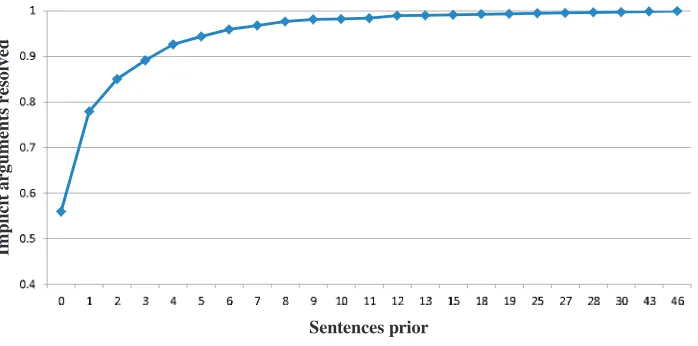
Figure 1
Location of implicit arguments. Of all implicitly filled argument positions, they-axis indicates
the percentage that are filled at least once within the number of sentences indicated by thex-axis
(multiple fillers may exist for the same position).
produce many false positives without a significant increase in recall. Section 6 discusses additional implications of this skewed distribution.
4. Implicit Argument Model 4.1 Model Formulation
Given a nominal predicate instancepwith a missing argument positioniargn, the task is to search the surrounding discourse for a constituent c that fillsiargn. The implicit argument model conducts this search over all constituents that are marked with a core argument label (arg0, arg1, etc.) associated with a NomBank or PropBank predicate. Thus, the model assumes a pipeline organization in which a document is initially analyzed by traditional verbal and nominal SRL systems. The core arguments from this stage then become candidates for implicit argumentation. Adjunct arguments are excluded.
A candidate constituentcwill often form a coreference chain with other constituents in the discourse. Consider the following abridged sentences, which are adjacent in their Penn TreeBank document:
(30) [Mexico] desperately needs investment.
(31) Conservative Japanese investors are put off by [Mexico’s] investment regulations.
(32) Japan is the fourth largest investor in [cMexico], with 5% of the total [pinvestments].
Gerber and Chai SRL of Implicit Arguments for Nominal Predicates
Table 2
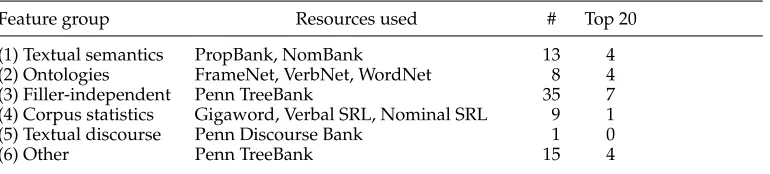
Primary feature groups used by the model. The third column gives the number of features in the group, and the final column gives the number of features from the group that were ranked in the top 20 among all features.
Feature group Resources used # Top 20
(1) Textual semantics PropBank, NomBank 13 4
(2) Ontologies FrameNet, VerbNet, WordNet 8 4
(3) Filler-independent Penn TreeBank 35 7
(4) Corpus statistics Gigaword, Verbal SRL, Nominal SRL 9 1
(5) Textual discourse Penn Discourse Bank 1 0
(6) Other Penn TreeBank 15 4
one can draw evidence from other mentions inc’s coreference chain. Example (30) states that Mexico needs investment. Example (31) states that Mexico regulates investment. These propositions, which can be derived via traditional SRL analyses, should increase our confidence thatcis theiarg2ofinvestmentin Example (32).
Thus, the unit of classification for a candidate constituent c is the three-tuple p,iargn,c, wherecis a coreference chain comprisingcand its coreferent constituents.6 We defined a binary classification functionPr(+| p,iargn,c) that predicts the probabil-ity that the entprobabil-ity referred to bycfills the missing argument positioniargnof predicate instance p. In the remainder of this article, we will refer to c as the primary filler, differentiating it from other mentions in the coreference chain c. This distinction is necessary because our evaluation requires the model to select at most one filler (i.e.,c) for each missing argument position. In the following section, we present the feature set used to represent each three-tuple within the classification function.
4.2 Model Features
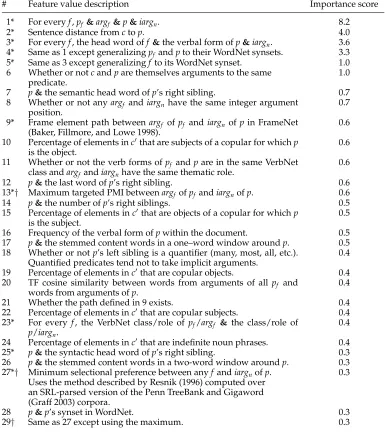
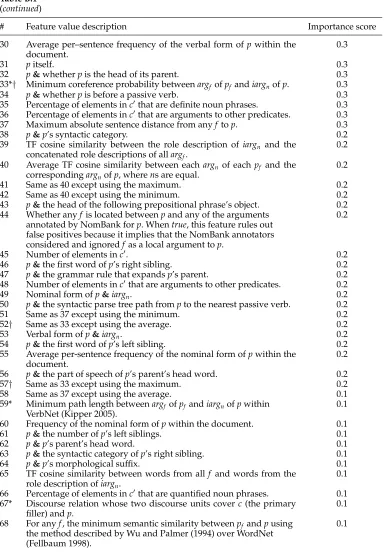
Appendix Table B.1 lists all features used by the model described in the previous section. For convenience, Table 2 presents a high-level grouping of the features and the resources used to compute them. The broadest distinction to be made is whether a feature depends on elements ofc. Features inGroup 3do not, whereas all others do. The features inGroup 3characterize the predicate–argument position being filled (pand iargn), independently of the candidate filler. This group accounts for 43% of the features and 35% of those in the top 20.7The remaining features depend on elements ofcin some way.Group 1features characterize the tuple using the SRL propositions contained in the text being evaluated.Group 2features place thep,iargn,ctuple into a manually constructed ontology and compute a value based on the structure of that ontology. Group 4features compute statistics of the tuple within a large corpus of semantically analyzed text.Group 5contains a single feature that captures the discourse structure properties of the tuple. Group 6 contains all other features, most of which capture the syntactic relationships between elements ofcandp. In the following sections, we provide detailed examples of features from each group shown in Table 2.
6 We used OpenNLP for coreference identification:http://opennlp.sourceforge.net.
4.2.1 Group 1: Features Derived from the Semantic Content of the Text.Feature 1was often selected first by the feature selection algorithm. This feature captures the semantic properties of the candidate filler c and the argument position being filled. Consider the following Penn TreeBank sentences:
(33) [arg0The two companies] [pproduce] [arg1market pulp, containerboard and white paper]. The goods could be manufactured closer to customers, saving [pshipping] costs.
Here we are trying to fill theiarg0 ofshipping. Letccontain a single mention,The two
companies, which is thearg0ofproduce. Feature 1 takes a value ofproduce−arg0−ship−
arg0. This value, which is derived from the text itself, asserts that producers are also shippers. To reduce data sparsity, we generalized the predicates to their WordNet synset IDs (creating Feature 4). We also generalized the predicates and arguments to their VerbNet thematic roles using SemLink (creating Feature 23). Although the generalized features rely on ontologies, they do so in a trivial way that does not take advantage of the detailed structure of the ontologies. Such structure is used by features in the next group.
4.2.2 Group 2: Features Derived from Manually Constructed Ontologies.Feature 9captures the semantic relationship between predicate–argument positions by examining paths between frame elements in FrameNet. SemLink8maps PropBank argument positions to their FrameNet frame elements. For example, thearg1position ofsellmaps to theGoods frame element of theSell frame. NomBank argument positions (e.g., arg1 of sale) can be mapped to FrameNet by first converting the nominal predicate to its verb form. By mapping predicate–argument structures into FrameNet, one can take advantage of the rich network of frame–frame relations provided by the resource.
The value of Feature 9 has the following general form:
(34) Frame1.FE1
Rel1
−−−→Frame2.FE2
Rel2
−−−→. . .−−−−−→Reln−1 Framen.FEn
This path describes how the frame elements at either end are related. For example, consider the frame element path between the arg1 ofsell and thearg1 ofbuy, both of which denote the goods being transferred:
(35) Sell.Goods−−−−→Inherits Give.Theme−−−→Causes Get.Theme−−−−−−→Inherited by Buy.Goods
This path can be paraphrased as follows: things that are sold (Sell.Goods) are part of a more general give scenario (Give.Theme) that can also be viewed as a get scenario (Get.Theme) in which the buyer receives something (Buy.Goods). This complex world knowledge is represented compactly using the relationships defined in FrameNet. In our experiments, we searched all possible frame element paths of length five or less that use the following relationships:
r
Causative–ofGerber and Chai SRL of Implicit Arguments for Nominal Predicates
r
Inchoative–ofr
Inheritsr
Precedesr
Subframe–ofFeature 9 is helpful in situations such as the following (contrived):
(36) Consumers bought many [ccars] this year at reduced prices.
(37) [pSales] are expected to drop when the discounts are eliminated.
In Example (37) we are looking for the iarg1 (thing sold) of sale. The path shown in Example (35) indicates quite clearly that the candidatecarsfrom Example (36), being the entity purchased, is a suitable filler for this position. Lastly, note that the value for Feature 9 is the actual path instead of a numeric value. Whenccontains multiple coreferential elements, this feature can be instantiated using multiple values (i.e., paths). Ultimately, these instantiations are binarized into the LibLinear input format, so the existence of multiple feature values does not pose a problem.
Feature 59 is similar to Feature 9 (the frame element path) except that it cap-tures the distance between predicate–argument positions within the VerbNet hierarchy. Consider the following VerbNet classes:
13.2 lose, refer, relinquish, remit, resign, restore, gift, hand out, pass out, shell out 13.5.1.1 earn, fetch, cash, gain, get, save, score, secure, steal
The path fromearntolosein the VerbNet hierarchy is as follows:
(38) 13.5.1.1↑13.5.1↑13.5↑13↓13.2
The path in Example (38) is four links long. Intuitively,earnandloseare related to each other—they describe two possible outcomes of a financial transaction. The VerbNet path quantifies this intuition, with shorter paths indicating closer relationships. This informa-tion can be used to identify implicit arguments in situainforma-tions such as the following from the Penn TreeBank (abridged):
(39) [cMonsanto Co.] is expected to continue reporting higher [pearnings].
(40) The St. Louis-based company is expected to report that [plosses] are narrowing.
are not compatible. Lastly, recall thatcmight contain multiple coreferential elements. In such a situation, the minimum path length is selected as the value for this feature.
4.2.3 Group 3: Filler-independent Features.Many of the features used by the model do not depend on elements ofc. These features are usually specific to a particular predicate. Consider the following example:
(41) Statistics Canada reported that its [arg1industrial–product] [pprice] index dropped 2% in September.
The “[pprice] index” collocation is rarely associated with anarg0 in NomBank or with an iarg0 in the annotated data (both argument positions denote the seller).Feature 25 accounts for this type of behavior by encoding the syntactic head of p’s right sibling. The value of Feature 25 for Example 41 isprice:index. Contrast this with the following:
(42) [iarg0The company] is trying to prevent further [pprice] drops.
The value of Feature 25 for Example (42) isprice:drop. This feature captures an important distinction between the two uses ofprice: the former cannot easily take aniarg0, whereas the latter can. Many other features in Table B.1 depend only on the predicate and have values that take the formpredicate:feature value.
4.2.4 Group 4: Features Derived from Corpus Statistics.Feature 13is inspired by the work of Chambers and Jurafsky (2008), who investigated unsupervised learning of narrative event sequences using pointwise mutual information (PMI) between syntactic positions. We extended this PMI score to semantic arguments instead of syntactic dependencies. Thus, the value for this feature is computed as follows:
pmi(p1,argi,
p2,argj
)=log Pcoref pmi(p1,argi,
p2,argj
) Pcoref pmi(p1,argi,∗)Pcoref pmi(
p2,argj
,∗) (2)
We computed Equation (2) by applying verbal SRL (Punyakanok, Roth, and Yih 2008), nominal SRL (Gerber, Chai, and Meyers 2009), and coreference identification (OpenNLP) to the Gigaword corpus (Graff 2003); because these tools are not fast enough to process all 1,000,000 documents in the corpus, however, we selected subsets of the corpus for each p1/p2 combination observed in our implicit argument data. We first indexed the Gigaword corpus using the Lucene search engine.9 We then queried this index using the simple boolean query “p1 ANDp2,” which retrieved documents relevant to the predicates considered in Equation (2). Assuming the resulting data have Ncoreferential pairs of arguments, the numerator in Equation (2) is defined as follows:
Pcoref pmi(p1,argi,
p2,argj
)= #coref(p1,argi,
p2,argj
)
N (3)
In Equation (3), #coref returns the number of times the given argument positions are found to be coreferential. In order to penalize low-frequency observations with
Gerber and Chai SRL of Implicit Arguments for Nominal Predicates
artificially high scores, we used the simple discounting method described by Pantel and Ravichandran (2004) resulting in the following modification of Equation (3):
x=#coref(p1,argi,
p2,argj
) Pcoref pmi(p1,argi,
p2,argj
)= x
N∗x+x 1 (4)
Thus, if two argument positions are rarely observed as coreferent, the value x x+1 will be small, reducing the PMI score. The denominator in Equation (2) is computed with a similar discount factor:
x1=#coref(p1,argi,∗) x2=#coref(
p2,argj
,∗)
Pcoref pmi(p1,argi,∗)Pcoref pmi(
p2,argj
,∗)= x1x2 (N2) min(x1,x2)
min(x1,x2)+1
(5)
Thus, if either of the argument positions is rarely observed as coreferent with other argument positions, the value min(x1,x2)
min(x1,x2)+1 will be small, making the denominator of
Equation (2) large, reducing the PMI score. In general, the discount factors reduce the PMI score for argument positions that are not frequent in the corpus.
We refer to Equation (2) as atargetedPMI score because it relies on data that have been chosen specifically for the calculation at hand. Table 3 shows a sample of targeted PMI scores between thearg1oflossand other argument positions. There are two things to note about this data: First, the argument positions listed are all naturally related to thearg1 of loss. Second, the discount factor changes the final ranking by moving the less frequentrecouppredicate from a raw rank of 1 to a discounted rank of 3, preferring instead the more commonwinpredicate.
The information in Table 3 is useful in situations such as the following (contrived):
(43) Mary won [cthe tennis match].
(44) [arg0John’s] [ploss] was not surprising.
[image:21.486.54.437.589.663.2]In Example (44) we are looking for theiarg1ofloss. The information in Table 3 strongly suggests that the marked candidatec, being thearg1 ofwin, would be a suitable filler
Table 3
Targeted PMI scores between thearg1oflossand other argument positions. The second column
gives the number of times that the argument position in the row is found to be coreferent with
thearg1of thelosspredicate. A higher value in this column results in a lower discount factor.
See Equation (4) for the discount factor.
Argument position #coref with loss.arg1 Raw PMI score Discounted PMI score
win.arg1 37 5.68 5.52
gain.arg1 10 5.13 4.64
recoup.arg1 2 6.99 4.27
steal.arg1 4 5.18 4.09
for this position. Lastly, note that if c were to form a coreference chain with other constituents, it would be possible to calculate multiple PMI scores. In such cases, the targeted PMI feature uses the maximum of all scores.
Feature 27captures the selectional preference of a predicatepfor the elements inc with respect to argument positioniargn. In general, selectional preference scores denote the strength of attraction for a predicate–argument position to a particular word or class of words. To calculate the value for this feature, we used the information–theoretic model proposed by Resnik (1996), which is defined as follows:
Pref(p,argn,s∈WordNet)=
Pr(s|p,argn)log
Pr(s|p,argn) Pr(s)
Z (6)
Z=
si∈WordNet
Pr(si|p,argn)log
Pr(si|p,argn) Pr(si)
In Equation (6), Pref calculates the preference for a WordNet synset s in the given predicate–argument position. Prior and posterior probabilities forswere calculated by examining the arguments present in the Penn TreeBank combined with 20,000 docu-ments randomly selected from the Gigaword corpus. PropBank and NomBank supplied arguments for the Penn TreeBank, and we used the aforementioned verbal and nominal SRL systems to extract arguments from Gigaword. The head word for each argument was mapped to its WordNet synsets, and counts for these synsets were updated as suggested by Resnik (1996). Note that a synset s that is not observed in the training data will receive a score of zero becausePr(s|p,argn) will be zero.
Equation (6) computes the preference of a predicate–argument position for a synset; a single word can map to multiple synsets if its sense is ambiguous, however. Given a wordwand its synsetss1,s2,. . .,sn, the preference of a predicate–argument position for wis defined as follows:
Pref(p,argn,w)=
siPref(p,argn,si)
n (7)
That is, the preference for a word is computed as the average preference across all possi-ble synsets. The final value for Feature 27 is computed using the word-based preference score defined in Equation (7). Given a candidate implicit argument c comprising the primary fillercand its coreferent mentions, the following value is obtained:
Pref(p,iargn,c)=min
f∈cPref(p,argn,f) (8)
In Equation (8), each f is the syntactic head of a constituent from c. The value of Equation (8) is in (−∞,+∞), with larger values indicating higher preference forcas the implicit filler of positioniargn.
Gerber and Chai SRL of Implicit Arguments for Nominal Predicates
discounting to penalize low–frequency observations, producing an estimate of coreference probability as follows:
Corefjoint=#coref(p1,argi,
p2,argj
) Corefmarginal=#coref(p1,argi,∗)
Pcoref(p1,argi,
p2,argj
)= Corefjoint Corefmarginal ∗
Corefjoint Corefjoint+1 ∗
Corefmarginal
Corefmarginal+1 (9)
In Equation (9), Pcoref should be read as “the probability that p1,argi is coref-erential withp2,argj
givenp1,argiis coreferential with something.” For example, we observed that thearg1 for predicatereassess (the entity reassessed) is coreferential with six other constituents in the corpus. Table 4 lists the argument positions with which this argument is coreferential along with the raw and discounted probabilities. The discounted probabilities can help identify the implicit argument in the following contrived examples:
(45) Senators must rethink [ctheir strategy for the upcoming election].
(46) The [preassessment] must begin soon.
In Example (46) we are looking for theiarg1 ofreassess. Table 4 tells us that the marked candidate (an arg1 to rethink) is likely to fill this missing argument position. When
c forms a coreference chain with other constituents, this feature uses the minimum coreference probability between the implicit argument position and elements in the chain.
4.2.5 Group 5: Features Derived from the Discourse Structure of the Text.Feature 67identifies the discourse relation (if any) that holds between the candidate constituentcand the filled predicatep. Consider the following example:
(47) [iarg0SFE Technologies] reported a net loss of $889,000 on sales of $23.4 million.
(48) That compared with an operating [ploss] of [arg1$1.9 million] on sales of $27.4 million in the year–earlier period.
[image:23.486.52.434.607.663.2]In this case, acomparisondiscourse relation (signaled by the underlined text) holds be-tween the first and second sentence. The coherence provided by this relation encourages
Table 4
Coreference probabilities betweenreassess.arg1and other argument positions. See Equation (9)
for details on the discount factor.
Argument Raw coreference probability Discounted coreference probability
rethink.arg1 3/6=0.5 0.32
define.arg1 2/6=0.33 0.19
an inference that identifies the markediarg0(the loser). The value for this feature is the name of the discourse relation (e.g.,comparison) whose two discourse units cover the candidate (iarg0 above) and filled predicate (p above). Throughout our investigation, we used gold-standard discourse relations provided by the Penn Discourse TreeBank (Prasad et al. 2008).
4.2.6 Group 6: Other Features.A few other features that were prominent according to our feature selection process are not contained in the groups described thus for.Feature 2 encodes the sentence distance fromc(the primary filler) to the predicate for which we are filling the implicit argument position. The prominent position of this feature agrees with our previous observation that most implicit arguments can be resolved within a few sentences of the predicate (see Figure 1 on p. 770).Feature 3is another simple yet highly ranked feature. This feature concatenates the head of an element of c with p and iargn. For example, in sentences (45) and (46), this feature would have a value of strategy−reassess−arg1, asserting that strategies are reassessed.Feature 5generalizes this feature by replacing the head word with its WordNet synset.
4.2.7 Comparison with Features for Traditional SRL. The features described thus far are quite different from those used in previous work to identify arguments in the traditional nominal SRL setting (see the work of Gerber, Chai, and Meyers 2009). The most impor-tant feature used in traditional SRL—the syntactic parse tree path—is notably absent. This difference is due to the fact that syntactic information, although present, does not play a central role in the implicit argument model. The most important features are those that capture semantic properties of the implicit predicate–argument position and the candidate filler for that position.
4.3 Post-processing for Final Output Selection
Without loss of generality, assume there exists a predicate instancepwith two missing argument positions iarg0 and iarg1. Also assume that there are three candidate fillers
c1,c2, andc3within the candidate window. The discriminative model will calculate the probability that each candidate fills each missing argument position. Graphically:
iarg0 iarg1
c1 0.3 0.4
c2 0.1 0.05
c3 0.6 0.3
There exist two constraints on possible assignments of candidates to positions. First, a candidate may not be assigned to more than one missing argument position. To enforce this constraint, only the top-scoring cell in each row is retained, leading to the following:
iarg0 iarg1
c1 - 0.4
c2 0.1
-Gerber and Chai SRL of Implicit Arguments for Nominal Predicates
Second, a missing argument position can only be filled by a single candidate. To enforce this constraint, only the top-scoring cell in each column is retained, leading to the following:
iarg0 iarg1
c1 - 0.4
c2 -
-c3 0.6
-Having satisfied these constraints, a thresholdtis imposed on the remaining cell prob-abilities.10 Cells with probabilities less thantare cleared. Assuming thatt=0.42, the final assignment would be as follows:
iarg0 iarg1
c1 -
-c2 -
-c3 0.6
-In this case, c3 fills iarg0 with probability 0.6 and iarg1 remains unfilled. The latter outcome is desirable because not all argument positions have fillers that are present in the discourse.
5. Evaluation 5.1 Data
All evaluations in this study were performed using a randomized cross-validation configuration. The 1,247 predicate instances were annotated document by document. In order to remove any confounding factors caused by specific documents, we first randomized the annotated predicate instances. Following this, we split the predicate instances evenly into ten folds and used each fold as testing data for a model trained on the instances outside the fold. This evaluation set-up is an improvement versus the one we previously reported (Gerber and Chai 2010), in which fixed partitions were used for training, development, and testing.
During training, the system was provided with annotated predicate instances. The system identified missing argument positions and generated a set of candidates for each such position. A candidate three-tuplep,iargn,cwas given a positive label if the candidate implicit argumentc(the primary filler) was annotated as filling the missing argument position; otherwise, the candidate three-tuple was given a negative label. During testing, the system was presented with each predicate instance and was required to identify all implicit arguments for the predicate.
Throughout the evaluation process we assumed the existence of gold-standard PropBank and NomBank information in all documents. This factored out errors from traditional SRL and affected the following stages of system operation:
r
Missing argument identification.The system was required to figure outwhich argument positions were missing. Each of the ten predicates was associated with an unambiguous role set, so determining the missing argument positions amounted to comparing the existing local arguments with the argument positions listed in the predicate’s role set. Because gold-standard local NomBank arguments were used, this stage produced no errors.
r
Candidate generation.As mentioned in Section 4.1, the set of candidatesfor a missing argument position contains constituents labeled with a core (e.g.,arg0) PropBank or NomBank argument label. We used gold-standard PropBank and NomBank arguments; it is not the case that all annotated implicit arguments are given a core argument label by PropBank or NomBank, however. Thus, despite the gold-standard argument labels, this stage produced errors in which the system failed to generate a true-positive candidate for an implicit argument position. Approximately 96% of implicit argument positions are filled by gold-standard PropBank or NomBank arguments.
r
Feature extraction.Many of the features described in Section 4.2 rely onunderlying PropBank and NomBank argument labels. For example, the top-ranked Feature 1 relates the argument position of the candidate to the missing argument position. In our experiments, values for this feature contained no errors because gold-standard PropBank and NomBank labels were used. Note, however, that many features were derived from the output of an automatic SRL process that occasionally produced errors (e.g., Feature 13, which used PMI scores between automatically identified arguments). These errors were present in both the training and evaluation stages.
We also assumed the existence of gold-standard syntactic structure when possible. This was done in order to focus our investigation on the semantic nature of implicit arguments.
5.2 Scoring Metrics
We evaluated system performance using the methodology proposed by Ruppenhofer et al. (2010). For each missing argument position of a predicate instance, the system was required to either (1) identify a single constituent that fills the missing argument position or (2) make no prediction and leave the missing argument position unfilled. To give partial credit for inexact argument bounds, we scored predictions using the Dice coefficient, which is defined as follows:
Dice(Predicted,True)= 2∗ |Predicted
True|