ePrints Soton
Copyright © and Moral Rights for this thesis are retained by the author and/or other
copyright owners. A copy can be downloaded for personal non-commercial
research or study, without prior permission or charge. This thesis cannot be
reproduced or quoted extensively from without first obtaining permission in writing
from the copyright holder/s. The content must not be changed in any way or sold
commercially in any format or medium without the formal permission of the
copyright holders.
When referring to this work, full bibliographic details including the author, title,
awarding institution and date of the thesis must be given e.g.
AUTHOR (year of submission) "Full thesis title", University of Southampton, name
of the University School or Department, PhD Thesis, pagination
E-SCHOLARS IN THE SEMANTIC WEB
By
Simon Robert Kampa
B.Sc. (Hons)
A thesis submitted for the degree of
Doctor of Philosophy
Department of Electronics and Computer Science,
University of Southampton,
United Kingdom.
ABSTRACT
FACULTY OF ENGINEERING
ELECTRONICS AND COMPUTER SCIENCE DEPARTMENT
Doctor of Philosophy
Who are the Experts?
e-Scholars in the Semantic Web
by Simon Robert Kampa
Scholarly research is the sum of diverse activities and leads to the dissemination
of a large amount of material. Traditional approaches to exploring and becoming
proficient within an esoteric research field rely on slow and sometimes ineffective
discourse, and depend more on a scholar’s detective skill, effort, and perseverance.
However, the Web has introduced the potential for improved accessibility,
inter-connectivity, and more efficient and effective communication; we are becoming
e-Scholars.
Current efforts on the Web have focussed mainly on improving the accessibility
of on-line research material and as a result, researchers have yet to realise the full
implications of the new medium. Consequently, the emphasis must shift to
im-proving and enhancing access to scholarly material; this research proposes a novel
approach by presenting researchers with the facility to comprehensively, extensively,
and rationally explore their research field and ask intricate questions about it and
the individual facts and issues raised by it. This is realised through the integration
of principles from the hypertext, Semantic Web, and digital library fields to
inter-connect and analyse all scholarly material in the academic domain. The e-Scholar
Knowledge Inference Model (ESKIMO) demonstrates the approach and provides a
Contents
Acknowledgements xv
Chapter 1 Introduction 1
1.1 Research Motivation . . . 1
1.2 Research Statement and Contribution . . . 4
1.3 Thesis Structure . . . 5
1.4 Declaration . . . 5
Chapter 2 Hypertext and the Web 7 2.1 Introduction . . . 7
2.2 The Birth of Hypertext . . . 7
2.2.1 Memex . . . 8
2.2.2 NLS/Augment . . . 8
2.2.3 Xanadu . . . 9
2.3 Popularising Hypertext . . . 10
2.3.1 KMS . . . 10
2.3.2 Notecards . . . 11
2.3.3 Intermedia . . . 11
2.3.4 HyperTIES . . . 12
2.3.5 Hypercard . . . 12
2.4 Towards Open Systems . . . 13
2.4.1 Sun Link Service . . . 14
2.4.2 Microcosm . . . 15
2.4.3 Multicard . . . 16
2.4.4 Chimera . . . 16
2.4.5 The Distributed Link Service . . . 17
2.5 The World Wide Web . . . 18
2.5.1 Hyper-G . . . 21
2.5.2 Devise Hypermedia . . . 22
2.6 Linking on the Web . . . 23
2.6.1 Anchors . . . 23
2.6.2 Link Construction . . . 24
2.6.3 Declarative Linking? . . . 25
2.7 Link Semantics (and the Web) . . . 25
2.7.1 Textnet . . . 26
2.7.2 gIBIS . . . 27
2.7.3 MacWeb . . . 28
2.7.4 Aquanet . . . 28
2.7.5 XLink and XPointer . . . 29
2.8 Navigating the Web . . . 32
2.8.1 Navigation vs. Retrieval . . . 33
2.8.2 Navigation Issues . . . 33
2.9 Summary . . . 37
Chapter 3 The Cutting Edge of the Web: The Semantic Web 39 3.1 Introduction . . . 39
3.2 Before the Semantic Web: Metadata . . . 40
3.2.1 Attribute-based Metadata . . . 42
3.2.2 Object-based Metadata . . . 46
3.2.3 Metadata on the Web . . . 51
3.3 The Semantic Web . . . 52
3.3.1 Scenario . . . 53
3.3.2 Architectural Model . . . 54
3.4 Technologies for the Semantic Web . . . 59
3.4.1 Processing Documents . . . 59
3.4.2 Querying Documents . . . 60
3.4.3 Infrastructure: Agents and Web Services . . . 61
Chapter 4 Knowledge in the Semantic Web 64
4.1 Introduction . . . 64
4.2 Structuring Data and Ontologies . . . 65
4.3 Ontology Construction . . . 68
4.3.1 Conceptualisation and Capture . . . 69
4.3.2 Formalisation . . . 70
4.4 Ontology Tools . . . 71
4.4.1 Editors . . . 71
4.4.2 Collaborative Environments . . . 73
4.5 Ontologies in the Semantic Web . . . 74
4.5.1 SHOE . . . 74
4.5.2 Ontobroker Project . . . 75
4.5.3 RDFS . . . 77
4.5.4 DAML . . . 77
4.5.5 OIL . . . 78
4.5.6 DAML+OIL . . . 78
4.6 Alternatives to Ontologies . . . 79
4.6.1 Database Schemas . . . 79
4.6.2 Topic Maps . . . 80
4.7 Critique . . . 81
4.8 Researching the Semantic Web . . . 82
4.8.1 Ontobroker Project . . . 82
4.8.2 COHSE . . . 83
4.8.3 OntoPortal . . . 85
4.8.4 HealthCyberMap . . . 86
4.8.5 AKT . . . 86
4.8.6 OntoKnowledge . . . 87
4.8.7 Commercial Efforts . . . 88
4.9 Summary . . . 88
Chapter 5 From Scholars to e-Scholars 90 5.1 Introduction . . . 90
5.2.1 Research . . . 93
5.2.2 The Citation . . . 94
5.2.3 Peer Review . . . 96
5.3 The Next Scientific Revolution? . . . 96
5.3.1 Accessibility . . . 97
5.3.2 Peer Interaction . . . 97
5.3.3 Interconnectivity . . . 98
5.4 Publication on the Web . . . 99
5.4.1 E-print Archives . . . 100
5.4.2 Electronic Journals . . . 100
5.4.3 Digital Libraries . . . 103
5.5 Scholarly Analysis and the Web . . . 105
5.5.1 Citation Networks . . . 105
5.5.2 Bibliometrics . . . 107
5.6 Supporting e-Scholars . . . 111
5.6.1 D3E and JIME . . . 111
5.6.2 ScholOnto . . . 111
5.6.3 ResearchIndex . . . 114
5.6.4 Open Citation Project . . . 115
5.6.5 SLinkS . . . 116
5.6.6 Foxtrot . . . 117
5.7 Summary . . . 118
Chapter 6 Study: Research on the Web 120 6.1 Introduction . . . 120
6.2 Motivation . . . 120
6.3 Background Studies . . . 121
6.4 Survey . . . 122
6.5 Hypothesis . . . 124
6.6 The Experiment . . . 124
6.6.1 Experiment Questions . . . 124
6.6.2 Hardware and Software . . . 126
6.6.4 Assumptions . . . 127
6.7 Results . . . 127
6.7.1 Qualitative Analysis . . . 127
6.7.2 Quantitative Analysis . . . 130
6.8 Comment on Results . . . 134
6.9 Summary . . . 136
Chapter 7 Supporting Research in the Semantic Web 138 7.1 Introduction . . . 138
7.2 Representing the Scholarly Community . . . 139
7.3 Ontological Hypertext . . . 140
7.3.1 Intelligent Navigation . . . 144
7.3.2 Query-by-linking . . . 145
7.4 Scholarly Inquiry . . . 146
7.4.1 Reasoning over Scholarly Material . . . 146
7.4.2 Augmented Bibliometrics . . . 149
7.5 Web Scholar System . . . 150
7.6 Related Work . . . 152
7.6.1 Hypertext Semantics . . . 152
7.6.2 Thoth-II . . . 153
7.6.3 Ontobroker . . . 155
7.6.4 ConceptLab . . . 155
7.6.5 Web of Knowledge . . . 156
7.6.6 PROPIE . . . 157
7.6.7 ScholOnto . . . 158
7.7 Summary . . . 159
Chapter 8 Scholarly Hypertext in the Semantic Web: OntoPortal 161 8.1 Introduction . . . 161
8.2 Overview . . . 162
8.2.1 Features . . . 163
8.2.2 Architecture . . . 165
8.3.1 Installation . . . 167
8.3.2 Navigating and Exploring . . . 169
8.3.3 Authoring . . . 174
8.4 Applications of OntoPortal . . . 177
8.4.1 MetaPortal . . . 177
8.4.2 TPortal and XPortal . . . 178
8.4.3 Icon Directory . . . 179
8.5 Commentary . . . 181
8.6 Improvements . . . 182
8.7 Summary . . . 183
Chapter 9 Supporting e-Scholars with ESKIMO 185 9.1 Introduction . . . 185
9.2 Scholarly community Ontology . . . 186
9.2.1 Overview . . . 186
9.2.2 Representation . . . 188
9.2.3 Evaluation and Documentation . . . 190
9.3 Hypertext Research Theme Ontology . . . 191
9.4 Populating ESKIMO . . . 193
9.4.1 Data Acquisition . . . 193
9.4.2 Knowledge Acquisition . . . 194
9.5 Architecture . . . 196
9.5.1 Query Engine . . . 198
9.5.2 Ontological Hypertext Engine . . . 199
9.5.3 Inference Engines . . . 199
9.5.4 Output Controller . . . 203
9.6 ESKIMO in Practice . . . 204
9.6.1 Navigating Scholarly Material . . . 204
9.6.2 Scholarly Inquiry . . . 208
9.7 Integrating ESKIMO . . . 217
9.8 Evaluating ESKIMO . . . 220
9.8.1 Structure of the evaluation . . . 220
9.8.3 Results . . . 223
9.8.4 Discussion of Results . . . 225
9.9 Summary . . . 226
Chapter 10 Conclusions and Further Work 229 10.1 e-Scholars in the Semantic Web . . . 229
10.1.1 Summary . . . 229
10.1.2 Influencing Work . . . 231
10.1.3 Where are we heading? . . . 232
10.2 Contributions . . . 232
10.2.1 Does the Web support scholarly activity? . . . 232
10.2.2 The Scholarly Community . . . 233
10.2.3 Interlinking Research Material using Ontological Hypertext . 233 10.2.4 Supporting Scholarly Inquiry . . . 233
10.2.5 Scholarly Research in the Semantic Web . . . 233
10.2.6 An Integration Exercise . . . 234
10.3 Further Work . . . 234
10.3.1 Who are the experts? . . . 234
10.3.2 The Knowledge Cycle . . . 234
10.3.3 Supporting other Research Areas . . . 235
10.3.4 Temporal Aspects . . . 236
10.3.5 Facts and Issues . . . 236
10.3.6 Scholarly Services . . . 237
10.4 Concluding Statement . . . 237
Appendix A Experiment 1 Instructions 239
Appendix B Experiment 2 Instructions 241
Appendix C Scholarly Community Ontology represented in RDFS 244
Appendix D Scholarly Community Ontology Documentation 249
List of Figures
2.1 A KMS frame . . . 11
2.2 Hypertext timeline . . . 14
2.3 Structure of a URL . . . 19
2.4 Hyper-G data model . . . 21
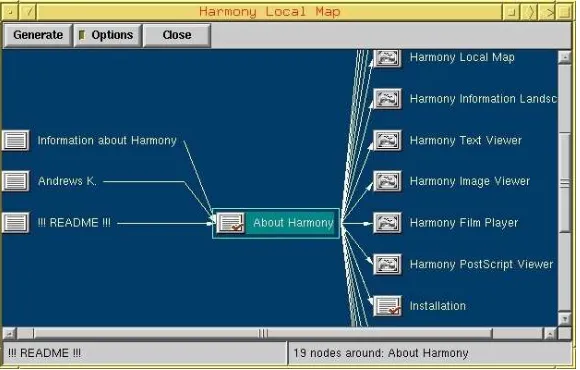
2.5 Harmony’s location map orientation tool . . . 22
2.6 Harmony’s collection browser . . . 22
3.1 MCF as a directed linked graph . . . 46
3.2 The RDF data model . . . 48
3.3 An example of the RDF data model . . . 49
3.4 XML Deployment . . . 50
3.5 Architectural model of the Semantic Web (Berners-Lee, 2000) . . . 55
3.6 Simple inference example . . . 57
4.1 Simple ontology example . . . 67
4.2 Stages in ontology construction . . . 68
4.3 An ontology construction process . . . 69
4.4 Part of a newspaper ontology . . . 71
4.5 Prot´eg´e 2000 interface . . . 72
4.6 Ontolingua Architecture . . . 73
4.7 Topic occurrences and associations . . . 80
4.8 The Ontology Triangle . . . 82
4.9 COHSE architecture . . . 84
5.1 Example entry in the SCI citation index (Garfield, 1979a) . . . 94
5.2 Post Modern electronic journal . . . 102
5.3 Searching the Post Modern e-journal . . . 102
5.4 ACM Digital Library . . . 104
5.5 Searching the ACM Digital Library . . . 105
5.6 Example citation network . . . 106
5.7 Co-citation vs. Coupling . . . 108
5.8 Co-citation network for the Computer Graphics discipline . . . 109
5.9 JIME interface . . . 112
5.10 Ontology used to represent claims . . . 112
5.11 ScholOnto Claim Maker . . . 113
5.12 Viewing concepts and claims in ScholOnto . . . 113
5.13 ResearchIndex - Document information . . . 115
5.14 ResearchIndex - Citation information . . . 115
5.15 ResearchIndex - Citation information . . . 116
6.1 Experiment technical setup . . . 126
6.2 Client tool for experiment . . . 126
6.3 Comparison of question durations with and without quality ratings 133 6.4 Comparison of number of resources with and without quality ratings 133 7.1 Constructing the scholarly community . . . 140
7.2 Ontological hypertext as a meta-layer over underlying Web resources 143 7.3 Hierarchical hypertext vs. Ontological hypertext . . . 144
7.4 WSS architecture . . . 150
7.5 Interface into WSS . . . 151
7.6 Ontological hypertext in WSS . . . 151
7.7 WSS Query window . . . 152
7.8 A Thoth-II network . . . 154
7.9 ConceptLab screen shot . . . 156
8.1 Context in OntoPortal . . . 164
8.2 OntoPortal Architecture . . . 165
8.3 Organisation of OntoPortal information . . . 167
8.4 OntoPortal database construction . . . 169
8.6 Theme introductory screen . . . 170
8.7 Trail 1/4 - Literature instances . . . 171
8.8 Trail 2/4 - Literature instance . . . 171
8.9 Trail 3/4 - Standard instance . . . 172
8.10 Trail 4/4 - Literature instance . . . 172
8.11 Searching in OntoPortal . . . 173
8.12 Search results in OntoPortal . . . 173
8.13 A discussion thread in OntoPortal . . . 174
8.14 Adding a discussion in OntoPortal . . . 174
8.15 OntoPortal author mode . . . 175
8.16 OntoPortal literature editing form . . . 176
8.17 OntoPortal import facility . . . 176
8.18 MetaPortal ontology . . . 178
8.19 TPortal ontology . . . 179
8.20 XPortal ontology . . . 179
8.21 Icon Directory ontology . . . 180
9.1 Scholarly community ontology . . . 187
9.2 Scholarly community ontology with themes . . . 191
9.3 Hypertext Theme Ontology . . . 192
9.4 Knowledge acquisition for ESKIMO . . . 195
9.5 Components of ESKIMO . . . 197
9.6 ESKIMO user request procedure . . . 197
9.7 ESKIMO query engine . . . 198
9.8 ESKIMO Ontological Hypertext engine . . . 199
9.9 ESKIMO inference engine . . . 200
9.10 Initial Screen (ESKIMO) . . . 204
9.11 All activities (ESKIMO) . . . 205
9.12 Theme selector (ESKIMO) . . . 205
9.13 Activity instance (ESKIMO) . . . 206
9.14 Published paper (ESKIMO) . . . 207
9.15 Person instance followed from the published paper (ESKIMO) . . . 208
9.17 Context icons (ESKIMO) . . . 209
9.18 Search results (ESKIMO) . . . 209
9.19 Seminal papers (ESKIMO) . . . 213
9.20 Experts of empirical studies in hypertext (ESKIMO) . . . 213
9.21 Queries available for the person concept (ESKIMO) . . . 214
9.22 Collaborators based on bibliometric measures (ESKIMO) . . . 214
9.23 Collaborators based on entire scholarly domain (ESKIMO) . . . 215
9.24 Co-cited fellow researchers (ESKIMO) . . . 216
9.25 Collaborating teams (ESKIMO) . . . 216
9.26 Team impact factor (ESKIMO) . . . 217
9.27 Augmenting ESKIMO: community View . . . 218
9.28 Augmenting ESKIMO: Analysis . . . 218
9.29 ESKIMO facilities within Adobe Acrobat . . . 219
List of Tables
5.1 Citation vs. Argumentation . . . 95
6.1 Answers to survey question 1 . . . 123
6.2 Answers to survey question 2 . . . 123
6.3 Questions for Task 1 . . . 125
6.4 Questions for Task 2 . . . 125
6.5 Primary methods used for solving Task 1 . . . 128
6.6 Primary methods used for solving Task 2 . . . 130
6.7 Duration of each question . . . 130
6.8 Table of unique resources visited by each participant . . . 131
6.9 Table of quality ratings for each question . . . 132
7.1 Contrasting approaches to resolving scholarly queries . . . 140
9.1 Slots for each concept in the Scholarly Ontology . . . 188
9.2 Questions supported by the classic bibliometrics inference engine . . 210
9.3 Questions supported by the augmented bibliometrics inference engine 211 9.4 Questions supported by the scholarly community inference engine . 212 9.5 Confidence values for the ESKIMO evaluation . . . 223
Acknowledgements
I would like to thank Leslie Carr for being a constructive, insightful, and
entertain-ing supervisor who has done an excellent job in supervising his first Ph.D. student.
Thanks must also go to all the people in the group who have helped me along the
way and always provided assistance when required. In particular, I would like to
thank Danius Michaelides and Timothy Miles-Board for spending a considerable
time proofreading my thesis and supplying useful feedback, and also Guillermo
Power, Gareth Hughes, and Mark Weal for sharing a bay and making my
work-ing environment a more pleasant, entertainwork-ing, and rewardwork-ing one. And lastly but
by no means least, I extend an enormous thanks to my parents who have always
supported and encouraged me in my work and my girlfriend Claire who was
ex-tremely supportive throughout and tolerated being completely ignored during the
final months of writing this thesis. (I think it’s now my turn to do the dishes for
the next few months.)
Chapter 1
Introduction
1.1 Research Motivation
Scholars (researchers, scientists, or academics) are individuals involved in advanced
learning within a well-defined speciality area who desire in-depth information to
support their research and enable the contribution of further ideas, thoughts,
theo-ries, and observations. Their prevailing activity is becoming proficient within their
chosen esoteric research field; a task that necessarily involves exploring and
examin-ing the material that the discipline has produced. This involves findexamin-ing papers in a
library, discussions with peers, and attending events like conferences. However, this
approach is slow and sometimes ineffective and relies on scholars using detective
skills (e.g. What did this author go on to write?,What other papers discuss this
is-sue?, and Who else works on this project?) and considerable effort in investigating
the field.
While conducting research, scholars frequently make pertinent and intricate
questions about the material they encounter and their discipline in general, such
as What has this author gone on to write?, What are the significant papers in this
field?, Who collaborates with this person?, and How has this theory affected this
field? New postgraduate students in particular, must determine the seminal papers
and experts in their research field to enable them to become proficient and
con-tribute to the field. Reviewing papers requires researchers to be aware of significant
and related material and be able to position the paper in the context of the entire
field. Answering these questions relies on peers, and significant effort and detective
ability.
The World Wide Web, a global and distributed information repository, has the
potential to improve support for scholarly research by providing improved
accessi-bility and interconnectivity to enormous amounts of scholarly material. This has
already resulted in thousands of electronic journals and digital libraries appearing,
new peer review potentials being explored (Harnad, 1991), and more efficient and
effective discourse (Valauskas, 1997; Sumner & Shum, 1998). Indeed, these unique
opportunities prompted Dewar (1998) to note that “there are some provocative
parallels” with the Scientific Revolution. As a result, we are becoming electronic
scholars (e-Scholars).
Most of the initial effort has been on placing scholarly literature on-line and
referencing it using technologies like the Digital Object Identifier (DOI), although
less research has been directed at how the access of on-line papers can be enhanced
by fully exploiting the multifaceted potentials that the medium provides. The
emphasis must therefore shift from placing literature on-line, to improving and
enhancing access to it.
However, as in paper-based research, the scholarly material on the Web is centred
on literature, and related and peripheral material and information is not
intercon-nected. For example, information on researchers, activities, organisations, societies,
conferences, and journals are rarely explicitly linked, partly due to conflicting rights
of publishers, and partly due to the lack of infrastructure, technology, and
expe-rience. Thus, researchers view papers as isolated documents and fail to further
analyse, examine, and draw from its many associations to additional information.
When a paper is located, it is printed and read, although, aside from following
citations, the scholar rarely is able to further explore related material. However,
with an explicit understanding of a paper’s authors, where they work, and what
projects they work on, it would be possible to effectively answer questions such as
What other projects has this organisation produced?, What papers has this project
produced?, and Who are the colleagues of this researcher?
The pertinent and intricate questions scholars ask about the material in their
research field are poorly supported by the keyword-based search engines prevalent
Therefore, e-Scholars are locked in a similar situation as their paper-based
coun-terparts; finding, examining, and asking questions about scholarly material require
significant effort and detective ability.
This research therefore proposes a novel research environment that provides
scholars with the facility to exploreall the material in their research field extensively
and intelligently, and ask intricate questions about it. The approach draws from
three distinct research fields: hypertext, the Semantic Web, and digital libraries.
Hypertext is the organisation of information fragments into connected
associ-ations. Initially, this was used to connect documents, although the use of link
semantics to accurately specify the intended semantics of a relation, and link
ab-straction to enable links to be manipulated, processed, and analysed as independent
link specifications, have been proposed and are applied in this research.
Hypertext also introduces a new form of searching information by navigating the
interconnected hypertext fragments. This form of information seeking is suitable for
scholars who frequently do not have specific information on papers or researchers
and instead browse scholarly material and home in on relevant work. However,
poorly constructed hypertexts introduce problems of disorientation and cognitive
overload (Conklin, 1987; Cockburn & Jones, 1996) and effective scholarly hypertexts
have yet to be fully realised on the Web (Baragar, 1995; Theng, 1999).
The Semantic Web is an initiative to extend the Web with machine readable
and understandable knowledge about its content. Fundamental to this initiative
are ontologies; a mechanism to provide an explicit conceptualisation of a domain
and enable machines to understand the information described on the Web. The
Semantic Web dramatically improves the potential to support scholars. This has
already been demonstrated to improve interconnectivity of documents (Carret al.,
2001) and provide semantic access to annotated knowledge from Web pages (Fensel
et al., 1998).
In this research, an explicit model of scholarly material is used to
automati-cally construct scholarly hypertexts and present researchers with a principled,
con-sistent, and highly interlinked hypertext; a concept termed ontological hypertext.
Furthermore, machine reasoning is employed to respond to the intricate questions
Two systems, OntoPortal and ESKIMO, have been implemented to embrace
these principles and provide scholars with a novel exploration environment that
allows them to comprehensively and intelligently explore their research field and
ask pertinent questions about it.
ESKIMO demonstrates the potentials that the Semantic Web provides to
sup-port scholarly research and provides the platform for evaluation and further
re-search. Facilities not available in traditional paper-based research or on the Web
are demonstrated, and evaluations indicate that these encourage researchers to take
a more active and involved role in their information exploration task. Furthermore,
new interoperability standards for scholarly data (Hellman, 1999; Lagoze & de
Som-pel, 2001; Brodyet al., 2001b), mean it will become possible to dynamically update
and maintain these advanced services and allow scholars to track the developments
in their field as they happen.
1.2 Research Statement and Contribution
The objective of this research is to explore and identify methods of supporting and
enhancing scholarly research on the Web. The Semantic Web has introduced a
framework to enable machines to understand the content of scholarly material, and
a novel approach is proposed that draws from this to present scholars with new
research possibilities. This involves the intelligent interlinking of scholarly material
and machine analysis to respond to typical research questions.
The contributions of this work are:
• Assessing how the Web currently measures up to a scholar’s research activities.
• Proposingontological hypertext as a method of interlinking complex research
fields to construct a principled and consistent scholarly hypertext.
• Identifying typical research questions and providing the facility to resolve
them efficiently.
• Implementing a scholarly research environment to enable researchers to
ex-plore their research field and all its related artifacts and objects, and ask
1.3 Thesis Structure
Chapters 2, 3, 4, and 5 cover important background material and related work. No
new contributions are presented in these chapters.
Chapter 2 introduces the hypertext concept and identifies the key issues used in
this thesis. Significant historical and contemporary hypertext systems are described.
Chapter 3 introduces the Semantic Web initiative. The Semantic Web is
pro-moting an intelligent Web where navigation, information retrieval, and machine
processing will benefit from machines being able to understand the content of the
documents.
Chapter 4 describes ontologies, which are a fundamental part of the
Seman-tic Web. They provide a mechanism for defining complex domains for machine
understanding.
Chapter 5 introduces scholars and their research activities. Traditional research
techniques are introduced as well as the new approaches possible on the Web.
Chapters 6, 7, 8, and 9 detail the contributions made from this thesis work.
Chapter 6 discusses a user experiment that was conducted to measure the
sup-port the Web affords to scholarly research.
Chapter 7 introduces the key concepts from this research, namely the
interlink-ing of scholarly material and how inquiry can be supported.
Chapter 8 discusses the OntoPortal system, which demonstrates how complex
research fields can be interlinked and presented to the researcher in a principled
and consistent manner.
Chapter 9 covers the ESKIMO system, which provides a comprehensive support
environment for scholars that enables them to explore their research field and make
pertinent questions about it. An evaluation of this system is also presented.
Chapter 10 concludes this thesis by reviewing the work and proposing ideas for
further work.
1.4 Declaration
The work contained within this thesis has been carried out within a collaborative
Dr. Leslie Carr and Timothy Miles-Board were involved in discussions and
imple-mentation of the OntoPortal system as part of a contract between IAM and DERA,
Chapter 2
Hypertext and the Web
2.1 Introduction
This chapter introduces the hypertext concept, the organisation of information
fragments into connected associations, its advancements, and its use in a global
information system, the World Wide Web.
Hypertext is essential to this research as it provides the facility and technology
to interconnect diverse scholarly material and present researchers with a complete,
coherent, and traversable view of the material they are interested in. Developments
in hypertext, particularly adding semantics to links and abstracting links from the
documents they appear in, have also introduced new approaches to presenting,
managing, and analysing hypertext that this research draws from and evolves into
the ontological hypertext concept described in Chapter 7.
A brief historical background to hypertext is presented, followed by an overview
of the significant advances, particularly those in the context of this research. The
concepts of hypertext linking and how explicit link semantics are used to improve
an author’s and user’s view of connected material are then explored. Hypertext also
enables navigation as a new paradigm for exploring documents, this is explained,
and the problems it introduces outlined.
2.2 The Birth of Hypertext
Hypertext1 is the organisation of information into connected associations. It is
about non-sequential text. One could argue that the roots of hypertext are in
1
The term hypermedia is used when referring to any type of media.
ecclesiastical readings such as the bible, where cross-referencing and annotations
are common.
However, if we presume that hypertext refers to the non-sequential reading of
digital documents, then the roots are found approximately 57 years ago. In 1945
the director of the Office of Scientific Research and Development, Vannevar Bush,
published his seminal paper describing what he called the “Memex”.
2.2.1 Memex
Memex (Bush, 1945) (“memory extender”) was a revolutionary, albeit fictional,
device to store all an individual’s records, books, and literature and provide an
ac-cess mechanism based on linking everything together. Bush proposed microfiche as
the storage mechanism (resulting in stored information being off-line with reduced
access speeds).
Bush was struck by the “growing mountain of research” and realised that the
plethora of publications inhibited scholars making “real” use of it. It appeared to
Bush that the main problem was that of selection, or information retrieval, and this
he noted was down to the storage, structure, and tagging of the information.
The Memex was envisioned to provide a global storage system and enable users
to make connections between fragments of information. Bush referred to these
connections as trails and the practice of making these resulted in a “trail of
inter-est” being constructed. Trails represent an individual’s path as they traverse the
literature and are recalled at a later stage to help re-navigate the information.
Sub-sequent systems, such as MEMOIR (Pikrakiset al., 1998), have used this notion to
analyse user trails and suggest further paths worth exploring.
2.2.2 NLS/Augment
The first successful implementation of the hypertext concept was not presented
until 1963, when a research team lead by Douglas Englebart (better known for
in-troducing the mouse as a revolutionary pointing device) developed the NLS (oNLine
System) to realise his vision of using machines to provide instantaneous connections
between documents (in contrast to Bush’s proposal of microfiche). In tribute to this
work, the NLS system was chosen as the second node on the ARPANET network,
NLS provided cross-referencing of research papers for sharing among
geograph-ically distributed scientists, which allowed early digital libraries to be created and
their papers retrieved using hypertext linking. The objective of NLS was therefore
to boost significantly an individual’s, a group’s, and an organisation’s performance
by providing fast access to interlinked material.
The system consisted of three major components: a database of text fragments,
view filters (used to view particular information sets), and views (used to structure
information). Documents in NLS were marked up with anchor information to form
the endpoints of links. NLS later evolved and was commercialised into Augment
(Engelbart et al., 1973).
2.2.3 Xanadu
In 1965 another visionary, Theodor Nelson, first coined the word hypertext (as
“non-sequential writing”) and proposed the publishing system Xanadu (Nelson,
1980; Nelson, 1987) as a unified literary environment. The purpose of Xanadu
was to establish Nelson’s view of a ‘docuverse’: a searchable global library of all
documents ever published interconnected using hypertext technology. Xanadu has
so far failed to be fully implemented although it has been released into the open
source community.
Xanadu represented the first concerted effort towards developing a complex and
comprehensive hypertext system. Nelson proposed a mechanism by which any
ver-sion of a document was stored only once and linked to whenever it was required,
resulting in a significant reduction in storage requirements. Nelson referred to this as
transclusion and the documents where the actual text was archived as permascrolls.
Transclusion offers many advantages aside from storage. Firstly, as text
frag-ments are only stored once, versioning becomes manageable as newer versions
re-place earlier text fragments and links are provided to the previous versions. Authors
transcluding these text fragments are therefore guaranteed that they are always
including the latest version. Secondly, transclusion enables readers to view all
doc-uments in the docuverse that contain the transcluded fragment, or view the source
text where the fragment originally occurs. Finally, it also makes the collection of
of copyrighted text is transcluded into a document this can be recorded and used
when royalty fees are calculated.
Nelson introduced the concept of different link types between documents in
Xanadu but stated that the definition and use of these link types was the
respon-sibility of the author.
2.3 Popularising Hypertext
This section outlines the significant work that was published in the early stages of
hypertext research and was influential in the use and promotion of the hypertext
concept for a variety of different scenarios and applications.
2.3.1 KMS
KMS (Knowledge Management System) (Akscyn et al., 1988) was a highly
devel-oped commercial hypertext system designed to “help organisations manage their
knowledge” and was used in various applications such as electronic publishing,
on-line manuals, project management, and software engineering documents. It was
based on ZOG, which provided users with a task management system and
inter-linked on-line manuals. Work on ZOG began in 1972 and was later tested on the
aircraft carrier USS Carl Vinson. Based on its success, Knowledge Systems was
established to commercialise ZOG as KMS.
KMS provided a simple paradigm to organise information. The main metaphor
was that of a frame (Figure 2.1). This was the only node (document) type defined
in KMS and enabled the representation of a broad range of knowledge. A frame
could contain any combination of text and graphics and could be linked to any
other frame. Like NLS, link information was embedded within the frames.
Linking in KMS provided the primary form of navigation. Two link types were
supported: tree links and annotation links. Tree (structural) links connected lower
level-frames in a hierarchy and were used to for example, connect chapters of a book.
Annotation links indicated associative relationships and pointed to comments,
def-initions, and cross-references. Annotation links were distinguished by placing a ‘@’
Figure 2.1: A KMS frame
2.3.2 Notecards
Notecards (Halasz et al., 1987), developed at Xerox PARC, represented the first
widely used hypertext system. It was based on four basic constructs designed to
help researchers and designers organise and develop their ideas: notecards, links,
browsers, and fileboxes. Users created a series of typed, linked nodes (notecards)
to create a web of interconnected information. Notecards could be collected into
fileboxes and a browser was used to view the resulting web. Using only notecards,
fileboxes, and links, users navigated the information contained in the system.
The Notecards browser displayed a graphical overview of the link structures
between the documents, using different line patterns to represent the various link
types. This work led directly to Halasz publishing his seminal paper on
identi-fying seven issues for hypertext systems, Reflections on NoteCards: Seven issues
for the next generation of hypermedia systems (Halasz, 1988). The seven issues
described by Halasz are: search and query, composites, virtual structures,
com-putation in/over hypertext networks, versioning, collaborative work, tailorability.
Although Halasz speculated that hypertext as a field would vanish by 1992, this
did not happen and the seven issues are still relevant to modern hypertext systems.
2.3.3 Intermedia
Developed at Brown University, Intermedia (Yankelovich et al., 1988) provided a
classroom hypertext system to support teaching and learning. Intermedia used a
dramatic approach in providing hypertext features by supporting it at the system
hypertext facilities to be used by any application running on the system. A suite of
applications were provided including a text and graphics editor, a 3D model viewer,
and a video editor. Each of the different media types viewed in these applications
could be linked.
Linking data was stored separate from documents and multiple sets of these
linkbases were allowed. This enabled users, such as students, to create their own web
and link documents they did not own. Histories, tours, local maps, timelines, and
other concept maps assisted users in understanding their context while navigating.
Context improves a user’s cognitive understanding of where they are and where
they have been and thereby reduces the possibility of becoming lost.
2.3.4 HyperTIES
The HyperTIES (Interactive Encyclopedia Systems) (Shneiderman, 1987) work
started in 1983 and was based on the metaphor of the electronic encyclopedia.
It was designed to allow authors to easily create and publish hypertexts using a
simple user interface. In fact, it was used in 1989 to create the first commercial
electronic book, Hypertext Hands-On! (Shneiderman & Kearsley, 1989). Also,
after the system was commercialised in 1987, it was used by Hewlett-Packard to
distribute electronic documentation for its LaserJet printer in 15 languages.
In HyperTIES, each document was referred to as an article, and cross-references
between these were implemented as highlighted text links or image maps. Indeed,
Shneiderman invented the idea of using the text itself as the link marker (later
called embedded menus or illuminated links as users were presented with a preview
of a link before following it). Browsing was supported through the navigation of
these links and backtracking was provided as HyperTIES recorded the paths users
followed while traversing a hypertext.
Significantly, HyperTIES provided many of the ideas that would later become
important in the success of the Web. Aside from providing text link markers and
simple navigation, HyperTIES provided a markup language (incidentally also called
HTML - HyperTIES Markup Language), image maps, and a history facility.
2.3.5 Hypercard
Hypercard (Smith & Bernhardt, 1988) was not strictly a hypertext system in itself,
as it popularised the hypertext concept. This was in no small part due to the free
bundling of the system with Apple computers. Hypercard used a ‘stack of cards’
metaphor, each of which contained text, pictures, and other interface elements.
Hypertext-like functionality was provided through scripts attached to buttons on a
card which could point to other cards.
The only in-built navigation in Hypercard was the search and history tools.
However, as the basic scripting used in the system was within the grasp of most
developers, it was easy to use HyperCard as the framework for a hypertext system.
A serious limitation, however, was that anchors could not be placed within text but
were restricted to interface objects like buttons. Therefore, any changes to a card’s
text required the interface objects to be manually moved.
A similar, although relatively unused, environment to Hypercard, LinkWay, was
created for the Microsoft DOS operating system and pages and folders were used
as the metaphor.
2.4 Towards Open Systems
Early hypertext work demonstrated the feasibility and practicality of linking
docu-ments using hypertext. In addition, the basic idea of hypertext being a connection
between two documents was extended with novel concepts such as link typing and
abstracting the link from the content to which it applies.
Since the early work, hypertext research has progressed (Figure 2.2). It has
been applied to large information systems (Berners-Lee et al., 1993), to a variety
of different media (Davis et al., 1993), and other disciplines such as software
de-velopment environments (Anderson et al., 1994) and educational systems (Furuta
et al., 1997). Theoretical models of hypertext have been proposed in the Dexter
Hypertext Reference Model (Halasz & Schwartz, 1994) and FOHM (Fundamental
Open Hypertext Model) (Millardet al., 2000) which aim to capture the abstractions
found in hypertext systems, notably the link and anchor, with the aim of providing
a framework to compare systems and develop interoperable standards.
A significant shift has also occurred in the architecture and representation of
hypertext systems. Early monolithic systems, such as NLS and KMS, were termed
closed hypertext systems as they represented rigid, encapsulated programs that
Figure 2.2: Hypertext timeline
and embedded within documents, meaning custom applications were required to
view the resulting hypertext. Closed systems also rarely worked outside the scenario
for which they were constructed. On the other hand, recent hypertext systems aim
to provide a strict separation between the various hypertext constructs, the content,
and the applications. These open hypertext (hypermedia) systems have the ability
to integrate hypertext data created in different applications and formats and thereby
improve the interoperability of hypertext services.
This section presents an overview of open systems that demonstrate the
princi-ples of open hypermedia in different applications and scenarios.
2.4.1 Sun Link Service
The Sun Link Service (Pearl, 1987) was the first example of the open hypermedia
concept and was a protocol and toolkit to add hypertext functionality into normal
applications on a Sun workstation. The service also demonstrated the link service
concept, which manipulated links as first class objects, resulting in nodes and links
being stored separately. Links were then combined with the nodes when the node
was requested.
The link service was a novel concept as links were represented as individual
objects rather than fixed embedded connections between static documents. In a link
service, the link is a specification of a relationship where the source and destination
of a link are specified and applied to any number of documents, providing a highly
flexible linking mechanism.
The independence of the link also meant that the link service could be
inte-grated into other applications and enabled them to benefit from hypertext without
to applications with no in-built hypertext functionality, such as text editors and
spreadsheet programs.
2.4.2 Microcosm
Microcosm (Fountainet al., 1990; Daviset al., 1993; Hallet al., 1993), developed at
the University of Southampton, was an open hypermedia system which employed
a dynamic link service and was aimed as an educational tool. The system’s open
architecture enabled the integration of third party applications and these were used
to view linked material.
Document viewers communicated with Microcosm through a messaging system
to which a chain of filters was attached (e.g. link service, link history facility).
When a user opened a document in a Microcosm compliant viewer, it requested
links to be added to the document. The series of filters then processed the request
(e.g. by adding, modifying, or deleting links) and returned the relevant links.
However, a major problem introduced by link services is context. Linkbases are
potentially very large, meaning the number of inserted links has to be somehow
controlled, or the user faces filtering through out-of-context links. A coarse-grained
solution would be to identify the user’s context and then toggle the state of the
appropriate linkbases. For example, if the user is viewing pages on sailing, then
the boat and weather linkbases are turned on, while the computer terms linkbase
is switched off. Microcosm required users to select linkbases manually.
Microcosm provided a range of dynamic link types:
• Specific links are links from a specific point in a source document to a specific
destination document.
• Local links specify a link from any location within a specified document to a
specific destination document.
• Generic links have a fixed destination while the source anchor can occur at
any position in any document.
Generic links enable authors to construct ‘declarative’ links that can be applied
to multiple documents. For example, a generic link can be constructed to link
every occurrence of the phrase ‘IAM Group’ in any document to the IAM Group
homepage. This unique concept added a high degree of openness to hypertext
Microsoft has introduced a similar technology termed Smart Tags, which applies
generic-style linking to its products, like Office and Internet Explorer. Hughes et
al. (2002) note the political and technical criticism that this has attracted.
Pri-marily, critics argue against altering content (in this case adding links) without the
explicit permission of the document author. Smart Tags are also open to be
ex-ploited by commercial companies for advertising purposes, (e.g. a link on a keyword
takes the user to an on-line shop) or they could raise contentious issues (e.g. the
word ‘visa’ links to a credit card company’s site). While generic linking on a global
scale raises serious issues, a controlled linking system where (i) the default setting
of generic linking is disabled, (ii) users have the ability to switch the linking on or
off when they desire, and (iii) users choose which linkbases they require, is credible.
2.4.3 Multicard
Multicard (Rizk & Sauter, 1992) was a hypermedia toolkit to allow programmers to
construct and manipulate hypermedia structures. As it followed an open systems
approach, it did not handle the actual content of nodes and users could use any
compliant authoring or programming tool. Multicard communicated with
compli-ant editors by using a communication protocol similar to that used in Microcosm:
M2000. Any editor that provided at least the minimum M2000 support could begin
to take advantage of the hypermedia functionality provided by Multicard.
The core of the toolkit consisted of the representation of hypermedia objects.
These included nodes, links, groups (logical collection of nodes and other groups),
and anchors. Nodes, groups, and anchors could have scripts attached to them
to extend their behaviour, for example, by manipulating a document’s content.
Multicard also provided a standard authoring environment (itself implemented using
Multicard) to assist in creating hypermedia objects and scripts.
2.4.4 Chimera
Chimera (Andersonet al., 1994) provided hypertext services within a Software
De-velopment Environment (SDE) to visualise and capture the multifaceted
relation-ships between the objects in these environments. An SDE is highly heterogeneous
of prototypes, design specifications, requirements documentation, code, test
infor-mation, and scripts. The relations between these objects are varied and complex,
and lead to a cognitive load on the software engineer.
Chimera proposed the use of hypertext services to capture and visualize these
relations, enabling software developers to locate the required objects and
under-stand their relation to a programming issue. Chimera only handled the linking
between the objects, leaving the presentation of the content and the linking to the
application. This meant that the particular applications could customise the link
presentation to best suit the type of content.
Significantly, Chimera did not restrict the anchors of links and instead modelled
them as a collection, enabling n-ary links to be created. When the user selected a
link with multiple ends, all the destinations could be viewed at once, for example,
by starting several viewing applications. This is useful when a link from a code
fragment points to a relevant specification and an accompanying example. However,
n-ary linking places a sizeable demand on the screen real estate.
2.4.5 The Distributed Link Service
The Distributed Link Service (DLS) (Carret al., 1995) (later commercialised as
We-bcosm) abstracted linking from a document’s content, and provided a hypermedia
linking service to be used in conjunction with Web (Section 2.5) document servers
to improve the overall connectivity of on-line documents. It was based on work from
the Microcosm project and supported generic linking. While the Sun Link Service
and Microcosm ran on local machines and added hypertext to local applications,
the DLS linkbases were distributed and links were retrieved from them and added
to documents to compliment the links already provided within them. An interface
agent was provided that ran on the user’s browser and requested links from the
DLS when a document downloaded. This added a high degree of openness to the
Web.
The DLS had advantages to both users and authors. As links were added based
on simple textual matches (e.g. the word ‘programming’), it was possible that the
linkbase(s) would contain multiple destinations for this keyword. Therefore, the
to only being presented with a single one. Users were also provided with weak
con-textual support; the link servers supported multiple linkbases and users manually
selected the appropriate linkbases to reflect their current task context. For
exam-ple, if a user explored information on computer graphics, then the graphics linkbase
was used enabling the user to create a reader-driven (as opposed to author driven)
personalised Web space. Alternatively, the Queries In Context (QuIC) (El-Beltagy
et al., 2001) system analyses Web pages to automatically derive a context and then
uses this to determine which links to add to the page.
With the DLS, authors were given flexibility and a reduced authoring overhead.
Rather than having to edit individual documents and mark them up with linking
information, links were only edited in the linkbase through the interface agent. If
the author wished to modify the destination location for the word ‘programming’,
then this only needed to be edited once in the linkbase, rather than for each time
the word appeared in a document.
2.5 The World Wide Web
To date, the most popular example of a hypertext system is the World Wide Web
(WWW or Web), created by Tim Berners-Lee in 1989 in response to the difficulties
of exchanging resources on the Internet (Berners-Lee et al., 1993).
The roots of the Internet can be traced back to 1969, when the US Defence
De-partment wanted to control computer systems remotely and provide remote access
to information. Therefore it created a network of interconnected systems called the
ARPAnet2. During the 1970s the network grew to include several research
insti-tutes and laboratories. Important communication standards, such as the TCP/IP
stack of protocols, were also developed during the ARPAnet years.
In 1989, ARPAnet was shut down and the Internet emerged out of the loosely
connected networks and the newly created backbone network, NSFNET. Three
years later, Berners-Lee, a software engineer at the Centre for European Particle
Physics (CERN), developed a hypermedia system that has now become universally
referred to as the World Wide Web, and with it, three simple, albeit significant,
standards: the Uniform Resource Locator (URL) (Berners-Lee et al., 1994) for
Figure 2.3: Structure of a URL
addressing, the Hypertext Transfer Protocol (HTTP) (Berners-Lee, 1991) for
ex-changing documents, and the Hypertext Mark-up Language (HTML) (Berners-Lee,
1992) for encoding and marking up documents. These standards were fundamental
to the success of the Web as they presented a standardised global protocol to view
and exchange documents.
The protocols meant that it was simpler to create Web documents, link them
(retrieving a document was now simply a matter of clicking on a link), and address
servers around the world. This simplicity has made the Web a more attractive
proposition to inexperienced users. However, limitations are noticeable in the
pro-tocols, which reduce the overall effectiveness of the Web. These protocols and their
restrictions are briefly discussed.
A URL is used to specify an address of a Web page, and its structure is illustrated
in Figure 2.3. The protocol type is specified before the ‘://’, in this example HTTP.
The text between the protocol and the first ‘/’ indicates the host which represents
a server on the Web. The location and name of the file to retrieve is specified
between the ‘/’ and the end of the address or the ‘#’ or ‘?’ characters. The
fragment identifier is used to specify the location of the link anchor. However,
the fragment identifier only works in HTML files where the anchor end has been
explicitly marked up inside the document. If the page author fails to maintain the
anchor, then the fragment identifier part of a URL will fail to function. Arguments
(e.g. CGI3 parameters) can be specified to be passed on to the server for use in
responding to the request.
HTTP is an application protocol for exchanging files on the Web. Typically,
an HTTP client, such as a browser, contacts an HTTP server (as specified in the
domain part of a URL) and requests a page on the user’s behalf. Using the file
location part of the URL, the HTTP server locates the file and returns it to the
3
user. The protocol is stateless, meaning each request is executed independently
without any information about previous requests. This was intended to improve
performance by reducing a connection’s overhead. However, by not retaining any
state information it is difficult to retain user information and customise the content
to their preferences, for example when using dynamic linking. This restriction has
been addressed in technologies such as Java, JavaScript, and HTTP Cookies, which
enable state to be saved between different Web pages and sessions.
Content on the Web is authored in HTML, which, through a series of mark-up
symbols, formats a file for presentation in a user’s browser. HTML is a presentation
oriented format meaning it contains little structural coding. An HTML file can
include references to a variety of other media including graphics and sound. Linking
is accomplished by explicitly inserting a URL within HTML link mark-up. This
enables the user to construct simple, binary, unidirectional links that act like GOTO
commands in programming languages.
However, Web addresses are sensitive to change and decay as the resources
they point to are removed or altered, meaning link integrity becomes a serious
issue. In addition, by embedding URLs directly in Web content, maintaining links
becomes difficult as changes to an address have to be made to all files that reference
it. Furthermore, only authors can modify links, removing the benefits that link
services provide. This also removes the possibility of bi-directional linkage between
different Web sites as authors are required to access and modify both the source
and destination documents.
The Web represents an enormous collection of linked resources and is a shift from
earlier hypertext systems, which generally began simply as a vision of interconnected
reference material. However, while the Web is a hypertext system, many researchers
are disappointed by the lack of hypertext features inherited from classic systems
(Bieber et al., 1997a; Ladd et al., 1997), such as link and node semantics (Section
2.7), transclusion, openness, dynamic linking, and linkbases. The next two
sub-sections discuss two efforts to extend the Web with greater hypertext functionality,
Figure 2.4: Hyper-G data model
2.5.1 Hyper-G
Hyper-G (Kappeet al., 1993; Andrewset al., 1995) (later released as HyperWave) is
an open hypermedia system for the Internet that allows users to interact more with
the underlying hypertext data. Unlike previous client and server systems on the
Internet (e.g. Gopher, Web) which had no graphical navigational aids, were
read-only, and supported a single structure, Hyper-G provides a large-scale, distributed,
multi-user, structured hypermedia information system.
Hyper-G’s data model (Figure 2.4) is far richer than previous Internet systems.
The main concept in the Hyper-G environment is a hierarchy of collections, similar
to the class system in object-oriented programming languages. Documents are
grouped into collections which themselves can belong to further collections. A
cluster is a special collection used to create multimedia aggregates.
Binary links have the usual source and target anchors. However, the target
does not have to point to a document or fragment within it, but can also point to
a collection. Furthermore, links are stored and managed separately meaning the
possibility of the dangling link problem (Davis, 1999) is reduced as authors only
have to manage a link database as opposed to all the individual documents the links
appear in.
The Harmony browser on the UNIX platform and the Amadeus browser on
Figure 2.5: Harmony’s location map orientation tool
Figure 2.6: Harmony’s collection browser
browsers can still access the information without the extended features that
Hyper-G provides. A local map to visualise the link neighbourhood of the current
doc-ument (Figure 2.5) is provided as a context tool to reduce the possibility of
dis-orientation. The collection browser (Figure 2.6) is used to display neighbouring
collections.
2.5.2 Devise Hypermedia
Devise Hypermedia (DHM) (Grønbæk & Trigg, 1994), based on the Dexter
Refer-ence Model, is a system based around a client-server model and provides hypermedia
functionality through multiple database servers. It supports collaborative system
development and design, which enables users to cooperatively use and edit a
[image:39.595.242.407.308.494.2]proves insufficient, for instance, in modelling generic links.
Rather than propose a replacement Web, Grønbæket al. (Grønbæket al., 1997)
propose augmenting it with DHM services and thereby adding some of the hypertext
functionality that the Web lacks. (The general framework of DHM enables it to
model the Web.) This would provide Web users with four significant advantages:
• Links can be created on documents that users do not own
• Simple Web and DHM-based links (e.g. bi-directional links with multiple
endpoints) can be traversed.
• Documents can be grouped into collections.
• Cooperation between users on shared pages (e.g. to use and edit a shared
site).
A platform independent solution is proposed by Grønbæket al. that uses
tradi-tional Web browsers in combination with technologies such as Java and JavaScript4.
This approach does not rely on custom browsers (c.f. Hyper-G enabled browsers)
or on browser patching (c.f. Microcosm, DLS).
2.6 Linking on the Web
Hypertext links explicitly assert a relationship between a source and a target node,
usually due to a semantic relationship that exists between them. Link and node
type, strength, and other properties of a relationship are supported by some
hy-pertext systems (Trigg, 1983; Fountain et al., 1990; Robert & Lecolinet, 1998),
although not by the Web.
This section comments on the linking facilities on the Web and contrasts these
with the facilities in other hypertext systems.
2.6.1 Anchors
The source and target of a link refers either to a document or to a fragment within
it (e.g. section of text). If a text fragment forms one of the endpoints, then an
anchor is required to specify the exact position within the document. This leads
to four types of linking:
4
1. Fragment to Document - the phrase ‘IAM Group’ to the homepage of the
IAM Group
2. Fragment to Fragment - the phrase ‘contact the IAM Group’ to the specific
part of the IAM Group homepage that lists contact details
3. Document to Fragment - the ‘IAM Group’ homepage to the address section
of the contacts page information
4. Document to Document - the outdated ‘MMRG’ homepage to the ‘IAM
Group’ homepage
Hyper-G and the Web support the first two linking types. Hyper-G also supports
bi-directional linking, while only uni-directional linking is possible on the Web.
The final two linking types have the source anchor set to the entire document.
While this facility could be desirable in some scenarios, it is difficult to conceive
how this could be applied consistently to a document interface system such as a
Web browser (perhaps by adding a special link symbol at the top of a document).
Also, and more significantly, a document, unless it only contains a few words, will
have many potential anchors within its text, and so constructing a source anchor
that represents an entire document implies that link which uses it is (i) especially
important and noteworthy and (ii) indicative of the nature of the linked documents.
Therefore, any misuse of this type of link would confuse the hypertext reader and
detract from the actual intention of the author.
2.6.2 Link Construction
Links and anchors can be created explicitly when a document is authored, or added
dynamically when a document is retrieved. DeRose (1989) proposes a simple link
taxonomy to divide links into these two general categories.
• Extensional: Static link created and stored at authoring time.
• Intensional: Implicit link, not stored, but dynamically computed and added
to the document later.
The majority of linking on the Web is extensional, as these links are easier to
create and the intended relationship can be precisely defined. However, storing and
manipulating extensional links and ensuring link integrity are serious issues, and
the other hand, avoids these problems although requires an understanding of the
structure of a document as a computational process must identify the position of a
link anchor and work out where to link to.
2.6.3 Declarative Linking?
Bieber et al. (1997b) suggest that linking on the Web is comparable to
second-generation programming languages where only low level functionality is available.
As we move beyond second generation languages, the emphasis should shift to
what the author wants (declarative), rather than the method used to produce it
(procedural). He claims that hypertext authors should adopt the same style and
definewhat they mean by a link, rather than simply producing the code to create the
connection. Declarative linking is an important issue frequently visited throughout
this thesis, and is used in ESKIMO to more effectively organise scholarly material.
Although the linking facilities on the Web are limited, the link makes the Web
unique, as without it, it is merely an information repository like FTP. The HTML
and URL standards provide authors with a simple method to quickly construct links
and thereby create a set of interconnected documents they can publish. This
inher-ent simplicity has ensured the success of the basic hypertext capabilities available
on the Web.
2.7 Link Semantics (and the Web)
Representing and modelling links as simple, binary, uni-directional relationships
precludes their obvious semantic nature. A simple link does not embody all
com-plex relationships that exist between resources as well as those that the author
wishes to define (Golovchinsky, 1997) and as a result is inadequate as a navigational
mechanism (Conklin, 1987). Instead, a link must inform users how the content of
the destination node is meant to change their perception (or interpretation) of the
source node (Kopak, 1999).
A link defines a meaningful connection between two related documents and the
exploitation of this meaning has resulted in the creation of a rich set of tools, such
as contextual navigation, advanced authoring, and information retrieval (Bieber
et al., 1997a), and these are discussed shortly. Landow (1997) acknowledges that
cognitive maps of the information space. Typed links also address the potential
problem of disorientation and cognitive confusion arising from large
associatively-linked hyper-sets, since the user is able to predict the effect of traversing a link
before the act of traversal has actually taken place (DeRose, 1989).
Nanard et al. (1993) believe that semantically typed nodes and links help
au-thors organise information more effectively and provide context to readers, and
recommend using link types as early in the design process as possible (even when
the underlying hypermedia system fails to support the concept) (Nanard & Nanard,
1995). This assists authors in structuring and organising their work at a cognitive
level.
Baron (1994) identifies two categories of link types in her research:
organisa-tional and content-based. Organisaorganisa-tional links tie hypertext nodes together at the
surface structure, such as index pages and navigational buttons (e.g. next,
previ-ous). Content-based links cover the specific relationships that exist between nodes
in a hypertext. This link category is further divided into semantic, rhetorical, and
pragmatic links. Semantic links are used to describe (in basic terms) the
rela-tionships between concepts. Rhetorical links provide ancillary information such as
illustrations, summaries, and definitions, and pragmatic links define relationships
with practical results, such as a warning message.
The ubiquitous HTML standard used on the Web includes mechanisms to specify
link typing, with the CLASS, REL, and REV attributes of the anchor (A) and link
(LINK) tags. However, a lack of standardisation on their values and meaning has
resulted in them being largely ignored.
In this section, systems that explicitly incorporate and use link typing are
dis-cussed. This leads to the new linking standards being developed for the Web at the
World Wide Web Consortium (W3C).
2.7.1 Textnet
One of the earliest works to address link typing in hypertext is Trigg’s doctoral work
(Trigg, 1983). Trigg created Textnet, a system implemented in Lisp, to support
scientific activity in text creation, footnoting, and annotation. Trigg believed that
eventually all scientific activity would move on-line and typed hypertext would
There were four main concepts in Textnet: chunks, tocs, links, and paths.
Chunks were fragments of text (e.g. part of a scientific publication), tocs
cor-responded to table of content entries, links connected chunk and toc nodes, and
paths defined a series of connections defined by links (i.e. ordered list of nodes).
Trigg realised the value of “make[ing] explicit the relationship between two
nodes” and introduced link typing through a taxonomy of 75 basic link types.
These are broadly divided into normal links and commentary links. Normal links
connect nodes of scientific work using types such as solution, summarization, and
continuation. Commentary links connect statements with the node they refer to
(e.g. solves, contradict, mislead, rambling).
Subsequent systems, such as Notecards (Halaszet al., 1987) and VIKI (Marshall
et al., 1994), have further explored Trigg’s link typing concept to improve authoring
and navigational aspects of hypertext systems.
2.7.2 gIBIS
gIBIS (graphical Issue Based Information System) (Conklin & Begeman, 1988;
Con-klin & Begeman, 1989) was an argumentation system that used node and link
typ-ing. It graphically presented these and used the links to represent Rittel’s IBIS
model relationships (Rittle, 1972) developed in the early seventies. IBIS was based
around the concept of an issue having statements (positions) made about it. Each
position may attract arguments that either support or refute it. In gIBIS, issues,
positions, and arguments form the three node types. There were nine types of links
that could be specified