Abstract—The quantile function of probability distributions is often sought after because of their usefulness. The quantile function of some distributions cannot be easily obtained by inversion method and approximation is the only alternative way. Several ways of quantile approximation are available, of which quantile mechanics is one of such approach. This paper is focused on the use of quantile mechanics approach to obtain the quantile ordinary differential equation of the Chi-square distribution since the quantile function of the distribution does not have close form representations except at degrees of freedom equals to two. Power series, Adomian decomposition method (ADM) and differential transform method (DTM) was used to find the solution of the nonlinear Chi-square quantile differential equation at degrees of freedom equals to two. The approximate solutions converge to the closed (exact) solution. Furthermore, power series method was used to obtain the solutions for other degrees of freedom and series expansion was obtained for large degrees of freedom.
Index Terms— Chi-square, quantile function, differential equation, shape parameter, Adomian decomposition method, differential transform method.
I. INTRODUCTION
HE search for analytic expression of quantile functions has been a subject of intense research due to the importance of quantile functions. Several approximations are available in literature which can be categorized into four, namely: functional approximations, series expansions, numerical algorithms and closed form written in terms of a quantile function of another probability distribution which can also be refer to quantile normalization. In general, the notion of approximation of the quantile functions have been discussed extensively by [1-6]
The quantile function of the Chi-square is very important in statistical estimation [ 7-8]. Moreover the aim of the paper is to apply the use of quantile mechanics approach proposed by [9] to obtain a nonlinear second order ordinary differential equation which can be termed as “Chi-square Quantile Differential Equation (CQDE)” using a transformation of the probability density function (PDF) of the Chi-square distribution. This is a step towards the
Manuscript received July 16, 2017; revised July 31, 2017. This work was sponsored by Covenant University, Ota, Nigeria.
H. I. Okagbue and T. A. Anake are with the Department of Mathematics, Covenant University, Ota, Nigeria.
[email protected] [email protected]
M.O. Adamu is with the Department of Mathematics, University of Lagos, Akoka, Lagos, Nigeria.
quantile approximation of the distribution. This is because distributions with shape parameters require two steps towards effective quantile approximation [10]. Chi-square is an example of such distribution. The solution of CQDE is the major contribution of the paper. This was done by the use of the power series, ADM and DTM for the case where the degrees of freedom is equal to two. This is to validate the methods for other cases and to create room for result comparison since the quantile function of the Chi-square distribution has closed form representation at that instance. The power series was used to obtain solutions for the other degrees of freedom. The quantile mechanics as mentioned earlier is series expansion method of quantile approximation and has been applied for normal distribution [9], beta distribution [9], gamma [11], hyperbolic [12], exponential [13] and student’s t [14].
II. FORMULATION
The probability density function of the chi-square distribution and the cumulative distribution function are given by;
1
2 2
2
1
( )
e ,
0,
[0,
)
2
( / 2)
k x k
f x
x
k
x
k
(1)
,
2 2
( , )
,
2 2
2
k x
k x
F x k
P
k
(2)
where
(.,.)
incomplete gamma function and(.,.)
P
regularized gamma function.The quantile mechanics (QM) approach was used to obtain the second order nonlinear differential equation. QM is applied to distributions whose CDF is monotone increasing and absolutely continuous. Chi-square distribution is one of such distributions. That is;
1
( )
( )
Q p
F
p
(3) Where the functionF
1( )
p
is the compositional inverse of the CDF. Suppose the PDF f(x) is known and the differentiation exists. The first order quantile equation is obtained from the differentiation of equation (3) to obtain;1
1
1
( )
(
( ))
( ( ))
Q p
F F
p
f Q p
(4) Since the probability density function is the derivative of the cumulative distribution function. The solution to equationSolutions of Chi-square Quantile Differential
Equation
Hilary I. Okagbue, Member, IAENG, Muminu O. Adamu, Timothy A. Anake
(4) is often cumbersome as noted by Ulrich and Watson [15]. This is due to the nonlinearity of terms introduced by the density function f. Some algebraic operations are required to find the solution of equation (4).
Moreover, equation (4) can be written as;
( ( ))
( ) 1
f Q p Q p
(5) Applying the traditional product rule of differentiation to obtain;2
( )
( ( ))( ( ))
Q p
V Q p
Q p
(6) Where the nonlinear term;( )
d
(ln ( ))
V x
f x
dx
(7)These were the results of [9]. It can be deduced that the further differentiation enables
researchers to apply some known techniques to finding the solution of equation (6).
The reciprocal of the probability density function of the chi-square distribution is transformed as a function of the quantile function.
( ) 1
2 2 2
( )
2 ( ( / 2)) ( )
e
k k Q p
dQ p
k
Q p
dp
(8)Differentiate again to obtain;
( ) 1
2 2
2
2
2 ( )
2 2
( )
( )
e
2
( )
2 ( ( / 2))
( )
1
( )
e
2
k Q p kk Q p
dQ p
Q p
dp
d Q p
k
dp
k
dQ p
Q p
dp
(9) Factorization is carried out;2 2 2 ( ) 1 2 2
1 ( )
2
2 2
1 2
( )
2 ( ( / 2))
( )
( )
e
2
2
( )
( )
( )
e
2
( )
k
k Q p
k
k Q p k
d Q p
k
dp
dQ p
Q p
dp
k Q p
dQ p
Q p
dp
Q p
(10) 2 2 2 2( )
1
( )
2
( )
2
2 ( )
d Q p
dQ p
k
dQ p
dp
dp
Q p
dp
(11) The second order nonlinear ordinary differential equations is given as;
2 2
2
( )
1
2
( )
2
2 ( )
d Q p
k
dQ p
dp
Q p
dp
(12) With the boundary conditions;Q
(0)
0,
Q
(0) 1
.III. POWER SERIES SOLUTION
The cumulative distribution function and its inverse (quantile function) of the chi- square distribution do not have closed form. However, an analytical formula is
available for the cumulative distribution function of the Chi-square distribution when the degrees of freedom k = 2. The formula is given as;
2
( )
2(1 e )
x
F x
(13) The quantile function Q(p) can be obtained as;( ) ( )
2 2
2(1 e
)
1 e
2
Q p Q p
p
p
(14) Taking logarithm;( )
ln 1
2
2
Q p
p
(15) The quantile function is given by;2
( )
ln 1
2
p
Q p
(16) The exact solution (equation (16)) is compared with the approximate solution (equation (12), to compare the convergence of the approximate solution to the exact. This is to create an avenue for comparison between the exact and approximate values and consequently examine the validityof the quantile mechanics. When k = 2, equation (12) becomes;
2 2
2
( )
( )
2
d Q p
dQ p
0
dp
dp
(17) Alternatively, the PDF of the chi-square distribution at k = 2 can be used. The PDF is given as;2
( )
e
x
f x
(18) Applying the Quantile Mechanics approach to obtain;( ) 2
( )
e
Q pdQ p
dp
(19)( ) 2
2 2
( )
1
( )
e
2
Q p
d Q p
dQ p
dp
dp
(20)
2 2
2
( )
1
( )
2
d Q p
dQ p
dp
dp
(21) Equation (21) is the same with equation (17).The general power series solution of equations (12) or (16) is given by;
2 3 4
0 1 2 3 4
5 6
5 6
0
( )
...
n nn
Q p
c
c p
c p
c p
c p
c p
c p
c p
(22)Differentiate equation (22);
2 3
1 2 3 4
4 5 1
5 6
1
( )
2
3
4
5
6
...
n nn
Q p
c
c p
c p
c p
c p
c p
nc p
(23) Differentiate equation (23);2 3
2 3 4 5
4 5 2
6 7
2
( )
2
6
12
20
30
42
...
(
1)
n nn
Q p
c
c p
c p
c p
c p
c p
n n
c p
(24)terms.
1
2 2 4
1
3 2 3 12
2 2 1
4 2 3 4 32
3 1
5 4 2 3 5 80
4 2 1
6 5 2 4 3 6 192
5
7 6
constant: 4
1 0
p: 12
4
0
p : 24
4
6
0
p : 40
8
12
0
p : 60
10
16
9
0
p : 84
12
20
c
c
c
c
c
c
c
c
c
c
c
c c
c
c
c
c c
c
c
c
c
c
2 5 3 41
7 448
6 2
8 7 2 6 3 5 4
1 8 1024
24
0
p : 112
14
24
30
16
0
c
c c
c
c
c
c c
c c
c
c
(25)The coefficients are substituted into equation (22) to obtain the power series solution. The power series solution of equation (17) or (21) is given by;
2 3 4 5
6 7 8
1
1
1
1
( )
4
12
32
80
1
1
1
...
192
448
1024
Q p
p
p
p
p
p
p
p
p
(26)
This is the approximate solution of equation (16),
IV. NUMERICAL RESULTS
Adomian Decomposition Methods (ADM) and Differential Transform Methods (DTM) are used to confirm the results of the power series. This is achieved by using the methods to solve equation (12) and compare with the exact value that is equation (11). The methods are semi-analytic in nature and have been applied extensively in numerical analysis, computational fluid mechanics, rigid bodies’ analysis, elasticity, mathematical finance, risk analysis and so on. Details on the theories, modifications and applications of ADM and DTM can be found in [16], [17], [18], [19], [20], [21], [22], [23], [24]. Adomian Decomposition Method
Writing equation (21) in the integral form gives;
2 0 0
1
( )
2
p pdQ
u p
p
dPdP
dP
(27)By ADM, the infinite series solution is of the form;
0
( )
n( )
n
u p
u p
(28) Now using (27) in (21), we have;2
0 0 0
1
( )
2
p p n ndQ
u p
p
dPdP
dP
(29)In view of (29), the zeroth order term can be written as;
0
( )
n nu p
p
(30) while other terms can be determined using the recurrence relations
2
0 0 0
1
( )
2
p p n ndQ
u p
dPdP
dP
(31)The nonlinear terms in equation (31) can be represented as 2
dQ
B
dP
(32) and the Adomian polynomials are computed as follows:2
0 0 1
0 1
2
0 2 1
2
0 3 1 2
3
,
2
,
2
,
2
2
dQ
dQ dQ
B
B
dP
dP dP
dQ dQ
dQ
B
dP dP
dP
dQ dQ
dQ dQ
B
dP dP
dP dP
(33)Substituting equation (32) in equation (31) yields
0 0 0
1
( )
2
p p n n nu p
B dPdP
(34) Solving equations (30) and (34) yields the solution equation(21).
The series solution of equation (21) using the ADM is;
2 3 4
5 6 7
1
1
1
( )
4
12
32
1
1
11
...
80
320
6720
Q p
p
p
p
p
p
p
p
(35)
Differential Transform Method To solve the initial value problems by DTM we first
transform equations (21) as;
0
(
1)(
1)
1
1
(
2)
(
1) (
1)
(
2)! 2
k r
r
k
r
U k
U k
U k
r
k
(36)and the initial condition as
(0)
0,
(1)
1
U
U
(37) Using equation (37) in (36) and resolving the change ofvariables give the solution of equation (21) The series solution of equation (21) using the DTM is;
2 3 4 5
6 7 8
1
1
1
1
( )
4
12
32
80
1
1
1
...
192
448
1024
Q p
p
p
p
p
p
p
p
p
(38)
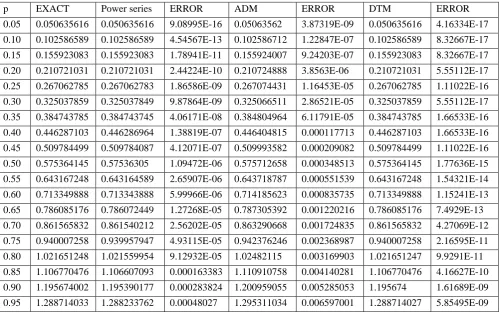
The three methods converge favorably to the exact value as shown in Table 1. That is the series solutions of equations (21), (35) and (38).
V. EXTENSION TO DIFFERENT DEGREES OF FREEDOM
The equations formed a series which can be used to predict p for any given degree of freedom k.
2
1
( )
,
1
4(
1)
Q p
p
p
k
k
(39) For very large k,( )
Q p
p
(40)
VI. CONCLUDING REMARKS
In this paper, the power series method, ADM and DTM was used to obtain the approximate solutions of the Chi-square quantile differential equations at degrees of freedom equals to two. Chi-square distribution has closed form
representation of both CDF and QF at that instance. The approximate solutions converge to the exact solution. The procedure serves as a validation mode for other degrees of freedom. The series solutions for up to degrees of freedom equal to 20 and for large cases were included. The methods used are efficient in handing nonlinear ODE and is recommended for solving quantile differential equations of probability distributions and most importantly quantile differential equations.
ACKNOWLEDGMENT
The authors are unanimous in appreciation of financial sponsorship from Covenant University. The constructive suggestions of the reviewers are greatly appreciated.
Table 1: Numerical results of power series, ADM and DTM
p EXACT Power series ERROR ADM ERROR DTM ERROR
[image:4.595.49.549.313.626.2]Table 2: Coefficients of the power series solution for different degrees of freedom
k
c
1
c
2c
3c
4c
5c
6c
71 1 1
5
6
7
48
871
1440
7131
23040
46977941
4838400
2 1
1
4
1
12
1
32
1
80
1
192
1
448
3 1
1
8
1
36
109
576
3167
230400
165701
16588800
3316213
1219276800
4 1
1
12
1
72
1301
8640
2647
259200
413599
261273600
484086437
87787929600
5 1
1
16
1
120
481
3840
23
3000
54733
36864000
254245339
46448640000
6 1
1
20
1
180
5407
50400
239
40320
12683
13608000
1332597397
266716800000
7 1
1
24
1
252
1135
12096
35857
7620480
5735
9144576
516617447
118294235136
8 1
1
28
1
336
523
18816
11803
13171200
782767
12170188800
9 1
1
32
1
432
10373
138240
18017
5702400
2854367
8758886400
10 1
1
36
1
540
5839
85536
105263
42768000
539797
7506369000
11 1
1
40
1
660
3301
52800
239491
58080000
12257407
48787200000
12 1
1
44
1
792
52285
906048
830068087
226040855040
829051693
4068735390720
13 1
1
48
1
936
33703
628992
130147
76658400
513382873
313992806400
14 1
1
52
1
1092
28397
567840
237119
158995200
5262391
52706908800
15 1
1
56
1
1260
827
17640
60419
52479000
3006253
158696496000
16 1
1
60
1
1440
129617
2937600
248951
211507200
16702817
241118208000
17 1
1
64
1
1632
8705
208896
29683
28113920
15186127
259097886720
18 1
1
68
1
1836
187291
4744224
339179
355816800
12716789
254053195200
19 1
1
72
1
2052
55409
1477440
2544787
2947492800
95609147
1600741232640
20 1
1
76
1
2280
86647
2425920
1049101
1334256000
261139993
6996838464000
[image:5.595.44.526.81.748.2]REFERENCES
[1] J.S. Dagpunar, “An easily implemented generalised inverse Gaussian generator,” Comm. Stat. Simul. Comput., vol. 18, no. 2, pp. 703-710, 1989.
[2] N.R. Farnum, “A fixed point method for finding percentage points,” Appl. Stat., vol. 40, no. 1, pp. 123-126, 1991.
[3] Y. Lai, “Generating inverse Gaussian random variates by approximation,” Comput. Stat. Data Analy., vol. 53, no. 10, pp. 3553-3559, 2009.
[4] G. Derflinger, W. Hörmann and J. Leydold, “Random variate generation by numerical inversion when only the density is known,” ACM Transac. Model. Comp. Simul., vol. 20, no. 4, Article 18, 2010. [5] G. Derflinger, W. Hörmann, J. Leydold, and H. Sak, Efficient
numerical inversion for financial simulations. In Monte Carlo and Quasi-Monte Carlo Methods, Springer Berlin Heidelberg, pp. 297-304, 2009.
[6] J. Leydold and W. Hörmann, “ Generating generalized inverse Gaussian random variates by fast inversion,” Comput. Stat. Data Analy., vol. 55, no. 1, pp. 213-217, 2011.
[7] C.W. Brain and J. Mi. "On some properties of the quantiles of the chi-square distribution and their applications to interval estimation."
Comm. Stat. Theo. Meth., vol. 30, no. 8-9, pp. 1851-1867, 2001. [8] T. Inglot, “Inequalities for quantiles of the chi-square distribution”,
Prob. Math. Stat., vol. 30, no. 2, pp. 339-351, 2010. [9] G. Steinbrecher and W.T. Shaw, “Quantile mechanics,” Euro. J. Appl.
Math., vol. 19, no. 2, pp. 87-112, 2008.
[10] T. Luu, Fast and accurate parallel computation of quantile functions for random number generation, Doctoral thesis, University College London, 2016.
[11] T. Luu, “Efficient and accurate parallel inversion of the gamma distribution,” SIAM J. Scientific Comp., vol. 37, no. 1, C122-C141, 2015.
[12] W.T. Shaw and N. Brickman, “Differential Equations for Monte Carlo Recycling and a GPU-Optimized Normal Quantile,” arXiv preprint arXiv:0901.0638, 2009.
[13] W.T. Shaw, “Eco-mputational Finance: Differential Equations for Monte Carlo Recycling” arXiv preprint arXiv:0901.0638, 2009. [14] W.T. Shaw and A. Munir, “Dependency without copulas or
ellipticity,” Euro. J. Finance, vol. 15, no. 7-8, pp. 661-674, 2009. [15] G. Ulrich and L.T. Watson, “A method for computer generation of
variates from arbitrary continuous distributions,” SIAM J. Scientific Comp., vol. 8, no. 2, pp. 185–197, 1987.
[16] G. Adomian, “A review of the decomposition method in applied mathematics,” J. Math. Analy. Appl., vol. 135, no. 2, pp. 501-544, 1988.
[17] A.M. Wazwaz, “A comparison between Adomian decomposition method and Taylor series method in the series solutions,” Appl. Math. Comput., vol. 97, no. 1, pp. 37-44, 1998.
[18] A.M. Wazwaz, “A reliable modification of Adomian decomposition method,” Appl. Math. Comput., vol. 102, no. 1, pp. 77-86, 1999. [19] A.M. Wazwaz, “Adomian decomposition method for a reliable
treatment of the Bratu-type equations,” Appl. Math. Comput., vol. 166, no. 3, pp. 652-663, 2005.
[20] A.M. Wazwaz and S.M. El-Sayed, “A new modification of the Adomian decomposition method for linear and nonlinear operators,” Appl. Math. Comput., vol. 122, no. 3, pp. 393-405, 2001.
[21] J.K. Zhou, “Differential transformation and its applications for electrical circuits,” Huazhong University, Wuhan, 1986. [22] A.A. Opanuga, S.O. Edeki, H.I. Okagbue, G.O. Akinlabi, A.S.
Osheku and B. Ajayi, “On numerical solutions of systems of ordinary differential equations by numerical-analytical method”, Appl. Math. Sciences, vol. 8, no. 164, pp. 8199 – 8207, 2014.
[23] S.O. Edeki , A.A. Opanuga, H.I. Okagbue , G.O. Akinlabi, S.A. Adeosun and A.S. Osheku, “A Numerical-computational technique for solving transformed Cauchy-Euler equidimensional equations of homogenous type. Adv. Studies Theo. Physics, vol. 9, no. 2, pp. 85 – 92, 2015.
[24] A.A. Opanuga, S.O. Edeki, H.I. Okagbue, S.A. Adeosun and M.E. Adeosun, “Some Methods of Numerical Solutions of Singular System of Transistor Circuits”, J. Comp. Theo. Nanosci., vol. 12, no. 10, pp. 3285-3289, 2015.