Automatic Detection of Stable Grammatical Features in N-Grams
Mikhail Kopotev1 Lidia Pivovarova1,2 Natalia Kochetkova3 Roman Yangarber1 1 University of Helsinki, Finland
2St.Petersburg State University, Russia
3 Moscow Institute of Electronics and Mathematics, NRU HSE, Russia
Abstract
This paper presents an algorithm that allows the user to issue a query pattern, collects multi-word expressions (MWEs) that match the pattern, and then ranks them in a uniform fashion. This is achieved by quantifying the strength of all possible relations between the tokens and their features in the MWEs. The al-gorithm collects the frequency of morphologi-cal categories of the given pattern on a unified scale in order to choose the stable categories and their values. For every part of speech, and for all of its categories, we calculate a normal-ized Kullback-Leibler divergence between the category’s distribution in the pattern and its distribution in the corpus overall. Categories with the largest divergence are considered to be the most significant. The particular values of the categories are sorted according to a fre-quency ratio. As a result, we obtain morpho-syntactic profiles of a given pattern, which in-cludes the most stable category of the pattern, and their values.
1 Introduction
In n-grams, the relations among words and among their grammatical categories cover a wide spectrum, ranging from idioms to syntactic units, such as a verb phrase. In most cases, the words are linked to-gether by both grammatical and lexical relations. It is difficult to decide, which relation is stronger in each particular case. For example, in the idiomatic phrasemeet the eye, the relationship is lexical rather than grammatical. A phrasal verbmeet upis similar to single-word verbs and has its own meaning. It can be interpreted as one lexeme, spelled as two words.
On the other hand, phrases likemeet the require-ments, meet the specifications, meet the demands
are traditionally called “collocations.” However, the question arises about the role played by the noun fol-lowing the verb: is it a lexically free direct object, or a part of stable lexical unit, or to some extend both? These words are bound by both grammatical and lexical relations, and we assume that the major-ity of word combinations in any language have such a dual nature.
Lastly, the relationship between the words in the English phrasemeet herdiffers from those above in that it may be described as purely grammatical—the verbmeetreceives a direct object.
Distinguishingcollocations, i.e. “co-occurrences of words” fromcolligations, i.e. “co-occurrence of word forms with grammatical phenomena” (Gries and Divjak, 2009) is not always a simple task; there is no clear boundary between various types of word combinations inasmuch as they can be simultane-ously a collocation and a colligation—this type of MWE is calledcollostructionsin (Stefanowitsch and Gries, 2003). It was proposed that language as such is a “constructicon” (Goldberg, 2006), which means that fusion is its core nature. For this reason, devis-ing formal methods to measure the strength of mor-phological or lexical relations between words be-comes a challenge.
Our approach aims to treat multi-word expres-sions (MWEs) of various nature—idioms, multi-word lexemes, collocations and colligations—on an equal basis, and to compare the strength of vari-ous possible relations between the tokens in a MWE quantitatively. We search for “the underlying cause”
for the frequent co-occurrence of certain words: whether it is due to their morphological categories, or lexical compatibility, or a combination of both. In this paper, however, we focus on colligations, ignor-ing collocations and collostructions.
For languages with rich morphology the situation is more complicated, because each word may have several morphological categories that are not inde-pendent and interact with each other. This paper fo-cuses on Russian, which not only has free word or-der and rich morphology,1but is also a language that is well-investigated. A good number of corpora and reference grammars are available to be used for eval-uation. The data we use in this work is the n-gram corpus, extracted from a deeply annotated and care-fully disambiguated (partly manually) sub-corpus of the Russian National Corpus (RNC). The size of dis-ambiguated corpus used in this paper is 5 944 188 words of running text.
2 Related Work
Much effort has been invested in automatic extrac-tion of MWEs from text. A great variety of method are used, depending on the data, the particular tasks and the types of MWEs to be extracted. Pecina (2005) surveys 87 statistical measures and meth-ods, and even that is not a complete list. The most frequently used metrics, inter alia, are Mu-tual Information (MI), (Church and Hanks, 1990), t-score (Church et al., 1991), and log-likelihood (Dun-ning, 1993). The common disadvantage of these is their dependency on the number of words included in the MWE. Although there is a large number of papers that use MI for bigram extraction, only a few use the MI measure for three or more collocates, e.g., (Tadi´c and ˇSojat, 2003; Wermter and Hahn, 2006; Kilgarriff et al., 2012),
Frantzi et al. (2000) introduced the c-value and nc-value measures to extract terms of different lengths. Daudaravicius (2010) has developed a promising method that recognizes collocations in text. Rather than extracting MWEs, this method cuts the text into a sequence of MWEs of length from 1 to 7 words; the algorithm may produce different
1
The Multitext-East specification, which aims to create an unified cross-language annotation scheme, defines 156 morpho-syntactic tags for Russian as compared to 80 tags for English (http://nl.ijs.si/ME/V4/msd/html).
chunking for the same segment of text within dif-ferent corpora. Nevertheless, extraction of variable-length MWE is a challenging task; the majority of papers in the field still use measures that take the number of collocates as a core parameter.
Entropy and other probabilistic measures have been used for MWE extraction since the earliest work. For example, the main idea in (Shimohata et al., 1997; Resnik, 1997), is that the MWE’s idiosyn-crasy, (Sag et al., 2002), is reflected in the distribu-tions of the collocates. Ramisch et al. (2008) intro-duced the Entropy of Permutation and Insertion:
EP I =− m X
a=0
p(ngrama) log[p(ngrama)] (1)
wherengram0 is the original MWE, andngrama are its syntactically acceptable permutations. Kullback-Leibler divergence was proposed by Resnik (1997) to measure selective prefer-ence for the word sense disambiguation (WSD) task. Fazly and Stevenson (2007) applied a set of statistical measures to classify verb+noun MWEs and used Kullback-Leibler divergence, among other methods, to measure the syntactic cohesion of a word combination. Van de Cruys and Moir´on (2007) used normalized Kullback-Leibler diver-gence to find idiomatic expression with verbs in Dutch.
Russian MWE-studies have emerged over the last decade. Khokhlova and Zakharov (2009) applied MI, t-score and log-likelihood to extract verb collo-cations; Yagunova and Pivovarova (2010) studied the difference between Russian lemma/token col-locations and also between various genres; Do-brov and Loukachevitch (2011) implemented term extraction algorithms. However, there is a lack of study of both colligations and collostructions in Rus-sian. The only work known to us is by Sharoff (2004), who applied the MI-score to extract prepo-sitional phrases; however, the only category he used was the POS.
As far as we aware, the algorithm we present in this paper has not been applied to Russian or to other languages.
3 Method
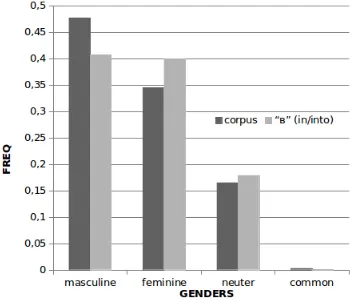
Figure 1: Distributions of noun cases in the corpus and in a sample—following the preposition “в” (in)
Figure 2: Distributions of nominal gender in the corpus and in a sample—following the preposition “в” (in)
to find the most stable morphological categories of words that can fill this gap. Moreover, the user can specify the particular properties of words that can fill the gap—for example, specify that the output should include only plural nouns. Thus, the combination of the surrounding words and morphological constrains form an initial querypatternfor the algorithm.
Our model tries to capture the difference between distributions of linguistic features in the general cor-pus as compared to distributions within the given pattern. For example, Figure 1 shows the tion of cases in the corpus overall vs. their distribu-tion in words following the preposidistribu-tion “в” (in/into). Figure 2 shows the corresponding distributions of gender. Gender is distributed similarly in the cor-pus and in the sample restricted by the pattern; by contrast, the distribution of cases is clearly different.
This is due to the fact that the preposition governs the case of the noun, but has no effect on gender. To measure this difference between the distributions we use the Kullback-Leibler divergence:
Div(C) =
N X
i=1
Pipattern×log(P
pattern i
Picorpus) (2)
where C is the morphological category in a pattern—e.g., case or gender,—having the values
1..N, Pipattern is the relative frequency of value i
restricted by the pattern, andPicorpus is the relative frequency of the same value in the general corpus. Since the number of possible values for a category is variable—e.g., eleven for case, four for gender, and hundreds of thousands for lemmas—the divergence needs to be normalized. The normalization could be done in various ways, e.g., against the entropy or some maximal divergence in the data; in our experi-ments, the best results were obtained using a variant proposed in (Bigi, 2003), where the divergence be-tween the corpus distribution and the uniform distri-bution is used as the normalizing factor:
N ormDiv(C) = Div(C)
E(C) + log(n) (3)
whereE(C) is the entropy of category C andnis the number of possible values ofC; the termlog(n)
is the entropy of the uniform distribution overn out-comes (which is the maximal entropy). The category with the highest value of normalized divergence is seen as maximally preferred by the pattern.
[image:3.612.95.271.260.410.2]which is why its appearance in combination with preposition “в” (in) is significant, even though its frequency is not much higher than the frequency of the (erroneous) nominative case in the same pattern.
To find the significant values of a particular cate-gory we use the ratio between the frequencies of the value in a sample and in the corpus:
f requency ratio= P
pattern i
Picorpus (4)
Iff requentcy ratio >1, then the category’s value is assumed to beselectedby the pattern.
Finally, we note that the distribution of POS varies considerably within every pattern as compared to its distribution in the corpus. For example, prepositions can be followed only by noun groups and can never be followed by verbs or conjunctions. This means the Kullback-Leibler divergence for any POS, nat-urally assumes the highest value inanypattern; for this reason, we exclude the POS category from con-sideration in our calculation, aiming to find more subtle and interesting regularities in the data.
To summarize, the algorithm works as follows: for a givenquery pattern
1. search all words that appear in the query pattern and group them according to their POS tags.
2. for every POS, calculate the normalized Kullback-Leibler divergence for all of its cat-egories; categories that show the maximum di-vergence are considered to be the most signifi-cant for the given pattern;
3. for every relevant category, sort its values ac-cording to the frequency ratio; if frequency ra-tio is less than1, the value considered to be ir-relevant for this pattern.
4 Experiments
In this paper, we conduct an in-depth evaluation fo-cusing on a limited number of linguistic phenom-ena, namely: bigrams beginning with single-token prepositions, which impose strong morpho-syntactic constraints in terms of case government. We in-vestigate 25 prepositions, such as “без” (without), “в” (in/to), etc. We evaluate the corpus of bi-grams systematically against these queries, although
we expect that the model we propose here pro-duces relevant results for a much wider range of constructions—to be confirmed in further work.
4.1 Prepositions and Morphological Category
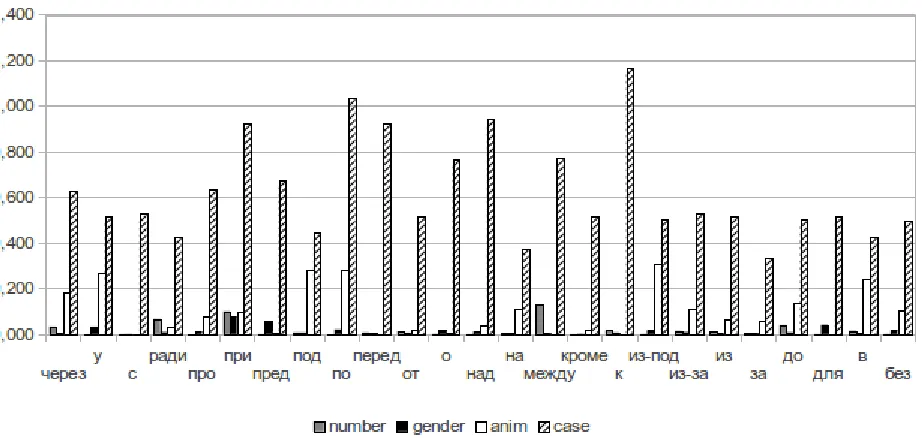
A syntactic property of prepositions in Russian is that they govern nominal phrases, i.e., that we expect the largest normalized divergence in queries such as {Preposition + X }, where the POS of X isnoun, to occur exactly with the category of case. Figure 3 shows the normalized divergence for four lexical and morphological categories. Among them, Case has the maximal divergence for all prepositions, which matches our expectation with 100% accuracy.
According to the figure, the morphological cat-egory of Animacy2 is also interesting, in that it has a high value for some prepositions, like “ из-под” (from under), “под” (under), “над” (above). A good example is the preposition “из-под” (from under). Its semantic properties cause inanimate nouns to appear much more frequently than ani-mate ones. Consequently, we observe a higher diver-gence, due to inanimate nouns like “из-под земли” (from under ground), “из-под снега” (from under the snow), etc. Another good example of hidden semantic properties is a pair of prepositions “под” (under) and “над” (above). One can expect that their syntactic behaviour is more or less similar, but the histogram shows that Animacy (surprisingly) has a much higher divergence for “под” (under) to be ignored. Indeed, a deeper corpus-based anal-ysis reveals a stable, frequently used construction, which gives many points to animate nouns, e.g., “замаскированный под невесту” (disguised as a bride). It is notable that this particular effect is not mentioned in any grammar book, (to the best of our knowledge).
To conclude, the Case category is the clear win-ner in terms of having the greatest normalized di-vergence, and the output fully matches the expecta-tion on all 25 common preposiexpecta-tions that we tested. Other results are also clearly interesting due to their links to semantic properties, that is, to colloca-tions. The next task is, therefore to discriminate
2
Figure 3: Normalized divergence of noun categories (grammemes) for patternpreposition+X.
between the runners-up, like Animacy for “под” (under), which seem to be interesting to some ex-tent, and clear losers like Gender, in the example above. To do that we need to find an appropriate threshold—preferably automatically—between rel-evant and non-relrel-evant results. The algorithm ranks the categories according to their divergence; the cat-egory that has the top rank is certainly meaning-ful. The question is how to determine which among the rest are significant as well; this is left for future work.
4.2 Specific Values of the Category with Maximum Divergence
The next question we explore is which particular
values of the maximally divergent category—here, Case—are selected by a given preposition. As we mentioned above, we use the frequency ratio for this task. We collected a list of cases3 that appear af-ter the given preposition, according to the algorithm with f requency ratio > 1; which cases are pos-sible according to grammatical descriptions,4which
3The current annotation scheme of our data has eleven case tags, namely: nom, voc, gen, gen2, dat, acc, acc2, ins, loc, loc2, adnum.
4
Note, that not all possible prep+case combinations are rep-resented in the corpus; for example, the combination{“ради” (for the sake of)+gen2}does not appear in our data, and only eight times in the RNC overall. For evaluation we take into
cases were produced by the algorithm, and the num-ber of correct cases in the system’s response. We expect that by using the frequency ratio we can re-duce the noise; for example, of the eight cases that match the pattern{“c” (with) +Noun }only four are relevant.
The algorithm predicts the correct relevant set for 21 of 25 prepositions, giving a total precision of 95%, recall of 89%, and F-measure of 92%. The prepositions highlighted in bold in Table 1 are those that were incorrectly processed for various reasons; the error analysis is presented below.
14: “о” (about) The algorithm unexpectedly flags thevoc(vocative) as a possible case after this prepo-sition. This is incorrect; checking the data we dis-covered that this mistake was due to erroneous an-notation: the interjection “o” (oh), as in “O боже!” (Oh God!), is incorrectly annotated as the preposi-tion “o” (about). The error occurs twice in the data. However, as the vocative is extremely rare in the data (its frequency in the corpus is less than 0,0004), two erroneous tags are sufficient to give it a high rank. Similar annotation errors for more frequent cases are eliminated by the algorithm. For example, as we mentioned in the previous section, the nominative
Preposition Meaning Expected cases Response
1 без without gen/gen2 gen/gen2
2 в in/into acc/acc2/loc/loc2 acc/acc2/loc/loc2
3 для for gen/gen2 gen/gen2
4 до until gen/gen2 gen/gen2
5 за behind acc/ins acc/ins
6 из from gen/gen2 gen/gen2
7 из-за from behind gen/gen2 gen/gen2 8 из-под from under gen/gen2 gen/gen2
9 к to dat dat
10 кроме beyond gen gen
11 между between ins ins
12 на on acc/loc/loc2 acc/loc/loc2
13 над above ins ins
14 о about acc/loc loc/voc
15 от from gen/gen2 gen/gen2
16 перед in front of ins ins
17 пред in front of ins ins
18 по by/up to dat/loc/acc dat
19 под under acc/ins acc/ins
20 при at/by loc loc
21 про about acc acc
22 ради for gen gen
23 с with gen/gen2/acc/ins gen2/ins
24 у near gen gen
25 через through acc acc/adnum
Expected 45
Response 42
Correct 40
Precision 0.95
Recall 0.89
[image:6.612.153.462.52.442.2]F-measure 0.92
Table 1: Noun cases expected and returned by the algorithm for Russian prepositions.
case after preposition “в” (in) appears 88 times in our data; however this case is not returned by the al-gorithm, since it is below the frequency ratio thresh-old.
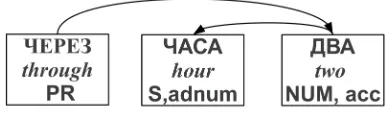
25: “через” (through/past) The adnumerative (adnum) is a rare case in our data, so even a single occurrence in a sample is considered important by the algorithm. A single bigram is found in the data, where the token “часа” (hours)—correctly anno-tated with theadnum tag—predictably depends on the Numeral, i.e., “два” (two), rather than on prepo-sition “через” (through/past), see Figure 4. The numeral appears inpost-position—a highly marked word order that is admissible in this colloquial con-struction in Russian: “через часа два” (lit.: after hours two = idiom: after about two hours), where
Figure 4: Distributions of cases in the corpus and in a sample. (Arrows indicate syntactic dependency.)
the preposition governs the Case of the numeral, and the numeral governs a noun thatprecedesit.
[image:6.612.329.524.481.538.2]tree-bank is not always available for a given language; in fact, we do not have access to any Russian tree-bank suitable for this task.
23: “с” (with) This is a genuine error. The algo-rithm misses two of four correct cases, Genitive and Accusative, because both are widely used across the corpus, which reduces their frequency ratio in the sub-sample. Our further work will focus on finding flexible frequency ratio thresholds, which is now set to one. Two of the correct cases (Instrumental and Gen2) are well over the threshold, while Genitive, with 0.6924, and Accusative, with 0.0440, fall short.
18: “по” (by/along) For this preposition the al-gorithm predicts 1 case out of 3. This situation is slightly different from the previous ones, since the accusative and locative cases are much more rare with preposition “по” (by/along) than the dative: 245 instances out of 15387 for accusative, and 222 for locative in our data. We hypothesize that this means that such “Prep+case” combinations are con-strained lexically to a greater extent than grammat-ically. To check this hypothesis we calculate the frequency ratio for all lemmas that appear with the respective patterns { “по” (by/along) + acc} and {“по” (by/along) +loc}. As a result, 15 distinct lemmas were extracted by{ “по” (by) +acc}; 13 out of them havef requency ratio >1. The major-ity of the lemmas belong to the semantic class “part of the body” and are used in a very specific Rus-sian construction, which indicates “an approximate level”, e.g. “по локоть” (up to (one’s) elbow), cf. English“up to one’s neck in work”. This construc-tion has limited productivity, and we are satisfied that the Accusative is omitted in the output for gram-matical categories, since the algorithm outputs all tokens that appear in the{“по” (by/along)+acc} as relevant lemmas.
The case of { “по” (by) + loc } is more com-plex: 44 of 76 combinations return a frequency greater than 1. Analysis of annotation errors reveals a compact collection of bureaucratic cliches, like “по прибытии” (upon arrival), “по истечении” (upon completion), etc., which all share the seman-tics of “immediately following X”, and are pragmat-ically related. These are expressions belonging to the same bureaucratic jargon and sharing the same morphological pattern, however, they are below the
threshold. Again, we are faced with need to tune the threshold to capture this kind of potentially interest-ing lexical combinations. In general, semantic and pragmatic factors influence the ability of words to combine, and the algorithm shows it in some way, though these aspects of the problem are beyond the scope of our experiments in the current stage.
5 Discussion and Future Work
5.1 Development of the algorithm
We have presented a part an overall system under de-velopment. In the preceding sections, we investigate an area where collocations and colligations meet. To summarize, the algorithm, based on the corpus of n-grams, treats both morpho-syntactic and lexical co-occurrences as a unified continuum, which has no clear borders. The evaluation of the morphological output raises some new questions for further devel-opment:
• At present, the low precision for both low- and high-frequency tags depends on the threshold, which needs to be studied further.
• The values of divergences are currently not normalized among the different query patterns. This may be a difficult question, and we plan to investigate this further. The algorithm provides a way to compare the strength of very diverse collocations, which have nothing in common, in terms of their degree of idiomatization.
• We observe that the longer the n-gram, the more we expect it to be a collocation; stable bigrams appear more frequently to be colliga-tions, while stable 4-grams are more often col-locations. The problem is that those colloca-tions with a highly frequent first collocate, e.g., “в” (in), cannot be found using our algorithm as it stands now.
pro-files, introduced by Gries and Divjak (2009). We plan to develop this approach with the further assumption that the distribution of to-kens/lexemes within a pattern is based on rel-evant grammatical properties, which are ob-tained in an earlier step of our algorithm. For instance, for “не до X” (not up to X) we have found that the grammatical profile for X is N.gen/gen2, and the tokenf requency ratiois greater than1as well. Building the list of to-kens that are the most stable for this pattern, we compare their distributions within the pattern to all N.gen/gen2 tokens in the corpus. This yields the following tokens as the most relevant: “не до смеха” (lit.: not up to laughter.gen = id-iom: no laughing matter);“не до жиру” (lit. not up to fat.gen2 = idiom: no time/place for complacency), which reveals an interesting set of idioms.
5.2 Extensions and Applications
The model has no restriction on the length of data to be used, and is applicable to various languages. Finnish (which is morphologically rich) and English (morphologically poor) will be examined next. As for Russian, so far the algorithm has been systemat-ically evaluated against bigrams, although we have 3-, 4- and 5-grams at our disposal for future work.
A reliable method that is able to determine pat-terns of frequently co-occurring lexical and gram-matical features within a corpus can have far-reaching practical implications. One particular ap-plication that we are exploring is the fine-tuning of semantic patterns that are commonly used in in-formation extraction (IE), (Grishman, 2003). Our work on IE focuses on different domains and differ-ent languages, (Yangarber et al., 2007; Atkinson et al., 2011). Analysis of MWEs that occur in extrac-tion patterns would provide valuable insights into how the patterns depend on the particular style or
genreof the corpus, (Huttunen et al., 2002). Subtle, genre-specific differences in expression can indicate whether a given piece of text is signaling the pres-ence an event of interest.
5.3 Creating Teaching-Support Tools
Instructors teaching a foreign language are regu-larly asked how words co-occur: What cases and
word forms appear after a given preposition? Which ones should I learn by rote and which ones follow rules? The persistence of such questions indicates that this is an important challenge to be addressed— we should aim to build a system that can automati-cally generate an integrated answer. A tool that pro-duces answers to these questions would be of great help for teachers as well as students. The presented algorithm can support an easy-to-use Web-based ap-plication, or an application for a mobile device. We plan to develop a service, which is able to process queries described in the paper. This service would be an additional interface to a corpus, aimed at find-ing not only the linear context of words but also their collocational and constructional preferences. We be-lieve that such an interface would be useful for both research and language-learning needs.
Acknowledgments
We are very grateful to the Russian National Cor-pus developers, especially E. Rakhilina and O. Lya-shevskaya, for providing us with the data.
References
Martin Atkinson, Jakub Piskorski, Erik van der Goot, and Roman Yangarber. 2011. Multilingual real-time event extraction for border security intelligence gathering. In U. Kock Wiil, editor, Counterterrorism and Open Source Intelligence, pages 355–390. Springer Lecture Notes in Social Networks, Vol. 2, 1st edition.
Brigitte Bigi. 2003. Using Kullback-Leibler distance for text categorization. In Fabrizio Sebastiani, edi-tor,Advances in Information Retrieval, volume 2633 ofLecture Notes in Computer Science, pages 305–319. Springer Berlin, Heidelberg.
Kenneth Ward Church and Patrick Hanks. 1990. Word association norms, mutual information, and lexicogra-phy. Computational linguistics, 16(1):22–29.
Kenneth Church, William Gale, Patrick Hanks, and Don-ald Kindle. 1991. Using statistics in lexical analy-sis. Lexical acquisition: exploiting on-line resources to build a lexicon.
Vidas Daudaravicius. 2010. Automatic identification of lexical units. Computational Linguistics and Intelli-gent text processing CICling-2009.
Ted Dunning. 1993. Accurate methods for the statistics of surprise and coincidence. Computational linguis-tics, 19(1):61–74.
Afsaneh Fazly and Suzanne Stevenson. 2007. Dis-tinguishing subtypes of multiword expressions using linguistically-motivated statistical measures. In Pro-ceedings of the Workshop on A Broader Perspective on Multiword Expressions, pages 9–16. Association for Computational Linguistics.
Katerina Frantzi, Sophia Ananiadou, and Hideki Mima. 2000. Automatic recognition of multi-word terms: the c-value/nc-value method. International Journal on Digital Libraries, 3(2):115–130.
Adele Goldberg. 2006. Constructions at work: The na-ture of generalization in language. Oxford University Press, USA.
Stefan Th. Gries and Dagmar Divjak. 2009. Behavioral profiles: a corpus-based approach to cognitive seman-tic analysis. New directions in cognitive linguistics, pages 57–75.
Ralph Grishman. 2003. Information extraction. In
The Handbook of Computational Linguistics and Nat-ural Language Processing, pages 515–530. Wiley-Blackwell.
Silja Huttunen, Roman Yangarber, and Ralph Grishman. 2002. Diversity of scenarios in information extraction. InProceedings of the Third International Conference on Language Resources and Evaluation (LREC 2002), Las Palmas de Gran Canaria, Spain, May.
Maria Khokhlova and Viktor Zakharov. 2009. Statistical collocability of Russian verbs. After Half a Century of Slavonic Natural Language Processing, pages 125– 132.
Adam Kilgarriff, Pavel Rychl`y, Vojtech Kov´ar, and Vıt Baisa. 2012. Finding multiwords of more than two words. InProceedings of EURALEX2012.
Scott Martens and Vincent Vandeghinste. 2010. An effi-cient, generic approach to extracting multi-word ex-pressions from dependency trees. In CoLing Work-shop: Multiword Expressions: From Theory to Appli-cations (MWE 2010).
Pavel Pecina. 2005. An extensive empirical study of collocation extraction methods. InProceedings of the ACL Student Research Workshop, pages 13–18. Asso-ciation for Computational Linguistics.
Carlos Ramisch, Paulo Schreiner, Marco Idiart, and Aline Villavicencio. 2008. An evaluation of methods for the extraction of multiword expressions. In Proceed-ings of the LREC Workshop-Towards a Shared Task for Multiword Expressions (MWE 2008), pages 50–53. Philip Resnik. 1997. Selectional preference and sense
disambiguation. InProceedings of the ACL SIGLEX Workshop on Tagging Text with Lexical Semantics: Why, What, and How, pages 52–57. Washington, DC.
Ivan Sag, Timothy Baldwin, Francis Bond, Ann Copes-take, and Dan Flickinger. 2002. Multiword expres-sions: A pain in the neck for NLP.Computational Lin-guistics and Intelligent Text Processing, pages 189– 206.
Violeta Seretan. 2008. Collocation extraction based on syntactic parsing. Ph.D. thesis, University of Geneva. Serge Sharoff. 2004. What is at stake: a case study of Russian expressions starting with a preposition. In
Proceedings of the Workshop on Multiword Expres-sions: Integrating Processing, pages 17–23. Associ-ation for ComputAssoci-ational Linguistics.
Sayori Shimohata, Toshiyuki Sugio, and Junji Nagata. 1997. Retrieving collocations by co-occurrences and word order constraints. InProceedings of the eighth conference on European chapter of the Association for Computational Linguistics, pages 476–481. Associa-tion for ComputaAssocia-tional Linguistics.
Anatol Stefanowitsch and Stefan Th Gries. 2003. Col-lostructions: Investigating the interaction of words and constructions. International journal of corpus linguis-tics, 8(2):209–243.
Marko Tadi´c and Kreˇsimir ˇSojat. 2003. Finding multi-word term candidates in Croatian. InProceedings of IESL2003 Workshop, pages 102–107.
Tim Van de Cruys and Begona Villada Moir´on. 2007. Lexico-semantic multiword expression extraction. In
Proceedings of the 17th Meeting of Computational Linguistics in the Netherlands (CLIN), pages 175–190. Joachim Wermter and Udo Hahn. 2006. You can’t beat frequency (unless you use linguistic knowledge) – a qualitative evaluation of association measures for col-location and term extraction. In Proceedings of the 21st International Conference on Computational Lin-guistics and 44th Annual Meeting of the Association for Computational Linguistics, pages 785–792. Elena Yagunova and Lidia Pivovarova. 2010. The nature
of collocations in the Russian language. The experi-ence of automatic extraction and classification of the material of news texts. Automatic Documentation and Mathematical Linguistics, 44(3):164–175.