Implementation of Microservice Technology on Mobile
Learning Development
Maksy Sendiang
Information Technology Dept Manado State Polytechnic North Sulawesi - Indonesia
Jerry H. Purnama
Mechanical Engineering Dept Manado State Polytechnic North Sulawesi - Indonesia
ABSTRACT
Software development using microservice has many advantages over conventional technology. The short number of comprehension and applied examples of microservice technology have caused the software developed using this technology is confined. This research aims to apply microservice technology in the development of mobile learning (MLearning). Implementation of microservice will break the application into stand-alone entities and isolated with others. Thus failure in an entity will not effect the application as a whole system. This research using a mixture of quantitative and qualitative methods in collecting and analyzing data. The data obtained is modeled with an object-oriented approach by used Unified Modelling Language tool (UML). RUP method as one of software development method that gives focus to software architecture is used to develop the MLearning. By this research expected a MLearning is produced using microservice technology. It is expected this MLearning will improve the quality of education in Manado State Vocational High School. The conclusion of this research is that the development of MLearning with microservice technology will form a robust application that gives a positive impact on teaching and learning process at Manado State Vocational High School.
General Terms
Web development, Cloud computing
Keywords
Microservice,mLearning,entity,UML,RUP
1.
INTRODUCTION
In the era of digital technology, the use of mobile devices become a necessity for both individuals and organizations to improve their performance. Mobile devices have become practical tool in accessing information and communication, so they are used in various fields the such as education, health, social and others. The rapid development of mobile devices is supported by the progress of innovation in both hardware and software. In the field of software, the proliferation of mobile applications such as eLearning, eGovernment, games have added software functionality and have an impact on the market demand for mobile devices that continues to increase over time.
According to Cavus & Ibrahim [2009], Mobile learning enables multimedia communication by deploying text, voice,
is any kind of learning that happens when the learner is not controlled by time and location. Mobile learning happens when the learner applies mobile technologies to absorp the learning materials. By using mobile learning students with various backgrounds even those with disabilities can take advantage of distance learning facilities.. Furthermore, mobile learning is equiped with some amazing features that can not be found on other equipments. These features include the ability to take and share images in real time, maps and GPS. Vasiliaou & Economides, 2011 conclude that mobile learning has served impressive educational and learning facilities by integration with wireless networks, mobile devices and other network technologies..
Software on a large scale is generally built in a distributed way and consists of various media connected in one network. In this context, microservice is a new software development pattern where the overall software functions are provided by smaller software components. These components use and provide software services and are developed by the team separately. Unlike traditional software development where the development team and operational teams are separate, in microservice each team provides all development and operational requirements for services or services built (DevOPs).
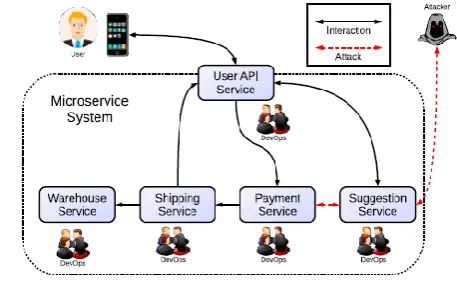
[image:1.595.320.549.521.662.2]The picture below shows an example of a microservice consisting of five services that work together to provide applications for external users.
2 Users run client applications both mobile applications and
web-based applications that access the external User API provided by the system. The service API is indeed an internall service that provides the requested function (warehause service, shipping serice, payment service, suggestion service). Each of these services is maintained by the DevOps team who develop, deploy and maintain the system.
As noted above, the development of software using microservice technology has many advantages compared to conventional technology. Lack of understanding and applied examples of microservice technology is one of the causes of the lack of software developed using this technology. This research aims to implement microservice technology in the development of mobile learning (MLearning). Application of microservice will break applications into entities that stand alone and are isolated from other entities. Thus failure in one entity will not affect the overall application
2.
RESEARCH METHODOLOGY
The system development strategy utilized in the improvement of this application is Rational Unified Process (RUP). This strategy is utilized on the grounds that the time required in the advancement of this application is generally short and furthermore this application will encounter upgrades amid the improvement procedure.
Rational Unified Process (RUP) software development process that is most broadly utilized today by groups engaged with programming advancement (system analyst, project manager) (Qiali Chen, 2015).
RUP is a software engineering process with great definition and great organizing. RUP gives a decent meaning of structure for programming venture life stream. RUP has four phases or stages that should be possible iteratively. In this strategy there are four phases of programming improvement, in particular:
1. Inception; it is the phase of displaying the business procedure and characterizing the requirement for the framework to be made
2. Elaboration; more spotlight on arranging the framework design. This stage can likewise be made to decide if the coveted framework engineering can be made or not. This stage additionally underlines the examination of framework outline and framework usage and the normal outcomes from this stage are satisfy the turning point engineering lifecycle
3. Construction;this stage is more centered around creating segments or framework highlights.
4. Transition; this stage more on the sending or establishment of the framework with the goal that it tends to be comprehended by the client. Activities at this stage incorporate client preparing, support and framework testing whether they meet client desires.
3.
RESULTS AND DISCUSSION
3.1
System Modelling
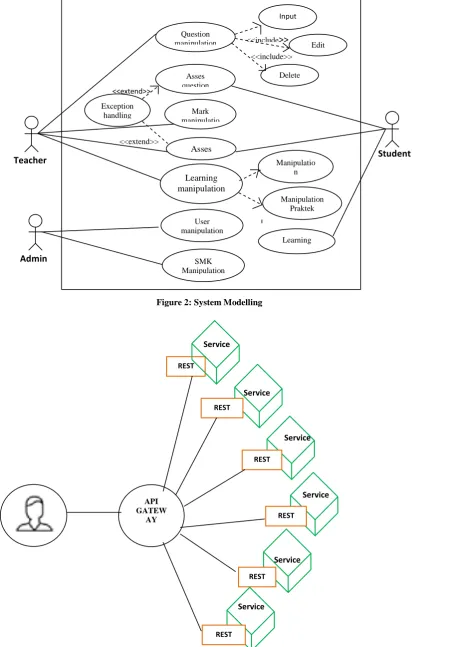
The building system can be seen in the following UML diagram (figure 2)..
3.2
System Architecture
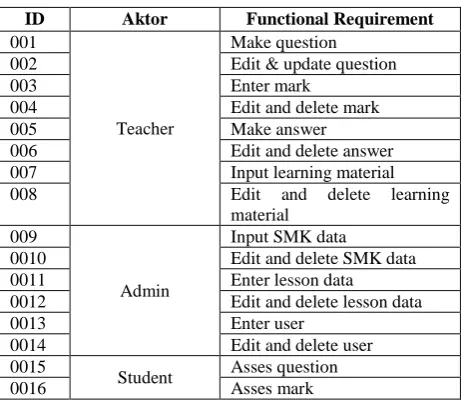
[image:2.595.316.547.320.521.2]The system architecture that is built refers to the functional requirements obtained from interviews with prospective users and utilizes references from literature studies. Functional requirements are arranged in table form (table 1) and consist of actor requirements and functional requirements. Actors are users who will use applications, namely administrators, teachers and students ).
Table 1. Functional Requirement
ID Aktor Functional Requirement
001
Teacher
Make question
002 Edit & update question
003 Enter mark
004 Edit and delete mark
005 Make answer
006 Edit and delete answer
007 Input learning material
008 Edit and delete learning
material 009
Admin
Input SMK data
0010 Edit and delete SMK data
0011 Enter lesson data
0012 Edit and delete lesson data
0013 Enter user
0014 Edit and delete user
0015
Student Asses question
0016 Asses mark
REST
API
Service
Nilai
REST
API
Service
Jawaban
REST
API
Service
SMK
REST
API
Service
Mapel
Service REST
API
Service
Soal
API GATEW
AY
Gateway
[image:3.595.54.531.73.721.2]Teacher
Figure 2: System Modelling
Learning asses
Admin
Student
Question manipulation
Asses question
Mark manipulatio
n
Asses mark Learning manipulation
Input
Soal
Edit
Soal
Delete
Soal
<<include>>
<<include>>
Manipulatio n Teori
Manipulation Praktek Exception
handling
<<extend>> >
<<extend>>
User manipulation
4 As shown in the picture above, all requests from users will go
[image:4.595.309.551.69.332.2]through the Gateway API which will then direct this request to a particular service . In addition, the Gateway API has role for the protocol translation and provides the custom API that users need. The gateway API provides an example endpoint (/ question? ProblemID = 101) so that users can access the question with ID number 101. Implementation of the Gateway API and some of the above microsystems can be seen in the following figure
Figure 4: API Gateway
3.3
System Testing
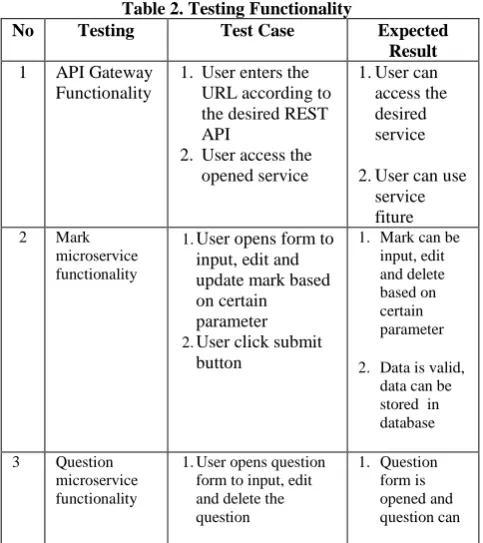
[image:4.595.56.285.174.379.2]System testing in the form of functional testing is carried out to analyze the built-in microservice system. Testing functionality is one of the black box testing that is done to ensure that the system functions as it is modeled / expected. The results of testing functionality can be seen in the table below:
Table 2. Testing Functionality
No Testing Test Case Expected Result
1 API Gateway Functionality
1. User enters the URL according to the desired REST API
2. User access the opened service
1.User can access the desired service
2.User can use service fiture 2 Mark
microservice functionality
1.User opens form to input, edit and update mark based on certain parameter 2.User click submit
button
1. Mark can be input, edit and delete based on certain parameter
2. Data is valid, data can be stored in database
3 Question microservice functionality
1.User opens question form to input, edit and delete the question
1. Question form is opened and question can
No Testing Test Case Expected Result
2.User click submit button
be accessed
2. Validation is OK and question can accessed from database
4 Learning material microservice functionality
1. User opens learning form and input learning material
2. User chooses submit button 1. Learning function can be used 2. Learning material is stored into database
5 User
microservice functionality
1. User open form to input, edit and delete data
2. User choose submit button
1. User can use the form
2. User data can be stored into database
4.
CONCLUSION
The microservice architecture breaks applications into independent entities that are called through the Gateway API. The mobile learning application that is built has six micservices that can be developed as needed by adding certain services to the existing system. The effective lumen framework for building microservice and supporting the development of RESTFUL API applications
5.
REFERENCES
[1] Cavus,N., & Ibrahim,D. (2009). M-Learning: An experiment in using SMS to support learning new English words. British Journal of Educational Technology, 40(1),78-91.
[2] D.V. Sanchez, E.H.Rubio, E.F.Ruiz and Viveros, “Student Role Functionalities Towards Learning Management Systems as Open Platforms Through Mobile Devices”, IEEE 201 S. M. Metev and V. P. Veiko, Laser Assisted Microtechnology, 2nd ed., R. M. Osgood, Jr., Ed. Berlin, Germany: Springer-Verlag, 1998.
[3] L.Bass, P.Clements, Software Architecture in Practice, 3rd ed, Boston, MA : Addison-Wesley professional, 2012, ch.13
[4] N.Pachler, B.Bachmair, J.Cook and G.Kress, Mobile Learning:Structures, Agency, Practices, 1st ed,New York,NY:Springer,2010,ch. 1,pp. 3-10
[5] N.Serrano, J.Hernantes, and G.Gallado, “Mobile Web Apps”, IEEE Software 2013
[image:4.595.48.290.494.766.2][7] Shen,R., Wang,M. (2008). Increasing interactivity in blended classrooms through a cutting-edge mobile learning system. British Journal of Educational Technology, 39(6), 1073-1086