© 2019, IRJET | Impact Factor value: 7.34 | ISO 9001:2008 Certified Journal
| Page 704
Improvisation in the Attendance Supervision Method through RFID
Based Door Access System
Assistant Professor Anjali Sanjivanrao More
1, Neelofar Pathan
2, Prasad Kadu
31
Assistant Professor of Computer Engineering, Savitribai Phule Pune University
2Pursuing Bachelor of Electronics and Tele-Communication Engineering
3
Pursuing Bachelor of Computer Engineering
,
Suman Ramesh Tulsiani Technical Campus Faculty of
Engineering Kamshet, Pune, India.
---***---Abstract - In modern years, there has been a rise in thefigure of applications based on Radio Frequency Identification (RFID) methods and have been strongly applied to different areas as various as transportation, health-care, cultivation, and hospitality business to mention a few. RFID technology helps automatic wireless identification using electronic passive and active tags with suitable readers. In this paper, an attempt is made to solve the recurrent lecture attendance monitoring problem in developing countries using RFID technology. The purpose of RFID to student attendance monitoring as acquired and deployed in this study is capable of eliminating time wasted during the manual collection of attendance and a chance for the educational administrators to capture face-to-face classroom statistics for allocation of relevant attendance scores and further managerial decisions.
Key Words: Data Visualization; RFID (Radio-frequency identification); Arduino controller; IR sensor and Student Attendance system.
1. INTRODUCTION
The attendance management system deals with the maintenance of the student’s or employee’s attendance details. Nowadays RFID, which stands for Radio Frequency Identification, is an automatic classification technology used for recovering from or storing data on RFID Tags without any physical contact. RFID system primarily incorporates RFID Tags, RFID Reader, Middleware and a Backend database. RFID Cards are uniquely and universally identified by an identification sequence, supervised by the rubrics of EPC global Tag Data Standard. A tag can either be indifferently activated by an RFID reader or it can actively send RF flags to the reader. Global System for Mobile (GSM) MODEM is a class of radio MODEM devices that are designed for communication of a computer with the GSM and GPRS network. It requires a SIM (Subscriber Identity Module) card just alike mobile phones to activate communication with the interface. Also, they have an International Mobile Equipment Identity (IMEI) number similar to mobile phones for their identification. The RFID reader, through its antenna, reads the information stored on these tags when it’s in its vicinity. The reader, whose active range is based on its operational frequency, is planned to explore at a certain frequency. The operational frequency of the reader reaches from 125 kHz –
2.4 GHz. Some students do not come to the classroom due to one reason or another and because of this they do not perform well in their research, so there is a need to monitor student attendance in the classroom to enhance their academic performance. Trainees are expected to audit 60 percent of the class before they are allowed to sit for the course examination. The old-fashioned method of taking attendance in schools and colleges has been discarded.
2. RELATED WORK
[14]The use of Radio-frequency identification (RFID) technology in the automated computerized environment and for tracking objects has been widely researched upon by researchers and deployed by various organizations as part of their automation systems. References provide examples of a real RFID contactless data link deployments that appropriate RFID technology for object tracking and automated data gathering solution.[17] [5]RFID is a technology that utilizes radio waves to transfer data from an electronic tag, called RFID tag or label, connected to an object, through a reader for identifying and tracking the object In 1945, Leon Theremin discovered an surveillance tool (for spy activities) for the Soviet Union which retransmitted incident radio waves with audio frequency information.
[11] Krenare R. Pireva et al. suggests that the use of Radio-frequency identification (RFID) technology in an automated electronic environment and for tracking objects has been widely researched upon by researchers and deployed by various organizations as part of their automation systems. Hang Yuru, Chen Delong and Tan Liping, April 2013, suggested, The Research and Application of College Student Attendance System based on RFID Technology. [19]Combined with the actual situation of college student's class attendance system, the design of student attendance system nodes based on RFID has been proposed. In this paper, the hardware node of the system and the developing processes of related applications have been a detailed presentation. The designed system not only can improve work efficiency but also can save human and material resources
© 2019, IRJET | Impact Factor value: 7.34 | ISO 9001:2008 Certified Journal
| Page 705
bulky method for taking understudy participation in schooland switch the worldview of understudy's address participation checking in the classroom. An easy and cheap RFID Based Authentication System model has effectively created. [16]The design of the framework can give several advantages over the customary policy for getting participation. This framework will help in the programmed capacity of participation and guardians will be informed in an instance of non-attendance. In this framework using the AVR controller, ensures quick control, price viability, and low power utilization.
[6] Ankita Agrawal and Ashish Bansal, ―Online Attendance Management System Using RFID with Object Counter say that The Student Attendance System using Radio Frequency Identification technology with object counter will significantly enhance the modern standard process of student attendance reporting and tracking usage, mainly in a university environment.[4][9] The system promotes a fully-automated approach in capturing student attendance and monitoring the student on the university campus. The attendance taken is secure and accurate. The system is user-friendly with easily accessible switches and communication ports. Attendance can be stored and retrieved.
Sr.no Year of
Publication Findings Drawbacks 1 2016 [1] The proposed system
reduces paperwork. Power saving concept system is economic with respective organizations. The proposed system is helpful to remove all the outdated methods for making attendance and take in to account the newly smarter method.
an individual has to enter attendance online it may cause a chance of human error.
2 2013
[20][2] In proposed work author have utilized the veracity of RFID implementing functions and automatic student course.
This is a hardware project. Data is displayed in LCD so the user does not have many options to navigate. 3 2013 [15] In the developed
system object is built and open
source-based RFID
attendance
management system which increases performance and efficiency was successfully achieved.
This project has used LCD so the user doesn't have many options to navigate.
4 2013 [3] This proposed work elaborates on the implementation of
Open-source software takes more
RFID based student attendance
management system using open-source software in a multiuser
environment.
time to do changes.
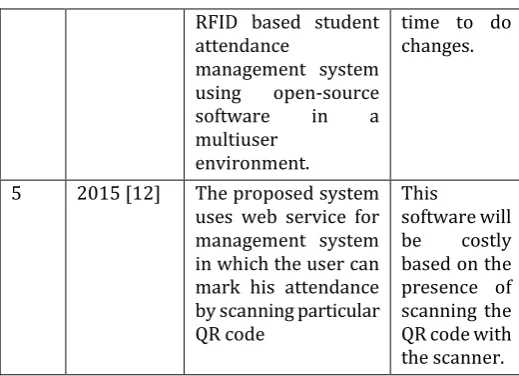
5 2015 [12] The proposed system uses web service for management system in which the user can mark his attendance by scanning particular QR code
This
software will be costly based on the presence of scanning the QR code with the scanner.
3. EXISTING SYSTEM
[10]Barcode Attendance System The barcode method is a general type of time and attendance system through which the ability to measure and track employees’ time could be developed with the computerization through barcode technology, the errors previously made in the hand-operated payroll or attendances are excreted. As a result, the system provides high levels of accuracy and reliability in the tracking of employee attendance. [13]Besides, the costs associated with the installation of the system are not too much relative to the cost of payroll or attendance errors. Every operator is assigned a badge/card in which there is a barcode. To check into or down of the company, the badge/card is interchanged on the time clock, and the data is captured by the clock. This data from the clock can be downloaded by the manager or the administrator and then used for updating and maintaining time and attendance records.
[image:2.595.303.563.83.271.2]PROPOSED SYSTEM ARCHITECTURE
© 2019, IRJET | Impact Factor value: 7.34 | ISO 9001:2008 Certified Journal
| Page 706
WORKING OF PROPOSED SYSTEMUser should show his identity through RFID tag to the RFID reader, Now the RFID reader takes the information about the user and compares it with existing data present in the database.
1. If the user is valid user, then the door gets unlocked and allows the user to come in.
2. Once the user enters, the IR sensor catches/senses the entry of the particular user.
3. If two users enter at a time the IR sensor senses, it and gives warning through buzzer which creates alarm and indicates that invalid entry has been made. It gives a reminder to the invalid user to make his entry valid.
4. After certain time interval when the user completes its task and comes out, while returning the user passes through IR sensor, if the user exits after particular time interval his/her attendance will be marked but If the user comes out before a scheduled time the IR sensor doesn’t make his entry count and the attendance is not marked.
5. All the marked attendance is now stored in the database and record is been created.
HARDWARE REQUIREMENTS:
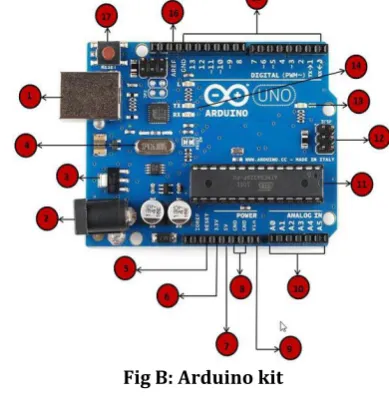
1. Arduino Kit
is an open-source radionics platform.
boards can read inputs – light on a sensor, a finger on a key, or a Twitter report – and turn it into an
initiating a motor, switching on an LED, distributing something online.
can tell your board what to do by giving a set of instructions to the microcontroller on the board. To do so you manage the Arduino programming language (based on Wiring), and the Arduino Software (IDE), based on Processing.
FEATURES OF ARDUINO
Low-priced
Cross-platform
A simple, clear programming atmosphere
Free and extensible software
[image:3.595.332.527.96.304.2] Free and extensible hardware
Fig B: Arduino kit
2. IR sensors
An infrared sensor is an automatic device, that transmits to sense some aspects of the surroundings. An IR sensor can measure the heat of an object as well as catches the action. These varieties of sensors estimate only infrared transmission, rather than emitting it which is called a receptive IR sensor. Usually, in the infrared spectrum, all the objects radiate some form of thermal radiation. These kinds of radiations are transparent to our eyes, which can be exhibited by an infrared sensor.
Fig C: IR Sensor
The emitter is simply an IR LED (Light Emitting Diode) and the detector is easily an IR photodiode that is sensitive to IR radiation of the related wavelength as When IR light falls on the photodiode, the resistances and the output voltages will change in proportion to the magnitude of the IR light received.
3. RFID reader
[image:3.595.355.515.439.588.2]© 2019, IRJET | Impact Factor value: 7.34 | ISO 9001:2008 Certified Journal
| Page 707
stored in the integrated circuit of the transponder (silicon [image:4.595.63.241.133.261.2]chip), and communicates them, depending on the application, to a host system.
Fig D: RFID Reader
4. RFID tags
The heart of an RFID system is an information carrier, referred to as the transponder, or only the Chip. The designs and modes of the function of the transponders also differ depending on the frequency range, just as with the antennas.
Fig E: RFID Tag
REFERENCES
[1] Darshankumar Dalwadi, Insiya Guriwala, Shiwangi Chaudhary, Miloni Kapadia and Megha Savalia, “RFID Based Student Attendance Management System: A Review and an Approach” April 2016, Vol.6, No.2, pp.262-265.
[2] Arulogun O. T., Olatunbosun, A., Fakolujo O. A., and Olaniyi, O. M. ,” RFID-Based Students Attendance Management System”,International Journal of Scientific and Engineering Research February-2013 , Vol. 4, Iss. 2, pp.1-9
[3] Elima Dussian.” RFID based student attendance system”, International Journal of Computer Applications National Conference cum Workshop on Bioinformatics and Computational Biology, NCWBCB- 2014.
[4] Priyanka Sahara, Pranali Gaikwd, Snehal Narule, Nutan Thakre, Puja Chandekar.” RFID Technology based attendance management system”, International Journal of Engineering and Computer Science, Vol. 6 Iss. March 2017, pp. 20458-20463.
[5] Unnati A. Pate and Dr. Swaminarayan Priya, “Development of a student attendance management system using RFID and face recognition: a review”, International Journal of Advance Research in Research Vol. 2, Iss. 8, August 2014.
[6] Ankita Agrawal and Ashish Bansal, “Online attendance management system using RFID with object counter”, International Journal of Information and Computation Technology. Vol. 3, Issu. 3 (2013), pp. 131-138
[7] Pushpa S. Gagare., Priyanka A. Sathe, Vedant T. Pawaskar. and Sagar S. Bhave,” Smart Attendance System “, International Journal on Recent and Innovation Trends in Computing and Communication, Vol. 2 Iss.1 ( 2017) pp.57-60
[8] Anusha V Pai1, Atul Krishna, Kshama P M and Menita Correa,” Web service for student attendance management system”. Vol 3, pp 1-13
[9] Nurbek Saparkhojayev and Selim Guvercin, “Attendance control system based on RFID-technology”. International Journal of Computer Science Issues, Vol. 9, Iss. 3, No 1, May 2012, pp. 317-329
[10]Shashank Shukla, Shailee Shah and Pooja Save, “RFID based attendance management system”, International Journal of Electrical and Computer Engineering, Vol. 3, No. 6, December 2013, pp. 784-790.
[11]Krenare R. Pireva and Jeton Siqeca, “RFID: Management system for students’ attendance” 15th Workshop on International Stability, Technology, and Culture the International Federation of Automatic Control, June, 2013. pp.
[12]Abdul Aziz Mohammed and Jyothi Kameswari U,” Web-server based student attendance system using RFID technology”, International Journal of Engineering Trends and Technology, Vol.4, Iss.5, May 2013, pp.1559-1568
[13]Moth Myint Thein, Chaw Myat New and Hla Myo, “Attendance management system based on RFID and fingerprint reader”. International journal of scientific & technology research, Vol.4, Isse. 07, JULY 2015, pp.67-73
[14]Ononiwu G. Chiagozie, Okorafor G. Nwaji, “radio frequency identification (RFID) based attendance system with automatic door unit”, Vol 2., pp. 1-11
[15]Priyanka Sahare, Pranali Gaikwad, Snehal Narule, Nutan Thakre and Puja Chandekar,” RFID technology based attendance management system”, Vol. 6 Iss. 3 March 2017, pp. 20458-20463.
[image:4.595.71.253.342.446.2]© 2019, IRJET | Impact Factor value: 7.34 | ISO 9001:2008 Certified Journal
| Page 708
[17]F. Zhou, C. Chen, D. Jing, C. Huang and H. Min.”Evaluating and optimizing power-consumption of anti-collision protocols for applications in RFID systems”, Auto-ID Labs Tech. Report.
[18]Naval Bhandari, Anirudha Sahoo and Sridhar Iyer,” Radio frequency identification - a basic primer. White Paper”, AIM Ine WP-98/002R2, August 2001. Pp. 51-59
[19]D. Engels and S. Sarma. “The reader collision problem”. IEEE International Conference on Systems, Man and Cybernetics, 3:6, 2002, pp.217-225.
[20]A. Sahoo, S. Iyer, and N. Bhandari, “Improving RFID system to read tags efficiently”, 2006.pp. 8457-8463
FUTURE SCOPE AND CONCLUSION