Proceedings of the 2019 Conference on Empirical Methods in Natural Language Processing 3314
Let’s Ask Again: Refine Network for Automatic Question Generation
Preksha Nema†‡∗ Akash Kumar Mohankumar†∗ Mitesh M. Khapra†‡ Balaji Vasan Srinivasan• Balaraman Ravindran†‡
†IIT Madras, India •Adobe Research
‡Robert Bosch Center for Data Science and Artificial Intelligence, IIT Madras
{preksha,miteshk,ravi}@cse.iitm.ac.in
[email protected] {balsrini}@adobe.com
Abstract
In this work, we focus on the task of Au-tomatic Question Generation (AQG) where given a passage and an answer the task is to generate the corresponding question. It is de-sired that the generated question should be (i) grammatically correct (ii) answerable from the passage and (iii) specific to the given an-swer. An analysis of existing AQG mod-els shows that they produce questions which do not adhere to one or more of the above-mentioned qualities. In particular, the gener-ated questions look like an incomplete draft of the desired question with a clear scope for refinement. To alleviate this shortcoming, we propose a method which tries to mimic the human process of generating questions by first creating an initial draft and then refin-ing it. More specifically, we propose Re-fine Network (RefNet) which contains two de-coders. The second decoder uses a dual at-tention network which pays atat-tention to both (i) the original passage and (ii) the question (initial draft) generated by the first decoder. In effect, it refines the question generated by the first decoder, thereby making it more cor-rect and complete. We evaluate RefNet on three datasets, viz., SQuAD, HOTPOT-QA, and DROP, and show that it outperforms exist-ing state-of-the-art methods by 7-16% on all of these datasets. Lastly, we show that we can improve the quality of the second decoder on specific metrics, such as, fluency and answer-ability by explicitly rewarding revisions that improve on the corresponding metric during training. The code has been made publicly available1.
1 Introduction
Over the past few years, there has been a growing interest in Automatic Question Generation (AQG)
∗
* The first two authors have contributed equally to this work.
1https://github.com/PrekshaNema25/RefNet-QG
Passage 1: Liberated by Napoleon’s army in 1806, Warsaw was made the capital of the newly created Duchy of Warsaw.
Generated Questions
Baseline What wasthe capitalof the newly duchy of Warsaw?
RefNet Who liberatedWarsaw in 1806? Reward-RefNet Whose armyliberated Warsaw
in 1806?
Passage 2:To fix carbon dioxide into sugar molecules in the process of photosynthesis, chloroplasts usean en-zyme called rubisco
Generated Questions
Baseline What does chloroplasts use? RefNet What does chloroplasts useto fix
carbon dioxide into sugar molecules? Reward-RefNet Whatdochloroplasts use to fix
[image:1.595.304.522.211.411.2]carbon dioxide into sugar molecules?
Table 1: Samples of generated questions from Base-line, RefNet and Reward-RefNet model on the SQuAD dataset. Answers are shown inblue
.
The above examples indicate that there is clear scope of improving the general quality of the ques-tions. Additionally, the quality can be specifically improved in terms of aspects like: fluency (Exam-ple 2) and answerability (Exam(Exam-ple 1). One way to approach this is by re-visiting the passage and answer with the aim to refinethe initial draft by generating a better question in the second pass and then improving it with respect to a certain aspect. We can draw a comparison between this process and how humans tend to write a rough initial draft first and then refine it over multiple passes, where the later revisions focus on improving the draft aiming at certain aspects like fluency or complete-ness. With this motivation, we propose Refine Network (RefNet), which examines the initially generated question and performs a second pass to generate arevisedquestion. Furthermore, we pro-poseReward-RefNetwhich uses explicit reward signals to achieve refinement focused on specific properties of the question such as fluency and an-swerability.
Our RefNet is a seq2seq based model that com-prises of two decoders: Preliminary and Refine-ment Decoder. The Refinement Decoder takes the initial draft of the question generated by the Pre-liminary decoder as an input along with passage and answer, and generates the refined question by attending onto both the passage and the initial draft using a Dual Attention Network. The pro-posed dual attention aids RefNet to generate the final question by revisiting the appropriate parts of the input passage and initial draft. From Table1, we can infer that our RefNet model is able to gen-erate better questions in the second pass by fixing the errors in the initial draft. Our Reward-RefNet model uses REINFORCE with a baseline algo-rithm to explicitly reward the Refinement Decoder for generating a better question as compared to the Preliminary Decoder based on certain desired pa-rameters like fluency and answerability. This leads to more answerable (see Reward-RefNet example for passage1in Table1) and fluent (see Reward-RefNet example for passage 2 in Table 1) ques-tions as compared to vanilla RefNet model.
Our experiments show that the proposed RefNet model outperforms existing state-of-the-art mod-els on the SQuAD dataset by12.3% and3.7% (on BLEU) given the relevant sentence and passage re-spectively. We also achieve state-of-the-art results on HOTPOT-QA and DROP datasets with an
im-provement of7.57% and15.25% respectively over the single-decoder baseline (on BLEU). Our hu-man evaluations further validate these results. We further analyze and explain the impact of includ-ing the Refinement Decoder by examininclud-ing the in-teraction between both the decoders. Interestingly, we observe that the inclusion of the Refinement Decoder boosts the quality of the questions gener-ated by the initial decoder also. Lastly, our human evaluation of the questions generated by Reward-RefNet corroborate empirical results, i.e., it im-proves the questionw.r.t. to fluency and answer-ability as compared to RefNet questions.
2 Refine Networks (RefNet) Model
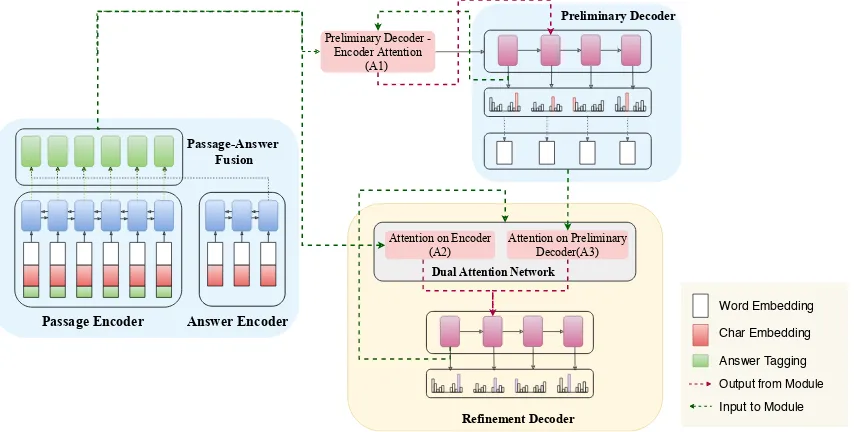
In this section, we discuss various components of our proposed model as shown in Figure 1. For a given passage P = {w1p, . . . , wpm} of length
m and answer A = {wa
1, . . . , wna} of length n,
we first obtainanswer-awarelatent representation,
U={h˜p1, . . . ,h˜pm}, for every word of the passage
and an answer representationha(as described in
Section2.1). We then generate an initial draftQ˜ =
{q˜1, . . . ,q˜T}by computingq˜tas
˜
qt= arg max
˜
q l
Y
t=1
˜
p(˜qt|˜qt−1, . . . ,˜q1,U,ha)
Herep˜(.)is a probability distribution modeled using the Preliminary Decoder. We then refine the initial draft Q˜ using the Refinement Decoder to obtain the refined draftQ={q1, . . . qT}:
qt= arg max q
l
Y
t=1
p(qt|qt−1, . . . ,q1,Q˜,U,ha)
We then use explicit rewards to enforce refinement on a desired metric, such as, fluency or answer-ability through our Reward-RefNet model. In the following sub-sections, we describe the passage encoder, preliminary and refinement decoders and our reward mechanism.
2.1 Passage and Answer Encoder
Preliminary Decoder -Encoder Attention
(A1)
Attention on Encoder (A2)
Attention on Preliminary Decoder(A3)
Passage-Answer Fusion
Passage Encoder Answer Encoder
Preliminary Decoder
Word Embedding
Char Embedding
Answer Tagging
Output from Module
Input to Module Refinement Decoder
[image:3.595.88.517.65.281.2]Dual Attention Network
Figure 1: Our RefNet model with Preliminary and Refinement Decoder.
Embedding Layer: In this layer, we compute a
d-dimensional embedding for every word in the passage and the answer. This embedding is ob-tained by concatenating the word’s Glove embed-ding (Pennington et al., 2014) with its charac-ter based embedding as discussed in (Seo et al., 2016). Additionally, for passage words, we also compute a positional embedding based on the rel-ative position of the word w.r.t. the answer span as described in (Zhao et al.,2018). For every pas-sage word, this positional embedding is also con-catenated to the word and character based dings. We discuss the impact of character embed-dings and answer tagging in Appendix A. In the subsequent sections, we will refer to embedding of thei-th passage wordwipase(wpi)and thej-th answer wordwaj ase(waj).
Contextual Layer: In this layer, we compute a contextualized representation for every word in the passage by passing the word embeddings (as computed above) through a bidirectional-LSTM (Hochreiter and Schmidhuber,1997):
−→
htp=LSTM(e(wpt),h−→pt−1) ∀t∈[1, m]
where−h→pt is the hidden state of the forward LSTM at time t. We then concatenate the forward and backward hidden states ashpt = [−h→tp;←h−pt].
The answer could correspond to a span in the passage. Letj+ 1andj+nbe the start and end indices of the answer span in the passage respec-tively. We can thus refer to{hpj+1, . . . ,hpj+n}as
the representation of the answer words in the con-text of the passage. We then obtain concon-textualized representations for thenanswer words by passing them through LSTM as follows:
−→
hat =LSTM([e(wta),hpj+t],−h→at−1) ∀t∈[1, n]
The final stateha = [−h→na;←h−an]of this Bi-LSTM is used as the answer representation in the subse-quent stages. When the answer is not present in the passage, onlye(wat)is passed to the LSTM.
Passage-Answer Fusion Layer: In this layer, we refine the representations of the passage words based on the answer representation as follows:
˜
hpi = tanh (Wu[hpi;ha;hpi ha]) ∀i∈[1, m]
HereWu ∈Rl×3l. lis the hidden size of LSTM. This is similar to how (Seo et al., 2016) capture interactions between passage and question for QA. We useU = {h˜p1, . . . ,h˜pm}as the fused
passage-answer representation which is then used by our decoder(s) to generate the questionQ.
2.2 Preliminary and Refinement Decoders
As discussed earlier, RefNet has two decoders, viz., Preliminary Decoder and Refinement De-coder, as described below:
using an LSTM as follows:
˜
hdt =LSTM([ew(˜qt−1); ˜ct−1;ha],h˜dt−1)
˜
ct= m
X
i=1
αtih˜pi (1)
Here h˜d
t is the hidden state at time t, ha is the
answer representation as computed above,˜ct−1is an attention weighted sum of the contextualized passage word representations, αi
t are
parameter-ized and normalparameter-ized attention weights (Bahdanau et al., 2014). Let’s call this attention network as
A1. ew(q˜t)is the embedding of the wordq˜t. We
obtainq˜tas:
˜
qt=argmax
˜
q (softmax(Wo[Wc[˜h d
t; ˜ct])), (2)
whereWcis aRl×2lmatrix andWois the output
matrix which projects the final representation to RV whereV is the vocabulary size.
Refinement Decoder: Once the preliminary decoder generates the entire question, the refine-ment decoder uses it to generate an updated ver-sion of the question using aDual Attention Net-work. It first computes an attention weighted sum of the embeddings of the words generated by the first decoder as:
gt= T
X
i=1
βitew(q˜i)
whereβt
i are parameterized and normalized
atten-tion weights computed by attenatten-tion network A3. Since the initial draft could be erroneous or in-complete, we obtain additional information from the passage instead of only relying on the output of the first decoder. We do so by computing a con-text vectorctas
ct= m
X
i=1
γith˜pi
whereγitare parameterized and normalized atten-tion weights computed by attenatten-tion network A3. The hidden state of the refinement decoder at time
tis computed as follows:
hdt =LSTM([e(qt−1);ct−1;gt−1;ha],hdt−1) Finally,qtis predicted using
qt=argmax
q (softmax(Wo[W
0
c[hdt;ct−1;gt−1]))
whereWc0 is a weight matrix andWo is the
out-put matrix which is shared with the Preliminary decoder (Equation2). Note that RefNet generates two variants of the question : initial draftQ˜ and final draftQ. We compare these two versions of the generated questions in Section4.
2.3 Reward-RefNet
Next, we address the following question: Can the refinement decoder be explicitly rewarded for gen-erating a question which is better than that gener-ated by the preliminary decoder on certain desired parameters? For example, (Nema and Khapra, 2018) define fluency and answerability as desired qualities in the generated question. They evalu-ate fluency using BLEU score and answerability using a score which captures whether the ques-tion contains the required {named entities, im-portant words, function words, question types}
(and is thus answerable). We use these fluency and answerability scores proposed by (Nema and Khapra,2018) as reward signals. We first compute the rewardr(Q˜) andr(Q) for the question gen-erated by the preliminary and refinement decoder respectively. We then use “REINFORCE with a baseline” algorithm (Williams, 1992) to reward Refinement Decoder using the Preliminary De-coder’s rewardr(Q˜)as the baseline. More specif-ically, given the Preliminary Decoder’s generated word sequence Q˜ = {q˜1,q˜2, . . . ,q˜T} and the
Refinement Decoder’s generated word sequence
Q = {q1, q2, . . . , qT} obtained from the
distribu-tionp(qt|qt−1, . . . ,q1,Q˜,U,ha), the training loss is defined as follows
L(Q) =(r(Q)−r(Q˜))· T
X
t=1
logp(qt|qt−1, . . . , q1,Q˜,U,ha)
wherer(Q)andr(Q˜)are the rewards obtained by comparing with the reference question Q∗. As mentioned, this reward r(.) can be the fluency score or answerability score as defined by (Nema and Khapra,2018).
2.4 Copy Module
Dataset Model n-gram
BLEU-1 BLEU-2 BLEU-3 BLEU-4 ROUGE-L METEOR QBLEU4
SQuAD (Sentence Level)
(Sun et al.,2018) 43.02 28.14 20.51 15.64 - - -(Zhao et al.,2018) 44.51 29.07 21.06 15.82 44.24 19.67 -(Kim et al.,2019) - - - 16.17 - - -EAD 44.74 29.79 22.00 16.84 44.78 20.60 24.7
RefNet 47.27 31.88 23.65 18.16 47.14 23.40 27.4
SQuAD (Passage Level)
(Zhao et al.,2018) 45.07 29.58 21.60 16.38 44.48 20.25 -EAD 44.61 29.37 21.50 16.36 43.95 20.11 24.2
RefNet 46.41 30.66 22.42 16.99 45.03 21.10 26.6
HOTPOT
(Zhao et al.,2018)* 45.29 32.06 24.43 19.29 40.40 19.29 25.7
EAD 46.00 32.47 24.82 19.68 41.52 23.27 26.2
RefNet 45.45 33.13 26.05 21.17 43.12 25.81 28.7
DROP Dataset
(Zhao et al.,2018)* 39.56 29.19 22.53 18.07 45.01 19.68 31.4
EAD 39.21 29.10 22.65 18.42 45.07 19.56 31.8
[image:5.595.75.524.63.244.2]RefNet 42.81 32.63 25.78 21.23 47.49 22.25 33.6
Table 2: Comparsion of RefNet model with existing approaches and EAD model. Here * denotes our implemen-tation of the corresponding work.
3 Experimental Details
In this section, we discuss (i) the datasets for which we tested our proposed model, (ii) imple-mentation details and (iii) evaluation metrics used to compare our model with the baseline and exist-ing works.
3.1 Datasets
SQuAD (Rajpurkar et al., 2016): It contains 100K (question, answer) pairs obtained from536 Wikipedia articles, where the answers are a span in the passage. For SQuAD, AQG has been tried from both sentences and passages. In the former case, only the sentence which contains the answer span is used as input, whereas in the latter case the entire passage is used. We use the same train-validation-test splits as usedin(Zhao et al.,2018).
Hotpot QA(Yang et al.,2018) : Hotpot-QA is a multi-document and multi-hop QA dataset. Along with the triplet (P, A, Q), the authors also provide supporting facts that potentially lead to the answer. The answers here are either yes/no or answer span in P. We concatenate these supporting facts to form the passage. We use10% of the training data for validation and use the original dev set as test set.
DROP(Dua et al.,2019): The DROP dataset is a reading comprehension benchmark which requires discrete reasoning over passage. It contains96K questions which require discrete operations such as addition, counting, or sorting to obtain the an-swer. We use10% of the original training data for validation and use the original dev set as test set.
3.2 Implementation Details
We use 300dimensional pre-trained Glove word embeddings, which are fixed during training. For character-level embeddings, we initially use a20 dimensional embedding for the characters which is then projected to100dimensions. For answer-tagging, we use embedding size of3. The hidden size for all the LSTMs is fixed to512. We use 2-layer, 1-layer and 2-layer stacked BiLSTM for the passage encoder, answer encoder and the decoders (both) respectively. We take the top 30,000 fre-quent words as the vocabulary. We use Adam op-timizer with a learning rate of0.0004and train our models for10epochs using cross entropy loss. For the Reward-RefNet model, we fine-tune the pre-trained model with the loss function mentioned in Section2.3for3epochs. The best model is chosen based on the BLEU (Papineni et al.,2002) score on the validation split. For all the results we use beam search decoding with a beam size of5.
3.3 Evaluation
We evaluate our models, based on n-gram sim-ilarity metrics BLEU (Papineni et al., 2002), ROUGE-L (Lin,2004), and METEOR (Lavie and Denkowski, 2009) using the package released in (Sharma et al., 2017)2. We also quantify the answerability of our models using QBLEU-43(Nema and Khapra,2018).
2
https://github.com/Maluuba/nlg-eval
3https://github.com/PrekshaNema25/
4 Results and Discussions
In this section, we present the results and analysis of our proposed model RefNet. Throughout this section, we refer to our models as follows:
Encode-Attend-Decode (EAD) modelis our sin-gle decoder model containing the encoder and the Preliminary Decoder described earlier. Note that the performance of this model is comparable to our implementation of the model proposed in (Zhao et al.,2018).
Refine Network (RefNet) modelincludes the en-coder, the Preliminary Decoder and the Refine-ment Decoder.
We will (i) compare RefNet’s performance with EAD and existing models across all the mentioned datasets (ii) report human evaluations to compare RefNet and EAD (iii) analyze Refinement and Pre-liminary Decoders iv) present the performance of Reward RefNet with two different reward signal (fluency and answerability).
4.1 RefNet’s performance across datasets
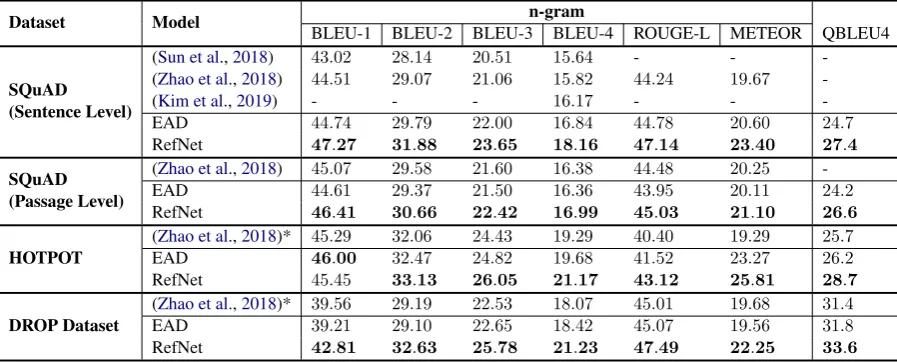
In Table 2, we compare the performance of RefNet with existing single decoder architectures across different datasets. On BLEU-4 metric, RefNet beats the existing state-of-the-art model by 12.30%,9.74%,17.48%, and3.71% respectively on SQuAD (sentence), HOTPOT-QA, DROP and SQuAD (passage) dataset. Also it outperforms EAD by 7.83%, 7.57%, 15.25% and 3.85% re-spectively on SQuAD (sentence), HOTPOT-QA, DROP and SQuAD (passage). In general, RefNet is consistently better than existing models across all n-gram scores (BLEU, ROUGE-L and ME-TEOR). Along with n-gram scores, we also ob-serve improvements on Q-BLEU4 as well, which as described earlier, gives a measure of both an-swerability and fluency.
4.2 Human Evaluations
We conducted human evaluations to analyze the quality of the questions produced by EAD and RefNet. We randomly sampled500questions gen-erated from the SQuAD (sentence level) dataset and asked the annotators to compare the qual-ity of the generated questions. The annotators were shown a pair of questions, one generated by EAD and one by RefNet from the same sentence, and were asked to decide which one was better in terms of Fluency, Completeness, and Answer-ability. They were allowed to skip the question
Passage: Before the freeze ended in 1952, there were only 108 existing television stations in the United States; a few major cities (such as Boston) had onlytwo
television stations, ... Questions
[image:6.595.308.524.203.267.2]EAD: how many television stations existed in boston ? RefNet: how many television stations did boston have in the united ?
Table 3: An example where EAD model was better than RefNet. The ground truth answers are shown in blue.
Model Decoder BLEU-4 QBLEU-4
withoutA3 RefNet
17.16 25.80
Initial Draft 17.59 26.00
withA3 RefNet
18.37 27.40
Initial Draft 17.89 26.00
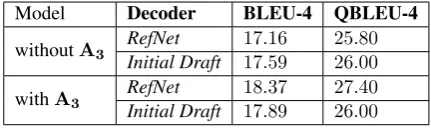
Table 4: Comparison between Preliminary Decoder and Refinement Decoder in RefNet Model for SQuAD Sentence Level QG.
pairs where they could not make a clear choice. Three annotators rated each question and the fi-nal label was calculated based on majority vot-ing. We observed that the RefNet model outper-forms the EAD model across all three metrics. Over 68.6%, 66.7% and 64.2% of the generated questions from RefNet were respectively more flu-ent, complete and answerable when compared to the EAD model. However, there are some cases where EAD does better than RefNet. For exam-ple, in Table3, we show that while trying to gen-erate a more elaborate question, RefNet introduces an additional phrase“in the united”which is not required. Due to such instances, annotators pre-ferred the EAD model in around 30% of the in-stances.
4.3 Analysis of Refinement Decoder and Preliminary Decoder
The two decoders impact each other through two paths: (i) indirect path, where they share the en-coder and the output projection to the vocabulary
Sample:
Sentence:For instance , the language{xx — x is any binary string}can be solved in linear timeon a multi-tape Turing machine , but necessarily requires
quadratic time in the model of single-tape Turing machines .
Reference Question:A multi-tape Turing machine requires what type of time for a solution ?
withA3 Refinement DecoderPreliminary Decoder:: in what time can the language be solved on a multi-tape turing machine ?in what time can the language be solved ?
[image:7.595.309.526.191.261.2]withoutA3 Refinement Decoder:Preliminary Decoder:in what time can the languagein what time can the language — x x x x is solved ?{xx — x x x x is any binary string ?
Table 5: Generated samples by Preliminary Decoder and Refinement Decoder in RefNet model.
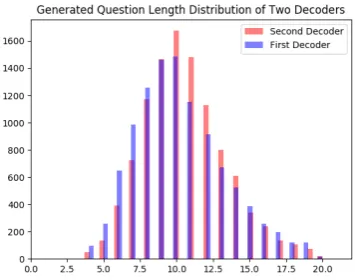
Figure 2: Generated Question Length Distribution for Preliminary Decoder (First Decoder) and Refinement Decoder (Second Decoder).
shared encoder and output layer get from the Re-finement Decoder. When we add the direct path (attention network) between the two decoders, the performance of the Refinement Decoder improves as compared to the Preliminary Decoder as shown in rows 3 and 4 of the Table4
Comparison on Answerability:We also evaluate both the initial and refined draft using QBLEU4. As discussed earlier, Q-Metric measures Answer-ability using four components, viz., Named Enti-ties, Important Words, Function Words, and Ques-tion Type. We observe that the increase in Q-Metric for refined questions is because the RefNet model can correct/add the relevant Named Enti-ties in the question. In particular, we observe that the Named Entity component score in Q-Metric increases from32.42for the first draft to37.81for the refined draft.
Qualitative Analysis: Figure2 shows that the RefNet model indeed generates more elaborate questions when compared to the Preliminary De-coder. As shown in Table5, the quality of the re-fined question is better than the initial draft of the questions. Here RefNet adds the phrase “multi-tape Turing Machine,” (row 2) which removes any
Model
BLEU Reward Signal
Answerability Reward Signal
BLEU4 %prefer-ence Ans.
[image:7.595.88.266.202.342.2]%prefer ence RefNet 18.37 32.9% 36.9 30% Reward-RefNet 18.52 67.1% 37.5 70%
Table 6: Impact of Reward-RefNet on fluency and an-swerability. %preference denotes the percentage of times annotators prefer the generated output from the model for fluency in case of BLEU Reward signal and answerability in case of Answerability Reward signal.
Passage:Cost engineers and estimatorsapply expertise to relate the work and materials involved to a proper valuation
Questions
Generated: Who apply expertise to relate the work and materials involved to a proper valuation ?
True: Who applies expertise to relate the work and ma-terials involved to a proper valuation ?
Table 7: An example of question with significant over-lap with the passage. The answer is shown inblue.
ambiguity in the question.
4.4 Analysis of Reward-RefNet
In this section, we analyze the impact of employ-ing different reward signals in Reward-RefNet. As discussed earlier in section2.3, we use fluency and answerability scores as reward signals. As shown in Table6, when BLEU-4 (fluency) is used as a reward signal, there is improvement in BLEU-4 scores of Reward-RefNet as compared to RefNet model. We validated these results through human evaluations across 200samples. Annotators pre-fer the Reward-RefNet model in67% of the cases for fluency. Similarly when we use Answerability score as a reward signal, answerability improves for the model and annotators prefer the Reward-RefNet in70% of the cases for answerability. The performance of Reward-RefNet on fluency and an-swerability is similar for other datasets (see Ap-pendix B).
Figure 3: Originality Analysis: Plot of Q-BLEU score vsN- the number points selected.
We observe that current state-of-the-art models perform very well in terms of BLEU/QBLEU scores when the actual question has significant overlap with the passage. For example, consider a passage from the SQuAD dataset in Table 7, where except the question word who, the model sequentially copies everything from the passage and achieves a QBLEU score of92.4. However, the model performs poorly in situations where the true question is novel and does not contain a large sequence of words from the passage itself. In or-der to quantify this, we first sort the true questions based on its BLEU-2 overlap with the passage in ascending order. We then select the first N true questions and compute the QBLEU score with the generated questions. The results are shown in red in Figure3. Towards the left, where there are true questions with low overlap with the passage, the performance is poor, but it gradually improves as the overlap increases.
The task of generating questions with high orig-inality(where the model phrases the question in its own words) is a challenging aspect of AQG since it requires complete understating of the seman-tics and syntax of the language. In order to im-prove questions generated on originality, we ex-plicitly reward our model for having low n-gram score with the passage as compared to the initial draft. As a result we observe that with Reward-RefNet(Originality), there is an improvement in the performance where the overlap with the pas-sage was less (as shown in blue in Figure 3).As shown in Table8, although both questions are an-swerable given the passage, the question generated from Reward-RefNet(Originality) is better.
Passage: McLetchie was elected on the Lothian re-gional list and the Conservatives suffered a net loss of five seats , with leader Annabel Goldieclaiming that their support had held firm, nevertheless, she too an-nounced she would step down as leader of the party. Questions
True: Who announced she would step down as leader of the Conservatives ?
RefNet: whoclaiming that their support had held firm ? Reward-RefNet: who was the leader of the conserva-tives?
Table 8: An example where Reward-RefNet(Originality) is better than RefNet.
5 Related Work
6 Conclusion and Future Work
In this work, we proposed Refine Networks (RefNet)for Question Generation to focus on re-fining and improving the initial version of the gen-erated question. Our proposed RefNet model con-sisting of a Preliminary Decoder and a Refine-ment Decoder with Dual Attention Network out-performs the existing state-of-the-art models on the SQuAD, HOTPOT-QA and DROP datasets. Along with automated evaluations, we also con-ducted human evaluations to validate our findings. We further showed that using Reward-RefNet im-proves the initial draft on specific aspects like flu-ency, answerability and originality. As a future work, we would like to extend RefNet to have the ability to decide whether a refinement is needed on the generated initial draft.
Acknowledgements
We thank Amazon Web Services for providing free GPU compute and Google for supporting Preksha Nema’s contribution in this work through Google Ph.D. Fellowship programme. We would like to acknowledge Department of Computer Sci-ence and Engineering, IIT Madras and Robert Bosch Center for Data Sciences and Artificial In-telligence, IIT Madras (RBC-DSAI) for provid-ing us sufficient resources. We would also like to thank Patanjali SLPSK, Sahana Ramnath, Rahul Ramesh, Anirban Laha, Nikita Moghe and the anonymous reviewers for their valuable and con-structive suggestions.
References
Dzmitry Bahdanau, Kyunghyun Cho, and Yoshua Bengio. 2014. Neural machine translation by jointly learning to align and translate. CoRR, abs/1409.0473.
Xinya Du and Claire Cardie. 2017. Identifying where to focus in reading comprehension for neural ques-tion generaques-tion. InEMNLP, pages 2067–2073. As-sociation for Computational Linguistics.
Xinya Du, Junru Shao, and Claire Cardie. 2017. Learn-ing to ask: Neural question generation for readLearn-ing comprehension. InACL (1), pages 1342–1352. As-sociation for Computational Linguistics.
Dheeru Dua, Yizhong Wang, Pradeep Dasigi, Gabriel Stanovsky, Sameer Singh, and Matt Gardner. 2019. DROP: A reading comprehension benchmark re-quiring discrete reasoning over paragraphs. InProc. of NAACL.
Michael Heilman and Noah A. Smith. 2010. Good question! statistical ranking for question genera-tion. InHLT-NAACL, pages 609–617. The Associa-tion for ComputaAssocia-tional Linguistics.
Sepp Hochreiter and J¨urgen Schmidhuber. 1997. Long short-term memory. Neural Comput., 9(8):1735– 1780.
Unnat Jain, Ziyu Zhang, and Alexander G. Schwing. 2017. Creativity: Generating diverse questions us-ing variational autoencoders. InCVPR, pages 5415– 5424. IEEE Computer Society.
Yanghoon Kim, Hwanhee Lee, Joongbo Shin, and Kyomin Jung. 2019. Improving neural ques-tion generaques-tion using answer separaques-tion. CoRR, abs/1809.02393.
Igor Labutov, Sumit Basu, and Lucy Vanderwende. 2015. Deep questions without deep understanding. In ACL (1), pages 889–898. The Association for Computer Linguistics.
Alon Lavie and Michael J. Denkowski. 2009. The meteor metric for automatic evaluation of machine translation.Machine Translation, 23(2-3):105–115.
Yikang Li, Nan Duan, Bolei Zhou, Xiao Chu, Wanli Ouyang, and Xiaogang Wang. 2017. Visual ques-tion generaques-tion as dual task of visual quesques-tion an-swering. CoRR, abs/1709.07192.
Chin-Yew Lin. 2004. Rouge: A package for automatic evaluation of summaries. InProc. ACL workshop on Text Summarization Branches Out, page 10.
David Lindberg, Fred Popowich, John C. Nesbit, and Philip H. Winne. 2013. Generating natural language questions to support learning on-line. In ENLG, pages 105–114. The Association for Computer Lin-guistics.
Jack Mostow and Wei Chen. 2009. Generating instruc-tion automatically for the reading strategy of self-questioning. In AIED, volume 200 ofFrontiers in Artificial Intelligence and Applications, pages 465– 472. IOS Press.
Preksha Nema and Mitesh M. Khapra. 2018. Towards a better metric for evaluating question generation sys-tems. CoRR, abs/1808.10192.
Kishore Papineni, Salim Roukos, Todd Ward, and Wei-Jing Zhu. 2002. Bleu: a method for automatic eval-uation of machine translation. InACL, pages 311– 318. ACL.
Romain Paulus, Caiming Xiong, and Richard Socher. 2018. A deep reinforced model for abstractive sum-marization.CoRR, abs/1705.04304.
Pranav Rajpurkar, Jian Zhang, Konstantin Lopyrev, and Percy Liang. 2016. Squad: 100, 000+ questions for machine comprehension of text. InProceedings of the 2016 Conference on Empirical Methods in Nat-ural Language Processing, EMNLP 2016, Austin, Texas, USA, November 1-4, 2016, pages 2383–2392.
Sathish Reddy, Dinesh Raghu, Mitesh M. Khapra, and Sachindra Josh. 2017. Generating natural language question-answer pairs from a knowledge graph us-ing a RNN based question generation model. In EACL (1), pages 376–385. Association for Compu-tational Linguistics.
Steven J. Rennie, Etienne Marcheret, Youssef Mroueh, Jarret Ross, and Vaibhava Goel. 2017. Self-critical sequence training for image captioning. 2017 IEEE Conference on Computer Vision and Pattern Recog-nition (CVPR), pages 1179–1195.
Abigail See, Peter J. Liu, and Christopher D. Manning. 2017. Get to the point: Summarization with pointer-generator networks. InACL.
Min Joon Seo, Aniruddha Kembhavi, Ali Farhadi, and Hannaneh Hajishirzi. 2016. Bidirectional at-tention flow for machine comprehension. CoRR, abs/1611.01603.
Iulian Vlad Serban, Alberto Garc´ıa-Dur´an, C¸ aglar G¨ulc¸ehre, Sungjin Ahn, Sarath Chandar, Aaron C. Courville, and Yoshua Bengio. 2016. Generating factoid questions with recurrent neural networks: The 30m factoid question-answer corpus. InACL (1). The Association for Computer Linguistics.
Shikhar Sharma, Layla El Asri, Hannes Schulz, and Jeremie Zumer. 2017. Relevance of unsupervised metrics in task-oriented dialogue for evaluating nat-ural language generation. CoRR, abs/1706.09799.
Heung-yeung Shum, Xiao-dong He, and Di Li. 2018. From eliza to xiaoice: challenges and opportunities with social chatbots. Frontiers of Information Tech-nology & Electronic Engineering, 19(1):10–26.
Linfeng Song, Zhiguo Wang, and Wael Hamza. 2017. A unified query-based generative model for ques-tion generaques-tion and quesques-tion answering. CoRR, abs/1709.01058.
Xingwu Sun, Jing Liu, Yajuan Lyu, Wei He, Yan-jun Ma, and Shi Wang. 2018. Answer-focused and position-aware neural question generation. In Pro-ceedings of the 2018 Conference on Empirical Meth-ods in Natural Language Processing, pages 3930– 3939, Brussels, Belgium. Association for Computa-tional Linguistics.
Ronald J. Williams. 1992. Simple statistical gradient-following algorithms for connectionist reinforce-ment learning. Mach. Learn., 8(3-4):229–256.
Yingce Xia, Fei Tian, Lijun Wu, Jianxin Lin, Tao Qin, Nenghai Yu, and Tie-Yan Liu. 2017. Deliberation
networks: Sequence generation beyond one-pass de-coding. In I. Guyon, U. V. Luxburg, S. Bengio, H. Wallach, R. Fergus, S. Vishwanathan, and R. Gar-nett, editors, Advances in Neural Information Pro-cessing Systems 30, pages 1784–1794. Curran As-sociates, Inc.
Zhilin Yang, Peng Qi, Saizheng Zhang, Yoshua Ben-gio, William W. Cohen, Ruslan Salakhutdinov, and Christopher D. Manning. 2018. HotpotQA: A dataset for diverse, explainable multi-hop question answering. In Proceedings of the Conference on Empirical Methods in Natural Language Processing (EMNLP).
Kaichun Yao, Libo Zhang, Tiejian Luo, Lili Tao, and Yanjun Wu. 2018. Teaching machines to ask ques-tions. InIJCAI.
Xingdi Yuan, Tong Wang, C¸ aglar G¨ulc¸ehre, Alessan-dro Sordoni, Philip Bachman, Saizheng Zhang, Sandeep Subramanian, and Adam Trischler. 2017. Machine comprehension by text-to-text neural ques-tion generaques-tion. InRep4NLP@ACL, pages 15–25. Association for Computational Linguistics.
Yao Zhao, Xiaochuan Ni, Yuanyuan Ding, and Qifa Ke. 2018. Paragraph-level neural question gener-ation with maxout pointer and gated self-attention networks. InEMNLP.