3931
Recommendations for Datasets for Source Code Summarization
Alex LeClair, Collin McMillan
Department of Computer Science and Engineering University of Notre Dame
{aleclair, cmc}@nd.edu
Abstract
Source Code Summarization is the task of writing short, natural language descriptions of source code. The main use for these de-scriptions is in software documentation e.g. the one-sentence Java method descriptions in JavaDocs. Code summarization is rapidly becoming a popular research problem, but progress is restrained due to a lack of suit-able datasets. In addition, a lack of commu-nity standards for creating datasets leads to confusing and unreproducible research results – we observe swings in performance of more than 33% due only to changes in dataset de-sign. In this paper, we make recommendations for these standards from experimental results. We release a dataset based on prior work of over 2.1m pairs of Java methods and one sen-tence method descriptions from over 28k Java projects. We describe the dataset and point out key differences from natural language data, to guide and support future researchers.
1 Introduction
Source Code Summarization is the task of writ-ing short, natural language descriptions of source code (Eddy et al.,2013). The most common use for these descriptions is in software documen-tation, such as the summaries of Java methods in JavaDocs (Kramer, 1999). Automatic gener-ation of code summaries is a rapidly-expanding research area at the crossroads of Computational Linguistics and Software Engineering, as a grow-ing tally of new workshops and NSF-sponsored meetings have recognized (Cohen and Devanbu,
2018;Quirk,2015). The reason, in a nutshell, is that the vast majority of code summarization tech-niques are adaptations of techtech-niques originally de-signed to solve NLP problems.
A major barrier to ongoing research is a lack of standardized datasets. In many NLP tasks such as Machine Translation there are large, curated
datasets (e.g. Europarl (Koehn, 2018)) used by several research groups. The benefit of these stan-dardized datasets is twofold: First, scientists are able to evaluate new techniques using the same test conditions as older techniques. And second, the datasets tend to conform to community customs of best practice, which avoids errors during evalua-tion. These benefits are generally not yet available to code summarization researchers; while large, public code repositories do exist, most research projects must parse and process these repositories on their own, leading to significant differences on one project to another. The result is that research progress is slowed as reproducibilty of earlier re-sults is difficult.
Inevitably, differences in dataset creation also occur that can mislead researchers and over or un-derstate the performance of some techniques. For example, a recent source code summarization pa-per reports achieving 25 BLEU when generating English descriptions of Java methods with an ex-isting technique (Gu et al.,2018), which is 5 points higher than the original paper reports (Iyer et al.,
2016). The paper also reports 35+ BLEU for a vanilla seq2seq NMT model, which is 16 points higher than what we are able to replicate. While it is not our intent to single out any one paper, we do wish to call attention to a problem in the research area generally: a lack of standard datasets leads to results that are difficult to interpret and replicate.
2 Related Work
Related work to this paper consists of approaches for source code summarization. As with many research areas, data-driven AI-based approaches have superseded heuristic/template-based tech-niques, though overall the field is quite new. Work by Haiducet al.(Haiduc et al., 2010a,b) in 2010 coined the term “source code summarization”, and several heuristic/template-based techniques fol-lowed including work by Sridhara et al. ( Srid-hara et al.,2010,2011), McBurneyet al.( McBur-ney and McMillan, 2016), and Rodeghero et al.(Rodeghero et al.,2015).
More recent techniques are data-driven, though the overall size of the field is small. Literature includes work by Hu et al. (Hu et al., 2018a,b) and Iyer et al. (Iyer et al., 2016). Projects tar-geting problems similar to code summarization have been published widely, including on com-mit message generation (Jiang et al.,2017;Loyola et al.,2017), method name generation (Allamanis et al., 2016), pseudocode generation (Oda et al.,
2015), and code search (Gu et al.,2018). Nazaret al.(Nazar et al.,2016) provide a survey.
Of note is that no standard datasets for code summarization have yet been published. Each of the above papers takes an ad hoc approach, in which the authors download large repositories of code and apply their own preprocessing. There are few standard practices, leading to major dif-ferences in the reported results in different papers, as discussed in the previous section. For example, the works by LeClairet al. (LeClair and McMil-lan, 2019) and Hu et al. (Hu et al., 2018a) both modify the CODENN model from Iyeret al.(Iyer et al., 2016) to work on Java methods and com-ments. LeClair et al. and Hu et al. report very disparate results: A BLEU-4 score of 6.3 for CO-DENN on one dataset, and 25.3 on another, even though both datasets were generated from Java source code repositories.
These disparate results happen for a variety of reasons, such as a difference in data set sizes and tokenization schemes. LeClairet al.use a data set of 2.1 million Java method-comment pairs while Huet al. use a total of 69,708. Huet al. also re-place out of vocabulary (OOV) tokens in the com-ments with <UNK> in the training, validation, and testing sets, while LeClairet al.remove OOV tokens from the training set only.
3 Dataset Preparations
The dataset we use in this paper is based on the dataset provided by LeClair et al. (LeClair and McMillan, 2019) in a pre-release. We used this dataset because it is both the largest and most re-cent in source code summarization. That dataset has its origins in the Sourcerer project by Lopeset al. (Lopes et al., 2010), which includes over 51 million Java methods. LeClair et al. provided the dataset after minimal initial processing that fil-tered for Java methods with JavaDoc comments in English, and removed methods over 100 words long and comments>13 and<3 words. The result is a dataset of 2.1m Java methods and associated comments. LeClairet al. do additional process-ing, but do not quantify the effects of their deci-sions – this is a problem because other researchers would not know which of the decisions to follow. We explore the following research questions to help provide guidelines and justifications for our design decisions in creating the dataset.
3.1 Research Questions
Our research objective and contribution in this pa-per is to quantify the effect of key dataset pro-cessing configurations, with the aim to make rec-ommendations on which configurations should be used. We ask the following Research Questions:
RQ1 What is the effect of splitting by method ver-sus splitting by project?
RQ2 What is the effect of removing automatically generated Java methods?
The scope of the dataset in this paper is source code summarization of Java methods – the dataset contains pairs of Java methods and JavaDoc de-scriptions of those methods. However, we be-lieve these RQs will provide guidance for similar datasets e.g. C/C++ functions and descriptions, or other units of granularity e.g. code snippets in-stead of methods/functions.
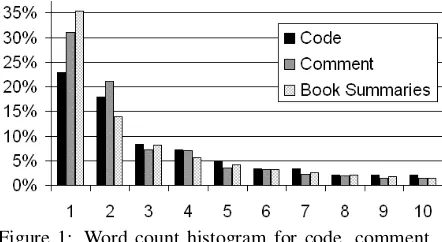
Figure 1: Word count histogram for code, comment, and the book summaries. About 22% of words occur one time across all Java methods, versus 35% in the book summaries.
are used in methods from the same project, and even worse, it is possible that overloaded methods appear in both the training and test sets. How-ever, this possibility is theoretical and a nega-tive effect has never been shown. In contrast, we split by project: randomly divide the Java projects into training/validation/test groups, then place all methods from e.g. test projects into the test set.
The rationale behind RQ2 is that automati-cally generated code is common in many Java projects (Shimonaka et al., 2016), and that it is possible that very similar code is generated for projects in the training set and the test-ing/validation sets. Shimonakaet al.(Shimonaka et al.,2016) point out that the typical approach for identifying auto-generated code is a simple case-insensitive text search for the phrase “generated by” in the comments of the Java files. LeClairet al.(LeClair and McMillan,2019) report that this search turns out to be quite aggressive, catching nearly all auto-generated code in the repository. However, as with RQ1, the effect of this filter is theoretical and has not been measured in practice.
3.2 Methodology
[image:3.595.73.294.48.169.2]Our methodology for answering RQ1 is to com-pare the results of a standard NMT algorithm with the dataset split by project, to the results of the same algorithm on the same dataset, except with the dataset split by function. But because random splits could be “lucky”, we created four random datasets split by project, and four split by function, seen in Table2. We then use an off-the-shelf, stan-dard NMT technique called attendgruprovided pre-release by LeClairet al.(LeClair and McMil-lan,2019) and used as a baseline approach in their recent paper. The technique is just an attentional encoder/decoder based on single-layer GRUs, and represents a strong NMT baseline used by many papers. We trainattendgruwith each of the four training sets, find the best-performing model using
Figure 2: Histogram of word occurrences per docu-ment. Approximately 34% of words occur in only one Java method, 20% occur in two methods, etc.
the validation set associated with that training set (out of 10 maximum epochs), and then obtain test performance for that model. We report the average of the results over the four random splits. Note that we used the same configuration forattendgruas LeClairet al. report, except that we reduced the output vocabulary to 10k to reduce model size.
Our process for RQ2is similar. We created four random split-by-project sets in which automati-cally generated code wasnot removed. Then we compared them to the four random split-by-project sets we created for RQ1 (in which auto-generated code was removed).
3.3 Dataset Characteristics
SplittingStrategy Set1 Set2 Set3 Set4 Split by project 17.81 16.73 17.11 17.99 Split by function 20.97 23.74 23.67 23.68 Auto-generated code included 19.11 19.09 18.04 15.66
Table 1: Average BLEU Scores from 15 epochs for each of the four sets.
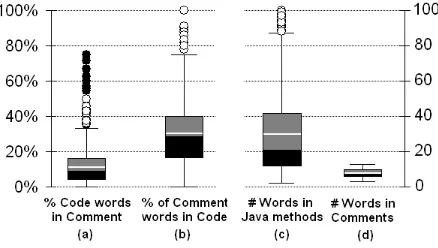
A related observation is that Java methods tend to be much longer than comments (Figure 3 ar-eas (c) and (d)). Typically, code summarization tools take inspiration from NMT algorithms de-signed for cases of similar encoder/decoder se-quence length. Many algorithms such as recur-rent networks are sensitive to sequence length, and may not be optimal off-the-shelf.
[image:4.595.75.294.552.676.2]A third observation is that the words in meth-ods and comments tend to overlap, but in fact a vast majority of words are different (70% of words in code summary comments do not occur in the code method, see Figure 3 area (b)). This situa-tion makes the code summarizasitua-tion problem quite difficult because the words in the comments repre-sent high level concepts, while the words in the source code represent low level implementation details – a situation known as the “concept assign-ment problem” (Biggerstaff et al.,1993). A code summarization algorithm cannot only learn a word dictionary as it might in a typical NMT setting, or select summarizing words from the method for a summary as a natural language summarization tool might. A code summarization algorithm must learn to identify concepts from code details, and assign high level terms to those concepts.
Figure 3: Overlap of words between methods and ments (areas a and b). Over 30% of words in com-ments, on average also occur in the method it describes. About 11% of words in code, on average, also occur in the comment describing it. Also, word length of meth-ods and comments (areas c and d). Methmeth-ods average around 30 words, versus 10 for comments.
4 Experimental Results & Conclusion
In this section, we answer our Research Questions and provide supporting evidence and rational.
4.1 RQ1: Splitting Strategy
We observe a large “false” boost in BLEU score when split by function instead of split by project (see Figure 4). We consider this boost false be-cause it involves placing functions from projects in the test set into the training set – an unrealis-tic scenario. An average of four runs when split by project was 17.41 BLEU, a result relatively consistent across the splits (maximum was 18.28 BLEU, minimum 16.10). In contrast, when split by function, the average BLEU score was 23.02, and increase of nearly one third as seen in Ta-ble 1. Our conclusion is that splitting by func-tion is to be avoided during dataset creafunc-tion for source code summarization. Beyond this narrow answer to the RQ, in general, any leakage of infor-mation from test set projects into the training or validation sets ought to be strongly avoided, even if the unit of granularity is smaller than a whole project. We reiterate from Section 1 that this is not a theoretical problem: many papers published using data-driven techniques for code summariza-tion and other research problems split their data at the level of granularity under study.
[image:4.595.307.525.607.737.2]BP Set1 BP Set2 BP Set3 BP Set4 BF All Sets Training Set 1,935,860 1,950,026 1,942,291 1,933,677 1,943,723 Validation Set 105,693 100,920 104,837 105,997 107,984
[image:5.595.115.483.61.121.2]Testing Set 107,568 98,175 101,993 109,447 107,984
Table 2: Number of method-comment pairs in the train, validation, test sets used in each random split set when split by project (BP) and by function (BF).
4.2 RQ2: Removing Autogen. Code
We also found a boost in BLEU score when not re-moving automatically generated code, though the difference was less than observed for RQ1. The baseline performance increased to 18 BLEU when not removing auto-generated code, and it varied much more depending on the split (some projects have much more auto-generated code than others). Our recommendation is that, in general, reason-able precautions should be implemented to remove auto-generated code from the dataset because we do find evidence that auto-generated code can af-fect the results of experiments.
5 Discussion
This paper provides benefits to researchers in the field of automatic source code summarization in two areas. First, we provide insight into the effects of splitting a Java method and comment dataset by project or by function, and how these differ-ent splitting methods effect the task of source code summarization. Second, we provide a dataset of 2.1m pairs of Java methods and one sentence method descriptions in a cleaned and tokenized format (discussed in6) as well as a training, vali-dation, testing split.
Note however that there may be cases where re-searchers wish to adapt our recommendations for a specific context. For example, when generating comments in an IDE. The problem of code sum-marization in an IDE is slightly different than what we have presented, and would benefit from includ-ing code-comment pairs from the same project. IDEs have the advantage of access to a program-mer’s source code and edit history in real time – they do not rely on a repository collected post-hoc. Morenoet al.(Moreno et al.,2013) take advantage of this information to generate Java class sum-maries in an eclipse plugin – their tool uses both the class and project level information from com-pleted projects to generate these summaries, while not using any information from outside sources.
However, even in this case, care must be taken to avoid unrealistic scenarios, such as ensuring
that the training set consists only of code older than the code in the test set. For example, consider a programmer at revision 75 of his or her project who requests automatically generated comments from the IDE, then goes on to write a total of 100 revisions for the project. An experiment simulat-ing this situation should only use revisions 1-74 as training data – revisions 76+ are “in the future” from the perspective of the real world situation.
6 Downloadable Dataset
In our online appendix we have made three down-loadable sets available. The first is our SQL database, generated using the tool from McMil-lanet al.(McMillan et al.,2011), that contains the file name, method comment, and start/end lines for each method, we call this dataset our “Raw Dataset”. We also provide a link to the Sourcerer dataset (Linstead et al.,2009) which is used as a base for the dataset in LeClairet al.(LeClair and McMillan,2019). In addition to the Raw Dataset, we also provide a “Filtered Dataset” that consists of a set of 2.1m method comment pairs. In the Fil-tered Dataset we removed auto-generated source code files, as well all method’s that do not have an associated comment. No preprocessing was ap-plied to the source code and comment strings in the Filtered Dataset. The third downloadable set we supply is the “Tokenized Dataset”. In the Tok-enized Dataset, we processed the source code and comments from the Filtered Dataset identically to the tokenization scheme described in Section 5 of (LeClair and McMillan, 2019). This set also provides a training, validation, and test set as well as a script to easily reshuffle these sets.
The URL for download is:
http://leclair.tech/data/funcom
Acknowledgments
References
Miltiadis Allamanis, Hao Peng, and Charles Sutton. 2016. A convolutional attention network for ex-treme summarization of source code. In Inter-national Conference on Machine Learning, pages 2091–2100.
Ted J Biggerstaff, Bharat G Mitbander, and Dallas Webster. 1993. The concept assignment problem in program understanding. InProceedings of the 15th international conference on Software Engineering, pages 482–498. IEEE Computer Society Press.
William Cohen and Prem Devanbu. 2018. Workshop on nlp for software engineering.
Brian P Eddy, Jeffrey A Robinson, Nicholas A Kraft, and Jeffrey C Carver. 2013. Evaluating source code summarization techniques: Replication and expan-sion. In Program Comprehension (ICPC), 2013 IEEE 21st International Conference on, pages 13– 22. IEEE.
Xiaodong Gu, Hongyu Zhang, and Sunghun Kim. 2018. Deep code search. InProceedings of the 40th International Conference on Software Engineering, pages 933–944. ACM.
Sonia Haiduc, Jairo Aponte, and Andrian Marcus. 2010a. Supporting program comprehension with source code summarization. InProceedings of the 32Nd ACM/IEEE International Conference on Soft-ware Engineering-Volume 2, pages 223–226. ACM.
Sonia Haiduc, Jairo Aponte, Laura Moreno, and An-drian Marcus. 2010b. On the use of automated text summarization techniques for summarizing source code. In2010 17th Working Conference on Reverse Engineering, pages 35–44. IEEE.
Xing Hu, Ge Li, Xin Xia, David Lo, and Zhi Jin. 2018a. Deep code comment generation. InProceedings of the 26th Conference on Program Comprehension, pages 200–210. ACM.
Xing Hu, Ge Li, Xin Xia, David Lo, Shuai Lu, and Zhi Jin. 2018b. Summarizing source code with trans-ferred api knowledge. InIJCAI, pages 2269–2275.
Srinivasan Iyer, Ioannis Konstas, Alvin Cheung, and Luke Zettlemoyer. 2016. Summarizing source code using a neural attention model. InProceedings of the 54th Annual Meeting of the Association for Com-putational Linguistics (Volume 1: Long Papers), volume 1, pages 2073–2083.
Siyuan Jiang, Ameer Armaly, and Collin McMillan. 2017. Automatically generating commit messages from diffs using neural machine translation. In Pro-ceedings of the 32nd IEEE/ACM International Con-ference on Automated Software Engineering, pages 135–146. IEEE Press.
Philipp Koehn. 2018. European parliament proceed-ings parallel corpus 1996-2011. http://www.
statmt.org/europarl/. Accessed October
25, 2018.
Douglas Kramer. 1999. Api documentation from source code comments: a case study of javadoc. In
Proceedings of the 17th annual international confer-ence on Computer documentation, pages 147–153. ACM.
Alexander LeClair and Collin McMillan. 2019. A neu-ral model for generating natuneu-ral language summaries of program subroutines. International Conference on Software Engineering (ICSE) (*under review*).
Erik Linstead, Sushil Bajracharya, Trung Ngo, Paul Rigor, Cristina Lopes, and Pierre Baldi. 2009.
Sourcerer: mining and searching internet-scale soft-ware repositories.Data Mining and Knowledge Dis-covery, 18:300–336. 10.1007/s10618-008-0118-x.
C. Lopes, S. Bajracharya, J. Ossher, and P. Baldi. 2010.
UCI source code data sets.
Pablo Loyola, Edison Marrese-Taylor, and Yutaka Mat-suo. 2017. A neural architecture for generating natu-ral language descriptions from source code changes.
arXiv preprint arXiv:1704.04856.
Paul W McBurney and Collin McMillan. 2016. Auto-matic source code summarization of context for java methods. IEEE Transactions on Software Engineer-ing, 42(2):103–119.
Collin McMillan, Mark Grechanik, Denys Poshy-vanyk, Qing Xie, and Chen Fu. 2011. Portfolio: finding relevant functions and their usage. In Pro-ceedings of the 33rd International Conference on Software Engineering, pages 111–120. ACM.
L. Moreno, A. Marcus, L. Pollock, and K. Vijay-Shanker. 2013. Jsummarizer: An automatic gener-ator of natural language summaries for java classes. In 2013 21st International Conference on Program Comprehension (ICPC), pages 230–232.
Najam Nazar, Yan Hu, and He Jiang. 2016. Summariz-ing software artifacts: A literature review. Journal of Computer Science and Technology, 31(5):883– 909.
Yusuke Oda, Hiroyuki Fudaba, Graham Neubig, Hideaki Hata, Sakriani Sakti, Tomoki Toda, and Satoshi Nakamura. 2015. Learning to generate pseudo-code from source code using statistical ma-chine translation (t). InAutomated Software Engi-neering (ASE), 2015 30th IEEE/ACM International Conference on, pages 574–584. IEEE.
Chris Quirk. 2015. Nsf interdisciplinary work-shop on statistical nlp and software
engineer-ing. http://www.languageandcode.org/
nlse2015/. Accessed October 25, 2016.
summarization.IEEE Transactions on Software En-gineering, 41(11):1038–1054.
Kento Shimonaka, Soichi Sumi, Yoshiki Higo, and Shinji Kusumoto. 2016. Identifying auto-generated code by using machine learning techniques. In Em-pirical Software Engineering in Practice (IWESEP), 2016 7th International Workshop on, pages 18–23. IEEE.
Giriprasad Sridhara, Emily Hill, Divya Muppaneni, Lori Pollock, and K Vijay-Shanker. 2010. To-wards automatically generating summary comments for java methods. InProceedings of the IEEE/ACM international conference on Automated software en-gineering, pages 43–52. ACM.